Over the last few days I have been working on Shadows and Stars. Currently, I am editing a scene where Mikash and Daryn go to a festival of ivory in the capitol city of Janhalo. As I am not familiar with sculpting ivory, I did a little research on it yesterday. Right now, I am working on developing a better description of an alien city than the one I have currently. Therefore, I went onto YouTube and looked up “Unusual skyscrapers” to stimulate my imagination. The first video I found is really fascinating and has some humor (check out the unofficial names for some of these towers), so I thought I would post it here.
First of all, my heartfelt condolences go out to all the families who lost loved ones on 9/11. That tragedy and its consequences, both direct and indirect, changed the US and our society forever. We will be feeling the repercussions of that day for decades, if not generations, to come. It awoke us to the dangers of an rapidly morphing and unpredictable world in the 21st century. Although at a great price, it taught us to be always vigilant and not to take our peace for granted. There are those, both in and out of the country, that would topple us in an instant if given the chance. In these challenging, divisive times, it is critical for us to remember when facing adversities of all types the seasoned adage “United we stand; divided we fall.” Stay woke! Stay alert! Remember that our strength through unity is unconquerable if we can overcome our differences and work together for the good of the nation. Truth will prevail.
Now, for my update:
I continue to work onShadows and Stars as much as opportunity affords. I am now at 147,000+ words and still completing the first draft. I have recently made some critical headway in coming up with two good ideas to fill out a couple of plot holes. I have a few more to go, though they should not be as challenging.
Coming hopefully soon.
I am also working on how to best publicize my works and am studying marketing strategies to use once Shadows and Stars is on its way to publication. I will be publishing this via traditional methods not via Amazon or another self-publishing platform. I will no doubt need an agent first, which will take time to find. Once he has a publisher lined up, it may be awhile before Shadows and Stars goes to print.
As part of putting my name before the public to facilitate marketing prior to the publication of Shadows and Stars, I am trying to resurrect some old concepts/drafts I have for short stories. This is taking a little time away from Shadows and Stars, but not a lot. The ideas for these stories are coming to me rapidly. A few bits of micro fiction will be coming out between Halloween and the new Year. I will keep you informed on those.
I have renewed my membership to the Horror Writers Association and I intend to take maximum advantage of their marketing and publicity opportunities. I am currently an affiliate member, but I hope to meet the requirements soon to be an “Active Writer”, which is the top membership rank. There are several way to do this, but the one I am shooting for is to have three stories totalling at least 7,500 words published at professional rates, which is 6 cents.word and up. I intend to write three stories of at least 2,500 words each and find a publisher for them. One story, called “A Semblance of Normalcy” is at 2,006 words now, but I can easily add another 500 and keep the writing concise. I have started two others and each is about 1,000-2,000 word range currently. These are drafts I have had in my files for a few years, but I am now making a sincere effort to finish them up.
Whatever stories are published I will include in either a new edition of A Tale of Hell and Other Works of Horror or come out with a second volume of horror with a different title.
There are a lot of other developments and plans, but I will discuss those at a later date. I have other goals to accomplish now.
Don’t forget that Click and Alien Embrace are free on Kindle today.
If you don’t have Kindle, don’t fret. I have almost all my works in paperback. Check for those when you visit Amazon. If it isn’t in paperback currently, it will be soon.
Amazon distributes via print on demand to many bookstores and libraries. If you don’t want to deal with Amazon, ask for my works at your local book outlet or library.
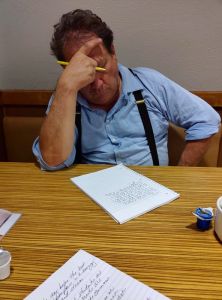
Working late at night in an IHOP in Midland, Texas, May 2019 (photo by Francene Kilgore-Slattery)
I have managed to get some critical progress done on Shadows and Stars today. I have a few major plot holes in my first draft. My goal over the weekend was to fill them and add a significant amount of words (though still keeping the work concise) to the text.
I forget what I did Friday evening. If I recall correctly, I work on finding book reviewers in library journals. Libraries buy a lot books. I became familiar with the process of submitting a book to a library journal for review and what the major journals are.
On Saturday, I mailed off a copy of Nocturne… for review. I ran some errands. I was stymied in coming up with ideas for Shadows and Stars. I got a few words written, but couldn’t get the creative juices flowing all that well. I fell asleep on the sofa.
On Sunday, I woke up on the sofa about 6:00 a.m. I went to bed, but had an idea, though not relation to Shadows and Stars. I had been thinking about Nocturne and that I still have a few poems laying here here and probably some at home in Kentucky. On the spur of the moment, I decided to create another volume of poetry. I decided to call it Remnants (of a Life). I would put in it some of my early unpublished poems that I could find here, and maybe some prose shorts, and maybe some stuff from my things in storage in Kentucky. Eventually, I decided not to use the prose. I went through a few dozen spiral-bound notebooks dating from way back, some dating back to the 90’s, and pulled out a few unpublished poems. I started typing those into a draft. I decided to put together a collection of 365 poems of varying lengths, though I would have to write most of them. I chose 365 so that the book would be relatively thick and because 365 is the number of days in a year, the basic cycle of human existence. That consumed the morning. I did find about half a dozen poems that I decided to include in another edition of Nocturne. I will also gather whatever poems I can find in Kentucky that are suitable and include them in that edition also. All that took up the morning. The poems will be primarily observations on life. Some will be on past relationships.
Prevent the spread of the Coronavirus/COVID-19. Follow federal, state, and local guidelines. Use common sense when the guidelines are insufficient.
Other than that, I stayed home, but still had problems with the creative juices with regards to Shadows and Stars. I got a few words written though. I spent a lot of time staring into space. I went over a lot of my past notes on Shadows and Stars trying to see if I had had a suitable idea in the past that I could use.
Today, I spent at home. I went over my notes again. I came up with ideas to fill two of the major holes. I did not type up text, per se. I typed up some rough ideas of the plot for those two sections, refined those, and typed them up. That made me feel real good. Now, I can write those two sections and have my details covered. I am now checking for other plot holes and I took care of a few small ones today. I think I can make some decent progress this month. I have been trying to overcome these plot holes for a couple months anyhow.
The end is in sight. Thank God.
I would write more, but it’s late, and I have to go to work in the morning.
Cinefx’s focus is, naturally, on movies vs. writing. However, I have seen this video at least three to four times and it is one of the best analyses of what dialogue is. Watching this for the first time was enlightening.
I learn a lot about how to write from studying movies. After all, movies are just another form of storytelling. While writing a novel does not involve concerns like camera angle or stagecraft or background, there are commonalities with film such as dialogue, character development, and plot.
Besides, I simply love movies. I have probably seen a lot more movies than I have read books. I love the experience of going into a theatre and being focused on an immense screen reacting to the scenes in unison with the rest of the audience. Unfortunately, I have not been able to make it to the movies much over the last few years and Coronavirus has not helped matters. I haven’t been to the movies at all since well before the Coronavirus pandemic began.
At Buzzard Beach, Arkansas
Streaming movies on your home TV is just not the same experience as watching them in a theater. Even if you have a screen that is fifty feet across and a completely dark room. Odds are you won’t have the same size audience. Imagine going to a football game and you are the only fan in the bleachers. It’s not the same experience as when the bleachers are filled. Humans are social animals. While we often appreciate solitude, being in the company of others is our natural state.
Movies are an interesting form of storytelling. It must be, without a doubt, challenging to tell a good story in less than two hours. If you own any audiobooks, check the play time on them. Unabridged audiobooks of novels last anywhere from seven to thirteen hours or more. This is undoubtedly why a lot of movies are based on short stories or novellas or plays. A really long play might last three hours. Even if someone tries to condense a novel like Roots or Don Quixote into a TV miniseries, the miniseries will still not be able to cover all the nuances of the novel, though a lot of the novel’s nuances may be covered by the actors’ performance and the scenery which can be shown vs. being described.
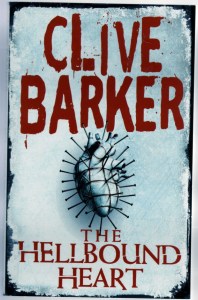
The movie “Hellraiser” was based on Clive Barker’s novel The Hellbound Heart. The movie does not veer too much from the novel, though there are significant differences in details. In the original novel Pinhead was a woman with diamond-capped pins in her head.
These are some of the reasons I love to watch Cinefix on YouTube. It really helps me with my art of storytelling. I see things from a different perspective.
One way to look at this is that when you read a story, you probably visualize the events in that story just as you would see them in a movie. Both deal with the images that form in your mind as you experience a story. While with a novel, you have to imagine how the events are depicted, with a movie you eliminate this step and the events are depicted for you–hopefully in accordance with how the underlying novel or play was written. Filmmakers are notorious for changing endings trying to improve the storyline or to develop their own art.
By the way, when you compare the cost of going to a movie that will last for two hours vs. the cost of buying a novel that will keep you entertained for ten, you can see the novel is the better deal economically.
But I digress.
Anyway, let me know your thoughts.
Don’t forget to like, comment, and subscribe.
Hasta luego.
Prevent the spread of Coronavirus/COVID-19 for the sake of yourself, your friends, and your family.
I have spent a long time writing a short story entitled “The Interrogation of General Tsak” and I finished it today. I can take a quick breather before I get back to Shadows and Stars.
Phil Slattery March, 2015
This is the story of a self-centered Air Force colonel who is interrogating a captured,princiled alien general after a failed invasion of Earth at the end of a decade-long war. It is 5,813 words in length.
As I wrote this off and on over the last several months, I kept discovering more and more nuances that I had to answer in order to avoid any plot holes. I really hate to leave any plot holes in a serious story. It makes me appear careless and unprofessional. I have finally worked them all out and the story is now intricately woven together like a weaver finch’s nest. I hope it holds together as well.
I had intended to spend the day working on Shadows and Stars, but over the last few days, I have had an inexplicable drive to finish this story and to cover all the minute details. I have spent the day doing that and running a few errands. I feel this is a story that will fall apart if something is overlooked.
I have submitted the story to The Dark magazine. I should hear from them soon.
One of the errands I ran today was to mail a copy of Nocturne to American Book Review. Hopefully, I will get a good review from them. Wish me well.
I spent a lot of yesterday researching getting my books carried by libraries. In order to be carried by a major library, a book needs good reviews in a respected journal. Unfortunately, I have been trying to find reviewers on Amazon and Goodreads and on various websites. I have also learned that libraries also prefer to purchase books from Ingram Spark or another wholesaler rather than directly from a website such as Amazon.
This is another reason I need to pursue publishing the print versions of my works with Ingram-Spark. I have started the process with A Tale of Hell and Other Works of Horror. So far, I like the process more than I like the Amazon process. I have more control over how my final work will appear among other things. I will probably publish Nocturne with them next.
So now I am trying to find ways to be reviewed in a journal respected by major libraries. I am finding out that there several of these. Of course, each has a different submittal process. I will take it a step at a time as usual.
Prevent the spread of the Coronavirus/COVID-19.
Major libraries also like to carry books that are in the Library of Congress. Unfortunately, for a self-published book to be carried in the Library of Congress, it must be submitted unpublished. I will have to give this a shot with my next self-published book, which may be another collection of my horror shorts. It might be another poetry book if I can find more of my poems from the 80’s-90’s.
This eBook is made available at no cost and with almost no restrictions
whatsoever. You may copy it, give it away or re-use it under the terms
of the Project Gutenberg of Australia License which may be viewed online at http://gutenberg.net.au/licence.html
“Forgive me…Forgive me.”
His voice was less assured as he replied:
“Get up, dry your eyes. I, too, have a good deal to reproach myself with.”
“No, no,” she sobbed.
He shook his head.
“I ought never to have left you; you loved me. Just at first after it all happened…when I could still feel the fire of the vitriol burning my face, when I began to realize that I should never see again, that all my life I should be a thing of horror, of Death, certainly I wasn’t able to think of it like that. It isn’t possible to resign oneself all at once to such a fate…But living in this eternal darkness, a man’s thoughts pierce far below the surface and grow quiet like those of a person falling asleep, and gradually calm comes. To-day, no longer able to use my eyes, I see with my imagination. I see again our little house, our peaceful days, and your smile. I see your poor little face the night I said that last good-bye.”
“The judge couldn’t imagine any of that, could he? And it was only fair to try to explain, for they thought only of your action, the action that made me into…what I am. They were going to send you to prison where you would slowly have faded . . No years of such punishment for you could have given me back my eyes…When you saw me go into the witness-box you were
Maurice Level 1875-1926
afraid, weren’t you? You believed that I would charge you, have you condemned? No, I could never have done that never…”
She was still crying. Her face buried in her hands.
“How good you are!…”
“I am just…”
In a voice that came in jerks she repeated:
“I repent, I repent; I have done the most awful thing to you that a woman could do, and you—you begged for my acquittal! And now you can even fid words of pity for me! What can I do to prove my sorrow? Oh, you are wonderful…wonderful…”
He let her go on talking and weeping; his head thrown back, his hands on the arms of his chair, he listened apparently without emotion. When she was calm again, he asked:
“What are you going to do now?”
“I don’t know…I shall rest for a few days…I am so tired hen I shall go back to work. I shall try to find a place in a shop or as a mannequin.”
His voice was a little stifled as he asked:
“You are still as pretty as ever?”
She did not reply.
“I want to know if you are as pretty as you used to be?”
She remained silent. With a slight shiver, he murmured: “It is dark now, isn’t it? Turn on the light. Though I can no longer see, I like to feel that there is light around me…Where are you?…Near the mantelpiece?…Stretch out your hand. You will find the switch there.”
No sense even of light could penetrate his eyelids, but from the sudden sound of horror she stifled, he knew that the lamp was on. For the first time she was able to see the result of her work, the terrifying face streaked with white swellings, seamed with red furrows, a narrow black band around the eyes. While he had pleaded for her in court, she had crouched on her seat weeping, not daring to look at him; now, before this abominable thing, she grew sick with a kind of disgust. But it was without any anger that he murmured:
“I am very different from the man you knew in the old days–I horrify you now, don’t I? You shrink from me?…”
She tried to keep her voice steady.
“Certainly not. I am here, in the same place…”
“Yes, now…and I want you to come still nearer. If you knew how the thought of your hands tempt me in my darkness. How I should love to feel their softness once again. But I dare not…And yet that is what I wanted to ask you: to let me feel your hand for a minute in mine. We, the blind, can get such marvelous memories from just a touch.”
Turning her head away, she held out her arm. Caressing her fingers, he murmured:
“Ah, how good. Don’t tremble. Let me try to imagine we are lovers again just as we used to be…but you are not wearing my ring. Why? I have not taken yours oft. Do you remember? You said, ‘It is our wedding-ring. Why have you taken it off?”
“I dare not wear it…”
“You must put it on again. You will wear it? Promise me.”
She stammered:
“I promise you.”
He was silent for a little while; then in a calmer voice:
“It must be quite dark now. How cold I am! If you only knew how cold it feels when one is blind. Your hands are warm; mine are frozen. I have not yet developed the fuller sense of touch.”
“It takes time, they say…At present I am like a little child learning.”
She let her fingers remain in his, sighing:
“Oh, Mon Dieu…Mon Dieu…”
Speaking like a man in a dream, he went on:
“How glad I am that you came. I wondered whether you would, and I felt I wanted to keep you with me for a long, long time: always…But that wouldn’t be possible. Life with me would be too sad. You see, little one, when people have memories like ours, they must be careful not to spoil them, and it must be horrible to look at me now, isn’t it?”
She tried to protest; what might have been a smile passed over his face.
“Why lie? I remember I once saw a man whose mistress had thrown vitriol over him. His face was not human. Women turned their heads away as they passed, while he, not being able to see and so not knowing, went on talking to the people who were shrinking away from him. I must be, I am like that poet wretch, am I not? Even you who knew me as I used to be, you tremble with disgust; I can feel it. For a long time you will be haunted by the remembrance of my face…it will come in between you and everything else…How the thought hurts…but don’t let us go on talking about me…You said just now that you were going back to work. Tell me your plans; come nearer, I don’t hear as well as I used to…Well?”
Their two armchairs were almost touching. She was silent. He sighed:
“Ah, I can smell your scent! How I have longed for it. I bought a bottle of the perfume you always used, but on me it didn’t smell the same. From you it comes mixed with the scent of your skin and hair. Come nearer, let me drink it in…You are going away, you will never come back again; let me draw in for the last time as much of you as I can…You shiver…am I then so horrible?”
She stammered:.”No…it is cold…”
“Why are you so lightly dressed? I don’t believe you brought a cloak. In November, too. It must be damp and dreary in the streets. How you tremble! How warm and comfortable it was in our little home…do you remember? You used to lay your face on my shoulder, and I used to hold you close to me. Who would want to sleep in my arms now? Come nearer. Give me your hand…There…What did you think when your lawyer told you I had asked to see you?”
“I thought I ought to come.”
“Do you still love me?”
Her voice was only a breath:
“Yes…”
Very slowly, his voice full of supplication, he said:
“I want to kiss you for the last time. I know it will be almost torture for you…Afterwards I Won’t ask anything more. You can go…May I?…Will you let me?…”
Involuntarily she shrank back; then, moved by shame and pity, not daring to refuse a joy to the poor wretch, she laid her head on his shoulder, held up her mouth and shut her eyes. He pressed her gently to him, silent, prolonging the happy moment. She opened her eyes, and seeing the terrible face so near, almost touching her own, for the second time she shivered with disgust and would have drawn sharply away. But he pressed her closer to him, passionately.
“You would go away so soon?…Stay a little longer…You haven’t seen enough of me…Look at me…and give me your mouth again…more of it than that…It is horrible, isn’t it?”
She moaned:
“You hurt me…”
“Oh, no,” he sneered, “I frighten you.”
She struggled.
“You hurt me! You hurt me!”
In a low voice he said:
“Sh-h. No noise; be quiet. I’ve got you now and I’ll keep you. For how many days have I waited for this moment…Keep still, I say, keep still! No nonsense! You know I am much stronger than you.”
He seized both her hands in one of his, took a little bottle from the pocket of his coat, drew out the stopper with his teeth, and went on in the same quiet voice:
“Yes, it is vitriol; bend your head…there…You will see; we are going to be incomparable lovers, made for each other…Ah, you tremble? Do you understand now why I had you acquitted, and why I made you come here to-day? Your pretty face will be exactly like mine. You will be a monstrous thing, and like me, blind!…Ah, yes, it hurts, hurts terribly.”
She opened her mouth to implore. He ordered:
“No! Not that! Shut your mouth! I don’t want to kill you, that would make it too easy for you.”
Gripping her in the bend of his arm, he pressed his hand on her mouth and poured the acid slowly over her forehead, her eyes, her cheeks. She struggled desperately, but he held her too firmly and kept on pouring as he talked:
“There…a little more…you bite, but that’s nothing…It hurts, doesn’t it? It is Hell. . .”
Suddenly he flung her away, crying:
“I am burning myself.”
She fell writhing on the floor. Already her face was nothing but a red rag.
Then he straightened himself, stumbled over her, felt about the wall to find the switch, and put out the light. And round them, as in them, was a great Darkness…
As I finish up Shadows and Stars, my sci-fi/adventure/horror novel/work in progress, the wisdom of Steinbeck’s advice becomes increasingly powerful. I have been going through the exact same processes he describes here. Hearing these again for the umpteenth time (I am seen them before in various magazine articles and videos) but with having the experience of finishing a novel, the truth of these has hit me harder than ever before. Before, they were one of those things that you and say, “wow, that makes sense”. But having lived these now, the wisdom of these hits me like a hammer. Take them to heart. They will help in your writing adventure.
I found this on YouTube earlier. This is a 1974 interview with Orson Welles in which he talks about being a close friend of Ernest Hemingway. It’s amusing and for me, as a Hemingway aficionado, quite fascinating. I may start posting the YouTube videos I find most interesting or I may even develop a page of them for everyone’s reference.
I recently published a new print edition of A Tale of Hell and Other Works of Horror to make the cover more appealing and to reduce the price.
A few days ago, I had four works of micro/flash fiction accepted by Ezine 51. The next day, I took one of the rejected pieces, a drabble (i.e. a horror story of exactly 100 words) entitled “Special” and submitted it to another magazine.
Since then I have been trying to finish a sci-fi/horror short story of just under 5,000 words, entitled “Laughing from B’con” to submit it somewhere. This story centers around the hostile interrogation of the leader of a defeated alien fleet that attempted to invade Earth at the end of a decade-long war. Even though it is short, this story has a intricate backstory and is thus challenging to bring to a satisfying denouement without any plot holes.
As I tried to fall asleep a little while ago (insomnia), I remembered another horror story that I have been working on for a few years that is called “The Confession of Father Lactance”. It will be a little under 5,000 words. In it, a man in Hell encounters a priest named Father Lactance who wants to confess his sins to someone. In the year 1634, Father Lactance had participated in the judgement and execution of another priest named
Father Urbain Grandier, 1627
Urbain Grandier for witchcraft and consorting with the devil. This story is based on an actual trial and execution that occurred in Loudun, France, in 1634. Aldous Huxley wrote a non-fiction novel about it entitled The Devils of Loudun, which was eventually turned into a play in 1960, a movie entitled The Devils (starring Vanessa Redgrave and Oliver Reed in 1971, and into an opera by Krzysztof Penderecki. When I left off working on the story about a year ago, I was very close to completing, but I wanted to read Huxley’s work (I had been using other sources for my research) to ensure I was making the story as historically accurate as possible while keeping it in the realm of fiction. If I can complete this soon and have it published by December, I will include it in the third edition of A Tale of Hell and Other Works of Horror.
If I can include this story, the drabble, and the other microfiction into A Tale of Hell… I will probably raise the price of the book by a buck or two. I might leave it where it is too. While at the Barnes and Noble in Little Rock last weekend, I did a quick survey of novels of about 300 pages, which is the current length of A Tale of Hell… and found they generally range in price from about $15 to $28. Paying $16 or $17 for a print edition of this work should still be a bargain.
I will consider maybe adding a few black and white illustrations like the one above to add to the reading experience.
Thoughts? Comments?
Don’t forget to like this article and to subscribe to my website.
THE “Red Death” had long devastated the country. No pestilence had ever been so fatal, or so hideous. Blood was its Avator and its seal — the redness and the horror of blood. There were sharp pains, and sudden dizziness, and then profuse bleeding at the pores, with dissolution. The scarlet stains upon the body and especially upon the face of the victim, were the pest ban which shut him out from the aid and from the sympathy of his fellow-men. And the whole seizure, progress and termination of the disease, were the incidents of half an hour.
But the Prince Prospero was happy and dauntless and sagacious. When his dominions were half depopulated, he
Edgar Allan Poe, 1848
summoned to his presence a thousand hale and light-hearted friends from among the knights and dames of his court, and with these retired to the deep seclusion of one of his castellated abbeys. This was an extensive and magnificent structure, the creation of the prince’s own eccentric yet august taste. A strong and lofty wall girdled it in. This wall had gates of iron. The courtiers, having entered, brought furnaces and massy hammers and welded the bolts. They resolved to leave means neither of ingress or egress to the sudden impulses of despair or of frenzy from within. The abbey was amply provisioned. With such precautions the courtiers might bid defiance to contagion. The external world could take care of itself. In the meantime it was folly to grieve, or to think. The prince had provided all the appliances of pleasure. There were buffoons, there were improvisatori, there were ballet-dancers, there were musicians, there was Beauty, there was wine. All these and security were within. Without was the “Red Death.”
It was toward the close of the fifth or sixth month of his seclusion, and while the pestilence raged most furiously abroad, that the Prince Prospero entertained his thousand friends at a masked ball of the most unusual magnificence.
It was a voluptuous scene, that masquerade. But first let me tell of the rooms in which it was held. There were seven — an imperial suite. In many palaces, however, such suites form a long and straight vista, while the folding doors slide back nearly to the walls on either hand, so that the view of the whole extent is scarcely impeded. Here the case was very different; as might have been expected from the duke’s love of the bizarre. The apartments were so irregularly disposed that the vision embraced but little more than one at a time. There was a sharp turn at every twenty or thirty yards, and at each turn a novel effect. To the right and left, in the middle of each wall, a tall and narrow Gothic window looked out upon a closed corridor which pursued the windings of the suite. These windows were of stained glass whose color varied in accordance with the prevailing hue of the decorations of the chamber into which it opened. That at the eastern extremity was hung, for example, in blue — and vividly blue were its windows. The second chamber was purple in its ornaments and tapestries, and here the panes were purple. The third was green throughout, and so were the casements. The fourth was furnished and lighted with orange — the fifth with white — the sixth with violet. The seventh apartment was closely shrouded in black velvet tapestries that hung all over the ceiling and down the walls, falling in heavy folds upon a carpet of the same material and hue. But in this chamber only, the color of the windows failed to correspond with the decorations. The panes here were scarlet — a deep blood color. Now in no one of the seven apartments was there any lamp or candelabrum, amid the profusion of golden ornaments that lay scattered to and fro or depended from the roof. There was no light of any kind emanating from lamp or candle within the suite of chambers. But in the corridors that followed the suite, there stood, opposite to each window, a heavy tripod, bearing a brazier of fire, that projected its rays through the tinted glass and so glaringly illumined the room. And thus were produced a multitude of gaudy and fantastic appearances. But in the western or black chamber the effect of the fire-light that streamed upon the dark hangings through the blood-tinted panes, was ghastly in the extreme, and produced so wild a look upon the countenances of those who entered, that there were few of the company bold enough to set foot within its precincts at all.
It was in this apartment, also, that there stood against the western wall, a gigantic clock of ebony. Its pendulum swung to and fro with a dull, heavy, monotonous clang; and when the minute-hand made the circuit of the face, and the hour was to be stricken, there came from the brazen lungs of the clock a sound which was clear and loud and deep and exceedingly musical, but of so peculiar a note and emphasis that, at each lapse of an hour, the musicians of the orchestra were constrained to pause, momentarily, in their performance, to harken to the sound; and thus the waltzers perforce ceased their evolutions; and there was a brief disconcert of the whole gay company; and, while the chimes of the clock yet rang, it was observed that the giddiest grew pale, and the more aged and sedate passed their hands over their brows as if in confused revery or meditation. But when the echoes had fully ceased, a light laughter at once pervaded the assembly; the musicians looked at each other and smiled as if at their own nervousness and folly, and made whispering vows, each to the other, that the next chiming of the clock should produce in them no similar emotion; and then, after the lapse of sixty minutes, (which embrace three thousand and six hundred seconds of the Time that flies,) there came yet another chiming of the clock, and then were the same disconcert and tremulousness and meditation as before.
But, in spite of these things, it was a gay and magnificent revel. The tastes of the duke were peculiar. He had a fine eye for colors and effects. He disregarded the decora of mere fashion. His plans were bold and fiery, and his conceptions glowed with barbaric lustre. There are some who would have thought him mad. His followers felt that he was not. It was necessary to hear and see and touch him to be sure that he was not.
He had directed, in great part, the moveable embellishments of the seven chambers, upon occasion of this great fete; and it was his own guiding taste which had given character to the masqueraders. Be sure they were grotesque. There were much glare and glitter and piquancy and phantasm — much of what has been since seen in “Hernani.” There were arabesque figures with unsuited limbs and appointments. There were delirious fancies such as the madman fashions. There were much of the beautiful, much of the wanton, much of the bizarre, something of the terrible, and not a little of that which might have excited disgust. To and fro in the seven chambers there stalked, in fact, a multitude of dreams. And these — the dreams — writhed in and about, taking hue from the rooms, and causing the wild music of the orchestra to seem as the echo of their steps. And, anon, there strikes the ebony clock which stands in the hall of the velvet. And then, for a moment, all is still, and all is silent save the voice of the clock. The dreams are stiff-frozen as they stand. But the echoes of the chime die away — they have endured but an instant — and a light, half-subdued laughter floats after them as they depart. And now again the music swells, and the dreams live, and writhe to and fro more merrily than ever, taking hue from the many tinted windows through which stream the rays from the tripods. But to the chamber which lies most westwardly of the seven, there are now none of the maskers who venture; for the night is waning away; and there flows a ruddier light through the blood-colored panes; and the blackness of the sable drapery appals; and to him whose foot falls upon the sable carpet, there comes from the near clock of ebony a muffled peal more solemnly emphatic than any which reaches their ears who indulge in the more remote gaieties of the other apartments.
But these other apartments were densely crowded, and in them beat feverishly the heart of life. And the revel went whirlingly on, until at length there commenced the sounding of midnight upon the clock. And then the music ceased, as I have told; and the evolutions of the waltzers were quieted; and there was an uneasy cessation of all things as before. But now there were twelve strokes to be sounded by the bell of the clock; and thus it happened, perhaps that more of thought crept, with more of time, into the meditations of the thoughtful among those who revelled. And thus too, it happened, perhaps, that before the last echoes of the last chime had utterly sunk into silence, there were many individuals in the crowd who had found leisure to become aware of the presence of a masked figure which had arrested the attention of no single individual before. And the rumor of this new presence having spread itself whisperingly around, there arose at length from the whole company a buzz, or murmur, expressive of disapprobation and surprise — then, finally, of terror, of horror, and of disgust.
In an assembly of phantasms such as I have painted, it may well be supposed that no ordinary appearance could have excited such sensation. In truth the masquerade license of the night was nearly unlimited; but the figure in question had out-Heroded Herod, and gone beyond the bounds of even the prince’s indefinite decorum. There are chords in the hearts of the most reckless which cannot be touched without emotion. Even with the utterly lost, to whom life and death are equally jests, there are matters of which no jest can be made. The whole company, indeed, seemed now deeply to feel that in the costume and bearing of the stranger neither wit nor propriety existed. The figure was tall and gaunt, and shrouded from head to foot in the habiliments of the grave. The mask which concealed the visage was made so nearly to resemble the countenance of a stiffened corpse that the closest scrutiny must have had difficulty in detecting the cheat. And yet all this might have been endured, if not approved, by the mad revellers around. But the mummer had gone so far as to assume the type of the Red Death. His vesture was dabbled in blood — and his broad brow, with all the features of the face, was besprinkled with the scarlet horror.
When the eyes of Prince Prospero fell upon this spectral image (which with a slow and solemn movement, as if more fully to sustain its role, stalked to and fro among the waltzers) he was seen to be convulsed, in the first moment with a strong shudder either of terror or distaste; but, in the next, his brow reddened with rage.
“Who dares?” he demanded hoarsely of the courtiers who stood near him — “who dares insult us with this blasphemous mockery? Seize him and unmask him — that we may know whom we have to hang at sunrise, from the battlements!”
It was in the eastern or blue chamber in which stood the Prince Prospero as he uttered these words. They rang throughout the seven rooms loudly and clearly — for the prince was a bold and robust man, and the music had become hushed at the waving of his hand.
It was in the blue room where stood the prince, with a group of pale courtiers by his side. At first, as he spoke, there was a slight rushing movement of this group in the direction of the intruder, who, at the moment was also near at hand, and now, with deliberate and stately step, made closer approach to the speaker. But from a certain nameless awe with which the mad assumptions of the mummer had inspired the whole party, there were found none who put forth hand to seize him; so that, unimpeded, he passed within a yard of the prince’s person; and, while the vast assembly, as if with one impulse, shrank from the centres of the rooms to the walls, he made his way uninterruptedly, but with the same solemn and measured step which had distinguished him from the first, through the blue chamber to the purple — through the purple to the green — through the green to the orange — through this again to the white — and even thence to the violet, ere a decided movement had been made to arrest him. It was then, however, that the Prince Prospero, maddening with rage and the shame of his own momentary cowardice, rushed hurriedly through the six chambers, while none followed him on account of a deadly terror that had seized upon all. He bore aloft a drawn dagger, and had approached, in rapid impetuosity, to within three or four feet of the retreating figure, when the latter, having attained the extremity of the velvet apartment, turned suddenly and confronted his pursuer. There was a sharp cry — and the dagger dropped gleaming upon the sable carpet, upon which, instantly afterwards, fell prostrate in death the Prince Prospero. Then, summoning the wild courage of despair, a throng of the revellers at once threw themselves into the black apartment, and, seizing the mummer, whose tall figure stood erect and motionless within the shadow of the ebony clock, gasped in unutterable horror at finding the grave cerements and corpse-like mask which they handled with so violent a rudeness, untenanted by any tangible form.
And now was acknowledged the presence of the Red Death. He had come like a thief in the night. And one by one dropped the revellers in the blood-bedewed halls of their revel, and died each in the despairing posture of his fall. And the life of the ebony clock went out with that of the last of the gay. And the flames of the tripods expired. And Darkness and Decay and the Red Death held illimitable dominion over all.
Working on a play in Hasting’s Hardback Café, late evening, October 16, 2015.
I found this tonight while looking for something to play in the background while working on Shadows and Stars. This is exactly the kind of place where I love to write, usually with some coffee or tea in a cheap spiral notebook and a simple, but quality pen. I have tried writing while drinking and it usually doesn’t work out for me if I drink anything other than wine. Wine, though, seems a comfortable drink to have while scribbling down whatever drifts into my consciousness and having a small, good quality cigar. Since I don’t drink anymore, I have only fond memories of these places.
In fact, I enjoyed this type of place so much and am so comfortable in that environment, that I will probably be playing this video a LOT at night while I write. Night is the best time to play this video, particularly with the light downs to match those in the pub. When I play an ambience video like this, I like to make my surroundings as close as possible resemble the scene in the video, so that I can almost feel being in that place. In the daytime, I like to play videos that show a woods in the daytime, as that is what I see out my window next to where I write on my laptop.
On the other hand, I would be perfectly at home in this setting with friends, new found friends or old friends, just smoking and joking (as they say in the Navy) and getting slowly wasted, but not so wasted that I couldn’t make it out the door to a cab.
If you read my previous post, you know this is the kind of place I would love to gather a small circle of friends to discuss book reviews like Clifford Sargeant does on Better than Food.
I intend to write up some of my experiences of those bygone days, though they will be changed enough to be classified as fiction and people’s names will be changed to protect the guilty.
This video is three hours long, but if you watch the first minute you will get the idea. Try watching it sometime on a rainy night with the lights out while enjoying your favorite adult beverage or smoke.
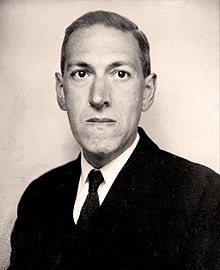
H.P. Lovecraft in June, 1934. He passed away in 1937.
I have read a fair amount of Lovecraft’s works and I have been watching some animated versions on YouTube lately (see the May 9 Saturday Night Special for an example; more are forthcoming). Also, within the past few years, as a soon-to-be novelist, I am becoming familiar with how critical publicity is to the success of an author.
I suppose my subconscious has been working in the background, but a thought occurred to me this morning out of the blue. Maybe why Lovecraft was not successful in his time was because he lacked publicity, at least I am not aware of any publicity campaigns he undertook.
It has been said that Lovecraft was unappreciated in his time, because people did not recognize the quality of his writing. It seems to me that the reason that the public did not appreciate might be because they didn’t know it existed. Though I am no Lovecraft scholar, does anyone know where his work was mentioned outside of the magazine in which it was currently appearing? For that matter, does anyone know of an instance where Lovecraft submitted his work to a more highly-respected magazine than Weird Tales or other pulp fiction mills? Does anyone know of Lovecraft being interviewed on the radio or in a magazine. Maybe he did all of the above, but I never heard about it. Of course, there’s the fact that Lovecraft never wrote a full-length novel (depending on your definition of a novel, of course). Then his publisher would have had to drum up some publicity for him at least.
Instead, like any lonely geek, he stayed in his room, writing his letters and stories, submitting the latter to magazines, I suppose at every opportunity, and sending the former to his friends who were also writers.
I see this same characteristic among many other writers I have met over the years. They write quality work, but because writers frequently tend to be introverts, they either avoid publicity, because it makes them uncomfortable, or, being naturally humble, they don’t have faith in their works. They lack confidence.
I wonder how the literary world would have changed had Lovecraft taken the publicity avenues that were available to him then.
I wonder how many undiscovered Lovecrafts are living now in ignominy because of their unfamiliarity with the numerous ways to publicize themselves today or that haven’t had the confidence in themselves or their works to sally forth with a novel, which might make a world of difference to their careers and lives.
I don’t want to seem unsympathetic (being something of an introvert myself), but the problem boils down to the old military adage: “No guts, no glory”. A writer needs “glory” (of some type at least) in order to be successful.
I want to give a shout-out to all the writers (worldwide) out there for helping relieve stress and bolster the human spirit. These are particularly difficult times for everyone given the spread of the Coronavirus and its increasingly severe effects on the economy and on in life in general along with the bizarre and depressing political news that increases with each day, no matter which side of the aisle you sit on.
As I read more and watch more TV (particularly YouTube) with the increasing isolation and closure of so many restaurants and other public gathering spots, I come to realize how important a role writers play in our daily lives. Writers enable readers (as well as themselves) to escape into a more pleasant world, depending upon the genre of course. In all cases writers at least offer distractions in which the public can become immersed for a time and take its mind off the daily anxieties and fears around us. This is important, because taking our minds off our worries enables us to relax, however briefly, and allows us to heal psychologically and emotionally, both of which have healing effects on our bodies. These days, this nation and all others need healing in every sense I can imagine.
I want to give a shout-out to all the writers (worldwide) out there for helping relieve stress and bolster the human spirit. These are particularly difficult times for everyone given the spread of the Coronavirus and its increasingly severe effects on the economy and on in life in general along with the bizarre and depressing political news that increases with each day, no matter which side of the aisle you sit on.
As I read more and watch more TV (particularly YouTube) with the increasing isolation and closure of so many restaurants and other public gathering spots, I come to realize how important a role writers play in our daily lives. Writers enable readers (as well as themselves) to escape into a more pleasant world, depending upon the genre of course. In all cases writers at least offer distractions in which the public can become immersed for a time and take its mind off the daily anxieties and fears around us. This is important, because taking our minds off our worries enables us to relax, however briefly, and allows us to heal psychologically and emotionally, both of which have healing effects on our bodies. These days, this nation and all others need healing in every sense I can imagine.









 Phil Slattery, Writer, Publisher