The “Dracula” Conversation


I am a member of GoodReads.com as are several of my friends.  One, a gentleman named Tim Stamps, whom I have known since my college days at Eastern Kentucky University, recently posted a review of Dracula, on which I commented.  Thus began a brief conversation which I think you may find interesting for several reasons.   I have quoted it below, editing out any non-relevant personal matters (after having obtained Tim’s permission to post it).


Tim Stamps’s Reviews > Dracula

16399814

Tim Stamps‘s review

Apr 06, 13
I could only read this during the Winter months, when the weather is cloudy, dark and gloomy. When I read fiction I prefer the classics, to learn how people thought in earlier times. The actual character of Dracula was the most un-interesting of the characters in the book. It turns out that Stoker only knew Vlad’s Dracula name but knew nothing of his past, and the character is actually based more on Jack the Ripper.  Also it was interesting to read a book made up of supposed diary entries and newspaper articles – although most actual diaries and articles written by everyday people are nowhere near as long and detailed, especially back then when paper was scarce. I understand Mary Shelley wrote Frankenstein in the same format, and other books of that time did the same.  If you can find a copy, listen to the first half hour of this Coast to Coast show: http://www.coasttocoastam.com/show/20…
 message 1:      by      Phil          –            rated it 4 stars
Phil Slattery      Tim, if you like reading classic horror tales like Dracula, then you should definitely read Frankenstein. Others you may want to check out are The Strange Case of Dr. Jekyll and Mr. Hyde, The Picture of Dorian Gray, the works of Algernon Blackwood, Lord Dunsany, Arthur Machen, and Joseph Sheridan Le Fanu.  I have been writing horror lately and have established a blog on it that often discusses past writers of the horror genre. You may want to check it out at www.philslattery.wordpress.com.  You may find some of the authors I discuss of interest. One who is known more as a writer of science fiction than of horror (though the boundary is often indistinct at best) is H.G. Wells who wrote The Time Machine, War of the Worlds, The Island of Dr. Moreau, and others.
Tim Stamps      True, I definitely plan to read Frankenstein. Also have been planning on getting into Wuthering Heights and the Brönte sisters books. I’ve always been a fan of H.G. Wells, also Orwell’s dystopian works – still trying to get around to reading Huxley’s Brave New World (when I find my copy) – I can also add ebooks to a kindle, but the kindle doesn’t exactly replace paper.   I’ve depended on the movies too much – finding lots of extra details in the books that the films leave out. (I don’t really spend much time reading actually.) I’ll explore your site.. thanks! By the way, are there any horror films you really like?  Or gothic tales.  There don’t seem to be many recent ones that play into fears as well as the older ones. Some of the classics: “The Innocents” (version of Henry James’ “Turn of the Screw”), George Romero’s “Martin”, “The Exorcist”, even “The Shining” and the early “Halloween” pictures.  Recent films like “The Ring” and “the Sixth Sense” have potential.   I read in your blog that to be a great horror writer you need to understand the psychology and emotions of fear. Perhaps horror screenplay writers nowadays need to go back to the basics – just slashing people up and showing gruesome killings isn’t enough to heighten the sense of fear.  They seem to have forgotten Hitchcock and his methods of manipulating people’s emotions, although that was a time when people actually paid attention to dialog. I don’t know what it’s going to take to make a great horror movie today. Is it even possible?
Phil SlatteryTim wrote: “True, I definitely plan to read Frankenstein. Also have been planning on getting into Wuthering Heights and the Brönte sisters books. I’ve always been a fan of H.G. Wells, also Orwell’s dystopian w…”
Yes, you are right in all accounts, except that modern screenplay writers need to go back to the basics.  They cannot go back to someplace they have never been.   They need to learn the basics first. Stephen King identifies three types of horror:  horror, the gross-out, and terror (the exact lengthy quote can be found on GoodReads).  Modern, popular, mass-market screenplay writers use the gross-out form to excess. The great horror writers of the past (such as Lovecraft, Poe, Blackwood, etc.) never described anything gross.  Yet their tales are terrifying.   There is an art to horror, and Hitchcock’s concept of suspense (i.e. terror lies not in seeing something happen, but in knowing that something is about to happen) is one of the best means of achieving horror.
There are great horror movies today, but one has to veer away from the mass-market and Hollywood to find them.  Independent films and small companies are your best shot:  someone who cares about the art.  Netflix and Hulu TV are good for finding these (and finding them cheaply at that).  The series American Horror Story is quite entertaining, though it can be bloody at times. Foreign films can be an excellent source with Japan, Korea, England, Australia, and Spain coming immediately to mind. I noted that your profile says you are in the Seattle area now.  Lion’s Gate Films in Vancouver, BC makes some good films (outside of the horrifyingly gross-out Saw series).
I have seen some good horror films lately, but am having a hard time recalling their names, therefore I am reviewing some lists of top horror films on line, but of course that isn’t helping much as the lists are mass-market oriented.  One that pops out now is the original Swedish version of “Let the Right One In”.  “Dagon”, a Spanish film based somewhat loosely on a Lovecraft story (“The Shadow over Innsmouth”) is not bad. The New Zealand film “The Devil’s Island” has some interesting ideas behind it, though it is quite bloody.  That’s all I can think of on the spur of the moment.
Tim Stamps      hi Phil, Sorry about “Seattle” – don’t know how that happened (I must’ve not filled it in – the site just guessed or something.) Anyway, actually I am (still) in… I love watching foreign horror… for 70s-era foreign horror, Dario Argento comes to mind, although he leans toward the gross-out variety.  Lovecraft-written films are always great. I’ll check out these you mention (and any others you run across) – if you come up with a list of interesting foreign horror for the last 3 decades or so let me know. I have one plug: watch for “Nobody in Particular”, a crime-drama I helped out on, being re-edited – should be out sometime this year.
Thoughts?  Comments?

Jorge Oscar Rossi’s “Archetypal Horror: H.P. Lovecraft and Carl Gustav Jung”

Cthulhu

I ran across an interesting article today at http://www.quintadimension.com/article66.html, entitled “Archetypal Horror:  H.P. Lovecraft and Carl Gustav Jung”.  It was written by Jorge Oscar Rossi, an Argentinian writer of science fiction (and fantastic literature in general), and published on December, 8, 2000.  Please note that the article and his autobiography are in Spanish.

I am no master of Spanish, having had only two years in college and some practical, albeit frequent, experience in Texas and Mexico over the last twenty years.   However, Señor Rossi’s article is well-written and relatively easy reading, so that I feel I caught the gist of it, if not all the nuances.

His main point (and anyone with a better knowledge of Spanish than I, including Señor Rossi, may correct me if I am wrong) is that Lovecraft’s ancient gods of the Cthulhu mythos represent archetypal forms of horror in the Jungian sense of “archetype”.

If you have a basic comprehension of Spanish, the article is quite intriguing and worth taking a shot at reading.

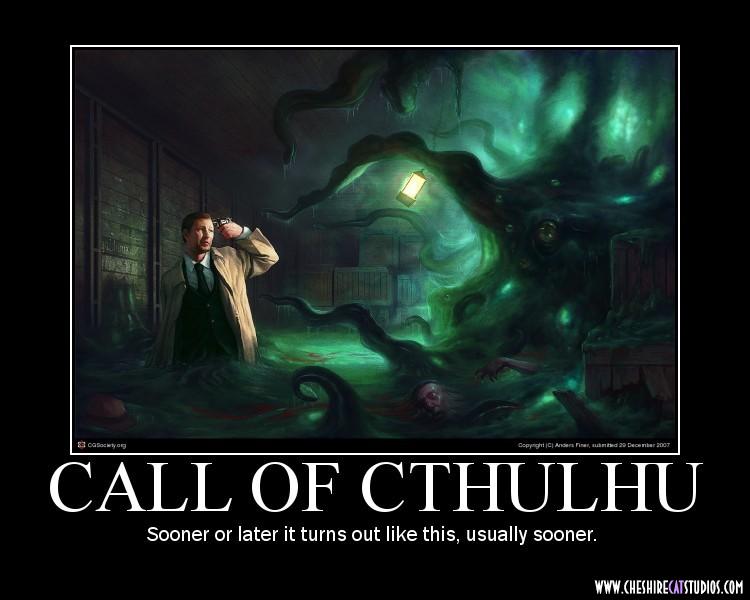
If nothing esle, the article will help you view the poster above from another perspective: what is the meaning of the poster if the creature above symbolizes archetypal fears shared by everyone?

Thoughts?  Comments?

Thoughts on Speculative Fiction

Lovecraft in the Agony of ContemplationIllustration by MirrorCradle
Lovecraft in the Agony of Contemplation
Illustration by MirrorCradle

As I was driving about town today, I started reflecting on the difference between mainstream, so-to-speak literary fiction and speculative fiction (usually defined as consisting of the science-fiction, fantasy, and horror genres).  I recall reading somewhere, years ago, in the submissions guidelines for a mainstream fiction magazine, that mainstream fiction consisted of whatever did not fit into a genre.  Then, I considered that accurate and reasonable;  now I consider it somewhat snobbish.  In fact, the more I think about it, the more short-sighted and narrow-minded that statement becomes.

Speculative fiction, including the horror genre, deals with fantastic, often surreal, situations.  Mainstream fiction, if you go by the definition above, deals with anything not fantastic, not surreal, i.e. the real, events that could happen in the real world.  It would seem to me that the truly gifted writer would be the one with the greater imagination, the one who can conjure entire civilizations and fantastic creatures out of his mind alone.  My favorite authors for many years have been, and continue to be, Hemingway and Fitzgerald, based on their styles and how their stories can touch me.  However, if had to state who had the greatest imagination out of the history of writers, Tolkien would be at the top, simply because he was able to create an entire world out of his imagination (granted most of the ideas were based in Nordic mythology) and make it and his characters believeable.  Lovecraft and his Cthulhu mythos would be a close second.

Reading the guidelines of horror publications, I find that many of them do not want werewolf/vampire/zombie (w/v/z)stories.  They want something different, original.   That is a difficult challenge.   I could dream up w/v/z stories all day long, but creating something out of thin air, like Stephen King or Clive Barker does,  and to do it consistenly, is truly admirable. I have written one or two stories along the w/v/z line, but now I am taking up the challenge of writing something truly imaginative.    I have no good ideas just yet, but I am examining how horror authors of the past came up with ideas and what were their inspirations.

So now here is a question of the night:  if you are trying to write material outside the w/v/z tradition, how are you coming up with ideas?  Have you put any new slant on horror?  Do your inspirations come from dreams or from looking at real-world object and then allowing yourself to explore the possibities if something about that scene was just a little bit different?

Thoughts?  Comments?


Lovecraft Country

Lovecraft CountryIllustration by Miihkali, 2009
Lovecraft Country
Illustration by Miihkali, 2009

I love maps and found an interesting one at Wikimedia tonight.  The above is an illustration of “Lovecraft Country” as drawn by Miihkali (from Finland) in 2009.   It is in the public domain. 

The description that accompanies the map (the bottom paragraph is in Finnish) reads:

English: So called ‘Lovecraft country’ of Cthulhu Mythos, showing some of the most important cities of Massachusetts alongside with towns invented by Lovecraft. Imaginary towns are marked with square, real ones with circle.

Suomi: Cthulhu-mytologian “Lovecraft-maa”; joitain merkittäviä Massachusettsin kaupunkeja yhdessä Lovecraftin keksimien kanssa. Kuvitteelliset paikat on merkitty neliöllä, oikeat pallolla.
 
Thoughts?  Comments?

Slattery’s Tao of Writing, Part 4: “Warehouses and All”

Lovecraft in the Agony of ContemplationIllustration by MirrorCradle
Lovecraft in the Depths of Contemplation
Illustration by MirrorCradle

 A problem I have encountered over the last few months is that most of the short stories on which I am working are too long for most publications, but too short to publish as novels.

Most magazines accept short stories of about 2,000 words.  Above that, there seems to be a law of inverse proportions :  the more words your short story has, the fewer publishers who will take it.  Unfortunately,  lately I find it difficult to write a story in less than 10,000 words.   

Usually, I start with a simple concept for a story, but as I write, I see more and more details coming to light, details I think are important to understand what is happening in the story.  I keep whittling down the words, contracting here, expanding there, omitting this and that, keeping the story as lean and muscular as possible while fleshing out the story enough so that the reader can live the story vicariously, but somehow the story keeps growing.

There is a school of thought that stories are out there in the literary ether, just waiting for the right author to come along and give them birth.   That is certainly the way it seems at times.  We could expand that comparison even further and say that stories are also like babies after birth and each will eventually grow to a certain size–whether we want it to or not.   But we have much more control over the size of a short story than we do the size of a baby. 

Here is a link to one of my earliest stories, “Sudan“, which was published by Ascent Aspirations several years ago.  It has 2,095 words.  It is not a work of horror.  It is by my current standards rather amateurish.   I based the story on a rather poignant story told to me by a former US assistant agricultural attache to Sudan, whom I met in Luxor, Egypt in 1989.   That story lingered in the back of my mind for some time, almost haunting me, as if it had always been waiting to be told to the world and it refused to pass up this chance, before I finally wrote it down.   It was published by Ascent Aspirations in August, 2002. 

In 2009, I came across www.sixsentences.blogspot.com, which challenges writers to tell a story in six sentences or less.   The assistant attache’s story still touched me after twenty years, so I decided to see if I could tell it in six sentences.  I did.  I changed the title and location and submitted it as “Warehouses and All“. 

While the original Ascent Aspirations version was good, I believe the Six Sentences version is much better, more powerful, more poignant, perhaps because it is more compact. 

Both these stories have exactly the same meaning.   Which length suits it best?    It is hard to say.  Ultimately, deciding the length of a story depends upon the effect the writer wishes to instill in the reader.   I do not think there is any way to concoct a rule of thumb about how to determine the length of short story.   The writer must simply have a subjective feel for what length is appropriate.   That is part of the art of writing.

There are probably many wonderful stories out there that cannot find a publisher because they do not fit the space constraints of most publications.   The reality of the literary world is that publishers do have space constraints and if a writer wishes to be published, he will have to conform to those constraints.  But this should not be seen as a brutal, demeaning demand for an author to butcher one of his stories as if he were a literary Abraham about to sacrifice Isaac on a stone altar.  It should be seen as a challenge, an opportunity for personal growth as a writer, because then one is forced to look seriously, impartially, critically, and clincally at the work, and to ask oneself, “What is it that I really want to say?  What do I want the reader to experience?  How can I make this more powerful, more meaningful?  What is the essence of this story?” 

You may find that while it is challenging, it is not impossible to pack the meaning of 2,095 words into six sentences and still achieve the effect you wish to impart.

Now, if you will pardon me, I have to go listen to my own advice.

Thoughts?  Comments?

Beyond the Veil of Reality

Face of Horror Houseby Horror House
Face of Horror House
by Horror House

Last night, I watched an adaptation of Lovecraft’s “Dreams in the Witch House” on the Masters of Horror series (season 1, episode 2) on Netflix .   Afterwards, being late and time for bed, instead of finding the story on Project Gutenberg or some other cost-free source so that I could read it firsthand, I read a summary of the story on Wikipedia to see if the adaptation was at least reasonably accurate.  It seemed to be, even though the story was set in the modern day and the ending varied significantly from the original.  But, in accordance with today’s tastes, it was rather bloody and cruel in ways I am sure Lovecraft never intended (I say this after having read a considerable amount of his most famous works).

The most interesting aspect of the story to me was not the story itself, but speculating on how Lovecraft came up with the story’s concept.

I understand from the Wikipedia article that Lovecraft had recently attended a lecture and read up somewhat on non-Euclidean space.   Apparently, he was intrigued with the idea of existence on different planes.  Somehow he came up with the idea that the different planes of existence might intersect and beings would be able to move from one plane to the next.  This is the concept that the protagonist of the story, Walter Gilman (a graduate student in Physics) is studying when he moves into the Witch house, which was a boarding house in the fictional town of Arkham, Massachusetts, but three hundred years ago was the residence of a witch.  Gilman, as I interpret the TV story, notices that the corner formed by the intersection of two walls and the ceiling in his room coincides with the intersection of three dimensions.  It is this intersection that the witch who previously resided in the house and her familiar (a really nasty creature combining a rat with the face of a man) uses to re-enter the house in the modern day and create havoc for Gilman and the other residents.   I won’t give away the ending, but it is a good story and probably one of the more reasonably accurate adaptations of a Lovecraft story that you are likely to find.

What I found most interesting was speculating if  how Lovecraft came up with the story was to be looking at the intersection of three walls in his house and wonder if different planes of existence could intersect like that and, if they could, could creatures use the intersection to move from one plane to the other?   I am always fascinated by how writers come up with ideas for their works.   Did you ever wonder what spurred Richard Matheson to write I am Legend or Stephen King to write Carrie?

I know that some authors of Horror  (such as Algernon Blackwood, Lord Dunsany, and Arthur Machen) were intrigued by the idea of a plane of existence beyond what we take for reality, that what we perceive as reality may actually just mask the true reality.  Apparently, Lovecraft was thus intrigued as well and used his ideas of a possible alternative reality as the foundation for what others would later term “the Cthulhu Mythos”.

After having contemplated this since last night, I have been asking myself, what did these intelligent men see in their interpretations of the everyday world that would lead them to believe in the possible existence of an alternative reality?    Based upon my experience with humanity, I have come to realize that some people have some downright bizarre concepts of the world around them, but how did these concepts originate?  What causes their perceptions to be so radically different from mine?  Is it a matter of genetics that causes their synapses to be linked together differently?  Do they have slightly different body chemistries influencing their thoughts?  Is it that they simply encountered different views of the world as they grew up?  Is there a reality that they can perceive but I cannot–in the same way as I can see the workings of God in everything about me, but others do not and thus call themselves atheists and agnostics?

What are your thoughts?

Fascinating Habits of Writers of Horror

GRACIN~2

Some writers have interesting habits.

I have always found one of the most interesting aspects of studying the lives of famous writers to be the personal habits they have while writing.   The habits show the writer’s personal side and perhaps give an insight into how their creativity is ingrained in their natures. Following are some examples of the better known habits of mainstream authors (the few examples I have collected of “horror habits” follow these).

Hemingway said that he, at least in his Paris years, wrote for four hours each day before going to work at the Kansas City Star office, he wrote using pencils and a spiral bound notebook, and he started each days writing by sharpening twenty pencis.

F. Scott Fitzgerald never rewrote anything less than nine times.

Thomas Mann was very disciplined and rose and dressed in a suit each day as if he were going to work at a bank (even though he was going only so far as his living room), started each day at the same time (I think 8:00 a.m.), wrote for four hours, broke for lunch for an hour, wrote for another four hours, and then ended his day, by going back to his bedroom and taking off his suit.

Hunter Thompson and Henry Miller were at the opposite end of the discipline scale and might write for days, then not write again for days or weeks, before going on another binge of writing.  Thompson might write some lines on a napkin while having lunch at a restaurant, then take the napkin and force it through a fax to get the work to his editors at Rolling Stone.

 Here are the tidbits on writing habits by authors of horror.

Thomas Cotterill, another WordPress member, wrote this interesting article on the habits of Stephen King.  I have read elsewhere that Stephen King normally writes a first draft, which he runs past his wife, Tabitha, makes some changes and then sends it out to friends for their inputs, and then writes a final draft, which he sends to the publisher.

I have yet to find anything detailed about Poe’s habits, but I did find this general description on the website of the Edgar Allan Poe Society of Baltimore.

“Edgar A. Poe, one of the Editors of the Broadway Journal. He never rests. There is a small steam-engine in his brain, which not only sets the cerebral mass in motion, but keeps the owner in hot water. His face is a fine one, and well gifted with intellectual beauty. Ideality, with the power of analysis, is shown in his very broad, high and massive forehead — a forehead which would have delighted Gall beyond measure. He would have have [[sic]] made a capital lawyer — not a very good advocate, perhaps, but a famous unraveller of all subtleties. He can thread his way through a labyrinth of absurdities, and pick out the sound thread of sense from the tangled skein with which it is connected. He means to be candid, and labours under the strange hallucination that he is so;  but he has strong prejudices, and, without the least intention of irreverence, would wage war with the Deity, if the divine canons militated against his notions. His sarcasm is subtle and searching. He can do nothing in the common way; and buttons his coat after a fashion peculiarly his own. If we ever caught him doing a thing like any body else, or found him reading a book any other way than upside down, we should implore his friends to send for a straitjacket, and a Bedlam doctor. He were mad, then, to a certtainty.”               — (Thomas Dunn English, “Notes About Men of Note,” The Aristidean, April 1845, p. 153. At this time, Poe and English were still friends, and the tone of this item is happy and jocular. In reviewing this issue of the Aristidean in his own Broadway Journal, for May 3, 1845, Poe comments “. . . the ‘Notes about Men of Note’ are amusing” (BJ, 1845, p. 285, col. 1).)

Dean Koontz says this about his own writing habits on his website:

“I work 10- and 11-hour days because in long sessions I fall away more completely into story and characters than I would in, say, a six-hour day. On good days, I might wind up with five or six pages of finished work; on bad days, a third of a page. Even five or six is not a high rate of production for a 10- or 11-hour day, but there are more good days than bad. And the secret is doing it day after day, committing to it and avoiding distractions. A month–perhaps 22 to 25 work days–goes by and, as a slow drip of water can fill a huge cauldron in a month, so you discover that you have 75 polished pages. The process is slow, but that’s a good thing. Because I don’t do a quick first draft and then revise it, I have plenty of time to let the subconscious work; therefore, I am led to surprise after surprise that enriches story and deepens character. I have a low boredom threshold, and in part I suspect I fell into this method of working in order to keep myself mystified about the direction of the piece–and therefore entertained. A very long novel, like FROM THE CORNER OF HIS EYE can take a year. A book like THE GOOD GUY, six months.”

Here is an interesting interview by M.R. Hunter with Richard Matheson in Lastheplace.com.  Apparently, Mr. Matheson does not have a computer, but writes everything in longhand and then has it typed up.

I have yet to find anything on Lovecraft’s writing habits, but here is a link to HPLovecraft.com that details his personal interests including his unusual dietary habits.

Lord Dunsany had the most eccentric habits of which I have heard.  The Wikipedia article on Lord Dunsany states:

“Dunsany’s writing habits were considered peculiar by some. Lady Beatrice said that “He always sat on a crumpled old hat while composing his tales.” (The hat was eventually stolen by a visitor to Dunsany Castle.) Dunsany almost never rewrote anything; everything he ever published was a first draft.[7] Much of his work was penned with quill pens, which he made himself; Lady Beatrice was usually the first to see the writings, and would help type them. It has been said that Lord Dunsany would sometimes conceive stories while hunting, and would return to the Castle and draw in his family and servants to re-enact his visions before he set them on paper.[citation needed]”

If you know of a source for information on the work habits of one or more horror writers, please share it.   If you are searching for a topic of an article to write, I would like to suggest writing on the work habits (or interests) of horror writers.  It would be fascinating to see if there is a common thread among them or if they vary from the habits of mainstream authors.  For example, I have found out that Algernon Blackwood, Arthur Machen, and Bram Stoker were members of the Hermetic Order of the Golden Dawn.

Anyway, I am now officially rambling.

If you have any thoughts or comments on this article, please share them.

Who influenced Edgar Allan Poe?

Edgar Allan Poe, circa 1849

Over the last couple of hours I have been wandering the Internet, searching for interesting tidbits about writers of horror to post on my blog.  I have been noting how Algernon Blackwood, Arthur Machen, Lord Dunsany, and M.R. James and a host of others influenced Lovecraft, who in turn influenced Stephen King along with generations of writers and film producers, and how Poe influenced them all.  Of course, the next question that came to me was “who influenced Poe?”

I did a quick, cursory search of the Internet and found no good answer.   A few speculated that he was influenced by the events of his life (duh, aren’t we all?), while a few others speculated that he was influenced by other prominent authors of his time (again:  duh, aren’t we all).   No one I found yet seems to be able to cite Poe’s influences like they can of Lovecraft, King, or others.

Does anyone know of a reliable source that cites the authors that Poe read?

Addendum:

(February 17, 2013) Here is the beginning of an answer to my question.  Follow this link to the article “The Influence of E.T.A. Hoffmann on the Tales of Edgar Allan Poe” by Palmer Cobb, in Volume III of Studies in Philology, The University Press, Chapel Hill, 1908.

Algernon Blackwood

Blackwood by Ianus

Algernon Blackwood

Illustration by Ianus

Algernon Blackwood (1869-1951) was a prolific writer and is probably one of the forgotten masters of the horror genre.  He was a favorite of H.P. Lovecraft as the three quotes below (from www.hplovecraft.com) illustrate:

“Aside from Poe, I think Algernon Blackwood touches me most closely—& this in spite of the oceans of unrelieved puerility which he so frequently pours forth. I am dogmatic enough to call The Willows the finest weird story I have ever read, & I find in the Incredible Adventures & John Silence material a serious & sympathetic understanding of the human illusion-weaving process which makes Blackwood rate far higher as a creative artist than many another craftsman of mountainously superior word-mastery & general technical ability…” (to Vincent Starrett, 6 December 1927)

“He actually analyses and reproduces faithfully the details of the persistent human illusion of—and out-reaching toward—a misty world of vari-coloured wonders, transcended natural laws, limitless possibilities, delighted discoveries, and ceaseless adventurous expentancy…. Of all Blackwood’s voluminous output, only a golden minimum represents him at his best—but that is such a marvellous best that we can well forgive him all his slush and prattle. It is my firm opinion that his longish short story The Willows is the greatest weird tale ever written. (with Machen’s The White People as a good second.) Little is said—everything is suggested!” (to Fritz Leiber, 9 November 1936)

“It is safe to say that Blackwood is the greatest living weirdist despite unevenness and a poor prose style.” (to Willis Conover, 10 January 1937)

Blackwood pursued a variety of jobs and careers during his lifetime, but based on the current Wikipedia article about him, his two main passions seem to have been writing and mysticism.  According to this article, Blackwood once wrote to Peter Penzoldt:

“My fundamental interest, I suppose, is signs and proofs of other powers that lie hidden in us all; the extension, in other words, of human faculty. So many of my stories, therefore, deal with extension of consciousness; speculative and imaginative treatment of possibilities outside our normal range of consciousness. … Also, all that happens in our universe is natural; under Law; but an extension of our so limited normal consciousness can reveal new, extra-ordinary powers etc., and the word “supernatural” seems the best word for treating these in fiction. I believe it possible for our consciousness to change and grow, and that with this change we may become aware of a new universe. A “change” in consciousness, in its type, I mean, is something more than a mere extension of what we already possess and know.”

His two best known stories are The Willows and The Wendigo.  I have not read The Wendigo yet, but I started The Willows two days ago and am into Chapter II currently.  So far, it is very well written with a beautiful description of a canoe trip down the Danube.  Towards the end of Chapter I, Blackwood begins to slowly bring out some eerie aspects of an island on which the narrator and his Swedish traveling companion have pitched camp for the night.  With the beginning of Chapter II, the supernatural element begins to build ominously in a way that somehow reminds me of Mussorgsky’s symphony “Night on Bald Mountain”.  If you are familiar with Mussorgsky’s opus, you know how I suspect the story will develop.    I look forward to finishing The Willows as soon as possible and beginning The Wendigo shortly thereafter.

Thoughts?  Comments?

Russian Cthulhu Nesting Dolls

cthylhufhtagn_mikebilz

I mentioned yesterday that German was my first major at college.  Russian was my second.  Therefore I had to dive into Russian horror at least a bit today to satisfy my curiosity.  So I did a quick search on Google Images and found out that Russian horror is apparently alive and well.

The most interesting item I found in my search results were these Lovecraftian nesting dolls.  I did not have time to go to the website (agreatbecoming.com), but I did see that the name of the photo is cthylhufhtagn_mikebilz.jpg [sic].   I assume Mike Bilz is the artist (very creative, Mike!)  At first opportunity I will visit the site.

Addendum:

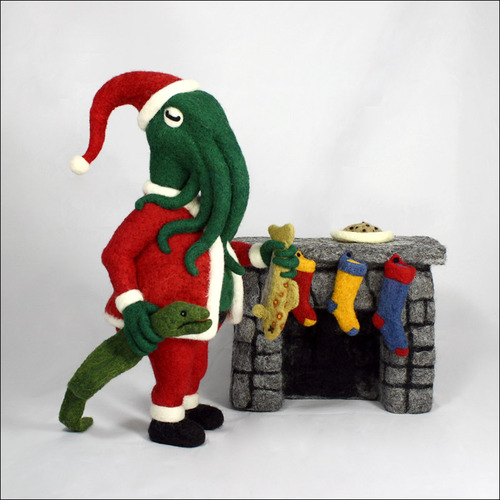
I visited agreatbecoming.com after posting this blog and found that it mainly focuses on computer games.  The blurb at the top of the webpage describes it as A blog about games, networked media, technology, evolution & nature..”You are privy to a great becoming, but you recognize nothing…”    Interestingly,  there are a considerable number of Cthulhu knick-knacks shown–making the site worth a visit for fans of Lovecraft.  For example, here is a Cthulhu Santa (from reyenamarillo.tumblr.com).


Cthulhu Santa

Enjoy your visit to agreatbecoming.com!


Addendum to Post on German Horror

Die Schattenuhr

I have been exploring German horror on the web since my last post, particularly the photos of the German Horror Writers Circle on Facebook, where I found this really beautiful, really cool cover that I just had to share.  The post is by Nina Horvath and says “Cover zu ‘Die Schattenuhr’, erstellt von Mark Freier nach einem Werk von Zdzisław Beksiński” (Cover to ‘The Clock of Shadows’, published by Mark Freier after a work by Zdzisław Beksiński).  At the very top of the page, “Die Bizarre Welt des Edgar Allen Poe” translates to “The Bizarre World of Edgar Allen Poe”.  One thing I have already learned about horror in Germany is that American horror is very popular over there–in particular Lovecraft and Poe.

Really, what is horror?

H_P__Lovecraft_by_MirrorCradle -- resized

H.P. Lovecraft by Mirror Cradle

I like the illustration above, not only because it shows Lovecraft in the throes of creation, but also because it can be a metaphor for anyone in the deepest and darkest of contemplations or beset with a multitude of woes.  For now, though, I will say that it represents Lovecraft contemplating today’s question which is:  forget everything you have ever read about horror, what is horror to you?

Stephen King made this comment (I found it on goodreads.com):

“The 3 types of terror: The Gross-out: the sight of a severed head tumbling down a flight of stairs, it’s when the lights go out and something green and slimy splatters against your arm. The Horror: the unnatural, spiders the size of bears, the dead waking up and walking around, it’s when the lights go out and something with claws grabs you by the arm. And the last and worse one: Terror, when you come home and notice everything you own had been taken away and replaced by an exact substitute. It’s when the lights go out and you feel something behind you, you hear it, you feel its breath against your ear, but when you turn around, there’s nothing there…”

To me, these seem to be the superficialities of terror and horror.   If we use disease as a metaphor for horror, then these are its symptoms.   The virus lying at the root of horror is man’s inhumanity to man.   Seeing a severed head tumbling down stairs is indeed horrible;  seeing the murderer sever the head would be even worse, but being able to look into the soul of the murderer and see that the motive for the act stems from the murderer’s complete indifference to the suffering of others would be even worse.   Perhaps even worse than that would be seeing that that indifference to others is not uncommon.

Many have speculated on what fascinates people about horror.   Why would anyone enjoy being frightened?   An article I read last night (I think from Wikipedia) says essentially (I am summarizing in my own words) that it is because the security our civilization our modern society affords us has eliminated the need for the primal fear that developed as a survival mechanism during the early days of evolution.    That may be true to some degree, but if society eliminated some fears, it instilled others.    How many have seen the movie “Candyman”?   How many have seen “I am Legend?” or “The Omega Man” (both derive from the novel “I am Legend” by Richard Matheson), which is only one example of post-apocalyptic literature that would have been inconceivable in primeval times.

Instead of some overreaching drive extending throughout mankind, it may be that the need simply stems from the fact that the adrenaline rush, the focus on the moment, the muscle tension, and all the other physical sensations experienced during fright are the same or very similar to those experienced during sex, but without the sexual arousal itself.   These are also similar to the sensations experienced during peaks of athletic activity.    I was in the martial arts for many years and I can testify that the adrenaline rush experienced during sparring matches or when one is performing at peak ability can be addicting.   Being frightened puts one on a similar level of physical and mental awareness, because it is an instinctual preparation to fight as if one is actually being threatened.  The great thing about horror though is that while one enjoys all the physical highs of one’s body revving up for action, there is no actual threat.  Everyone is safe.   Candyman is not actually going to come out of the screen and track you down (though your subsequent nightmares may tell you otherwise).

So, please put yourself in Mr. Lovecraft’s place in the illustration above and ask yourself, what is horror?

A Little Dark Humor for my Readers

Cthulhu

My posts have been deep of late, so I thought I would lighten things up with a little dark humor.  I found this someplace on the internet and I love it.  I apologize to the artist for not having recorded its source, but whoever you are, I love your work! 

While I’m at it, I’ll add another of my favorites.  Again, I didn’t record the artist’s name, but I love his work.

Werewolf-1

The Unrecognized Masters of Horror

If they tried really hard, the majority of the public could perhaps name only four writers of horror:  Stephen King, H.P.Lovecraft, Edgar Allan Poe, and Clive Barker.   Fans of the horror genre could doubtlessly name many more with the number of the authors they could name reflecting the intensity of their interest.  For example, a person who can name fifteen authors of horror most likely has a more intense interest in the genre than someone who can name only five.

I would say that it is a safe bet that one or more of these authors are the topics in least 75% of all the conversations about horror literature going on at any one moment.  While we amateurs can  improve our skills from studying these four, I think we have a lot to learn from studying authors other than these four.

I recently read a compilation of stories that Lovecraft cites in his work “Supernatural Horror in Literature”.  Of course, only Poe appears among his cited predecessors.   Most of his influences are writers probably most of the modern public has never heard of (Lord Dunsany, Edward Lucas White, Arthur Machen, etc.) though they were as well known in their time as Dean Koontz and Peter Straub are today.

My question to you is:  who are the unrecognized masters of horror that the modern public should know but in all likelihood do not?  Whose name does not usually make it into any top ten list of masters of horror but should?