Selections from The Writer’s Home Companion

Edgar Allan Poe, circa 1849

The other day I happened to find my copy of The Writer’s Home Companion (by James Charlton and Lisbeth Mark, 1987), which I had lost/forgotten some time back. I have been perusing it since and have found several anecdotes on various authors of horror, which had not captured my attention when I purchased the book, because I was not interested in writing horror at the time.  I am quoting them below for your entertainment and consideration.   They provide a few insights and lessons into the art and business of writing as well as into the lives of writers, if not in the art of horror specifically.  If you would like to read more of the book, you can probably find a copy at your local library or half-price bookstore.

“Edgar Allan Poe opted to self-publish Tamerlane and Other Poems. He was able to sell only forty copies and made less than a dollar after expenses. Ironically, over a century later, one of his self-published copies sold at auction for over $11,000.”

Stephen King at Comicon, 2007 Photo by Penguino
Stephen King
at Comicon, 2007
Photo by Penguino

“Stephen King sent his first novel to the editor of the suspense novel The Parallax View. William G. Thompson rejected that submission and several subsequent manuscripts until King sent along Carrie. Years later some of those earlier projects were published under King’s pseudonym Richard Bachmann, and one was affectionately dedicated to ‘W.G.T.'”

“Edgar Allan Poe perpetrated a successful hoax in the New York Sun with an article he wrote in the April 13, 1844 edition of the paper.  He described the arrival, near Charleston, South Carolina, of a group of English ‘aeronauts’ who, as he told the story, had crossed the Atlantic in a dirigible in just seventy-five hours. Poe had cribbed most of his narrative from an account by Monck Mason of an actual balloon trip he and his companions had made from London to Germany in November 1836.  Poe’s realistically detailed fabrication fooled everyone.”

Robert Louis Stevenson Portrait by Girolamo Nerli  (1860-1926)
Robert Louis Stevenson
Portrait by Girolamo Nerli
(1860-1926)

“Robert Louis Stevenson was thrashing about in his bed one night, greatly alarming his wife.  She woke him up, infuriating Stevenson, who yelled, ‘I was dreaming a fine bogey tale!’  The nightmare from which he had been unwillingly extracted was the premise for the story of Dr. Jekyll and Mr. Hyde.”

“Amiably discussing the validity of ghosts, Lord Byron and Percy Bysshe Shelley decided to try their poetic skills at writing the perfect horror story.  While nothing came of their efforts, Shelley’s young wife, Mary Wollstonecroft, overheard the challenge and went about telling her own.  It began ‘It was on a dreary night of November that I beheld the Accomplishment of my toils.’  Her work was published in 1818, when she was twenty-one, and was titled Frankenstein.”

“Edgar Allan Poe was expelled from West Point in 1831 for ‘gross neglect of duty’.  The explanation for his dismissal had to do with his following, to the letter, with an order to appear on the parade grounds in parade dress, which, according to the West Point rule book, consisted of ‘white belt and gloves.’  Poe reportedly arrived with his rifle, dressed in his belt and gloves–and nothing else.”

Sir Edward Bulwer-Lytton, First Baron Lytton Portrait by Henry William Pickersgill
Sir Edward Bulwer-Lytton, First Baron Lytton
Portrait by Henry William Pickersgill

“Traveling along the Italian Riviera, Lord Bulwer-Lytton, done up in an embarrassingly elaborate outfit, acknowledged the stares of passersby.  Lady Lytton, amused at his vanity, suggested that it was not admiration, but ‘that ridiculous dress’ that caught people’s eyes.  Lytton responded, ‘You think that people stare at my dress and not at me?  I will give you the most absolute and convincing proof that your theory has no foundation.’  Keeping on only his hat and boots, Lytton removed every other article of clothing and rode in his open carriage for ten miles to prove his point.”

If you have anecdotes about your favorite authors that you would like to share, please do.

Questions?  Comments?

Review of Barrio Tales

Barrio Tales

In Barrio Tales, two well-off American college students (perhaps recent college grads) head into the Mexican border town of Barrio one night to buy cheap drugs from a man named Pedro, whom they have never met.  While they wait in the desert,  a really creepy man comes up to their car and tells them he can take them to Pedro.    They head to a shack where they sit around a campfire and the stranger tells them three horrific stories of Mexicans in the U.S. while the students impatiently wait.   The stories are entitled “Maria”, “Uncle Tio’s Taco Truck”, and “El Monstruo” (The Monster).  The stories, while they can keep your attention, are not great horror.  Perhaps the best way to sum up the movie is as an above-average, low-intensity slasher flick.

“Maria” is the story of the vengeance wreaked by the grandmother of a beautiful young woman who comes to work in the US as a maid at a billionaire’s home.  While the billionaire and his wife are vacationing in the Turks and Caicos, their son comes home from his college graduation to find the new maid and the $15,000 his parents have left him for the summer.  He immediately calls three friends over, including one who is hiding his Mexican heritage from the others (this enables him to be the only one who can communicate decently with Maria). Another, the lead jerk, is hot for the maid and tries to seduce her with marijuana, which she refuses. Later that evening, the friends have some girls over for a pool party involving cocaine and other drugs.  When Maria cannot sleep and comes to the party in her house robe (I assume she is going to ask them to keep the noise down, though she never gets the chance to say why she came down),  the lead jerk tries to coerce her into taking off her clothes.  When she doesn’t comply, he playfully tosses her into the pool.  Unfortunately, she strikes her head on the side of the pool and dies.   The group panics and buries her body.  However, the girl had an apparently intensely mystical connection with her grandmother, who casts a spell that causes each boy to die an excruciatingly gruesome death.

Uncle Tio is a popular man with the teenagers and working people of his southern California neighborhood.  He runs a taco truck and serves delicious tacos, sometimes giving them away.  What makes his tacos so delicious is his secret ingredient:  neighborhood teenagers.  Can you see where this one is going already?

El Monstruo is a local legendary monster that kills illegal immigrants crossing the border.   In the reality of this story, El Monstruo turns out to be a particularly monstrous man and his family of serial killers, who lure groups of Mexicans crossing the border to their ranch, where they dispatch them with a variety of cruel means.  Unfortunately for the family, one of the latest group of victims escapes, who, unknown to the family, is the group’s “coyote” (the trafficker who leads the group across the border).  The coyote fetches his brother and a friend to exact vengeance on El Monstruo and his twisted offspring.

There is not a lot of suspense here.  This movie probably won’t keep you on the edge of your seat, but it is kind of entertaining.  The most interesting facet of the movie is that the cinematography is well done for something this low budget.  Although the movie was produced in 2012,  it has a gritty feel you find in early 70’s pulp horror,.  The characters are well-drawn and the college students are more three-dimensional and realistic than what you find in most slasher films where the actors are simply two-dimensional targets that speak empty-headed lines when they are not screaming in terror.  The acting was above-average and actually showed some degree of depth.

My main complaint about the film is just that the basic premise was just not imaginative.   The film probably would have been a lot better if the screenwriter, director, and producer had gotten together and done something to fire up their imaginations — like using some of the drugs they talk about in the movie.  The feeling I get from this movie is that the director and producer took care of the details, but somehow they missed maintaining a good line of suspense and let the film become all too predictable .

The director and producer also let at least two details slip.  Maria’s grandmother casts a spell to kill Maria’s murderers, yet earlier she insists to one that her grandmother is not a witch.   Meanwhile, the law apparently never gets wind of the accident and no one, even the parents, ever finds out in spite of the fact that there were several students at the party in addition to the four main malefactors.  Maybe I am being overly picayunish, but it just would have been a bit tighter story line if the director could have at least had someone mention that somebody’s parents had paid off a judge or tied up the case in court or something to cover that gap.  This is all I noticed.  It wouldn’t surprise me if there were several more.

Did you think I forgot about the two guys waiting in the desert for Pedro?  You can probably guess the outcome of their story.

The best time to see this film is late night on Netflix while having a few beers or during an attack of insomnia.   Were this still in theatres, I would say that it is worth the price of a matinee, but I wouldn’t spend any more than that.  Do go see it dollar movie night though,  especially if you have had a few drinks and need to sober up, just to see it on the big screen if for no other reason.

Thoughts?  Comments?


Five Reasons Everyone Should Know Sir Edward Bulwer-Lytton | Interesting Literature

Sir Edward Bulwer-Lytton, First Baron Lytton Portrait by Henry William Pickersgill
Sir Edward Bulwer-Lytton, First Baron Lytton
Portrait by Henry William Pickersgill

Five Reasons Everyone Should Know Sir Edward Bulwer-Lytton | Interesting Literature.

I found this article at http://www.interestingliterature.wordpress.com just a few minutes ago.  Though the article does not deal with horror per se, the article will be of interest to horror aficionados (especially horror-historians) because for a short time Sir Edward Bulwer-Lytton was one of the more famous writers of horror during the nineteenth century.   His work of horror, “The House and the Brain”, is mentioned in Lovecraft’s famous essay “Supernatural Horror in Literature”.  Lovecraft said of Bulwer-Lytton:

“At this time a wave of interest in spiritualistic charlatanry, mediumism, Hindoo theosophy, and such matters, much like that of the present day, was flourishing; so that the number of weird tales with a ‘psychic” or pseudoscientific basis became very considerable.  For a number of these the prolific and popular Edward Bulwer-Lytton was responsible;  and despite the large doses of turgid rhetoric and empty romanticism in his products, his success in the weaving of a certain kind of bizarre charm cannot be denied.”

Lovecraft goes on to discuss with some degree of praise three of Bulwer-Lytton’s works:  the short story “The House and the Brain” and the novels Zanoni and A Strange Story.  I read “The House and the Brain” some time back and found it an interesting story (though a little long) and even riveting in some parts.  It is about a man who decides to spend the night in a haunted house where no one has been able to stay for very long because it is inhabited by terrifying apparitions.  True to the style of many nineteenth-century stories, the intrepid protagonist finds something of a scientific explanation behind the haunting.  It is definitely worth reading.

I have mentioned Bulwer-Lytton and some of the things for which he is famous in my previous post “The Best Literary Facts from the Twitterverse”, which was also reposted from http://www.interestingliterature.wordpress.com.   You might want to check it out for a few additional facts.

Thoughts?  Comments?

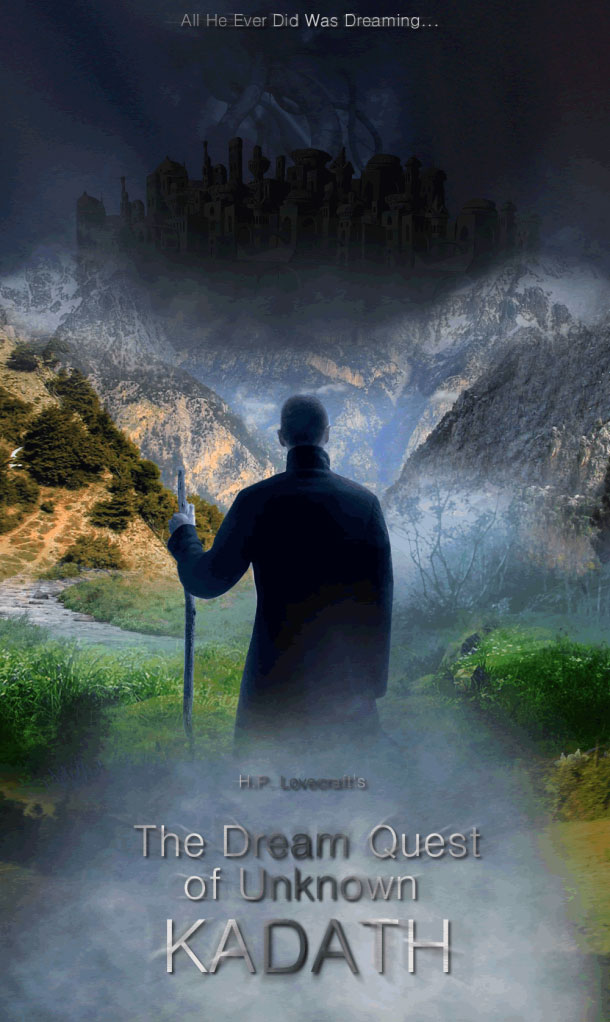
At the Midpoint of “The Dream-Quest of the Unknown Kadath”

poster by vggonzalez, 2009 at www.gatostudios.wordpress.com Please observe any copyright restrictions.
poster by vggonzalez, 2009 at http://www.gatostudios.wordpress.com
Please observe any copyright restrictions.

One of the several books I am reading currently is an anthology of Lovecraft’s dream cycle.    Its story that I am reading now is “The Dream-Quest of the Unknown Kadath”.   I wrote up my views on the work today for Goodreads.com and thought I would share them here as well (though in a slightly modified version):

I am a Lovecraft fan, but I find “The Dream-Quest…” very tough reading.  I want to finish it, if for no other reason than to be able to say I managed to struggle my way through it and achieve my goal in spite of the hardships I encountered like the explorer of a literary Amazon.

The language is cumbersome and the plot is just Randolph Carter escaping one bad situation after another by luck.  Still, I am only about half-way through, and the optimistic side of me keeps hoping it gets better.  I don’t have much hope though, particularly after reading part of the Wikipedia article on it, which gives Lovecraft’s own views, which echo my own:

“Lovecraft himself declared that ‘it isn’t much good; but forms useful practice for later and more authentic attempts in the novel form.’ He expressed concern while writing it that ‘Randolph Carter’s adventures may have reached the point of palling on the reader; or that the very plethora of weird imagery may have destroyed the power of any one image to produce the desired impression of strangeness.”[8]

In the paragraph preceding this one in Wikipedia, Joanna Russ sums up the work nicely:

“The Dream-Quest has evoked a broad range of reactions, “some HPL enthusiasts finding it almost unreadable and others…comparing it to the Alice books and the fantasies of George MacDonald.[6] Joanna Russ referred to The Dream-Quest as “charming…but alas, never rewritten or polished”. [7]

Count me among the ones who find it almost unreadable, with its awkward, first-draft phrasing and its confused attempt to set a tone using an imagined scholarly, courtly language somewhere between Shakespeare and Poe.

However, I do love this awesome poster, which I found at http://gatostudio.wordpress.com/2009/03/21/the-dream-quest-of-unknown-kadath-poster/.  Please visit this beautiful site.  If you decide you would like to use this poster, please check with gatostudio and adhere to all copyright restrictions.

I just wish Lovecraft had written the story as masterfully as Mr. Gonzalez drew his poster and H.P. had lived up to the promise of the fantastic adventure to which the poster alludes.    The poster really outshines the story.    Given another two or three drafts, this story may have outshone all of Lovecraft’s other works.

Thoughts?  Comments?

www.HyperSmash.com

In A Glass Darkly by Sheridan Le Fanu

Here’s a good review of one of the forgotten masters: Joseph Sheridan Le Fanu. For more on Le Fanu, check out my previous post on him.

Colin's avatarThe Black Abyss

In A Glass Darkly

By Sheridan Le Fanu

Format: Paperback, 272 pages.

Publisher: Wordsworth Editions, 2007.


What are the chances of two horror novels being reviewed in the space of a couple of weeks with titles based on 1 Corinthians 13 (“For now we see through a glass, darkly”), kind of slim, but that’s the kind of joined up thinking you get at Highlanders Book Reviews (or pure jammy fluke as they say round these parts!). Perhaps what’s more fascinating is that without Sheridan Le Fanu’s misquote it is highly unlikely that we would have ever arrived at Bill Hussey’s Through A Glass Darkly despite the 136 year gap, let me explain.

Joseph Thomas Sheridan Le Fanu was an Irish writer who, during the 19th C, was one of the founders of the written ghost story. For a more detailed biography have a look here or here but bear…

View original post 505 more words

The Best Literary Facts from the Twitterverse

http://interestingliterature.wordpress.com/2013/09/06/the-best-literary-facts-from-the-twitterverse/

Follow the link above for some fascinating literary tidbits.   If you don’t have the time to wade through all for the horror triva, here they are:

Bram Stoker’s wife, Florence Balcombe, was previously suitored by Oscar Wilde. (@l0lhey)

In 1862, Sir Edward Bulwer-Lytton was offered the chance to be King of Greece. (@LeighaMcR)

Dickens & Poe were friends. 3 letters between them survive (alas, letters don’t mention of the death of Dickens’ pet raven). (@LauraShovan)

 Sir Edward Bulwer-Lytton, for those of you not into horror esoterica, was a well-known writer of the nineteenth century who dabbled in a variety of genres.  H.P. Lovecraft thought highly of his story “The House and the Brain”, which is included in the collection The World’s Greatest Horror Stories (2004, edited by Stephen Jones and Dave Carson).   According to Wikipedia, Bulwer-Lytton was the originator of some very famous and very frequently coined phrases that are still around:   “the pen is mightier than the sword”, “the great unwashed”, and “the almighty dollar”.  Bulwer-Lytton also invented that well-known line with which Snoopy invariably starts his novel in “Peanuts”:  “it was a dark and stormy night…”

Thoughts?  Comments?

Fictional Realism and You


Today at Stumble Upon, I found a fascinating article entitled “10 Mind-Blowing Theories That Will Change Your Perception of the World”.  Of the ten, the most fascinating for writers is #9, “Fictional Realism” which reads:

9. Fictional realism.

This is the most fascinating branch of multiverse theory. Superman is real. Yes, some of you would probably choose a different story, for argument’s sake, Harry Potter might be real too. This branch of the theory argues that given an infinite number of universes, everything must exist somewhere. So, all of our favorite fiction and fantasy may be descriptive of an alternate universe, one where all the right pieces came in to place to make it happen.

So, according to this, Cthulhu and all the rest of the Lovecraftian universe and the eldritch world may actually exist out there someplace just beyond our ken in a parallel universe.  Somehow horror becomes scarier when it becomes possible at some level.

Thoughts? Comments?

Story Review: Ray Bradbury’s “The Illustrated Man”

The blogger on Padre Island, January, 2011.

 Padre Island, January, 2011.

I read “The Illustrated Man” for the first time yesterday.  I have been interested in reading it for many years now, after having seen the movie starring Rod Steiger as a television re-run perhaps as far back as the 70’s.    But recently I have been reading “The Martian Chronicles” and when I found myself over the last few days in the Midland, TX public library with time to kill, I thought I would investigate other Bradbury works (even though I have “The Martian Chronicles” in the car).

The movie bears little resemblance to the short story.  In the movie a young man (as best I recall) is camping in the woods as he travels across country, when Rod Steiger staggers into the man’s campsite.  Somehow (my memory is vague) Steiger reveals his body is covered with tattoos and tells the camper that the future can be seen in the empty spaces on his chest and back.  At this point, the spaces on his chest and back form the framework for a series of four short tales, which, if I recall correctly, are other Ray Bradbury stories.    I will not reveal the end, which I recall as being quite good.

The actual story is not a collection of four stories, but a single tale of a man, William Philippus Phelps, who works erecting tents for a circus, but volunteers to become the tattooed man for the carnival sideshow after his weight balloons up to 300 pounds after he “stress-eats” because of the problems between himself and his new bride and he can no longer perform his job for the circus.  Desperate to have any job at the circus, Phelps volunteers to have himself covered in tattoos.   Someone steers him in the direction of an old woman who lives in the nearby woods and who does tattoos for free.   He finds her and from her descrition (aged with eyes, nostrils, and ears sewn shut and living in a shack), she sounds very much like a witch.    She inks the tattoos, which seem magically alive and writhing, but she also places a large bandage in the center of his chest and one in the center of his back and makes him swear not to remove the one on his chest for a week and the one on his back a week after that that.   When Phelps does remove the one on his chest during the course of a show, it shows him strangling his wife, whom the tattoo witch had never seen.  I won’t spoil the ending for you, which is quite enjoyable and reveals what is under the bandage on his back, because I strongly recommend that you read the story, which is only a few pages long.

Though Bradbury is, of course, world renown for his science fiction, this story falls much better into the horror genre.  There is no science anywhere in story, only carnival folk, magical tattoos inked by a frightening witch, suspense, anger, and, ultimately, violence.  The story is beautifully written with the language clear, concise, flowing, and simple yet powerful.  I felt emotionally and intellectually drawn into the story and into Phelps’s life and felt empathy for his plight.  This is an excellent work of horror, though its author’s fame as a demigod of science fiction undoubtedly has most people classify it erroneously.

Thoughts?  Comments?

Movie Review: “The ABC’s of Death”


I watched “The ABC’s of Death” about a couple of weeks ago on Netflix.   This is a bizarre, mind-blowing film that is not for the squeamish and definitely not for children.  Though I had to turn my face a couple of times when the gore and violence becaume more than I could stomach, I found it a fun, fascinating film to watch late on a Saturday night particularly as Halloween approaches.

The link above to the Internet Movie Database (IMDb)will give you the vital details, including the following excellent synopsis:

The ABC’s OF DEATH is an ambitious anthology film featuring segments directed by over two dozen of the world’s leading talents in contemporary genre film. Inspired by children’s educational ABC books, the motion picture is comprised of 26 individual chapters, each helmed by a different director assigned a letter of the alphabet. The directors were then given free reign in choosing a word to create a story involving death. Provocative, shocking, funny and ultimately confrontational; THE ABC’s OF DEATH is the definitive snapshot of the diversity of modern horror. Drafthouse Films, Magnet Pictures and Timpson Films are proud to present this alphabetical arsenal of destruction orchestrated by what Fangoria calls “a stunning roll call of some of the most exciting names in horror across the world.”                Written byAnonymous

No matter what your favorite horror subgenre, I would wager there is something in this film for you:  from suspense to gore to horror with an outlandish fantasy twist to shock to nudity to humor to…whatever.

One of the most entertaining aspects to me was to see how a director, once given a letter, used his/her creativity to develop a story based around that letter.  On the surface, this is easy when one is dealing with a common letter like “M” (murder of course springs to mind immediately or mayhem) or “H” (for hell, horror, etc.), but what do you do with “Q” (“Q is for Quack” was my favorite) or “Z” ?   Just watching creative genius at work was a blast for me.

Though I watched it on Netflix, if it was out at theatres, I would say pay full price on a Saturday night to see this.  It is a great date movie–so long as your date has a taste for the bizarre.

Impressions of Five Writing Styles

I was in the Farmington public library yesterday trying to pull together some ideas for a story, but I could not concentrate long enough to formulate many good thoughts, because I felt more in a mood to receive information rather than to transmit.

Within the last few days I have started reading a collection of Lovecraft stories entitled The Dream Cycle of H.P. Lovecraft:  Dreams of Terror and Death (an excellent work; read it if you get the chance), edited by Neil Gaiman.  While wandering through the stacks, I pulled out a copy of Stephen King’s From a Buick 8 and took it back to my seat.  I had started reading it several years ago, but never finished it.  I thought I would review it and maybe start on it again soon.   As I read it, I noticed an interesting difference between King’s style and Lovecraft’s. Lovecraft gives a lot more of the backstory of a work in a few pages than King does.

As it so happens, I had also passed by the John Updike section a little earlier in the library and I have a few of his novels, which I have never read.  I went back and picked up his Rabbit, Run for comparison.  I thought about the differences between these three and a couple of other famous writers and came up with what I consider to be an interesting observation  (though it might bore those of you who are more advanced in the craft of writing than I am):  it is fascinating to see how much information about a work’s backstory or the larger setting of a story an author can put in the first 2-3 pages or so of a work.  For what it’s worth, here are my initial subjective impressions of the five writers under consideration yesterday.

In the first few pages of Rabbit, Run Updike details how Rabbit Angstrom happens to walk upon a basketball game among six kids in an alleyway (circa 1960). He watches and then joins the game, and impresses them with his basketball prowess, having been a high school basketball star about 8-9 years earlier.  He then goes home to where his wife is contemplating cooking dinner.   Updike takes us through this step by step and we don’t learn a lot other than Rabbit was a basketball star in high school several years back  and at 26 he has a middle class life now with a job for which he wears a suit to work.  I know that Updike is a very respected writer with two Pulitzers to his credit, but this story gets off to a very slow start for me and I learn very little about Rabbit Angstrom in the opening pages.  There is also very little emotional pull in these opening pages to draw me into the story.

In the opening chapter of A Farewell to Arms, Hemingway describes the scene from the window of an Italian house used as a hospital as troops pass en route to the Austrian front over the course of about a year.   He also describes how the leaves fall from a nearby tree and how the dust during the summers turns everything bone white, both of which (to me) symbolize the deaths of myriad troops on the front.   In maybe 2-3 pages, Hemingway not only gives us the overall setting of being at the Italo-Austrian front, he also draws us in with considerable emotional impact of the tragedy of the watching thousands of weary troops slogging through rain and mud or trudging through dust and heat on their way to their deaths.

In Quiet Flows the Don (1940), Soviet author Mikhail Sholokhov (winner of the 1965 Nobel prize for literature) describes the lives of Don Cossacks from before the First World War up to the Russian Revolution.  In its first few pages, Sholokhov describes life in a village of Cossacks, describes the relationship between father and son, shows how the son is having an affair with another Cossack’s wife, and shows the history and underlying peccadilloes of the family back for circa 200 years.  While his style is non-emotional, one cannot help but to feel for the family and to be drawn into the story.  It is a hard book to put down.

In From a Buick 8, Stephen King tells the story of a mysterious car that is kept in storage at a Pennsylvania State Troopers’ post.  In his first few pages, King describes the main characters and how they interrelate and how they all fit into the world of that post.  King makes the reader feel as if he were seeing the post from the perspective from one of its members.  You know the same things about all the members of that tight-knit community as if you were one of them.   Though the opening is not on the grand scale of A Farewell to Arms or Quiet Flows the Don, one feels the story on a much more intimate level while on a larger scale than in Rabbit, Run.    In the opening pages of From a Buick 8, King makes the reader feel as if he were part of a small community, while Sholokhov makes the reader feel as if he were part of a village, and Hemingway makes the reader feel a part of an entire battle front.

Dreams of Terror and Death is a collection of short stories, but in it the unfinished tale “The Descendant” stands out as an example of Lovecraft’s ability to an enormous backstory/setting into a few pages.  In these few pages, Lovecraft describes how a young man brings a copy of the dread Necronomicon to an aging scholar and how the scholar begins to relate the history of a millennia-old castle on the Yorkshire coast that hides the entrance to the elder world.  The story, even in its few pages touches on black magic; ancient, forgotten civilizations; other dimensions; and probably a dozen other mysterious subjects that instill the sort of eerie curiosity into a reader that compels a person into the black recesses of an unexplored cave. You sense something dangerous is lurking just out of sight, but you cannot contain the urge to find out what it is.

The instilling of this eerie curiosity that keeps one on the edge of the movie theater seat or turning the pages of the novel is a hallmark of all good horror and of all good horror writers.

Thoughts?  Comments?

Your Beast, By Any Other Name

Surfing the ‘net today I found an interesting article at davidsearls.com on  the art of writing novel titles:  Your Beast, By Any Other Name.  If you are in the process of writing a story or novel, it will probably be worth a few minutes of your time to check out this article.  In it, Mr. Searls gives his thoughts and a list of examples of what are excellent titles.  I posted a lengthy comment to it, which I will quote here for your convenience:

Excellent list of titles!  Though I have few published works, from all those I have in the works, I know it is difficult finding exactly the right title that intrigues the passerby while giving something of a clue as to the nature of the story.  My paltry four published stories I think meet this criteria, but I would like to hear your opinion of them:  “Dream Warrior”, “Wolfsheim”, “A Tale of Hell”, and “Murder by Plastic”.

As a bit of trivia, Hemingway had an interesting way of choosing titles.  He would search the Bible for catchy lines under he had a list of a hundred, and then would start crossing them off as he searched for the best one.

As I think of it, having an emotionally-charged verb in the title, such as “murder” or “dying” or “rampage” in the title would be a good idea, because of the sudden, visceral impact it would carry.  Though not a horror novel, Faulkner’s “As I Lay Dying” would be a good example.  A good emotionally-charged noun and/or adjective would be a good second choice.  Some examples of these are Clive Barker’s “The Hellbound Heart” or “The Damnation Game” or “Books of Blood”.  “Psycho” is another good example.  “Hell House” is a good one; “Interview with a Vampire” is another.

And a mysterious title that needs explanation thus drawing the reader into reading the work out of sheer curiosity is another good technique.  “The Call of Cthulhu” is the prime example of this to my mind.

Thoughts?  Comments?

Review: The Worlds’ Greatest Horror Stories


Last night I finished The World’s Greatest Horror Stories, published in 2004 by Magpie Books and edited by Stephen Jones and Dave Carson.  This is a collection of stories mentioned in Lovecraft’s essay “Supernatural Horror in Literature”, which is included in the collection.  Reading this book gives one a good foundation in the history of the horror genre up to Lovecraft’s time.   It includes such masterworks as Poe’s “The Fall of the House of Usher”, Machen’s “The Great God Pan”, M.R. James’s “Count Magnus”, Charles Dickens’s “The Signalman”, Guy de Maupassant’s “The Horla”, Rudyard Kipling’s “The Mark of the Beast”, and Robert Louis Stevenson’s “The Bodysnatcher” along with many others.

Though a couple may be a little long-winded by today’s standards, overall these are wonderful stories, classic supernatural tales demonstrating what horror should be that were lauded by none other than the father of modern supernatural horror himself!  I highly recommend this to anyone with an interest in literature in general though particularly of course to those with an interest in the horror genre. The beauty of these tales is their ability to keep the reader in edge-of-your-seat suspense,terrified and spellbound, without resorting to the more-often-than-not overdone and too often appalling gimmicks of gore and shock. These tales show that grisly details are not needed to enthrall an audience, but that imagination and craftsmanship are.

Thoughts?  Comments?

Dr. Polidori and “The Vampyre”

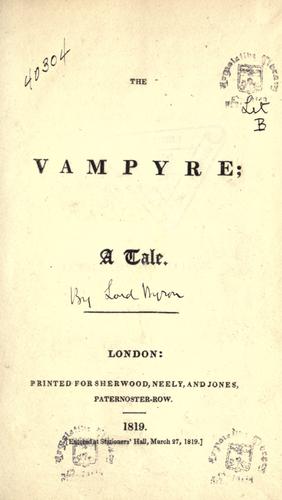
Title Page of Vampyre 1819 (Note handwritten attribution to Lord Byron)
Title Page of Vampyre
1819
(Note handwritten attribution to Lord Byron)

On June 22, I was continuing my reading of Lovecraft’s “Supernatural Horror in Literature” when I encountered an interesting tidbit.   When Mary Shelley was writing Frankenstein in the famous competition with her husband, Percy Shelley, and Lord Byron, another competitor was Dr. John William Polidori, whose story story from that competition, “The Vampyre”, went on to be the only other work of that competition that went on to achieve any sort of renown (according to Lovecraft).

Wikipedia has an interesting explanation for the title page above:

“The Vampyre” was first published on 1 April 1819 by Henry Colburn in the New Monthly Magazine with the false attribution “A Tale by Lord Byron“. The name of the work’s protagonist, “Lord Ruthven“, added to this assumption, for that name was originally used in Lady Caroline Lamb‘s novel Glenarvon (from the same publisher), in which a thinly-disguised Byron figure was also named Lord Ruthven. Despite repeated denials by Byron and Polidori, the authorship often went unclarified…Later printings removed Byron’s name and added Polidori’s name to the title page.

Go to this link for the Project Gutenberg etext of “Vampyre”.  Modern printings can be found at the Open Library.

John William Polidori 1795-1821 (from Wikimedia)
John William Polidori
1795-1821
(from Wikimedia)

Another couple of interesting notes from the Wikipedia article on The Vampyre:

“The story was an immediate popular success, partly because of the Byron attribution and partly because it exploited the gothic horror predilections of the public. Polidori transformed the vampire from a character in folklore into the form that is recognized today—an aristocratic fiend who preys among high society.[1]

“Polidori’s work had an immense impact on contemporary sensibilities and ran through numerous editions and translations. An adaptation appeared in 1820 with Cyprien Bérard’s novel, Lord Ruthwen ou les Vampires, falsely attributed to Charles Nodier, who himself then wrote his own version, Le Vampire, a play which had enormous success and sparked a “vampire craze” across Europe. This includes operatic adaptations by Heinrich Marschner (see Der Vampyr) and Peter Josef von Lindpaintner (see Der Vampyr), both published in the same year and called “The Vampire”. Nikolai Gogol, Alexandre Dumas, and Alexis Tolstoy all produced vampire tales, and themes in Polidori’s tale would continue to influence Bram Stoker‘s Dracula and eventually the whole vampire genre. Dumas makes explicit reference to Lord Ruthwen in The Count of Monte Cristo, going so far as to state that his character “The Comtesse G…” had been personally acquainted with Lord Ruthwen.[10]

I find it fascinating that possibly the two greatest motifs in the history of horror literature (Frankenstein and vampires) were started at the same friendly competition between four friends.

Unfortunately,  Dr. Polidori did not live to see the success of the literary phenomenon he created.   The article goes on to note:

“He [Polidori] died in London on 24 August 1821, weighed down by depression and gambling debts. Despite strong evidence that he committed suicide by means of prussic acid (cyanide), the coroner gave a verdict of death by natural causes.[3]

Continue reading “Dr. Polidori and “The Vampyre””

My Poem “Faust” Has Been Reprinted

I am happy to announce that as of today, July 10, 2013, my poem “Faust” has been reprinted in Blood Moon Rising Magazine.   Please follow the link to view my favorite of all the poems I have written and to visit their excellent magazine.

In Memory of Richard Matheson

Richard Matheson Photo by JaSunni, 2008
Richard Matheson
Photo by JaSunni, 2008

On Monday, I learned of the death of Richard Matheson, one of the great horror writers of the twentieth century.   As my tribute to him, here are a few quotations from and about him along with a few examples on how he generated his ideas.  There were a lot, so I picked the ones that seemed most philosophical about writing and life in general in order to get a feel for the man behind the writing.

From Goodreads:

“What condemnation could possibly be more harsh than one’s own, when self-pretense is no longer possible?” ― Richard Matheson, What Dreams May Come

“We’ve forgotten much. How to struggle, how to rise to dizzy heights and sink to unparalleled depths. We no longer aspire to anything. Even the finer shades of despair are lost to us. We’ve ceased to be runners. We plod from structure to conveyance to employment and back again. We live within the boundaries that science has determined for us. The measuring stick is short and sweet. The full gamut of life is a brief, shadowy continuum that runs from gray to more gray. The rainbow is bleached. We hardly know how to doubt anymore. (“The Thing”)” ― Richard Matheson, Collected Stories, Vol. 1    

“If men only felt about death as they do about sleep, all terrors would cease. . . Men sleep contentedly, assured that they will wake the following morning. They should feel the same about their lives.” ― Richard Matheson, What Dreams May Come

“In a world of monotonous horror there could be no salvation in wild dreaming.” ― Richard Matheson, I Am Legend    

“Now when I die, I shall only be dead.” ― Richard Matheson, I am Legend and Other Stories

 From Wikiquotes:

I think What Dreams May Come is the most important (read effective) book I’ve written. It has caused a number of readers to lose their fear of death — the finest tribute any writer could receive. … Somewhere In Time is my favorite novel.

“Ed Gorman Calling: We Talk to Richard Matheson” (2004).

From Uphillwriting.org:

If you go too far in fantasy and break the string of logic, and become nonsensical, someone will surely remind you of your dereliction…Pound for pound, fantasy makes a tougher opponent for the creative person.

Richard Matheson

And here are a couple of quote about Matheson–also from Wikiquotes:

Matheson gets closer to his characters than anyone else in the field of fantasy today. … You don’t read a Matheson story — you experience it.

Robert Bloch, as quoted in an address by Anthony Boucher (29 August 1958), at the “Solacon”, the 1958 Worldcon

He has many … virtues, notably an unusual agility in trick prose and trick construction and a too-little-recognized (or exercised) skill on offtrail humor; but his great strength is his power to take a reader inside a character or a situation.

Anthony Boucher in an address at the “Solacon”, the1958 Worldcon (29 August 1958)

Wikipedia offers an interesting paragraph on how Matheson came up with the ideas for some of his more famous works:

Matheson cited specific inspirations for many of his works. Duel derived from an incident in which he and a friend, Jerry Sohl, were dangerously tailgated by a large truck on the same day as the Kennedy assassination. (However, there are similarities with William M. Robson’s script of the July 15, 1962 episode of the radio drama, Suspense, “Snow on 66”.[citation needed]) A scene from the 1953 movie Let’s Do It Again in which Aldo Ray and Ray Milland put on each other’s hats, one of which is far too big for the other, sparked the thought “what if someone put on his own hat and that happened,” which became The Shrinking Man. Bid Time Return began when Matheson saw a movie poster featuring a beautiful picture of Maude Adams and wondered what would happen if someone fell in love with such an old picture. In the introduction to Noir: 3 Novels of Suspense (1997), which collects three of his early books, Matheson said that the first chapter of his suspense novel Someone is Bleeding (1953) describes exactly his meeting with his wife Ruth, and that in the case of What Dreams May Come, “the whole novel is filled with scenes from our past.”

Thoughts?  Comments?