Publisher, Rural Fiction Magazine; publisher, The Chamber Magazine; founder, the Farmington Writers Circle. I have written short stories and poetry for many years. In my careers as a Naval officer and in the federal government, I have written thousands of documents of many types. I am currently working on a second edition for my poetry collection and a few novels.
For a long time I have thought it would be fun to do movie reviews. With this post I will start doing them occasionally for this blog. My rating system is quite simple: is the movie worth (a) the full price of admission, (b) the price of a matinee, (c) wait until it comes out on DVD, (d) wait until it comes out on Netflix or some other free venue, or (d) don’t bother.
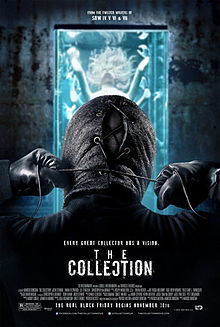
The Collection has been out for a while and I saw it on Netflix, but this would have been worth the price of full admission on a Saturday night on its release weekend.
This is a tense, edge-of-your-seat, full-throttle horror adventure almost from the opening credits. While the plot is your basic protagonists-venture-into-the-evil-guy’s-lair-and-fight-their-way-out, this has a lot of tense action and some unexpected twists that make it worthwhile. There is some gore, but proportionately, it is not as much as in the recent remake of Evil Dead, though there are quite a few bodies that have been turned into gross insect-like creatures by “the collector” that might cause those without strong stomachs to leave the room for a few minutes. The ending has a nice, little twist that gives the viewer a nice sense of closure to the whole event.
If you are deeply into serious horror as literature or films and sit around with your friends discussing trends in horror literature since the time of Horace Walpole, don’t see this expected to find unbroken ground or new motifs or anything of a high-brow nature. See this for the pure adrenalin rush that enthralls and takes you beyond the veil of this humdrum reality for a couple of eye-popping hours.
By chance, I surfed my way into Poets and Writers online today and was very fortunate to fall into their videos of “Authors on Short Stories”. I was pleasantly surprised to find that perhaps the author who is the subject of many, if not most, of the videos is Stephen King, who answers questions, discusses the craft of writing short stories, and reads from his works. You should not miss his talk on the difficulty of writing short stories and the trickiness of writing novellas. There is also a video with comments by several current short story writers on the difficulty of writing short stories, which echoes Mr. King’s comments on the difficulty in writing short stories.
I was surprised, though I probably shouldn’t have been, to hear Mr. King talk about the artistry of Raymond Carver in writing short stories. I have read one collection of Carver’s short stories (Where I’m Calling From) and they are nowhere near the horror genre, though they are great examples of mainstream literary storytelling as an art form.
Mr. King’s point about Carver’s stories is that he was a master of keeping stories short, which Mr. King finds difficult to do. He says that he often starts a story and before long it is ballooning into a novel. Raymond Carver had a great ability to keep his stories very short. As I mentioned, I have read a Where I’m Calling From and all the stories in it tend to be very short. I am guessing in the 2,000 -5,000 word range at most. Although I tended to find them boring at the time I read them in the mid-eighties, I have to admit that when I look back on them now, I am amazed at the depth contained in each.
Though I am only a fledgling writer with few stories to my credit, I am already learning that I share one thing in common with Mr. King: I find that I often start writing a short story and before I am very far along with it, it balloons into a potential novel, of which I have about three or four that I work on from time to time. In fact, as I have mentioned in a previous post, I have started exploring the distinctions between short stories, novelettes, novellas, and novels, because so many of my planned short stories are developing into novelettes and novellas.
It is amazing how a story seems to take on a life of its own and grow whether you want it to or not. It is very difficult to keep a story to within a limited number of words. King mentions that this is one thing at which Carver excelled. As I said, when I read Carver’s stories, I found them boring. But now that I am pursuing the craft of writing much more seriously than I did then and I reflect on King’s statement, I can appreciate the enormous difficulty Carver must have had in keeping his tales so compact. I am only now starting to appreciate Carver’s artistry. I should probably go back and read more of his works just to better my own writing. I guess I am maturing in my art.
However, just because this post is turning out to be longer than I had intended does not mean that I am maturing in my art. It just means that once again I am being longwinded and that I have a tendency to ramble.
If you have a chance, it would be worth your while as well to check out the works of Raymond Carver. Though he is not an author of horror, he has a lot to offer to the study of writing as an art.
Last night I finished The World’s Greatest Horror Stories, published in 2004 by Magpie Books and edited by Stephen Jones and Dave Carson. This is a collection of stories mentioned in Lovecraft’s essay “Supernatural Horror in Literature”, which is included in the collection. Reading this book gives one a good foundation in the history of the horror genre up to Lovecraft’s time. It includes such masterworks as Poe’s “The Fall of the House of Usher”, Machen’s “The Great God Pan”, M.R. James’s “Count Magnus”, Charles Dickens’s “The Signalman”, Guy de Maupassant’s “The Horla”, Rudyard Kipling’s “The Mark of the Beast”, and Robert Louis Stevenson’s “The Bodysnatcher” along with many others.
Though a couple may be a little long-winded by today’s standards, overall these are wonderful stories, classic supernatural tales demonstrating what horror should be that were lauded by none other than the father of modern supernatural horror himself! I highly recommend this to anyone with an interest in literature in general though particularly of course to those with an interest in the horror genre. The beauty of these tales is their ability to keep the reader in edge-of-your-seat suspense,terrified and spellbound, without resorting to the more-often-than-not overdone and too often appalling gimmicks of gore and shock. These tales show that grisly details are not needed to enthrall an audience, but that imagination and craftsmanship are.
I watched “Cabin in the Woods” last night for the first time and found it to be a terrific movie. If you haven’t seen it, I highly recommend it.
The acting is good as is the cinematography, and the action is almost non-stop with wonderfully executed surprises and a reasonable amount of gore that isn’t overdone (as in the recent “Evil Dead” remake).
But what truly fascinated me is the way the director and screenwriter (whose names I unfortunately don’t recall) masterfully intertwined at least three of the most popular horror themes into an incredibly imaginative plot.
The first is that of five teenagers undergoing a variety of horrors and torments at a secluded cabin in the woods much as in the aforementioned “Evil Dead”. By the way, the cabin in “Cabin in the Woods” looks a lot like the cabin in the original “Evil Dead” so I have to wonder if they used the same set or simply copied it as a sort of cinematic nod to the horror subgenre of teens in an isolated cabin.
The second theme I think is more commonly seen in science fiction than horror, but it occurs there too: a covert society of “puppeteers” watches and controls society. In this case, they are controlling what happens to the teenagers in the cabin for the purpose of sacrificing them to an oligarchy of ancient, evil gods who live below ground.
The oligarchy of ancient, evil gods is the third theme and its best-known incarnation in the horror genre is as the Cthulhu mythos of H.P. Lovecraft, though there have been others, most often derived from Lovecraft’s works, though a few pre-date H.P.
By all means, take the time to view “Cabin in the Woods” for the sheer delight of watching it, if for nothing else. But if you have a serious interest in the horror genre, be prepared to be swept up in some fascinating analysis. A lot goes on in this film and anyone well-read in horror will probably be able to spot tons of subtleties that escaped my novice’s eye.
Take a look at this quick video called “Appearances Can Be Deceiving” from wimp.com and let me know if you this this might qualify as horror, given the final outcome. The film is touching and does not set up a suspenseful, mysterious, or otherwise horror-like atmosphere, but there is a touch of the supernatural in its Twilight-Zonish ending.
Yesterday I read “Fish Head” by Irvin S. Cobb in The World’s Greatest Horror Stories, edited by Stephen Jones and Dave Carson. Though the cover above is from a 1985 chapbook, the story was originally published in 1913 in The Cavalier and was one of Lovecraft’s favorites. The link above will take you to the Gaslight text.
I highly recommend reading the story. Although there is little action and what little there is is contained in the last two pages, the story is very effective at setting up a suspenseful mood just in telling the telling the story of Reelfoot Lake and its mysterious inhabitant called “Fish Head” because of his resemblance to a catfish.
I suspect that Cobb, who was a native of Paducah, Kentucky situated near Reelfoot Lake, probably drew upon actual visits to Reelfoot to describe the atmosphere and environment in such realistic detail that, to me, almost seems to reverberate with a sense that one is experiencing the lake as vicariously as one can.
“Fish Head” is an interesting study in the use of language creating atmosphere, mystery, and suspense by the use of description alone. Please read it at your first opportunity. You won’t regret it.
In light of my most recent post on Dr. Polidori and The Vampyre, here is an interesting article from Live Science via Yahoo News on the discovery of a cemetery of bodies who were apparently suspected of being vampires: “Vampire” Graves Uncovered in Poland.
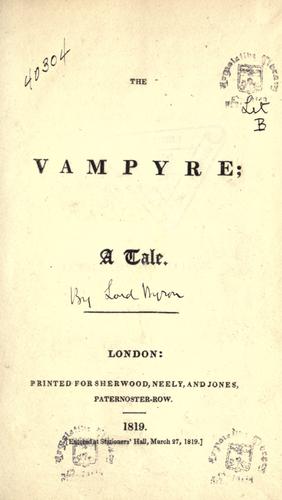
Title Page of Vampyre 1819 (Note handwritten attribution to Lord Byron)
On June 22, I was continuing my reading of Lovecraft’s “Supernatural Horror in Literature” when I encountered an interesting tidbit. When Mary Shelley was writing Frankenstein in the famous competition with her husband, Percy Shelley, and Lord Byron, another competitor was Dr. John William Polidori, whose story story from that competition, “The Vampyre”, went on to be the only other work of that competition that went on to achieve any sort of renown (according to Lovecraft).
Wikipedia has an interesting explanation for the title page above:
“The Vampyre” was first published on 1 April 1819 by Henry Colburn in the New Monthly Magazine with the false attribution “A Tale by Lord Byron“. The name of the work’s protagonist, “Lord Ruthven“, added to this assumption, for that name was originally used in Lady Caroline Lamb‘s novel Glenarvon (from the same publisher), in which a thinly-disguised Byron figure was also named Lord Ruthven. Despite repeated denials by Byron and Polidori, the authorship often went unclarified…Later printings removed Byron’s name and added Polidori’s name to the title page.
Go to this link for the Project Gutenberg etext of “Vampyre”. Modern printings can be found at the Open Library.
John William Polidori 1795-1821 (from Wikimedia)
Another couple of interesting notes from the Wikipedia article on The Vampyre:
“The story was an immediate popular success, partly because of the Byron attribution and partly because it exploited the gothic horror predilections of the public. Polidori transformed the vampire from a character in folklore into the form that is recognized today—an aristocratic fiend who preys among high society.[1]“
“Polidori’s work had an immense impact on contemporary sensibilities and ran through numerous editions and translations. An adaptation appeared in 1820 with Cyprien Bérard’s novel, Lord Ruthwen ou les Vampires, falsely attributed to Charles Nodier, who himself then wrote his own version, Le Vampire, a play which had enormous success and sparked a “vampire craze” across Europe. This includes operatic adaptations by Heinrich Marschner (see Der Vampyr) and Peter Josef von Lindpaintner (see Der Vampyr), both published in the same year and called “The Vampire”. Nikolai Gogol, Alexandre Dumas, and Alexis Tolstoy all produced vampire tales, and themes in Polidori’s tale would continue to influence Bram Stoker‘s Dracula and eventually the whole vampire genre. Dumas makes explicit reference to Lord Ruthwen in The Count of Monte Cristo, going so far as to state that his character “The Comtesse G…” had been personally acquainted with Lord Ruthwen.[10]“
I find it fascinating that possibly the two greatest motifs in the history of horror literature (Frankenstein and vampires) were started at the same friendly competition between four friends.
Unfortunately, Dr. Polidori did not live to see the success of the literary phenomenon he created. The article goes on to note:
“He [Polidori] died in London on 24 August 1821, weighed down by depression and gambling debts. Despite strong evidence that he committed suicide by means of prussic acid (cyanide), the coroner gave a verdict of death by natural causes.[3]“
I am happy to announce that as of today, July 10, 2013, my poem “Faust” has been reprinted in Blood Moon Rising Magazine. Please follow the link to view my favorite of all the poems I have written and to visit their excellent magazine.
On Monday, I learned of the death of Richard Matheson, one of the great horror writers of the twentieth century. As my tribute to him, here are a few quotations from and about him along with a few examples on how he generated his ideas. There were a lot, so I picked the ones that seemed most philosophical about writing and life in general in order to get a feel for the man behind the writing.
From Goodreads:
“What condemnation could possibly be more harsh than one’s own, when self-pretense is no longer possible?” ― Richard Matheson, What Dreams May Come
“We’ve forgotten much. How to struggle, how to rise to dizzy heights and sink to unparalleled depths. We no longer aspire to anything. Even the finer shades of despair are lost to us. We’ve ceased to be runners. We plod from structure to conveyance to employment and back again. We live within the boundaries that science has determined for us. The measuring stick is short and sweet. The full gamut of life is a brief, shadowy continuum that runs from gray to more gray. The rainbow is bleached. We hardly know how to doubt anymore. (“The Thing”)” ― Richard Matheson, Collected Stories, Vol. 1
“If men only felt about death as they do about sleep, all terrors would cease. . . Men sleep contentedly, assured that they will wake the following morning. They should feel the same about their lives.” ― Richard Matheson, What Dreams May Come
“In a world of monotonous horror there could be no salvation in wild dreaming.” ― Richard Matheson, I Am Legend
“Now when I die, I shall only be dead.” ― Richard Matheson, I am Legend and Other Stories
From Wikiquotes:
I think What Dreams May Come is the most important (read effective) book I’ve written. It has caused a number of readers to lose their fear of death — the finest tribute any writer could receive. … Somewhere In Time is my favorite novel.
“Ed Gorman Calling: We Talk to Richard Matheson” (2004).
From Uphillwriting.org:
If you go too far in fantasy and break the string of logic, and become nonsensical, someone will surely remind you of your dereliction…Pound for pound, fantasy makes a tougher opponent for the creative person.
– Richard Matheson
And here are a couple of quote about Matheson–also from Wikiquotes:
Matheson gets closer to his characters than anyone else in the field of fantasy today. … You don’t read a Matheson story — you experience it.
Robert Bloch, as quoted in an address by Anthony Boucher (29 August 1958), at the “Solacon”, the 1958 Worldcon
He has many … virtues, notably an unusual agility in trick prose and trick construction and a too-little-recognized (or exercised) skill on offtrail humor; but his great strength is his power to take a reader inside a character or a situation.
Anthony Boucher in an address at the “Solacon”, the1958 Worldcon (29 August 1958)
Wikipedia offers an interesting paragraph on how Matheson came up with the ideas for some of his more famous works:
Matheson cited specific inspirations for many of his works. Duel derived from an incident in which he and a friend, Jerry Sohl, were dangerously tailgated by a large truck on the same day as the Kennedy assassination. (However, there are similarities with William M. Robson’s script of the July 15, 1962 episode of the radio drama, Suspense, “Snow on 66”.[citation needed]) A scene from the 1953 movie Let’s Do It Again in which Aldo Ray and Ray Milland put on each other’s hats, one of which is far too big for the other, sparked the thought “what if someone put on his own hat and that happened,” which became The Shrinking Man. Bid Time Return began when Matheson saw a movie poster featuring a beautiful picture of Maude Adams and wondered what would happen if someone fell in love with such an old picture. In the introduction to Noir: 3 Novels of Suspense (1997), which collects three of his early books, Matheson said that the first chapter of his suspense novel Someone is Bleeding (1953) describes exactly his meeting with his wife Ruth, and that in the case of What Dreams May Come, “the whole novel is filled with scenes from our past.”
Albert Bitzius (1797-1854) was a Swiss pastor and author, who is better known by his pen name of Jeremias Gotthelf. Gotthelf was a prolific writer whose novels and stories were based on the people of his village, Luetzelflueh, in the Bernese Emmental.
Albert Bitzius (Jeremias Gotthelf) circa 1844
Gotthelf is considered an important writer not only in Switzerland, but also as an important writer throughout the German-speaking world. Gotthelf’s works were primarily what we would today consider mainstream literature, but he did write one short novel that would be considered horror and for which he is renown: The Black Spider. Wikipedia notes:
The Black Spider is Gotthelf’s best known work. At first little noticed, the story is now considered by many critics to be among the masterworks of the German Biedermeier era and sensibility. Thomas Mann wrote of it in his The Genesis of Doctor Faustus that Gotthelf “often touched the Homeric” and that he admired The Black Spider “like no other piece of world literature.” [Thomas Mann quotation from One World Classics.]
I read The Black Spider as an undergrad around 1979. It sticks in my mind to this day. Admittedly, I had to read the Wikipedia synopsis to recall all the details, but over the decades I can still picture the hunter/the devil kissing Christine on the cheek knowing something evil would come from that simple, slightly stinging kiss and then the outpouring of thousands of murderous spiders from that spot when she breaks her oath to him. Somehow I can still recall how I felt the loathsome horror of that moment for her, not as if it were happening to me, but almost as if it were happening to someone standing next to me, as if it were happening to someone I knew. Perhaps this is because I sympathized with her goal. Christine was trying to save her village, her friends, and her family from starvation and overwork at the hands of a merciless overlord. The only way she could do it was to try to outwit the devil at the risk of horrendous consequences if she failed…and she did fail. I think it was the nobility and selflessness of Christine’s altruism that still sticks with me emotionally after thirty years. The Russian author Anton Chekhov once advised writers to write with “sympathetic characters”; this is undoubtedly a terrific example of that principle.
The Black Spider by Franz Karl Basler-Kopp (1879-1937)
One writing class I had several years ago advised to establish an “intellectual and emotional connection” between the audience and the subject. That has always proven to be excellent advice. In the case of “The Black Spider”, Gotthelf certainly established an emotional connection between Christine and myself. There have been times in my life, as in the lives of everyone else, when I have made sacrifices for the good of others (though of course not with the horrendous consequences that Christine suffers). Perhaps that is what enables us, the audience, to sympathize with Christine’s plight and to experience her torment vicariously.
Thinking back, it is with the characters with whom I have some type of shared experience, that I sympathize the most when something horrific happens to them. If we, as writers of horror, are to give our stories great emotional impact, then we have to develop characters that have their foundations in everyday experiences which our audiences can share. Lovecraft advised having average people as characters, because this made the supernatural appear truly supernatural. In “The Black Spider” all of Gotthelf’s characters are quite average, thus the supernatural events of the story strike home with great impact. Perhaps that is because we can visualize these events more clearly on some level as if we were watching them occur to our neighbors. Most of the characters in Stephen King’s writing seem to me to be quite average and we feel the same sympathy for their predicaments, because they are average..like us.
Sometimes, when I am reading an engrossing text in a quiet environment where I can fully concentrate on the text, I seem to almost slip into a nebulous world where I am experiencing the story as if I were in a lucid dream. With sympathetic characters like Christine, what little remains to separate myself from that dream world is shattered and I feel their sufferings much more acutely, as if they were happening to me, as if I were actually living the experience.
For me, being able to shatter that barrier between dream world and reality for my audience is part of the magic of writing. After all, isn’t magic the creation of illusion?
I just saw this video on a man with Crazy Accordion Skills on Amazing and Crazy Videos on Facebook and it started me thinking. If literature is living vicariously for both writer and audience, how could I describe the experience this gentleman is having so that my readers live it? What is he feeling emotionally, psychologically, and physically? What drives him to spend long hours at practice so that he can perform like this? What does it feel like for his hands and fingers to fly up and down the keyboard? There are probably a thousand questions like this that I could ask, but you get the idea. How could you describe something like this and make it seem as magical as this performance?
A friend of mine just posted this on Facebook. It is only twelve seconds in length, and it is apparently real, but it is a horror movie in the modern sense. To find this and others, search for “Amazing and Crazy Videos” on Facebook.
“The Pit and the Pendulum” Illustration by Arthur Rackham, 1935
A day or two ago, I finished reading volume 1 of Clive Barker’s Books of Blood. His style is beautiful; his choice of words is meticulous; his characters are carefully interwoven; and his imagination is mind-boggling. If you haven’t read this and you call yourself a fan of horror, you should probably be ashamed (I feel ashamed that I have not read him before now). You are missing out on some terrific stories. Now I understand why Stephen King called him “the future of horror”.
But of all his praiseworthy attributes, the one that stands out from all the others is his imagination. I cannot even imagine how he formulates his ideas. For “Midnight Meat Train”, was he just riding a subway and wonder “where does this go? What’s at the end of the line? Maybe there are cannibals at the end of the line? Where did they come from?” How did he associate cannibals with a subway? [Of course, this is all speculation I am just pulling out of the air. I have read nothing about Barker’s gifted imagination. I am using my own imagination and my experience in developing stories to speculate about his methods.]
I heard some place many years ago that genius is not seeing the similarities between apples and oranges (anyone can see the differences), but seeing the similarities between apples and tractors–or in this case, seeing the possible connections between cannibals and subways.
In “In the Hills, the Cities” How did he come up with the concept of giants made of tens of thousands of people functioning together as a single entity? Was he thinking of the original druid burning men and wonder, “what if they were bigger and could come alive?”
To come up with stories such as these, one must think completely out of the box, out of the established paradigm (per Robert Pirsig’s Zen and the Art of Motorcycle Maintenance).
The more I read of works like this, the more I take to heart the advice I see occasionally from publishers that they do not want to see more werewolf-vampire-zombie (wvz) stories or that wvz stories must be very well done to be published. I enjoy wvz stories as much as the next reader, but if I were a publisher, I do not know if I could stomach seeing hundreds come across my desk in a month for years on end.
In his work “Supernatural Horror in Literature”, Lovecraft stresses the importance of an element of the supernatural being present in what he then termed “weird fiction” because if anything is possible, then there are no longer any physical laws of reality to shield us from the horrors that may actually be in the universe. Barker does exactly that. In his writing, there are no limits to what may happen to any one at any time. We are all under the threat of horrific annihilation at any moment.
Likewise, another of Lovecraft’s bits of advice is that characters must be ordinary people so that the appearance of the supernatural will be obvious and stronger than if the characters were all super characters. This makes sense. Superman is only super when he is on earth; he would be just another overworked taxpayer on Krypton. From what I have seen so far in volume 1 of Books of Blood, all of Barker’s characters are quite ordinary people caught up in quite extraordinary and horrible circumstances. Perhaps his way of characterization is genius in itself. I think anyone can make up a fantastic character, but to make someone real, to make a genuine person and have their character show through, when it is easier to make up a shallow one or two dimensional stick figure…isn’t that a form of genius in its own right? In terms of characterization, Barker’s imagination does not tend to the supernatural, but to the perceptive and to the meticulous. [No, I haven’t read The Hellbound Heart yet but I have read “The Yattering and Jack”, and I feel confident that when I do finally encounter Pinhead (I have seen a few of the Hellraiser series), he will certainly not be two-dimensional even though he is definitely supernatural.]
But I digress.
The upshot of all this is that as writers we should push our imaginations to the limits, exploring new ways of coming up with ideas, and disdain themes and motifs that have been worked to death for decades. That is a great part of the challenge of writing. Though I love classic literature such as that by Hemingway and Fitzgerald, their works do not push the limits of the imagination as do the writers of speculative fiction such as Barker and Lovecraft or Bradbury and Asimov. Writers of speculative fiction are explorers of the imagination.
But of the subgenres of speculative fiction, where does that leave writers of horror?
It leaves us as explorers of the dark arts of the imagination. Whereas writers of science fiction and fantasy may push into better worlds like Magellan sailing around the globe, we authors of horror push into the dark, threatening, forbidding areas of the imagination, much as the conquistadors pushed into the Central American jungles or intrepid British explorers pushed along the Congo or Amazon in search of wealth or lost cities. Indeed, it could be said that we are searching for metaphorical lost cities in the recesses of the mind, seeking long-hidden worlds surrounded by mystery and horror.
If life is a journey, then we, as writers of horror are choosing the most terrifying journey through the imagination that we can, because we love the thrill of being faced with horror on every side.





 Phil Slattery, Writer, Publisher