
Observations on “Baby Shoes” and Hemingway’s Iceberg Principle

Ernest Hemingway Thought I do not know who the creator of this work is, I must ask that you respect their copyright.
Ernest Hemingway
(Though I do not know who the creator of this work is, I must ask that you respect their copyright.)

There is a story that Ernest Hemingway wrote the following to win a bet with other writers that he could write the shortest story:

“For sale:  baby shoes.  Never worn.”

Even a little research on the Internet shows that there is considerable doubt that Hemingway wrote this story, with the earliest reference to it as a Hemingway work not appearing until 1991.  There is also considerable evidence that the story existed in various forms as early as 1910, when Hemingway was 11 and well before his writing career began.   Whatever the facts, it is an extreme example of the lean, muscular writing for which Hemingway was famous.

In an interview with The Paris Review (see The Writer’s Chapbook, 1989, pp. 120-121), Hemingway did say:

“If it is any use to know it,  I always try to write on the principle of the iceberg.  There is seven-eighths of it underwater for every part that shows.  Anything you know you can eliminate and it only strengthens your iceberg.  It is the part that doesn’t show.  If a writer omits something because he does not know it then there is a hole in the story…First I have tried to eliminate everything unnecessary to conveying experience to the reader so that after he or she has read something it will become a part of his or her experience and seem actually to have happened.  This is very hard to do and I’ve worked at it very hard.”

So “Baby Shoes” is a good example of Hemingway’s iceberg principle, even if he didn’t write it.

“Baby Shoes” is also a good example of what I like to think of as the Tao of writing (see my earlier posts):  creating a story by a careful, strategic use of what is not said.  No where in the story does it state that a couple had apparently been expecting a baby, that they bought shoes for it, but then something happened to the baby to cause its death, and now the parents want to sell the shoes.    None of that is stated.  It is all implied, but yet we know what happened–or at least we have a good idea of what happened, even if we do not know the concrete facts of the matter.

There are also other facets of the story that we can infer, albeit tenuously.  From the fact that they bought baby shoes we can infer that the parents were probably eager to have the child.  From the fact that the parents want to sell the shoes we can infer that they probably don’t want them around any more as a remainder of a painful experience, but at the same time they may want to see someone else make good use of them or that they are hard up for money.

But one question I have that concerns human psychology is why is it that most people can read these same six words and come away with the same perception of what occurred?  Does it have to do with Jungian Archetypes floating around in each of us or is it that each of us has had the same broad experience(s) so that we can interpret these six words in a very similar way?

In the art of sculpture, those areas of a work that are empty, yet give the work its form, are called “negative space”.  An example is the space between each of your fingers.  If there were no space, there would be no individual fingers.   In that sense, a story like “Baby Shoes” makes maximum use of what might be termed “literary negative space”.

It is not really the words that give this story its power, but how we psychologically connect the ideas behind the words that fuel this extremely brief, but epic and poignant tale.

This is part of the magic of writing:  conjuring worlds out of nothing.

Thoughts?  Comments?


Guest Blog: ‘The Raven’ – Nevermore

Edgar Allan Poe, 1848

Guest Blog: ‘The Raven’ – Nevermore.

Interesting article, though I tend to disagree with his descriptions of what was going through Poe’s mind when he wrote this.  Though I am not a skeptic, I tend to be skeptical when someone tells me in effect “yes, that is what he says, but this is what he meant…”  Poe definitely hyped the bejeezus out of the poem (and his ego) by calling it the best poem ever written, but as for the rest…who knows?

Thoughts?  Comments?


Just a few quick thoughts…

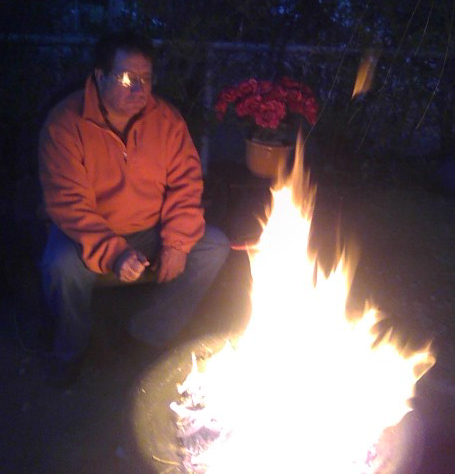
The blogger relaxing by the front yard firepit on a chilly New Mexico evening.

I was just sitting here trying to choose one of my many first drafts to work on for tonight, when I started thinking about the different “approaches” (for lack of a better term at the moment) to horror.  By “approaches” I mean a very brief synopsis of a writer’s general outlook on or method of writing horror.    Maybe a better way to express it would be to say the way the author approaches his genre (still not quite right, but I am getting closer to the idea).

An example would be to say that Poe’s approach was to bring out the horror in realistic situations (mostly, he did dabble in the fantastic occasionally).  “The Black Cat” is about a murderer who unknowingly seals up a cat with the corpse of his victim.  Nothing fantastic there.  “The Tell-Tale Heart” is about a murderer whose conscience drives him to confession.  “The Fall of the House of Usher” is about a family with an inherited genetic trait of hypersensitivity.   So forth and so on.

Lovecraft’s approach was to spin tales of the fantastic, especially about a race of elder gods who once dominated the planet millions of years ago and of which mankind encounters remnants on rare occasion.

Stephen King’s approach is to plant an element of the fantastic among ordinary people in ordinary places and watch them react to it.

Clive Barker’s approach seems to be to take something that is fantastic, bloody, cruel, evil and gruesome and either drop it somewhere a single character can deal with it or bring it out of the shadows where a character can deal with it.

Seeing these different approaches in relation to each other makes me think about how do I want to approach an idea or a draft I have of a story.  Do I want to drop the fantastic into the real or bring out the horror in the everyday or in realistic situations or can I come up with something else, my own approach, that is none of these?  That is the challenge of creativity:  to come up with something no one else has done.   Maybe I can just go with the purely fantastic.  Maybe I can try to find the real in the fantastic.

How many different ways are there to horrify an audience?

There is the real and the fantastic and all those subtle shades of gray in between the two.  Can there be anything else?

Thoughts?  Comments?

Mentalfloss Article: 7 Creative Ways Modern Horror Films Get Rid of Cell Phones

The blogger hiking in the Bisti Wilderness near Farmington, NM.

Here’s an interesting article for those writing a story and are trying to find a way to negate a cell phone.  You probably won’t want to use these (that runs counter to being creative), but these methods may point you in the right direction:  http://mentalfloss.com/article/56842/7-creative-ways-modern-horror-films-get-rid-cell-phones.

The Lexicon of Horror has been updated.

Death Calls the Tune (original work by Phil Slattery)
Death Calls the Tune
(original work by Phil Slattery)

Tonight I updated my page “The Lexicon of Horror” with ghoul, goblin, horror, Malleus Maleficarum, and oppression.

Stephen King, H.P. Lovecraft, and the X-files

mod 130419_0008I just finished watching an episode of the X-Files entitled “Chinga” [note to Spanish-speakers out there:  I don’t know who chose the title, so please forgive my language] from Season Five and I  noticed that it was written by Stephen King and Chris Carter (the creator of the X-Files).  The story’s antagonist is a talking doll that can force people to injure or kill themselves in gruesome ways.   Like many, if not most, of King’s stories, there is no explanation of how the came to exist.  All the viewer finds out about it is that a lobsterman pulled it up one night in a lobster trap and his daughter comes to possess it after he meets his own gruesome fate.

I find in my own writing that I like to provide an explanation or background as to how things originate.  This is just my nature.  I like to know the origins of things.  However, I have come to believe of late that, in terms of horror, that is a very nineteenth century  concept.

Lovecraft said in his essay “Supernatural Horror in Literature”:

“A certain atmosphere of breathless and unexplainable dread of outer, unknown forces must be present; and there must be a hint, expressed with a seriousness and protentiousness becoming its subject, of that most terrible conception of the human brain — a malign and particular suspension or defeat of those fixed laws of Nature which are our only daily safeguard against the assaults of chaos and the daemons of unplumbed space.”

For me, what Lovecraft is saying is that if the laws of nature are negated, then anything is possible and monsters like Cthulhu really could exist and are capable of doing us harm at any moment.  Combine this with his statement that “The oldest and strongest emotion of mankind is fear and the oldest and strongest kind of fear is fear of the unknown” and it becomes apparent that stories like “Chinga” derive much of their horror effect from the fact that the origin of the threat to a story’s protagonist(s) is unknown or that there is no explanation for the threat.

This would mean that one of  things that provides to “Chinga”  the element of horror that it has, is the fact that origin of the doll is unknown.  Therefore, any of us when we are fishing or scuba diving or swimming in any body of water, could discover a doll that would turn his/her life into a nightmare.   That is a scary thought.

Of course, this means that Stephen King would be one of the greatest practitioners of this technique, which I believe he is.

I think I shall try to experiment with this in the near future.

Thoughts?  Comments?


Recommended Reading: The Stories “Strange Horizons” Prefers Not to See

The blogger standing on the bank of the San Juan River in Farmington, NM.

I was searching for a market for one of my stories today, when I came across “Strange Horizons”‘s list of stories they see too often (http://www.strangehorizons.com/guidelines/fiction-common.shtml). This is an interesting and entertaining article on (in my humble opinion) not only the types of fiction that “Strange Horizons” prefers not to see, but also the types of stories not to submit to any quality magazine: the tired, the clichéd, the preaching, the didactic, the sugary-sweet, the unprofessional, the polemic, the ranting, and the diatribes among a host of others. The list is so extensive, one could almost create a list of the characteristics of good literature by simply listing the antitheses of the types listed here. Yes, this list is oriented toward sci-fi writers, but if one were to replace the sci-fi specific terms with those of another genre, one would have a list of examples of mediocre to poor writing for that genre. Of course, neither this list nor any other can be completely exhaustive of all examples of either good or bad writing, but it would be an interesting mental exercise.

Thoughts? Comments?

Excellent Discussion of Horror History at HWA

mod 130419_0008I happened across an excellent roundtable on Horror History 101 at the Horror Writer’s Association (http://horror.org/horror-roundtable-16-horror-history-101/) today while at lunch.  Check it out.  It has a great panel of experts and a wide-ranging discussion of the great horror writers of the past from the beginning of horror with Horace Walpole up to Lovecraft and more.

Horror at Project Gutenberg

100_1736
The blogger on the banks of the San Juan River, Farmington, New Mexico, 2013

If you are an avid reader (of anything) and are not familiar with Project Gutenberg (http://www.gutenberg.org/wiki/Main_Page), you are doing yourself a great disservice. As they state on their homepage:

Project Gutenberg offers over 46,000 free ebooks: choose among free epub books, free kindle books, download them or read them online.

We carry high quality ebooks: All our ebooks were previously published by bona fide publishers. We digitized and diligently proofread them with the help of thousands of volunteers.

No fee or registration is required, but if you find Project Gutenberg useful, we kindly ask you to donate a small amount so we can buy and digitize more books. Other ways to help include digitizing more books,recording audio books, or reporting errors.

Over 100,000 free ebooks are available through our Partners, Affiliates and ResourcesOur ebooks may be freely used in the United States because most are not protected by U.S. copyright law, usually because their copyrights have expired. They may not be free of copyright in other countries. Readers outside of the United States must check the copyright laws of their countries before downloading or redistributing our ebooks. We also have a number of copyrighted titles, for which the copyright holder has given permission for unlimited non-commercial worldwide use.”

As they state, most of these books are available because their copyrights have expired, making them usually quite dated.  However, for anyone with a bent for the historical, Project Gutenberg is a gold mine.  I did a quick search for “horror” on their website and received 169 titles in response.  For a few, the only relation to the horror genre was the word “horror” in the title (such as “Southern Horrors: Lynch Law in All its Phases–which is a horrible subject, but is non-fiction vs. horror fiction).  However, many are the classics or founding works of the horror genre, such as Frankenstein by Mary Shelley, Dracula by Bram Stoker, The Vampyre: a Tale by John William Polidori, The Castle of Otranto by Horace Walpole, The Strange Case of Dr. Jekyll and Mr. Hyde by Robert Louis Stevenson, Fantome de’l Opera (Phantom of the Opera) by Gaston Leroux, many works by Edgar Allan Poe,  The Great God Pan by Arthur Machen, The King in Yellow by Robert W. Chambers, The Shunned House by H.P. Lovecraft, and many others.

Please take the time to visit this treasure trove of literature and of the horror genre, and if you are so inclined, please consider making a donation (via their website) to support their worthy cause.

Thoughts?  Comments?

Dump-a-Day: 16 Micro Horror Stories

The blogger hiking in the Bisti Wilderness near Farmington, NM.

I have been surfing the net over lumch and ran across this site with 16 fun very, very (micro?) horror stories. Check it out: http://www.dumpaday.com/random-pictures/funny-pictures/short-horror-stories-will-send-chills-spine-16-pics/.    Here’s the first one as a quick sample (all were submitted by “Jon” on January 28, 2015):

“Growing up with cats and dogs, I got used to the sounds of scratching at my door while I slept. Now that I live alone, it is much more unsettling.”

Note to Self for January 6, 2015

The blogger on Padre Island, January, 2011.

After I lay down in bed last night, I had one of those thoughts that just pops up in the middle of the night, particularly after writing for a while in the evening (which I had been). I write this now more for my own memory than anything, but I hope it will be of some use to someone else out there.

The thought was that the purpose of every word in a horror story should be to make that story scarier.

This is a very simple idea that may be patently obvious to most of you, but it may not be to some. In any case, my intuition suggested that I publish it.

Thoughts? Comments?

The Quick 10: 10 Unexpected Horror Writers

winston-221x300The Quick 10: 10 Unexpected Horror Writers.  Here is an interesting article  I ran across at Mentalfloss.com.   I would never have suspected most of these of ever having even an interest in horror.  Stacey Conradt wrote the article in 2009.

H. H. Holmes’s Castle–Stop 3 on Slattery’s Tour of Horror Locales

Herman Webster Mudgett a.k.a. H.H. Holmes. From Wikipedia.

I am having troubling sleeping tonight and thought I would continue with our tour of the world’s horror locales.  [I am not having nightmares about H.H. Holmes, if that is what you are thinking or even about any other horror topic.]

One of America’s first and most prolific serial killers was Herman Webster Mudgett, who went by his now better known alias of H.H. Holmes (1861-1896).  Although his life has been recently documented in a few films and books, Holmes is still perhaps one of America’s lesser known serial killers.  Most of the following information is taken from the Wikipedia article on Holmes, which supports my previous readings on Holmes in several sources.   Please go to Wikipedia for more details than my brief synopsis provides.  It is a well-written article and I rely on it here, only because I wish to provide a brief introduction to Holmes to support the photos and visual record I am providing.

Holmes started his criminal career while attending the University of Michigan Medical School, where he would steal cadavers from the laboratory, disfigure them, and then try to collect on insurance policies he had taken out on them after claiming they had been killed in accidents.  After graduation, Mudgett moved to Chicago to pursue a career in pharmaceuticals, but also began conducting many shady business deals while being a bigamist and philanderer in his private life.

After moving to Chicago in 1886, Holmes took a job at Dr. Elizabeth Holton’s drugstore.  After her husband’s death, Holmes

Holmes's Castle from Wikipedia
Holmes’s Castle
from Wikipedia

bought the business and the lot across the street at 601-603 West 63rd Street. [I had not noticed this before, but if one takes the first digit in each number of the address and combines them, the result is 666.]  In the lot he built what would become known as his murder castle.

Wikipedia provides a nice synopsis of what happened there:

“Holmes purchased a lot across from the drugstore where he built his three-story, block-long “castle” as it was dubbed by those in the neighborhood. The address of the Castle was 601-603 W. 63rd St.[16] It was called the World’s Fair Hotel and opened as a hostelry for the World’s Columbian Exposition in 1893, with part of the structure devoted to commercial space. The ground floor of the Castle contained Holmes’ own relocated drugstore and various shops, while the upper two floors contained his personal office and a maze of over 100 windowless rooms with doorways opening to brick walls, oddly-angled hallways, stairways to nowhere, doors openable only from the outside, and a host of other strange and labyrinthine constructions. Holmes repeatedly changed builders during the construction of the Castle, so only he fully understood the design of the house.[3]

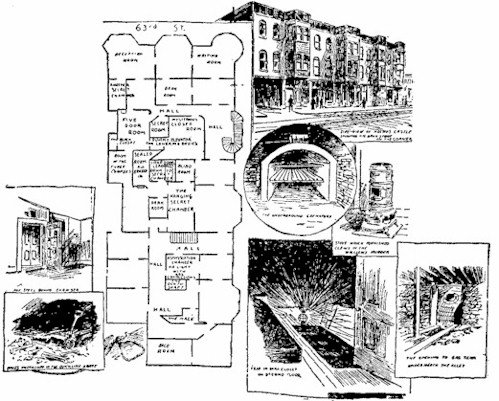
A diagram of Holmes's Castle from weirdchicago.com (originally from the Chicago Tribune)
A diagram of Holmes’s Castle from weirdchicago.com (originally from the Chicago Tribune)

“During the period of building construction in 1889, Holmes met Benjamin Pitezel, a carpenter with a past of lawbreaking, whom Holmes exploited as a stooge for his criminal schemes. A district attorney later described Pitezel as Holmes’ “tool… his creature.”[17]

“After the completion of the hotel, Holmes selected mostly female victims from among his employees (many of whom were required as a condition of employment to take out life insurance policies, for which Holmes would pay the premiums but was also the beneficiary), as well as his lovers and hotel guests, whom he would later kill.[14] Some were locked in soundproof bedrooms fitted with gas lines that let him asphyxiate them at any time. Other victims were locked in a huge soundproof bank vault near his office, where they were left to suffocate.[8] The victims’ bodies were dropped by secret chute to the basement,[3] where some were meticulously dissected, stripped of flesh, crafted into skeleton models, and then sold to medical schools. Holmes also cremated some of the bodies or placed them in lime pits for destruction. Holmes had two giant furnaces as well as pits of acid, bottles of various poisons, and even a stretching rack.[3] Through the connections he had gained in medical school, he sold skeletons and organs with little difficulty.”

After the World’s Columbian Exposition ended, Holmes moved out of Chicago to evade creditors and continued pursuing his

Plans of Floors 2 and 3 from steampunkchicago.com

various nefarious trades throughout the country.   Eventually, he was arrested by the Pinkertons for an insurance scam.  While Holmes was in prison awaiting trial, authorities interviewed the former janitor at Holmes’s castle and found out that he had never been allowed entry to the upper floors.  Upon further investigation, the real purpose behind Holmes’s castle was discovered.

Estimates of the number of Holmes’s victims range from 20-200, with 27 being the only number verified by any means.  Most of his victims were women, though a few were men and children.  Holmes confessed to murdering thirty people in Chicago, Indianapolis, and Toronto, though some of the people he claimed to have killed were later found to still be alive.

Holmes was put on trial for the murder of his partner-in-crime, Benjamin Pitezel, in October, 1895.  He was hanged in Philadelphia’s Moyamensing Prison on May 7, 1896, for Pitezel’s murder.   Holmes’s castle was mysteriously gutted by fire in August, 1895, two months before his trial began.  The building was finally razed in 1938.

Holmes being executed.  From jesslb6.blogspot,com
Holmes being executed.
From jesslb6.blogspot,com

The site is now the location of the US Post Office’s Englewood Branch.

I have included a few photos of the castle and the Englewood Post Office for your viewing pleasure.

By coincidence, while gathering photos for this article, I found a statement on Cragin Spring’s Flickr page that a movie on Holmes called “Devil in the White City” was due out in 2013 and was to star Leonardo DiCaprio.    A Wikipedia article on it states that it is based on a 2003 book by Erik Larson and Leonardo DiCaprio bought the film rights in 2010.  Imdb states only that it is in development.

The Englewood post office now at the site of Holmes's Castle, November 5, 2011. Photo by Malcolm Logan from myamericanodyssey.com
The Englewood post office now at the site of Holmes’s Castle, November 5, 2011. Photo by Malcolm Logan from myamericanodyssey.com

Thoughts?  Comments?

Recommendation: “Best New Horror 25” edited by Stephen Jones

Please respect any copyrights pertaining to this cover.

One of the best gifts I received this Christmas was Best New Horror 25 (for the year 2013) edited by Stephen Jones.   I consider this book a must-have for any serious horror aficionado.

In addition to having 21 stories by such icons as Clive Barker, Ramsey Campbell, and Neil Gaiman (among others),  Mr. Jones provides a ninety page synopsis of horror in 2013, a “necrology” (list of those having died) in 2013, and a list of useful addresses for the horrorphile of small press publishers, websites, organizations, and magazines.

I had not heard of Mr. Jones before receiving this book, but the biography the book provides shows him to a well-respected editor of horror in many genres and a recipient of many awards, some a few times over, including the Bram Stoker Award,  Horror Guild awards, British Fantasy awards, and other.  For those desiring more background on  Mr. Jones, please visit his website at http://www.stephenjoneseditor.com.

Of course, I have not had the time in the past two days to start reading this volume in any depth, but I have skimmed through it and found it to be very informative.  As you who follow my blog can guess, I love the ninety-page intro, because it gives a thorough overview of what happened in 2013 from something of a historian’s viewpoint.

The only downside I have found, so far, is that the Necrology includes several non-horror entertainers and figures, which are superfluous to the work’s theme.  For example, Mr. Jones mentions the death of Annette Funicello, who, so far as I know, was never in a horror film.  If anyone knows of a horror film she was in, please let me know so that I can post an apology to Mr. Jones.

This 592-page volume is a welcome addition to my horror library and I look forward to exploring it in great depth as it will help me catch up on the current state of affairs in horror (which some of you no doubt know that I seriously need as I tend to focus on classic horror of the 20th and 19th centuries).   I recommend this book to anyone else who has a serious desire to survey the current state of the art.

For a detailed review of the book, visit either the Amazon.com article or visit http://www.locusmag.com/Reviews/2014/09/stefan-dzaimianowicz-reviews-stephen-jones-best-new-horror-25/.

Thoughts?  Comments?