Dr. Polidori and “The Vampyre”

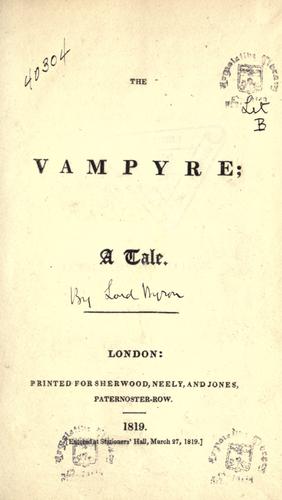
Title Page of Vampyre 1819 (Note handwritten attribution to Lord Byron)
Title Page of Vampyre
1819
(Note handwritten attribution to Lord Byron)

On June 22, I was continuing my reading of Lovecraft’s “Supernatural Horror in Literature” when I encountered an interesting tidbit.   When Mary Shelley was writing Frankenstein in the famous competition with her husband, Percy Shelley, and Lord Byron, another competitor was Dr. John William Polidori, whose story story from that competition, “The Vampyre”, went on to be the only other work of that competition that went on to achieve any sort of renown (according to Lovecraft).

Wikipedia has an interesting explanation for the title page above:

“The Vampyre” was first published on 1 April 1819 by Henry Colburn in the New Monthly Magazine with the false attribution “A Tale by Lord Byron“. The name of the work’s protagonist, “Lord Ruthven“, added to this assumption, for that name was originally used in Lady Caroline Lamb‘s novel Glenarvon (from the same publisher), in which a thinly-disguised Byron figure was also named Lord Ruthven. Despite repeated denials by Byron and Polidori, the authorship often went unclarified…Later printings removed Byron’s name and added Polidori’s name to the title page.

Go to this link for the Project Gutenberg etext of “Vampyre”.  Modern printings can be found at the Open Library.

John William Polidori 1795-1821 (from Wikimedia)
John William Polidori
1795-1821
(from Wikimedia)

Another couple of interesting notes from the Wikipedia article on The Vampyre:

“The story was an immediate popular success, partly because of the Byron attribution and partly because it exploited the gothic horror predilections of the public. Polidori transformed the vampire from a character in folklore into the form that is recognized today—an aristocratic fiend who preys among high society.[1]

“Polidori’s work had an immense impact on contemporary sensibilities and ran through numerous editions and translations. An adaptation appeared in 1820 with Cyprien Bérard’s novel, Lord Ruthwen ou les Vampires, falsely attributed to Charles Nodier, who himself then wrote his own version, Le Vampire, a play which had enormous success and sparked a “vampire craze” across Europe. This includes operatic adaptations by Heinrich Marschner (see Der Vampyr) and Peter Josef von Lindpaintner (see Der Vampyr), both published in the same year and called “The Vampire”. Nikolai Gogol, Alexandre Dumas, and Alexis Tolstoy all produced vampire tales, and themes in Polidori’s tale would continue to influence Bram Stoker‘s Dracula and eventually the whole vampire genre. Dumas makes explicit reference to Lord Ruthwen in The Count of Monte Cristo, going so far as to state that his character “The Comtesse G…” had been personally acquainted with Lord Ruthwen.[10]

I find it fascinating that possibly the two greatest motifs in the history of horror literature (Frankenstein and vampires) were started at the same friendly competition between four friends.

Unfortunately,  Dr. Polidori did not live to see the success of the literary phenomenon he created.   The article goes on to note:

“He [Polidori] died in London on 24 August 1821, weighed down by depression and gambling debts. Despite strong evidence that he committed suicide by means of prussic acid (cyanide), the coroner gave a verdict of death by natural causes.[3]

Continue reading “Dr. Polidori and “The Vampyre””

In Memory of Richard Matheson

Richard Matheson Photo by JaSunni, 2008
Richard Matheson
Photo by JaSunni, 2008

On Monday, I learned of the death of Richard Matheson, one of the great horror writers of the twentieth century.   As my tribute to him, here are a few quotations from and about him along with a few examples on how he generated his ideas.  There were a lot, so I picked the ones that seemed most philosophical about writing and life in general in order to get a feel for the man behind the writing.

From Goodreads:

“What condemnation could possibly be more harsh than one’s own, when self-pretense is no longer possible?” ― Richard Matheson, What Dreams May Come

“We’ve forgotten much. How to struggle, how to rise to dizzy heights and sink to unparalleled depths. We no longer aspire to anything. Even the finer shades of despair are lost to us. We’ve ceased to be runners. We plod from structure to conveyance to employment and back again. We live within the boundaries that science has determined for us. The measuring stick is short and sweet. The full gamut of life is a brief, shadowy continuum that runs from gray to more gray. The rainbow is bleached. We hardly know how to doubt anymore. (“The Thing”)” ― Richard Matheson, Collected Stories, Vol. 1    

“If men only felt about death as they do about sleep, all terrors would cease. . . Men sleep contentedly, assured that they will wake the following morning. They should feel the same about their lives.” ― Richard Matheson, What Dreams May Come

“In a world of monotonous horror there could be no salvation in wild dreaming.” ― Richard Matheson, I Am Legend    

“Now when I die, I shall only be dead.” ― Richard Matheson, I am Legend and Other Stories

 From Wikiquotes:

I think What Dreams May Come is the most important (read effective) book I’ve written. It has caused a number of readers to lose their fear of death — the finest tribute any writer could receive. … Somewhere In Time is my favorite novel.

“Ed Gorman Calling: We Talk to Richard Matheson” (2004).

From Uphillwriting.org:

If you go too far in fantasy and break the string of logic, and become nonsensical, someone will surely remind you of your dereliction…Pound for pound, fantasy makes a tougher opponent for the creative person.

Richard Matheson

And here are a couple of quote about Matheson–also from Wikiquotes:

Matheson gets closer to his characters than anyone else in the field of fantasy today. … You don’t read a Matheson story — you experience it.

Robert Bloch, as quoted in an address by Anthony Boucher (29 August 1958), at the “Solacon”, the 1958 Worldcon

He has many … virtues, notably an unusual agility in trick prose and trick construction and a too-little-recognized (or exercised) skill on offtrail humor; but his great strength is his power to take a reader inside a character or a situation.

Anthony Boucher in an address at the “Solacon”, the1958 Worldcon (29 August 1958)

Wikipedia offers an interesting paragraph on how Matheson came up with the ideas for some of his more famous works:

Matheson cited specific inspirations for many of his works. Duel derived from an incident in which he and a friend, Jerry Sohl, were dangerously tailgated by a large truck on the same day as the Kennedy assassination. (However, there are similarities with William M. Robson’s script of the July 15, 1962 episode of the radio drama, Suspense, “Snow on 66”.[citation needed]) A scene from the 1953 movie Let’s Do It Again in which Aldo Ray and Ray Milland put on each other’s hats, one of which is far too big for the other, sparked the thought “what if someone put on his own hat and that happened,” which became The Shrinking Man. Bid Time Return began when Matheson saw a movie poster featuring a beautiful picture of Maude Adams and wondered what would happen if someone fell in love with such an old picture. In the introduction to Noir: 3 Novels of Suspense (1997), which collects three of his early books, Matheson said that the first chapter of his suspense novel Someone is Bleeding (1953) describes exactly his meeting with his wife Ruth, and that in the case of What Dreams May Come, “the whole novel is filled with scenes from our past.”

Thoughts?  Comments?

“The Black Spider”

Albert Bitzius (1797-1854) was a Swiss pastor and author, who is better known by his pen name of Jeremias Gotthelf.  Gotthelf was a prolific writer whose novels and stories were based on the people of his village, Luetzelflueh, in the Bernese Emmental.

Albert Bitzius  (Jeremias Gotthelf) circa 1844
Albert Bitzius
(Jeremias Gotthelf)
circa 1844

Gotthelf is considered an important writer not only in Switzerland, but also as an important writer throughout the German-speaking world.  Gotthelf’s works were primarily what we would today consider mainstream literature, but he did write one short novel that would be considered horror and for which he is renown:  The Black Spider.  Wikipedia notes:

The Black Spider is Gotthelf’s best known work. At first little noticed, the story is now considered by many critics to be among the masterworks of the German Biedermeier era and sensibility.  Thomas Mann wrote of it in his The Genesis of Doctor Faustus that Gotthelf “often touched the Homeric” and that he admired The Black Spider “like no other piece of world literature.” [Thomas Mann quotation from One World Classics.]

The story can be read in the original German at Projekt Gutenberg DE.  A good synopsis can be found at Wikipedia.

I read The Black Spider as an undergrad around 1979.  It sticks in my mind to this day.  Admittedly,  I had to read the Wikipedia synopsis to recall all the details, but over the decades I can still picture the hunter/the devil kissing Christine on the cheek knowing something evil would come from that simple, slightly stinging kiss and then the outpouring of thousands of murderous spiders from that spot when she breaks her oath to him.  Somehow I can still recall how I felt the loathsome horror of that moment for her, not as if it were happening to me, but almost as if it were happening to someone standing next to me, as if it were happening to someone I knew.  Perhaps this is because I sympathized with her goal.  Christine was trying to save her village, her friends, and her family from starvation and overwork at the hands of a merciless overlord.  The only way she could do it was to try to outwit the devil at the risk of horrendous consequences if she failed…and she did fail.  I think it was the nobility and selflessness of Christine’s altruism that  still sticks with me emotionally after thirty years.  The Russian author Anton Chekhov once advised writers to write with “sympathetic characters”;  this is undoubtedly a terrific example of that principle. 

The Black Spider by Franz Karl Basler-Kopp  (1879-1937)
The Black Spider
by Franz Karl Basler-Kopp
(1879-1937)

One writing class I had several years ago advised to establish an “intellectual and emotional connection” between the audience and the subject.   That has always proven to be excellent advice.  In the case of “The Black Spider”, Gotthelf certainly established an emotional connection between Christine and myself.   There have been times in my life, as in  the lives of everyone else, when I have made sacrifices for the good of others (though of course not with the horrendous consequences that Christine suffers). Perhaps that is what enables us, the audience, to sympathize with Christine’s plight and to experience her torment vicariously.

Thinking back, it is with the characters with whom I have some type of shared experience, that I sympathize the most  when something horrific happens to them.  If we, as writers of horror, are to give our stories great emotional impact, then we have to develop characters that have their foundations in everyday experiences which our audiences can share.   Lovecraft advised having average people as characters, because this made the supernatural appear truly supernatural.   In “The Black Spider” all of Gotthelf’s characters are quite average, thus the supernatural events of the story strike home with great impact.  Perhaps that is because we can visualize these events more clearly on some level as if we were watching them occur to our neighbors.  Most of the characters in Stephen King’s writing seem to me to be quite average and we feel the same sympathy for their predicaments, because they are average..like us.

Sometimes, when I am reading an engrossing text in a quiet environment where I can fully concentrate on the text, I seem to almost slip into a nebulous world where I am experiencing the story as if I were in a lucid dream.   With sympathetic characters like Christine, what little remains to separate myself from that dream world is shattered and I feel their sufferings much more acutely, as if they were happening to me, as if I were actually living the experience.

For me, being able to shatter that barrier between dream world and reality for my audience is part of the magic of writing.  After all, isn’t magic the creation of illusion?

Thoughts?  Comments?

Lovecraft on the Supernatural

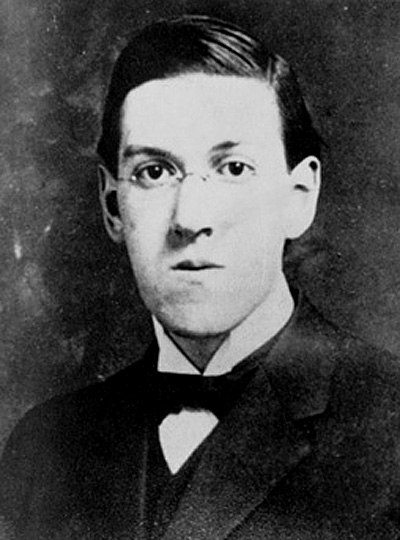
H.P. Lovecraft, 1915


I was reading Lovecraft’s “Supernatural Horror in Literature” the other day when I came across this line concerning the nature of  the “weird tale”:

“A certain atmosphere of breathless and unexplainable dread of outer, unknown forces must be present; and there must be a hint, expressed with a seriousness and protentiousness becoming its subject, of that most terrible conception of the human brain — a malign and particular suspension or defeat of those fixed laws of Nature which are our only daily safeguard against the assaults of chaos and the daemons of unplumbed space.”

With me, this idea hit home.  I have always thought that the more realistic I could make a story, the more frightening it would be for the reader, because it could possibly happen. Lovecraft takes the complete opposite approach.  In essence, he says let’s dispense with the chains of our preconceptions of reality then see what could happen.   He is right.  If anything can happen, the horrors that could happen to humanity are limitless and unimaginable.

Now let’s take this line of thought a step or two further philosophically.  Perhaps our concept of reality is really a sort of protective shell, a defense mechanism created by our minds that shields us from being overwhelmed by the thousands of possible ways we could meet our ends.  If a person tried to conceive of all the ways he/she might die at any moment, no matter how miniscule the odds, his/her mind might be overwhelmed and paralyzed by fear or destroyed by paranoia and madness.   The only way the mind could survive would then be to limit the possibilities to only those with the greatest probability of happening at that moment, in essence, wrapping itself in a protective cocoon of denial.

If there are any philosophy majors out there reading this, please feel free to bring up this idea in class.  I would love to hear the arguments for and against this.

Now, let’s go a step even further.   If we start to see our perception of reality as only a concept, as only a protective shell in a much greater universe, as only one alternative among thousands or millions of possibilities, then the possibility of creatures like Cthulhu, Shoggoth, Nylarhotep, the “ancient ones”, and all the other monsters contained in Lovecraft’s vivid imagination becomes very real.

Lovecraft’s world of the “ancient ones” is frightening enough when we think it has no chance of happening, but it becomes truly terrifying if we think it has even the slightest chance of actually happening.

Thoughts?  Comments?

Jorge Oscar Rossi’s “Archetypal Horror: H.P. Lovecraft and Carl Gustav Jung”

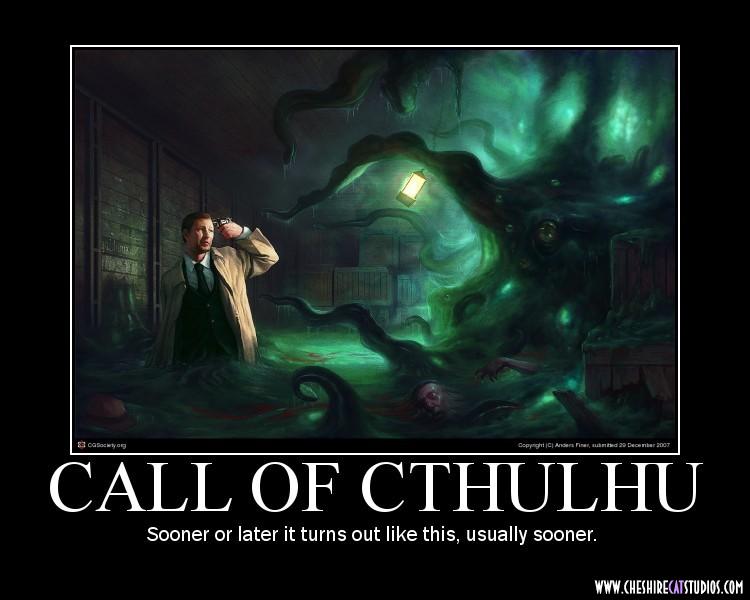
Cthulhu

I ran across an interesting article today at http://www.quintadimension.com/article66.html, entitled “Archetypal Horror:  H.P. Lovecraft and Carl Gustav Jung”.  It was written by Jorge Oscar Rossi, an Argentinian writer of science fiction (and fantastic literature in general), and published on December, 8, 2000.  Please note that the article and his autobiography are in Spanish.

I am no master of Spanish, having had only two years in college and some practical, albeit frequent, experience in Texas and Mexico over the last twenty years.   However, Señor Rossi’s article is well-written and relatively easy reading, so that I feel I caught the gist of it, if not all the nuances.

His main point (and anyone with a better knowledge of Spanish than I, including Señor Rossi, may correct me if I am wrong) is that Lovecraft’s ancient gods of the Cthulhu mythos represent archetypal forms of horror in the Jungian sense of “archetype”.

If you have a basic comprehension of Spanish, the article is quite intriguing and worth taking a shot at reading.

If nothing esle, the article will help you view the poster above from another perspective: what is the meaning of the poster if the creature above symbolizes archetypal fears shared by everyone?

Thoughts?  Comments?

Thoughts on Speculative Fiction

Lovecraft in the Agony of ContemplationIllustration by MirrorCradle
Lovecraft in the Agony of Contemplation
Illustration by MirrorCradle

As I was driving about town today, I started reflecting on the difference between mainstream, so-to-speak literary fiction and speculative fiction (usually defined as consisting of the science-fiction, fantasy, and horror genres).  I recall reading somewhere, years ago, in the submissions guidelines for a mainstream fiction magazine, that mainstream fiction consisted of whatever did not fit into a genre.  Then, I considered that accurate and reasonable;  now I consider it somewhat snobbish.  In fact, the more I think about it, the more short-sighted and narrow-minded that statement becomes.

Speculative fiction, including the horror genre, deals with fantastic, often surreal, situations.  Mainstream fiction, if you go by the definition above, deals with anything not fantastic, not surreal, i.e. the real, events that could happen in the real world.  It would seem to me that the truly gifted writer would be the one with the greater imagination, the one who can conjure entire civilizations and fantastic creatures out of his mind alone.  My favorite authors for many years have been, and continue to be, Hemingway and Fitzgerald, based on their styles and how their stories can touch me.  However, if had to state who had the greatest imagination out of the history of writers, Tolkien would be at the top, simply because he was able to create an entire world out of his imagination (granted most of the ideas were based in Nordic mythology) and make it and his characters believeable.  Lovecraft and his Cthulhu mythos would be a close second.

Reading the guidelines of horror publications, I find that many of them do not want werewolf/vampire/zombie (w/v/z)stories.  They want something different, original.   That is a difficult challenge.   I could dream up w/v/z stories all day long, but creating something out of thin air, like Stephen King or Clive Barker does,  and to do it consistenly, is truly admirable. I have written one or two stories along the w/v/z line, but now I am taking up the challenge of writing something truly imaginative.    I have no good ideas just yet, but I am examining how horror authors of the past came up with ideas and what were their inspirations.

So now here is a question of the night:  if you are trying to write material outside the w/v/z tradition, how are you coming up with ideas?  Have you put any new slant on horror?  Do your inspirations come from dreams or from looking at real-world object and then allowing yourself to explore the possibities if something about that scene was just a little bit different?

Thoughts?  Comments?


Is “The Epic of Gilgamesh” the first work of horror?

GilgameshPhoto by Samantha from Indonesia, Sydney Uni., 2006
Gilgamesh
Photo by Samantha from Indonesia, Sydney Uni., 2006

I have been wondering about what the first work of horror actually is.  The standard answer I find on the Internet is, of course, that the first horror novel is The Castle of Otranto by Horace Walpole in 1764, but that doesn’t satisfy me.  I have read a lot of Greek mythology since my early teens and I know they are filled with the kinds of horror that would make Clive Barker shudder and they were written probably 2,000 years before Walpole.    Then I recalled The Epic of Gilgamesh. 

The Epic of Gilgamesh is perhaps the oldest written story in any language.  It is a long poem, probably written about the 18th century B.C.    I read The Epic of Gilgamesh a few years ago, and although not lengthy, it is difficult to summarize.  In essence, it is the story of a Mesopotamian king named Gilgamesh who builds many wonders but is cruel to his people.  To teach him a lesson, the gods create a wild man named Enkidu in the wilderness who later becomes a close friend of Gilgamesh and with whom Gilgamesh goes on many adventures fighting demons and monsters only to lose Enkidu to disease later.   After Enkidu’s demise, Gilgamesh seeks out Utnapishtim (the Mesopotamian version of Noah) to see if he (Gilgamesh) can have eternal life, but the answer is no.  Gilgamesh returns to his kingdom a wiser man.   Here is a link to a more detailed summary at Spark Notes.   There are several translations in hard copy, but if you are curious about the original form, here is one that can be found at ancienttexts.org.

The Epic of Gilgamesh could perhaps best be described as a myth expressed as an epic poem with elements of horror.  It was probably written more to express a certain philosophy or to record a myth than to entertain, which is the ultimate goal of horror novels and films.    Nonetheless, it does contain elements of horror, particularly supernatural horror, and in the modern age, if it is read outside of a classroom, I think it will be read mostly for entertainment.   So, while it was not written as a novel, would it be accurate to say that The Epic of Gilgamesh is the first work of horror?    If it is, then aficianados of the horror genre could state with pride that the first written work in any language was a work of horror.

What do you think?

Beyond the Veil of Reality

Face of Horror Houseby Horror House
Face of Horror House
by Horror House

Last night, I watched an adaptation of Lovecraft’s “Dreams in the Witch House” on the Masters of Horror series (season 1, episode 2) on Netflix .   Afterwards, being late and time for bed, instead of finding the story on Project Gutenberg or some other cost-free source so that I could read it firsthand, I read a summary of the story on Wikipedia to see if the adaptation was at least reasonably accurate.  It seemed to be, even though the story was set in the modern day and the ending varied significantly from the original.  But, in accordance with today’s tastes, it was rather bloody and cruel in ways I am sure Lovecraft never intended (I say this after having read a considerable amount of his most famous works).

The most interesting aspect of the story to me was not the story itself, but speculating on how Lovecraft came up with the story’s concept.

I understand from the Wikipedia article that Lovecraft had recently attended a lecture and read up somewhat on non-Euclidean space.   Apparently, he was intrigued with the idea of existence on different planes.  Somehow he came up with the idea that the different planes of existence might intersect and beings would be able to move from one plane to the next.  This is the concept that the protagonist of the story, Walter Gilman (a graduate student in Physics) is studying when he moves into the Witch house, which was a boarding house in the fictional town of Arkham, Massachusetts, but three hundred years ago was the residence of a witch.  Gilman, as I interpret the TV story, notices that the corner formed by the intersection of two walls and the ceiling in his room coincides with the intersection of three dimensions.  It is this intersection that the witch who previously resided in the house and her familiar (a really nasty creature combining a rat with the face of a man) uses to re-enter the house in the modern day and create havoc for Gilman and the other residents.   I won’t give away the ending, but it is a good story and probably one of the more reasonably accurate adaptations of a Lovecraft story that you are likely to find.

What I found most interesting was speculating if  how Lovecraft came up with the story was to be looking at the intersection of three walls in his house and wonder if different planes of existence could intersect like that and, if they could, could creatures use the intersection to move from one plane to the other?   I am always fascinated by how writers come up with ideas for their works.   Did you ever wonder what spurred Richard Matheson to write I am Legend or Stephen King to write Carrie?

I know that some authors of Horror  (such as Algernon Blackwood, Lord Dunsany, and Arthur Machen) were intrigued by the idea of a plane of existence beyond what we take for reality, that what we perceive as reality may actually just mask the true reality.  Apparently, Lovecraft was thus intrigued as well and used his ideas of a possible alternative reality as the foundation for what others would later term “the Cthulhu Mythos”.

After having contemplated this since last night, I have been asking myself, what did these intelligent men see in their interpretations of the everyday world that would lead them to believe in the possible existence of an alternative reality?    Based upon my experience with humanity, I have come to realize that some people have some downright bizarre concepts of the world around them, but how did these concepts originate?  What causes their perceptions to be so radically different from mine?  Is it a matter of genetics that causes their synapses to be linked together differently?  Do they have slightly different body chemistries influencing their thoughts?  Is it that they simply encountered different views of the world as they grew up?  Is there a reality that they can perceive but I cannot–in the same way as I can see the workings of God in everything about me, but others do not and thus call themselves atheists and agnostics?

What are your thoughts?

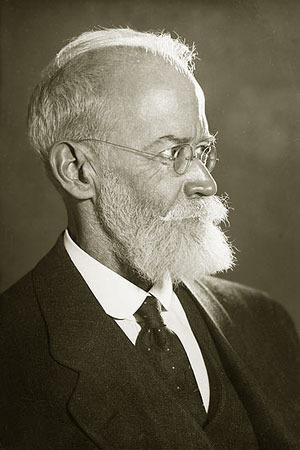
Edward Lucas White

Edward Lucas White 1866-1934
Edward Lucas White
1866-1934

If you have never heard of Edward Lucas White (as I had not until recently), do yourself a favor and look up his short story “Lukundoo” (1925).   This is probably one of the best and most terrifying horror stories I have ever read and it is the story for which White is best known.  Probably his next best known story is “The House of Nightmare” (1906), though it is not nearly as good as ‘Luknudoo” and by today’s standards of horror would be considered more of a quaint tale told by children around a campfire than true horror.  Nonetheless, Lovecraft considered White to be one of the masters of “weird fiction” and mentions him in his treatise “Supernatural Horror in Literature.”

One interesting aspect of White is that he based at least some of his stories on his nightmares, which is not uncommon among horror authors, but after reading “Lukundoo” I had to ask myself, “what was going on in this guy’s psyche?”

Do you base any of your works on dreams or nightmares?   Write in and let us know.

Algernon Blackwood

Blackwood by Ianus

Algernon Blackwood

Illustration by Ianus

Algernon Blackwood (1869-1951) was a prolific writer and is probably one of the forgotten masters of the horror genre.  He was a favorite of H.P. Lovecraft as the three quotes below (from www.hplovecraft.com) illustrate:

“Aside from Poe, I think Algernon Blackwood touches me most closely—& this in spite of the oceans of unrelieved puerility which he so frequently pours forth. I am dogmatic enough to call The Willows the finest weird story I have ever read, & I find in the Incredible Adventures & John Silence material a serious & sympathetic understanding of the human illusion-weaving process which makes Blackwood rate far higher as a creative artist than many another craftsman of mountainously superior word-mastery & general technical ability…” (to Vincent Starrett, 6 December 1927)

“He actually analyses and reproduces faithfully the details of the persistent human illusion of—and out-reaching toward—a misty world of vari-coloured wonders, transcended natural laws, limitless possibilities, delighted discoveries, and ceaseless adventurous expentancy…. Of all Blackwood’s voluminous output, only a golden minimum represents him at his best—but that is such a marvellous best that we can well forgive him all his slush and prattle. It is my firm opinion that his longish short story The Willows is the greatest weird tale ever written. (with Machen’s The White People as a good second.) Little is said—everything is suggested!” (to Fritz Leiber, 9 November 1936)

“It is safe to say that Blackwood is the greatest living weirdist despite unevenness and a poor prose style.” (to Willis Conover, 10 January 1937)

Blackwood pursued a variety of jobs and careers during his lifetime, but based on the current Wikipedia article about him, his two main passions seem to have been writing and mysticism.  According to this article, Blackwood once wrote to Peter Penzoldt:

“My fundamental interest, I suppose, is signs and proofs of other powers that lie hidden in us all; the extension, in other words, of human faculty. So many of my stories, therefore, deal with extension of consciousness; speculative and imaginative treatment of possibilities outside our normal range of consciousness. … Also, all that happens in our universe is natural; under Law; but an extension of our so limited normal consciousness can reveal new, extra-ordinary powers etc., and the word “supernatural” seems the best word for treating these in fiction. I believe it possible for our consciousness to change and grow, and that with this change we may become aware of a new universe. A “change” in consciousness, in its type, I mean, is something more than a mere extension of what we already possess and know.”

His two best known stories are The Willows and The Wendigo.  I have not read The Wendigo yet, but I started The Willows two days ago and am into Chapter II currently.  So far, it is very well written with a beautiful description of a canoe trip down the Danube.  Towards the end of Chapter I, Blackwood begins to slowly bring out some eerie aspects of an island on which the narrator and his Swedish traveling companion have pitched camp for the night.  With the beginning of Chapter II, the supernatural element begins to build ominously in a way that somehow reminds me of Mussorgsky’s symphony “Night on Bald Mountain”.  If you are familiar with Mussorgsky’s opus, you know how I suspect the story will develop.    I look forward to finishing The Willows as soon as possible and beginning The Wendigo shortly thereafter.

Thoughts?  Comments?

“Dream Warrior” to be Published

My short story “Dream Warrior” is currently slated to be published by the online magazine Sorcerous Signals  in their February, 2013 issue as well as their February, 2013 issue of Mystic Signals (a print edition combining Sorcerous Signals and The Lorelei Signal).

For my friends and relatives not familiar with the publishing industry:  please be advised that the story is only scheduled to be published in February and that I do not have an exact date yet.   The last edition was published on November 12, therefore it will probably be published about mid-February.  In my experience, stories appear on schedule about 90% of the time.   Occasionally, something happens and the story has to be delayed, but (again, in my experience) the story always appears.

I would like to thank the editor of Sorcerous Signals, Carol Hightshoe, for accepting my work.  I overlooked her letter of acceptance in my e-mail in October and was not aware of “Dream Warrior’s” acceptance until she diligently and professionally followed up and inquired about the story some time later.

The story is about a teenage boy in Corpus Christi, TX, who seeks revenge on the hoodlums responsible for the rape and death of his girlfriend.   After his first attempt fails and they threaten his life, he runs to Mexico to live with his great-grandfather, who teaches him the ways of the ancient Aztec sorcerers so that he can have his revenge.

I got the idea for the story while researching south Texas history for another (as yet unfinished) story and came across a website on Aztec sorcery.  Its author, whose name unfortunately escapes me at the moment, graciously responded to my inquiries and provided me with a wealth of fascinating information.  If I can find his name and website in my e-mails, I will publish them later.

I hope everyone enjoys “Dream Warrior”.    Please help me thank Carol and her staff by visiting the site often and encouraging everyone you know to do the same.   Check your local media outlets for Mystic Signals.

ETA Hoffmann

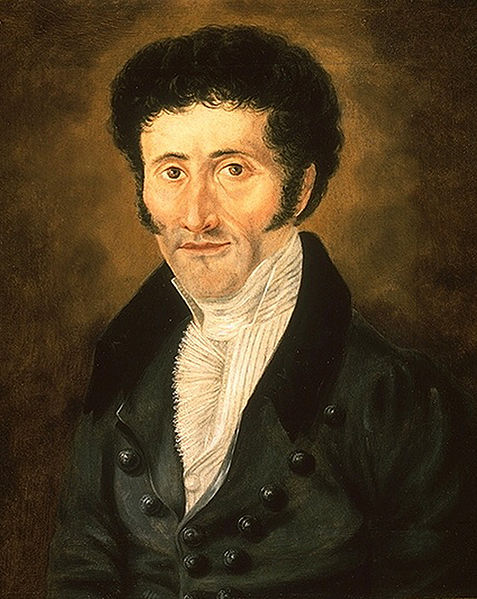
477px-ETA_Hoffmann_3

Unless you are a literature/horror aficinado, you may never have heard of  Ernst Theodor Amadeus Hoffmann, a German writer from the late 18th century.  He predated Poe by almost half a century and in his time was probably as well known then as Stephen King and Clive Barker are today.   His stories were considered terrifying in his time.   Several of his stories were the basis for the well-known opera by Jacques Offenbach “Tales of Hoffmann”.  If you have never heard the music from this, it would be worthwhile to listen for it or to buy a CD of it.  It is very impressive.  As with the photo of Stoker, I obtained this image from Wikimedia Commons, where it is listed as being in the public domain.

The Unrecognized Masters of Horror

If they tried really hard, the majority of the public could perhaps name only four writers of horror:  Stephen King, H.P.Lovecraft, Edgar Allan Poe, and Clive Barker.   Fans of the horror genre could doubtlessly name many more with the number of the authors they could name reflecting the intensity of their interest.  For example, a person who can name fifteen authors of horror most likely has a more intense interest in the genre than someone who can name only five.

I would say that it is a safe bet that one or more of these authors are the topics in least 75% of all the conversations about horror literature going on at any one moment.  While we amateurs can  improve our skills from studying these four, I think we have a lot to learn from studying authors other than these four.

I recently read a compilation of stories that Lovecraft cites in his work “Supernatural Horror in Literature”.  Of course, only Poe appears among his cited predecessors.   Most of his influences are writers probably most of the modern public has never heard of (Lord Dunsany, Edward Lucas White, Arthur Machen, etc.) though they were as well known in their time as Dean Koontz and Peter Straub are today.

My question to you is:  who are the unrecognized masters of horror that the modern public should know but in all likelihood do not?  Whose name does not usually make it into any top ten list of masters of horror but should?