Observations on “Baby Shoes” and Hemingway’s Iceberg Principle

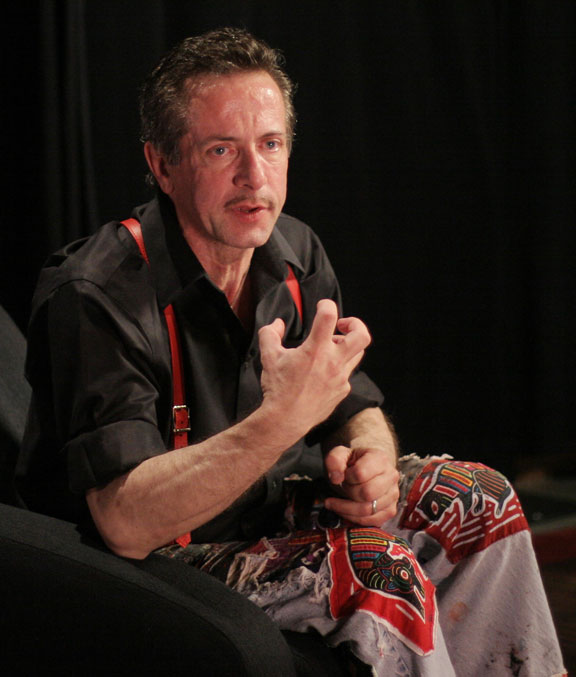
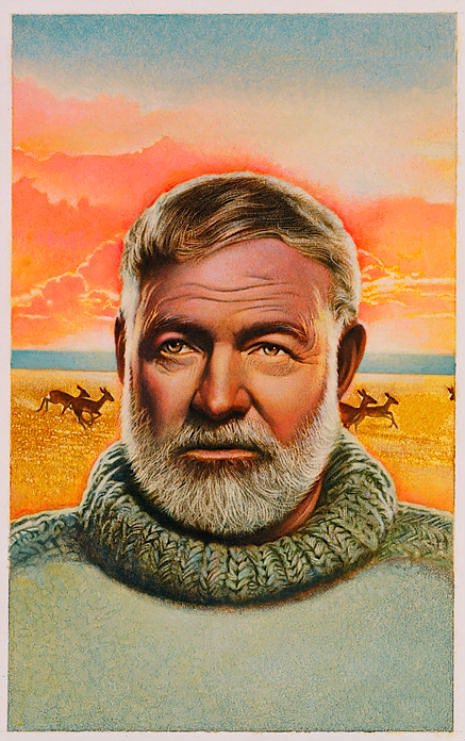
Ernest Hemingway Thought I do not know who the creator of this work is, I must ask that you respect their copyright.
Ernest Hemingway
(Though I do not know who the creator of this work is, I must ask that you respect their copyright.)

There is a story that Ernest Hemingway wrote the following to win a bet with other writers that he could write the shortest story:

“For sale:  baby shoes.  Never worn.”

Even a little research on the Internet shows that there is considerable doubt that Hemingway wrote this story, with the earliest reference to it as a Hemingway work not appearing until 1991.  There is also considerable evidence that the story existed in various forms as early as 1910, when Hemingway was 11 and well before his writing career began.   Whatever the facts, it is an extreme example of the lean, muscular writing for which Hemingway was famous.

In an interview with The Paris Review (see The Writer’s Chapbook, 1989, pp. 120-121), Hemingway did say:

“If it is any use to know it,  I always try to write on the principle of the iceberg.  There is seven-eighths of it underwater for every part that shows.  Anything you know you can eliminate and it only strengthens your iceberg.  It is the part that doesn’t show.  If a writer omits something because he does not know it then there is a hole in the story…First I have tried to eliminate everything unnecessary to conveying experience to the reader so that after he or she has read something it will become a part of his or her experience and seem actually to have happened.  This is very hard to do and I’ve worked at it very hard.”

So “Baby Shoes” is a good example of Hemingway’s iceberg principle, even if he didn’t write it.

“Baby Shoes” is also a good example of what I like to think of as the Tao of writing (see my earlier posts):  creating a story by a careful, strategic use of what is not said.  No where in the story does it state that a couple had apparently been expecting a baby, that they bought shoes for it, but then something happened to the baby to cause its death, and now the parents want to sell the shoes.    None of that is stated.  It is all implied, but yet we know what happened–or at least we have a good idea of what happened, even if we do not know the concrete facts of the matter.

There are also other facets of the story that we can infer, albeit tenuously.  From the fact that they bought baby shoes we can infer that the parents were probably eager to have the child.  From the fact that the parents want to sell the shoes we can infer that they probably don’t want them around any more as a remainder of a painful experience, but at the same time they may want to see someone else make good use of them or that they are hard up for money.

But one question I have that concerns human psychology is why is it that most people can read these same six words and come away with the same perception of what occurred?  Does it have to do with Jungian Archetypes floating around in each of us or is it that each of us has had the same broad experience(s) so that we can interpret these six words in a very similar way?

In the art of sculpture, those areas of a work that are empty, yet give the work its form, are called “negative space”.  An example is the space between each of your fingers.  If there were no space, there would be no individual fingers.   In that sense, a story like “Baby Shoes” makes maximum use of what might be termed “literary negative space”.

It is not really the words that give this story its power, but how we psychologically connect the ideas behind the words that fuel this extremely brief, but epic and poignant tale.

This is part of the magic of writing:  conjuring worlds out of nothing.

Thoughts?  Comments?
 

Stephen King, H.P. Lovecraft, and the X-files

mod 130419_0008I just finished watching an episode of the X-Files entitled “Chinga” [note to Spanish-speakers out there:  I don’t know who chose the title, so please forgive my language] from Season Five and I  noticed that it was written by Stephen King and Chris Carter (the creator of the X-Files).  The story’s antagonist is a talking doll that can force people to injure or kill themselves in gruesome ways.   Like many, if not most, of King’s stories, there is no explanation of how the came to exist.  All the viewer finds out about it is that a lobsterman pulled it up one night in a lobster trap and his daughter comes to possess it after he meets his own gruesome fate.

I find in my own writing that I like to provide an explanation or background as to how things originate.  This is just my nature.  I like to know the origins of things.  However, I have come to believe of late that, in terms of horror, that is a very nineteenth century  concept.

Lovecraft said in his essay “Supernatural Horror in Literature”:

“A certain atmosphere of breathless and unexplainable dread of outer, unknown forces must be present; and there must be a hint, expressed with a seriousness and protentiousness becoming its subject, of that most terrible conception of the human brain — a malign and particular suspension or defeat of those fixed laws of Nature which are our only daily safeguard against the assaults of chaos and the daemons of unplumbed space.”

For me, what Lovecraft is saying is that if the laws of nature are negated, then anything is possible and monsters like Cthulhu really could exist and are capable of doing us harm at any moment.  Combine this with his statement that “The oldest and strongest emotion of mankind is fear and the oldest and strongest kind of fear is fear of the unknown” and it becomes apparent that stories like “Chinga” derive much of their horror effect from the fact that the origin of the threat to a story’s protagonist(s) is unknown or that there is no explanation for the threat.

This would mean that one of  things that provides to “Chinga”  the element of horror that it has, is the fact that origin of the doll is unknown.  Therefore, any of us when we are fishing or scuba diving or swimming in any body of water, could discover a doll that would turn his/her life into a nightmare.   That is a scary thought.

Of course, this means that Stephen King would be one of the greatest practitioners of this technique, which I believe he is.

I think I shall try to experiment with this in the near future.

Thoughts?  Comments?


Note to Self for January 6, 2015

The blogger on Padre Island, January, 2011.

After I lay down in bed last night, I had one of those thoughts that just pops up in the middle of the night, particularly after writing for a while in the evening (which I had been). I write this now more for my own memory than anything, but I hope it will be of some use to someone else out there.

The thought was that the purpose of every word in a horror story should be to make that story scarier.

This is a very simple idea that may be patently obvious to most of you, but it may not be to some. In any case, my intuition suggested that I publish it.

Thoughts? Comments?

Thunder in Writing

Illustration of Space Travel from youpict.com

About 2:00 a.m. on December 6, on the drive home after visiting my sister and her husband, I was contemplating where I want to go with my current work-in-progress.  I am loathe to give away the plot, so suffice it to say that it involves a scientist that travels to another planet and tours it with a  fellow scientist from that planet.  I have come to realize over the last few days that the original plot concept is boring, although in terms of literature it would be fairly intriguing, because of the internal struggles the main character would face and some social issues it would raise.

It occurred to me is that the critical question was not where to take the plot of the story, but where do I want the book to go in terms of its impact on the society/world.  I am not so naïve as to think that it would have a earth-shattering impact like Dan Brown’s Da Vinci Code or be controversial like Henry Miller’s Tropic of Cancer or Aldous Huxley’s Brave New World or even break out like Stephen King’s Carrie, but no matter how it is received publically or critically, it will make an impact, even if it is negligible one.  The best I reason that I can do, is to try to make as big a splash as possible on its release and hope that it brings me some measure of success or at least puts me on the road to success.  But what can I do to create that splash?  What have been the characteristics of other initial successes?

I don’t know how the analogy suddenly popped into my mind, but I realized that what the story needs is thunder. Perhaps it was that a light rain had fallen sporadically over the last few days and the land was still wet with shallow puddles still lingering on the road in spots on this near-freezing night.  Somehow this struck a chord in my subconscious that stirred echoes of similar post-thunderstorm summer nights.  As I look back on that moment, though I wasn’t even thinking of those novels, it occurs to me now that they each have an element I would describe as “thunder”, something that resounds across the land striking a nerve in the public consciousness.

For some novels, like The Da Vinci Code,  the thunder is an aspect that touches on a sensitive nerve within a large number of the public.    In The Da Vinci Code‘s instance, this was deeply ingrained religious beliefs that, like the foundation of a house, if disturbed, shake the entire house.

For novels like The Tropic of Cancer, the thunder is something that disturbs the public’s sense of decency, which could be argued to be the image of itself that the public wishes to project.

Brave New World did not make as great an impact on its initial reception as it did later, when many of the technologies and issues it describes actually started to come into being.   Then it thundered greatly.

Carrie did not rock the literary or moral or religious foundations of society, but it was a great personal thunder for Stephen King and brought him suddenly into the public view.

There are undoubtedly other forms of thunder, but these are the ones that spring into mind initially.

Once I recognized that my goal as a writer is to thunder, the next question became what type of thunder do I want to have?

For me, I want to ask a profound question (or questions) that demand answers.   As stated, I don’t want to give away the plot of the novel(la), so I will unfortunately have to leave you in suspense for now, but check back with my blog periodically and let’s see if I can achieve this.  Wish me luck.

Thoughts?  Comments?


Notes on Clive Barker’s “The Hellbound Heart”…so far….

I am just past the halfway point in Clive Barker’s The Hellbound Heart, the novella upon which the orginal “Hellraiser” movie was based. This is one really terrific read.  It is one of those that is hard to put down, even though you know what happens next, because the movie, which you saw twenty years ago and have seen periodically since then,  so closely resembles the book. 

Clive Barker, Seattle, 2007 by Steven Friederich

The prose is simple, but not Hemingway simple, and there are moments of actual narrative beauty (such as when Barker poignantly describes the passing of seasons in the beginning of one chapter) that seem to be glimpses of insight into a latent aspect of Barker’s immense talent:  that he is able to write actually artistic prose that captures a moment, an emotion, or a sensation with a light touch that carries over to the reader.  I have read the first two volumes (so far) of Barker’s Books of Blood and this quality seems to be lacking in them.  In Books of Blood, he writes splendidly, but not beautifully, not poignantly.  

I also love the way he keeps his characters to a minimum, so that seeing the complex relationships between them is easy.

Another fascinating aspect of Barker’s storytelling in this instance is that he can put his characters in horrifying situations, yet he does not try to be any more graphic than is necessary to invoke an emotional response in the ready.  The few truly graphic scenes I have encountered so far are graphic, but not gratuitously graphic.  An example would be when the recently-resurrected Frank starts to have sex with with brother’s wife Julia.  He shows the act beginning and ends the chapter leaving what happens up to the reader’s imagination.  Yes, this is an old trick straight out of made-for-TV movies, but do you really need to visualize every gory detail of a woman having sex with someone who is still half-corpse?  I didn’t.  And seeing that would not have helped the storytelling and if anything, it would have only detracted from it.   Besides, if someone wants to visualize that unnerving scene for themselves, they are going to whether or not Barker describes it for them.  All that is necessary to show the development of the characters and the plot is to show that they did have sex, because that act in itself shows something about them.  About Frank it show how incredibly callous he is to Julia and how centered he is in the world of his own pleasure.  About Julia, it shows her love for Frank is so self-sacrificing that she is willing to commit the most vile acts for him while taking obscene pleasure in them in her own way. 

Anyway, those are just a few notes so far.  I need to have dinner and do some housework and to read more of this fascinating work.   Hopefully, I will be able to write more soon.

Thoughts?  Comments?

MovieNews | Opinion: How to define a horror film – entertainment.ie

Poster from Johannascheezburger.com via Halloween Mike's Horror Everyday on Facebook.
Poster from Johannascheezburger.com via Halloween Mike’s Horror Everyday on Facebook.

Here is an interesting viewpoint on just what makes a horror film:  MovieNews | Opinion: How to define a horror film – entertainment.ie.

Visit “The Works of Edgar Allan Poe, Volume 1” but not for the obvious reason.

Edgar Allan Poe, 1848

The Works of Edgar Allan Poe, Volume 1.  Yes, this link takes you to a collection of Poe’s works, but the reason I am mentioning it here is because the preface to this particular volume includes fascinating biographical notes and insight into the character of this master of horror that may help you understand the roots of his creative genius and how art sometimes came close to imitating life for Mr. Poe.

When you open the page, you may find yourself a little distance from the top of the article at the beginning of a section entitled “The Death of Edgar Allan Poe”.  While this section is fascinating in its own right, scroll to the top for the entire preface.  The works of Poe, beginning with the story of Hans Pfall, begin a bit down from “The Death…”

28 Totally Relatable Quotes About Books

Detail of Madonna des Kanonikus Georg van der Paele by Jan van Eyck, 1436
Detail of Madonna des Kanonikus Georg van der Paele
by Jan van Eyck, 1436

Purely for your entertainment, here are 28 Totally Relatable Quotes About Books.  I know I can relate to a lot of them.  I’m sure you will find a few for yourself.  One reason I find these interesting is because many of them show me how intensely involved readers will become with a book.  As I have mentioned in previous posts, I believe that people live a vicarious existence through a story.  When we write, we are not just writing a book or a story, we are creating a universe in which people will hopefully want to, not just visit, but dwell.  All of the writer’s art should therefore focus on creating a virtual reality for one’s readers.  To do that, we need a good  grounding in, or at least a good feel for, human psychology, because we have to shape our creations to fit the human psyche.  How do thoughts come into being?  How do they lead from one to another?  How do images form in the mind?  No, I am not saying that we need Ph.D.’s in psychology to be good writers, but I think we need some sort of archetypal insight into human nature if we are to be the great writers we hope to be.  Darn.  I’m rambling again.  🙂

Impressions of Five Writing Styles

I was in the Farmington public library yesterday trying to pull together some ideas for a story, but I could not concentrate long enough to formulate many good thoughts, because I felt more in a mood to receive information rather than to transmit.

Within the last few days I have started reading a collection of Lovecraft stories entitled The Dream Cycle of H.P. Lovecraft:  Dreams of Terror and Death (an excellent work; read it if you get the chance), edited by Neil Gaiman.  While wandering through the stacks, I pulled out a copy of Stephen King’s From a Buick 8 and took it back to my seat.  I had started reading it several years ago, but never finished it.  I thought I would review it and maybe start on it again soon.   As I read it, I noticed an interesting difference between King’s style and Lovecraft’s. Lovecraft gives a lot more of the backstory of a work in a few pages than King does.

As it so happens, I had also passed by the John Updike section a little earlier in the library and I have a few of his novels, which I have never read.  I went back and picked up his Rabbit, Run for comparison.  I thought about the differences between these three and a couple of other famous writers and came up with what I consider to be an interesting observation  (though it might bore those of you who are more advanced in the craft of writing than I am):  it is fascinating to see how much information about a work’s backstory or the larger setting of a story an author can put in the first 2-3 pages or so of a work.  For what it’s worth, here are my initial subjective impressions of the five writers under consideration yesterday.

In the first few pages of Rabbit, Run Updike details how Rabbit Angstrom happens to walk upon a basketball game among six kids in an alleyway (circa 1960). He watches and then joins the game, and impresses them with his basketball prowess, having been a high school basketball star about 8-9 years earlier.  He then goes home to where his wife is contemplating cooking dinner.   Updike takes us through this step by step and we don’t learn a lot other than Rabbit was a basketball star in high school several years back  and at 26 he has a middle class life now with a job for which he wears a suit to work.  I know that Updike is a very respected writer with two Pulitzers to his credit, but this story gets off to a very slow start for me and I learn very little about Rabbit Angstrom in the opening pages.  There is also very little emotional pull in these opening pages to draw me into the story.

In the opening chapter of A Farewell to Arms, Hemingway describes the scene from the window of an Italian house used as a hospital as troops pass en route to the Austrian front over the course of about a year.   He also describes how the leaves fall from a nearby tree and how the dust during the summers turns everything bone white, both of which (to me) symbolize the deaths of myriad troops on the front.   In maybe 2-3 pages, Hemingway not only gives us the overall setting of being at the Italo-Austrian front, he also draws us in with considerable emotional impact of the tragedy of the watching thousands of weary troops slogging through rain and mud or trudging through dust and heat on their way to their deaths.

In Quiet Flows the Don (1940), Soviet author Mikhail Sholokhov (winner of the 1965 Nobel prize for literature) describes the lives of Don Cossacks from before the First World War up to the Russian Revolution.  In its first few pages, Sholokhov describes life in a village of Cossacks, describes the relationship between father and son, shows how the son is having an affair with another Cossack’s wife, and shows the history and underlying peccadilloes of the family back for circa 200 years.  While his style is non-emotional, one cannot help but to feel for the family and to be drawn into the story.  It is a hard book to put down.

In From a Buick 8, Stephen King tells the story of a mysterious car that is kept in storage at a Pennsylvania State Troopers’ post.  In his first few pages, King describes the main characters and how they interrelate and how they all fit into the world of that post.  King makes the reader feel as if he were seeing the post from the perspective from one of its members.  You know the same things about all the members of that tight-knit community as if you were one of them.   Though the opening is not on the grand scale of A Farewell to Arms or Quiet Flows the Don, one feels the story on a much more intimate level while on a larger scale than in Rabbit, Run.    In the opening pages of From a Buick 8, King makes the reader feel as if he were part of a small community, while Sholokhov makes the reader feel as if he were part of a village, and Hemingway makes the reader feel a part of an entire battle front.

Dreams of Terror and Death is a collection of short stories, but in it the unfinished tale “The Descendant” stands out as an example of Lovecraft’s ability to an enormous backstory/setting into a few pages.  In these few pages, Lovecraft describes how a young man brings a copy of the dread Necronomicon to an aging scholar and how the scholar begins to relate the history of a millennia-old castle on the Yorkshire coast that hides the entrance to the elder world.  The story, even in its few pages touches on black magic; ancient, forgotten civilizations; other dimensions; and probably a dozen other mysterious subjects that instill the sort of eerie curiosity into a reader that compels a person into the black recesses of an unexplored cave. You sense something dangerous is lurking just out of sight, but you cannot contain the urge to find out what it is.

The instilling of this eerie curiosity that keeps one on the edge of the movie theater seat or turning the pages of the novel is a hallmark of all good horror and of all good horror writers.

Thoughts?  Comments?

Recommendation: The Popular Uncanny

I found a fascinating article just now that I highly recommend visiting:  “Winter Chills with Mike Arnzen”.  You can find it at http://nonhorrorreadersurvey.wordpress.com/2010/12/21/winter-chills-with-mike-arnzen/.  It is a fascinating look into how Freud’s concept of the Uncanny can be found in modern horror and in popular culture.    It is worth checking out.

What music inspires you to horror?

Poster from Johannascheezburger.com via Halloween Mike's Horror Everyday on Facebook.
Poster from Johannascheezburger.com via Halloween Mike’s Horror Everyday on Facebook.

For the first time in a long time, I was listening to CDs on the car stereo as I drove back from Farmington (New Mexico) on the 14th, when I started feeling once again the latent but powerful emotions I associate with certain songs.  The songs in question were Puddle of Mudd’s “Spaceship” from Songs in the Key of Love and Hate and “Would?” from Alice in Chains’s Dirt.  When I was not that much younger than I am now, I used to listen to a broad range of music (from classical to hard rock to New Age and more) almost constantly.  Therefore it will not be surprising if I state that others that stir me range from ACDC’s “Back in Black” and Nirvana’s “Smells Like Teen Spirit” to  Mussorgsky’s “Night on Bald Mountain” and Beethoven’s Ninth Symphony, and, for a complete change of pace, to Enya’s “Orinoco Flow” and Michael Gettel’s San Juan Suite, both of which seem to stir not a tumult of emotions, but instead have the opposite effect and cause me to almost drift away on a sea of tranquility.

As I am sure is the case with most people, I find all my favorite songs enjoyable, but there were, and still are, some that stir me deeply and can even now resurrect feelings of intense excitement and passion as if I were reliving my “Glory Days” (which, by the way, is an excellent Springsteen tune that really hits home these days).

Out of those that stir my emotions the most, are a select group that have a certain je ne sais quois, a combination of primal rhythm, deep-toned vocalization, and soul-stirring guitar riffs,  that do not stimulate the intellect as much as they instigate remote, subconscious parts of the mind to coalesce into a riot of images shaping themselves into the essential kernel of some grim tale that I know I can nurture, expand, and carefully, painstakingly mold into a narrative that would enthrall Dante or Milton–had I the time or unswerving diligence to concentrate on its writing.

“Enter Sandman” by Metallica is an excellent example of this.  Even though the song is about the destruction of a family (according to Wikipedia), something about it compels me to write an intricate novel of espionage, assassination, betrayal, deception, and the inner horrors of the human psyche that paces back and forth in the recesses of my mind like a tiger in a cage, watching for an opportunity to spring forth into the light of day upon an unsuspecting yet willing audience.   I have probably  20,000-30,000 or more words in the current draft of this story and I will probably trash most of these the next time I sit down to tackle this task.    One day I will have to dedicate myself to finishing the story, because this is the only way I know I will be able to rid myself of the tiger’s pacing and of his relentless stare that bores into the back of my neocortex.  As my life stands now, between chores at home and working 50-60 hours per week at my day job, I can find little time during an average week to work on the various short stories, novelettes, and novellas I have started over the past year.

Sad to say, I have two or three good novels that have been waiting over a decade or more for their genesis.  Probably with each of them I associate some tune from my more turbulent past, if not with the entire work, then with at least some scene that plays over and over in my head like a teaser clip from a movie trailer.

For me, this is one of the delicious agonies of being a writer.  I have so many fascinating concepts whirling through my head that I just know instinctively can be great works and that I enjoy revisiting whenever I have a few seconds to daydream but the lack of time in my daily life stymies their creation.

My question to you tonight, is are there musical works that inspire you to create works of horror and terror?

Lovecraft on the Supernatural

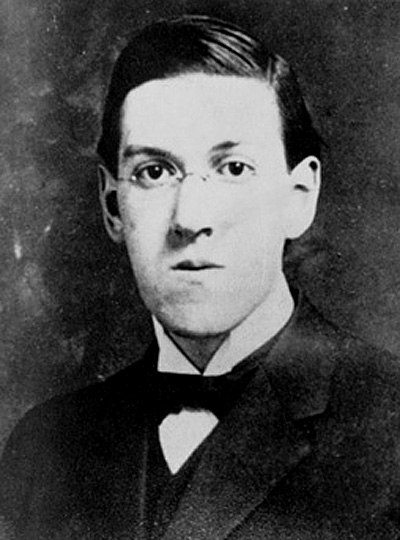
H.P. Lovecraft, 1915


I was reading Lovecraft’s “Supernatural Horror in Literature” the other day when I came across this line concerning the nature of  the “weird tale”:

“A certain atmosphere of breathless and unexplainable dread of outer, unknown forces must be present; and there must be a hint, expressed with a seriousness and protentiousness becoming its subject, of that most terrible conception of the human brain — a malign and particular suspension or defeat of those fixed laws of Nature which are our only daily safeguard against the assaults of chaos and the daemons of unplumbed space.”

With me, this idea hit home.  I have always thought that the more realistic I could make a story, the more frightening it would be for the reader, because it could possibly happen. Lovecraft takes the complete opposite approach.  In essence, he says let’s dispense with the chains of our preconceptions of reality then see what could happen.   He is right.  If anything can happen, the horrors that could happen to humanity are limitless and unimaginable.

Now let’s take this line of thought a step or two further philosophically.  Perhaps our concept of reality is really a sort of protective shell, a defense mechanism created by our minds that shields us from being overwhelmed by the thousands of possible ways we could meet our ends.  If a person tried to conceive of all the ways he/she might die at any moment, no matter how miniscule the odds, his/her mind might be overwhelmed and paralyzed by fear or destroyed by paranoia and madness.   The only way the mind could survive would then be to limit the possibilities to only those with the greatest probability of happening at that moment, in essence, wrapping itself in a protective cocoon of denial.

If there are any philosophy majors out there reading this, please feel free to bring up this idea in class.  I would love to hear the arguments for and against this.

Now, let’s go a step even further.   If we start to see our perception of reality as only a concept, as only a protective shell in a much greater universe, as only one alternative among thousands or millions of possibilities, then the possibility of creatures like Cthulhu, Shoggoth, Nylarhotep, the “ancient ones”, and all the other monsters contained in Lovecraft’s vivid imagination becomes very real.

Lovecraft’s world of the “ancient ones” is frightening enough when we think it has no chance of happening, but it becomes truly terrifying if we think it has even the slightest chance of actually happening.

Thoughts?  Comments?

The “Dracula” Conversation


I am a member of GoodReads.com as are several of my friends.  One, a gentleman named Tim Stamps, whom I have known since my college days at Eastern Kentucky University, recently posted a review of Dracula, on which I commented.  Thus began a brief conversation which I think you may find interesting for several reasons.   I have quoted it below, editing out any non-relevant personal matters (after having obtained Tim’s permission to post it).


Tim Stamps’s Reviews > Dracula

16399814

Tim Stamps‘s review

Apr 06, 13
I could only read this during the Winter months, when the weather is cloudy, dark and gloomy. When I read fiction I prefer the classics, to learn how people thought in earlier times. The actual character of Dracula was the most un-interesting of the characters in the book. It turns out that Stoker only knew Vlad’s Dracula name but knew nothing of his past, and the character is actually based more on Jack the Ripper.  Also it was interesting to read a book made up of supposed diary entries and newspaper articles – although most actual diaries and articles written by everyday people are nowhere near as long and detailed, especially back then when paper was scarce. I understand Mary Shelley wrote Frankenstein in the same format, and other books of that time did the same.  If you can find a copy, listen to the first half hour of this Coast to Coast show: http://www.coasttocoastam.com/show/20…
 message 1:      by      Phil          –            rated it 4 stars
Phil Slattery      Tim, if you like reading classic horror tales like Dracula, then you should definitely read Frankenstein. Others you may want to check out are The Strange Case of Dr. Jekyll and Mr. Hyde, The Picture of Dorian Gray, the works of Algernon Blackwood, Lord Dunsany, Arthur Machen, and Joseph Sheridan Le Fanu.  I have been writing horror lately and have established a blog on it that often discusses past writers of the horror genre. You may want to check it out at www.philslattery.wordpress.com.  You may find some of the authors I discuss of interest. One who is known more as a writer of science fiction than of horror (though the boundary is often indistinct at best) is H.G. Wells who wrote The Time Machine, War of the Worlds, The Island of Dr. Moreau, and others.
Tim Stamps      True, I definitely plan to read Frankenstein. Also have been planning on getting into Wuthering Heights and the Brönte sisters books. I’ve always been a fan of H.G. Wells, also Orwell’s dystopian works – still trying to get around to reading Huxley’s Brave New World (when I find my copy) – I can also add ebooks to a kindle, but the kindle doesn’t exactly replace paper.   I’ve depended on the movies too much – finding lots of extra details in the books that the films leave out. (I don’t really spend much time reading actually.) I’ll explore your site.. thanks! By the way, are there any horror films you really like?  Or gothic tales.  There don’t seem to be many recent ones that play into fears as well as the older ones. Some of the classics: “The Innocents” (version of Henry James’ “Turn of the Screw”), George Romero’s “Martin”, “The Exorcist”, even “The Shining” and the early “Halloween” pictures.  Recent films like “The Ring” and “the Sixth Sense” have potential.   I read in your blog that to be a great horror writer you need to understand the psychology and emotions of fear. Perhaps horror screenplay writers nowadays need to go back to the basics – just slashing people up and showing gruesome killings isn’t enough to heighten the sense of fear.  They seem to have forgotten Hitchcock and his methods of manipulating people’s emotions, although that was a time when people actually paid attention to dialog. I don’t know what it’s going to take to make a great horror movie today. Is it even possible?
Phil SlatteryTim wrote: “True, I definitely plan to read Frankenstein. Also have been planning on getting into Wuthering Heights and the Brönte sisters books. I’ve always been a fan of H.G. Wells, also Orwell’s dystopian w…”
Yes, you are right in all accounts, except that modern screenplay writers need to go back to the basics.  They cannot go back to someplace they have never been.   They need to learn the basics first. Stephen King identifies three types of horror:  horror, the gross-out, and terror (the exact lengthy quote can be found on GoodReads).  Modern, popular, mass-market screenplay writers use the gross-out form to excess. The great horror writers of the past (such as Lovecraft, Poe, Blackwood, etc.) never described anything gross.  Yet their tales are terrifying.   There is an art to horror, and Hitchcock’s concept of suspense (i.e. terror lies not in seeing something happen, but in knowing that something is about to happen) is one of the best means of achieving horror.
There are great horror movies today, but one has to veer away from the mass-market and Hollywood to find them.  Independent films and small companies are your best shot:  someone who cares about the art.  Netflix and Hulu TV are good for finding these (and finding them cheaply at that).  The series American Horror Story is quite entertaining, though it can be bloody at times. Foreign films can be an excellent source with Japan, Korea, England, Australia, and Spain coming immediately to mind. I noted that your profile says you are in the Seattle area now.  Lion’s Gate Films in Vancouver, BC makes some good films (outside of the horrifyingly gross-out Saw series).
I have seen some good horror films lately, but am having a hard time recalling their names, therefore I am reviewing some lists of top horror films on line, but of course that isn’t helping much as the lists are mass-market oriented.  One that pops out now is the original Swedish version of “Let the Right One In”.  “Dagon”, a Spanish film based somewhat loosely on a Lovecraft story (“The Shadow over Innsmouth”) is not bad. The New Zealand film “The Devil’s Island” has some interesting ideas behind it, though it is quite bloody.  That’s all I can think of on the spur of the moment.
Tim Stamps      hi Phil, Sorry about “Seattle” – don’t know how that happened (I must’ve not filled it in – the site just guessed or something.) Anyway, actually I am (still) in… I love watching foreign horror… for 70s-era foreign horror, Dario Argento comes to mind, although he leans toward the gross-out variety.  Lovecraft-written films are always great. I’ll check out these you mention (and any others you run across) – if you come up with a list of interesting foreign horror for the last 3 decades or so let me know. I have one plug: watch for “Nobody in Particular”, a crime-drama I helped out on, being re-edited – should be out sometime this year.
Thoughts?  Comments?

Jorge Oscar Rossi’s “Archetypal Horror: H.P. Lovecraft and Carl Gustav Jung”

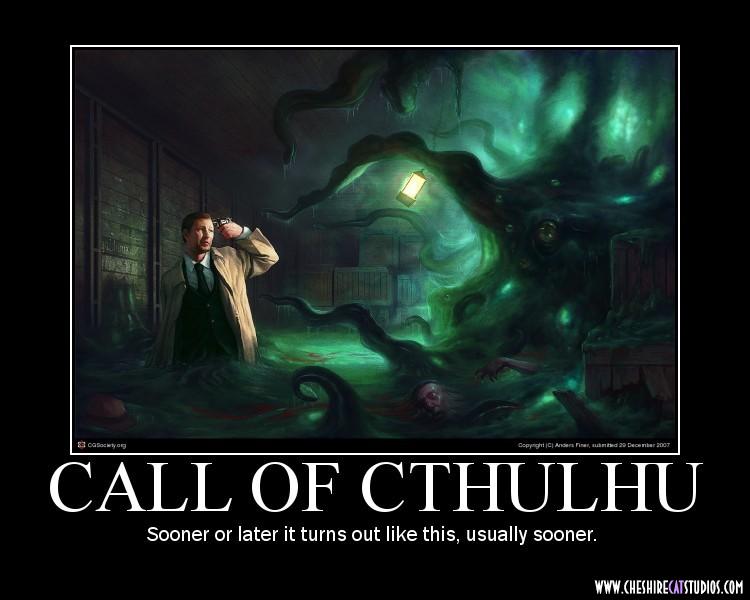
Cthulhu

I ran across an interesting article today at http://www.quintadimension.com/article66.html, entitled “Archetypal Horror:  H.P. Lovecraft and Carl Gustav Jung”.  It was written by Jorge Oscar Rossi, an Argentinian writer of science fiction (and fantastic literature in general), and published on December, 8, 2000.  Please note that the article and his autobiography are in Spanish.

I am no master of Spanish, having had only two years in college and some practical, albeit frequent, experience in Texas and Mexico over the last twenty years.   However, Señor Rossi’s article is well-written and relatively easy reading, so that I feel I caught the gist of it, if not all the nuances.

His main point (and anyone with a better knowledge of Spanish than I, including Señor Rossi, may correct me if I am wrong) is that Lovecraft’s ancient gods of the Cthulhu mythos represent archetypal forms of horror in the Jungian sense of “archetype”.

If you have a basic comprehension of Spanish, the article is quite intriguing and worth taking a shot at reading.

If nothing esle, the article will help you view the poster above from another perspective: what is the meaning of the poster if the creature above symbolizes archetypal fears shared by everyone?

Thoughts?  Comments?