Horror at Project Gutenberg

100_1736
The blogger on the banks of the San Juan River, Farmington, New Mexico, 2013

If you are an avid reader (of anything) and are not familiar with Project Gutenberg (http://www.gutenberg.org/wiki/Main_Page), you are doing yourself a great disservice. As they state on their homepage:

Project Gutenberg offers over 46,000 free ebooks: choose among free epub books, free kindle books, download them or read them online.

We carry high quality ebooks: All our ebooks were previously published by bona fide publishers. We digitized and diligently proofread them with the help of thousands of volunteers.

No fee or registration is required, but if you find Project Gutenberg useful, we kindly ask you to donate a small amount so we can buy and digitize more books. Other ways to help include digitizing more books,recording audio books, or reporting errors.

Over 100,000 free ebooks are available through our Partners, Affiliates and ResourcesOur ebooks may be freely used in the United States because most are not protected by U.S. copyright law, usually because their copyrights have expired. They may not be free of copyright in other countries. Readers outside of the United States must check the copyright laws of their countries before downloading or redistributing our ebooks. We also have a number of copyrighted titles, for which the copyright holder has given permission for unlimited non-commercial worldwide use.”

As they state, most of these books are available because their copyrights have expired, making them usually quite dated.  However, for anyone with a bent for the historical, Project Gutenberg is a gold mine.  I did a quick search for “horror” on their website and received 169 titles in response.  For a few, the only relation to the horror genre was the word “horror” in the title (such as “Southern Horrors: Lynch Law in All its Phases–which is a horrible subject, but is non-fiction vs. horror fiction).  However, many are the classics or founding works of the horror genre, such as Frankenstein by Mary Shelley, Dracula by Bram Stoker, The Vampyre: a Tale by John William Polidori, The Castle of Otranto by Horace Walpole, The Strange Case of Dr. Jekyll and Mr. Hyde by Robert Louis Stevenson, Fantome de’l Opera (Phantom of the Opera) by Gaston Leroux, many works by Edgar Allan Poe,  The Great God Pan by Arthur Machen, The King in Yellow by Robert W. Chambers, The Shunned House by H.P. Lovecraft, and many others.

Please take the time to visit this treasure trove of literature and of the horror genre, and if you are so inclined, please consider making a donation (via their website) to support their worthy cause.

Thoughts?  Comments?

McSweeney’s Internet Tendency: Selections From H.P. Lovecraft’s Brief Tenure as a Whitman’s Sampler Copywriter [Satire]

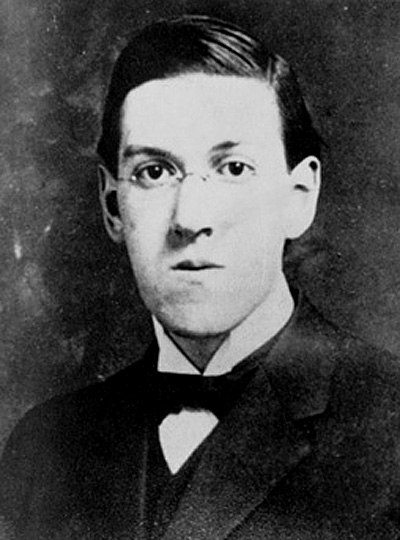
H.P. Lovecraft, 1915

Here’s a nice bit of humor for the day:  McSweeney’s Internet Tendency: Selections From H.P. Lovecraft’s Brief Tenure as a Whitman’s Sampler Copywriter..

Five Reasons Everyone Should Know Sir Edward Bulwer-Lytton | Interesting Literature

Sir Edward Bulwer-Lytton, First Baron Lytton Portrait by Henry William Pickersgill
Sir Edward Bulwer-Lytton, First Baron Lytton
Portrait by Henry William Pickersgill

Five Reasons Everyone Should Know Sir Edward Bulwer-Lytton | Interesting Literature.

I found this article at http://www.interestingliterature.wordpress.com just a few minutes ago.  Though the article does not deal with horror per se, the article will be of interest to horror aficionados (especially horror-historians) because for a short time Sir Edward Bulwer-Lytton was one of the more famous writers of horror during the nineteenth century.   His work of horror, “The House and the Brain”, is mentioned in Lovecraft’s famous essay “Supernatural Horror in Literature”.  Lovecraft said of Bulwer-Lytton:

“At this time a wave of interest in spiritualistic charlatanry, mediumism, Hindoo theosophy, and such matters, much like that of the present day, was flourishing; so that the number of weird tales with a ‘psychic” or pseudoscientific basis became very considerable.  For a number of these the prolific and popular Edward Bulwer-Lytton was responsible;  and despite the large doses of turgid rhetoric and empty romanticism in his products, his success in the weaving of a certain kind of bizarre charm cannot be denied.”

Lovecraft goes on to discuss with some degree of praise three of Bulwer-Lytton’s works:  the short story “The House and the Brain” and the novels Zanoni and A Strange Story.  I read “The House and the Brain” some time back and found it an interesting story (though a little long) and even riveting in some parts.  It is about a man who decides to spend the night in a haunted house where no one has been able to stay for very long because it is inhabited by terrifying apparitions.  True to the style of many nineteenth-century stories, the intrepid protagonist finds something of a scientific explanation behind the haunting.  It is definitely worth reading.

I have mentioned Bulwer-Lytton and some of the things for which he is famous in my previous post “The Best Literary Facts from the Twitterverse”, which was also reposted from http://www.interestingliterature.wordpress.com.   You might want to check it out for a few additional facts.

Thoughts?  Comments?

At the Midpoint of “The Dream-Quest of the Unknown Kadath”

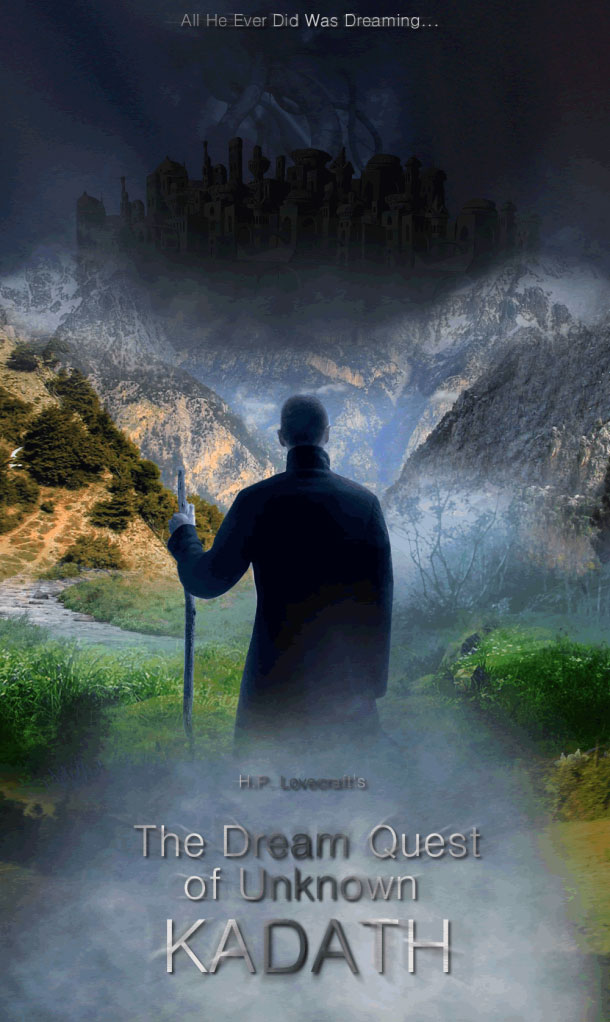
poster by vggonzalez, 2009 at www.gatostudios.wordpress.com Please observe any copyright restrictions.
poster by vggonzalez, 2009 at http://www.gatostudios.wordpress.com
Please observe any copyright restrictions.

One of the several books I am reading currently is an anthology of Lovecraft’s dream cycle.    Its story that I am reading now is “The Dream-Quest of the Unknown Kadath”.   I wrote up my views on the work today for Goodreads.com and thought I would share them here as well (though in a slightly modified version):

I am a Lovecraft fan, but I find “The Dream-Quest…” very tough reading.  I want to finish it, if for no other reason than to be able to say I managed to struggle my way through it and achieve my goal in spite of the hardships I encountered like the explorer of a literary Amazon.

The language is cumbersome and the plot is just Randolph Carter escaping one bad situation after another by luck.  Still, I am only about half-way through, and the optimistic side of me keeps hoping it gets better.  I don’t have much hope though, particularly after reading part of the Wikipedia article on it, which gives Lovecraft’s own views, which echo my own:

“Lovecraft himself declared that ‘it isn’t much good; but forms useful practice for later and more authentic attempts in the novel form.’ He expressed concern while writing it that ‘Randolph Carter’s adventures may have reached the point of palling on the reader; or that the very plethora of weird imagery may have destroyed the power of any one image to produce the desired impression of strangeness.”[8]

In the paragraph preceding this one in Wikipedia, Joanna Russ sums up the work nicely:

“The Dream-Quest has evoked a broad range of reactions, “some HPL enthusiasts finding it almost unreadable and others…comparing it to the Alice books and the fantasies of George MacDonald.[6] Joanna Russ referred to The Dream-Quest as “charming…but alas, never rewritten or polished”. [7]

Count me among the ones who find it almost unreadable, with its awkward, first-draft phrasing and its confused attempt to set a tone using an imagined scholarly, courtly language somewhere between Shakespeare and Poe.

However, I do love this awesome poster, which I found at http://gatostudio.wordpress.com/2009/03/21/the-dream-quest-of-unknown-kadath-poster/.  Please visit this beautiful site.  If you decide you would like to use this poster, please check with gatostudio and adhere to all copyright restrictions.

I just wish Lovecraft had written the story as masterfully as Mr. Gonzalez drew his poster and H.P. had lived up to the promise of the fantastic adventure to which the poster alludes.    The poster really outshines the story.    Given another two or three drafts, this story may have outshone all of Lovecraft’s other works.

Thoughts?  Comments?

www.HyperSmash.com

The Best Literary Facts from the Twitterverse

http://interestingliterature.wordpress.com/2013/09/06/the-best-literary-facts-from-the-twitterverse/

Follow the link above for some fascinating literary tidbits.   If you don’t have the time to wade through all for the horror triva, here they are:

Bram Stoker’s wife, Florence Balcombe, was previously suitored by Oscar Wilde. (@l0lhey)

In 1862, Sir Edward Bulwer-Lytton was offered the chance to be King of Greece. (@LeighaMcR)

Dickens & Poe were friends. 3 letters between them survive (alas, letters don’t mention of the death of Dickens’ pet raven). (@LauraShovan)

 Sir Edward Bulwer-Lytton, for those of you not into horror esoterica, was a well-known writer of the nineteenth century who dabbled in a variety of genres.  H.P. Lovecraft thought highly of his story “The House and the Brain”, which is included in the collection The World’s Greatest Horror Stories (2004, edited by Stephen Jones and Dave Carson).   According to Wikipedia, Bulwer-Lytton was the originator of some very famous and very frequently coined phrases that are still around:   “the pen is mightier than the sword”, “the great unwashed”, and “the almighty dollar”.  Bulwer-Lytton also invented that well-known line with which Snoopy invariably starts his novel in “Peanuts”:  “it was a dark and stormy night…”

Thoughts?  Comments?

Fictional Realism and You


Today at Stumble Upon, I found a fascinating article entitled “10 Mind-Blowing Theories That Will Change Your Perception of the World”.  Of the ten, the most fascinating for writers is #9, “Fictional Realism” which reads:

9. Fictional realism.

This is the most fascinating branch of multiverse theory. Superman is real. Yes, some of you would probably choose a different story, for argument’s sake, Harry Potter might be real too. This branch of the theory argues that given an infinite number of universes, everything must exist somewhere. So, all of our favorite fiction and fantasy may be descriptive of an alternate universe, one where all the right pieces came in to place to make it happen.

So, according to this, Cthulhu and all the rest of the Lovecraftian universe and the eldritch world may actually exist out there someplace just beyond our ken in a parallel universe.  Somehow horror becomes scarier when it becomes possible at some level.

Thoughts? Comments?

Impressions of Five Writing Styles

I was in the Farmington public library yesterday trying to pull together some ideas for a story, but I could not concentrate long enough to formulate many good thoughts, because I felt more in a mood to receive information rather than to transmit.

Within the last few days I have started reading a collection of Lovecraft stories entitled The Dream Cycle of H.P. Lovecraft:  Dreams of Terror and Death (an excellent work; read it if you get the chance), edited by Neil Gaiman.  While wandering through the stacks, I pulled out a copy of Stephen King’s From a Buick 8 and took it back to my seat.  I had started reading it several years ago, but never finished it.  I thought I would review it and maybe start on it again soon.   As I read it, I noticed an interesting difference between King’s style and Lovecraft’s. Lovecraft gives a lot more of the backstory of a work in a few pages than King does.

As it so happens, I had also passed by the John Updike section a little earlier in the library and I have a few of his novels, which I have never read.  I went back and picked up his Rabbit, Run for comparison.  I thought about the differences between these three and a couple of other famous writers and came up with what I consider to be an interesting observation  (though it might bore those of you who are more advanced in the craft of writing than I am):  it is fascinating to see how much information about a work’s backstory or the larger setting of a story an author can put in the first 2-3 pages or so of a work.  For what it’s worth, here are my initial subjective impressions of the five writers under consideration yesterday.

In the first few pages of Rabbit, Run Updike details how Rabbit Angstrom happens to walk upon a basketball game among six kids in an alleyway (circa 1960). He watches and then joins the game, and impresses them with his basketball prowess, having been a high school basketball star about 8-9 years earlier.  He then goes home to where his wife is contemplating cooking dinner.   Updike takes us through this step by step and we don’t learn a lot other than Rabbit was a basketball star in high school several years back  and at 26 he has a middle class life now with a job for which he wears a suit to work.  I know that Updike is a very respected writer with two Pulitzers to his credit, but this story gets off to a very slow start for me and I learn very little about Rabbit Angstrom in the opening pages.  There is also very little emotional pull in these opening pages to draw me into the story.

In the opening chapter of A Farewell to Arms, Hemingway describes the scene from the window of an Italian house used as a hospital as troops pass en route to the Austrian front over the course of about a year.   He also describes how the leaves fall from a nearby tree and how the dust during the summers turns everything bone white, both of which (to me) symbolize the deaths of myriad troops on the front.   In maybe 2-3 pages, Hemingway not only gives us the overall setting of being at the Italo-Austrian front, he also draws us in with considerable emotional impact of the tragedy of the watching thousands of weary troops slogging through rain and mud or trudging through dust and heat on their way to their deaths.

In Quiet Flows the Don (1940), Soviet author Mikhail Sholokhov (winner of the 1965 Nobel prize for literature) describes the lives of Don Cossacks from before the First World War up to the Russian Revolution.  In its first few pages, Sholokhov describes life in a village of Cossacks, describes the relationship between father and son, shows how the son is having an affair with another Cossack’s wife, and shows the history and underlying peccadilloes of the family back for circa 200 years.  While his style is non-emotional, one cannot help but to feel for the family and to be drawn into the story.  It is a hard book to put down.

In From a Buick 8, Stephen King tells the story of a mysterious car that is kept in storage at a Pennsylvania State Troopers’ post.  In his first few pages, King describes the main characters and how they interrelate and how they all fit into the world of that post.  King makes the reader feel as if he were seeing the post from the perspective from one of its members.  You know the same things about all the members of that tight-knit community as if you were one of them.   Though the opening is not on the grand scale of A Farewell to Arms or Quiet Flows the Don, one feels the story on a much more intimate level while on a larger scale than in Rabbit, Run.    In the opening pages of From a Buick 8, King makes the reader feel as if he were part of a small community, while Sholokhov makes the reader feel as if he were part of a village, and Hemingway makes the reader feel a part of an entire battle front.

Dreams of Terror and Death is a collection of short stories, but in it the unfinished tale “The Descendant” stands out as an example of Lovecraft’s ability to an enormous backstory/setting into a few pages.  In these few pages, Lovecraft describes how a young man brings a copy of the dread Necronomicon to an aging scholar and how the scholar begins to relate the history of a millennia-old castle on the Yorkshire coast that hides the entrance to the elder world.  The story, even in its few pages touches on black magic; ancient, forgotten civilizations; other dimensions; and probably a dozen other mysterious subjects that instill the sort of eerie curiosity into a reader that compels a person into the black recesses of an unexplored cave. You sense something dangerous is lurking just out of sight, but you cannot contain the urge to find out what it is.

The instilling of this eerie curiosity that keeps one on the edge of the movie theater seat or turning the pages of the novel is a hallmark of all good horror and of all good horror writers.

Thoughts?  Comments?

Your Beast, By Any Other Name

Surfing the ‘net today I found an interesting article at davidsearls.com on  the art of writing novel titles:  Your Beast, By Any Other Name.  If you are in the process of writing a story or novel, it will probably be worth a few minutes of your time to check out this article.  In it, Mr. Searls gives his thoughts and a list of examples of what are excellent titles.  I posted a lengthy comment to it, which I will quote here for your convenience:

Excellent list of titles!  Though I have few published works, from all those I have in the works, I know it is difficult finding exactly the right title that intrigues the passerby while giving something of a clue as to the nature of the story.  My paltry four published stories I think meet this criteria, but I would like to hear your opinion of them:  “Dream Warrior”, “Wolfsheim”, “A Tale of Hell”, and “Murder by Plastic”.

As a bit of trivia, Hemingway had an interesting way of choosing titles.  He would search the Bible for catchy lines under he had a list of a hundred, and then would start crossing them off as he searched for the best one.

As I think of it, having an emotionally-charged verb in the title, such as “murder” or “dying” or “rampage” in the title would be a good idea, because of the sudden, visceral impact it would carry.  Though not a horror novel, Faulkner’s “As I Lay Dying” would be a good example.  A good emotionally-charged noun and/or adjective would be a good second choice.  Some examples of these are Clive Barker’s “The Hellbound Heart” or “The Damnation Game” or “Books of Blood”.  “Psycho” is another good example.  “Hell House” is a good one; “Interview with a Vampire” is another.

And a mysterious title that needs explanation thus drawing the reader into reading the work out of sheer curiosity is another good technique.  “The Call of Cthulhu” is the prime example of this to my mind.

Thoughts?  Comments?

Review: The Worlds’ Greatest Horror Stories


Last night I finished The World’s Greatest Horror Stories, published in 2004 by Magpie Books and edited by Stephen Jones and Dave Carson.  This is a collection of stories mentioned in Lovecraft’s essay “Supernatural Horror in Literature”, which is included in the collection.  Reading this book gives one a good foundation in the history of the horror genre up to Lovecraft’s time.   It includes such masterworks as Poe’s “The Fall of the House of Usher”, Machen’s “The Great God Pan”, M.R. James’s “Count Magnus”, Charles Dickens’s “The Signalman”, Guy de Maupassant’s “The Horla”, Rudyard Kipling’s “The Mark of the Beast”, and Robert Louis Stevenson’s “The Bodysnatcher” along with many others.

Though a couple may be a little long-winded by today’s standards, overall these are wonderful stories, classic supernatural tales demonstrating what horror should be that were lauded by none other than the father of modern supernatural horror himself!  I highly recommend this to anyone with an interest in literature in general though particularly of course to those with an interest in the horror genre. The beauty of these tales is their ability to keep the reader in edge-of-your-seat suspense,terrified and spellbound, without resorting to the more-often-than-not overdone and too often appalling gimmicks of gore and shock. These tales show that grisly details are not needed to enthrall an audience, but that imagination and craftsmanship are.

Thoughts?  Comments?

The Canon of Horror

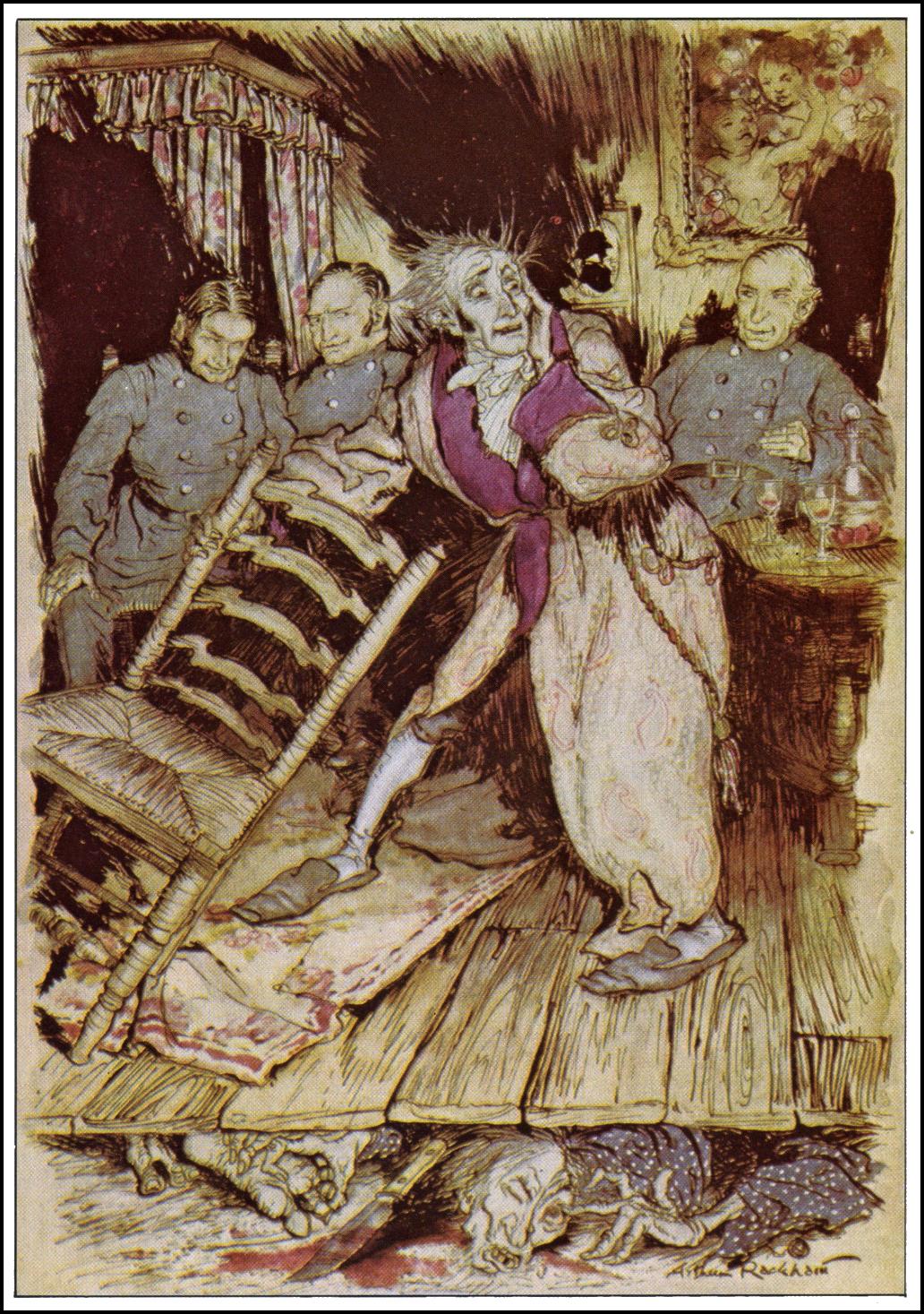
"The Tell-Tale Heart" Illustration by Arthur Rackham, 1935
“The Tell-Tale Heart”
Illustration by Arthur Rackham, 1935

I was just musing that if a canon of horror literature could be developed, what should it include?   This would be a collection of say ten works that define horror literature and that everyone seriously interested in horror should read if he/she they wish to learn what horror is and should be.   This would not be a collection of the most popular works (whether novel, short story, essay, screenplay, theater, etc.) of horror, which would change constantly, but ten works which would define horror now and forever as the Bible does Christianity, as the Koran does Islam, and as the Analects of Confucius do Confucianism.   These should be eternal works that at the end of time, after the Zombie Apocalypse when no more books are written, the few remaining survivors of humanity can review all the literary works of all time and say, “These ten defined the horror genre.”  Of course, this canon will be forever debated, but lively, engaged discussion is the fun of a list like this.

To start off this conversation, here are my initial ten recommendations (subject to change as my reading progresses).  I will keep this list to one work from each of ten authors so that works by one author do not overwhelm the list.  This is not in any order of priority or preference–just as they pop into my mind.   Although these reflect my own reading (which tends to the past more than the present), I have added one or two authors I haven’t read, but from what I understand, have made significant contributions to the horror genre.

  1. “The Tell-Tale Heart” by Edgar Allen Poe
  2. Books of Blood by Clive Barker
  3. Carrie by Stephen King
  4. Frankenstein by Mary Shelley
  5. “The Shadow over Innsmouth” by H.P. Lovecraft
  6. “Lukundoo” by Edward Lucas White
  7. “The Sandman” by E.T. A. Hoffmann
  8. Dracula by Bram Stoker
  9. “The Willows” by Algernon Blackwood
  10. Psycho by Robert Bloch
  11. I am Legend by Richard Matheson

H.R. Giger’s Necronomicon

Portrait of H.R. Giger copyright 1998 by Dana Frank/NYC from hrgiger.com
Portrait of H.R. Giger
copyright 1998 by Dana Frank/NYC
from hrgiger.com


If you are not familiar with the works of Swiss artist Hans Rudolf Giger, you are probably familiar with movies that use his art: the Alien series, Poltergeist II, Batman Forever, and Prometheus among others.  Though his works are considered surreal or of science fiction rather than horror, to me there seems to be something of an unstated horrific element to them and therefore I have included them as tonight’s post.

Perhaps a more tangible connection between Giger and the world of horror is that his book, upon which the original Alien design was based was entitled H.R. Giger’s Necronomicon, after, of course, the fictitious Necronomicon of H.P. Lovecraft.   Here I quote a short article on it from Wikipedia:

Necronomicon was the first major published compendium of images by Swiss artist H. R. Giger. Originally published in 1977, the book was given to director Ridley Scott during the pre-production of the film Alien, who then hired Giger to produce artwork and conceptual designs for the film.

“The book was originally published by Sphinx Verlag and was republished in 1993 by Morpheus International with additional artwork from Giger’s Alien designs. A subsequent collection of his images followed as H. R. Giger’s Necronomicon 2, printed in 1985 by Edition C of Switzerland.

“Giger’s Necronomicon is named for H. P. Lovecraft’s Necronomicon, a fictional grimoire Lovecraft invented and used as a plot device in his stories. Lovecraft’s Necronomicon was a compendium of pre-human lore compiled by the fictional mad Arab Abdul Alhazred, circa 700.[1]

Giger’s works are a fascinating foray into the surreal, erotic, and horrifying possibilities of the world of biomechanics.  A quick search in Google images for “Giger art” or a vist to hrgiger.com will prove quite rewarding.  Here are a few examples to whet your appetite (please note that all images used in this post are copyrighted by the author/artist and are used here only under US “fair use” guidelines) .

The Dali Edition of "H.R. Giger's Necronomicon" (Please note this work is copyrighted by the artist/author and is used here only under US "fair use" guidelines)
The Dali Edition of “H.R. Giger’s Necronomicon”


Landscape XIX by H.R. Giger
Landscape XIX
by H.R. Giger


Alien IV by H.R. Giger
Alien IV
by H.R. Giger


Li I by H.R. Giger
Li I
by H.R. Giger

Thoughts?  Comments?

Lovecraft and “Berkeley Square”

H.P. Lovecraft, 1915

I was lazily drifting through the web tonight, when I came upon a bit of interesting trivia.   According to HPLovecraft.com, one of Lovecraft’s favorite films was “Berkeley Square”.   He is quoted as saying about it:

“But with all its defects this thing gave me an uncanny wallop. When I revisited it I saw it through twice – & I shall probably go again on its next return. It is the most weirdly perfect embodiment of my own moods & pseudo-memories that I have ever seen…” (to J. Vernon Shea, 4 February 1934)

According to the Internet Movie Database, the storyline is:  “A young American man is transported back to London in the time of the American Revolution and meets his ancestors.”

A review by “clementj” on the same page describes it as follows:

“This is a very amusing love story with a good dash of humor. Much of the humor centers around the culture clash between Standish and the 18th century family. Standish uses modern terms and slips when he reveals things that happen in the future. The culture clash is a cautionary tale for would be travelers. This film appealed to many women because Leslie Howard was a heart throb for many of them. My mother loved this film and could watch it over and over. She was so disappointed when late in her life it disappeared from the old movies shown on TV.

“It is currently not commercially available, but a number of vendors have poor quality CDs or tapes for sale. All of these were probably made from a VHS tape from a TV showing. The tape was deteriorated and possibly copied several times so there is a lot of instability and wiggling of the image. The original broadcast used extreme compression of the video and sound. As a result the noise level rises to become very loud until dialog causes the gain to be cut. As a result the dialog is sometimes very indistinct. The music which was originally soft also rises to match the level of the dialog. Once this is restored by hand, the film is fairly listenable. The complaint of another reviewer about the music being too loud may stem from watching a copy with similarly compressed sound. In addition the broadcast severely cropped the film and did not stabilize the jitter.

This is a film that deserves restoration from the existing prints, but when and if this happens is unknown. Until then buying one of the existing CDs may be the only way to view this fine film.”

On the message board at the bottom of that page is a post by aaronjv-1 that mentions that a brand new 35mm print was slated to play at the Lovecraft film festival in September, 2011.   He goes on to say about the film:

“The grandson of director Frank Lloyd will introduce the picture and talk about his granddad’s favorite, which was also H.P. Lovecraft’s favorite–he watched it four times, and it inspired him to write his own classic time-traveler possession tale, “The Shadow Out of Time”.

A quick search on Google reveals that the film is available on youtube at http://www.youtube.com/watch?v=Ge8Qn3pGE_E.

I hope to watch it tonight.   Please feel free to do the same and post your comments here.  I would love to hear what you have to say.

Lovecraft on the Supernatural

H.P. Lovecraft, 1915


I was reading Lovecraft’s “Supernatural Horror in Literature” the other day when I came across this line concerning the nature of  the “weird tale”:

“A certain atmosphere of breathless and unexplainable dread of outer, unknown forces must be present; and there must be a hint, expressed with a seriousness and protentiousness becoming its subject, of that most terrible conception of the human brain — a malign and particular suspension or defeat of those fixed laws of Nature which are our only daily safeguard against the assaults of chaos and the daemons of unplumbed space.”

With me, this idea hit home.  I have always thought that the more realistic I could make a story, the more frightening it would be for the reader, because it could possibly happen. Lovecraft takes the complete opposite approach.  In essence, he says let’s dispense with the chains of our preconceptions of reality then see what could happen.   He is right.  If anything can happen, the horrors that could happen to humanity are limitless and unimaginable.

Now let’s take this line of thought a step or two further philosophically.  Perhaps our concept of reality is really a sort of protective shell, a defense mechanism created by our minds that shields us from being overwhelmed by the thousands of possible ways we could meet our ends.  If a person tried to conceive of all the ways he/she might die at any moment, no matter how miniscule the odds, his/her mind might be overwhelmed and paralyzed by fear or destroyed by paranoia and madness.   The only way the mind could survive would then be to limit the possibilities to only those with the greatest probability of happening at that moment, in essence, wrapping itself in a protective cocoon of denial.

If there are any philosophy majors out there reading this, please feel free to bring up this idea in class.  I would love to hear the arguments for and against this.

Now, let’s go a step even further.   If we start to see our perception of reality as only a concept, as only a protective shell in a much greater universe, as only one alternative among thousands or millions of possibilities, then the possibility of creatures like Cthulhu, Shoggoth, Nylarhotep, the “ancient ones”, and all the other monsters contained in Lovecraft’s vivid imagination becomes very real.

Lovecraft’s world of the “ancient ones” is frightening enough when we think it has no chance of happening, but it becomes truly terrifying if we think it has even the slightest chance of actually happening.

Thoughts?  Comments?