Last night I finished The World’s Greatest Horror Stories, published in 2004 by Magpie Books and edited by Stephen Jones and Dave Carson. This is a collection of stories mentioned in Lovecraft’s essay “Supernatural Horror in Literature”, which is included in the collection. Reading this book gives one a good foundation in the history of the horror genre up to Lovecraft’s time. It includes such masterworks as Poe’s “The Fall of the House of Usher”, Machen’s “The Great God Pan”, M.R. James’s “Count Magnus”, Charles Dickens’s “The Signalman”, Guy de Maupassant’s “The Horla”, Rudyard Kipling’s “The Mark of the Beast”, and Robert Louis Stevenson’s “The Bodysnatcher” along with many others.
Though a couple may be a little long-winded by today’s standards, overall these are wonderful stories, classic supernatural tales demonstrating what horror should be that were lauded by none other than the father of modern supernatural horror himself! I highly recommend this to anyone with an interest in literature in general though particularly of course to those with an interest in the horror genre. The beauty of these tales is their ability to keep the reader in edge-of-your-seat suspense,terrified and spellbound, without resorting to the more-often-than-not overdone and too often appalling gimmicks of gore and shock. These tales show that grisly details are not needed to enthrall an audience, but that imagination and craftsmanship are.
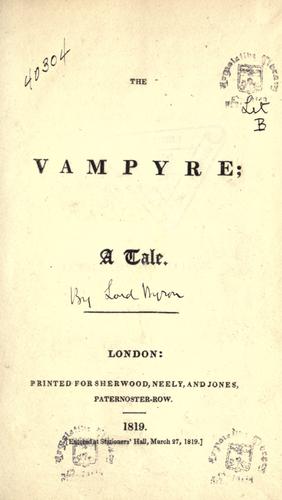
Title Page of Vampyre 1819 (Note handwritten attribution to Lord Byron)
On June 22, I was continuing my reading of Lovecraft’s “Supernatural Horror in Literature” when I encountered an interesting tidbit. When Mary Shelley was writing Frankenstein in the famous competition with her husband, Percy Shelley, and Lord Byron, another competitor was Dr. John William Polidori, whose story story from that competition, “The Vampyre”, went on to be the only other work of that competition that went on to achieve any sort of renown (according to Lovecraft).
Wikipedia has an interesting explanation for the title page above:
“The Vampyre” was first published on 1 April 1819 by Henry Colburn in the New Monthly Magazine with the false attribution “A Tale by Lord Byron“. The name of the work’s protagonist, “Lord Ruthven“, added to this assumption, for that name was originally used in Lady Caroline Lamb‘s novel Glenarvon (from the same publisher), in which a thinly-disguised Byron figure was also named Lord Ruthven. Despite repeated denials by Byron and Polidori, the authorship often went unclarified…Later printings removed Byron’s name and added Polidori’s name to the title page.
Go to this link for the Project Gutenberg etext of “Vampyre”. Modern printings can be found at the Open Library.
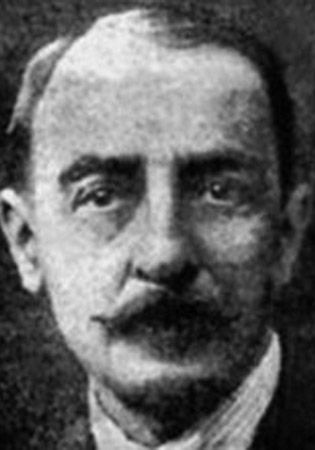
John William Polidori 1795-1821 (from Wikimedia)
Another couple of interesting notes from the Wikipedia article on The Vampyre:
“The story was an immediate popular success, partly because of the Byron attribution and partly because it exploited the gothic horror predilections of the public. Polidori transformed the vampire from a character in folklore into the form that is recognized today—an aristocratic fiend who preys among high society.[1]“
“Polidori’s work had an immense impact on contemporary sensibilities and ran through numerous editions and translations. An adaptation appeared in 1820 with Cyprien Bérard’s novel, Lord Ruthwen ou les Vampires, falsely attributed to Charles Nodier, who himself then wrote his own version, Le Vampire, a play which had enormous success and sparked a “vampire craze” across Europe. This includes operatic adaptations by Heinrich Marschner (see Der Vampyr) and Peter Josef von Lindpaintner (see Der Vampyr), both published in the same year and called “The Vampire”. Nikolai Gogol, Alexandre Dumas, and Alexis Tolstoy all produced vampire tales, and themes in Polidori’s tale would continue to influence Bram Stoker‘s Dracula and eventually the whole vampire genre. Dumas makes explicit reference to Lord Ruthwen in The Count of Monte Cristo, going so far as to state that his character “The Comtesse G…” had been personally acquainted with Lord Ruthwen.[10]“
I find it fascinating that possibly the two greatest motifs in the history of horror literature (Frankenstein and vampires) were started at the same friendly competition between four friends.
Unfortunately, Dr. Polidori did not live to see the success of the literary phenomenon he created. The article goes on to note:
“He [Polidori] died in London on 24 August 1821, weighed down by depression and gambling debts. Despite strong evidence that he committed suicide by means of prussic acid (cyanide), the coroner gave a verdict of death by natural causes.[3]“
I am happy to announce that as of today, July 10, 2013, my poem “Faust” has been reprinted in Blood Moon Rising Magazine. Please follow the link to view my favorite of all the poems I have written and to visit their excellent magazine.
On Monday, I learned of the death of Richard Matheson, one of the great horror writers of the twentieth century. As my tribute to him, here are a few quotations from and about him along with a few examples on how he generated his ideas. There were a lot, so I picked the ones that seemed most philosophical about writing and life in general in order to get a feel for the man behind the writing.
From Goodreads:
“What condemnation could possibly be more harsh than one’s own, when self-pretense is no longer possible?” ― Richard Matheson, What Dreams May Come
“We’ve forgotten much. How to struggle, how to rise to dizzy heights and sink to unparalleled depths. We no longer aspire to anything. Even the finer shades of despair are lost to us. We’ve ceased to be runners. We plod from structure to conveyance to employment and back again. We live within the boundaries that science has determined for us. The measuring stick is short and sweet. The full gamut of life is a brief, shadowy continuum that runs from gray to more gray. The rainbow is bleached. We hardly know how to doubt anymore. (“The Thing”)” ― Richard Matheson, Collected Stories, Vol. 1
“If men only felt about death as they do about sleep, all terrors would cease. . . Men sleep contentedly, assured that they will wake the following morning. They should feel the same about their lives.” ― Richard Matheson, What Dreams May Come
“In a world of monotonous horror there could be no salvation in wild dreaming.” ― Richard Matheson, I Am Legend
“Now when I die, I shall only be dead.” ― Richard Matheson, I am Legend and Other Stories
From Wikiquotes:
I think What Dreams May Come is the most important (read effective) book I’ve written. It has caused a number of readers to lose their fear of death — the finest tribute any writer could receive. … Somewhere In Time is my favorite novel.
“Ed Gorman Calling: We Talk to Richard Matheson” (2004).
From Uphillwriting.org:
If you go too far in fantasy and break the string of logic, and become nonsensical, someone will surely remind you of your dereliction…Pound for pound, fantasy makes a tougher opponent for the creative person.
– Richard Matheson
And here are a couple of quote about Matheson–also from Wikiquotes:
Matheson gets closer to his characters than anyone else in the field of fantasy today. … You don’t read a Matheson story — you experience it.
Robert Bloch, as quoted in an address by Anthony Boucher (29 August 1958), at the “Solacon”, the 1958 Worldcon
He has many … virtues, notably an unusual agility in trick prose and trick construction and a too-little-recognized (or exercised) skill on offtrail humor; but his great strength is his power to take a reader inside a character or a situation.
Anthony Boucher in an address at the “Solacon”, the1958 Worldcon (29 August 1958)
Wikipedia offers an interesting paragraph on how Matheson came up with the ideas for some of his more famous works:
Matheson cited specific inspirations for many of his works. Duel derived from an incident in which he and a friend, Jerry Sohl, were dangerously tailgated by a large truck on the same day as the Kennedy assassination. (However, there are similarities with William M. Robson’s script of the July 15, 1962 episode of the radio drama, Suspense, “Snow on 66”.[citation needed]) A scene from the 1953 movie Let’s Do It Again in which Aldo Ray and Ray Milland put on each other’s hats, one of which is far too big for the other, sparked the thought “what if someone put on his own hat and that happened,” which became The Shrinking Man. Bid Time Return began when Matheson saw a movie poster featuring a beautiful picture of Maude Adams and wondered what would happen if someone fell in love with such an old picture. In the introduction to Noir: 3 Novels of Suspense (1997), which collects three of his early books, Matheson said that the first chapter of his suspense novel Someone is Bleeding (1953) describes exactly his meeting with his wife Ruth, and that in the case of What Dreams May Come, “the whole novel is filled with scenes from our past.”
Albert Bitzius (1797-1854) was a Swiss pastor and author, who is better known by his pen name of Jeremias Gotthelf. Gotthelf was a prolific writer whose novels and stories were based on the people of his village, Luetzelflueh, in the Bernese Emmental.
Albert Bitzius (Jeremias Gotthelf) circa 1844
Gotthelf is considered an important writer not only in Switzerland, but also as an important writer throughout the German-speaking world. Gotthelf’s works were primarily what we would today consider mainstream literature, but he did write one short novel that would be considered horror and for which he is renown: The Black Spider. Wikipedia notes:
The Black Spider is Gotthelf’s best known work. At first little noticed, the story is now considered by many critics to be among the masterworks of the German Biedermeier era and sensibility. Thomas Mann wrote of it in his The Genesis of Doctor Faustus that Gotthelf “often touched the Homeric” and that he admired The Black Spider “like no other piece of world literature.” [Thomas Mann quotation from One World Classics.]
I read The Black Spider as an undergrad around 1979. It sticks in my mind to this day. Admittedly, I had to read the Wikipedia synopsis to recall all the details, but over the decades I can still picture the hunter/the devil kissing Christine on the cheek knowing something evil would come from that simple, slightly stinging kiss and then the outpouring of thousands of murderous spiders from that spot when she breaks her oath to him. Somehow I can still recall how I felt the loathsome horror of that moment for her, not as if it were happening to me, but almost as if it were happening to someone standing next to me, as if it were happening to someone I knew. Perhaps this is because I sympathized with her goal. Christine was trying to save her village, her friends, and her family from starvation and overwork at the hands of a merciless overlord. The only way she could do it was to try to outwit the devil at the risk of horrendous consequences if she failed…and she did fail. I think it was the nobility and selflessness of Christine’s altruism that still sticks with me emotionally after thirty years. The Russian author Anton Chekhov once advised writers to write with “sympathetic characters”; this is undoubtedly a terrific example of that principle.
The Black Spider by Franz Karl Basler-Kopp (1879-1937)
One writing class I had several years ago advised to establish an “intellectual and emotional connection” between the audience and the subject. That has always proven to be excellent advice. In the case of “The Black Spider”, Gotthelf certainly established an emotional connection between Christine and myself. There have been times in my life, as in the lives of everyone else, when I have made sacrifices for the good of others (though of course not with the horrendous consequences that Christine suffers). Perhaps that is what enables us, the audience, to sympathize with Christine’s plight and to experience her torment vicariously.
Thinking back, it is with the characters with whom I have some type of shared experience, that I sympathize the most when something horrific happens to them. If we, as writers of horror, are to give our stories great emotional impact, then we have to develop characters that have their foundations in everyday experiences which our audiences can share. Lovecraft advised having average people as characters, because this made the supernatural appear truly supernatural. In “The Black Spider” all of Gotthelf’s characters are quite average, thus the supernatural events of the story strike home with great impact. Perhaps that is because we can visualize these events more clearly on some level as if we were watching them occur to our neighbors. Most of the characters in Stephen King’s writing seem to me to be quite average and we feel the same sympathy for their predicaments, because they are average..like us.
Sometimes, when I am reading an engrossing text in a quiet environment where I can fully concentrate on the text, I seem to almost slip into a nebulous world where I am experiencing the story as if I were in a lucid dream. With sympathetic characters like Christine, what little remains to separate myself from that dream world is shattered and I feel their sufferings much more acutely, as if they were happening to me, as if I were actually living the experience.
For me, being able to shatter that barrier between dream world and reality for my audience is part of the magic of writing. After all, isn’t magic the creation of illusion?
I just saw this video on a man with Crazy Accordion Skills on Amazing and Crazy Videos on Facebook and it started me thinking. If literature is living vicariously for both writer and audience, how could I describe the experience this gentleman is having so that my readers live it? What is he feeling emotionally, psychologically, and physically? What drives him to spend long hours at practice so that he can perform like this? What does it feel like for his hands and fingers to fly up and down the keyboard? There are probably a thousand questions like this that I could ask, but you get the idea. How could you describe something like this and make it seem as magical as this performance?
The first paragraph of the Wikipedia article (as of April 17, 2013) gives a good, very basic introduction to Hanns Ewers:
“Hanns Heinz Ewers (3 November 1871 in Düsseldorf – 12 June 1943 in Berlin) was a Germanactor, poet, philosopher, and writer of short stories and novels. While he wrote on a wide range of subjects, he is now known mainly for his works of horror, particularly his trilogy of novels about the adventures of Frank Braun, a character modeled on himself. The best known of these is Alraune (1911).[1][2]“
The article continues on to describe some of his literary achievements:
“This was followed in 1911 by Alraune, a reworking of the Frankenstein myth, in which Braun collaborates in creating a female homunculus or android by impregnating a prostitute with the semen from an executed murderer. The result is a young woman without morals, who commits numerous monstrous acts. Alraune was influenced by the ideas of the eugenics movement, especially the book Degeneration by Max Nordau.[4]Alraune has been generally well received by historians of the horror genre; Mary Ellen Snodgrass describes Alraune as “Ewers’ decadent masterwork”,[2]Brian Stableford argues Alraune “deserves recognition as the most extreme of all “femme fatale” stories” [4] and E.F. Bleiler states the scenes in Alraune set in the Berlin underworld as among the best parts of the novel.[3] The novel was filmed several times, most recently by Erich von Stroheim in 1952.
Bleiler notes “Both Alraune and The Sorcerer’s Apprentice are remarkable for the emotion the author can arouse” and that Ewers’ writing is, at its best, “very effective”. However, Bleiler also argues Ewers’ work is marred by “annoying pretentiousness, vulgarity, and a very obtrusive and unpleasant author’s personality”.[3]“
So far I have read only two of Ewers’ short stories: “The Spider”, described as his “most anthologized work”, and “Fairyland”. I will need to read more of his works to be able to speak with some degree of confidence that I know what I am talking about, but my first impression of Ewers’ works is one of disappointment.
I read both works in English (though I speak German with moderate fluency), and his command of composition, organization, language, clarity, and suspense are competent enough, but at least the stories noted above seem to fall apart at having a comprehensible denouement, and in the area of having good taste.
“The Spider” starts off well enough with a great opening paragraph that sets the stage for suspense:
“When the student of medicine, Richard Bracquemont, decided to move
into room #7 of the small Hotel Stevens, Rue Alfred Stevens (Paris 6),
three persons had already hanged themselves from the cross-bar of the
window in that room on three successive Fridays.”
As the story develops, Bracquemont volunteers to work with the police in finding out why the three previous residents killed themselves by reporting what he sees during his stay. He records his observations in a diary. Over the next three or so weeks, Bracquemont begins observing a girl in another room across the street, who constantly spins at an old-fashioned spinning wheel. He begins to be attracted to her, he waves to her, they develop games to play over the distance (mimicking each other, etc.), he becomes infatuated with her, and obsession sets in all the while there are subtle hints of analogies between her and a female spider luring her mate to its death. I will not spoil the ending for you, if you want to read it (I read the version at Project Gutenberg Australia), but I will say that the story seemed rather drawn out and the ending was confusing with no real explanation as to why the story ends as it does. I suppose one could say it was “black magic”, as one critic noted, but there is nothing alluding to black magic anywhere previously in the story. The ending is sort of deus ex machina and very unsatisfying.
“Fairyland” is worse. It’s only virtue is that it is very short. It is the story of a cute little girl on a tramp steamer in Port-au-Prince who is the darling of the crew and who tells them of wonderful monsters she has seen ashore, monsters with enormous heads and limbs and scales. She offers to show them to the crew and the crew agrees to go along wondering what she has found. Not far from the docks, she shows them the local beggars who have enormous limbs from having contracted elephantiasis or scales from leprosy or a similar skin disease. While the crew is obviously overcome with disgust, the little girl prattles on about how cute the monsters are.
I am not one to berate anyone else over a lack of taste, but whoever published this deserved a good horsewhipping for deciding to put this atrocity in the public view. It is one of the more tasteless things I have ever seen. However, I will discourage anyone from reading it. After all, it is a matter of taste and we are dealing with matters of horror.
So far, Ewers is the one author of horror I have been most disappointed by. Still I will read at least a few more of his works before I solidify my opinion. At some point I may read Alraune only because it is his best known work, but from what I have seen of its reviews, it may be a struggle for me to wade through horrors which only the Marquis de Sade would appreciate.
Perhaps Ewers does deserve his accolades. I will only know by exploring his works further. So far though, I am not looking forward to the journey, which I make only out of intellectual curiosity.
There is one interesting sidelight about Ewers for fans of cinematic horror. One reviewer commented somewhere (I forget where) that Alraune was the original inspiration for genetically-mutated femme fatales like the alien in the Species trilogy.
I had never heard of Maurice Level (the pseudonym of Jeanne Mareteux-Level) before tonight, but after reading a couple of his short stories and a few critques of his work in general, I shall have to find more of his stories.
Level was a French writer known for his macabre stories, which were sometimes staged in the renown Theater of the Grand Guignol. Wikipedia says this about him:
“…Level’s short stories may be weak in characterization and motivation, but they are strong on obsession and violence. Their surprise endings are reminiscent of the stories of Guy de Maupassant. Many of Level’s stories were translated into English in the magazine Weird Tales. [1] As editor John Robert Colombo noted in Stories of Fear and Fascination (2007), Battered Silicon Dispatch Box French critics see Level as the heir of the Symbolist writer Villiers de l’Isle-Adam; British critics, as the successor of Edgar Allan Poe; American critics, as the contemporary of H. P. Lovecraft. Of this fiction, Lovecraft himself observed in Supernatural Horror in Literature (1945), “This type, however, is less a part of the weird tradition than a class peculiar to itself–the so-called conte cruel, in which the wrenching of the emotions is accomplished through dramatic tantalizations, frustrations, and gruesome physical horrors.” Critic Philippe Gontier wrote, “We can only admire, now almost one hundred years later, the great artistry with which Maurice Level fabricated his plots, with what care he fashioned all the details of their unfolding and how with a master’s hand he managed the building of suspense.” Level’s stories, with their gratuitous acts and mindless brutality, may be seen as precursors of “thriller” fiction and “slasher” films.”
A few of Level’s works can be found on the Internet. I read two tonight: “Under the Red Lamp” and “Last Kiss”. They are quite brief and quite terrifying. In my view, the Wikipedia article above provides a good assessment of what I have read so far. Level begins a story with a first sentence that grabs your attention, then sustains the mystery throughout the tale, until you reach a sudden, horrifying, denouement.
I highly recommend investigating his works when you have the time. He is an excellent writer that deserves more recognition than he has.
Here are a few places to start:
“The Last Kiss” at Moonlightstories.magick7.com A husband, blinded and hideously deformed when his wife threw vitriol in his face after he threatened to leave her, intervenes on her behalf when the case comes to court, preventing her from receiving a long jail sentence. At his request she pays him an emotional visit in which she begs his forgiveness and somehow even manages to kiss him, whereupon … Well, not for nothing is Level feted as a master practitioner of the conte cruel. (Synopsis from vaultofevil.proboards.com)
“In the Light of the Red Lamp” at amalgamatedspooks.com “In the first shock of grief, you sometimes have extraordinary ideas … can you believe that I photographed her lying on her deathbed? I took my camera into the white, silent room, and lit the magnesium wire. Yes, overwhelmed as I was with grief, I did with the most scrupulous precaution and care things from which I should shrink today, revolting things … yet it is a great consolation to know she is there, that I shall be able to see her again as she looked that last day.” Now, six months after his beloved’s death, accompanied by the narrator he prepares to develop the photographs of the dead woman. Slowly the images appear – and a horrible tragedy is revealed. (Synopsis from vaultofevil.proboards.com)
“The Grip of Fear” at Google Books (I haven’t read this yet, but it looks interesting.)
Apparently, many of his works are still available only in French, but some (notably those mentioned above) are available in English. His better known works are: Those who Return, Tales of Mystery and Horror, Tales of the Grand Guignol, Les Portes de L’Enfer, The Grip of Fear, and L’Epouvante.
Since “Murder by Plastic” was published by Every Day Fiction on March 24, I have been getting some interesting comments on it: some critical, some laudatory. For those of you who haven’t had a chance to visit the site yet, here they are:
9 Responses to “MURDER BY PLASTIC • by Phil Slattery”
Tina Wayland Says: March 24th, 2013 at 6:52 amI can’t help feeling like this one needed another rewrite. The story shines through so wonderfully in spots, but it feels hidden beneath some predictable plot twists and un-careful writing. The repeated words, like “heartbeat,” got caught in the writing instead of really reverberating.That said, I think the story itself takes us by the hand and runs. And what a ride!
Amanda Says: March 24th, 2013 at 10:04 amI think Joey may have been involved in a similar scenario before with Don Antonio and was aware of how it would play out. And, like the Don says, who wants to listen to a bunch of denials?Well written and enjoyable, but I also agree that repeated words took me out of the story a couple of times. The first line was brilliant, but the second reference to duct tape diminished the line’s impact.
Overall, a very enjoyable read.
Paul A. Freeman Says: March 24th, 2013 at 10:26 amBelieve it or not, I was perfectly sober when I posted #3.‘Wekk’; ‘potholes’? Maybe I should have loosened up with a drink or two before posting.
Michael Robertson Says: March 24th, 2013 at 12:48 pmI liked this. It was a good story. I agree with the rewrite comments. Overall an enjoyable read. Well, horrible read but that’s the point.
“There is a time for everything, and a season for every activity under the heavens:..” Ecclesiastes 3:1 (New International Version)
So when is the right time for profanity in literature? I have my beliefs, but I thought it would be interesting in finding some quotations from more respected writers (and entertainers) other than myself, so I went quote-shopping through BrainyQuotes.com and Goodreads.com.
“Under certain circumstances, profanity provides a relief denied even to prayer.” –Mark Twain
“I’ve tried to reduce profanity but I reduced so much profanity when writing the book that I’m afraid not much could come out. Perhaps we will have to consider it simply as a profane book and hope that the next book will be less profane or perhaps more sacred.” –Ernest Hemingway
“There was certainly less profanity in the Godfather than in the Sopranos. There was a kind of respect. It’s not that I totally agreed with it, but it was a great piece of art.” –Danny Aiello
“profanity and obscenity entitle people who don’t want unpleasant information to close their ears and eyes to you.” ― Kurt Vonnegut, Hocus Pocus
“Never use a big word when a little filthy one will do.” ― Johnny Carson
“What I’m saying might be profane, but it’s also profound.” ― Richard Pryor, Pryor Convictions: and Other Life Sentences
All make excellent points.
My personal belief is best summarized by Ecclesiastes 3:1 above, with the following addenda:
A word is either the expression of an idea or of an emotion and should be used accordingly. Profanity is therefore the expression of profane ideas or of intense emotions and should be used accordingly.
Profanity is by nature shocking to most of the general public. If used too frequently, it loses its effect and becomes tiresome. I have known people who have used profanity to excess and although they shock and offend on first meeting, they quickly become tiresome and annoying and their limited vocabulary quickly shows their narrow intellect (with few exceptions–I have heard some respected authors have had colorful vocabularies). Thus profanity is useful as a literary device only if it is used to show a person of that low character or to indicate irony. An example of the latter would be a person who is superficially of low character, but on closer examination is more profound and intelligent than expected–there are a few people like that. If profanity is to retain its shock value within a story, its use must be limited (the more limited the better), otherwise the story becomes tiresome and annoying.
Vonnegut makes an excellent point above. The more profanity one uses in a story, the less readers one will have–for whatever reason. This parallels Stephen Hawking’s experience as a writer. In the introduction of A Brief History of Time, Hawking says that someone told him that for every number used in a book, he would lose one reader. Therefore, in A Brief History of Time Hawking uses only one number in describing one of the most profound and complex scientific theories of history. An example from cinema would be the single profanity used in Gone with the Wind. That profanity was used at a critical moment and because it expressed so much at the right time, it was memorable and powerful. That moment would have lost much of its impact, if the movie had been as laced with profanity as Pulp Fiction (admittedly, I am a big fan of Pulp Fiction). For those reasons, I believe profanity in literature should be kept to an absolute minimum.
When used, profanity should have a definite purpose: to say something about a character, their emotional state, their state of mind, or their environment (e.g. in my story “A Tale of Hell”, the main character has problems with intense anger and actually ends up in hell. Profanity is part of his character on earth and part of his surroundings in hell, where, understandably, it would be constant and ubiquitous.
Profanity has only been commonly accepted in literature since the early Twentieth Century at best. Probably the foremost example of this would be Henry Miller’s Tropic of Cancer, which was first published in France in 1934, but which was banned in the U.S. Its publication by Grove Press in 1961 led to a series of obscenity trials ending in the Supreme Court finally declaring it non-obscene in 1964. Many, if not most, of the recognized masters of the horror genre wrote around or prior to 1934 and never used a single profanity, e.g. Lovecraft, Poe, Machen, Lord Dunsany, M.R. James, Sheridan Le Fanu, Blackwood, Ambrose Bierce, et cetera. Profanity is not necessary to achieve a horrifying effect. In fact, it becomes more of an artistic challenge to write something horrifying without profanity. Shock may be part of horror, but horror is much more than shock.
The upshot of all this for the contemporary writer is that, like everything else, profanity has its place, but its use must be balanced against what the author wishes to achieve while bearing in mind that its careless overuse can severely damage the reader’s experience and taint that reader’s perception of the author.
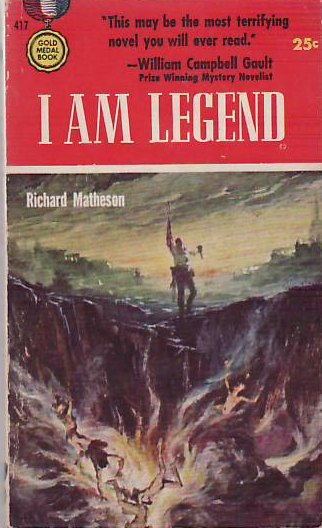
Cover of First Edition, 1954 (Please note that this cover is protected by copyright; please refer to Wikipedia for details on permissible use)
I have been reading Richard Matheson’s I am Legend recently whenever I have the opportunity. I would not say it is a fascinating book, but it is interesting. One particularly interesting aspect is that the book is not just about one man’s fight against zombies (which he terms “vampires”, but which fit better into the modern concept of zombies) , but that it also deals extensively with his fight against depression and loneliness in a post-apocalyptic future. Today, I happened to look up the work on Wikipedia and found the following interesting review written by Dan Schneider of International Writers Magazine: Book Review n 2005:
“…despite having vampires in it, [the novel] is not a novel on vampires, nor even a horror nor sci-fi novel at all, in the deepest sense. Instead, it is perhaps the greatest novel written on human loneliness. It far surpasses Daniel Defoe’s Robinson Crusoe in that regard. Its insights into what it is to be human go far beyond genre, and is all the more surprising because, having read his short stories – which range from competent but simplistic, to having classic Twilight Zone twists (he was a major contributor to the original TV series) there is nothing within those short stories that suggests the supreme majesty of the existential masterpiece I Am Legend was aborning.”
Mr. Schneider may very well be right that it may be the greatest novel written on human loneliness. If it is not, it is very close to the top. I have read Robinson Crusoe and my impression is that I am Legend surpasses that in describing the mental and emotional anguish of loneliness and bringing that inner struggle home to the modern reader.
In my view, one reason I am Legend is important to the horror genre, is because it shows another aspect of horror: personal, inner anguish and turmoil, which probably should be classified as a form of horror, if no one has done so yet. Anyone who has suffered extreme inner turmoil would probably agree that it is worthy of being termed horror. It may even be the most common form of real-life horror. I do not know the statistics for how many people are tortured at the hands of serial killers or executioners or other true-to-life monsters, but I would guess that it is far less than the number of people experiencing extreme negative emotions without actually having been physically tormented.
This aspect of inner horror can add another dimension to the otherwise average horror novel or movie, which, based on what I have seen, tends to emphasize physical violence or the threat of physical violence. In those works, the inner horror of the protagonists is usually assumed, but not examined in detail. Examining the inner emotions of protagonists and antagonists will help form empathy and sympathy for the characters within readers, particularly in those who have experienced a similar emotion, and will help form a tighter emotional connection between work and audience.
I recommend reading the Wikipedia article on I am Legend. It is quite fascinating. However, do not do as I have done and read it before completing the book. You will only spoil the ending for yourself.
Today, I received an e-mail from the folks at Every Day Fiction saying that they will publish my story “Murder by Plastic” either next month or the following month. Please watch the table of contents on their site for when it appears. I will post an update on my blog as soon as they notify me that it is up.
“Murder by Plastic” is flash fiction (about 998 words) that I can most accurately describe as on the border between crime thriller and horror. Please watch for it and visit Every Day Fiction often.
Lovecraft in the Depths of Contemplation Illustration by MirrorCradle
A problem I have encountered over the last few months is that most of the short stories on which I am working are too long for most publications, but too short to publish as novels.
Most magazines accept short stories of about 2,000 words. Above that, there seems to be a law of inverse proportions : the more words your short story has, the fewer publishers who will take it. Unfortunately, lately I find it difficult to write a story in less than 10,000 words.
Usually, I start with a simple concept for a story, but as I write, I see more and more details coming to light, details I think are important to understand what is happening in the story. I keep whittling down the words, contracting here, expanding there, omitting this and that, keeping the story as lean and muscular as possible while fleshing out the story enough so that the reader can live the story vicariously, but somehow the story keeps growing.
There is a school of thought that stories are out there in the literary ether, just waiting for the right author to come along and give them birth. That is certainly the way it seems at times. We could expand that comparison even further and say that stories are also like babies after birth and each will eventually grow to a certain size–whether we want it to or not. But we have much more control over the size of a short story than we do the size of a baby.
Here is a link to one of my earliest stories, “Sudan“, which was published by Ascent Aspirations several years ago. It has 2,095 words. It is not a work of horror. It is by my current standards rather amateurish. I based the story on a rather poignant story told to me by a former US assistant agricultural attache to Sudan, whom I met in Luxor, Egypt in 1989. That story lingered in the back of my mind for some time, almost haunting me, as if it had always been waiting to be told to the world and it refused to pass up this chance, before I finally wrote it down. It was published by Ascent Aspirations in August, 2002.
In 2009, I came across www.sixsentences.blogspot.com, which challenges writers to tell a story in six sentences or less. The assistant attache’s story still touched me after twenty years, so I decided to see if I could tell it in six sentences. I did. I changed the title and location and submitted it as “Warehouses and All“.
While the original Ascent Aspirations version was good, I believe the Six Sentences version is much better, more powerful, more poignant, perhaps because it is more compact.
Both these stories have exactly the same meaning. Which length suits it best? It is hard to say. Ultimately, deciding the length of a story depends upon the effect the writer wishes to instill in the reader. I do not think there is any way to concoct a rule of thumb about how to determine the length of short story. The writer must simply have a subjective feel for what length is appropriate. That is part of the art of writing.
There are probably many wonderful stories out there that cannot find a publisher because they do not fit the space constraints of most publications. The reality of the literary world is that publishers do have space constraints and if a writer wishes to be published, he will have to conform to those constraints. But this should not be seen as a brutal, demeaning demand for an author to butcher one of his stories as if he were a literary Abraham about to sacrifice Isaac on a stone altar. It should be seen as a challenge, an opportunity for personal growth as a writer, because then one is forced to look seriously, impartially, critically, and clincally at the work, and to ask oneself, “What is it that I really want to say? What do I want the reader to experience? How can I make this more powerful, more meaningful? What is the essence of this story?”
You may find that while it is challenging, it is not impossible to pack the meaning of 2,095 words into six sentences and still achieve the effect you wish to impart.
Now, if you will pardon me, I have to go listen to my own advice.
Some time back I was writing a story, thinking about how to be more mysterious in my writing, how to be less direct, yet provide more details in my narrative, when it occurred to me that (probably because I am a “dog person”) writing is often like talking about a dog without saying that you are talking about a dog.
Often, I have an idea or a feeling that I want to express, but if I try to express it directly and concisely, the reader will probably not apprehend the nuances I see in the idea. At the same time, much of the enjoyment in reading is trying to perceive the meaning behind the author’s words while experiencing the world of the work’s narrator vicariously. Therefore, as a writer, I want to get my ideas across without being so direct that the reader loses much of the fun of reading. For example, look at the first chapter of Hemingway’s A Farewell to Arms. Hemingway was known for his lean, muscular style, so you know he isn’t going to use any more words than necessary to express his ideas.
In the first chapter, he describes soldiers marching off to the front over the course of several months as he views them from a nearby house. As he watches the soldiers, the leaves fall from the trees, the vineyards dry up, the mountains turn brown and bare, and the dust the soldiers kick up turn everything bare and white–the color of bone. All these hint at death. Hemingway could have said simply, “Frederic Henry [the main character] watched the soldiers march off to their deaths”, but the reader would have lost the experience of living that time with Frederic and he would have lost sharing Frederic’s experience of witnessing an event and puzzling out its greater meaning for himself. All the artistic beauty of that chapter would have been lost.
I recall reading somewhere several years ago this idea described as the principle of contraction and expansion. That is no doubt true. Yet, to describe it so unemotionally as “contraction and expansion” seems aesthetically too clinical, too sterile, too confining a term for an idea concerning the breadth and depth of literary intellectual and emotional perception.
I think I prefer to think of this idea in terms of a dog, a living, breathing being full of warmth, love, loyalty, joy, anger, fear, tenderness, intelligence, stupidity, pain, and all the other abstract qualities sentient creatures have. Yes, I can simply say “dog” and hope my readers see all the nuances of a dog’s existence that I do, but they might not and I would be depriving them of the experience of sharing my perception and all the intimated nuances and emotions that come with it. So sometimes it is best just to describe the nuances of a dog’s life and let my readers enjoy drawing their own conclusions and along with these conclusions enjoy the subsequent discussions and debates among them as to who was right, who was wrong, who knew what he was talking about, who did not, and so on.
There are times when it is necessary to be concise, to pick a single word you hope is as pregnant with meaning for the reader as it is for you, but those times must be balanced against the times when the reader needs to experience an event and all its nuances. The writer, as artist, must decide how to balance out those moments. The writer strives to achieve a balance of ideas and perceptions. Balance is part of the art of writing. Balance is part of the Tao of writing.
Sometimes it is best to simply say “dog.” At other times it is best to talk about a dog without actually saying that you are talking about a dog.






 Phil Slattery, Writer, Publisher