Current headline at Through the Gaps showing illustrations for “Shapeshifter”, “Decision”, and “Sudan”
Through the Gaps has just published my story “Shapeshifter” about a werewolf sighting in France in 1601. For the first time I have three stories appearing simultaneously in one magazine: “Shapeshifter”, “Decision”, and “Sudan”. All are reprints of early works. Many thanks once again to the wonderful folks at Through the Gaps. Shown is a snippet from their current front page.
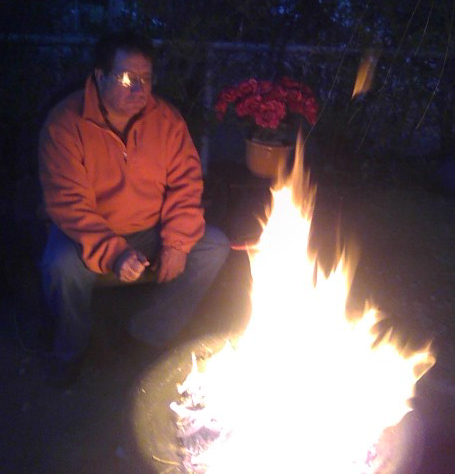
Relaxing by the front yard firepit on a chilly New Mexico evening circa 2013.
I just received word that my short horror story “A Tale of Hell” will be published by Fiction on the Web (www.fictionontheweb.co.uk) on May 24. Please check it out. “A Tale of Hell” is about a man who has a vivid dream of being in hell, but then strange things start to happen. Many thanks to Charlie Fish and all the other staff at Fiction on the Web who made this happen. “A Tale of Hell” was originally published by Midnight Times in 2006.
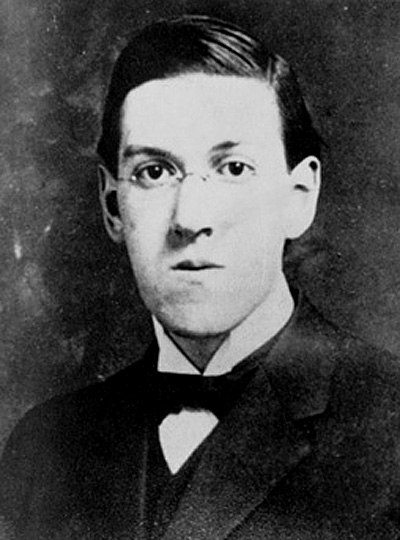
April 17, 1926: On this day, H.P Lovecraft returned to his home in Providence, Rhode Island after suffering a few years in the “hateful chaos” of Brooklyn. He never moved away again
Good review: Clive Barker ‘The Scarlet Gospels’ Advance Review. As you can see in my comments, the review sounds fair, honest, and straightforward. Also, I enjoyed his comments on Barker’s other works. Unfortunately, I have read only The Hellbound Heart and Books of Blood, but I want to read the others as soon as I can dedicate the time to each. However, I already have a couple of dozen works on my “to read” list including those on my Goodreads “to read” list. It is unfortunate that Mr. Barker may be going through a down period, but many, if not most, authors and artists of all types do. What is important is how long the down turn lasts.
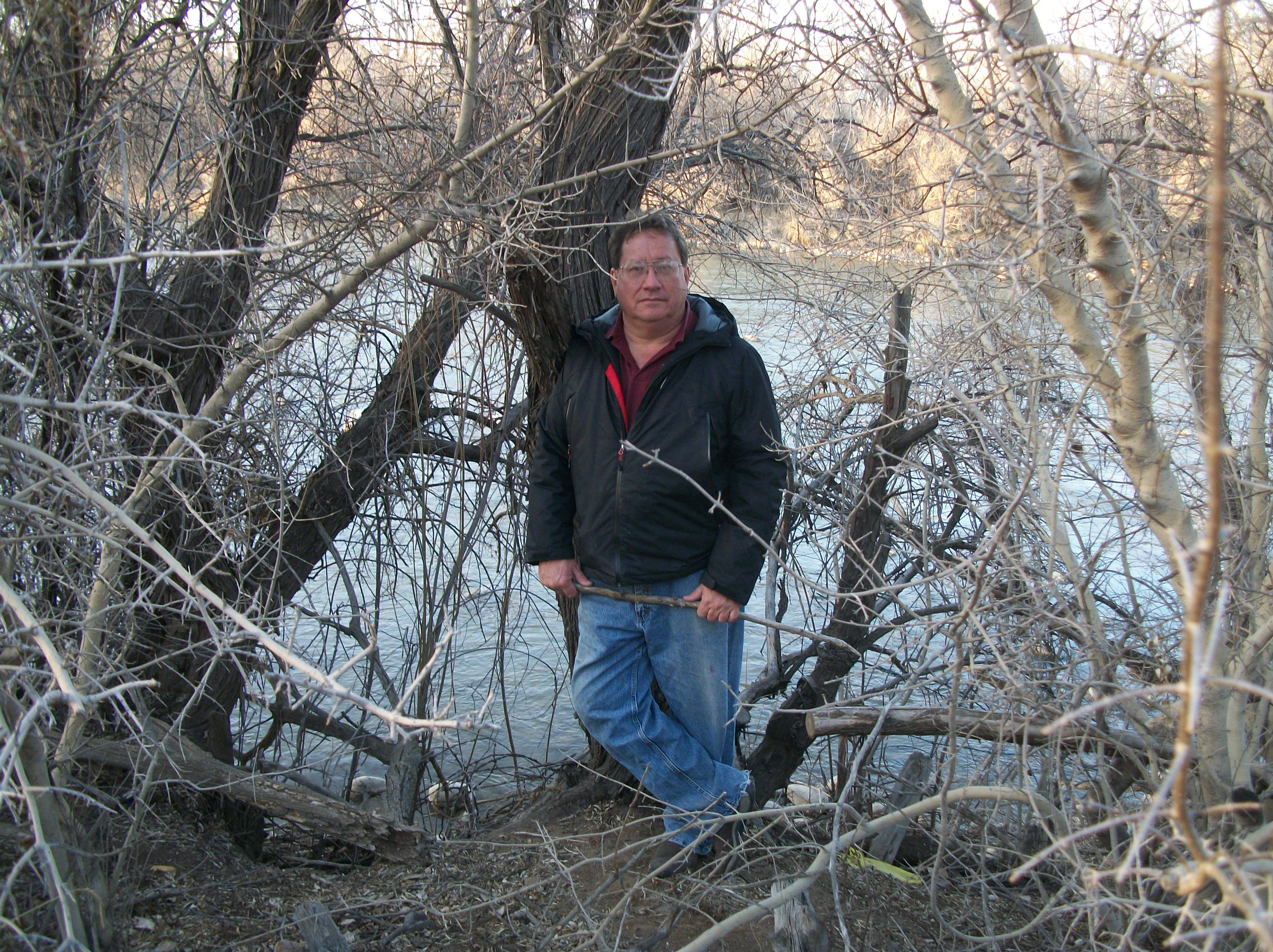
The blogger hiking in the Bisti Wilderness near Farmington, NM.
I just signed and returned the contract for my short horror story “Ivan” to appear in the April, 2016 edition of “Infernal Ink”. “Ivan” is about a young serial killer in the making. I would like to thank the “Infernal Ink” staff for publishing my work. This is the first time I have had a new work published in over a year or more.
The idea for “Ivan” came to me while returning from Navajo Lake through an isolated stretch of road in a large canyon at sunset. It was a very spooky setting and I thought about what would happen if a family became stranded in country like that and, while looking for help, wandered onto the estate of a serial killer. The upshot of that story was that the serial killer trapped them in his basement only to discover he was trapped in his own basement with a family of werewolves. I submitted it to several publications, but was consistently turned down. One staff critqued the manuscript by saying that it was such a common story line, they were taking bets on whether the family would turn out to be werewolves or vampires at the end. I took my cue from that and gave my work an honest review and decided that they were right. So I changed the ending to one I thought would be completely unexpected, sent out the new manuscript to a publisher to which I had not previously submitted any work, and the story has been accepted.
Please note that the story will appear in 2016 vs. 2015. It will be worth the wait.
Again, many heartfelt thanks to the “Infernal Ink” staff, Hydra M. Star and Dave Lipscomb, for publishing my work.
Check out the cool covers in this article from the folks over at Rare Horror. These remind me of ones I see going through those second-rate, family-run, second-hand bookstores that you find in side streets and back alleys (if you are lucky enough to find ones with the covers intact and not torn off): 5 Awesome Horror Book Covers.
Relaxing by the front yard firepit on a chilly New Mexico evening circa 2013.
I picked up a copy of the latest issue of “Cemetery Dance” this evening and read the Stephen King short story “Summer Thunder”. This is a very interesting piece. I won’t spoil the ending for you, but the story is about a man, his dog, and his neighbor, who have survived a nuclear holocaust and are slowly succumbing to radiation poisoning.
This story was quite different from the other Stephen King stories I have read (which have been quite a few, though not all by any means). There is no supernatural factor in the story. There are also no twists or surprises. The story maintains the same pace throughout, just as the protagonists face the same things day in and day out until they die.
I would classify this story as horror-tragedy, because, even though it has very little of the blood and gore normally associated with the horror genre, it definitely has a horror “feel” to it, but that horror is subtle and understated. “Summer Thunder” sets up a tragic scenario and the horror finds its basis in watching these people suffer through no fault of their own. They were not involved in starting the war in any way; that was done by world leaders thousands of miles away. These are the common citizens, the “Everymen” that normally populate King’s works as protagonists, and who must pay the horrific price for their government’s actions. That is the tragedy and that is a large part of the horror.
What is also horrifying about the story is not the action described in it, but the scenario it describes, because this scenario is definitely one that could literally happen to each of us, should our government and/or other governments decide for whatever reason, to push the proverbial button. Each of us can (or perhaps should) see ourselves as the main character, who will be forced to watch his or her world disintegrate after a nuclear apocalypse.
That concept alone should be enough to bring the true horror of this story: that this scenario is, and has been for a long time, a real possibility for each of us.
Neil Gaiman at the 2007 Scream Awards Photo by pinguino k
Here’s the second batch of writing tips from Open Culture. They include tidbits from Neil Gaiman, Henry Miller, Elmore Leonard, George Orwell, and Margaret Atwood. Enjoy.
Great article. Over the next week I hope to post more writing tips from great authors as they appeared in Open Culture. They have a wealth of good advice that I would like to share.
Interesting article, though I tend to disagree with his descriptions of what was going through Poe’s mind when he wrote this. Though I am not a skeptic, I tend to be skeptical when someone tells me in effect “yes, that is what he says, but this is what he meant…” Poe definitely hyped the bejeezus out of the poem (and his ego) by calling it the best poem ever written, but as for the rest…who knows?
The blogger relaxing by the front yard firepit on a chilly New Mexico evening.
I was just sitting here trying to choose one of my many first drafts to work on for tonight, when I started thinking about the different “approaches” (for lack of a better term at the moment) to horror. By “approaches” I mean a very brief synopsis of a writer’s general outlook on or method of writing horror. Maybe a better way to express it would be to say the way the author approaches his genre (still not quite right, but I am getting closer to the idea).
An example would be to say that Poe’s approach was to bring out the horror in realistic situations (mostly, he did dabble in the fantastic occasionally). “The Black Cat” is about a murderer who unknowingly seals up a cat with the corpse of his victim. Nothing fantastic there. “The Tell-Tale Heart” is about a murderer whose conscience drives him to confession. “The Fall of the House of Usher” is about a family with an inherited genetic trait of hypersensitivity. So forth and so on.
Lovecraft’s approach was to spin tales of the fantastic, especially about a race of elder gods who once dominated the planet millions of years ago and of which mankind encounters remnants on rare occasion.
Stephen King’s approach is to plant an element of the fantastic among ordinary people in ordinary places and watch them react to it.
Clive Barker’s approach seems to be to take something that is fantastic, bloody, cruel, evil and gruesome and either drop it somewhere a single character can deal with it or bring it out of the shadows where a character can deal with it.
Seeing these different approaches in relation to each other makes me think about how do I want to approach an idea or a draft I have of a story. Do I want to drop the fantastic into the real or bring out the horror in the everyday or in realistic situations or can I come up with something else, my own approach, that is none of these? That is the challenge of creativity: to come up with something no one else has done. Maybe I can just go with the purely fantastic. Maybe I can try to find the real in the fantastic.
How many different ways are there to horrify an audience?
There is the real and the fantastic and all those subtle shades of gray in between the two. Can there be anything else?




 Phil Slattery, Writer, Publisher