The Saturday Night Special: “The Phantom Coach” by Amelia B. Edwards (1864)

The circumstances I am about to relate to you have truth to recommend them. They happened to myself, and my recollection of them is as vivid as if they had taken place only yesterday. Twenty years, however, have gone by since that night. During those twenty years I have told the story to but one other person. I tell it now with a reluctance which I find it difficult to overcome. All I entreat, meanwhile, is that you will abstain from forcing your own conclusions upon me. I want nothing explained away. I desire no arguments. My mind on this subject is quite made up, and, having the testimony of my own senses to rely upon, I prefer to abide by it.
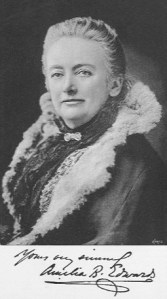
Amelia B. Edwards, 1890

Well! It was just twenty years ago, and within a day or two of the end of the grouse season. I had been out all day with my gun, and had had no sport to speak of. The wind was due east; the month, December; the place, a bleak wide moor in the far north of England. And I had lost my way. It was not a pleasant place in which to lose one’s way, with the first feathery flakes of a coming snowstorm just fluttering down upon the heather, and the leaden evening closing in all around. I shaded my eyes with my hand, and staled anxiously into the gathering darkness, where the purple moorland melted into a range of low hills, some ten or twelve miles distant. Not the faintest smoke-wreath, not the tiniest cultivated patch, or fence, or sheep-track, met my eyes in any direction. There was nothing for it but to walk on, and take my chance of finding what shelter I could, by the way. So I shouldered my gun again, and pushed wearily forward; for I had been on foot since an hour after daybreak, and had eaten nothing since breakfast.

Meanwhile, the snow began to come down with ominous steadiness, and the wind fell. After this, the cold became more intense, and the night came rapidly up. As for me, my prospects darkened with the darkening sky, and my heart grew heavy as I thought how my young wife was already watching for me through the window of our little inn parlour, and thought of all the suffering in store for her throughout this weary night. We had been married four months, and, having spent our autumn in the Highlands, were now lodging in a remote little village situated just on the verge of the great English moorlands. We were very much in love, and, of course, very happy. This morning, when we parted, she had implored me to return before dusk, and I had promised her that I would. What would I not have given to have kept my word!

Even now, weary as I was, I felt that with a supper, an hour’s rest, and a guide, I might still get back to her before midnight, if only guide and shelter could be found.

And all this time, the snow fell and the night thickened. I stopped and shouted every now and then, but my shouts seemed only to make the silence deeper. Then a vague sense of uneasiness came upon me, and I began to remember stories of travellers who had walked on and on in the falling snow until, wearied out, they were fain to lie down and sleep their lives away. Would it be possible, I asked myself, to keep on thus through all the long dark night? Would there not come a time when my limbs must fail, and my resolution give way? When I, too, must sleep the sleep of death. Death! I shuddered. How hard to die just now, when life lay all so bright before me! How hard for my darling, whose whole loving heart but that thought was not to be borne! To banish it, I shouted again, louder and longer, and then listened eagerly. Was my shout answered, or did I only fancy that I heard a far-off cry? I halloed again, and again the echo followed. Then a wavering speck of light came suddenly out of the dark, shifting, disappearing, growing momentarily nearer and brighter. Running towards it at full speed, I found myself, to my great joy, face to face with an old man and a lantern.

“Thank God!” was the exclamation that burst involuntarily from my lips.

Blinking and frowning, he lifted his lantern and peered into my face.

“What for?” growled he, sulkily.

“Well — for you. I began to fear I should be lost in the snow.”

“Eh, then, folks do get cast away hereabouts fra’ time to time, an’ what’s to hinder you from bein’ cast away likewise, if the Lord’s so minded?”

“If the Lord is so minded that you and I shall be lost together, friend, we must submit,” I replied; “but I don’t mean to be lost without you. How far am I now from Dwolding?”

“A gude twenty mile, more or less.”

“And the nearest village?”

“The nearest village is Wyke, an’ that’s twelve mile t’other side.”

“Where do you live, then?”

“Out yonder,” said he, with a vague jerk of the lantern.

“You’re going home, I presume?”

“Maybe I am.”

“Then I’m going with you.”

The old man shook his head, and rubbed his nose reflectively with the handle of the lantern.

“It ain’t o’ no use,” growled he. “He ‘ont let you in — not he.”

“We’ll see about that,” I replied, briskly. “Who is He?”

“The master.”

“Who is the master?”

“That’s nowt to you,” was the unceremonious reply.

“Well, well; you lead the way, and I’ll engage that the master shall give me shelter and a supper to-night.”

“Eh, you can try him!” muttered my reluctant guide; and, still shaking his head, he hobbled, gnome-like, away through the falling snow. A large mass loomed up presently out of the darkness, and a huge dog rushed out, barking furiously.

“Is this the house?” I asked.

“Ay, it’s the house. Down, Bey!” And he fumbled in his pocket for the key.

 I drew up close behind him, prepared to lose no chance of entrance, and saw in the little circle of light shed by the lantern that the door was heavily studded with iron nails, like the door of a prison. In another minute he had turned the key and I had pushed past him into the house.

 Once inside, I looked round with curiosity, and found myself in a great raftered hall, which served, apparently, a variety of uses. One end was piled to the roof with corn, like a barn. The other was stored with flour-sacks, agricultural implements, casks, and all kinds of miscellaneous lumber; while from the beams overhead hung rows of hams, flitches, and bunches of dried herbs for winter use. In the centre of the floor stood some huge object gauntly dressed in a dingy wrapping-cloth, and reaching half way to the rafters. Lifting a corner of this cloth, I saw, to my surprise, a telescope of very considerable size, mounted on a rude movable platform, with four small wheels. The tube was made of painted wood, bound round with bands of metal rudely fashioned; the speculum, so far as I could estimate its size in the dim light, measured at least fifteen inches in diameter. While I was yet examining the instrument, and asking myself whether it was not the work of some self-taught optician, a bell rang sharply.

“That’s for you,” said my guide, with a malicious grin. “Yonder’s his room.”

He pointed to a low black door at the opposite side of the hall. I crossed over, rapped somewhat loudly, and went in, without waiting for an invitation. A huge, white-haired old man rose from a table covered with books and papers, and confronted me sternly.

“Who are you?” said he. “How came you here? What do you want?”

“James Murray, barrister-at-law. On foot across the moor. Meat, drink, and sleep.”

He bent his bushy brows into a portentous frown.

“Mine is not a house of entertainment,” he said, haughtily. “Jacob, how dared you admit this stranger?”
 “I didn’t admit him,” grumbled the old man. “He followed me over the muir, and shouldered his way in before me. I’m no match for six foot two.”

“And pray, sir, by what right have you forced an entrance into my house?”

“The same by which I should have clung to your boat, if I were drowning. The right of self-preservation.”

“Self-preservation?”

“There’s an inch of snow on the ground already,” I replied, briefly; “and it would be deep enough to cover my body before daybreak.”

He strode to the window, pulled aside a heavy black curtain, and looked out.

“It is true,” he said. “You can stay, if you choose, till morning. Jacob, serve the supper.”

With this he waved me to a seat, resumed his own, and became at once absorbed in the studies from which I had disturbed him.

I placed my gun in a corner, drew a chair to the hearth, and examined my quarters at leisure. Smaller and less incongruous in its arrangements than the hall, this room contained, nevertheless, much to awaken my curiosity. The floor was carpetless. The whitewashed walls were in parts scrawled over with strange diagrams, and in others covered with shelves crowded with philosophical instruments, the uses of many of which were unknown to me. On one side of the fireplace, stood a bookcase filled with dingy folios; on the other, a small organ, fantastically decorated with painted carvings of medieval saints and devils. Through the half-opened door of a cupboard at the further end of the room, I saw a long array of geological specimens, surgical preparations, crucibles, retorts, and jars of chemicals; while on the mantelshelf beside me, amid a number of small objects, stood a model of the solar system, a small galvanic battery, and a microscope. Every chair had its burden. Every corner was heaped high with books. The very floor was littered over with maps, casts, papers, tracings, and learned lumber of all conceivable kinds.

 I stared about me with an amazement increased by every fresh object upon which my eyes chanced to rest. So strange a room I had never seen; yet seemed it stranger still, to find such a room in a lone farmhouse amid those wild and solitary moors! Over and over again, I looked from my host to his surroundings, and from his surroundings back to my host, asking myself who and what he could be? His head was singularly fine; but it was more the head of a poet than of a philosopher. Broad in the temples, prominent over the eyes, and clothed with a rough profusion of perfectly white hair, it had all the ideality and much of the ruggedness that characterises the head of Louis von Beethoven. There were the same deep lines about the mouth, and the same stern furrows in the brow. There was the same concentration of expression. While I was yet observing him, the door opened, and Jacob brought in the supper. His master then closed his book, rose, and with more courtesy of manner than he had yet shown, invited me to the table.
A dish of ham and eggs, a loaf of brown bread, and a bottle of admirable sherry, were placed before me.

“I have but the homeliest farmhouse fare to offer you, sir,” said my entertainer. “Your appetite, I trust, will make up for the deficiencies of our larder.”

I had already fallen upon the viands, and now protested, with the enthusiasm of a starving sportsman, that I had never eaten anything so delicious.

He bowed stiffly, and sat down to his own supper, which consisted, primitively, of a jug of milk and a basin of porridge. We ate in silence, and, when we had done, Jacob removed the tray. I then drew my chair back to the fireside. My host, somewhat to my surprise, did the same, and turning abruptly towards me, said:

“Sir, I have lived here in strict retirement for three-and-twenty years. During that time, I have not seen as many strange faces, and I have not read a single newspaper. You are the first stranger who has crossed my threshold for more than four years. Will you favour me with a few words of information respecting that outer world from which I have parted company so long?”

 “Pray interrogate me,” I replied. “I am heartily at your service.”

He bent his head in acknowledgment; leaned forward, with his elbows resting on his knees and his chin supported in the palms of his hands; stared fixedly into the fire; and proceeded to question me.

His inquiries related chiefly to scientific matters, with the later progress of which, as applied to the practical purposes of life, he was almost wholly unacquainted. No student of science myself, I replied as well as my slight information permitted; but the task was far from easy, and I was much relieved when, passing from interrogation to discussion, he began pouring forth his own conclusions upon the facts which I had been attempting to place before him. He talked, and I listened spellbound. He talked till I believe he almost forgot my presence, and only thought aloud. I had never heard anything like it then; I have never heard anything like it since. Familiar with all systems of all philosophies, subtle in analysis, bold in generalisation, he poured forth his thoughts in an uninterrupted stream, and, still leaning forward in the same moody attitude with his eyes fixed upon the fire, wandered from topic to topic, from speculation to speculation, like an inspired dreamer. From practical science to mental philosophy; from electricity in the wire to electricity in the nerve; from Watts to Mesmer, from Mesmer to Reichenbach, from Reichenbach to Swedenborg, Spinoza, Condillac, Descartes, Berkeley, Aristotle, Plato, and the Magi and mystics of the East, were transitions which, however bewildering in their variety and scope, seemed easy and harmonious upon his lips as sequences in music. By-and-by — I forget now by what link of conjecture or illustration — he passed on to that field which lies beyond the boundary line of even conjectural philosophy, and reaches no man knows whither. He spoke of the soul and its aspirations; of the spirit and its powers; of second sight; of prophecy; of those phenomena which, under the names of ghosts, spectres, and supernatural appearances, have been denied by the sceptics and attested by the credulous, of all ages.

“The world,” he said, “grows hourly more and more sceptical of all that lies beyond its own narrow radius; and our men of science foster the fatal tendency. They condemn as fable all that resists experiment. They reject as false all that cannot be brought to the test of the laboratory or the dissecting-room. Against what superstition have they waged so long and obstinate a war, as against the belief in apparitions? And yet what superstition has maintained its hold upon the minds of men so long and so firmly? Show me any fact in physics, in history, in archæology, which is supported by testimony so wide and so various. Attested by all races of men, in all ages, and in all climates, by the soberest sages of antiquity, by the rudest savage of to-day, by the Christian, the Pagan, the Pantheist, the Materialist, this phenomenon is treated as a nursery tale by the philosophers of our century. Circumstantial evidence weighs with them as a feather in the balance. The comparison of causes with effects, however valuable in physical science, is put aside as worthless and unreliable. The evidence of competent witnesses, however conclusive in a court of justice, counts for nothing. He who pauses before he pronounces, is condemned as a trifler. He who believes, is a dreamer or a fool.”

He spoke with bitterness, and, having said thus, relapsed for some minutes into silence. Presently he raised his head from his hands, and added, with an altered voice and manner, “I, sir, paused, investigated, believed, and was not ashamed to state my convictions to the world. I, too, was branded as a visionary, held up to ridicule by my contemporaries, and hooted from that field of science in which I had laboured with honour during all the best years of my life. These things happened just three-and-twenty years ago. Since then, I have lived as you see me living now, and the world has forgotten me, as I have forgotten the world. You have my history.”

“It is a very sad one,” I murmured, scarcely knowing what to answer.

“It is a very common one,” he replied. “I have only suffered for the truth, as many a better and wiser man has suffered before me.”

He rose, as if desirous of ending the conversation, and went over to the window.

“It has ceased snowing,” he observed, as he dropped the curtain, and came back to the fireside.

“Ceased!” I exclaimed, starting eagerly to my feet. “Oh, if it were only possible — but no! it is hopeless. Even if I could find my way across the moor, I could not walk twenty miles to-night.”

“Walk twenty miles to-night!” repeated my host. “What are you thinking of?”

“Of my wife,” I replied, impatiently. “Of my young wife, who does not know that I have lost my way, and who is at this moment breaking her heart with suspense and terror.”

“Where is she?”

“At Dwolding, twenty miles away.”

“At Dwolding,” he echoed, thoughtfully. “Yes, the distance, it is true, is twenty miles; but — are you so very anxious to save the next six or eight hours?”

“So very, very anxious, that I would give ten guineas at this moment for a guide and a horse.”

 “Your wish can be gratified at a less costly rate,” said he, smiling. “The night mail from the north, which changes horses at Dwolding, passes within five miles of this spot, and will be due at a certain cross-road in about an hour and a quarter. If Jacob were to go with you across the moor, and put you into the old coach-road, you could find your way, I suppose, to where it joins the new one?”

“Easily — gladly.”

He smiled again, rang the bell, gave the old servant his directions, and, taking a bottle of whisky and a wineglass from the cupboard in which he kept his chemicals, said:

“The snow lies deep, and it will be difficult walking to-night on the moor. A glass of usquebaugh before you start?”

I would have declined the spirit, but he pressed it on me, and I drank it. It went down my throat like liquid flame, and almost took my breath away.

“It is strong,” he said; “but it will help to keep out the cold. And now you have no moments to spare. Good night!”

I thanked him for his hospitality, and would have shaken hands, but that he had turned away before I could finish my sentence. In another minute I had traversed the hall, Jacob had locked the outer door behind me, and we were out on the wide white moor.

Although the wind had fallen, it was still bitterly cold. Not a star glimmered in the black vault overhead. Not a sound, save the rapid crunching of the snow beneath our feet, disturbed the heavy stillness of the night. Jacob, not too well pleased with his mission, shambled on before in sullen silence, his lantern in his hand, and his shadow at his feet. I followed, with my gun over my shoulder, as little inclined for conversation as himself. My thoughts were full of my late host. His voice yet rang in my ears. His eloquence yet held my imagination captive. I remember to this day, with surprise, how my over-excited brain retained whole sentences and parts of sentences, troops of brilliant images, and fragments of splendid reasoning, in the very words in which he had uttered them. Musing thus over what I had heard, and striving to recall a lost link here and there, I strode on at the heels of my guide, absorbed and unobservant. Presently — at the end, as it seemed to me, of only a few minutes — he came to a sudden halt, and said:

“Yon’s your road. Keep the stone fence to your right hand, and you can’t fail of the way.”

 “This, then, is the old coach-road?”

“Ay, ’tis the old coach-road.”

“And how far do I go, before I reach the cross-roads?”

“Nigh upon three mile.”

I pulled out my purse, and he became more communicative.

“The road’s a fair road enough,” said he, “for foot passengers; but ’twas over steep and narrow for the northern traffic. You’ll mind where the parapet’s broken away, close again the sign-post. It’s never been mended since the accident.”

“What accident?”

“Eh, the night mail pitched right over into the valley below — a gude fifty feet an’ more — just at the worst bit o’ road in the whole county.”

“Horrible! Were many lives lost?”

“All. Four were found dead, and t’other two died next morning.”

“How long is it since this happened?”

“Just nine year.”

“Near the sign-post, you say? I will bear it in mind. Good night.”

“Gude night, sir, and thankee.” Jacob pocketed his half-crown, made a faint pretence of touching his hat, and trudged back by the way he had come.

I watched the light of his lantern till it quite disappeared, and then turned to pursue my way alone. This was no longer matter of the slightest difficulty, for, despite the dead darkness overhead, the line of stone fence showed distinctly enough against the pale gleam of the snow. How silent it seemed now, with only my footsteps to listen to; how silent and how solitary! A strange disagreeable sense of loneliness stole over me. I walked faster. I hummed a fragment of a tune. I cast up enormous sums in my head, and accumulated them at compound interest. I did my best, in short, to forget the startling speculations to which I had but just been listening, and, to some extent, I succeeded.

Meanwhile the night air seemed to become colder and colder, and though I walked fast I found it impossible to keep myself warm. My feet were like ice. I lost sensation in my hands, and grasped my gun mechanically. I even breathed with difficulty, as though, instead of traversing a quiet north country highway, I were scaling the uppermost heights of some gigantic Alp. This last symptom became presently so distressing, that I was forced to stop for a few minutes, and lean against the stone fence. As I did so, I chanced to look back up the road, and there, to my infinite relief, I saw a distant point of light, like the gleam of an approaching lantern. I at first concluded that Jacob had retraced his steps and followed me; but even as the conjecture presented itself, a second light flashed into sight — a light evidently parallel with the first, and approaching at the same rate of motion. It needed no second thought to show me that these must be the carriage-lamps of some private vehicle, though it seemed strange that any private vehicle should take a road professedly disused and dangerousThere could be no doubt, however, of the fact, for the lamps grew larger and brighter every moment, and I even fancied I could already see the dark outline of the carriage between them. It was coming up very fast, and quite noiselessly, the snow being nearly a foot deep under the wheels.

And now the body of the vehicle became distinctly visible behind the lamps. It looked strangely lofty. A sudden suspicion flashed upon me. Was it possible that I had passed the cross-roads in the dark without observing the sign-post, and could this be the very coach which I had come to meet?

No need to ask myself that question a second time, for here it came round the bend of the road, guard and driver, one outside passenger, and four steaming greys, all wrapped in a soft haze of light, through which the lamps blazed out, like a pair of fiery meteors.

I jumped forward, waved my hat, and shouted. The mail came down at full speed, and passed me. For a moment I feared that I had not been seen or heard, but it was only for a moment. The coachman pulled up; the guard, muffled to the eyes in capes and comforters, and apparently sound asleep in the rumble, neither answered my hail nor made the slightest effort to dismount; the outside passenger did not even turn his head. I opened the door for myself, and looked in. There were but three travellers inside, so I stepped in, shut the door, slipped into the vacant corner, and congratulated myself on my good fortune.

The atmosphere of the coach seemed, if possible, colder than that of the outer air, and was pervaded by a singularly damp and disagreeable smell. I looked round at my fellow-passengers. They were all three, men, and all silent. They did not seem to be asleep, but each leaned back in his corner of the vehicle, as if absorbed in his own reflections. I attempted to open a conversation.

“How intensely cold it is to-night,” I said, addressing my opposite neighbour.

He lifted his head, looked at me, but made no reply.

“The winter,” I added, “seems to have begun in earnest.”

Although the corner in which he sat was so dim that I could distinguish none of his features very clearly, I saw that his eyes were still turned full upon me. And yet he answered never a word.

At any other time I should have felt, and perhaps expressed, some annoyance, but at the moment I felt too ill to do either. The icy coldness of the night air had struck a chill to my very marrow, and the strange smell inside the coach was affecting me with an intolerable nausea. I shivered from head to foot, and, turning to my left-hand neighbour, asked if he had any objection to an open window?

He neither spoke nor stirred.

I repeated the question somewhat more loudly, but with the same result. Then I lost patience, and let the sash down. As I did so, the leather strap broke in my hand, and I observed that the glass was covered with a thick coat of mildew, the accumulation, apparently, of years. My attention being thus drawn to the condition of the coach, I examined it more narrowly, and saw by the uncertain light of the outer lamps that it was in the last stage of dilapidation. Every part of it was not only out of repair, but in a condition of decay. The sashes splintered at a touch. The leather fittings were crusted over with mould, and literally rotting from the woodwork. The floor was almost breaking away beneath my feet. The whole machine, in short, was foul with damp, and had evidently been dragged from some outhouse in which it had been mouldering away for years, to do another day or two of duty on the road.

I turned to the third passenger, whom I had not yet addressed, and hazarded one more remark.

“This coach,” I said, “is in a deplorable condition. The regular mail, I suppose, is under repair?”

He moved his head slowly, and looked me in the face, without speaking a word. I shall never forget that look while I live. I turned cold at heart under it. I turn cold at heart even now when I recall it. His eyes glowed with a fiery unnatural lustre. His face was livid as the face of a corpse. His bloodless lips were drawn back as if in the agony of death, and showed the gleaming teeth between.

The words that I was about to utter died upon my lips, and a strange horror — a dreadful horror — came upon me. My sight had by this time become used to the gloom of the coach, and I could see with tolerable distinctness. I turned to my opposite neighbour. He, too, was looking at me, with the same startling pallor in his face, and the same stony glitter in his eyes. I passed my hand across my brow. I turned to the passenger on the seat beside my own, and saw — oh Heaven! how shall I describe what I saw? I saw that he was no living man — that none of them were living men, like myself! A pale phosphorescent light — the light of putrefaction — played upon their awful faces; upon their hair, dank with the dews of the grave; upon their clothes, earth-stained and dropping to pieces; upon their hands, which were as the hands of corpses long buried. Only their eyes, their terrible eyes, were living; and those eyes were all turned menacingly upon me!

A shriek of terror, a wild unintelligible cry for help and mercy; burst from my lips as I flung myself against the door, and strove in vain to open it.

 In that single instant, brief and vivid as a landscape beheld in the flash of summer lightning, I saw the moon shining down through a rift of stormy cloud — the ghastly sign-post rearing its warning finger by the wayside — the broken parapet — the plunging horses — the black gulf below. Then, the coach reeled like a ship at sea. Then, came a mighty crash — a sense of crushing pain — and then, darkness.

It seemed as if years had gone by when I awoke one morning from a deep sleep, and found my wife watching by my bedside I will pass over the scene that ensued, and give you, in half a dozen words, the tale she told me with tears of thanksgiving. I had fallen over a precipice, close against the junction of the old coach-road and the new, and had only been saved from certain death by lighting upon a deep snowdrift that had accumulated at the foot of the rock beneath. In this snowdrift I was discovered at daybreak, by a couple of shepherds, who carried me to the nearest shelter, and brought a surgeon to my aid. The surgeon found me in a state of raving delirium, with a broken arm and a compound fracture of the skull. The letters in my pocket-book showed my name and address; my wife was summoned to nurse me; and, thanks to youth and a fine constitution, I came out of danger at last. The place of my fall, I need scarcely say, was precisely that at which a frightful accident had happened to the north mail nine years before.

I never told my wife the fearful events which I have just related to you. I told the surgeon who attended me; but he treated the whole adventure as a mere dream born of the fever in my brain. We discussed the question over and over again, until we found that we could discuss it with temper no longer, and then we dropped it. Others may form what conclusions they please — I know that twenty years ago I was the fourth inside passenger in that Phantom Coach.


Announcement: Phil Slattery Teams with Darksomnia Productions to Produce Documentary of a Haunting

Francene Kilgore (l) and I on the set with Alrenzo Black (r) and 2tk (center) of Darksomnia Productions, August 6, 2016

My fiancée (Francene Kilgore) and I are teaming with Darksomnia Productions of Farmington, NM to produce a documentary/dramatization of a haunting that occurred in south Texas from about 2006-2010.  Filming is taking place.  Parts of the documentary will be dramatized by actors while my fiancee and I appear discussing the events.  The video should be completed within 1-2 months.   More details to come.


Darksomnia Productions

Alrenzo Black (l) and 2tk (r) of CEO's and co-founders of Darksomnia Productions.

Alrenzo Black (l) and 2tk (r) of CEO’s and co-founders of Darksomnia Productions.

The Farmington Writers Circle Meets Tonight

20151027_130831The Farmington Writers Circle meets tonight at 7:00 p.m. at Hastings Hardback Café in Farmington, NM.  The topic for the night will be how to generate reviews for your work.

The July meeting was attended by Gloria, Yvonne, Vicki, myself, and by author Delsheree Gladden (delshereegladden.com), whose website describes her as “USA Today Bestselling Young Adult and Romance Author”.  Delsheree provided some valuable insights into the world of publishing.

The Farmington Writers Circle is nascent organization of Farmington-area writers who are interested in finding or developing innovative ways of publicizing and marketing their works.   Meetings are usually round-table discussions, although occasionally a member will lead the discussion when it deals with an area of the member’s expertise.  The public is invited to attend.  There are no fees or requirements to attend meetings, which are usually held on the second Thursday of each month at 7:00 p.m. at the Hardback Café. Writers of any and all genres or non-writers with an interest in the art are welcome.  For more information, contact me via this website.

Reminder: Submissions of Works of Horror Being Considered for Publication

If you would like to submit a short horror story (flash fiction of less than 1,000 words preferred), an article or book/movie review on the art of writing horror fiction, or just on the art of writing, please send it to horror@philslattery.com.   Everything must be submitted by e-mail either in the body of the e-mail or a Word document (.doc or .docx).  There is no pay for any submission at this time (maybe after I win the Pulitzer or Nobel, but probably not before then).

I am seeking:

  1. Articles under 1,000 words on the art of writing horror (fiction of any length, poetry, screenplays, etc.) or on writing in general, but material along the lines of horror is preferred.  Articles on foreign horror are encouraged.
  2. Book and movie reviews, the more recently published or distributed the better, but I will consider reviews of classics works such as those of Poe, Lovecraft, Blackwood, etc. all the way back to Walpole (and before if sufficiently interesting).   These must be under 1,000 words also.
  3. Articles on horror in other countries are encouraged.  These must also be under 1,000 words.
  4. Translations of articles, stories, or poems from French, German, or Spanish are considered, but the original article/story/poem and its translation must not exceed 2,000 words.
  5. Horror poetry (under 32 lines) or articles on horror in poetry.
  6. Flash horror fiction (i.e. under 1,000 words) preferred, although longer stories may be accepted if really good.
  7. Horror screenplays (under 1,000 words), horror haiku, horror sonnets, basically anything innovative that can be considered horror will have a shot here.  I will even consider short videos, but I have not even experimented with them yet and do not know how to write the guidelines for them.  The first consideration, however, will have to be that they conform to WordPress’s guidelines for videos, so I’ll start with that.   If you want to submit a video, please do, but be aware that I may have to decline it, if it turns out that I do not have the technical expertise to post it and do it justice.   Drop me a note first about other formats however, so that I can determine if they are feasible within the limits of my blog and skill set.

Guidelines

  1. Be professional.
  2. Use standard manuscript format.  The easier it is for me to simply copy and paste into the website, the more likely you are to be published.
  3. With submissions include your website, twitter handle, or any other social media identification you like.  A short bio of 100 words or less (including a list of previous publications) is nice, but not required.   Knowing your publication history won’t influence whether or not you are accepted, but it might be nice for the readership to know.  If you don’t want to include any social media contact info, don’t include it.  Pseudonyms are fine, but please state them as the byline and include your actual name and contact info in the top left of the first page of the submission per standard manuscript format.
  4. rose and balisongIn the subject line of your e-mail state whether this is an article or review or poetry of fiction submission, your name, and the work’s title.  For example:  Article by Phil Slattery  “Poe’s Raven: an Analysis”
  5. No hardcopy submissions.  Everything must be submitted by e-mail either in the body of the e-mail or attached as a Word document (.doc or .docx).
  6. I would like to reach as large an audience as possible, so please keep profanity to an absolute minimum.
  7. I will try to respond to submissions as quickly as possible, but please allow at least a couple of weeks before querying about your article/story.
  8. There is no pay other than the honor of being published on this website.
  9. I am not taking multiple submissions or simultaneous submissions.  Once you have submitted one article/story, please wait about a week before submitting another.
  10. You may submit on piece of artwork or a photo to accompany your article/story.  I will edit it (mainly re-sizing) as needed to fit the space available.  I will not publish any form of what I deem pornography or in bad taste.  If you do not submit artwork or a photo, I may select something appropriate.  JPEGs, TIFs and other formats accepted by WordPress are okay, but keep the number of bytes to a minimum.  I have only a limited amount of space available.
  11. Artwork and photos may be submitted on their own and you must own the copyright to them.  There is no pay for these either.  If I do not use these right away, I may keep them until a use arises, but please let me know if this is okay.  If you no longer wish me to use them, please let me know as soon as possible.
  12. Do not send advertising (no matter how cleverly veiled it is).  It won’t be published.
  13. Gratuitous sex, extreme violence, violence to children, rape and anything else that offends my personal sensibilities will not be published.  Anything that seems to reflect an actual crime (past, present, or future) will be immediately turned over to the proper authorities.
  14. If I like your submission, I will publish it as soon as possible, probably within a week.  This will depend on the backlog of submissions and other factors.   Don’t ask for a timeframe.
  15. Reprints are okay, but you must tell me when and where the article/story/poem was first published.
  16. I do not want fan fiction.
  17. Always re-check the guidelines before submitting.  I may change them at any moment without prior notice.

I will update these guidelines as time allows and events warrant.  This page was last updated on July 23, 2016.

Please contact me via horror@philslattery.com with any questions.

Thoughts?  Comments?


The Saturday Night Special: “Ancient Lights” by Algernon Blackwood (1912)

From Southwater, where he left the train, the road led due west. That he knew; for the rest he trusted to luck, being one of those born walkers who dislike asking the way. He had that instinct, and as a rule it served him well. “A mile or so due west along the sandy road till you come to a stile on the right; then across the fields. You’ll see the red house straight before you.” He glanced at the post-card’s instructions once again, and once again he tried to decipher the scratched-out sentence—without success. It had been so elaborately inked over that no word was legible. Inked-out sentences in a letter were always enticing. He wondered what it was that had to be so very carefully obliterated.

The afternoon was boisterous, with a tearing, shouting wind that blew from the sea, across the Sussex weald. Massive clouds with

Algernon Blackwood 1869-1951
Algernon Blackwood
1869-1951

rounded, piled-up edges, cannoned across gaping spaces of blue sky. Far away the line of Downs swept the horizon, like an arriving wave. Chanc­tonbury Ring rode their crest—a scudding ship, hull down before the wind. He took his hat off and walked rapidly, breathing great draughts of air with delight and exhilaration. The road was deserted; no horsemen, bicycles, or motors; not even a tradesman’s cart; no single walker. But anyhow he would never have asked the way. Keeping a sharp eye for the stile, he pounded along, while the wind tossed the cloak against his face, and made waves across the blue puddles in the yellow road. The trees showed their under leaves of white. The bracken and the high new grass bent all one way. Great life was in the day, high spirits and dancing every­where. And for a Croydon surveyor’s clerk just out of an office this was like a holiday at the sea.

It was a day for high adventure, and his heart rose up to meet the mood of Nature. His umbrella with the silver ring ought to have been a sword, and his brown shoes should have been top-boots with spurs upon the heels. Where hid the enchanted Castle and the princess with the hair of sunny gold? His horse…

The stile came suddenly into view and nipped adventure in the bud. Everyday clothes took him prisoner again. He was a surveyor’s clerk, middle-aged, earning three pounds a week, coming from Croydon to see about a client’s proposed alterations in a wood—something to ensure a better view from the dining-room window. Across the fields, perhaps a mile away, he saw the red house gleaming in the sunshine; and resting on the stile a moment to get his breath he noticed a copse of oak and hornbeam on the right. “Aha,” he told himself “so that must be the wood he wants to cut down to improve the view? I’ll ’ave a look at it.” There were boards up, of course, but there was an inviting little path as well. “I’m not a trespasser,” he said; “it’s part of my business, this is.” He scrambled awkwardly over the gate and entered the copse. A little round would bring him to the field again.

But the moment he passed among the trees the wind ceased shouting and a stillness dropped upon the world. So dense was the growth that the sunshine only came through in isolated patches. The air was close. He mopped his forehead and put his green felt hat on, but a low branch knocked it off again at once, and as he stooped an elastic twig swung back and stung his face. There were flowers along both edges of the little path; glades opened on either side; ferns curved about in damper corners, and the smell of earth and foliage was rich and sweet. It was cooler here. What an enchanting little wood, he thought, turning down a small green glade where the sunshine flickered like silver wings. How it danced and fluttered and moved about! He put a dark blue flower in his buttonhole. Again his hat, caught by an oak branch as he rose, was knocked from his head, falling across his eyes. And this time he did not put it on again. Swinging his umbrella, he walked on with uncovered head, whistling rather loudly as he went. But the thickness of the trees hardly encouraged whistling, and something of his gaiety and high spirits seemed to leave him. He suddenly found himself treading circumspectly and with caution. The stillness in the wood was so peculiar.

There was a rustle among the ferns and leaves and something shot across the path ten yards ahead, stopped abruptly an instant with head cocked sideways to stare, then dived again beneath the underbrush with the speed of a shadow. He started like a frightened child, laughing the next second that a mere pheasant could have made him jump. In the distance he heard wheels upon the road, and wondered why the sound was pleasant. “Good old butcher’s cart,” he said to himself—then realised that he was going in the wrong direction and had somehow got turned round. For the road should be behind him, not in front.

And he hurriedly took another narrow glade that lost itself in greenness to the right. “That’s my direction, of course,” he said; “the trees has mixed me up a bit, it seems”—then found himself abruptly by the gate he had first climbed over. He had merely made a circle. Surprise became almost discomfiture then. And a man, dressed like a gamekeeper in browny green, leaned against the gate, hitting his legs with a switch. “I’m making for Mr. Lumley’s farm,” explained the walker. “This is his wood, I believe—” then stopped dead, because it was no man at all, but merely an effect of light and shade and foliage. He stepped back to reconstruct the singular illusion, but the wind shook the branches roughly here on the edge of the wood and the foliage refused to recon­struct the figure. The leaves all rustled strangely. And just then the sun went behind a cloud, making the whole wood look otherwise. Yet how the mind could be thus doubly deceived was indeed remarkable, for it almost seemed to him the man had answered, spoken—or was this the shuffling noise the branches made ?—and had pointed with his switch to the notice-board upon the nearest tree. The words rang on in his head, but of course he had imagined them: “No, it’s not his wood. It’s ours.” And some village wit, moreover, had changed the lettering on the weather-beaten board, for it read quite plainly, “Trespassers will be persecuted.”

And while the astonished clerk read the words and chuckled, he said to himself, thinking what a tale he’d have to tell his wife and children later—“The blooming wood has tried to chuck me out. But I’ll go in again. Why, it’s only a matter of a square acre at most. I’m bound to reach the fields on the other side if I keep straight on.” He remembered his position in the office. He had a certain dignity to maintain.

The cloud passed from below the sun, and light splashed suddenly in all manner of unlikely places. The man went straight on. He felt a touch of puzzling con­fusion somewhere; this way the copse had of shifting from sunshine into shadow doubtless troubled sight a little. To his relief at last, a new glade opened through the trees and disclosed the fields with a glimpse of the red house in the distance at the far end. But a little wicket gate that stood across the path had first to be climbed, and as he scrambled heavily over—for it would not open—he got the astonishing feeling that it slid off sideways beneath his weight, and towards the wood. Like the moving staircases at Harrod’s and Earl’s Court, it began to glide off with him. It was quite horrible. He made a violent effort to get down before it carried him into the trees, but his feet became entangled with the bars and umbrella, so that he fell heavily upon the farther side, arms spread across the grass and nettles, boots clutched between the first and second bars. He lay there a moment like a man crucified upside down, and while he struggled to get disentangled—feet, bars, and umbrella formed a regular net—he saw the little man in browny green go past him with extreme rapidity through the wood. The man was laughing. He passed across the glade some fifty yards away, and he was not alone this time. A companion like himself went with him. The clerk, now upon his feet again, watched them disappear into the gloom of green beyond. “They’re tramps, not gamekeepers,” he said to himself, half mortified, half angry. But his heart was thumping dreadfully, and he dared not utter all his thought.

He examined the wicket gate, convinced it was a trick gate somehow—then went hurriedly on again, disturbed beyond belief to see that the glade no longer opened into fields, but curved away to the right. What in the world had happened to him? His sight was so utterly at fault. Again the sun flamed out abruptly and lit the floor of the wood with pools of silver, and at the same moment a violent gust of wind passed shouting overhead. Drops fell clattering everywhere upon the leaves, making a sharp pattering as of many footsteps. The whole copse shuddered and went moving.

“Rain, by George,” thought the clerk, and feeling for his umbrella, discovered he had lost it. He turned back to the gate and found it lying on the farther side. To his amazement he saw the fields at the far end of the glade, the red house, too, ashine in the sunset. He laughed then, for, of course, in his struggle with the gate, he had somehow got turned round—had fallen back instead of forwards. Climbing over, this time quite easily, he retraced his steps. The silver band, he saw, had been torn from the umbrella. No doubt his foot, a nail, or something had caught in it and ripped it off. The clerk began to run; he felt extraordinarily dismayed.

But, while he ran, the entire wood ran with him, round him, to and fro, trees shifting like living things, leaves folding and unfolding, trunks darting backwards and forwards, and branches disclosing enormous empty spaces, then closing up again before he could look into them. There were footsteps everywhere, and laughing, crying voices, and crowds of figures gathering just behind his back till the glade, he knew, was thick with moving life. The wind in his ears, of course, produced the voices and the laughter, while sun and clouds, plunging the copse alternately in shadow and bright dazzling light, created the figures. But he did not like it, and went as fast as ever his sturdy legs could take him. He was frightened now. This was no story for his wife and children. He ran like the wind. But his feet made no sound upon the soft mossy turf.

Then, to his horror, he saw that the glade grew narrow, nettles and weeds stood thick across it, it dwindled down into a tiny path, and twenty yards ahead it stopped finally and melted off among the trees. What the trick gate had failed to achieve, this twisting glade accomplished easily—carried him in bodily among the dense and crowding trees.

There was only one thing to do—turn sharply and dash back again, run headlong into the life that followed at his back, followed so closely too that now it almost touched him, pushing him in. And with reckless courage this was what he did. It seemed a fearful thing to do. He turned with a sort of violent spring, head down and shoulders forward, hands stretched before his face. He made the plunge; like a hunted creature he charged full tilt the other way, meeting the wind now in his face.

Good Lord! The glade behind him had closed up as well; there was no longer any path at all. Turning round and round, like an animal at bay, he searched for an opening, a way of escape, searched frantically, breath­lessly, terrified now in his bones. But foliage surrounded him, branches blocked the way; the trees stood close and still, unshaken by a breath of wind; and the sun dipped that moment behind a great black cloud. The entire wood turned dark and silent. It watched him.

Perhaps it was this final touch of sudden blackness that made him act so foolishly, as though he had really lost his head. At any rate, without pausing to think, he dashed headlong in among the trees again. There was a sensation of being stiflingly surrounded and entangled, and that he must break out at all costs—out and away into the open of the blessed fields and air. He did this ill-considered thing, and apparently charged straight into an oak that deliber­ately moved into his path to stop him. He saw it shift across a good full yard, and being a measuring man, accustomed to theodolite and chain, he ought to know. He fell, saw stars, and felt a thousand tiny fingers tugging and pulling at his hands and neck and ankles. The stinging nettles, no doubt, were responsible for this. He thought of it later. At the moment it felt diabolically calculated.

But another remarkable illusion was not so easily explained. For all in a moment, it seemed, the entire wood went sliding past him with a thick deep rustling of leaves and laughter, myriad footsteps, and tiny little active, energetic shapes; two men in browny green gave him a mighty hoist—and he opened his eyes to find himself lying in the meadow beside the stile where first his incredible adventure had begun. The wood stood in its usual place and stared down upon him in the sunlight. There was the red house in the distance as before. Above him grinned the weather-beaten notice-board: “Tres­passers will be prosecuted.”

Dishevelled in mind and body, and a good deal shaken in his official soul, the clerk walked slowly across the fields. But on the way he glanced once more at the post­card of instructions, and saw with dull amazement that the inked-out sentence was quite legible after all beneath the scratches made across it: “There is a short cut through the wood—the wood I want cut down—if you care to take it.” Only “care” was so badly written, it looked more like another word; the “c” was uncommonly like “d.”

“That’s the copse that spoils my view of the Downs, you see,” his client explained to him later, pointing across the fields, and referring to the ordnance map beside him. “I want it cut down and a path made so and so.” His finger indicated direction on the map. “The Fairy Wood—it’s still called, and it’s far older than this house. Come now, if you’re ready, Mr. Thomas, we might go out and have a look at it. . .”


The Saturday Night Special: “Lost in a Pyramid or The Mummy’s Curse” by Louisa May Alcott (1869)

I

“And what are these, Paul?” asked Evelyn, opening a tarnished gold box
and examining its contents curiously.

“Seeds of some unknown Egyptian plant,” replied Forsyth, with a sudden
shadow on his dark face, as he looked down at the three scarlet grains
lying in the white hand lifted to him.

“Where did you get them?” asked the girl.

“That is a weird story, which will only haunt you if I tell it,” said
Forsyth, with an absent expression that strongly excited the girl’s
curiosity.

Piramida Cheopsa Photo by Janusz Reclaw, 2000
Piramida Cheopsa
Photo by
Janusz Reclaw, 2000

“Please tell it, I like weird tales, and they never trouble me. Ah, do  tell it; your stories are always so interesting,” she cried, looking up with such a pretty blending of entreaty and command in her charming face, that refusal was impossible.

“You’ll be sorry for it, and so shall I, perhaps; I warn you
beforehand, that harm is foretold to the possessor of those mysterious seeds,” said Forsyth, smiling, even while he knit his black brows, and regarded the blooming creature before him with a fond yet foreboding glance.

“Tell on, I’m not afraid of these pretty atoms,” she answered, with an
imperious nod.

“To hear is to obey. Let me read the facts, and then I will begin,”
returned Forsyth, pacing to and fro with the far-off look of one who
turns the pages of the past.

Evelyn watched him a moment, and then returned to her work, or play,
rather, for the task seemed well suited to the vivacious little
creature, half-child, half-woman.

“While in Egypt,” commenced Forsyth, slowly, “I went one day with my
guide and Professor Niles, to explore the Cheops. Niles had a mania
for antiquities of all sorts, and forgot time, danger and fatigue in
the ardor of his pursuit. We rummaged up and down the narrow passages,
half choked with dust and close air; reading inscriptions on the
walls, stumbling over shattered mummy-cases, or coming face to face
with some shriveled specimen perched like a hobgoblin on the little
shelves where the dead used to be stowed away for ages. I was
desperately tired after a few hours of it, and begged the professor to
return. But he was bent on exploring certain places, and would not
desist. We had but one guide, so I was forced to stay; but Jumal, my
man, seeing how weary I was, proposed to us to rest in one of the
larger passages, while he went to procure another guide for Niles. We
consented, and assuring us that we were perfectly safe, if we did not
quit the spot, Jumal left us, promising to return speedily. The
professor sat down to take notes of his researches, and stretching my
self on the soft sand, I fell asleep.

“I was roused by that indescribable thrill which instinctively warns
us of danger, and springing up, I found myself alone. One torch burned
faintly where Jumal had struck it, but Niles and the other light were
gone. A dreadful sense of loneliness oppressed me for a moment; then I
collected myself and looked well about me. A bit of paper was pinned
to my hat, which lay near me, and on it, in the professor’s writing
were these words:

“‘I’ve gone back a little to refresh my memory on certain points.
Don’t follow me till Jumal comes. I can find my way back to you, for I
have a clue. Sleep well, and dream gloriously of the Pharaohs. N N.’

“I laughed at first over the old enthusiast, then felt anxious then
restless, and finally resolved to follow him, for I discovered a
strong cord fastened to a fallen stone, and knew that this was the
clue he spoke of. Leaving a line for Jumal, I took my torch and
retraced my steps, following the cord along the winding ways. I often
shouted, but received no reply, and pressed on, hoping at each turn to
see the old man poring over some musty relic of antiquity. Suddenly
the cord ended, and lowering my torch, I saw that the footsteps had
gone on.

“‘Rash fellow, he’ll lose himself, to a certainty,’ I thought, really
alarmed now.

“As I paused, a faint call reached me, and I answered it, waited,
shouted again, and a still fainter echo replied.

“Niles was evidently going on, misled by the reverberations of the low
passages. No time was to be lost, and, forgetting myself, I stuck my
torch in the deep sand to guide me back to the clue, and ran down the
straight path before me, whooping like a madman as I went. I did not
mean to lose sight of the light, but in my eagerness to find Niles I
turned from the main passage, and, guided by his voice, hastened on.
His torch soon gladdened my eyes, and the clutch of his trembling
hands told me what agony he had suffered.

“‘Let us get out of this horrible place at once,’ he said, wiping the
great drops off his forehead.

“‘Come, we’re not far from the clue. I can soon reach it, and then we
are safe’; but as I spoke, a chill passed over me, for a perfect
labyrinth of narrow paths lay before us.

“Trying to guide myself by such land-marks as I had observed in my
hasty passage, I followed the tracks in the sand till I fancied we
must be near my light. No glimmer appeared, however, and kneeling down
to examine the footprints nearer, I discovered, to my dismay, that I
had been following the wrong ones, for among those marked by a deep
boot-heel, were prints of bare feet; we had had no guide there, and
Jumal wore sandals.

“Rising, I confronted Niles, with the one despairing word, ‘Lost!’ as
I pointed from the treacherous sand to the fast-waning light.

“I thought the old man would be overwhelmed but, to my surprise, he
grew quite calm and steady, thought a moment, and then went on,
saying, quietly:

“‘Other men have passed here before us; let us follow their steps,
for, if I do not greatly err, they lead toward great passages, where
one’s way is easily found.’

“On we went, bravely, till a misstep threw the professor violently to
the ground with a broken leg, and nearly extinguished the torch. It
was a horrible predicament, and I gave up all hope as I sat beside the
poor fellow, who lay exhausted with fatigue, remorse and pain, for I
would not leave him.

“‘Paul,’ he said suddenly, ‘if you will not go on, there is one more
effort we can make. I remember hearing that a party lost as we are,
saved themselves by building a fire. The smoke penetrated further than
sound or light, and the guide’s quick wit understood the unusual mist;
he followed it, and rescued the party. Make a fire and trust to
Jumal.’

“‘A fire without wood?’ I began; but he pointed to a shelf behind me,
which had escaped me in the gloom; and on it I saw a slender mummy-
case. I understood him, for these dry cases, which lie about in
hundreds, are freely used as firewood. Reaching up, I pulled it down,
believing it to be empty, but as it fell, it burst open, and out
rolled a mummy. Accustomed as I was to such sights, it startled me a
little, for danger had unstrung my nerves. Laying the little brown
chrysalis aside, I smashed the case, lit the pile with my torch, and
soon a light cloud of smoke drifted down the three passages which
diverged from the cell-like place where we had paused.

“While busied with the fire, Niles, forgetful of pain and peril, had
dragged the mummy nearer, and was examining it with the interest of a
man whose ruling passion was strong even in death.

“‘Come and help me unroll this. I have always longed to be the first
to see and secure the curious treasures put away among the folds of
these uncanny winding-sheets. This is a woman, and we may find
something rare and precious here,’ he said, beginning to unfold the
outer coverings, from which a strange aromatic odor came.

“Reluctantly I obeyed, for to me there was something sacred in the
bones of this unknown woman. But to beguile the time and amuse the
poor fellow, I lent a hand, wondering as I worked, if this dark, ugly
thing had ever been a lovely, soft-eyed Egyptian girl.

“From the fibrous folds of the wrappings dropped precious gums and
spices, which half intoxicated us with their potent breath, antique
coins, and a curious jewel or two, which Niles eagerly examined.

“All the bandages but one were cut off at last, and a small head laid
bare, round which still hung great plaits of what had once been
luxuriant hair. The shriveled hands were folded on the breast, and
clasped in them lay that gold box.”

“Ah!” cried Evelyn, dropping it from her rosy palm with a shudder.

“Nay; don’t reject the poor little mummy’s treasure. I never have
quite forgiven myself for stealing it, or for burning her,” said
Forsyth, painting rapidly, as if the recollection of that experience
lent energy to his hand.

“Burning her! Oh, Paul, what do you mean?” asked the girl, sitting up
with a face full of excitement.

“I’ll tell you. While busied with Madame la Momie, our fire had burned
low, for the dry case went like tinder. A faint, far-off sound made
our hearts leap, and Niles cried out: ‘Pile on the wood; Jumal is
tracking us; don’t let the smoke fail now or we are lost!’

“‘There is no more wood; the case was very small, and is all gone,’ I
answered, tearing off such of my garments as would burn readily, and
piling them upon the embers.

“Niles did the same, but the light fabrics were quickly consumed, and
made no smoke.

“‘Burn that!’ commanded the professor, pointing to the mummy.

“I hesitated a moment. Again came the faint echo of a horn. Life was
dear to me. A few dry bones might save us, and I obeyed him in
silence.

“A dull blaze sprung up, and a heavy smoke rose from the burning
mummy, rolling in volumes through the low passages, and threatening to
suffocate us with its fragrant mist. My brain grew dizzy, the light
danced before my eyes, strange phantoms seemed to people the air, and,
in the act of asking Niles why he gasped and looked so pale, I lost
consciousness.”

Evelyn drew a long breath, and put away the scented toys from her lap
as if their odor oppressed her.

Forsyth’s swarthy face was all aglow with the excitement of his story,
and his black eyes glittered as he added, with a quick laugh:

“That’s all; Jumal found and got us out, and we both forswore pyramids
for the rest of our days.”

“But the box: how came you to keep it?” asked Evelyn, eyeing it
askance as it lay gleaming in a streak of sunshine.

“Oh, I brought it away as a souvenir, and Niles kept the other
trinkets.”

“But you said harm was foretold to the possessor of those scarlet
seeds,” persisted the girl, whose fancy was excited by the tale, and
who fancied all was not told.

“Among his spoils, Niles found a bit of parchment, which he
deciphered, and this inscription said that the mummy we had so
ungallantly burned was that of a famous sorceress who bequeathed her
curse to whoever should disturb her rest. Of course I don’t believe
that curse has anything to do with it, but it’s a fact that Niles
never prospered from that day. He says it’s because he has never
recovered from the fall and fright and I dare say it is so; but I
sometimes wonder if I am to share the curse, for I’ve a vein of
superstition in me, and that poor little mummy haunts my dreams
still.”

A long silence followed these words. Paul painted mechanically and
Evelyn lay regarding him with a thoughtful face. But gloomy fancies
were as foreign to her nature as shadows are to noonday, and presently
she laughed a cheery laugh, saying as she took up the box again:

“Why don’t you plant them, and see what wondrous flower they will
bear?”

“I doubt if they would bear anything after lying in a mummy’s hand for
centuries,” replied Forsyth, gravely.

“Let me plant them and try. You know wheat has sprouted and grown that
was taken from a mummy’s coffin; why should not these pretty seeds? I
should so like to watch them grow; may I, Paul?”

“No, I’d rather leave that experiment untried. I have a queer feeling
about the matter, and don’t want to meddle myself or let anyone I love
meddle with these seeds. They may be some horrible poison, or possess
some evil power, for the sorceress evidently valued them, since she
clutched them fast even in her tomb.”

“Now, you are foolishly superstitious, and I laugh at you. Be
generous; give me one seed, just to learn if it will grow. See I’ll
pay for it,” and Evelyn, who now stood beside him, dropped a kiss on
his forehead as she made her request, with the most engaging air.

But Forsyth would not yield. He smiled and returned the embrace with
lover-like warmth, then flung the seeds into the fire, and gave her
back the golden box, saying, tenderly:

“My darling, I’ll fill it with diamonds or bonbons, if you please, but
I will not let you play with that witch’s spells. You’ve enough of
your own, so forget the ‘pretty seeds’ and see what a Light of the
Harem I’ve made of you.”

Evelyn frowned, and smiled, and presently the lovers were out in the
spring sunshine reveling in their own happy hopes, untroubled by one
foreboding fear.

II

“I have a little surprise for you, love,” said Forsyth, as he greeted
his cousin three months later on the morning of his wedding day.

“And I have one for you,” she answered, smiling faintly.

“How pale you are, and how thin you grow! All this bridal bustle is
too much for you, Evelyn.” he said, with fond anxiety, as he watched
the strange pallor of her face, and pressed the wasted little hand in his.

“I am so tired,” she said, and leaned her head wearily on her lover’s
breast. “Neither sleep, food, nor air gives me strength, and a curious
mist seems to cloud my mind at times. Mamma says it is the heat, but I
shiver even in the sun, while at night I burn with fever. Paul, dear,
I’m glad you are going to take me away to lead a quiet, happy life
with you, but I’m afraid it will be a very short one.”

“My fanciful little wife! You are tired and nervous with all this
worry, but a few weeks of rest in the country will give us back our
blooming Eve again. Have you no curiosity to learn my surprise?” he
asked, to change her thoughts.

The vacant look stealing over the girl’s face gave place to one of
interest, but as she listened it seemed to require an effort to fix
her mind on her lover’s words.

“You remember the day we rummaged in the old cabinet?”

“Yes,” and a smile touched her lips for a moment.

“And how you wanted to plant those queer red seeds I stole from the
mummy?”

“I remember,” and her eyes kindled with sudden fire.

“Well, I tossed them into the fire, as I thought, and gave you the
box. But when I went back to cover up my picture, and found one of
those seeds on the rug, a sudden fancy to gratify your whim led me to
send it to Niles and ask him to plant and report on its progress.
Today I hear from him for the first time, and he reports that the seed
has grown marvelously, has budded, and that he intends to take the
first flower, if it blooms in time, to a meeting of famous scientific
men, after which he will send me its true name and the plant itself.
From his description, it must be very curious, and I’m impatient to
see it.”

“You need not wait; I can show you the flower in its bloom,” and
Evelyn beckoned with the mechante smile so long a stranger to her
lips.

Much amazed, Forsyth followed her to her own little boudoir, and
there, standing in the sunshine, was the unknown plant. Almost rank in
their luxuriance were the vivid green leaves on the slender purple
stems, and rising from the midst, one ghostly-white flower, shaped
like the head of a hooded snake, with scarlet stamens like forked
tongues, and on the petals glittered spots like dew.

“A strange, uncanny flower! Has it any odor?” asked Forsyth, bending
to examine it, and forgetting, in his interest, to ask how it came
there.

“None, and that disappoints me, I am so fond of perfumes,” answered
the girl, caressing the green leaves which trembled at her touch,
while the purple stems deepened their tint.

“Now tell me about it,” said Forsyth, after standing silent for
several minutes.

“I had been before you, and secured one of the seeds, for two fell on
the rug. I planted it under a glass in the richest soil I could find,
watered it faithfully, and was amazed at the rapidity with which it
grew when once it appeared above the earth. I told no-one, for I meant
to surprise you with it; but this bud has been so long in blooming, I
have had to wait. It is a good omen that it blossoms today, and as it
is nearly white, I mean to wear it, for I’ve learned to love it,
having been my pet for so long.”

“I would not wear it, for, in spite of its innocent color, it is an
evil-looking plant, with its adder’s tongue and unnatural dew. Wait
till Niles tells us what it is, then pet it if it is harmless.”

“Perhaps my sorceress cherished it for some symbolic beauty–those old
Egyptians were full of fancies. It was very sly of you to turn the
tables on me in this way. But I forgive you, since in a few hours, I
shall chain this mysterious hand forever. How cold it is! Come out
into the garden and get some warmth and color for tonight, my love.”

But when night came, no-one could reproach the girl with her pallor,
for she glowed like a pomegranate-flower, her eyes were full of fire,
her lips scarlet, and all her old vivacity seemed to have returned. A
more brilliant bride never blushed under a misty veil, and when her
lover saw her, he was absolutely startled by the almost unearthly
beauty which transformed the pale, languid creature of the morning
into this radiant woman.

They were married, and if love, many blessings, and all good gifts
lavishly showered upon them could make them happy, then this young
pair were truly blest. But even in the rapture of the moment that made
her his, Forsyth observed how icy cold was the little hand he held,
how feverish the deep color on the soft cheek he kissed, and what a
strange fire burned in the tender eyes that looked so wistfully at
him.

Blithe and beautiful as a spirit, the smiling bride played her part in
all the festivities of that long evening, and when at last light, life
and color began to fade, the loving eyes that watched her thought it
but the natural weariness of the hour. As the last guest departed,
Forsyth was met by a servant, who gave him a letter marked “Haste.”
Tearing it open, he read these lines, from a friend of the
professor’s:

“DEAR SIR–Poor Niles died suddenly two days ago, while at the
Scientific Club, and his last words were: ‘Tell Paul Forsyth to beware
of the Mummy’s Curse, for this fatal flower has killed me.’ The
circumstances of his death were so peculiar, that I add them as a
sequel to this message. For several months, as he told us, he had been
watching an unknown plant, and that evening he brought us the flower
to examine. Other matters of interest absorbed us till a late hour,
and the plant was forgotten. The professor wore it in his buttonhole–
a strange white, serpent-headed blossom, with pale glittering spots,
which slowly changed to a glittering scarlet, till the leaves looked
as if sprinkled with blood. It was observed that instead of the pallor
and feebleness which had recently come over him, that the professor
was unusually animated, and seemed in an almost unnatural state of
high spirits. Near the close of the meeting, in the midst of a lively
discussion, he suddenly dropped, as if smitten with apoplexy. He was
conveyed home insensible, and after one lucid interval, in which he
gave me the message I have recorded above, he died in great agony,
raving of mummies, pyramids, serpents, and some fatal curse which had
fallen upon him.

“After his death, livid scarlet spots, like those on the flower,
appeared upon his skin, and he shriveled like a withered leaf. At my
desire, the mysterious plant was examined, and pronounced by the best
authority one of the most deadly poisons known to the Egyptian
sorceresses. The plant slowly absorbs the vitality of whoever
cultivates it, and the blossom, worn for two or three hours, produces
either madness or death.”

Down dropped the paper from Forsyth’s hand; he read no further, but
hurried back into the room where he had left his young wife. As if
worn out with fatigue, she had thrown herself upon a couch, and lay
there motionless, her face half-hidden by the light folds of the veil,
which had blown over it.

“Evelyn, my dearest! Wake up and answer me. Did you wear that strange
flower today?” whispered Forsyth, putting the misty screen away.

There was no need for her to answer, for there, gleaming spectrally on
her bosom, was the evil blossom, its white petals spotted now with
flecks of scarlet, vivid as drops of newly spilt blood.

But the unhappy bridegroom scarcely saw it, for the face above it
appalled him by its utter vacancy. Drawn and pallid, as if with some
wasting malady, the young face, so lovely an hour ago, lay before him
aged and blighted by the baleful influence of the plant which had
drunk up her life. No recognition in the eyes, no word upon the lips,
no motion of the hand–only the faint breath, the fluttering pulse,
and wide-opened eyes, betrayed that she was alive.

Alas for the young wife! The superstitious fear at which she had
smiled had proved true: the curse that had bided its time for ages was
fulfilled at last, and her own hand wrecked her happiness for ever.
Death in life was her doom, and for years Forsyth secluded himself to
tend with pathetic devotion the pale ghost, who never, by word or
look, could thank him for the love that outlived even such a fate as
this.

###

This eBook is made available at no cost and with almost no restrictions
whatsoever. You may copy it, give it away or re-use it under the terms
of the Project Gutenberg of Australia License which may be viewed online at
http://gutenberg.net.au/licence.html

Is Stephen King Really the Greatest Horror Contributor of All Time?

Written by: Matt Molgaard The horror genre can be an interesting and fickle animal. Do right by your fans and play faithful to terror and the obsessed viewer will walk with you through Hell, whethe…

Source: Is Stephen King Really the Greatest Horror Contributor of All Time?

The Saturday Night Special: “Man Overboard” by Winston Churchill (1898)

It was a little after half-past nine when the man fell overboard. The mail steamer was hurrying through the Red Sea in the hope of making up the time which the currents of the Indian Ocean had stolen.

The night was clear, though the moon was hidden behind clouds. The warm air was laden with

Winston Churchill in 1898 Age 24
Winston Churchill in 1898
Age: 24

moisture. The still surface of the waters was only broken by the movement of the great ship, from whose quarter the long, slanting undulations struck out like the feathers from an arrow shaft, and in whose wake the froth and air bubbles churned up by the propeller trailed in a narrowing line to the darkness of the horizon.

There was a concert on board. All the passengers were glad to break the monotony of the voyage and gathered around the piano in the companion-house. The decks were deserted. The man had been listening to the music and joining in the songs, but the room was hot and he came out to smoke a cigarette and enjoy a breath of the wind which the speedy passage of the liner created. It was the only wind in the Red Sea that night.

The accommodation-ladder had not been unshipped since leaving Aden and the man walked out on to the platform, as on to a balcony. He leaned his back against the rail and blew a puff of smoke into the air reflectively. The piano struck up a lively tune and a voice began to sing the first verse of “The Rowdy Dowdy Boys.” The measured pulsations of the screw were a subdued but additional accompaniment.

The man knew the song, it had been the rage at all the music halls when he had started for India seven years before. It reminded him of the brilliant and busy streets he had not seen for so long, but was soon to see again. He was just going to join in the chorus when the railing, which had been insecurely fastened, gave way suddenly with a snap and he fell backwards into the warm water of the sea amid a great splash.

For a moment he was physically too much astonished to think. Then he realized he must shout. He began to do this even before he rose to the surface. He achieved a hoarse, inarticulate, half-choked scream. A startled brain suggested the word, “Help!” and he bawled this out lustily and with frantic effort six or seven times without stopping. Then he listened.

“Hi! hi! clear the way For the Rowdy Dowdy Boys.” The chorus floated back to him across the smooth water for the ship had already completely passed by. And as he heard the music, a long stab of terror drove through his heart. The possibility that he would not be picked up dawned for the first time on his consciousness. The chorus started again:

“Then–I–say–boys, Who’s for a jolly spree? Rum–tum–tiddley–um, Who’ll have a drink with me?” “Help! Help! Help!” shrieked the man, now in desperate fear.

“Fond of a glass now and then, Fond of a row or noise; Hi! hi! clear the way For the Rowdy Dowdy Boys!”

The last words drawled out fainter and fainter. The vessel was steaming fast. The beginning of the second verse was confused and broken by the ever-growing distance. The dark outline of the great hull was getting blurred. The stern light dwindled.

Then he set out to swim after it with furious energy, pausing every dozen strokes to shout long wild shouts. The disturbed waters of the sea began to settle again to their rest and widening undulations became ripples. The aerated confusion of the screw fizzed itself upwards and out. The noise of motion and the sounds of life and music died away.

The liner was but a single fading light on the blackness of the waters and a dark shadow against the paler sky.

At length full realization came to the man and he stopped swimming. He was alone — abandoned. With the understanding the brain reeled. He began again to swim, only now instead of shouting he prayed — mad, incoherent prayers, the words stumbling into one another.

Suddenly a distant light seemed to flicker and brighten.

A surge of joy and hope rushed through his mind. They were going to stop — to turn the ship and come back. And with the hope came gratitude. His prayer was answered. Broken words of thanksgiving rose to his lips. He stopped and stared after the light — his soul in his eyes. As he watched it, it grew gradually but steadily smaller. Then the man knew that his fate was certain. Despair succeeded hope; gratitude gave place to curses. Beating the water with his arms, he raved impotently. Foul oaths burst from him, as broken as his prayers — and as unheeded.

The fit of passion passed, hurried by increasing fatigue. He became silent — silent as was the sea, for even the ripples were subsiding into the glassy smoothness of the surface. He swam on mechanically along the track of the ship, sobbing quietly to himself in the misery of fear. And the stern light became a tiny speck, yellower but scarcely bigger than some of the stars, which here and there shone between the clouds.

Nearly twenty minutes passed and the man’s fatigue began to change to exhaustion. The overpowering sense of the inevitable pressed upon him. With the weariness came a strange comfort — he need not swim all the long way to Suez. There was another course. He would die. He would resign his existence since he was thus abandoned. He threw up his hands impulsively and sank.

Down, down he went through the warm water. The physical death took hold of him and he began to drown. The pain of that savage grip recalled his anger. He fought with it furiously. Striking out with arms and legs he sought to get back to the air. It was a hard struggle, but he escaped victorious and gasping to the surface. Despair awaited him. Feebly splashing with his hands, he moaned in bitter misery:

“I can’t — I must. O God! Let me die.”

The moon, then in her third quarter, pushed out from behind the concealing clouds and shed a pale, soft glitter upon the sea. Upright in the water, fifty yards away, was a black triangular object. It was a fin. It approached him slowly.

His last appeal had been heard.

Hauntings at Ockram Hall

The Dead Smile   by Francis Marion Crawford  (1899) Tuesday’s Tale of Terror   March 15, 2015   Let’s go to Ireland for the month of March as we near St. Patrick’s Day. Come to this Irish cas…

Source: Hauntings at Ockram Hall

Snow Beings and Witchery

The Glamour of Snow  by Algernon Blackwood Tuesday’s Tale of Terror  March 1, 2016   Is it still winter? Are glittery snowflakes falling outside your window? Softy passing, softly gathering. L…

Source: Snow Beings and Witchery

Shareworthy Reading and Writing Links Mar 6

Don’t Lose Your Writing Groove This week I’ve been restarting my work-related writing engines. After a temporary slow down of client projects, the machine of my copywriting and marketin…

Source: Shareworthy Reading and Writing Links Mar 6

Interview with Dr. Kinitra D. Brooks, Horror Scholar by Nicole Kurtz

Interview with Dr. Kinitra D. Brooks, Horror Scholar by Nicole Kurtz Introduction: I sat down with Dr. Kinitra D. Brooks and discussed her approach to academic discourse on black women and w…

Source: Interview with Dr. Kinitra D. Brooks, Horror Scholar by Nicole Kurtz