
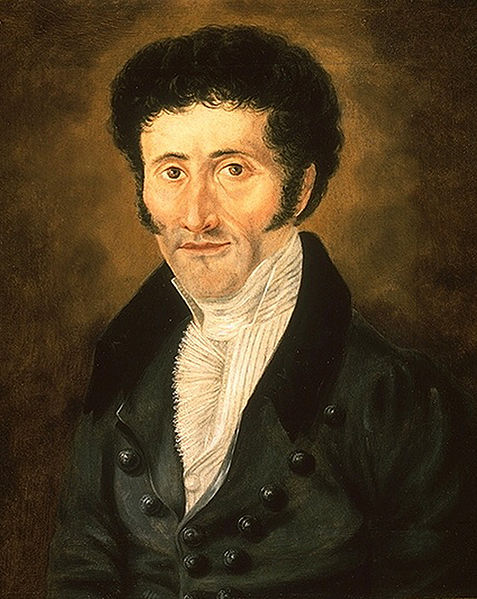
More on ETA Hoffmann

Ernst Theodor Amadeus Hoffmann1776-1822
Ernst Theodor Amadeus Hoffmann
1776-1822

I am up late tonight and thought I would just throw together a few additional tidbits on one of the earliest masters of horror:   ETA Hoffman.

Here is an interesting paragraph from The Literary Gothic:

24 January 1776 – 25 June 1822

You know the “Nutcracker” ballet, the one that every local ballet troupe is obligated to perform at Christmas?  This isn’t the guy — Tchaikovsky wrote that music in the 1890s, using the translation by Alexander Dumas (pere) rather than Hoffmann’s original.  But Hoffmann wrote the short story that lies behind it,  and it’s a short story that’s very unlike the charmingly sentimental puffery that little kids get dragged to every December.  Very unlike…  Hoffmann, a brilliant music critic and respectable composer as well as writer, is one of the major figures of German Romanticism, and  a powerful and disturbing writer — and disturbed, according to many; Sir Walter Scott, in his extended discussion of Hoffmann and literary supernaturalism, concludes that Hoffmann needs medical attention more than he needs literary criticism, and no less a student of dysfunctional minds (which I guess is just about everyone’s) than Sigmund Freud made Hoffman’s “The Sandman” the center of his essay on “The Uncanny.”  Hoffmann, although strongly influenced by Gothic literature, is probably best regarded as a fantasist rather than a “Gothic” or “horror” writer, although Freud’s term is perhaps the most apt.


This link leads to a rather lengthy article on Hoffmann and German Romanticism at theliterarylink.com.  I haven’t read it yet, but to a fan of German literature like myself, it looks fascinating.  I hope to find time to read it soon.

Here is a link to the text of “The Sandman“, one’s of Hoffmann’s most famous works.  Litgothic.com says about it:

“The classic — and widely anthologized — tale of a boy and his automaton — and, according to Freud, who discusses this work in his essay “The Uncanny,” castration anxiety.  Automata, by the way, were a happening phenomenon in the C19 — check out Edgar Allan Poe‘s “Maelzel’s Chess Player” and Hoffmann’s own “Automata” for other Gothic-tradition examples; for a general discussion of automata, check out The Automata Gallery or this History of Automata.”

Here is a link to the goodreads.com article on Hoffmann.   And from there here are two interesting quotes from Hoffmann:

Why should not a writer be permitted to make use of the levers of fear, terror and horror because some feeble soul here and there finds it more than it can bear? Shall there be no strong meat at table because there happen to be some guests there whose stomachs are weak, or who have spoiled their own digestions?”  ETA Hoffmann

“There are… otherwise quite decent people who are so dull of nature that they believe that they must attribute the swift flight of fancy to some illness of the psyche, and thus it happens that this or that writer is said to create not other than while imbibing intoxicating drink or that his fantasies are the result of overexcited nerves and resulting fever. But who can fail to know that, while a state of psychical excitement caused by the one or other stimulant may indeed generate some lucky and brilliant ideas, it can never produce a well-founded, substantial work of art that requires the utmost presence of mind.” 
―    E.T.A. Hoffmann,    Die Serapions Brüder: Gesammelte Erzählungen Und Märchen In Vier Bänden

Another link to another lengthy article on Hoffmann, but this one deals with Hoffmann’s treatment of “the uncanny”.

Another interesting summary of Hoffmann’s talent, this one from nndb.com:

“Hoffmann is one of the master novelists of the Romantic movement in Germany. He combined with a humor that reminds us of Jean Paul the warm sympathy for the artist’s standpoint towards life, which was enunciated by early Romantic leaders like Tieck and Wackenroder; but he was superior to all in the almost clairvoyant powers of his imagination. His works abound in grotesque and gruesome scenes — in this respect they mark a descent from the high ideals of the Romantic school; the gruesome was only one outlet for Hoffmann’s genius, and even here the secret of his power lay not in his choice of subjects, but in the wonderfully vivid and realistic presentation of them. Every line he wrote leaves the impression behind it that it expresses something felt or experienced; every scene, vision or character he described seems to have been real and living to him. It is this realism, in the best sense of the word, that made him the great artist he was, and gave him so extraordinary a power over his contemporaries.”

That’s it for tonight.  I am off to the land of dreams.

Beyond the Veil of Reality

Face of Horror Houseby Horror House
Face of Horror House
by Horror House

Last night, I watched an adaptation of Lovecraft’s “Dreams in the Witch House” on the Masters of Horror series (season 1, episode 2) on Netflix .   Afterwards, being late and time for bed, instead of finding the story on Project Gutenberg or some other cost-free source so that I could read it firsthand, I read a summary of the story on Wikipedia to see if the adaptation was at least reasonably accurate.  It seemed to be, even though the story was set in the modern day and the ending varied significantly from the original.  But, in accordance with today’s tastes, it was rather bloody and cruel in ways I am sure Lovecraft never intended (I say this after having read a considerable amount of his most famous works).

The most interesting aspect of the story to me was not the story itself, but speculating on how Lovecraft came up with the story’s concept.

I understand from the Wikipedia article that Lovecraft had recently attended a lecture and read up somewhat on non-Euclidean space.   Apparently, he was intrigued with the idea of existence on different planes.  Somehow he came up with the idea that the different planes of existence might intersect and beings would be able to move from one plane to the next.  This is the concept that the protagonist of the story, Walter Gilman (a graduate student in Physics) is studying when he moves into the Witch house, which was a boarding house in the fictional town of Arkham, Massachusetts, but three hundred years ago was the residence of a witch.  Gilman, as I interpret the TV story, notices that the corner formed by the intersection of two walls and the ceiling in his room coincides with the intersection of three dimensions.  It is this intersection that the witch who previously resided in the house and her familiar (a really nasty creature combining a rat with the face of a man) uses to re-enter the house in the modern day and create havoc for Gilman and the other residents.   I won’t give away the ending, but it is a good story and probably one of the more reasonably accurate adaptations of a Lovecraft story that you are likely to find.

What I found most interesting was speculating if  how Lovecraft came up with the story was to be looking at the intersection of three walls in his house and wonder if different planes of existence could intersect like that and, if they could, could creatures use the intersection to move from one plane to the other?   I am always fascinated by how writers come up with ideas for their works.   Did you ever wonder what spurred Richard Matheson to write I am Legend or Stephen King to write Carrie?

I know that some authors of Horror  (such as Algernon Blackwood, Lord Dunsany, and Arthur Machen) were intrigued by the idea of a plane of existence beyond what we take for reality, that what we perceive as reality may actually just mask the true reality.  Apparently, Lovecraft was thus intrigued as well and used his ideas of a possible alternative reality as the foundation for what others would later term “the Cthulhu Mythos”.

After having contemplated this since last night, I have been asking myself, what did these intelligent men see in their interpretations of the everyday world that would lead them to believe in the possible existence of an alternative reality?    Based upon my experience with humanity, I have come to realize that some people have some downright bizarre concepts of the world around them, but how did these concepts originate?  What causes their perceptions to be so radically different from mine?  Is it a matter of genetics that causes their synapses to be linked together differently?  Do they have slightly different body chemistries influencing their thoughts?  Is it that they simply encountered different views of the world as they grew up?  Is there a reality that they can perceive but I cannot–in the same way as I can see the workings of God in everything about me, but others do not and thus call themselves atheists and agnostics?

What are your thoughts?

Who influenced Edgar Allan Poe?

Edgar Allan Poe, circa 1849

Over the last couple of hours I have been wandering the Internet, searching for interesting tidbits about writers of horror to post on my blog.  I have been noting how Algernon Blackwood, Arthur Machen, Lord Dunsany, and M.R. James and a host of others influenced Lovecraft, who in turn influenced Stephen King along with generations of writers and film producers, and how Poe influenced them all.  Of course, the next question that came to me was “who influenced Poe?”

I did a quick, cursory search of the Internet and found no good answer.   A few speculated that he was influenced by the events of his life (duh, aren’t we all?), while a few others speculated that he was influenced by other prominent authors of his time (again:  duh, aren’t we all).   No one I found yet seems to be able to cite Poe’s influences like they can of Lovecraft, King, or others.

Does anyone know of a reliable source that cites the authors that Poe read?

Addendum:

(February 17, 2013) Here is the beginning of an answer to my question.  Follow this link to the article “The Influence of E.T.A. Hoffmann on the Tales of Edgar Allan Poe” by Palmer Cobb, in Volume III of Studies in Philology, The University Press, Chapel Hill, 1908.

Algernon Blackwood

Blackwood by Ianus

Algernon Blackwood

Illustration by Ianus

Algernon Blackwood (1869-1951) was a prolific writer and is probably one of the forgotten masters of the horror genre.  He was a favorite of H.P. Lovecraft as the three quotes below (from www.hplovecraft.com) illustrate:

“Aside from Poe, I think Algernon Blackwood touches me most closely—& this in spite of the oceans of unrelieved puerility which he so frequently pours forth. I am dogmatic enough to call The Willows the finest weird story I have ever read, & I find in the Incredible Adventures & John Silence material a serious & sympathetic understanding of the human illusion-weaving process which makes Blackwood rate far higher as a creative artist than many another craftsman of mountainously superior word-mastery & general technical ability…” (to Vincent Starrett, 6 December 1927)

“He actually analyses and reproduces faithfully the details of the persistent human illusion of—and out-reaching toward—a misty world of vari-coloured wonders, transcended natural laws, limitless possibilities, delighted discoveries, and ceaseless adventurous expentancy…. Of all Blackwood’s voluminous output, only a golden minimum represents him at his best—but that is such a marvellous best that we can well forgive him all his slush and prattle. It is my firm opinion that his longish short story The Willows is the greatest weird tale ever written. (with Machen’s The White People as a good second.) Little is said—everything is suggested!” (to Fritz Leiber, 9 November 1936)

“It is safe to say that Blackwood is the greatest living weirdist despite unevenness and a poor prose style.” (to Willis Conover, 10 January 1937)

Blackwood pursued a variety of jobs and careers during his lifetime, but based on the current Wikipedia article about him, his two main passions seem to have been writing and mysticism.  According to this article, Blackwood once wrote to Peter Penzoldt:

“My fundamental interest, I suppose, is signs and proofs of other powers that lie hidden in us all; the extension, in other words, of human faculty. So many of my stories, therefore, deal with extension of consciousness; speculative and imaginative treatment of possibilities outside our normal range of consciousness. … Also, all that happens in our universe is natural; under Law; but an extension of our so limited normal consciousness can reveal new, extra-ordinary powers etc., and the word “supernatural” seems the best word for treating these in fiction. I believe it possible for our consciousness to change and grow, and that with this change we may become aware of a new universe. A “change” in consciousness, in its type, I mean, is something more than a mere extension of what we already possess and know.”

His two best known stories are The Willows and The Wendigo.  I have not read The Wendigo yet, but I started The Willows two days ago and am into Chapter II currently.  So far, it is very well written with a beautiful description of a canoe trip down the Danube.  Towards the end of Chapter I, Blackwood begins to slowly bring out some eerie aspects of an island on which the narrator and his Swedish traveling companion have pitched camp for the night.  With the beginning of Chapter II, the supernatural element begins to build ominously in a way that somehow reminds me of Mussorgsky’s symphony “Night on Bald Mountain”.  If you are familiar with Mussorgsky’s opus, you know how I suspect the story will develop.    I look forward to finishing The Willows as soon as possible and beginning The Wendigo shortly thereafter.

Thoughts?  Comments?

Okay…just one more addendum to German Horror

Skinner

I saw another really cool post on the photos of the German Horror Writers Circle that I just had to share.   The book cover above is of the novel “Meeting with Skinner” by Harald A. Weissen posted on Facebook on May 7, 2010.  The accompanying summary reads:

“Imagine, that everything great that has occurred in the world since the beginning of time has been steered from a control room – discoveries, wars, political reversals, poverty, and prosperity.

Imagine that a single person has been sitting in this control room for several decades and the fortunes of the human collective has been influenced at his own discretion.

Imagine that the next person in this room is crazy.

The search for the control room draws together a traumatised young woman by the name of Laika, Elendes Biest, and Skinner , the last illusionist.”

I just think it’s an awesome post and a fascinating concept.  The artwork is great too.

Thoughts?  Comments?


Addendum to Post on German Horror

Die Schattenuhr

I have been exploring German horror on the web since my last post, particularly the photos of the German Horror Writers Circle on Facebook, where I found this really beautiful, really cool cover that I just had to share.  The post is by Nina Horvath and says “Cover zu ‘Die Schattenuhr’, erstellt von Mark Freier nach einem Werk von Zdzisław Beksiński” (Cover to ‘The Clock of Shadows’, published by Mark Freier after a work by Zdzisław Beksiński).  At the very top of the page, “Die Bizarre Welt des Edgar Allen Poe” translates to “The Bizarre World of Edgar Allen Poe”.  One thing I have already learned about horror in Germany is that American horror is very popular over there–in particular Lovecraft and Poe.

German Horror (Deutsche Horrorfilme und Horrorliteratur)

I was checking my blog stats today and found out that two recent views came from Germany.    I was a German major in college and therefore I begin to be curious about what is happening today in the horror genre for both German movies and literature, since I unfortunately know little about either.

I did a quick search on Google for “German horror” and found this interesting article on IMDb.  I did another search for “German horror fiction” and “German horror literature” and found almost nothing of interest.  I searched for “German horror writers” and found the German Horror Writers Circle on Facebook, which I might use as a starting point for further investigations.   Later, I may search in German, but today I confined my inquiries to what is available in English due to a lack of time inflicted by other pressing matters.

I have to admit I have read very little modern German literature compared to German lit of the 19th century, that I am woefully unfamiliar with most modern German writers, and  that I am completely unfamiliar with modern German horror writers.  I know that in the distant past, Germany and other German-speaking lands have produced excellent writers of horror such as E.T.A. Hoffmann (see my post about Hoffmann) and Jeremias Gotthelf (“The Black Spider”, 1842).    Given the dearth of information readily available on modern German horror (at least on Google), I think the IMDb article mentioned above may have a point that because of German history since 1933, Germany may have (understandably) lost its taste for horror.   I find that unfortunate, because now that my curiosity about German horror has been aroused, I would love to read some first-rate German horror or at least see one or two first-rate German horror films from the last decade or two.

Therefore, my question for you in this blog is:  if you are familiar with German horror, what films or books do you recommend as introductions to the world of German horror?

My Short Story “Dream Warrior” Has Been Published

The_Dream_Warrior_150_dpi-600x383

Illustration by Marge Simon

My short story “Dream Warrior” has been published in the February-April issue of Sorcerous Signals.  Please check it out via the link above and explore the rest of the magazine as well.   Please note that currently a typo in the contents page mistakenly identifies this issue as the Nov.-Jan issue.  

“Dream Warrior” will also appear in Sorcerous Signals’  print edition Mystic Signals.  Please look for Mystic Signals at your local newstand or bookstore.

The wonderful illustration above was drawn by artist Marge Simon of the Sorcerous Signals staff for “Dream Warrior”.   Please read the story to understand the significance of the jaguar and the sun. 

I am very appreciative to the Sorcerous Signals staff for all they have done and especially to editor Carol Hightshoe for her patience, professionalism, and diligence.

Carl Jung and the Creative Subconscious

Carl_Jung_(1912)

Carl Gustav Jung, 1912

Someone told me recently that the pyschologist Carl Jung believed the work reveals something about the author.  We discussed this idea for a few minutes before it hit home in a very scary fashion, because we were discussing my works of horror.  I realized that at least sometimes my own subconscious fears may influence, if not determine, the course of my stories.  Storylines reflecting the subconscious fears of the author makes a lot of sense, because, to my mind at least, dreams and nightmares also originate in and reflect the undercurrents of the subconscious.

So, what do you think?   Is the subconscious wellspring responsible for the creation of dreams the same one responsible for creative works?  What does this say about authors like Yann Martel who wrote “Life of Pi”?   What does it say about authors like Clive Barker and H.P. Lovecraft and even myself?

While we are at it, here are three quotes from Jung to provide additional food for thought.  What do they say about writers of horror?   I found them at The Painter’s Keys:  Art Quotes from Carl Gustav Jung.

“Often the hands will solve a mystery that the intellect has struggled with in vain.”

“The secret of artistic creation and the effectiveness of art is to be found in a return to the state of ‘participation mystique’ – to that level of experience at which it is man who lives, and not the individual…”

“The creation of something new is not accomplished by the intellect but by the play instinct acting from inner necessity. The creative mind plays with the objects it loves.”

“Dream Warrior” to be Published

My short story “Dream Warrior” is currently slated to be published by the online magazine Sorcerous Signals  in their February, 2013 issue as well as their February, 2013 issue of Mystic Signals (a print edition combining Sorcerous Signals and The Lorelei Signal).

For my friends and relatives not familiar with the publishing industry:  please be advised that the story is only scheduled to be published in February and that I do not have an exact date yet.   The last edition was published on November 12, therefore it will probably be published about mid-February.  In my experience, stories appear on schedule about 90% of the time.   Occasionally, something happens and the story has to be delayed, but (again, in my experience) the story always appears.

I would like to thank the editor of Sorcerous Signals, Carol Hightshoe, for accepting my work.  I overlooked her letter of acceptance in my e-mail in October and was not aware of “Dream Warrior’s” acceptance until she diligently and professionally followed up and inquired about the story some time later.

The story is about a teenage boy in Corpus Christi, TX, who seeks revenge on the hoodlums responsible for the rape and death of his girlfriend.   After his first attempt fails and they threaten his life, he runs to Mexico to live with his great-grandfather, who teaches him the ways of the ancient Aztec sorcerers so that he can have his revenge.

I got the idea for the story while researching south Texas history for another (as yet unfinished) story and came across a website on Aztec sorcery.  Its author, whose name unfortunately escapes me at the moment, graciously responded to my inquiries and provided me with a wealth of fascinating information.  If I can find his name and website in my e-mails, I will publish them later.

I hope everyone enjoys “Dream Warrior”.    Please help me thank Carol and her staff by visiting the site often and encouraging everyone you know to do the same.   Check your local media outlets for Mystic Signals.

ETA Hoffmann

477px-ETA_Hoffmann_3

Unless you are a literature/horror aficinado, you may never have heard of  Ernst Theodor Amadeus Hoffmann, a German writer from the late 18th century.  He predated Poe by almost half a century and in his time was probably as well known then as Stephen King and Clive Barker are today.   His stories were considered terrifying in his time.   Several of his stories were the basis for the well-known opera by Jacques Offenbach “Tales of Hoffmann”.  If you have never heard the music from this, it would be worthwhile to listen for it or to buy a CD of it.  It is very impressive.  As with the photo of Stoker, I obtained this image from Wikimedia Commons, where it is listed as being in the public domain.

Balance

Writing horror is a grim pastime.   One spends many hours delving into the darkest aspects of the human soul.    One’s mind is filled with murder, torture, violence, hatred, as well as characters, places, and situations that belong in the deepest pits of Dante’s Inferno.   Granted, out of these depths often arise heroes who triumph over the evil surrounding them and thus bring out the highest and noblest aspects of the human spirit, which may provide psychological comfort and spiritual salvation to the author, but journeying into darkness periodically will take its toll on anyone to some degree.    I have to ask myself how many authors of horror fall victim to depression and other maladies of the spirit.

But now, let us take this scenario and turn it about into something positive, something uplifting.   Let me pose this question to you, my readership, in hopes that the answers I receive will benefit not only myself, but everyone else who reads them:   how do you, writers of horror, find relief from the psychological toll encountered during your sojourns into darkness?  How do you balance out your lives so that you continue to see the beauty of the world around you and do no not stay imprisoned in the worlds of evil you create?  Do you watch comedies at the movies?  Do you take long walks along a tranquil coast?   Do you cuddle with your children and pets?  Do you collect the artworks of Thomas Kinkade or someone else who paints idyllic scenes of light and earthly paradise?   Please let me and my readers know so that we can find new avenues out of our horror-filled ruts and blood-stained dungeons.

Whose skill with grammar do you admire most?

Most writers think of modeling their style after that of a famous writer.   A large part of any writer’s style is his use of grammar.   For example,  Hemingway’s lean, muscular, sparse, style is well-known.  His use of punctuation (which I am including under grammar) is also spare, using and where most writers would use commas in a rhetorical technique known as syndeton.    Whereas Hemingway’s minimalist approach is masterful, somewhere in the middle of the scale is Mario Puzo (The Godfather) whose mediocre grammar skills often show up in comma splices and dangling prepositions.   The writer I consider a master of both style and grammar is F.Scott Fitzgerald (The Great Gatsby).

My question to you is:  whom do you consider to be a master grammarian/stylist?

The Unrecognized Masters of Horror

If they tried really hard, the majority of the public could perhaps name only four writers of horror:  Stephen King, H.P.Lovecraft, Edgar Allan Poe, and Clive Barker.   Fans of the horror genre could doubtlessly name many more with the number of the authors they could name reflecting the intensity of their interest.  For example, a person who can name fifteen authors of horror most likely has a more intense interest in the genre than someone who can name only five.

I would say that it is a safe bet that one or more of these authors are the topics in least 75% of all the conversations about horror literature going on at any one moment.  While we amateurs can  improve our skills from studying these four, I think we have a lot to learn from studying authors other than these four.

I recently read a compilation of stories that Lovecraft cites in his work “Supernatural Horror in Literature”.  Of course, only Poe appears among his cited predecessors.   Most of his influences are writers probably most of the modern public has never heard of (Lord Dunsany, Edward Lucas White, Arthur Machen, etc.) though they were as well known in their time as Dean Koontz and Peter Straub are today.

My question to you is:  who are the unrecognized masters of horror that the modern public should know but in all likelihood do not?  Whose name does not usually make it into any top ten list of masters of horror but should?