Just now, I finished pasting Stephen King’s famous quotation on the three types of terror into my page on “Thoughts on Horror from the Masters” and I remembered that yesterday I was trying to remember the quotation, but could only recall a vague impression of it. Thinking on that impression now, I think that it was just as valid and true a one as the one by Mr. King, but simpler, more compact, and easier to remember. The concept is (I’ll refine this a little for the sake of clarity):
The three most common types of horror are: suspense (knowing someone runs the risk of decapitation at any moment), terror (seeing him/her being decapitated), and disgust (watching the head roll down the stairs).
I don’t think this idea should replace Mr. King’s by any means, but should probably be viewed as a simplification of his rather lengthy statement.
There are also probably a hundred more different flavors (i.e. variations of the sensation) of horror but these are the three that seem to me to be the most common, at least in movies and other popular media.
I was sitting on my sofa just now, contemplating various matters, one of which reminded me of Lovecraft’s “Shadow over Innsmouth”. I started thinking about how Lovecraft describe it and all his locations eerily. It occurred to me that he lived almost his entire life in Providence and seldom went out of its vicinity. In fact, most of the settings for his stories occur relatively near to Rhode Island. Apparently, he did not travel or often from his home. I started thinking that if he traveled little and only to nearby areas and if he saw the few places he went as spooky or eerie (which would explain why he could describe places so eerily), then maybe he was uncomfortable or had a fear of going outside his physical comfort zone. From what little I know of his day-to-day life, I have the impression that he probably did not leave his home very often and probably spent his time in his room writing or editing stories and writing tons of correspondence to his friends and colleagues.
This makes me wonder if Lovecraft had at least a touch of agoraphobia, a fear of public places.
He seems to have been fascinated with architecture and is very descriptive of it, but I have to wonder if that isn’t because if he was fascinated with it because it frightened him. If something frightens me, I watch it very closely and find out what I can about it in order to alleviate my fears.
I have never read anything about Lovecraft having agoraphobia and I am no psychologist. If anyone knows of an article on this subject, please let me know. I would also love to hear your thoughts and comments on this topic.
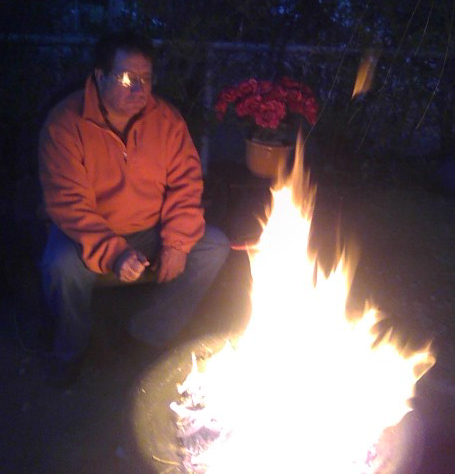
Relaxing by the front yard firepit on a chilly New Mexico evening circa 2013.
I picked up a copy of the latest issue of “Cemetery Dance” this evening and read the Stephen King short story “Summer Thunder”. This is a very interesting piece. I won’t spoil the ending for you, but the story is about a man, his dog, and his neighbor, who have survived a nuclear holocaust and are slowly succumbing to radiation poisoning.
This story was quite different from the other Stephen King stories I have read (which have been quite a few, though not all by any means). There is no supernatural factor in the story. There are also no twists or surprises. The story maintains the same pace throughout, just as the protagonists face the same things day in and day out until they die.
I would classify this story as horror-tragedy, because, even though it has very little of the blood and gore normally associated with the horror genre, it definitely has a horror “feel” to it, but that horror is subtle and understated. “Summer Thunder” sets up a tragic scenario and the horror finds its basis in watching these people suffer through no fault of their own. They were not involved in starting the war in any way; that was done by world leaders thousands of miles away. These are the common citizens, the “Everymen” that normally populate King’s works as protagonists, and who must pay the horrific price for their government’s actions. That is the tragedy and that is a large part of the horror.
What is also horrifying about the story is not the action described in it, but the scenario it describes, because this scenario is definitely one that could literally happen to each of us, should our government and/or other governments decide for whatever reason, to push the proverbial button. Each of us can (or perhaps should) see ourselves as the main character, who will be forced to watch his or her world disintegrate after a nuclear apocalypse.
That concept alone should be enough to bring the true horror of this story: that this scenario is, and has been for a long time, a real possibility for each of us.
I just finished watching an episode of the X-Files entitled “Chinga” [note to Spanish-speakers out there: I don’t know who chose the title, so please forgive my language] from Season Five and I noticed that it was written by Stephen King and Chris Carter (the creator of the X-Files). The story’s antagonist is a talking doll that can force people to injure or kill themselves in gruesome ways. Like many, if not most, of King’s stories, there is no explanation of how the came to exist. All the viewer finds out about it is that a lobsterman pulled it up one night in a lobster trap and his daughter comes to possess it after he meets his own gruesome fate.
I find in my own writing that I like to provide an explanation or background as to how things originate. This is just my nature. I like to know the origins of things. However, I have come to believe of late that, in terms of horror, that is a very nineteenth century concept.
Lovecraft said in his essay “Supernatural Horror in Literature”:
“A certain atmosphere of breathless and unexplainable dread of outer, unknown forces must be present; and there must be a hint, expressed with a seriousness and protentiousness becoming its subject, of that most terrible conception of the human brain — a malign and particular suspension or defeat of those fixed laws of Nature which are our only daily safeguard against the assaults of chaos and the daemons of unplumbed space.”
For me, what Lovecraft is saying is that if the laws of nature are negated, then anything is possible and monsters like Cthulhu really could exist and are capable of doing us harm at any moment. Combine this with his statement that “The oldest and strongest emotion of mankind is fear and the oldest and strongest kind of fear is fear of the unknown” and it becomes apparent that stories like “Chinga” derive much of their horror effect from the fact that the origin of the threat to a story’s protagonist(s) is unknown or that there is no explanation for the threat.
This would mean that one of things that provides to “Chinga” the element of horror that it has, is the fact that origin of the doll is unknown. Therefore, any of us when we are fishing or scuba diving or swimming in any body of water, could discover a doll that would turn his/her life into a nightmare. That is a scary thought.
Of course, this means that Stephen King would be one of the greatest practitioners of this technique, which I believe he is.
I think I shall try to experiment with this in the near future.
Hopefully, I will find the time to sit down and write another extensive post, but unfortunately, these days I seem inundated with personal and professional tasks. I try to read when I have the opportunity. When I do have some time free, I have been watching horror films and I have several which I recommend and on which I hope to be writing posts before long. I also hope to establish a webpage for a nascent lexicon of horror.
The Works of Edgar Allan Poe, Volume 1. Yes, this link takes you to a collection of Poe’s works, but the reason I am mentioning it here is because the preface to this particular volume includes fascinating biographical notes and insight into the character of this master of horror that may help you understand the roots of his creative genius and how art sometimes came close to imitating life for Mr. Poe.
When you open the page, you may find yourself a little distance from the top of the article at the beginning of a section entitled “The Death of Edgar Allan Poe”. While this section is fascinating in its own right, scroll to the top for the entire preface. The works of Poe, beginning with the story of Hans Pfall, begin a bit down from “The Death…”
For those of you dealing with the demon of literary Rejection right now, please follow the link to a nice, very concise article by Rachael Stanford by on the same. Once you have finished, follow the link at the bottom of the article to a fascinating article by Stephanie Ostroff about how nine famous authors (C.S. Lewis, Anne Frank, Rudyard Kipling, Jack Kerouac, H.G. Wells, Louisa May Alcott, George Orwell, Sylvia Plath, and William Golding) were rejected often hundreds of time, often quite rudely or in a demeaning fashion, yet persevered to become some of the world’s best known writers.
I like stories of rejection like these, because they remind me that not all publishers are as insightful as we writers hope they are. As with all other occupations, there are publishers who are better or worse at their jobs than others. Therefore, if one of my works is rejected, even numerous times, it does not mean that the work is necessarily a stinker. On the other hand, I must confess to have written at least a few stinkers, and therefore I cannot in all good conscience blame publishers for all my bad luck either.
For me, being honest with myself and critically looking at a work that has been rejected several times to determine whether I have honestly done my best with it or if it simply didn’t meet the publisher’s needs at the moment or if the publisher has sufficient I.Q. points to function reasonably well in human society is one of the hardest parts of writing (not writing rambling, run-on sentences like this one is another challenge).
Now I submit everything electronically. Twenty years ago, when I first started writing, I submitted everything by mail. I always kept a file of the rejection slips I collected, so I would always have a working list of who would be eating a heaping dish of crow when I became famous. In fact, for several years I used to pin them to a bulletin board so I could look at them and smirk now and then. I still keep my electronic rejections, though I still need to create a file for them, for the same reason.
I have yet to become famous and the list is still growing, but having all those rejections gives me something to which I can look forward. At least they serve a purpose, which they would not if I took them seriously and let them drag me down: they give me encouragement and they help me persevere by instilling a spirit to prevail.
I was reading Lovecraft’s “Supernatural Horror in Literature” the other day when I came across this line concerning the nature of the “weird tale”:
“A certain atmosphere of breathless and unexplainable dread of outer, unknown forces must be present; and there must be a hint, expressed with a seriousness and protentiousness becoming its subject, of that most terrible conception of the human brain — a malign and particular suspension or defeat of those fixed laws of Nature which are our only daily safeguard against the assaults of chaos and the daemons of unplumbed space.”
With me, this idea hit home. I have always thought that the more realistic I could make a story, the more frightening it would be for the reader, because it could possibly happen. Lovecraft takes the complete opposite approach. In essence, he says let’s dispense with the chains of our preconceptions of reality then see what could happen. He is right. If anything can happen, the horrors that could happen to humanity are limitless and unimaginable.
Now let’s take this line of thought a step or two further philosophically. Perhaps our concept of reality is really a sort of protective shell, a defense mechanism created by our minds that shields us from being overwhelmed by the thousands of possible ways we could meet our ends. If a person tried to conceive of all the ways he/she might die at any moment, no matter how miniscule the odds, his/her mind might be overwhelmed and paralyzed by fear or destroyed by paranoia and madness. The only way the mind could survive would then be to limit the possibilities to only those with the greatest probability of happening at that moment, in essence, wrapping itself in a protective cocoon of denial.
If there are any philosophy majors out there reading this, please feel free to bring up this idea in class. I would love to hear the arguments for and against this.
Now, let’s go a step even further. If we start to see our perception of reality as only a concept, as only a protective shell in a much greater universe, as only one alternative among thousands or millions of possibilities, then the possibility of creatures like Cthulhu, Shoggoth, Nylarhotep, the “ancient ones”, and all the other monsters contained in Lovecraft’s vivid imagination becomes very real.
Lovecraft’s world of the “ancient ones” is frightening enough when we think it has no chance of happening, but it becomes truly terrifying if we think it has even the slightest chance of actually happening.
I ran across an interesting article today at http://www.quintadimension.com/article66.html, entitled “Archetypal Horror: H.P. Lovecraft and Carl Gustav Jung”. It was written by Jorge Oscar Rossi, an Argentinian writer of science fiction (and fantastic literature in general), and published on December, 8, 2000. Please note that the article and his autobiography are in Spanish.
I am no master of Spanish, having had only two years in college and some practical, albeit frequent, experience in Texas and Mexico over the last twenty years. However, Señor Rossi’s article is well-written and relatively easy reading, so that I feel I caught the gist of it, if not all the nuances.
His main point (and anyone with a better knowledge of Spanish than I, including Señor Rossi, may correct me if I am wrong) is that Lovecraft’s ancient gods of the Cthulhu mythos represent archetypal forms of horror in the Jungian sense of “archetype”.
If you have a basic comprehension of Spanish, the article is quite intriguing and worth taking a shot at reading.
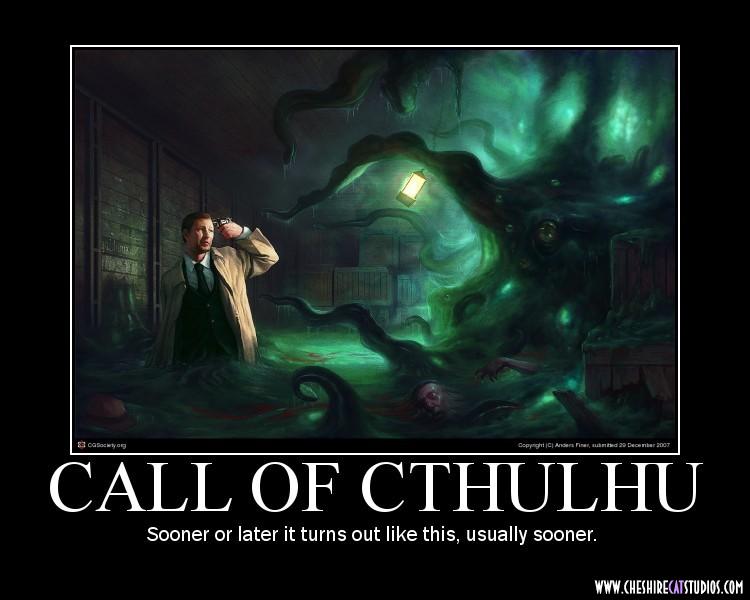
If nothing esle, the article will help you view the poster above from another perspective: what is the meaning of the poster if the creature above symbolizes archetypal fears shared by everyone?
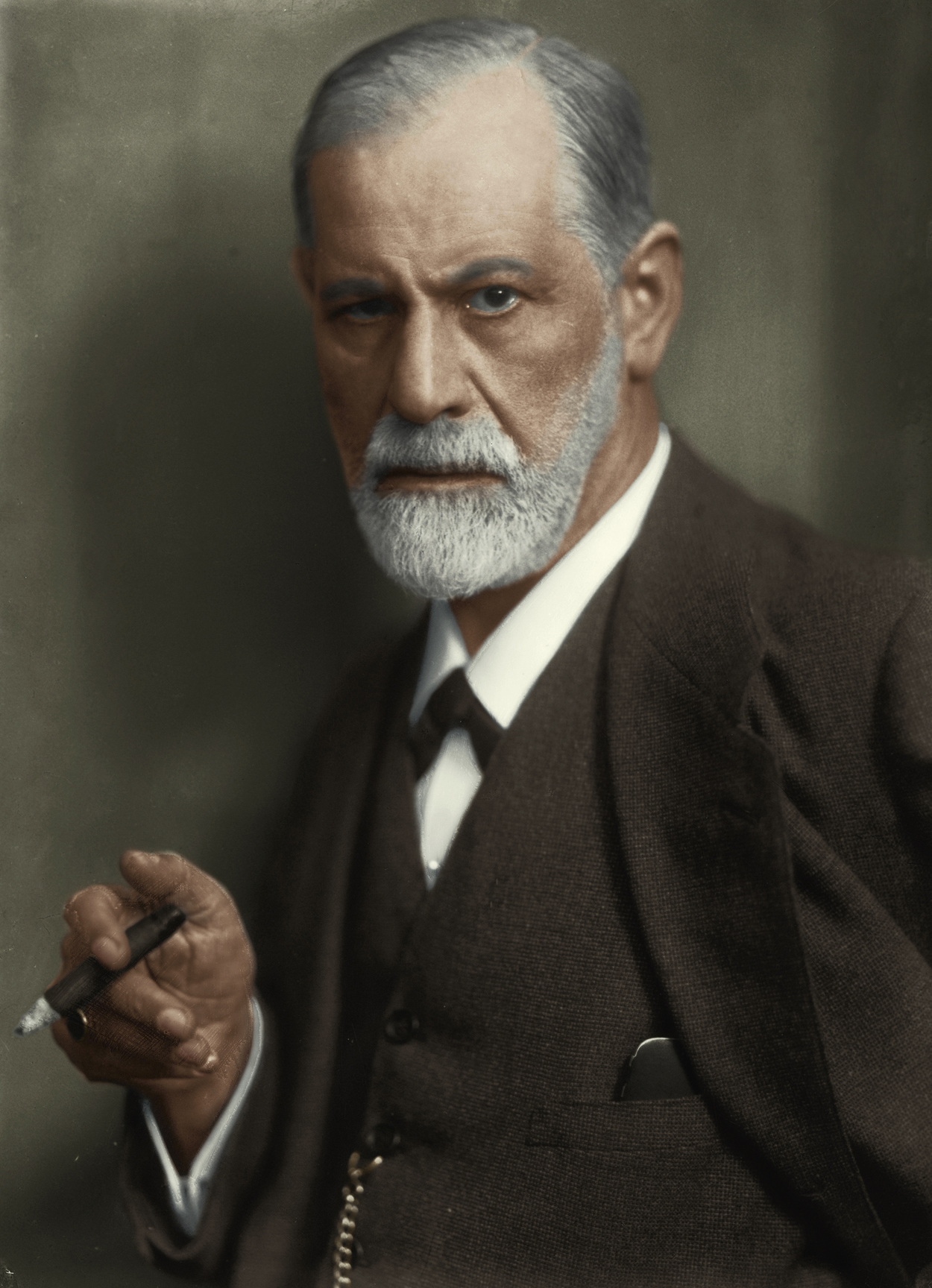
While many people can write a horror story, those who have a profound understanding of the emotions associated with horror will have a greater chance of writing a truly great horror story. With that in mind, as tonight’s post I offer a comment from Dr. C. George Boeree on Freud’s view of fear, which he termed “anxiety”. This quote is part of a longer articles which can be found at http://webspace.ship.edu/cgboer/freud.html. I like the quote, because it explains Freud’s concept in a straightforward, simple, clear way that I can grasp easily. I also like the quote because it gives me three different types of fear to instill in my audience vicariously. As I have mentioned in previous posts, when someone reads a story, they are experiencing the events of that story vicariously. As writers of horror, one of the primary emotions we want to instill is fear. In this short comment, Dr. Boeree provides us with three flavors of fear we can instill in our audiences.
“The ego — the “I” — sits at the center of some pretty powerful forces: reality; society, as represented by the superego; biology, as represented by the id. When these make conflicting demands upon the poor ego, it is understandable if it — if you — feel threatened, feel overwhelmed, feel as if it were about to collapse under the weight of it all. This feeling is called anxiety, and it serves as a signal to the ego that its survival, and with it the survival of the whole organism, is in jeopardy.
“Freud mentions three different kind of anxieties: The first is realistic anxiety, which you and I would call fear. Actually Freud did, too, in German. But his translators thought “fear” too mundane! Nevertheless, if I throw you into a pit of poisonous snakes, you might experience realistic anxiety.
“The second is moral anxiety. This is what we feel when the threat comes not from the outer, physical world, but from the internalized social world of the superego. It is, in fact, just another word for feelings like shame and guilt and the fear of punishment.
“The last is neurotic anxiety. This is the fear of being overwhelmed by impulses from the id. If you have ever felt like you were about to “lose it,” lose control, your temper, your rationality, or even your mind, you have felt neurotic anxiety. Neurotic is actually the Latin word for nervous, so this is nervous anxiety. It is this kind of anxiety that intrigued Freud most, and we usually just call it anxiety, plain and simple.”
Undoubtedly, Jung had his own views of fear, with which I am not familiar, and other psychiatrists have theirs, and Freud’s views may well be outdated, or even proven wrong. However, if we are to understand the nature of fear, Freud is a good a place to start as any.
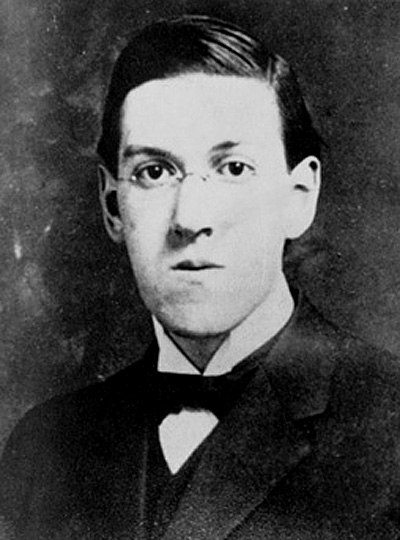
I like the illustration above, not only because it shows Lovecraft in the throes of creation, but also because it can be a metaphor for anyone in the deepest and darkest of contemplations or beset with a multitude of woes. For now, though, I will say that it represents Lovecraft contemplating today’s question which is: forget everything you have ever read about horror, what is horror to you?
Stephen King made this comment (I found it on goodreads.com):
“The 3 types of terror: The Gross-out: the sight of a severed head tumbling down a flight of stairs, it’s when the lights go out and something green and slimy splatters against your arm. The Horror: the unnatural, spiders the size of bears, the dead waking up and walking around, it’s when the lights go out and something with claws grabs you by the arm. And the last and worse one: Terror, when you come home and notice everything you own had been taken away and replaced by an exact substitute. It’s when the lights go out and you feel something behind you, you hear it, you feel its breath against your ear, but when you turn around, there’s nothing there…”
To me, these seem to be the superficialities of terror and horror. If we use disease as a metaphor for horror, then these are its symptoms. The virus lying at the root of horror is man’s inhumanity to man. Seeing a severed head tumbling down stairs is indeed horrible; seeing the murderer sever the head would be even worse, but being able to look into the soul of the murderer and see that the motive for the act stems from the murderer’s complete indifference to the suffering of others would be even worse. Perhaps even worse than that would be seeing that that indifference to others is not uncommon.
Many have speculated on what fascinates people about horror. Why would anyone enjoy being frightened? An article I read last night (I think from Wikipedia) says essentially (I am summarizing in my own words) that it is because the security our civilization our modern society affords us has eliminated the need for the primal fear that developed as a survival mechanism during the early days of evolution. That may be true to some degree, but if society eliminated some fears, it instilled others. How many have seen the movie “Candyman”? How many have seen “I am Legend?” or “The Omega Man” (both derive from the novel “I am Legend” by Richard Matheson), which is only one example of post-apocalyptic literature that would have been inconceivable in primeval times.
Instead of some overreaching drive extending throughout mankind, it may be that the need simply stems from the fact that the adrenaline rush, the focus on the moment, the muscle tension, and all the other physical sensations experienced during fright are the same or very similar to those experienced during sex, but without the sexual arousal itself. These are also similar to the sensations experienced during peaks of athletic activity. I was in the martial arts for many years and I can testify that the adrenaline rush experienced during sparring matches or when one is performing at peak ability can be addicting. Being frightened puts one on a similar level of physical and mental awareness, because it is an instinctual preparation to fight as if one is actually being threatened. The great thing about horror though is that while one enjoys all the physical highs of one’s body revving up for action, there is no actual threat. Everyone is safe. Candyman is not actually going to come out of the screen and track you down (though your subsequent nightmares may tell you otherwise).
So, please put yourself in Mr. Lovecraft’s place in the illustration above and ask yourself, what is horror?
Someone told me recently that the pyschologist Carl Jung believed the work reveals something about the author. We discussed this idea for a few minutes before it hit home in a very scary fashion, because we were discussing my works of horror. I realized that at least sometimes my own subconscious fears may influence, if not determine, the course of my stories. Storylines reflecting the subconscious fears of the author makes a lot of sense, because, to my mind at least, dreams and nightmares also originate in and reflect the undercurrents of the subconscious.
So, what do you think? Is the subconscious wellspring responsible for the creation of dreams the same one responsible for creative works? What does this say about authors like Yann Martel who wrote “Life of Pi”? What does it say about authors like Clive Barker and H.P. Lovecraft and even myself?
“Often the hands will solve a mystery that the intellect has struggled with in vain.”
“The secret of artistic creation and the effectiveness of art is to be found in a return to the state of ‘participation mystique’ – to that level of experience at which it is man who lives, and not the individual…”
“The creation of something new is not accomplished by the intellect but by the play instinct acting from inner necessity. The creative mind plays with the objects it loves.”






 Phil Slattery, Writer, Publisher