
at Comicon, 2007
Photo by Penguino
Great article. Over the next week I hope to post more writing tips from great authors as they appeared in Open Culture. They have a wealth of good advice that I would like to share.

Great article. Over the next week I hope to post more writing tips from great authors as they appeared in Open Culture. They have a wealth of good advice that I would like to share.
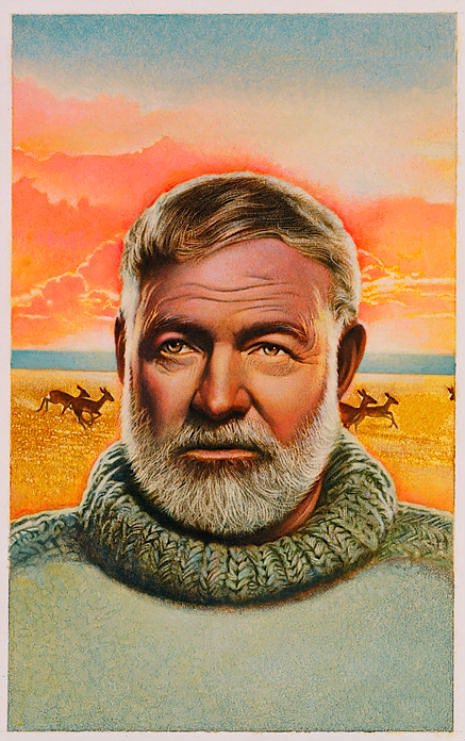
There is a story that Ernest Hemingway wrote the following to win a bet with other writers that he could write the shortest story:
“For sale: baby shoes. Never worn.”
Even a little research on the Internet shows that there is considerable doubt that Hemingway wrote this story, with the earliest reference to it as a Hemingway work not appearing until 1991. There is also considerable evidence that the story existed in various forms as early as 1910, when Hemingway was 11 and well before his writing career began. Whatever the facts, it is an extreme example of the lean, muscular writing for which Hemingway was famous.
In an interview with The Paris Review (see The Writer’s Chapbook, 1989, pp. 120-121), Hemingway did say:
“If it is any use to know it, I always try to write on the principle of the iceberg. There is seven-eighths of it underwater for every part that shows. Anything you know you can eliminate and it only strengthens your iceberg. It is the part that doesn’t show. If a writer omits something because he does not know it then there is a hole in the story…First I have tried to eliminate everything unnecessary to conveying experience to the reader so that after he or she has read something it will become a part of his or her experience and seem actually to have happened. This is very hard to do and I’ve worked at it very hard.”
So “Baby Shoes” is a good example of Hemingway’s iceberg principle, even if he didn’t write it.
“Baby Shoes” is also a good example of what I like to think of as the Tao of writing (see my earlier posts): creating a story by a careful, strategic use of what is not said. No where in the story does it state that a couple had apparently been expecting a baby, that they bought shoes for it, but then something happened to the baby to cause its death, and now the parents want to sell the shoes. None of that is stated. It is all implied, but yet we know what happened–or at least we have a good idea of what happened, even if we do not know the concrete facts of the matter.
There are also other facets of the story that we can infer, albeit tenuously. From the fact that they bought baby shoes we can infer that the parents were probably eager to have the child. From the fact that the parents want to sell the shoes we can infer that they probably don’t want them around any more as a remainder of a painful experience, but at the same time they may want to see someone else make good use of them or that they are hard up for money.
But one question I have that concerns human psychology is why is it that most people can read these same six words and come away with the same perception of what occurred? Does it have to do with Jungian Archetypes floating around in each of us or is it that each of us has had the same broad experience(s) so that we can interpret these six words in a very similar way?
In the art of sculpture, those areas of a work that are empty, yet give the work its form, are called “negative space”. An example is the space between each of your fingers. If there were no space, there would be no individual fingers. In that sense, a story like “Baby Shoes” makes maximum use of what might be termed “literary negative space”.
It is not really the words that give this story its power, but how we psychologically connect the ideas behind the words that fuel this extremely brief, but epic and poignant tale.
This is part of the magic of writing: conjuring worlds out of nothing.
Thoughts? Comments?

Guest Blog: ‘The Raven’ – Nevermore.
Interesting article, though I tend to disagree with his descriptions of what was going through Poe’s mind when he wrote this. Though I am not a skeptic, I tend to be skeptical when someone tells me in effect “yes, that is what he says, but this is what he meant…” Poe definitely hyped the bejeezus out of the poem (and his ego) by calling it the best poem ever written, but as for the rest…who knows?
Thoughts? Comments?
I was just sitting here trying to choose one of my many first drafts to work on for tonight, when I started thinking about the different “approaches” (for lack of a better term at the moment) to horror. By “approaches” I mean a very brief synopsis of a writer’s general outlook on or method of writing horror. Maybe a better way to express it would be to say the way the author approaches his genre (still not quite right, but I am getting closer to the idea).
An example would be to say that Poe’s approach was to bring out the horror in realistic situations (mostly, he did dabble in the fantastic occasionally). “The Black Cat” is about a murderer who unknowingly seals up a cat with the corpse of his victim. Nothing fantastic there. “The Tell-Tale Heart” is about a murderer whose conscience drives him to confession. “The Fall of the House of Usher” is about a family with an inherited genetic trait of hypersensitivity. So forth and so on.
Lovecraft’s approach was to spin tales of the fantastic, especially about a race of elder gods who once dominated the planet millions of years ago and of which mankind encounters remnants on rare occasion.
Stephen King’s approach is to plant an element of the fantastic among ordinary people in ordinary places and watch them react to it.
Clive Barker’s approach seems to be to take something that is fantastic, bloody, cruel, evil and gruesome and either drop it somewhere a single character can deal with it or bring it out of the shadows where a character can deal with it.
Seeing these different approaches in relation to each other makes me think about how do I want to approach an idea or a draft I have of a story. Do I want to drop the fantastic into the real or bring out the horror in the everyday or in realistic situations or can I come up with something else, my own approach, that is none of these? That is the challenge of creativity: to come up with something no one else has done. Maybe I can just go with the purely fantastic. Maybe I can try to find the real in the fantastic.
How many different ways are there to horrify an audience?
There is the real and the fantastic and all those subtle shades of gray in between the two. Can there be anything else?
Thoughts? Comments?

Here’s an interesting article for those writing a story and are trying to find a way to negate a cell phone. You probably won’t want to use these (that runs counter to being creative), but these methods may point you in the right direction: http://mentalfloss.com/article/56842/7-creative-ways-modern-horror-films-get-rid-cell-phones.

If I do not enjoy writing a story, how can I expect my readers to enjoy reading it?
About 2:00 a.m. on December 6, on the drive home after visiting my sister and her husband, I was contemplating where I want to go with my current work-in-progress. I am loathe to give away the plot, so suffice it to say that it involves a scientist that travels to another planet and tours it with a fellow scientist from that planet. I have come to realize over the last few days that the original plot concept is boring, although in terms of literature it would be fairly intriguing, because of the internal struggles the main character would face and some social issues it would raise.
It occurred to me is that the critical question was not where to take the plot of the story, but where do I want the book to go in terms of its impact on the society/world. I am not so naïve as to think that it would have a earth-shattering impact like Dan Brown’s Da Vinci Code or be controversial like Henry Miller’s Tropic of Cancer or Aldous Huxley’s Brave New World or even break out like Stephen King’s Carrie, but no matter how it is received publically or critically, it will make an impact, even if it is negligible one. The best I reason that I can do, is to try to make as big a splash as possible on its release and hope that it brings me some measure of success or at least puts me on the road to success. But what can I do to create that splash? What have been the characteristics of other initial successes?
I don’t know how the analogy suddenly popped into my mind, but I realized that what the story needs is thunder. Perhaps it was that a light rain had fallen sporadically over the last few days and the land was still wet with shallow puddles still lingering on the road in spots on this near-freezing night. Somehow this struck a chord in my subconscious that stirred echoes of similar post-thunderstorm summer nights. As I look back on that moment, though I wasn’t even thinking of those novels, it occurs to me now that they each have an element I would describe as “thunder”, something that resounds across the land striking a nerve in the public consciousness.
For some novels, like The Da Vinci Code, the thunder is an aspect that touches on a sensitive nerve within a large number of the public. In The Da Vinci Code‘s instance, this was deeply ingrained religious beliefs that, like the foundation of a house, if disturbed, shake the entire house.
For novels like The Tropic of Cancer, the thunder is something that disturbs the public’s sense of decency, which could be argued to be the image of itself that the public wishes to project.
Brave New World did not make as great an impact on its initial reception as it did later, when many of the technologies and issues it describes actually started to come into being. Then it thundered greatly.
Carrie did not rock the literary or moral or religious foundations of society, but it was a great personal thunder for Stephen King and brought him suddenly into the public view.
There are undoubtedly other forms of thunder, but these are the ones that spring into mind initially.
Once I recognized that my goal as a writer is to thunder, the next question became what type of thunder do I want to have?
For me, I want to ask a profound question (or questions) that demand answers. As stated, I don’t want to give away the plot of the novel(la), so I will unfortunately have to leave you in suspense for now, but check back with my blog periodically and let’s see if I can achieve this. Wish me luck.
Thoughts? Comments?

Purely for your entertainment, here are 28 Totally Relatable Quotes About Books. I know I can relate to a lot of them. I’m sure you will find a few for yourself. One reason I find these interesting is because many of them show me how intensely involved readers will become with a book. As I have mentioned in previous posts, I believe that people live a vicarious existence through a story. When we write, we are not just writing a book or a story, we are creating a universe in which people will hopefully want to, not just visit, but dwell. All of the writer’s art should therefore focus on creating a virtual reality for one’s readers. To do that, we need a good grounding in, or at least a good feel for, human psychology, because we have to shape our creations to fit the human psyche. How do thoughts come into being? How do they lead from one to another? How do images form in the mind? No, I am not saying that we need Ph.D.’s in psychology to be good writers, but I think we need some sort of archetypal insight into human nature if we are to be the great writers we hope to be. Darn. I’m rambling again. 🙂

Last night, I watched an adaptation of Lovecraft’s “Dreams in the Witch House” on the Masters of Horror series (season 1, episode 2) on Netflix . Afterwards, being late and time for bed, instead of finding the story on Project Gutenberg or some other cost-free source so that I could read it firsthand, I read a summary of the story on Wikipedia to see if the adaptation was at least reasonably accurate. It seemed to be, even though the story was set in the modern day and the ending varied significantly from the original. But, in accordance with today’s tastes, it was rather bloody and cruel in ways I am sure Lovecraft never intended (I say this after having read a considerable amount of his most famous works).
The most interesting aspect of the story to me was not the story itself, but speculating on how Lovecraft came up with the story’s concept.
I understand from the Wikipedia article that Lovecraft had recently attended a lecture and read up somewhat on non-Euclidean space. Apparently, he was intrigued with the idea of existence on different planes. Somehow he came up with the idea that the different planes of existence might intersect and beings would be able to move from one plane to the next. This is the concept that the protagonist of the story, Walter Gilman (a graduate student in Physics) is studying when he moves into the Witch house, which was a boarding house in the fictional town of Arkham, Massachusetts, but three hundred years ago was the residence of a witch. Gilman, as I interpret the TV story, notices that the corner formed by the intersection of two walls and the ceiling in his room coincides with the intersection of three dimensions. It is this intersection that the witch who previously resided in the house and her familiar (a really nasty creature combining a rat with the face of a man) uses to re-enter the house in the modern day and create havoc for Gilman and the other residents. I won’t give away the ending, but it is a good story and probably one of the more reasonably accurate adaptations of a Lovecraft story that you are likely to find.
What I found most interesting was speculating if how Lovecraft came up with the story was to be looking at the intersection of three walls in his house and wonder if different planes of existence could intersect like that and, if they could, could creatures use the intersection to move from one plane to the other? I am always fascinated by how writers come up with ideas for their works. Did you ever wonder what spurred Richard Matheson to write I am Legend or Stephen King to write Carrie?
I know that some authors of Horror (such as Algernon Blackwood, Lord Dunsany, and Arthur Machen) were intrigued by the idea of a plane of existence beyond what we take for reality, that what we perceive as reality may actually just mask the true reality. Apparently, Lovecraft was thus intrigued as well and used his ideas of a possible alternative reality as the foundation for what others would later term “the Cthulhu Mythos”.
After having contemplated this since last night, I have been asking myself, what did these intelligent men see in their interpretations of the everyday world that would lead them to believe in the possible existence of an alternative reality? Based upon my experience with humanity, I have come to realize that some people have some downright bizarre concepts of the world around them, but how did these concepts originate? What causes their perceptions to be so radically different from mine? Is it a matter of genetics that causes their synapses to be linked together differently? Do they have slightly different body chemistries influencing their thoughts? Is it that they simply encountered different views of the world as they grew up? Is there a reality that they can perceive but I cannot–in the same way as I can see the workings of God in everything about me, but others do not and thus call themselves atheists and agnostics?
What are your thoughts?

H.P. Lovecraft by Mirror Cradle
I like the illustration above, not only because it shows Lovecraft in the throes of creation, but also because it can be a metaphor for anyone in the deepest and darkest of contemplations or beset with a multitude of woes. For now, though, I will say that it represents Lovecraft contemplating today’s question which is: forget everything you have ever read about horror, what is horror to you?
Stephen King made this comment (I found it on goodreads.com):
“The 3 types of terror: The Gross-out: the sight of a severed head tumbling down a flight of stairs, it’s when the lights go out and something green and slimy splatters against your arm. The Horror: the unnatural, spiders the size of bears, the dead waking up and walking around, it’s when the lights go out and something with claws grabs you by the arm. And the last and worse one: Terror, when you come home and notice everything you own had been taken away and replaced by an exact substitute. It’s when the lights go out and you feel something behind you, you hear it, you feel its breath against your ear, but when you turn around, there’s nothing there…”
To me, these seem to be the superficialities of terror and horror. If we use disease as a metaphor for horror, then these are its symptoms. The virus lying at the root of horror is man’s inhumanity to man. Seeing a severed head tumbling down stairs is indeed horrible; seeing the murderer sever the head would be even worse, but being able to look into the soul of the murderer and see that the motive for the act stems from the murderer’s complete indifference to the suffering of others would be even worse. Perhaps even worse than that would be seeing that that indifference to others is not uncommon.
Many have speculated on what fascinates people about horror. Why would anyone enjoy being frightened? An article I read last night (I think from Wikipedia) says essentially (I am summarizing in my own words) that it is because the security our civilization our modern society affords us has eliminated the need for the primal fear that developed as a survival mechanism during the early days of evolution. That may be true to some degree, but if society eliminated some fears, it instilled others. How many have seen the movie “Candyman”? How many have seen “I am Legend?” or “The Omega Man” (both derive from the novel “I am Legend” by Richard Matheson), which is only one example of post-apocalyptic literature that would have been inconceivable in primeval times.
Instead of some overreaching drive extending throughout mankind, it may be that the need simply stems from the fact that the adrenaline rush, the focus on the moment, the muscle tension, and all the other physical sensations experienced during fright are the same or very similar to those experienced during sex, but without the sexual arousal itself. These are also similar to the sensations experienced during peaks of athletic activity. I was in the martial arts for many years and I can testify that the adrenaline rush experienced during sparring matches or when one is performing at peak ability can be addicting. Being frightened puts one on a similar level of physical and mental awareness, because it is an instinctual preparation to fight as if one is actually being threatened. The great thing about horror though is that while one enjoys all the physical highs of one’s body revving up for action, there is no actual threat. Everyone is safe. Candyman is not actually going to come out of the screen and track you down (though your subsequent nightmares may tell you otherwise).
So, please put yourself in Mr. Lovecraft’s place in the illustration above and ask yourself, what is horror?

Carl Gustav Jung, 1912
Someone told me recently that the pyschologist Carl Jung believed the work reveals something about the author. We discussed this idea for a few minutes before it hit home in a very scary fashion, because we were discussing my works of horror. I realized that at least sometimes my own subconscious fears may influence, if not determine, the course of my stories. Storylines reflecting the subconscious fears of the author makes a lot of sense, because, to my mind at least, dreams and nightmares also originate in and reflect the undercurrents of the subconscious.
So, what do you think? Is the subconscious wellspring responsible for the creation of dreams the same one responsible for creative works? What does this say about authors like Yann Martel who wrote “Life of Pi”? What does it say about authors like Clive Barker and H.P. Lovecraft and even myself?
While we are at it, here are three quotes from Jung to provide additional food for thought. What do they say about writers of horror? I found them at The Painter’s Keys: Art Quotes from Carl Gustav Jung.
“Often the hands will solve a mystery that the intellect has struggled with in vain.”
“The secret of artistic creation and the effectiveness of art is to be found in a return to the state of ‘participation mystique’ – to that level of experience at which it is man who lives, and not the individual…”
“The creation of something new is not accomplished by the intellect but by the play instinct acting from inner necessity. The creative mind plays with the objects it loves.”
 Phil Slattery, Writer, Publisher