The Saturday Night Special: “What was it?” by Fitz-James O’Brien (1859)

It is, I confess, with considerable diffidence that I approach the strange narrative which I am about to relate. The events which I purpose detailing are of so extraordinary a character that I am quite prepared to meet with an unusual amount of incredulity and scorn. I accept all such beforehand. I have, I trust, the literary courage to face unbelief. I have, after mature consideration, resolved to narrate, in as simple and straightforward a manner as I can compass, some facts that passed under my observation, in the month of July last, and which, in the annals of the mysteries of physical science, are wholly unparalleled.

I live at No. — Twenty-sixth Street, in New York. The house is in some respects a curious one. It has enjoyed for the last two years the reputation of being haunted. It is a large and stately residence, surrounded by what was once a garden, but which is now only a green enclosure used for bleaching clothes. The dry basin of what has been a fountain, and a few fruit trees ragged and unpruned, indicate that this spot in past days was a pleasant, shady retreat, filled with fruits and flowers and the sweet murmur of waters.
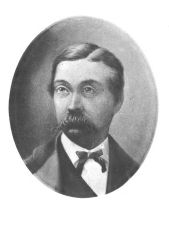
Fitz-James O'Brien 1828-1862
Fitz-James O’Brien
1828-1862

The house is very spacious. A hall of noble size leads to a large spiral staircase winding through its centre, while the various apartments are of imposing dimensions. It was built some fifteen or twenty years since by Mr. A——, the well-known New York merchant, who five years ago threw the commercial world into convulsions by a stupendous bank fraud. Mr. A——, as every one knows, escaped to Europe, and died not long after, of a broken heart. Almost immediately after the news of his decease reached this country and was verified, the report spread in Twenty-sixth Street that No. — was haunted. Legal measures had dispossessed the widow of its former owner, and it was inhabited merely by a caretaker and his wife, placed there by the house agent into whose hands it had passed for the purposes of renting or sale. These people declared that they were troubled with unnatural noises. Doors were opened without any visible agency. The remnants of furniture scattered through the various rooms were, during the night, piled one upon the other by unknown hands. Invisible feet passed up and down the stairs in broad daylight, accompanied by the rustle of unseen silk dresses, and the gliding of viewless hands along the massive balusters. The caretaker and his wife declared they would live there no longer. The house agent laughed, dismissed them, and put others in their place. The noises and supernatural manifestations continued. The neighbourhood caught up the story, and the house remained untenanted for three years. Several persons negotiated for it; but, somehow, always before the bargain was closed they heard the unpleasant rumours and declined to treat any further.

It was in this state of things that my landlady, who at that time kept a boarding-house in Bleecker Street, and who wished to move further up town, conceived the bold idea of renting No. — Twenty-sixth Street. Happening to have in her house rather a plucky and philosophical set of boarders, she laid her scheme before us, stating candidly everything she had heard respecting the ghostly qualities of the establishment to which she wished to remove us. With the exception of two timid persons,—a sea-captain and a returned Californian, who immediately gave notice that they would leave,—all of Mrs. Moffat’s guests declared that they would accompany her in her chivalric incursion into the abode of spirits.

Our removal was effected in the month of May, and we were charmed with our new residence. The portion of Twenty-sixth Street where our house is situated, between Seventh and Eighth avenues, is one of the pleasantest localities in New York. The gardens back of the houses, running down nearly to the Hudson, form, in the summer time, a perfect avenue of verdure. The air is pure and invigorating, sweeping, as it does, straight across the river from the Weehawken heights, and even the ragged garden which surrounded the house, although displaying on washing days rather too much clothesline, still gave us a piece of greensward to look at, and a cool retreat in the summer evenings, where we smoked our cigars in the dusk, and watched the fireflies flashing their dark lanterns in the long grass.

Of course we had no sooner established ourselves at No. — than we began to expect ghosts. We absolutely awaited their advent with eagerness. Our dinner conversation was supernatural. One of the boarders, who had purchased Mrs. Crowe’s “Night Side of Nature” for his own private delectation, was regarded as a public enemy by the entire household for not having bought twenty copies. The man led a life of supreme wretchedness while he was reading this volume. A system of espionage was established, of which he was the victim. If he incautiously laid the book down for an instant and left the room, it was immediately seized and read aloud in secret places to a select few. I found myself a person of immense importance, it having leaked out that I was tolerably well versed in the history of supernaturalism, and had once written a story the foundation of which was a ghost. If a table or a wainscot panel happened to warp when we were assembled in the large drawing-room, there was an instant silence, and every one was prepared for an immediate clanking of chains and a spectral form.

After a month of psychological excitement, it was with the utmost dissatisfaction that we were forced to acknowledge that nothing in the remotest degree approaching the supernatural had manifested itself. Once the black butler asseverated that his candle had been blown out by some invisible agency while he was undressing himself for the night; but as I had more than once discovered this coloured gentleman in a condition when one candle must have appeared to him like two, I thought it possible that, by going a step further in his potations, he might have reversed this phenomenon, and seen no candle at all where he ought to have beheld one.

Things were in this state when an accident took place so awful and inexplicable in its character that my reason fairly reels at the bare memory of the occurrence. It was the tenth of July. After dinner was over I repaired, with my friend Dr. Hammond, to the garden to smoke my evening pipe. Independent of certain mental sympathies which existed between the Doctor and myself, we were linked together by a vice. We both smoked opium. We knew each other’s secret, and respected it. We enjoyed together that wonderful expansion of thought, that marvellous intensifying of the perceptive faculties, that boundless feeling of existence when we seem to have points of contact with the whole universe,—in short, that unimaginable spiritual bliss, which I would not surrender for a throne, and which I hope you, reader, will never—never taste.

Those hours of opium happiness which the Doctor and I spent together in secret were regulated with a scientific accuracy. We did not blindly smoke the drug of paradise, and leave our dreams to chance. While smoking, we carefully steered our conversation through the brightest and calmest channels of thought. We talked of the East, and endeavoured to recall the magical panorama of its glowing scenery. We criticized the most sensuous poets,—those who painted life ruddy with health, brimming with passion, happy in the possession of youth and strength and beauty. If we talked of Shakespeare’s “Tempest,” we lingered over Ariel, and avoided Caliban. Like the Guebers, we turned our faces to the East, and saw only the sunny side of the world.

This skilful colouring of our train of thought produced in our subsequent visions a corresponding tone. The splendours of Arabian fairyland dyed our dreams. We paced the narrow strip of grass with the tread and port of kings. The song of the rana arborea, while he clung to the bark of the ragged plum-tree, sounded like the strains of divine musicians. Houses, walls, and streets melted like rain clouds, and vistas of unimaginable glory stretched away before us. It was a rapturous companionship. We enjoyed the vast delight more perfectly because, even in our most ecstatic moments, we were conscious of each other’s presence. Our pleasures, while individual, were still twin, vibrating and moving in musical accord.

On the evening in question, the tenth of July, the Doctor and myself drifted into an unusually metaphysical mood. We lit our large meerschaums, filled with fine Turkish tobacco, in the core of which burned a little black nut of opium, that, like the nut in the fairy tale, held within its narrow limits wonders beyond the reach of kings; we paced to and fro, conversing. A strange perversity dominated the currents of our thought. They would not flow through the sun-lit channels into which we strove to divert them. For some unaccountable reason, they constantly diverged into dark and lonesome beds, where a continual gloom brooded. It was in vain that, after our old fashion, we flung ourselves on the shores of the East, and talked of its gay bazaars, of the splendours of the time of Haroun, of harems and golden palaces. Black afreets continually arose from the depths of our talk, and expanded, like the one the fisherman released from the copper vessel, until they blotted everything bright from our vision. Insensibly, we yielded to the occult force that swayed us, and indulged in gloomy speculation. We had talked some time upon the proneness of the human mind to mysticism, and the almost universal love of the terrible, when Hammond suddenly said to me, “What do you consider to be the greatest element of terror?”

The question puzzled me. That many things were terrible, I knew. Stumbling over a corpse in the dark; beholding, as I once did, a woman floating down a deep and rapid river, with wildly lifted arms, and awful, upturned face, uttering, as she drifted, shrieks that rent one’s heart while we, spectators, stood frozen at a window which overhung the river at a height of sixty feet, unable to make the slightest effort to save her, but dumbly watching her last supreme agony and her disappearance. A shattered wreck, with no life visible, encountered floating listlessly on the ocean, is a terrible object, for it suggests a huge terror, the proportions of which are veiled. But it now struck me, for the first time, that there must be one great and ruling embodiment of fear,—a King of Terrors, to which all others must succumb. What might it be? To what train of circumstances would it owe its existence?

“I confess, Hammond,” I replied to my friend, “I never considered the subject before. That there must be one Something more terrible than any other thing, I feel. I cannot attempt, however, even the most vague definition.”

“I am somewhat like you, Harry,” he answered. “I feel my capacity to experience a terror greater than anything yet conceived by the human mind;—something combining in fearful and unnatural amalgamation hitherto supposed incompatible elements. The calling of the voices in Brockden Brown’s novel of ‘Wieland’ is awful; so is the picture of the Dweller of the Threshold, in Bulwer’s ‘Zanoni’; but,” he added, shaking his head gloomily, “there is something more horrible still than those.”

“Look here, Hammond,” I rejoined, “let us drop this kind of talk, for Heaven’s sake! We shall suffer for it, depend on it.”

“I don’t know what’s the matter with me tonight,” he replied, “but my brain is running upon all sorts of weird and awful thoughts. I feel as if I could write a story like Hoffman, tonight, if I were only master of a literary style.”

“Well, if we are going to be Hoffmanesque in our talk, I’m off to bed. Opium and nightmares should never be brought together. How sultry it is! Good night, Hammond.”

“Good night, Harry. Pleasant dreams to you.”

“To you, gloomy wretch, afreets, ghouls, and enchanters.”

We parted, and each sought his respective chamber. I undressed quickly and got into bed, taking with me, according to my usual custom, a book, over which I generally read myself to sleep. I opened the volume as soon as I had laid my head upon the pillow, and instantly flung it to the other side of the room. It was Goudon’s “History of Monsters,”—a curious French work, which I had lately imported from Paris, but which, in the state of mind I had then reached, was anything but an agreeable companion. I resolved to go to sleep at once; so, turning down my gas until nothing but a little blue point of light glimmered on the top of the tube, I composed myself to rest.

The room was in total darkness. The atom of gas that still remained alight did not illuminate a distance of three inches round the burner. I desperately drew my arm across my eyes, as if to shut out even the darkness, and tried to think of nothing. It was in vain. The confounded themes touched on by Hammond in the garden kept obtruding themselves on my brain. I battled against them. I erected ramparts of would-be blankness of intellect to keep them out. They still crowded upon me. While I was lying still as a corpse, hoping that by a perfect physical inaction I should hasten mental repose, an awful incident occurred. A Something dropped, as it seemed, from the ceiling, plumb upon my chest, and the next instant I felt two bony hands encircling my throat, endeavouring to choke me.

I am no coward, and am possessed of considerable physical strength. The suddenness of the attack, instead of stunning me, strung every nerve to its highest tension. My body acted from instinct, before my brain had time to realize the terrors of my position. In an instant I wound two muscular arms around the creature, and squeezed it, with all the strength of despair, against my chest. In a few seconds the bony hands that had fastened on my throat loosened their hold, and I was free to breathe once more. Then commenced a struggle of awful intensity. Immersed in the most profound darkness, totally ignorant of the nature of the Thing by which I was so suddenly attacked, finding my grasp slipping every moment, by reason, it seemed to me, of the entire nakedness of my assailant, bitten with sharp teeth in the shoulder, neck, and chest, having every moment to protect my throat against a pair of sinewy, agile hands, which my utmost efforts could not confine,—these were a combination of circumstances to combat which required all the strength, skill, and courage that I possessed.

At last, after a silent, deadly, exhausting struggle, I got my assailant under by a series of incredible efforts of strength. Once pinned, with my knee on what I made out to be its chest, I knew that I was victor. I rested for a moment to breathe. I heard the creature beneath me panting in the darkness, and felt the violent throbbing of a heart. It was apparently as exhausted as I was; that was one comfort. At this moment I remembered that I usually placed under my pillow, before going to bed, a large yellow silk pocket handkerchief. I felt for it instantly; it was there. In a few seconds more I had, after a fashion, pinioned the creature’s arms.

I now felt tolerably secure. There was nothing more to be done but to turn on the gas, and, having first seen what my midnight assailant was like, arouse the household. I will confess to being actuated by a certain pride in not giving the alarm before; I wished to make the capture alone and unaided.

Never losing my hold for an instant, I slipped from the bed to the floor, dragging my captive with me. I had but a few steps to make to reach the gas-burner; these I made with the greatest caution, holding the creature in a grip like a vice. At last I got within arm’s length of the tiny speck of blue light which told me where the gas-burner lay. Quick as lightning I released my grasp with one hand and let on the full flood of light. Then I turned to look at my captive.

I cannot even attempt to give any definition of my sensations the instant after I turned on the gas. I suppose I must have shrieked with terror, for in less than a minute afterward my room was crowded with the inmates of the house. I shudder now as I think of that awful moment. I saw nothing! Yes; I had one arm firmly clasped round a breathing, panting, corporeal shape, my other hand gripped with all its strength a throat as warm, as apparently fleshy, as my own; and yet, with this living substance in my grasp, with its body pressed against my own, and all in the bright glare of a large jet of gas, I absolutely beheld nothing! Not even an outline,—a vapour!

I do not, even at this hour, realize the situation in which I found myself. I cannot recall the astounding incident thoroughly. Imagination in vain tries to compass the awful paradox.

It breathed. I felt its warm breath upon my cheek. It struggled fiercely. It had hands. They clutched me. Its skin was smooth, like my own. There it lay, pressed close up against me, solid as stone,—and yet utterly invisible!

I wonder that I did not faint or go mad on the instant. Some wonderful instinct must have sustained me; for, absolutely, in place of loosening my hold on the terrible Enigma, I seemed to gain an additional strength in my moment of horror, and tightened my grasp with such wonderful force that I felt the creature shivering with agony.

Just then Hammond entered my room at the head of the household. As soon as he beheld my face—which, I suppose, must have been an awful sight to look at—he hastened forward, crying, “Great heaven, Harry! what has happened?”

“Hammond! Hammond!” I cried, “come here. O, this is awful! I have been attacked in bed by something or other, which I have hold of; but I can’t see it,—I can’t see it!”

Hammond, doubtless struck by the unfeigned horror expressed in my countenance, made one or two steps forward with an anxious yet puzzled expression. A very audible titter burst from the remainder of my visitors. This suppressed laughter made me furious. To laugh at a human being in my position! It was the worst species of cruelty. Now, I can understand why the appearance of a man struggling violently, as it would seem, with an airy nothing, and calling for assistance against a vision, should have appeared ludicrous. Then, so great was my rage against the mocking crowd that had I the power I would have stricken them dead where they stood.

“Hammond! Hammond!” I cried again, despairingly, “for God’s sake come to me. I can hold the—the thing but a short while longer. It is overpowering me. Help me! Help me!”

“Harry,” whispered Hammond, approaching me, “you have been smoking too much opium.”

“I swear to you, Hammond, that this is no vision,” I answered, in the same low tone. “Don’t you see how it shakes my whole frame with its struggles? If you don’t believe me, convince yourself. Feel it,—touch it.”

Hammond advanced and laid his hand in the spot I indicated. A wild cry of horror burst from him. He had felt it!

In a moment he had discovered somewhere in my room a long piece of cord, and was the next instant winding it and knotting it about the body of the unseen being that I clasped in my arms.

“Harry,” he said, in a hoarse, agitated voice, for, though he preserved his presence of mind, he was deeply moved, “Harry, it’s all safe now. You may let go, old fellow, if you’re tired. The Thing can’t move.”

I was utterly exhausted, and I gladly loosed my hold.

Hammond stood holding the ends of the cord that bound the Invisible, twisted round his hand, while before him, self-supporting as it were, he beheld a rope laced and interlaced, and stretching tightly around a vacant space. I never saw a man look so thoroughly stricken with awe. Nevertheless his face expressed all the courage and determination which I knew him to possess. His lips, although white, were set firmly, and one could perceive at a glance that, although stricken with fear, he was not daunted.

The confusion that ensued among the guests of the house who were witnesses of this extraordinary scene between Hammond and myself,—who beheld the pantomime of binding this struggling Something,—who beheld me almost sinking from physical exhaustion when my task of jailer was over,—the confusion and terror that took possession of the bystanders, when they saw all this, was beyond description. The weaker ones fled from the apartment. The few who remained clustered near the door and could not be induced to approach Hammond and his Charge. Still incredulity broke out through their terror. They had not the courage to satisfy themselves, and yet they doubted. It was in vain that I begged of some of the men to come near and convince themselves by touch of the existence in that room of a living being which was invisible. They were incredulous, but did not dare to undeceive themselves. How could a solid, living, breathing body be invisible, they asked. My reply was this. I gave a sign to Hammond, and both of us—conquering our fearful repugnance to touch the invisible creature—lifted it from the ground, manacled as it was, and took it to my bed. Its weight was about that of a boy of fourteen.

“Now, my friends,” I said, as Hammond and myself held the creature suspended over the bed, “I can give you self-evident proof that here is a solid, ponderable body, which, nevertheless, you cannot see. Be good enough to watch the surface of the bed attentively.”

I was astonished at my own courage in treating this strange event so calmly; but I had recovered from my first terror, and felt a sort of scientific pride in the affair, which dominated every other feeling.

The eyes of the bystanders were immediately fixed on my bed. At a given signal Hammond and I let the creature fall. There was a dull sound of a heavy body alighting on a soft mass. The timbers of the bed creaked. A deep impression marked itself distinctly on the pillow, and on the bed itself. The crowd who witnessed this gave a low cry, and rushed from the room. Hammond and I were left alone with our Mystery.

We remained silent for some time, listening to the low, irregular breathing of the creature on the bed, and watching the rustle of the bed-clothes as it impotently struggled to free itself from confinement. Then Hammond spoke.

“Harry, this is awful.”

“Ay, awful.”

“But not unaccountable.”

“Not unaccountable! What do you mean? Such a thing has never occurred since the birth of the world. I know not what to think, Hammond. God grant that I am not mad, and that this is not an insane fantasy!”

“Let us reason a little, Harry. Here is a solid body which we touch, but which we cannot see. The fact is so unusual that it strikes us with terror. Is there no parallel, though, for such a phenomenon? Take a piece of pure glass. It is tangible and transparent. A certain chemical coarseness is all that prevents its being so entirely transparent as to be totally invisible. It is not theoretically impossible, mind you, to make a glass which shall not reflect a single ray of light,—a glass so pure and homogeneous in its atoms that the rays from the sun will pass through it as they do through the air, refracted but not reflected. We do not see the air, and yet we feel it.”

“That’s all very well, Hammond, but these are inanimate substances. Glass does not breathe, air does not breathe. This thing has a heart that palpitates,—a will that moves it,—lungs that play, and inspire and respire.”

“You forget the phenomena of which we have so often heard of late,” answered the Doctor, gravely. “At the meetings called ‘spirit circles,’ invisible hands have been thrust into the hands of those persons round the table,—warm, fleshly hands that seemed to pulsate with mortal life.”

“What? Do you think, then, that this thing is——”

“I don’t know what it is,” was the solemn reply; “but please the gods I will, with your assistance, thoroughly investigate it.”

We watched together, smoking many pipes, all night long, by the bedside of the unearthly being that tossed and panted until it was apparently wearied out. Then we learned by the low, regular breathing that it slept.

The next morning the house was all astir. The boarders congregated on the landing outside my room, and Hammond and myself were lions. We had to answer a thousand questions as to the state of our extraordinary prisoner, for as yet not one person in the house except ourselves could be induced to set foot in the apartment.

The creature was awake. This was evidenced by the convulsive manner in which the bed-clothes were moved in its efforts to escape. There was something truly terrible in beholding, as it were, those second-hand indications of the terrible writhings and agonized struggles for liberty which themselves were invisible.

Hammond and myself had racked our brains during the long night to discover some means by which we might realize the shape and general appearance of the Enigma. As well as we could make out by passing our hands over the creature’s form, its outlines and lineaments were human. There was a mouth; a round, smooth head without hair; a nose, which, however, was little elevated above the cheeks; and its hands and feet felt like those of a boy. At first we thought of placing the being on a smooth surface and tracing its outlines with chalk, as shoemakers trace the outline of the foot. This plan was given up as being of no value. Such an outline would give not the slightest idea of its conformation.

A happy thought struck me. We would take a cast of it in plaster of Paris. This would give us the solid figure, and satisfy all our wishes. But how to do it? The movements of the creature would disturb the setting of the plastic covering, and distort the mould. Another thought. Why not give it chloroform? It had respiratory organs,—that was evident by its breathing. Once reduced to a state of insensibility, we could do with it what we would. Doctor X—— was sent for; and after the worthy physician had recovered from the first shock of amazement, he proceeded to administer the chloroform. In three minutes afterward we were enabled to remove the fetters from the creature’s body, and a modeller was busily engaged in covering the invisible form with the moist clay. In five minutes more we had a mould, and before evening a rough facsimile of the Mystery. It was shaped like a man,—distorted, uncouth, and horrible, but still a man. It was small, not over four feet and some inches in height, and its limbs revealed a muscular development that was unparalleled. Its face surpassed in hideousness anything I had ever seen. Gustav Doré, or Callot, or Tony Johannot, never conceived anything so horrible. There is a face in one of the latter’s illustrations to Un Voyage où il vous plaira, which somewhat approaches the countenance of this creature, but does not equal it. It was the physiognomy of what I should fancy a ghoul might be. It looked as if it was capable of feeding on human flesh.

Having satisfied our curiosity, and bound every one in the house to secrecy, it became a question what was to be done with our Enigma? It was impossible that we should keep such a horror in our house; it was equally impossible that such an awful being should be let loose upon the world. I confess that I would have gladly voted for the creature’s destruction. But who would shoulder the responsibility? Who would undertake the execution of this horrible semblance of a human being? Day after day this question was deliberated gravely. The boarders all left the house. Mrs. Moffat was in despair, and threatened Hammond and myself with all sorts of legal penalties if we did not remove the Horror. Our answer was, “We will go if you like, but we decline taking this creature with us. Remove it yourself if you please. It appeared in your house. On you the responsibility rests.” To this there was, of course, no answer. Mrs. Moffat could not obtain for love or money a person who would even approach the Mystery.

The most singular part of the affair was that we were entirely ignorant of what the creature habitually fed on. Everything in the way of nutriment that we could think of was placed before it, but was never touched. It was awful to stand by, day after day, and see the clothes toss, and hear the hard breathing, and know that it was starving.

Ten, twelve days, a fortnight passed, and it still lived. The pulsations of the heart, however, were daily growing fainter, and had now nearly ceased. It was evident that the creature was dying for want of sustenance. While this terrible life-struggle was going on, I felt miserable. I could not sleep. Horrible as the creature was, it was pitiful to think of the pangs it was suffering.

At last it died. Hammond and I found it cold and stiff one morning in the bed. The heart had ceased to beat, the lungs to inspire. We hastened to bury it in the garden. It was a strange funeral, the dropping of that viewless corpse into the damp hole. The cast of its form I gave to Doctor X——, who keeps it in his museum in Tenth Street.

As I am on the eve of a long journey from which I may not return, I have drawn up this narrative of an event the most singular that has ever come to my knowledge.

###

This eBook is for the use of anyone anywhere at no cost and with almost no restrictions whatsoever.  You may copy it, give it away or re-use it under the terms of the Project Gutenberg License included with this eBook or online at http://www.gutenberg.org
The Saturday Night Special: “The Masque of the Red Death” by E.A. Poe (1850)

THE “Red Death” had long devastated the country. No pestilence had ever been so fatal, or so hideous. Blood was its Avator and its seal — the redness and the horror of blood. There were sharp pains, and sudden dizziness, and then profuse bleeding at the pores, with dissolution. The scarlet stains upon the body and especially upon the face of the victim, were the pest ban which shut him out from the aid and from the sympathy of his fellow-men. And the whole seizure, progress and termination of the disease, were the incidents of half an hour.

But the Prince Prospero was happy and dauntless and sagacious. When his dominions were half depopulated, he

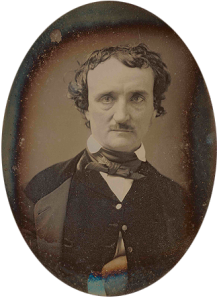
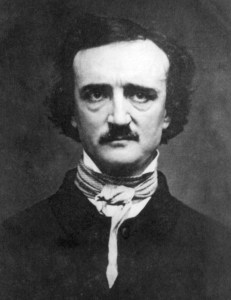
Edgar Allan Poe, 1848

summoned to his presence a thousand hale and light-hearted friends from among the knights and dames of his court, and with these retired to the deep seclusion of one of his castellated abbeys. This was an extensive and magnificent structure, the creation of the prince’s own eccentric yet august taste. A strong and lofty wall girdled it in. This wall had gates of iron. The courtiers, having entered, brought furnaces and massy hammers and welded the bolts. They resolved to leave means neither of ingress or egress to the sudden impulses of despair or of frenzy from within. The abbey was amply provisioned. With such precautions the courtiers might bid defiance to contagion. The external world could take care of itself. In the meantime it was folly to grieve, or to think. The prince had provided all the appliances of pleasure. There were buffoons, there were improvisatori, there were ballet-dancers, there were musicians, there was Beauty, there was wine. All these and security were within. Without was the “Red Death.”

It was toward the close of the fifth or sixth month of his seclusion, and while the pestilence raged most furiously abroad, that the Prince Prospero entertained his thousand friends at a masked ball of the most unusual magnificence.

It was a voluptuous scene, that masquerade. But first let me tell of the rooms in which it was held. There were seven — an imperial suite. In many palaces, however, such suites form a long and straight vista, while the folding doors slide back nearly to the walls on either hand, so that the view of the whole extent is scarcely impeded. Here the case was very different; as might have been expected from the duke’s love of the bizarre. The apartments were so irregularly disposed that the vision embraced but little more than one at a time. There was a sharp turn at every twenty or thirty yards, and at each turn a novel effect. To the right and left, in the middle of each wall, a tall and narrow Gothic window looked out upon a closed corridor which pursued the windings of the suite. These windows were of stained glass whose color varied in accordance with the prevailing hue of the decorations of the chamber into which it opened. That at the eastern extremity was hung, for example, in blue — and vividly blue were its windows. The second chamber was purple in its ornaments and tapestries, and here the panes were purple. The third was green throughout, and so were the casements. The fourth was furnished and lighted with orange — the fifth with white — the sixth with violet. The seventh apartment was closely shrouded in black velvet tapestries that hung all over the ceiling and down the walls, falling in heavy folds upon a carpet of the same material and hue. But in this chamber only, the color of the windows failed to correspond with the decorations. The panes here were scarlet — a deep blood color. Now in no one of the seven apartments was there any lamp or candelabrum, amid the profusion of golden ornaments that lay scattered to and fro or depended from the roof. There was no light of any kind emanating from lamp or candle within the suite of chambers. But in the corridors that followed the suite, there stood, opposite to each window, a heavy tripod, bearing a brazier of fire, that projected its rays through the tinted glass and so glaringly illumined the room. And thus were produced a multitude of gaudy and fantastic appearances. But in the western or black chamber the effect of the fire-light that streamed upon the dark hangings through the blood-tinted panes, was ghastly in the extreme, and produced so wild a look upon the countenances of those who entered, that there were few of the company bold enough to set foot within its precincts at all.

It was in this apartment, also, that there stood against the western wall, a gigantic clock of ebony. Its pendulum swung to and fro with a dull, heavy, monotonous clang; and when the minute-hand made the circuit of the face, and the hour was to be stricken, there came from the brazen lungs of the clock a sound which was clear and loud and deep and exceedingly musical, but of so peculiar a note and emphasis that, at each lapse of an hour, the musicians of the orchestra were constrained to pause, momentarily, in their performance, to harken to the sound; and thus the waltzers perforce ceased their evolutions; and there was a brief disconcert of the whole gay company; and, while the chimes of the clock yet rang, it was observed that the giddiest grew pale, and the more aged and sedate passed their hands over their brows as if in confused revery or meditation. But when the echoes had fully ceased, a light laughter at once pervaded the assembly; the musicians looked at each other and smiled as if at their own nervousness and folly, and made whispering vows, each to the other, that the next chiming of the clock should produce in them no similar emotion; and then, after the lapse of sixty minutes, (which embrace three thousand and six hundred seconds of the Time that flies,) there came yet another chiming of the clock, and then were the same disconcert and tremulousness and meditation as before.

But, in spite of these things, it was a gay and magnificent revel. The tastes of the duke were peculiar. He had a fine eye for colors and effects. He disregarded the decora of mere fashion. His plans were bold and fiery, and his conceptions glowed with barbaric lustre. There are some who would have thought him mad. His followers felt that he was not. It was necessary to hear and see and touch him to be sure that he was not.

He had directed, in great part, the moveable embellishments of the seven chambers, upon occasion of this great fete; and it was his own guiding taste which had given character to the masqueraders. Be sure they were grotesque. There were much glare and glitter and piquancy and phantasm — much of what has been since seen in “Hernani.” There were arabesque figures with unsuited limbs and appointments. There were delirious fancies such as the madman fashions. There were much of the beautiful, much of the wanton, much of the bizarre, something of the terrible, and not a little of that which might have excited disgust. To and fro in the seven chambers there stalked, in fact, a multitude of dreams. And these — the dreams — writhed in and about, taking hue from the rooms, and causing the wild music of the orchestra to seem as the echo of their steps. And, anon, there strikes the ebony clock which stands in the hall of the velvet. And then, for a moment, all is still, and all is silent save the voice of the clock. The dreams are stiff-frozen as they stand. But the echoes of the chime die away — they have endured but an instant — and a light, half-subdued laughter floats after them as they depart. And now again the music swells, and the dreams live, and writhe to and fro more merrily than ever, taking hue from the many tinted windows through which stream the rays from the tripods. But to the chamber which lies most westwardly of the seven, there are now none of the maskers who venture; for the night is waning away; and there flows a ruddier light through the blood-colored panes; and the blackness of the sable drapery appals; and to him whose foot falls upon the sable carpet, there comes from the near clock of ebony a muffled peal more solemnly emphatic than any which reaches their ears who indulge in the more remote gaieties of the other apartments.

But these other apartments were densely crowded, and in them beat feverishly the heart of life. And the revel went whirlingly on, until at length there commenced the sounding of midnight upon the clock. And then the music ceased, as I have told; and the evolutions of the waltzers were quieted; and there was an uneasy cessation of all things as before. But now there were twelve strokes to be sounded by the bell of the clock; and thus it happened, perhaps that more of thought crept, with more of time, into the meditations of the thoughtful among those who revelled. And thus too, it happened, perhaps, that before the last echoes of the last chime had utterly sunk into silence, there were many individuals in the crowd who had found leisure to become aware of the presence of a masked figure which had arrested the attention of no single individual before. And the rumor of this new presence having spread itself whisperingly around, there arose at length from the whole company a buzz, or murmur, expressive of disapprobation and surprise — then, finally, of terror, of horror, and of disgust.

In an assembly of phantasms such as I have painted, it may well be supposed that no ordinary appearance could have excited such sensation. In truth the masquerade license of the night was nearly unlimited; but the figure in question had out-Heroded Herod, and gone beyond the bounds of even the prince’s indefinite decorum. There are chords in the hearts of the most reckless which cannot be touched without emotion. Even with the utterly lost, to whom life and death are equally jests, there are matters of which no jest can be made. The whole company, indeed, seemed now deeply to feel that in the costume and bearing of the stranger neither wit nor propriety existed. The figure was tall and gaunt, and shrouded from head to foot in the habiliments of the grave. The mask which concealed the visage was made so nearly to resemble the countenance of a stiffened corpse that the closest scrutiny must have had difficulty in detecting the cheat. And yet all this might have been endured, if not approved, by the mad revellers around. But the mummer had gone so far as to assume the type of the Red Death. His vesture was dabbled in blood — and his broad brow, with all the features of the face, was besprinkled with the scarlet horror.

When the eyes of Prince Prospero fell upon this spectral image (which with a slow and solemn movement, as if more fully to sustain its role, stalked to and fro among the waltzers) he was seen to be convulsed, in the first moment with a strong shudder either of terror or distaste; but, in the next, his brow reddened with rage.

“Who dares?” he demanded hoarsely of the courtiers who stood near him — “who dares insult us with this blasphemous mockery? Seize him and unmask him — that we may know whom we have to hang at sunrise, from the battlements!”

It was in the eastern or blue chamber in which stood the Prince Prospero as he uttered these words. They rang throughout the seven rooms loudly and clearly — for the prince was a bold and robust man, and the music had become hushed at the waving of his hand.

It was in the blue room where stood the prince, with a group of pale courtiers by his side. At first, as he spoke, there was a slight rushing movement of this group in the direction of the intruder, who, at the moment was also near at hand, and now, with deliberate and stately step, made closer approach to the speaker. But from a certain nameless awe with which the mad assumptions of the mummer had inspired the whole party, there were found none who put forth hand to seize him; so that, unimpeded, he passed within a yard of the prince’s person; and, while the vast assembly, as if with one impulse, shrank from the centres of the rooms to the walls, he made his way uninterruptedly, but with the same solemn and measured step which had distinguished him from the first, through the blue chamber to the purple — through the purple to the green — through the green to the orange — through this again to the white — and even thence to the violet, ere a decided movement had been made to arrest him. It was then, however, that the Prince Prospero, maddening with rage and the shame of his own momentary cowardice, rushed hurriedly through the six chambers, while none followed him on account of a deadly terror that had seized upon all. He bore aloft a drawn dagger, and had approached, in rapid impetuosity, to within three or four feet of the retreating figure, when the latter, having attained the extremity of the velvet apartment, turned suddenly and confronted his pursuer. There was a sharp cry — and the dagger dropped gleaming upon the sable carpet, upon which, instantly afterwards, fell prostrate in death the Prince Prospero. Then, summoning the wild courage of despair, a throng of the revellers at once threw themselves into the black apartment, and, seizing the mummer, whose tall figure stood erect and motionless within the shadow of the ebony clock, gasped in unutterable horror at finding the grave cerements and corpse-like mask which they handled with so violent a rudeness, untenanted by any tangible form.

And now was acknowledged the presence of the Red Death. He had come like a thief in the night. And one by one dropped the revellers in the blood-bedewed halls of their revel, and died each in the despairing posture of his fall. And the life of the ebony clock went out with that of the last of the gay. And the flames of the tripods expired. And Darkness and Decay and the Red Death held illimitable dominion over all.

T

The Saturday Night Special: “The Hound” by H.P. Lovecraft (1922)

In my tortured ears there sounds unceasingly a nightmare whirring and flapping, and a faint distant baying as of some gigantic hound. It is not dream – it is not, I fear, even madness – for too much has already happened to give me these merciful doubts.

St John is a mangled corpse; I alone know why, and such is my knowledge that I am about to blow out my brains for fear I shall be mangled in the same way. Down unlit and illimitable corridors of eldrith phantasy sweeps the black, shapeless Nemesis that drives me to self-annihilation.

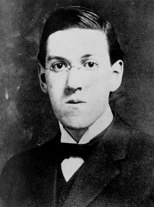
H.P. Lovecraft, 1915

May heaven forgive the folly and morbidity which led us both to so monstrous a fate! Wearied with the commonplaces of a prosaic world; where even the joys of romance and adventure soon grow stale, St John and I had followed enthusiastically every aesthetic and intellectual movement which promised respite from our devastating ennui. The enigmas of the symbolists and the ecstasies of the pre-Raphaelites all were ours in their time, but each new mood was drained too soon, of its diverting novelty and appeal.

Only the somber philosophy of the decadents could help us, and this we found potent only by increasing gradually the depth and diabolism of our penetrations. Baudelaire and Huysmans were soon exhausted of thrills, till finally there remained for us only the more direct stimuli of unnatural personal experiences and adventures. It was this frightful emotional need which led us eventually to that detestable course which even in my present fear I mention with shame and timidity – that hideous extremity of human outrage, the abhorred practice of grave-robbing.

I cannot reveal the details of our shocking expeditions, or catalogue even partly the worst of the trophies adorning the nameless museum we prepared in the great stone house where we jointly dwelt, alone and servantless. Our museum was a blasphemous, unthinkable place, where with the satanic taste of neurotic virtuosi we had assembled an universe of terror and decay to excite our jaded sensibilities. It was a secret room, far, far, underground; where huge winged daemons carven of basalt and onyx vomited from wide grinning mouths weird green and orange light, and hidden pneumatic pipes ruffled into kaleidoscopic dances of death the lines of red charnel things hand in hand woven in voluminous black hangings. Through these pipes came at will the odors our moods most craved; sometimes the scent of pale funeral lilies; sometimes the narcotic incense of imagined Eastern shrines of the kingly dead, and sometimes – how I shudder to recall it! – the frightful, soul-upheaving stenches of the uncovered-grave.

Around the walls of this repellent chamber were cases of antique mummies alternating with comely, lifelike bodies perfectly stuffed and cured by the taxidermist’s art, and with headstones snatched from the oldest churchyards of the world. Niches here and there contained skulls of all shapes, and heads preserved in various stages of dissolution. There one might find the rotting, bald pates of famous noblemen, and the fresh and radiantly golden heads of new-buried children.

Statues and paintings there were, all of fiendish subjects and some executed by St John and myself. A locked portfolio, bound in tanned human skin, held certain unknown and unnameable drawings which it was rumored Goya had perpetrated but dared not acknowledge. There were nauseous musical instruments, stringed, brass, and wood-wind, on which St John and I sometimes produced dissonances of exquisite morbidity and cacodaemoniacal ghastliness; whilst in a multitude of inlaid ebony cabinets reposed the most incredible and unimaginable variety of tomb-loot ever assembled by human madness and perversity. It is of this loot in particular that I must not speak – thank God I had the courage to destroy it long before I thought of destroying myself!

The predatory excursions on which we collected our unmentionable treasures were always artistically memorable events. We were no vulgar ghouls, but worked only under certain conditions of mood, landscape, environment, weather, season, and moonlight. These pastimes were to us the most exquisite form of aesthetic expression, and we gave their details a fastidious technical care. An inappropriate hour, a jarring lighting effect, or a clumsy manipulation of the damp sod, would almost totally destroy for us that ecstatic titillation which followed the exhumation of some ominous, grinning secret of the earth. Our quest for novel scenes and piquant conditions was feverish and insatiate – St John was always the leader, and he it was who led the way at last to that mocking, accursed spot which brought us our hideous and inevitable doom.

By what malign fatality were we lured to that terrible Holland churchyard? I think it was the dark rumor and legendry, the tales of one buried for five centuries, who had himself been a ghoul in his time and had stolen a potent thing from a mighty sepulchre. I can recall the scene in these final moments – the pale autumnal moon over the graves, casting long horrible shadows; the grotesque trees, drooping sullenly to meet the neglected grass and the crumbling slabs; the vast legions of strangely colossal bats that flew against the moon; the antique ivied church pointing a huge spectral finger at the livid sky; the phosphorescent insects that danced like death-fires under the yews in a distant corner; the odors of mould, vegetation, and less explicable things that mingled feebly with the night-wind from over far swamps and seas; and, worst of all, the faint deep-toned baying of some gigantic hound which we could neither see nor definitely place. As we heard this suggestion of baying we shuddered, remembering the tales of the peasantry; for he whom we sought had centuries before been found in this self same spot, torn and mangled by the claws and teeth of some unspeakable beast.

I remember how we delved in the ghoul’s grave with our spades, and how we thrilled at the picture of ourselves, the grave, the pale watching moon, the horrible shadows, the grotesque trees, the titanic bats, the antique church, the dancing death-fires, the sickening odors, the gently moaning night-wind, and the strange, half-heard directionless baying of whose objective existence we could scarcely be sure.

Then we struck a substance harder than the damp mould, and beheld a rotting oblong box crusted with mineral deposits from the long undisturbed ground. It was incredibly tough and thick, but so old that we finally pried it open and feasted our eyes on what it held.

Much – amazingly much – was left of the object despite the lapse of five hundred years. The skeleton, though crushed in places by the jaws of the thing that had killed it, held together with surprising firmness, and we gloated over the clean white skull and its long, firm teeth and its eyeless sockets that once had glowed with a charnel fever like our own. In the coffin lay an amulet of curious and exotic design, which had apparently been worn around the sleeper’s neck. It was the oddly conventionalised figure of a crouching winged hound, or sphinx with a semi-canine face, and was exquisitely carved in antique Oriental fashion from a small piece of green jade. The expression of its features was repellent in the extreme, savoring at once of death, bestiality and malevolence. Around the base was an inscription in characters which neither St John nor I could identify; and on the bottom, like a maker’s seal, was graven a grotesque and formidable skull.

Immediately upon beholding this amulet we knew that we must possess it; that this treasure alone was our logical pelf from the centuried grave. Even had its outlines been unfamiliar we would have desired it, but as we looked more closely we saw that it was not wholly unfamiliar. Alien it indeed was to all art and literature which sane and balanced readers know, but we recognized it as the thing hinted of in the forbidden Necronomicon of the mad Arab Abdul Alhazred; the ghastly soul-symbol of the corpse-eating cult of inaccessible Leng, in Central Asia. All too well did we trace the sinister lineaments described by the old Arab daemonologist; lineaments, he wrote, drawn from some obscure supernatural manifestation of the souls of those who vexed and gnawed at the dead.

Seizing the green jade object, we gave a last glance at the bleached and cavern-eyed face of its owner and closed up the grave as we found it. As we hastened from the abhorrent spot, the stolen amulet in St John’s pocket, we thought we saw the bats descend in a body to the earth we had so lately rifled, as if seeking for some cursed and unholy nourishment. But the autumn moon shone weak and pale, and we could not be sure.

So, too, as we sailed the next day away from Holland to our home, we thought we heard the faint distant baying of some gigantic hound in the background. But the autumn wind moaned sad and wan, and we could not be sure.

Less than a week after our return to England, strange things began to happen. We lived as recluses; devoid of friends, alone, and without servants in a few rooms of an ancient manor-house on a bleak and unfrequented moor; so that our doors were seldom disturbed by the knock of the visitor.

Now, however, we were troubled by what seemed to be a frequent fumbling in the night, not only around the doors but around the windows also, upper as well as lower. Once we fancied that a large, opaque body darkened the library window when the moon was shining against it, and another time we thought we heard a whirring or flapping sound not far off. On each occasion investigation revealed nothing, and we began to ascribe the occurrences to imagination which still prolonged in our ears the faint far baying we thought we had heard in the Holland churchyard. The jade amulet now reposed in a niche in our museum, and sometimes we burned a strangely scented candle before it. We read much in Alhazred’s Necronomicon about its properties, and about the relation of ghosts’ souls to the objects it symbolized; and were disturbed by what we read.

Then terror came.

On the night of September 24, 19–, I heard a knock at my chamber door. Fancying it St John’s, I bade the knocker enter, but was answered only by a shrill laugh. There was no one in the corridor. When I aroused St John from his sleep, he professed entire ignorance of the event, and became as worried as I. It was the night that the faint, distant baying over the moor became to us a certain and dreaded reality.

Four days later, whilst we were both in the hidden museum, there came a low, cautious scratching at the single door which led to the secret library staircase. Our alarm was now divided, for, besides our fear of the unknown, we had always entertained a dread that our grisly collection might be discovered. Extinguishing all lights, we proceeded to the door and threw it suddenly open; whereupon we felt an unaccountable rush of air, and heard, as if receding far away, a queer combination of rustling, tittering, and articulate chatter. Whether we were mad, dreaming, or in our senses, we did not try to determine. We only realized, with the blackest of apprehensions, that the apparently disembodied chatter was beyond a doubt in the Dutch language.

After that we lived in growing horror and fascination. Mostly we held to the theory that we were jointly going mad from our life of unnatural excitements, but sometimes it pleased us more to dramatize ourselves as the victims of some creeping and appalling doom. Bizarre manifestations were now too frequent to count. Our lonely house was seemingly alive with the presence of some malign being whose nature we could not guess, and every night that daemoniac baying rolled over the wind-swept moor, always louder and louder. On October 29 we found in the soft earth underneath the library window a series of footprints utterly impossible to describe. They were as baffling as the hordes of great bats which haunted the old manor-house in unprecedented and increasing numbers.

The horror reached a culmination on November 18, when St John, walking home after dark from the dismal railway station, was seized by some frightful carnivorous thing and torn to ribbons. His screams had reached the house, and I had hastened to the terrible scene in time to hear a whir of wings and see a vague black cloudy thing silhouetted against the rising moon.

My friend was dying when I spoke to him, and he could not answer coherently. All he could do was to whisper, “The amulet – that damned thing -”

Then he collapsed, an inert mass of mangled flesh.

I buried him the next midnight in one of our neglected gardens, and mumbled over his body one of the devilish rituals he had loved in life. And as I pronounced the last daemoniac sentence I heard afar on the moor the faint baying of some gigantic hound. The moon was up, but I dared not look at it. And when I saw on the dim-lighted moor a wide-nebulous shadow sweeping from mound to mound, I shut my eyes and threw myself face down upon the ground. When I arose, trembling, I know not how much later, I staggered into the house and made shocking obeisances before the enshrined amulet of green jade.

Being now afraid to live alone in the ancient house on the moor, I departed on the following day for London, taking with me the amulet after destroying by fire and burial the rest of the impious collection in the museum. But after three nights I heard the baying again, and before a week was over felt strange eyes upon me whenever it was dark. One evening as I strolled on Victoria Embankment for some needed air, I saw a black shape obscure one of the reflections of the lamps in the water. A wind, stronger than the night-wind, rushed by, and I knew that what had befallen St John must soon befall me.

The next day I carefully wrapped the green jade amulet and sailed for Holland. What mercy I might gain by returning the thing to its silent, sleeping owner I knew not; but I felt that I must try any step conceivably logical. What the hound was, and why it had pursued me, were questions still vague; but I had first heard the baying in that ancient churchyard, and every subsequent event including St John’s dying whisper had served to connect the curse with the stealing of the amulet. Accordingly I sank into the nethermost abysses of despair when, at an inn in Rotterdam, I discovered that thieves had despoiled me of this sole means of salvation.

The baying was loud that evening, and in the morning I read of a nameless deed in the vilest quarter of the city. The rabble were in terror, for upon an evil tenement had fallen a red death beyond the foulest previous crime of the neighborhood. In a squalid thieves’ den an entire family had been torn to shreds by an unknown thing which left no trace, and those around had heard all night a faint, deep, insistent note as of a gigantic hound.

So at last I stood again in the unwholesome churchyard where a pale winter moon cast hideous shadows and leafless trees drooped sullenly to meet the withered, frosty grass and cracking slabs, and the ivied church pointed a jeering finger at the unfriendly sky, and the night-wind howled maniacally from over frozen swamps and frigid seas. The baying was very faint now, and it ceased altogether as I approached the ancient grave I had once violated, and frightened away an abnormally large horde of bats which had been hovering curiously around it.

I know not why I went thither unless to pray, or gibber out insane pleas and apologies to the calm white thing that lay within; but, whatever my reason, I attacked the half frozen sod with a desperation partly mine and partly that of a dominating will outside myself. Excavation was much easier than I expected, though at one point I encountered a queer interruption; when a lean vulture darted down out of the cold sky and pecked frantically at the grave-earth until I killed him with a blow of my spade. Finally I reached the rotting oblong box and removed the damp nitrous cover. This is the last rational act I ever performed.

For crouched within that centuried coffin, embraced by a closepacked nightmare retinue of huge, sinewy, sleeping bats, was the bony thing my friend and I had robbed; not clean and placid as we had seen it then, but covered with caked blood and shreds of alien flesh and hair, and leering sentiently at me with phosphorescent sockets and sharp ensanguined fangs yawning twistedly in mockery of my inevitable doom. And when it gave from those grinning jaws a deep, sardonic bay as of some gigantic hound, and I saw that it held in its gory filthy claw the lost and fateful amulet of green jade, I merely screamed and ran away idiotically, my screams soon dissolving into peals of hysterical laughter.

Madness rides the star-wind… claws and teeth sharpened on centuries of corpses… dripping death astride a bacchanale of bats from nigh-black ruins of buried temples of Belial… Now, as the baying of that dead fleshless monstrosity grows louder and louder, and the stealthy whirring and flapping of those accursed web-wings closer and closer, I shall seek with my revolver the oblivion which is my only refuge from the unnamed and unnameable.

The Saturday Night Special: “Annabel Lee” by Edgar Allan Poe (1849)

It was many and many a year ago,
   In a kingdom by the sea,
That a maiden there lived whom you may know
   By the name of Annabel Lee;
And this maiden she lived with no other thought
   Than to love and be loved by me.
I was a child and she was a child,
   In this kingdom by the sea,
But we loved with a love that was more than love—
   I and my Annabel Lee—
With a love that the wingèd seraphs of Heaven
   Coveted her and me.
And this was the reason that, long ago,
   In this kingdom by the sea,
A wind blew out of a cloud, chilling
   My beautiful Annabel Lee;
So that her highborn kinsmen came
   And bore her away from me,
To shut her up in a sepulchre
   In this kingdom by the sea.
The angels, not half so happy in Heaven,
   Went envying her and me—
Yes!—that was the reason (as all men know,
   In this kingdom by the sea)
That the wind came out of the cloud by night,
   Chilling and killing my Annabel Lee.
But our love it was stronger by far than the love
   Of those who were older than we—
   Of many far wiser than we—
And neither the angels in Heaven above
   Nor the demons down under the sea
Can ever dissever my soul from the soul
   Of the beautiful Annabel Lee;
For the moon never beams, without bringing me dreams
   Of the beautiful Annabel Lee;
And the stars never rise, but I feel the bright eyes
   Of the beautiful Annabel Lee;
And so, all the night-tide, I lie down by the side
   Of my darling—my darling—my life and my bride,
   In her sepulchre there by the sea—
   In her tomb by the sounding sea.
Edgar Allan Poe, circa 1849

Now Taking Submissions and Announcements for the Arkansas Country Writers Circle Website

Phil Slattery portrait
Phil Slattery
March, 2015

I will consider articles, short stories, and poems for publication on the Arkansas County Writers Circle website. Please feel free to submit at any time. I will try to post your work as soon as I can. Of course, preference will be given to writers from Arkansas and particularly from Arkansas County. There is no pay other than having the distinction of being published and having another bullet for your writer’s resume.

I am looking for short, flash, or micro fiction that demonstrates the art of writing, whether it be prose, poetry, one-act plays, or any other form of literature of any genre.  I want to showcase literature in all its subtlety, beauty, intelligence, art, horror, terror, suspense, and gruesome detail.  I also want to push its limits with the challenge of staying under 2,500 words while making an intellectual and emotional connection with the reader. Do your best, most imaginative, most professional work.

I am also looking for non-fiction articles on the art of writing.   Please keep these to under 2,500 words as well. All rights will remain with the author. If you would like to submit an article or book/movie review on the art of writing horror fiction or just on the art of writing, please send it to philslattery87410@gmail.com.  Everything must be submitted by e-mail either in the body of the e-mail or a Word document (.doc or .docx).  There is no pay for any submission at this time (maybe after I win the Pulitzer or Nobel, but probably not before then).

In addition, I am taking announcements about works of literature of any genre.  If you are an author with a book-signing coming up or you will be giving a public talk somewhere or you have a book (or film) with a definite release date, announce it here.  If you have anything related to a creative work of literature that you would like to publicize, draft an announcement and send it in.  I reserve all editorial rights however to make any needed changes for clarity, etc, and to ask questions if the announcement isn’t clear on some point.  There will be no charge for this, at least initially, but I do reserve the right to charge fees later, if a lot of announcements start to flood my inbox.

Mark Twain

However, note that I will not do advertising for any product.  I want to publicize creative works and to help authors, poets, film makers, and others jump start their careers.  I am not a merchant.  As to where the line is between advertising a product and publicizing a work, that will be my subjective decision.  So if you want to sell pens, notebooks, software, or any other concrete product, try Amazon.com.

Fiction will probably be published on Fridays and articles on other nights as I feel appropriate.

You may submit stories and articles in languages besides English, but it must be in one of the languages in which I have at least some minimal ability. These are primarily German and Spanish, though I can read French to a degree. I need practice in all three.  Shorter articles will fare well here as I do not want to spend all day with a dictionary and grammar ensuring that the writing is up to par. Odds of these being accepted are sort of low, but if I can read them easily enough, I will consider them.

I reserve the right to change my mind as I develop this site.

Specifically, in terms of creative works, I am seeking:

  1. Articles under 2,500 words on the art of writing (fiction of any length, poetry, screenplays, etc.) or on writing in general  Articles on foreign literature are encouraged.
  2. Book and movie reviews, the more recently published or distributed the better.
  3. I will consider reviews of articles on literature in other countries.  These must also be under 2,500 words.
  4. Translations of articles, stories, or poems from French, German, or Spanish are considered, but the original article/story/poem and its translation must not exceed 2,500 words.
  5. Poetry (under 32 lines) or articles on poetry.
  6. Flash fiction (i.e. under 1,000 words).

Guidelines

  1. Be professional.
  2. Use standard manuscript format.  The easier it is for me to simply copy and paste into WordPress, the more likely you are to be published.
  3. Tennessee Williams, 1965
    Tennessee Williams, 1965

    With submissions include your website, twitter handle, or any other social media identification you like.  A short bio of 100 words or less (including a list of previous publications) is nice, but not required.   Knowing your publication history won’t influence whether or not you are accepted, but it might be nice for the readership to know.  If you don’t want to include any social media contact info, don’t include it.  Pseudonyms are fine, but please state them as the byline and include your actual name and contact info in the top left of the first page of the submission per standard manuscript format.

  4. In the subject line of your e-mail state whether this is an article or review or poetry of fiction submission, your name, and the work’s title.  For example:  Article by Phil Slattery  “Poe’s Raven: an Analysis”
  5. No hardcopy submissions.  Everything must be submitted by e-mail either in the body of the e-mail or attached as a Word document (.doc or .docx).
  6. I would like to reach as large an audience as possible, so please keep profanity to an absolute minimum.
  7. I will try to respond to submissions as quickly as possible, but please allow at least a couple of weeks before querying about your article/story.
  8. There is no pay other than the honor of being published on this website.
  9. I am not taking multiple submissions or simultaneous submissions.  Once you have submitted one article/story, please wait about a week before submitting another.
  10. You may submit on piece of artwork or a photo to accompany your article/story.  I will edit it (mainly re-sizing) as needed to fit the space available.  I will not publish any form of what I deem pornography or in bad taste.  If you do not submit artwork or a photo, I may select something appropriate.  JPEGs, TIFs and other formats accepted by WordPress are okay, but keep the number of bytes to a minimum.  I have only a limited amount of space available.
  11. Artwork and photos may be submitted on their own and you must own the copyright to them or they may be from the public domain (please state so if they are).  There is no pay for these either.  If I do not use these right away, I may keep them until a use arises, but please let me know if this is okay.  If you no longer wish me to use them, please let me know as soon as possible.
  12. Kate Chopin, 1894
    Kate Chopin, 1894

    Do not send advertising (no matter how cleverly veiled it is).  It won’t be published.

  13. Gratuitous sex, extreme violence, violence to children or animals, rape, excessive profanity, and anything else that offends my personal sensibilities will not be published.  Anything that seems to reflect an actual crime (past, present, or future) will be immediately turned over to the proper authorities.
  14. If I like your submission, I will publish it as soon as possible.  This will depend on the backlog of submissions and other factors.   Don’t ask for a time-frame.
  15. Reprints are okay, but you must tell me when and where the article/story/poem was first published.
  16. I do not want fan fiction.
  17. Always re-check the guidelines before submitting.  I may change them at any moment without prior notice.

I will update these guidelines as time allows and events warrant.  This page was last updated on June 4, 2019. Please contact me via philslattery87410@gmail.com with any questions. Thoughts?  Comments?

Update: November 12, 2019, Busy Weekend and Veteran’s Day

Writing at IHOP, 2019. Photo by Fran.
Working late at night at an IHOP in Midland, TX, May, 2019

Saturday and Sunday,  I spent a lot of time organizing my house after the recent move. I wanted to write, but as my wife notes, I feel more like writing in a clean environment. I had never noticed this until she mentioned it sometime back, but she is absolutely right.  I spent two days cleaning and organizing and come Monday evening, I really felt the drive to write.

During most of the day on Monday, however, I spent exploring the local area up to Stuttgart looking for places to hold writer circles meetings for the Arkansas Writers Circle that I am trying to establish. Not much luck on that front. No Starbuck’s in this area and the one coffee shop I found in DeWitt (420 and Turnrow is the name of the shop) closes at 7:00. It is a very nice place though and I hope to go there when I can. It is a nice, clean environment for relaxing and writing.  The arts center in Stuttgart was closed when I arrived. I will try contacting them later.

I did visit the Stuttgart and DeWitt campuses of the Philips Community College in DeWitt and Stuttgart. I hoped to contact their English professors, who I thought might know of any writers groups locally, if any one does. No one from the English department at either was there when I arrived, but I left a card. This afternoon Professor Liddell (of both campuses) called and left a message saying that there are no writers groups in the area to his knowledge. He also said that he would help spread the word about mine and that I could call him with questions. That is a big step for this project. Thanks, Professor Liddell.

I ran a couple of errands and ended up in Dumas. There I went to El Toro Mexican restaurant to write up some notes and get some delicious tortilla soup (the weather here was cold and rainy all day). I spent a couple of hours there and then went home. At home, I spent quite a few hours, typing up the new material I had concocted at El Toro into Shadows and Stars. I ended the night’s writing about 2:00 a.m., but still have a little to do when I go home tonight. My original goal was to make Shadows and Stars reach between 80,000 to 100,000 words. I am now over 91,000. I am trying to wrap this up. I will probably have between 100,000 to 110,000 by the time I finish. This will be the first draft. Then I polish the first draft until I am satisfied, which may be a while.

Also, yesterday I received an email from Austin Macauley publishers saying they had received Bobby the Brown Pelican.  It should be about three weeks before I hear something.

This morning as I was prepping for work, I came up with a few more ideas for children’s picture books. I remembered that I had started another call Alison the Odd Little Alien about a little girl named Alison, who travels to another planet, where she learns what it’s like to be the foreigner/alien in another land. I got the idea from one of my wife’s pupils, who suggested I write a story about aliens after I read Bobby the Brown Pelican to them. It shouldn’t take long to finish it. Probably less than three weeks. If Austin Macauley accepts my work, maybe I will submit Alison… next.

The Saturday Night Special: “The Phantom Coach” by Amelia B. Edwards (1864)

The circumstances I am about to relate to you have truth to recommend them. They happened to myself, and my recollection of them is as vivid as if they had taken place only yesterday. Twenty years, however, have gone by since that night. During those twenty years I have told the story to but one other person. I tell it now with a reluctance which I find it difficult to overcome. All I entreat, meanwhile, is that you will abstain from forcing your own conclusions upon me. I want nothing explained away. I desire no arguments. My mind on this subject is quite made up, and, having the testimony of my own senses to rely upon, I prefer to abide by it.

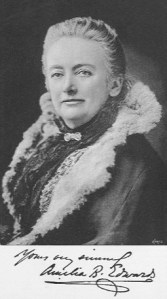
Amelia B. Edwards, 1890

Well! It was just twenty years ago, and within a day or two of the end of the grouse season. I had been out all day with my gun, and had had no sport to speak of. The wind was due east; the month, December; the place, a bleak wide moor in the far north of England. And I had lost my way. It was not a pleasant place in which to lose one’s way, with the first feathery flakes of a coming snowstorm just fluttering down upon the heather, and the leaden evening closing in all around. I shaded my eyes with my hand, and staled anxiously into the gathering darkness, where the purple moorland melted into a range of low hills, some ten or twelve miles distant. Not the faintest smoke-wreath, not the tiniest cultivated patch, or fence, or sheep-track, met my eyes in any direction. There was nothing for it but to walk on, and take my chance of finding what shelter I could, by the way. So I shouldered my gun again, and pushed wearily forward; for I had been on foot since an hour after daybreak, and had eaten nothing since breakfast.

Meanwhile, the snow began to come down with ominous steadiness, and the wind fell. After this, the cold became more intense, and the night came rapidly up. As for me, my prospects darkened with the darkening sky, and my heart grew heavy as I thought how my young wife was already watching for me through the window of our little inn parlour, and thought of all the suffering in store for her throughout this weary night. We had been married four months, and, having spent our autumn in the Highlands, were now lodging in a remote little village situated just on the verge of the great English moorlands. We were very much in love, and, of course, very happy. This morning, when we parted, she had implored me to return before dusk, and I had promised her that I would. What would I not have given to have kept my word!

Even now, weary as I was, I felt that with a supper, an hour’s rest, and a guide, I might still get back to her before midnight, if only guide and shelter could be found.

And all this time, the snow fell and the night thickened. I stopped and shouted every now and then, but my shouts seemed only to make the silence deeper. Then a vague sense of uneasiness came upon me, and I began to remember stories of travellers who had walked on and on in the falling snow until, wearied out, they were fain to lie down and sleep their lives away. Would it be possible, I asked myself, to keep on thus through all the long dark night? Would there not come a time when my limbs must fail, and my resolution give way? When I, too, must sleep the sleep of death. Death! I shuddered. How hard to die just now, when life lay all so bright before me! How hard for my darling, whose whole loving heart but that thought was not to be borne! To banish it, I shouted again, louder and longer, and then listened eagerly. Was my shout answered, or did I only fancy that I heard a far-off cry? I halloed again, and again the echo followed. Then a wavering speck of light came suddenly out of the dark, shifting, disappearing, growing momentarily nearer and brighter. Running towards it at full speed, I found myself, to my great joy, face to face with an old man and a lantern.

“Thank God!” was the exclamation that burst involuntarily from my lips.

Blinking and frowning, he lifted his lantern and peered into my face.

“What for?” growled he, sulkily.

“Well — for you. I began to fear I should be lost in the snow.”

“Eh, then, folks do get cast away hereabouts fra’ time to time, an’ what’s to hinder you from bein’ cast away likewise, if the Lord’s so minded?”

“If the Lord is so minded that you and I shall be lost together, friend, we must submit,” I replied; “but I don’t mean to be lost without you. How far am I now from Dwolding?”

“A gude twenty mile, more or less.”

“And the nearest village?”

“The nearest village is Wyke, an’ that’s twelve mile t’other side.”

“Where do you live, then?”

“Out yonder,” said he, with a vague jerk of the lantern.

“You’re going home, I presume?”

“Maybe I am.”

“Then I’m going with you.”

The old man shook his head, and rubbed his nose reflectively with the handle of the lantern.

“It ain’t o’ no use,” growled he. “He ‘ont let you in — not he.”

“We’ll see about that,” I replied, briskly. “Who is He?”

“The master.”

“Who is the master?”

“That’s nowt to you,” was the unceremonious reply.

“Well, well; you lead the way, and I’ll engage that the master shall give me shelter and a supper to-night.”

“Eh, you can try him!” muttered my reluctant guide; and, still shaking his head, he hobbled, gnome-like, away through the falling snow. A large mass loomed up presently out of the darkness, and a huge dog rushed out, barking furiously.

“Is this the house?” I asked.

“Ay, it’s the house. Down, Bey!” And he fumbled in his pocket for the key.

 I drew up close behind him, prepared to lose no chance of entrance, and saw in the little circle of light shed by the lantern that the door was heavily studded with iron nails, like the door of a prison. In another minute he had turned the key and I had pushed past him into the house.

 Once inside, I looked round with curiosity, and found myself in a great raftered hall, which served, apparently, a variety of uses. One end was piled to the roof with corn, like a barn. The other was stored with flour-sacks, agricultural implements, casks, and all kinds of miscellaneous lumber; while from the beams overhead hung rows of hams, flitches, and bunches of dried herbs for winter use. In the centre of the floor stood some huge object gauntly dressed in a dingy wrapping-cloth, and reaching half way to the rafters. Lifting a corner of this cloth, I saw, to my surprise, a telescope of very considerable size, mounted on a rude movable platform, with four small wheels. The tube was made of painted wood, bound round with bands of metal rudely fashioned; the speculum, so far as I could estimate its size in the dim light, measured at least fifteen inches in diameter. While I was yet examining the instrument, and asking myself whether it was not the work of some self-taught optician, a bell rang sharply.

“That’s for you,” said my guide, with a malicious grin. “Yonder’s his room.”

He pointed to a low black door at the opposite side of the hall. I crossed over, rapped somewhat loudly, and went in, without waiting for an invitation. A huge, white-haired old man rose from a table covered with books and papers, and confronted me sternly.

“Who are you?” said he. “How came you here? What do you want?”

“James Murray, barrister-at-law. On foot across the moor. Meat, drink, and sleep.”

He bent his bushy brows into a portentous frown.

“Mine is not a house of entertainment,” he said, haughtily. “Jacob, how dared you admit this stranger?”
 “I didn’t admit him,” grumbled the old man. “He followed me over the muir, and shouldered his way in before me. I’m no match for six foot two.”

“And pray, sir, by what right have you forced an entrance into my house?”

“The same by which I should have clung to your boat, if I were drowning. The right of self-preservation.”

“Self-preservation?”

“There’s an inch of snow on the ground already,” I replied, briefly; “and it would be deep enough to cover my body before daybreak.”

He strode to the window, pulled aside a heavy black curtain, and looked out.

“It is true,” he said. “You can stay, if you choose, till morning. Jacob, serve the supper.”

With this he waved me to a seat, resumed his own, and became at once absorbed in the studies from which I had disturbed him.

I placed my gun in a corner, drew a chair to the hearth, and examined my quarters at leisure. Smaller and less incongruous in its arrangements than the hall, this room contained, nevertheless, much to awaken my curiosity. The floor was carpetless. The whitewashed walls were in parts scrawled over with strange diagrams, and in others covered with shelves crowded with philosophical instruments, the uses of many of which were unknown to me. On one side of the fireplace, stood a bookcase filled with dingy folios; on the other, a small organ, fantastically decorated with painted carvings of medieval saints and devils. Through the half-opened door of a cupboard at the further end of the room, I saw a long array of geological specimens, surgical preparations, crucibles, retorts, and jars of chemicals; while on the mantelshelf beside me, amid a number of small objects, stood a model of the solar system, a small galvanic battery, and a microscope. Every chair had its burden. Every corner was heaped high with books. The very floor was littered over with maps, casts, papers, tracings, and learned lumber of all conceivable kinds.

 I stared about me with an amazement increased by every fresh object upon which my eyes chanced to rest. So strange a room I had never seen; yet seemed it stranger still, to find such a room in a lone farmhouse amid those wild and solitary moors! Over and over again, I looked from my host to his surroundings, and from his surroundings back to my host, asking myself who and what he could be? His head was singularly fine; but it was more the head of a poet than of a philosopher. Broad in the temples, prominent over the eyes, and clothed with a rough profusion of perfectly white hair, it had all the ideality and much of the ruggedness that characterises the head of Louis von Beethoven. There were the same deep lines about the mouth, and the same stern furrows in the brow. There was the same concentration of expression. While I was yet observing him, the door opened, and Jacob brought in the supper. His master then closed his book, rose, and with more courtesy of manner than he had yet shown, invited me to the table.
A dish of ham and eggs, a loaf of brown bread, and a bottle of admirable sherry, were placed before me.

“I have but the homeliest farmhouse fare to offer you, sir,” said my entertainer. “Your appetite, I trust, will make up for the deficiencies of our larder.”

I had already fallen upon the viands, and now protested, with the enthusiasm of a starving sportsman, that I had never eaten anything so delicious.

He bowed stiffly, and sat down to his own supper, which consisted, primitively, of a jug of milk and a basin of porridge. We ate in silence, and, when we had done, Jacob removed the tray. I then drew my chair back to the fireside. My host, somewhat to my surprise, did the same, and turning abruptly towards me, said:

“Sir, I have lived here in strict retirement for three-and-twenty years. During that time, I have not seen as many strange faces, and I have not read a single newspaper. You are the first stranger who has crossed my threshold for more than four years. Will you favour me with a few words of information respecting that outer world from which I have parted company so long?”

 “Pray interrogate me,” I replied. “I am heartily at your service.”

He bent his head in acknowledgment; leaned forward, with his elbows resting on his knees and his chin supported in the palms of his hands; stared fixedly into the fire; and proceeded to question me.

His inquiries related chiefly to scientific matters, with the later progress of which, as applied to the practical purposes of life, he was almost wholly unacquainted. No student of science myself, I replied as well as my slight information permitted; but the task was far from easy, and I was much relieved when, passing from interrogation to discussion, he began pouring forth his own conclusions upon the facts which I had been attempting to place before him. He talked, and I listened spellbound. He talked till I believe he almost forgot my presence, and only thought aloud. I had never heard anything like it then; I have never heard anything like it since. Familiar with all systems of all philosophies, subtle in analysis, bold in generalisation, he poured forth his thoughts in an uninterrupted stream, and, still leaning forward in the same moody attitude with his eyes fixed upon the fire, wandered from topic to topic, from speculation to speculation, like an inspired dreamer. From practical science to mental philosophy; from electricity in the wire to electricity in the nerve; from Watts to Mesmer, from Mesmer to Reichenbach, from Reichenbach to Swedenborg, Spinoza, Condillac, Descartes, Berkeley, Aristotle, Plato, and the Magi and mystics of the East, were transitions which, however bewildering in their variety and scope, seemed easy and harmonious upon his lips as sequences in music. By-and-by — I forget now by what link of conjecture or illustration — he passed on to that field which lies beyond the boundary line of even conjectural philosophy, and reaches no man knows whither. He spoke of the soul and its aspirations; of the spirit and its powers; of second sight; of prophecy; of those phenomena which, under the names of ghosts, spectres, and supernatural appearances, have been denied by the sceptics and attested by the credulous, of all ages.

“The world,” he said, “grows hourly more and more sceptical of all that lies beyond its own narrow radius; and our men of science foster the fatal tendency. They condemn as fable all that resists experiment. They reject as false all that cannot be brought to the test of the laboratory or the dissecting-room. Against what superstition have they waged so long and obstinate a war, as against the belief in apparitions? And yet what superstition has maintained its hold upon the minds of men so long and so firmly? Show me any fact in physics, in history, in archæology, which is supported by testimony so wide and so various. Attested by all races of men, in all ages, and in all climates, by the soberest sages of antiquity, by the rudest savage of to-day, by the Christian, the Pagan, the Pantheist, the Materialist, this phenomenon is treated as a nursery tale by the philosophers of our century. Circumstantial evidence weighs with them as a feather in the balance. The comparison of causes with effects, however valuable in physical science, is put aside as worthless and unreliable. The evidence of competent witnesses, however conclusive in a court of justice, counts for nothing. He who pauses before he pronounces, is condemned as a trifler. He who believes, is a dreamer or a fool.”

He spoke with bitterness, and, having said thus, relapsed for some minutes into silence. Presently he raised his head from his hands, and added, with an altered voice and manner, “I, sir, paused, investigated, believed, and was not ashamed to state my convictions to the world. I, too, was branded as a visionary, held up to ridicule by my contemporaries, and hooted from that field of science in which I had laboured with honour during all the best years of my life. These things happened just three-and-twenty years ago. Since then, I have lived as you see me living now, and the world has forgotten me, as I have forgotten the world. You have my history.”

“It is a very sad one,” I murmured, scarcely knowing what to answer.

“It is a very common one,” he replied. “I have only suffered for the truth, as many a better and wiser man has suffered before me.”

He rose, as if desirous of ending the conversation, and went over to the window.

“It has ceased snowing,” he observed, as he dropped the curtain, and came back to the fireside.

“Ceased!” I exclaimed, starting eagerly to my feet. “Oh, if it were only possible — but no! it is hopeless. Even if I could find my way across the moor, I could not walk twenty miles to-night.”

“Walk twenty miles to-night!” repeated my host. “What are you thinking of?”

“Of my wife,” I replied, impatiently. “Of my young wife, who does not know that I have lost my way, and who is at this moment breaking her heart with suspense and terror.”

“Where is she?”

“At Dwolding, twenty miles away.”

“At Dwolding,” he echoed, thoughtfully. “Yes, the distance, it is true, is twenty miles; but — are you so very anxious to save the next six or eight hours?”

“So very, very anxious, that I would give ten guineas at this moment for a guide and a horse.”

 “Your wish can be gratified at a less costly rate,” said he, smiling. “The night mail from the north, which changes horses at Dwolding, passes within five miles of this spot, and will be due at a certain cross-road in about an hour and a quarter. If Jacob were to go with you across the moor, and put you into the old coach-road, you could find your way, I suppose, to where it joins the new one?”

“Easily — gladly.”

He smiled again, rang the bell, gave the old servant his directions, and, taking a bottle of whisky and a wineglass from the cupboard in which he kept his chemicals, said:

“The snow lies deep, and it will be difficult walking to-night on the moor. A glass of usquebaugh before you start?”

I would have declined the spirit, but he pressed it on me, and I drank it. It went down my throat like liquid flame, and almost took my breath away.

“It is strong,” he said; “but it will help to keep out the cold. And now you have no moments to spare. Good night!”

I thanked him for his hospitality, and would have shaken hands, but that he had turned away before I could finish my sentence. In another minute I had traversed the hall, Jacob had locked the outer door behind me, and we were out on the wide white moor.

Although the wind had fallen, it was still bitterly cold. Not a star glimmered in the black vault overhead. Not a sound, save the rapid crunching of the snow beneath our feet, disturbed the heavy stillness of the night. Jacob, not too well pleased with his mission, shambled on before in sullen silence, his lantern in his hand, and his shadow at his feet. I followed, with my gun over my shoulder, as little inclined for conversation as himself. My thoughts were full of my late host. His voice yet rang in my ears. His eloquence yet held my imagination captive. I remember to this day, with surprise, how my over-excited brain retained whole sentences and parts of sentences, troops of brilliant images, and fragments of splendid reasoning, in the very words in which he had uttered them. Musing thus over what I had heard, and striving to recall a lost link here and there, I strode on at the heels of my guide, absorbed and unobservant. Presently — at the end, as it seemed to me, of only a few minutes — he came to a sudden halt, and said:

“Yon’s your road. Keep the stone fence to your right hand, and you can’t fail of the way.”

 “This, then, is the old coach-road?”

“Ay, ’tis the old coach-road.”

“And how far do I go, before I reach the cross-roads?”

“Nigh upon three mile.”

I pulled out my purse, and he became more communicative.

“The road’s a fair road enough,” said he, “for foot passengers; but ’twas over steep and narrow for the northern traffic. You’ll mind where the parapet’s broken away, close again the sign-post. It’s never been mended since the accident.”

“What accident?”

“Eh, the night mail pitched right over into the valley below — a gude fifty feet an’ more — just at the worst bit o’ road in the whole county.”

“Horrible! Were many lives lost?”

“All. Four were found dead, and t’other two died next morning.”

“How long is it since this happened?”

“Just nine year.”

“Near the sign-post, you say? I will bear it in mind. Good night.”

“Gude night, sir, and thankee.” Jacob pocketed his half-crown, made a faint pretence of touching his hat, and trudged back by the way he had come.

I watched the light of his lantern till it quite disappeared, and then turned to pursue my way alone. This was no longer matter of the slightest difficulty, for, despite the dead darkness overhead, the line of stone fence showed distinctly enough against the pale gleam of the snow. How silent it seemed now, with only my footsteps to listen to; how silent and how solitary! A strange disagreeable sense of loneliness stole over me. I walked faster. I hummed a fragment of a tune. I cast up enormous sums in my head, and accumulated them at compound interest. I did my best, in short, to forget the startling speculations to which I had but just been listening, and, to some extent, I succeeded.

Meanwhile the night air seemed to become colder and colder, and though I walked fast I found it impossible to keep myself warm. My feet were like ice. I lost sensation in my hands, and grasped my gun mechanically. I even breathed with difficulty, as though, instead of traversing a quiet north country highway, I were scaling the uppermost heights of some gigantic Alp. This last symptom became presently so distressing, that I was forced to stop for a few minutes, and lean against the stone fence. As I did so, I chanced to look back up the road, and there, to my infinite relief, I saw a distant point of light, like the gleam of an approaching lantern. I at first concluded that Jacob had retraced his steps and followed me; but even as the conjecture presented itself, a second light flashed into sight — a light evidently parallel with the first, and approaching at the same rate of motion. It needed no second thought to show me that these must be the carriage-lamps of some private vehicle, though it seemed strange that any private vehicle should take a road professedly disused and dangerousThere could be no doubt, however, of the fact, for the lamps grew larger and brighter every moment, and I even fancied I could already see the dark outline of the carriage between them. It was coming up very fast, and quite noiselessly, the snow being nearly a foot deep under the wheels.

And now the body of the vehicle became distinctly visible behind the lamps. It looked strangely lofty. A sudden suspicion flashed upon me. Was it possible that I had passed the cross-roads in the dark without observing the sign-post, and could this be the very coach which I had come to meet?

No need to ask myself that question a second time, for here it came round the bend of the road, guard and driver, one outside passenger, and four steaming greys, all wrapped in a soft haze of light, through which the lamps blazed out, like a pair of fiery meteors.

I jumped forward, waved my hat, and shouted. The mail came down at full speed, and passed me. For a moment I feared that I had not been seen or heard, but it was only for a moment. The coachman pulled up; the guard, muffled to the eyes in capes and comforters, and apparently sound asleep in the rumble, neither answered my hail nor made the slightest effort to dismount; the outside passenger did not even turn his head. I opened the door for myself, and looked in. There were but three travellers inside, so I stepped in, shut the door, slipped into the vacant corner, and congratulated myself on my good fortune.

The atmosphere of the coach seemed, if possible, colder than that of the outer air, and was pervaded by a singularly damp and disagreeable smell. I looked round at my fellow-passengers. They were all three, men, and all silent. They did not seem to be asleep, but each leaned back in his corner of the vehicle, as if absorbed in his own reflections. I attempted to open a conversation.

“How intensely cold it is to-night,” I said, addressing my opposite neighbour.

He lifted his head, looked at me, but made no reply.

“The winter,” I added, “seems to have begun in earnest.”

Although the corner in which he sat was so dim that I could distinguish none of his features very clearly, I saw that his eyes were still turned full upon me. And yet he answered never a word.

At any other time I should have felt, and perhaps expressed, some annoyance, but at the moment I felt too ill to do either. The icy coldness of the night air had struck a chill to my very marrow, and the strange smell inside the coach was affecting me with an intolerable nausea. I shivered from head to foot, and, turning to my left-hand neighbour, asked if he had any objection to an open window?

He neither spoke nor stirred.

I repeated the question somewhat more loudly, but with the same result. Then I lost patience, and let the sash down. As I did so, the leather strap broke in my hand, and I observed that the glass was covered with a thick coat of mildew, the accumulation, apparently, of years. My attention being thus drawn to the condition of the coach, I examined it more narrowly, and saw by the uncertain light of the outer lamps that it was in the last stage of dilapidation. Every part of it was not only out of repair, but in a condition of decay. The sashes splintered at a touch. The leather fittings were crusted over with mould, and literally rotting from the woodwork. The floor was almost breaking away beneath my feet. The whole machine, in short, was foul with damp, and had evidently been dragged from some outhouse in which it had been mouldering away for years, to do another day or two of duty on the road.

I turned to the third passenger, whom I had not yet addressed, and hazarded one more remark.

“This coach,” I said, “is in a deplorable condition. The regular mail, I suppose, is under repair?”

He moved his head slowly, and looked me in the face, without speaking a word. I shall never forget that look while I live. I turned cold at heart under it. I turn cold at heart even now when I recall it. His eyes glowed with a fiery unnatural lustre. His face was livid as the face of a corpse. His bloodless lips were drawn back as if in the agony of death, and showed the gleaming teeth between.

The words that I was about to utter died upon my lips, and a strange horror — a dreadful horror — came upon me. My sight had by this time become used to the gloom of the coach, and I could see with tolerable distinctness. I turned to my opposite neighbour. He, too, was looking at me, with the same startling pallor in his face, and the same stony glitter in his eyes. I passed my hand across my brow. I turned to the passenger on the seat beside my own, and saw — oh Heaven! how shall I describe what I saw? I saw that he was no living man — that none of them were living men, like myself! A pale phosphorescent light — the light of putrefaction — played upon their awful faces; upon their hair, dank with the dews of the grave; upon their clothes, earth-stained and dropping to pieces; upon their hands, which were as the hands of corpses long buried. Only their eyes, their terrible eyes, were living; and those eyes were all turned menacingly upon me!

A shriek of terror, a wild unintelligible cry for help and mercy; burst from my lips as I flung myself against the door, and strove in vain to open it.

 In that single instant, brief and vivid as a landscape beheld in the flash of summer lightning, I saw the moon shining down through a rift of stormy cloud — the ghastly sign-post rearing its warning finger by the wayside — the broken parapet — the plunging horses — the black gulf below. Then, the coach reeled like a ship at sea. Then, came a mighty crash — a sense of crushing pain — and then, darkness.

It seemed as if years had gone by when I awoke one morning from a deep sleep, and found my wife watching by my bedside I will pass over the scene that ensued, and give you, in half a dozen words, the tale she told me with tears of thanksgiving. I had fallen over a precipice, close against the junction of the old coach-road and the new, and had only been saved from certain death by lighting upon a deep snowdrift that had accumulated at the foot of the rock beneath. In this snowdrift I was discovered at daybreak, by a couple of shepherds, who carried me to the nearest shelter, and brought a surgeon to my aid. The surgeon found me in a state of raving delirium, with a broken arm and a compound fracture of the skull. The letters in my pocket-book showed my name and address; my wife was summoned to nurse me; and, thanks to youth and a fine constitution, I came out of danger at last. The place of my fall, I need scarcely say, was precisely that at which a frightful accident had happened to the north mail nine years before.

I never told my wife the fearful events which I have just related to you. I told the surgeon who attended me; but he treated the whole adventure as a mere dream born of the fever in my brain. We discussed the question over and over again, until we found that we could discuss it with temper no longer, and then we dropped it. Others may form what conclusions they please — I know that twenty years ago I was the fourth inside passenger in that Phantom Coach.

Update: November 5, 2019, Writing and Playlists

Working late at night in an IHOP in Midland, Texas, May 2019 (photo by Francene Kilgore-Slattery)

Yesterday and tonight, I have made some progress in critical plot junctures in Shadows and Stars.

I went to Dumas yesterday to pick up a prescription at the pharmacy. I stayed to have a good, tasty dinner of Enchiladas Verdes at El Toro. Afterwards, I stayed close to three hours to write. I got home around 9:30 or 10:00. I had a pain (muscle strain) in my right leg, so I took some Tylenol PM and lay down and listened to more of The Exorcist on audiobook until the pain went away and I could sleep.  I dozed off at some point, then finally rose and went to bed around 1:30. Then I had an idea pop up around 2:00, so I had to get up and write it down before it escaped. So I didn’t get to sleep until close to 3:00. I had to rise at 7:00 to go to work. It’s a good scene, a fun scene that will mix together comedy, drama, and suspense into a few tense minutes.  You’ll have to read the book to find out more. I don’t want to give away any spoilers.

Tonight, I went into Dumas to pick up some groceries. Afterwards, I had the special plate (chile relleno, tamale, enchilada, taco, chalupa, rice and beans) at El Toro, then stayed to write for a couple of hours. I made good progress jotting down ideas I have been having since this morning and filling plot holes in Shadows and Stars.

I decided to make a playlist for each of my works for sale on Amazon as well as for my works in progress. Though this will take some time, it will be interesting and fun…when I am not writing for whatever reason. I hope some of you have been listening to the playlists I already have up. I am really experimenting with trying to capture the mood of a work by producing a sort of soundtrack, hoping that if people listen to the soundtrack, they might become interested in the book. Sort of like when you buy a movie soundtrack at a store without having seen the movie. The soundtracks also help stimulate ideas or set the mood to work on Shadows and Stars. If you listen to any, let me know what you think. I am still tinkering with setting the tunes in an order that best captures the ebb and flow of the mood in the work.

I have only a couple of rudimentary test videos up now. I hope to make some headway soon in developing more professional ones.

I am really enjoying the audiobooks available on YouTube. I have really been catching up on my reading. I can turn on an audiobook, stretch out, and it’s like having someone read a long bedtime story to me. However, my bedtime stories tend to be quite serious in nature: works by Kafka, William Peter Blatty, Dostoevsky, Hesse, etc.

Although my website is not getting many views, the few I get are from all around the world. Today, I had visitors from:

Countries list
Visitors to my website on November 5, 2019, came from these nations.

The Arkansas County Writers Circle website had only three views today, all from Nigeria. Maybe someone from Arkansas is living in Nigeria. In any case, I am happy to have them visit me…unless it’s that phony prince that pesters people for money and promises them a fortune in return. I should find a spot in hell for him in The Man Who Escaped from Hell.

By the way, I am taking a break from reading Upton Sinclair’s The JungleIt’s too depressing. I am now focusing on finishing The Exorcist, which says something about The Jungle. Imagine a book so depressing that one reads The Exorcist for something more light-hearted and fun. After reading the first dozen or so chapters of The Jungle, I have to wonder how humanity has survived for all these millennia without cannibalizing itself. I know Sinclair worked in a stockyard as part of the research for the book, but after having done that and then sitting down to write it, it’s a wonder that Sinclair didn’t just hang himself or lose himself in alcoholism.

That’s all for tonight. Stay tuned. Hasta luego.

Update: YouTube Channel, November 2, 2019, Diegaro

Angel Peak
Angel Peak, Bloomfield, NM, 2019

I have added another playlist to aid in writing Shadows and Stars, During one part of the story, the protagonist, Daryn, and his guide/bodyguard, Sero, are trekking across the deep back country. Though trying to avoid people, as they proceed up a steep-walled canyon, they find a huge festival (think Walpurgisnacht) of believers in primitive religions occupies the far end, though they try to avoid it, a wrong turn takes them directly into its heart.  The festival is called the Diegaro (the Gathering of the Great Gods).

So that I can whip up ideas on how to describe the Diegaro, I have started collecting the type of music that would be played there into a YouTube playlist entitled Diegaro.  This consists of primitive, pagan chants, songs, and instruments but modernized. The songs are mostly strong and powerful (think The Hu), though I will probably also have some softer, meditative music in there as well (think Carlos Nakai). I will listen to these periodically and try to gain inspiration and ideas on how to describe the action at the Diegaro.

Give it a listen and let me know what you think.

Update: October 18, 2019, My Thoughts on How to Become a Writer

On October 18, I posted a comment on the “Writer’s Digest” article “How to Write a Science Fiction Novel” by Robert Lee Brewer published on August 19, 2019.

The article is well written and gives some good places for a novice to start exploring writing a sci-fi novel and coming to know its trials and travails.  However, I had to throw in my two cents about writing science fiction and writing in general, because I started out reading books on how to write, but it helped me little.  The thought that kept going through mind was that if the author of this book on writing was a great writer, why haven’t I heard of him?  Why isn’t he making a living just writing fiction? Why does he need to write books like this.  Yes, Stephen King wrote a great book on writing, but it’s hard to find another famous author who has.

The key for me to learning how to write has been to read great writers, read their comments on how to write, and to learn everything I can about English grammar (here I have an advantage over most because I have a verifiable knack for linguistics and have college credit in about six languages).  The two books that have helped me more than all the others are The Elements of Style by Strunk and White and Webster’s New World Guide to Punctuation.  Both are very concise and very short and inexpensive. I recommend them highly. Most importantly though is to WRITE! WRITE! WRITE! and READ! READ! READ!

Anyway, here is a link to the “Writer’s Digest” article for your edification and/or entertainment. My comments are currently awaiting moderation, but will hopefully be up soon. It will be interesting to see the responses I receive.

As soon as the comments come up, I will update this article.


Update: October 18, 2019, My Thoughts on How to Become a Writer

On October 18, I posted a comment on the “Writer’s Digest” article “How to Write a Science Fiction Novel” by Robert Lee Brewer published on August 19, 2019.

The article is well written and gives some good places for a novice to start exploring writing a sci-fi novel and coming to know its trials and travails.  However, I had to throw in my two cents about writing science fiction and writing in general, because I started out reading books on how to write, but it helped me little.  The thought that kept going through mind was that if the author of this book on writing was a great writer, why haven’t I heard of him?  Why isn’t he making a living just writing fiction? Why does he need to write books like this.  Yes, Stephen King wrote a great book on writing, but it’s hard to find another famous author who has.

The key for me to learning how to write has been to read great writers, read their comments on how to write, and to learn everything I can about English grammar (here I have an advantage over most because I have a verifiable knack for linguistics and have college credit in about six languages).  The two books that have helped me more than all the others are The Elements of Style by Strunk and White and Webster’s New World Guide to Punctuation.  Both are very concise and very short and inexpensive. I recommend them highly. Most importantly though is to WRITE! WRITE! WRITE! and READ! READ! READ!

Anyway, here is a link to the “Writer’s Digest” article for your edification and/or entertainment. My comments are currently awaiting moderation, but will hopefully be up soon. It will be interesting to see the responses I receive.

As soon as the comments come up, I will update this article.


Review: “Equus” the Movie (1977)

On Sunday, I watched Equus (1977) starring Richard Burton and Peter Firth. This is a powerful movie.

When I first heard about Equus, I thought it would focus entirely on the character of Alan Strang, an English teenager who blinds six horses and is sent to a mental institution by the courts. However, the movie (I have not seen the play, though I have started reading its script) seems to focus more on the character or Dr. Dysart, the psychiatrist who analyzes Alan Strang to find out his motives for blinding the horses in the stables where he worked.  In short, he was insane, but what made him insane?

I won’t go into a lot of detail about what Dr. Dysart finds or how he finds it, because that is the mystery to be solved.  Watching how both these characters change is fascinating. The movie analyzes both, perhaps giving a bit more emphasis on Dr. Dysart. I think this is because Dr. Dysart represents an educated audience looking into the soul of Alan Strang. What Dysart finds effects him deeply just as I think it effects an audience deeply, because what Dr. Dysart finds makes him examine his own relationship to the world and to God as well as reflecting on his own existence.  At one point, Dr. Dysart begins to so intensely understand Alan’s viewpoint that Ithe tells Mrs. Dysart that he actually envies Alan.

Both the movie and the play were written by Peter Shaffer, who won a Tony award for it and for his following play Amadeus, which was made into a much more successful movie than Equus.

The movie was directed by Sydney Lumet. An interesting difference between the movie and the play is that the movie is staged very realistically in offices, homes, a stable, etc. but the the play’s script has the stage set in a very minimalist, in a sense, abstract fashion. I would love to see a performance of Equus.  The minimalism would keep the audiences mind(s) focused on the characters and their interrelationships and not on the set or on anything that is peripheral or tangential and of no importance to the narrative.

I have to wonder how Peter Shaffer developed the character of Alan Strang. He wrote an exceptional portrayal of a madman and how he became mad. I understand that he based the play on a news article he read about a young Englishman who blinded six horses and then started loo,king into that story. That character is brought to life vividly by Peter Firth. I have to ask myself as well how Peter Firth developed his portrayal of Alan Strang.  The ideas of Shaffer and Firth on this character seemed to mesh wonderfully for an awe-inspiring performance.

It is interesting to note that, in one sense, this movies shows how the change in one man stimulated the change in another man.

I am no actor, but to me the acting in this movie was top-notch. Richard Burton gave a performance that on par with his performance in Who’s Afraid of Virginia Woolf? Peter Firth played Alan Strang.

All in all, this is a fascinating movie with strong performances that reach deeply into the characters’ souls and will very likely reach into the souls of the audience as well and cause them to reflect on their own existences just as Dr. Dysart does.


Arkansas County Writers Circle

I am considering starting a Writers Circle for Arkansas County in Arkansas just as I did in Farmington, NM. That group is still thriving. Here is a link to the Farmington Writers Circle, so you can see how it is doing.

Just as in Farmington, the Arkansas County Writers Circle would focus on publicity and marketing of the participants’ works. Anyone involved in writing as an art or profession or as a hobby is invited. We would welcome writers of all genres and styles from non-fiction to horror fiction to science fiction to young adult to authors of children’s books to romances to poetry to comics to journalism to whatever you can imagine.

Most writers circles focus on the art of writing,  This group is for writers who are interested in marketing or publicizing their works. Each meeting would be a round table discussion preceded by a reading of 30 minutes or less from one of the members.  The group would then offer their constructive criticism on the work read.  The meetings would last however long they last, but in general they may last up to an hour or longer depending on how many people attend.

I have not decided upon a meeting location yet, though it would probably be in Stuttgart at a coffee shop or at the Arts Center or maybe in DeWitt.  The meeting times and dates would be set at the first meeting. In New Mexico, we met on the second Thursday of each month at 6:30 pm for the reading followed by the discussion at 7:00.

There would be no dues or cost to participate. All you need to do is show up and join the discussion.

The group might even develop their own networking events and participate as a group in local events such as readings, book signings, etc.  We did this in Farmington and it worked well.  During one Art Walk in Farmington, our members participated with  a local art gallery and read from their works, sold some of their books, signed several books and made contacts with other writers, both amateur and professional.

If you live in Arkansas County or its environs, please let me know if you would be interested in participating.

Update: October 10, 2019 “Shadows and Stars” and “Nocturne…”

Taking a break from writing at Angel’s Peak Scenic Area, south of Bloomfield, NM, in 2018.

Because I got almost no sleep on Tuesday night, I was dragging all day and managed to get a few words written or deleted for Shadows and Stars. 

I did manage to read through Nocturne… and to at least think about where I should place the newly discovered poems and how the two poems might change the entire collection’s feel.

There is another poem that I would like to include, but it contains one very vulgar word. I may just delete that line. The poem is still powerful, but maybe not as powerful with that line removed, which may be seen as the climax of the poem.  Still, none of the other works in the collection contain an obscenity. I don’t want the collection to be known for this one obscenity, which might brand me as the pornographic poet. This one obscenity might also prevent people from buying the book, if they hear it’s in there. I am trying to make this work very poignant and sensitive, but this one word might offend and/or repel a lot of people.  Using it in a collection like this jars the reader and wakes him/her up, which is good and adds a touch of irony to the poem’s and the collections’ composition. I probably won’t include it.

I have another I would love to include, but its graphic depiction of the narrator being seduced might also be seen as pornography, though it contains no obscenities. Alas, I will have to leave this one out, though I like the idea of the moment of shock that it brings to a sensitive narrative.  I like to shock people on occasion, but using shock must be done with discretion or people become numb to it and it loses its effect over time.

Hopefully, I will make some progress tonight. Congestion is making it a little tricky to focus.

I don’t recall exactly, but I am at around 85,000 words for Shadows and Stars with my goal to be around 80,000-100,000.  I think it will take another 10,000-15,000 words to wrap this up nicely. I will go over 100,000, if that is what it takes to tell the story.

I enjoy editing and toying with words to get my message across exactly as I picture it in my mind.  Checking details to eliminate plot holes or inconsistencies is also a weird sort of fun. I can get lost in editing and time passes before I know it. It was in either “The Telltale Heart” or “The Black Cat” that Poe talks about the passing of so many hours “of the time that flies”. I love that expression.

Hasta luego.


The Saturday Night Special: “Casting the Runes” by M.R. James (1911)

Casting the Runes

April 15th, 190-

Dear Sir,

I am requested by the Council of the —— Association to return to you the draft of a paper on The Truth of Alchemy, which you have been good enough to offer to read at our forthcoming meeting, and to inform you that the Council do not see their way to including it in the programme.

I am,

Yours faithfully,

—— Secretary.

* * * * *

April 18th

Dear Sir,

I am sorry to say that my engagements do not permit of my affording you an interview on the subject of your proposed paper. Nor do our laws allow of your discussing the matter with a Committee of our Council, as you suggest. Please allow me to assure you that the fullest consideration was given to the draft which you submitted, and that it was not declined without having been referred to the judgement of a most competent authority. No personal question (it can hardly be necessary for me to add) can have had the slightest influence on the decision of the Council.

Believe me (ut supra).

* * * * *

April 20th

The Secretary of the —— Association begs respectfully to inform Mr Karswell that it is impossible for him to communicate the name of any person or persons to whom the draft of Mr Karswell’s paper may have been submitted; and further desires to intimate that he cannot undertake to reply to any further letters on this subject.

* * * * *

‘And who is Mr Karswell?’ inquired the Secretary’s wife. She had called at his office, and (perhaps unwarrantably) had picked up the last of these three letters, which the typist had just brought in.

‘Why, my dear, just at present Mr Karswell is a very angry man. But I don’t know much about him otherwise, except that he is a person of wealth, his address is Lufford Abbey, Warwickshire, and he’s an alchemist, apparently, and wants to tell us all about it; and that’s about all — except that I don’t want to meet him for the next week or two. Now, if you’re ready to leave this place, I am.’

‘What have you been doing to make him angry?’ asked Mrs Secretary.

‘The usual thing, my dear, the usual thing: he sent in a draft of a paper he wanted to read at the next meeting, and we referred it to Edward Dunning — almost the only man in England who knows about these things — and he said it was perfectly hopeless, so we declined it. So Karswell has been pelting me with letters ever since. The last thing he wanted was the name of the man we referred his nonsense to; you saw my answer to that. But don’t you say anything about it, for goodness’ sake.’

‘I should think not, indeed. Did I ever do such a thing? I do hope, though, he won’t get to know that it was poor Mr Dunning.’

‘Poor Mr Dunning? I don’t know why you call him that; he’s a very happy man, is Dunning. Lots of hobbies and a comfortable home, and all his time to himself.’

‘I only meant I should be sorry for him if this man got hold of his name, and came and bothered him.’

‘Oh, ah! yes. I dare say he would be poor Mr Dunning then.’

The Secretary and his wife were lunching out, and the friends to whose house they were bound were Warwickshire people. So Mrs Secretary had already settled it in her own mind that she would question them judiciously about Mr Karswell. But she was saved the trouble of leading up to the subject, for the hostess said to the host, before many minutes had passed, ‘I saw the Abbot of Lufford this morning.’ The host whistled. ‘Did you? What in the world brings him up to town?’ ‘Goodness knows; he was coming out of the British Museum gate as I drove past.’ It was not unnatural that Mrs Secretary should inquire whether this was a real Abbot who was being spoken of. ‘Oh no, my dear: only a neighbour of ours in the country who bought Lufford Abbey a few years ago. His real name is Karswell.’ ‘Is he a friend of yours?’ asked Mr Secretary, with a private wink to his wife. The question let loose a torrent of declamation. There was really nothing to be said for Mr Karswell. Nobody knew what he did with himself: his servants were a horrible set of people; he had invented a new religion for himself, and practised no one

M.R. James 1900
M.R. James
1900

could tell what appalling rites; he was very easily offended, and never forgave anybody; he had a dreadful face (so the lady insisted, her husband somewhat demurring); he never did a kind action, and whatever influence he did exert was mischievous. ‘Do the poor man justice, dear,’ the husband interrupted. ‘You forget the treat he gave the school children.’ ‘Forget it, indeed! But I’m glad you mentioned it, because it gives an idea of the man. Now, Florence, listen to this. The first winter he was at Lufford this delightful neighbour of ours wrote to the clergyman of his parish (he’s not ours, but we know him very well) and offered to show the school children some magic-lantern slides. He said he had some new kinds, which he thought would interest them. Well, the clergyman was rather surprised, because Mr Karswell had shown himself inclined to be unpleasant to the children — complaining of their trespassing, or something of the sort; but of course he accepted, and the evening was fixed, and our friend went himself to see that everything went right. He said he never had been so thankful for anything as that his own children were all prevented from being there: they were at a children’s party at our house, as a matter of fact. Because this Mr Karswell had evidently set out with the intention of frightening these poor village children out of their wits, and I do believe, if he had been allowed to go on, he would actually have done so. He began with some comparatively mild things. Red Riding Hood was one, and even then, Mr Farrer said, the wolf was so dreadful that several of the smaller children had to be taken out: and he said Mr Karswell began the story by producing a noise like a wolf howling in the distance, which was the most gruesome thing he had ever heard. All the slides he showed, Mr Farrer said, were most clever; they were absolutely realistic, and where he had got them or how he worked them he could not imagine. Well, the show went on, and the stories kept on becoming a little more terrifying each time, and the children were mesmerized into complete silence. At last he produced a series which represented a little boy passing through his own park — Lufford, I mean — in the evening. Every child in the room could recognize the place from the pictures. And this poor boy was followed, and at last pursued and overtaken, and either torn to pieces or somehow made away with, by a horrible hopping creature in white, which you saw first dodging about among the trees, and gradually it appeared more and more plainly. Mr Farrer said it gave him one of the worst nightmares he ever remembered, and what it must have meant to the children doesn’t bear thinking of. Of course this was too much, and he spoke very sharply indeed to Mr Karswell, and said it couldn’t go on. All he said was: “Oh, you think it’s time to bring our little show to an end and send them home to their beds? Very well!” And then, if you please, he switched on another slide, which showed a great mass of snakes, centipedes, and disgusting creatures with wings, and somehow or other he made it seem as if they were climbing out of the picture and getting in amongst the audience; and this was accompanied by a sort of dry rustling noise which sent the children nearly mad, and of course they stampeded. A good many of them were rather hurt in getting out of the room, and I don’t suppose one of them closed an eye that night. There was the most dreadful trouble in the village afterwards. Of course the mothers threw a good part of the blame on poor Mr Farrer, and, if they could have got past the gates, I believe the fathers would have broken every window in the Abbey. Well, now, that’s Mr Karswell: that’s the Abbot of Lufford, my dear, and you can imagine how we covet his society.’

‘Yes, I think he has all the possibilities of a distinguished criminal, has Karswell,’ said the host. ‘I should be sorry for anyone who got into his bad books.’

‘Is he the man, or am I mixing him up with someone else?’ asked the Secretary (who for some minutes had been wearing the frown of the man who is trying to recollect something). ‘Is he the man who brought out a History of Witchcraft some time back — ten years or more?’

‘That’s the man; do you remember the reviews of it?’

‘Certainly I do; and what’s equally to the point, I knew the author of the most incisive of the lot. So did you: you must remember John Harrington; he was at John’s in our time.’

‘Oh, very well indeed, though I don’t think I saw or heard anything of him between the time I went down and the day I read the account of the inquest on him.’

‘Inquest?’ said one of the ladies. ‘What has happened to him?’

‘Why, what happened was that he fell out of a tree and broke his neck. But the puzzle was, what could have induced him to get up there. It was a mysterious business, I must say. Here was this man — not an athletic fellow, was he? and with no eccentric twist about him that was ever noticed — walking home along a country road late in the evening — no tramps about — well known and liked in the place — and he suddenly begins to run like mad, loses his hat and stick, and finally shins up a tree — quite a difficult tree — growing in the hedgerow: a dead branch gives way, and he comes down with it and breaks his neck, and there he’s found next morning with the most dreadful face of fear on him that could be imagined. It was pretty evident, of course, that he had been chased by something, and people talked of savage dogs, and beasts escaped out of menageries; but there was nothing to be made of that. That was in ‘89, and I believe his brother Henry (whom I remember as well at Cambridge, but you probably don’t) has been trying to get on the track of an explanation ever since. He, of course, insists there was malice in it, but I don’t know. It’s difficult to see how it could have come in.’

After a time the talk reverted to the History of Witchcraft. ‘Did you ever look into it?’ asked the host.

‘Yes, I did,’ said the Secretary. ‘I went so far as to read it.’

‘Was it as bad as it was made out to be?’

‘Oh, in point of style and form, quite hopeless. It deserved all the pulverizing it got. But, besides that, it was an evil book. The man believed every word of what he was saying, and I’m very much mistaken if he hadn’t tried the greater part of his receipts.’

‘Well, I only remember Harrington’s review of it, and I must say if I’d been the author it would have quenched my literary ambition for good. I should never have held up my head again.’

‘It hasn’t had that effect in the present case. But come, it’s half-past three; I must be off.’

On the way home the Secretary’s wife said, ‘I do hope that horrible man won’t find out that Mr Dunning had anything to do with the rejection of his paper.’ ‘I don’t think there’s much chance of that,’ said the Secretary. ‘Dunning won’t mention it himself, for these matters are confidential, and none of us will for the same reason. Karswell won’t know his name, for Dunning hasn’t published anything on the same subject yet. The only danger is that Karswell might find out, if he was to ask the British Museum people who was in the habit of consulting alchemical manuscripts: I can’t very well tell them not to mention Dunning, can I? It would set them talking at once. Let’s hope it won’t occur to him.’

However, Mr Karswell was an astute man.

* * * * *

This much is in the way of prologue. On an evening rather later in the same week, Mr Edward Dunning was returning from the British Museum, where he had been engaged in research, to the comfortable house in a suburb where he lived alone, tended by two excellent women who had been long with him. There is nothing to be added by way of description of him to what we have heard already. Let us follow him as he takes his sober course homewards.

* * * * *

A train took him to within a mile or two of his house, and an electric tram a stage farther. The line ended at a point some three hundred yards from his front door. He had had enough of reading when he got into the car, and indeed the light was not such as to allow him to do more than study the advertisements on the panes of glass that faced him as he sat. As was not unnatural, the advertisements in this particular line of cars were objects of his frequent contemplation, and, with the possible exception of the brilliant and convincing dialogue between Mr Lamplough and an eminent K.C. on the subject of Pyretic Saline, none of them afforded much scope to his imagination. I am wrong: there was one at the corner of the car farthest from him which did not seem familiar. It was in blue letters on a yellow ground, and all that he could read of it was a name — John Harrington — and something like a date. It could be of no interest to him to know more; but for all that, as the car emptied, he was just curious enough to move along the seat until he could read it well. He felt to a slight extent repaid for his trouble; the advertisement was not of the usual type. It ran thus: ‘In memory of John Harrington, F.S.A., of The Laurels, Ashbrooke. Died Sept. 18th, 1889. Three months were allowed.’

The car stopped. Mr Dunning, still contemplating the blue letters on the yellow ground, had to be stimulated to rise by a word from the conductor. ‘I beg your pardon,’ he said, ‘I was looking at that advertisement; it’s a very odd one, isn’t it?’ The conductor read it slowly. ‘Well, my word,’ he said, ‘I never see that one before. Well, that is a cure, ain’t it? Someone bin up to their jokes ’ere, I should think.’ He got out a duster and applied it, not without saliva, to the pane and then to the outside. ‘No,’ he said, returning, ‘that ain’t no transfer; seems to me as if it was reg’lar in the glass, what I mean in the substance, as you may say. Don’t you think so, sir?’ Mr Dunning examined it and rubbed it with his glove, and agreed. ‘Who looks after these advertisements, and gives leave for them to be put up? I wish you would inquire. I will just take a note of the words.’ At this moment there came a call from the driver: ‘Look alive, George, time’s up.’ ‘All right, all right; there’s something else what’s up at this end. You come and look at this ’ere glass.’ ‘What’s gorn with the glass?’ said the driver, approaching. ‘Well, and oo’s ‘Arrington? What’s it all about?’ ‘I was just asking who was responsible for putting the advertisements up in your cars, and saying it would be as well to make some inquiry about this one.’ ‘Well, sir, that’s all done at the Company’s office, that work is: it’s our Mr Timms, I believe, looks into that. When we put up tonight I’ll leave word, and per’aps I’ll be able to tell you tomorrer if you ‘appen to be coming this way.’

This was all that passed that evening. Mr Dunning did just go to the trouble of looking up Ashbrooke, and found that it was in Warwickshire.

Next day he went to town again. The car (it was the same car) was too full in the morning to allow of his getting a word with the conductor: he could only be sure that the curious advertisement had been made away with. The close of the day brought a further element of mystery into the transaction. He had missed the tram, or else preferred walking home, but at a rather late hour, while he was at work in his study, one of the maids came to say that two men from the tramways was very anxious to speak to him. This was a reminder of the advertisement, which he had, he says, nearly forgotten. He had the men in-they were the conductor and driver of the car — and when the matter of refreshment had been attended to, asked what Mr Timms had had to say about the advertisement. ‘Well, sir, that’s what we took the liberty to step round about,’ said the conductor. ‘Mr Timms ‘e give William ’ere the rough side of his tongue about that: ‘cordin’ to ’im there warn’t no advertisement of that description sent in, nor ordered, nor paid for, nor put up, nor nothink, let alone not bein’ there, and we was playing the fool takin’ up his time. “Well,” I says, “if that’s the case, all I ask of you, Mr Timms,” I says, “is to take and look at it for yourself,” I says. “Of course if it ain’t there,” I says, “you may take and call me what you like.” “Right,” he says, “I will”: and we went straight off. Now, I leave it to you, sir, if that ad., as we term ’em, with ‘Arrington on it warn’t as plain as ever you see anythink — blue letters on yeller glass, and as I says at the time, and you borne me out, reg’lar in the glass, because, if you remember, you recollect of me swabbing it with my duster.’ ‘To be sure I do, quite clearly — well?’ ‘You may say well, I don’t think. Mr Timms he gets in that car with a light — no, he telled William to ‘old the light outside. “Now,” he says, “where’s your precious ad. what we’ve ‘eard so much about?” “‘Ere it is,” I says, “Mr Timms,” and I laid my ‘and on it.’ The conductor paused.

‘Well,’ said Mr Dunning, ‘it was gone, I suppose. Broken?’

‘Broke! — not it. There warn’t, if you’ll believe me, no more trace of them letters — blue letters they was — on that piece o’ glass, than — well, it’s no good me talkin’. I never see such a thing. I leave it to William here if — but there, as I says, where’s the benefit in me going on about it?’

‘And what did Mr Timms say?’

‘Why ‘e did what I give ’im leave to — called us pretty much anythink he liked, and I don’t know as I blame him so much neither. But what we thought, William and me did, was as we seen you take down a bit of a note about that — well, that letterin’—’

‘I certainly did that, and I have it now. Did you wish me to speak to Mr Timms myself, and show it to him? Was that what you came in about?’

‘There, didn’t I say as much?’ said William. ‘Deal with a gent if you can get on the track of one, that’s my word. Now perhaps, George, you’ll allow as I ain’t took you very far wrong tonight.’

‘Very well, William, very well; no need for you to go on as if you’d ‘ad to frog’s-march me ’ere. I come quiet, didn’t I? All the same for that, we ‘adn’t ought to take up your time this way, sir; but if it so ‘appened you could find time to step round to the Company orfice in the morning and tell Mr Timms what you seen for yourself, we should lay under a very ‘igh obligation to you for the trouble. You see it ain’t bein’ called — well, one thing and another, as we mind, but if they got it into their ‘ead at the orfice as we seen things as warn’t there, why, one thing leads to another, and where we should be a twelvemunce ‘ence — well, you can understand what I mean.’

Amid further elucidations of the proposition, George, conducted by William, left the room.

The incredulity of Mr Timms (who had a nodding acquaintance with Mr Dunning) was greatly modified on the following day by what the latter could tell and show him; and any bad mark that might have been attached to the names of William and George was not suffered to remain on the Company’s books; but explanation there was none.

Mr Dunning’s interest in the matter was kept alive by an incident of the following afternoon. He was walking from his club to the train, and he noticed some way ahead a man with a handful of leaflets such as are distributed to passers-by by agents of enterprising firms. This agent had not chosen a very crowded street for his operations: in fact, Mr Dunning did not see him get rid of a single leaflet before he himself reached the spot. One was thrust into his hand as he passed: the hand that gave it touched his, and he experienced a sort of little shock as it did so. It seemed unnaturally rough and hot. He looked in passing at the giver, but the impression he got was so unclear that, however much he tried to reckon it up subsequently, nothing would come. He was walking quickly, and as he went on glanced at the paper. It was a blue one. The name of Harrington in large capitals caught his eye. He stopped, startled, and felt for his glasses. The next instant the leaflet was twitched out of his hand by a man who hurried past, and was irrecoverably gone. He ran back a few paces, but where was the passer-by? and where the distributor?

It was in a somewhat pensive frame of mind that Mr Dunning passed on the following day into the Select Manuscript Room of the British Museum, and filled up tickets for Harley 3586, and some other volumes. After a few minutes they were brought to him, and he was settling the one he wanted first upon the desk, when he thought he heard his own name whispered behind him. He turned round hastily, and in doing so, brushed his little portfolio of loose papers on to the floor. He saw no one he recognized except one of the staff in charge of the room, who nodded to him, and he proceeded to pick up his papers. He thought he had them all, and was turning to begin work, when a stout gentleman at the table behind him, who was just rising to leave, and had collected his own belongings, touched him on the shoulder, saying, ‘May I give you this? I think it should be yours,’ and handed him a missing quire. ‘It is mine, thank you,’ said Mr Dunning. In another moment the man had left the room. Upon finishing his work for the afternoon, Mr Dunning had some conversation with the assistant in charge, and took occasion to ask who the stout gentleman was. ‘Oh, he’s a man named Karswell,’ said the assistant; ‘he was asking me a week ago who were the great authorities on alchemy, and of course I told him you were the only one in the country. I’ll see if I can catch him: he’d like to meet you, I’m sure.’

‘For heaven’s sake don’t dream of it!’ said Mr Dunning, ‘I’m particularly anxious to avoid him.’

‘Oh! very well,’ said the assistant, ‘he doesn’t come here often: I dare say you won’t meet him.’

More than once on the way home that day Mr Dunning confessed to himself that he did not look forward with his usual cheerfulness to a solitary evening. It seemed to him that something ill-defined and impalpable had stepped in between him and his fellow-men — had taken him in charge, as it were. He wanted to sit close up to his neighbours in the train and in the tram, but as luck would have it both train and car were markedly empty. The conductor George was thoughtful, and appeared to be absorbed in calculations as to the number of passengers. On arriving at his house he found Dr Watson, his medical man, on his doorstep. ‘I’ve had to upset your household arrangements, I’m sorry to say, Dunning. Both your servants hors de combat. In fact, I’ve had to send them to the Nursing Home.’

‘Good heavens! what’s the matter?’

‘It’s something like ptomaine poisoning, I should think: you’ve not suffered yourself, I can see, or you wouldn’t be walking about. I think they’ll pull through all right.’

‘Dear, dear! Have you any idea what brought it on?’ ‘Well, they tell me they bought some shell-fish from a hawker at their dinner-time. It’s odd. I’ve made inquiries, but I can’t find that any hawker has been to other houses in the street. I couldn’t send word to you; they won’t be back for a bit yet. You come and dine with me tonight, anyhow, and we can make arrangements for going on. Eight o’clock. Don’t be too anxious.’ The solitary evening was thus obviated; at the expense of some distress and inconvenience, it is true. Mr Dunning spent the time pleasantly enough with the doctor (a rather recent settler), and returned to his lonely home at about 11.30. The night he passed is not one on which he looks back with any satisfaction. He was in bed and the light was out. He was wondering if the charwoman would come early enough to get him hot water next morning, when he heard the unmistakable sound of his study door opening. No step followed it on the passage floor, but the sound must mean mischief, for he knew that he had shut the door that evening after putting his papers away in his desk. It was rather shame than courage that induced him to slip out into the passage and lean over the banister in his nightgown, listening. No light was visible; no further sound came: only a gust of warm, or even hot air played for an instant round his shins. He went back and decided to lock himself into his room. There was more unpleasantness, however. Either an economical suburban company had decided that their light would not be required in the small hours, and had stopped working, or else something was wrong with the meter; the effect was in any case that the electric light was off. The obvious course was to find a match, and also to consult his watch: he might as well know how many hours of discomfort awaited him. So he put his hand into the well-known nook under the pillow: only, it did not get so far. What he touched was, according to his account, a mouth, with teeth, and with hair about it, and, he declares, not the mouth of a human being. I do not think it is any use to guess what he said or did; but he was in a spare room with the door locked and his ear to it before he was clearly conscious again. And there he spent the rest of a most miserable night, looking every moment for some fumbling at the door: but nothing came.

The venturing back to his own room in the morning was attended with many listenings and quiverings. The door stood open, fortunately, and the blinds were up (the servants had been out of the house before the hour of drawing them down); there was, to be short, no trace of an inhabitant. The watch, too, was in its usual place; nothing was disturbed, only the wardrobe door had swung open, in accordance with its confirmed habit. A ring at the back door now announced the charwoman, who had been ordered the night before, and nerved Mr Dunning, after letting her in, to continue his search in other parts of the house. It was equally fruitless.

The day thus begun went on dismally enough. He dared not go to the Museum: in spite of what the assistant had said, Karswell might turn up there, and Dunning felt he could not cope with a probably hostile stranger. His own house was odious; he hated sponging on the doctor. He spent some little time in a call at the Nursing Home, where he was slightly cheered by a good report of his housekeeper and maid. Towards lunch-time he betook himself to his club, again experiencing a gleam of satisfaction at seeing the Secretary of the Association. At luncheon Dunning told his friend the more material of his woes, but could not bring himself to speak of those that weighed most heavily on his spirits. ‘My poor dear man,’ said the Secretary, ‘what an upset! Look here: we’re alone at home, absolutely. You must put up with us. Yes! no excuse: send your things in this afternoon.’ Dunning was unable to stand out: he was, in truth, becoming acutely anxious, as the hours went on, as to what that night might have waiting for him. He was almost happy as he hurried home to pack up.

His friends, when they had time to take stock of him, were rather shocked at his lorn appearance, and did their best to keep him up to the mark. Not altogether without success: but, when the two men were smoking alone later, Dunning became dull again. Suddenly he said, ‘Gayton, I believe that alchemist man knows it was I who got his paper rejected.’ Gayton whistled. ‘What makes you think that?’ he said. Dunning told of his conversation with the Museum assistant, and Gayton could only agree that the guess seemed likely to be correct. ‘Not that I care much,’ Dunning went on, ‘only it might be a nuisance if we were to meet. He’s a bad-tempered party, I imagine.’ Conversation dropped again; Gayton became more and more strongly impressed with the desolateness that came over Dunning’s face and bearing, and finally — though with a considerable effort — he asked him point-blank whether something serious was not bothering him. Dunning gave an exclamation of relief. ‘I was perishing to get it off my mind,’ he said. ‘Do you know anything about a man named John Harrington?’ Gayton was thoroughly startled, and at the moment could only ask why. Then the complete story of Dunning’s experiences came out — what had happened in the tramcar, in his own house, and in the street, the troubling of spirit that had crept over him, and still held him; and he ended with the question he had begun with. Gayton was at a loss how to answer him. To tell the story of Harrington’s end would perhaps be right; only, Dunning was in a nervous state, the story was a grim one, and he could not help asking himself whether there were not a connecting link between these two cases, in the person of Karswell. It was a difficult concession for a scientific man, but it could be eased by the phrase ‘hypnotic suggestion’. In the end he decided that his answer tonight should be guarded; he would talk the situation over with his wife. So he said that he had known Harrington at Cambridge, and believed he had died suddenly in 1889, adding a few details about the man and his published work. He did talk over the matter with Mrs Gayton, and, as he had anticipated, she leapt at once to the conclusion which had been hovering before him. It was she who reminded him of the surviving brother, Henry Harrington, and she also who suggested that he might be got hold of by means of their hosts of the day before. ‘He might be a hopeless crank,’ objected Gayton. ‘That could be ascertained from the Bennetts, who knew him,’ Mrs Gayton retorted; and she undertook to see the Bennetts the very next day.

* * * * *

It is not necessary to tell in further detail the steps by which Henry Harrington and Dunning were brought together.

* * * * *

The next scene that does require to be narrated is a conversation that took place between the two. Dunning had told Harrington of the strange ways in which the dead man’s name had been brought before him, and had said something, besides, of his own subsequent experiences. Then he had asked if Harrington was disposed, in return, to recall any of the circumstances connected with his brother’s death. Harrington’s surprise at what he heard can be imagined: but his reply was readily given.

‘John,’ he said, ‘was in a very odd state, undeniably, from time to time, during some weeks before, though not immediately before, the catastrophe. There were several things; the principal notion he had was that he thought he was being followed. No doubt he was an impressionable man, but he never had had such fancies as this before. I cannot get it out of my mind that there was ill-will at work, and what you tell me about yourself reminds me very much of my brother. Can you think of any possible connecting link?’

‘There is just one that has been taking shape vaguely in my mind. I’ve been told that your brother reviewed a book very severely not long before he died, and just lately I have happened to cross the path of the man who wrote that book in a way he would resent.’

‘Don’t tell me the man was called Karswell.’

‘Why not? that is exactly his name.’

Henry Harrington leant back. ‘That is final to my mind. Now I must explain further. From something he said, I feel sure that my brother John was beginning to believe — very much against his will — that Karswell was at the bottom of his trouble. I want to tell you what seems to me to have a bearing on the situation. My brother was a great musician, and used to run up to concerts in town. He came back, three months before he died, from one of these, and gave me his programme to look at — an analytical programme: he always kept them. “I nearly missed this one,” he said. “I suppose I must have dropped it: anyhow, I was looking for it under my seat and in my pockets and so on, and my neighbour offered me his, said ‘might he give it me, he had no further use for it,’ and he went away just afterwards. I don’t know who he was — a stout, clean-shaven man. I should have been sorry to miss it; of course I could have bought another, but this cost me nothing.” At another time he told me that he had been very uncomfortable both on the way to his hotel and during the night. I piece things together now in thinking it over. Then, not very long after, he was going over these programmes, putting them in order to have them bound up, and in this particular one (which by the way I had hardly glanced at), he found quite near the beginning a strip of paper with some very odd writing on it in red and black — most carefully done — it looked to me more like Runic letters than anything else. “Why,” he said, “this must belong to my fat neighbour. It looks as if it might be worth returning to him; it may be a copy of something; evidently someone has taken trouble over it. How can I find his address?” We talked it over for a little and agreed that it wasn’t worth advertising about, and that my brother had better look out for the man at the next concert, to which he was going very soon. The paper was lying on the book and we were both by the fire; it was a cold, windy summer evening. I suppose the door blew open, though I didn’t notice it: at any rate a gust — a warm gust it was — came quite suddenly between us, took the paper and blew it straight into the fire: it was light, thin paper, and flared and went up the chimney in a single ash. “Well,” I said, “you can’t give it back now.” He said nothing for a minute: then rather crossly, “No, I can’t; but why you should keep on saying so I don’t know.” I remarked that I didn’t say it more than once. “Not more than four times, you mean,” was all he said. I remember all that very clearly, without any good reason; and now to come to the point. I don’t know if you looked at that book of Karswell’s which my unfortunate brother reviewed. It’s not likely that you should: but I did, both before his death and after it. The first time we made game of it together. It was written in no style at all — split infinitives, and every sort of thing that makes an Oxford gorge rise. Then there was nothing that the man didn’t swallow: mixing up classical myths, and stories out of the Golden Legend with reports of savage customs of today — all very proper, no doubt, if you know how to use them, but he didn’t: he seemed to put the Golden Legend and the Golden Bough exactly on a par, and to believe both: a pitiable exhibition, in short. Well, after the misfortune, I looked over the book again. It was no better than before, but the impression which it left this time on my mind was different. I suspected — as I told you — that Karswell had borne ill-will to my brother, even that he was in some way responsible for what had happened; and now his book seemed to me to be a very sinister performance indeed. One chapter in particular struck me, in which he spoke of “casting the Runes” on people, either for the purpose of gaining their affection or of getting them out of the way — perhaps more especially the latter: he spoke of all this in a way that really seemed to me to imply actual knowledge. I’ve not time to go into details, but the upshot is that I am pretty sure from information received that the civil man at the concert was Karswell: I suspect — I more than suspect — that the paper was of importance: and I do believe that if my brother had been able to give it back, he might have been alive now. Therefore, it occurs to me to ask you whether you have anything to put beside what I have told you.’

By way of answer, Dunning had the episode in the Manuscript Room at the British Museum to relate.

‘Then he did actually hand you some papers; have you examined them? No? because we must, if you’ll allow it, look at them at once, and very carefully.’

They went to the still empty house — empty, for the two servants were not yet able to return to work. Dunning’s portfolio of papers was gathering dust on the writing-table. In it were the quires of small-sized scribbling paper which he used for his transcripts: and from one of these, as he took it up, there slipped and fluttered out into the room with uncanny quickness, a strip of thin light paper. The window was open, but Harrington slammed it to, just in time to intercept the paper, which he caught. ‘I thought so,’ he said; ‘it might be the identical thing that was given to my brother. You’ll have to look out, Dunning; this may mean something quite serious for you.’

A long consultation took place. The paper was narrowly examined. As Harrington had said, the characters on it were more like Runes than anything else, but not decipherable by either man, and both hesitated to copy them, for fear, as they confessed, of perpetuating whatever evil purpose they might conceal. So it has remained impossible (if I may anticipate a little) to ascertain what was conveyed in this curious message or commission. Both Dunning and Harrington are firmly convinced that it had the effect of bringing its possessors into very undesirable company. That it must be returned to the source whence it came they were agreed, and further, that the only safe and certain way was that of personal service; and here contrivance would be necessary, for Dunning was known by sight to Karswell. He must, for one thing, alter his appearance by shaving his beard. But then might not the blow fall first? Harrington thought they could time it. He knew the date of the concert at which the ‘black spot’ had been put on his brother: it was June 18th. The death had followed on Sept. 18th. Dunning reminded him that three months had been mentioned on the inscription on the car-window. ‘Perhaps,’ he added, with a cheerless laugh, ‘mine may be a bill at three months too. I believe I can fix it by my diary. Yes, April 23rd was the day at the Museum; that brings us to July 23rd. Now, you know, it becomes extremely important to me to know anything you will tell me about the progress of your brother’s trouble, if it is possible for you to speak of it.’ ‘Of course. Well, the sense of being watched whenever he was alone was the most distressing thing to him. After a time I took to sleeping in his room, and he was the better for that: still, he talked a great deal in his sleep. What about? Is it wise to dwell on that, at least before things are straightened out? I think not, but I can tell you this: two things came for him by post during those weeks, both with a London postmark, and addressed in a commercial hand. One was a woodcut of Bewick’s, roughly torn out of the page: one which shows a moonlit road and a man walking along it, followed by an awful demon creature. Under it were written the lines out of the “Ancient Mariner” (which I suppose the cut illustrates) about one who, having once looked round —

              walks on,
And turns no more his head,
Because he knows a frightful fiend
Doth close behind him tread.

The other was a calendar, such as tradesmen often send. My brother paid no attention to this, but I looked at it after his death, and found that everything after Sept. 18 had been torn out. You may be surprised at his having gone out alone the evening he was killed, but the fact is that during the last ten days or so of his life he had been quite free from the sense of being followed or watched.’

The end of the consultation was this. Harrington, who knew a neighbour of Karswell’s, thought he saw a way of keeping a watch on his movements. It would be Dunning’s part to be in readiness to try to cross Karswell’s path at any moment, to keep the paper safe and in a place of ready access.

They parted. The next weeks were no doubt a severe strain upon Dunning’s nerves: the intangible barrier which had seemed to rise about him on the day when he received the paper, gradually developed into a brooding blackness that cut him off from the means of escape to which one might have thought he might resort. No one was at hand who was likely to suggest them to him, and he seemed robbed of all initiative. He waited with inexpressible anxiety as May, June, and early July passed on, for a mandate from Harrington. But all this time Karswell remained immovable at Lufford.

At last, in less than a week before the date he had come to look upon as the end of his earthly activities, came a telegram: ‘Leaves Victoria by boat train Thursday night. Do not miss. I come to you to-night. Harrington.’

He arrived accordingly, and they concocted plans. The train left Victoria at nine and its last stop before Dover was Croydon West. Harrington would mark down Karswell at Victoria, and look out for Dunning at Croydon, calling to him if need were by a name agreed upon. Dunning, disguised as far as might be, was to have no label or initials on any hand luggage, and must at all costs have the paper with him.

Dunning’s suspense as he waited on the Croydon platform I need not attempt to describe. His sense of danger during the last days had only been sharpened by the fact that the cloud about him had perceptibly been lighter; but relief was an ominous symptom, and, if Karswell eluded him now, hope was gone: and there were so many chances of that. The rumour of the journey might be itself a device. The twenty minutes in which he paced the platform and persecuted every porter with inquiries as to the boat train were as bitter as any he had spent. Still, the train came, and Harrington was at the window. It was important, of course, that there should be no recognition: so Dunning got in at the farther end of the corridor carriage, and only gradually made his way to the compartment where Harrington and Karswell were. He was pleased, on the whole, to see that the train was far from full.

Karswell was on the alert, but gave no sign of recognition. Dunning took the seat not immediately facing him, and attempted, vainly at first, then with increasing command of his faculties, to reckon the possibilities of making the desired transfer. Opposite to Karswell, and next to Dunning, was a heap of Karswell’s coats on the seat. It would be of no use to slip the paper into these — he would not be safe, or would not feel so, unless in some way it could be proffered by him and accepted by the other. There was a handbag, open, and with papers in it. Could he manage to conceal this (so that perhaps Karswell might leave the carriage without it), and then find and give it to him? This was the plan that suggested itself. If he could only have counselled with Harrington! but that could not be. The minutes went on. More than once Karswell rose and went out into the corridor. The second time Dunning was on the point of attempting to make the bag fall off the seat, but he caught Harrington’s eye, and read in it a warning.

Karswell, from the corridor, was watching: probably to see if the two men recognized each other. He returned, but was evidently restless: and, when he rose the third time, hope dawned, for something did slip off his seat and fall with hardly a sound to the floor. Karswell went out once more, and passed out of range of the corridor window. Dunning picked up what had fallen, and saw that the key was in his hands in the form of one of Cook’s ticket-cases, with tickets in it. These cases have a pocket in the cover, and within very few seconds the paper of which we have heard was in the pocket of this one. To make the operation more secure, Harrington stood in the doorway of the compartment and fiddled with the blind. It was done, and done at the right time, for the train was now slowing down towards Dover.

In a moment more Karswell re-entered the compartment. As he did so, Dunning, managing, he knew not how, to suppress the tremble in his voice, handed him the ticket-case, saying, ‘May I give you this, sir? I believe it is yours.’ After a brief glance at the ticket inside, Karswell uttered the hoped-for response, ‘Yes, it is; much obliged to you, sir,’ and he placed it in his breast pocket.

Even in the few moments that remained — moments of tense anxiety, for they knew not to what a premature finding of the paper might lead — both men noticed that the carriage seemed to darken about them and to grow warmer; that Karswell was fidgety and oppressed; that he drew the heap of loose coats near to him and cast it back as if it repelled him; and that he then sat upright and glanced anxiously at both. They, with sickening anxiety, busied themselves in collecting their belongings; but they both thought that Karswell was on the point of speaking when the train stopped at Dover Town. It was natural that in the short space between town and pier they should both go into the corridor.

At the pier they got out, but so empty was the train that they were forced to linger on the platform until Karswell should have passed ahead of them with his porter on the way to the boat, and only then was it safe for them to exchange a pressure of the hand and a word of concentrated congratulation. The effect upon Dunning was to make him almost faint. Harrington made him lean up against the wall, while he himself went forward a few yards within sight of the gangway to the boat, at which Karswell had now arrived. The man at the head of it examined his ticket, and, laden with coats he passed down into the boat. Suddenly the official called after him, ‘You, sir, beg pardon, did the other gentleman show his ticket?’ ‘What the devil do you mean by the other gentleman?’ Karswell’s snarling voice called back from the deck. The man bent over and looked at him. ‘The devil? Well, I don’t know, I’m sure,’ Harrington heard him say to himself, and then aloud, ‘My mistake, sir; must have been your rugs! ask your pardon.’ And then, to a subordinate near him, ‘‘Ad he got a dog with him, or what? Funny thing: I could ‘a’ swore ‘e wasn’t alone. Well, whatever it was, they’ll ‘ave to see to it aboard. She’s off now. Another week and we shall be gettin’ the ‘oliday customers.’ In five minutes more there was nothing but the lessening lights of the boat, the long line of the Dover lamps, the night breeze, and the moon.

Long and long the two sat in their room at the ‘Lord Warden’. In spite of the removal of their greatest anxiety, they were oppressed with a doubt, not of the lightest. Had they been justified in sending a man to his death, as they believed they had? Ought they not to warn him, at least? ‘No,’ said Harrington; ‘if he is the murderer I think him, we have done no more than is just. Still, if you think it better — but how and where can you warn him?’ ‘He was booked to Abbeville only,’ said Dunning. ‘I saw that. If I wired to the hotels there in Joanne’s Guide, “Examine your ticket-case, Dunning,” I should feel happier. This is the 21st: he will have a day. But I am afraid he has gone into the dark.’ So telegrams were left at the hotel office.

It is not clear whether these reached their destination, or whether, if they did, they were understood. All that is known is that, on the afternoon of the 23rd, an English traveller, examining the front of St Wulfram’s Church at Abbeville, then under extensive repair, was struck on the head and instantly killed by a stone falling from the scaffold erected round the north-western tower, there being, as was clearly proved, no workman on the scaffold at that moment: and the traveller’s papers identified him as Mr Karswell.

Only one detail shall be added. At Karswell’s sale a set of Bewick, sold with all faults, was acquired by Harrington. The page with the woodcut of the traveller and the demon was, as he had expected, mutilated. Also, after a judicious interval, Harrington repeated to Dunning something of what he had heard his brother say in his sleep: but it was not long before Dunning stopped him.