The Value of Discussing Catcher in the Rye Beyond the Classroom

I believe it [Catcher in the Rye] should be taught in high school because these are the issues teens face or will face once they go to college, just as Holden did. Once in college, students will learn how phony the world is, if they haven’t already.

[The following is a comment I made today to a post on Catcher in the Rye made by Colorless Wonderland published four years ago.]

Excellent presentation and discussion! I am going to play the age card here and say that I recently turned 68 (born in 1957, 6 years after Catcher in the Rye was first published). The culture I grew up in was only a few years after the culture shown in Catcher, ergo, not much difference. I disagree with your opinion that Catcher should not be taught in high school. It definitely should be taught in high school, but not for the usual reasons that communities have for banning this book or for the reasons you state.

I believe it [Catcher in the Rye] should be taught in high school because these are the issues teens face or will face once they go to college, just as Holden did. Once in college, students will learn how phony the world is, if they haven’t already.

This is a coming-of-age novel, at a point in which many teens START discovering the phoniness of the world. However (somewhat in agreement with you), high school teachers should not be the ones discussing Catcher with students. Teachers will only teach what the local school board says they should teach or they put their jobs on the line, and a lot of communities still, even in 2025, want to teach the idealized American Dream, which is a textbook example of phoniness.

The people with which students should be discussing Catcher are a) other students or b) their parents (ideally). High school students need to prepare themselves for encountering the phoniness that lies ahead for them and which they will be encountering for the rest of their lives, as I have for 68 years. Of course, many parents will just try to teach the ideal American Dream or sugar-coat the future, but the honest ones, the good parents (or friends) will honestly prepare their children for what lies ahead. So, while the “teachers” may present the local school board’s view of what teens should learn, the student’s friends and family will teach the down-to-earth, worthwhile lessons.

The great thing about literature which is most valuable for the reader is not reading something and then discussing it with the teacher the community hired to teach its values, but discussing the material with classmates, family, and others, i.e. getting a lot of opinions and then having to decide, based on experience, which are the opinions worth considering, which are the most valuable, which are the most truthful and accurate, and deciding what one should take from them to help oneself prepare for the coming future.

Update: November 21, 2025

I have been feeling the need to resurrect Rural Fiction Magazine. I have been thinking about this a lot and there is something I love about publishing, particularly publishing something that is intended to help people, and RFM is intended to help people relax and avoid stress during these trying times for not only the US but also for nations around the globe.

I have been feeling the need to resurrect Rural Fiction Magazine. I have been thinking about this a lot and there is something I love about publishing, particularly publishing something that is intended to help people, and RFM is intended to help people relax and avoid stress during these trying times for not only the US but also for nations around the globe.

Publishing RFM is something I really love to do.

I will need to find a way to make money from it, and that is not easy for a literary magazine whether just in print or online. But, as I have learned so often in life, I will just have to (as Clint Eastwood said in one of his movies – I forget the name – in it he was a Marine gunnery sergeant invading Grenada in the 80’s. “…Improvise, adapt, and overcome”, which actually is sort of an unspoken principle of the Navy, where I spent my time in the Service. It is a very good principle and is actually reflected back throughout military history as far back as Sun Tzu’s The Art of War in the fifth century B.C.E.

So, I may not resurrect RFM soon; this will require substantial planning, but I think in the long run it will be worthwhile, if not financially, then perhaps spiritually, because it is something my subconscious demands of me.

If my writing seems erratic, itis because I am on my third White Lady (equal parts gin (in this instance Tanqueray), orange liquor (in this instance Cointreau), and freshly squeezed lemon juice.

In any case, please follow the leader’s guidance (unclorius) , and subscribe to our channel and like our videos. When Friend look we are peformane

Stay tuned as this story develops…

I have some ideas to oldearmacy

as to how to bath.

[Addendum: the first few paragraphs above are honest opinion, the ones after the word “gin” — well, what can I say other than White Ladies are really good? Updated December 3, 2025 at 1:20 am (CST) after a couple of gin and tonics.]

Samples of My Writing

Looking over my website tonight, I realized that … there are no samples of my fiction on this site. Ergo, I decided to correct that.

Looking over my website tonight, I realized that although I mention on my Published Works page where to find the few small books I have self-published so far, other than the non-fiction articles I write for this website, there are no samples of my fiction on this site. Instead, I recommend on my Published Works page that you can easily find them by Googling my name and “fiction”. Making you go that extra mile is not fair to you.

Therefore, I have developed this page as a quick shortcut to some of my works online at Fiction on the Web, a site located in England. Charlie Fish, the publisher and editor of Fiction on the Web has been gracious enough to publish several of my stories. Although the site does not pay, I do like to be published there, because Charlie’s readers are good about commenting on stories published there, and I have received some excellent comments on my works.

Here are links to each of my stories at Fiction on the Web. Instead of writing up my own synopsis of each, I will use each of Charlie’s taglines to entice you into reading each. These are in italics. I will also make a brief comment following each of Charlie’s taglines each of which will be followed by my initials thus: -PS.

The Scent

Phil Slattery’s lyrical vignette about the scent of an absent lover.

I based this story on an actual experience I had one evening, which is described almost exactly as it happened sometime around 2000. -PS

Murder by Plastic

Alan Patterson wakes up to find past indiscretions have caught up with him in Phil Slattery’s crime short.

I based this bit of flash fiction on a report that I once heard about a mobster’s (maybe John Gotti) son who was killed accidentally by a hit and run driver. Sometime later two big guys pulled up alongside him in a van one day, rushed him into the van, and he was never seen again. This is my fictitious account of what followed, but I also add a twist. -PS

Letters

An exchange of letters between a man and a woman who had an intense relationship two decades ago, and have not seen each other since; by Phil Slattery.

I had been reading something about the definition of the literary subgenre of dark romance and decided to try my hand at it. -PS

Bye-Bye

A former naval officer tells a stranger a story of young love from his time on Aircraft Carrier USS Enterprise; by Phil Slattery.

This is based on something I witnessed on the docks at the French port of Toulon when I was on board the USS Enterprise for a deployment in 1986. I took what I witnessed and carried a few steps further to what this couple’s future may have held. -PS

The Slightest of Indiscretions

A national park guide in New Mexico has lustful urges for a Vietnamese visitor with a domineering husband; by Phil Slattery.

Once again this is based on something I witnessed. This happened when I was working at Gila Cliff Dwellings National Monument in New Mexico during the summer of 2002. Once again, I expand this story into what might have happened. -PS

Decision

In early 1970s rural Kentucky, Travis, son of a cruelly racist mill worker, is forced into a moral dilemma.

I grew up in a time and area of Kentucky where there was some bigotry and prejudice against African-Americans, though nothing on the scale of what is described here. -PS

A Tale of Hell

Phill Slattery’s chilling vision of hell.

I was once thrown out of a bar in a situation similar to this. Again, I postulate what might have happened had the situation turned extreme. Don’t worry. I never saw the bartender again after I left the bar that night and, so far as I know, the jerk is still alive and kicking. -PS

Dream Warrior

Phil Slattery’s powerful revenge epic about a man who visits his Mexican grandfather for spiritual guidance after a violent crime results in the death if his fiancée.

I once read about how Aztec sorcerers believed they could kill people by entering their dreams somewhat like Freddy Krueger, but 500 years earlier. So, I developed a scenario showing how this might be done today. -PS

A Good Man

On the day before her death from lung cancer, Christopher’s mother tells him a secret about his father that may change his perception of his parents forever; by Phil Slattery.

It always fascinated me how someone could be a kindly grandfather, like my own, and yet have a dark past. Note this is pure fiction and my own grandfather was never in such a situation as far as I know. -PS

Please let me know what you think of each of these stories and maybe provide a brief critique in the comments, if you would. I am open to criticism. I believe just and fair criticism helps a writer grow.

I have collected a few of these along with others of the horror genre into A Tale of Hell and Other Works of Horror. It is available through print-on-demand from any major bookstore along with a few of my smaller collections.

Until next time, take care and stay grounded.

Update of November 17, 2025

I have recently decided to go ahead with my plans to create a second edition of my poetry collection, Nocturne (now available through Amazon). The second edition will include all the poems of the first edition plus some that were lost for many years….

It has been a long time since I last published anything and I miss publishing dearly. I enjoy it immensely and no small part of that enjoyment is working with all the hardworking contributors to both The Chamber and Rural Fiction Magazine. While The Chamber will not be returning in the foreseeable future, RFM may reappear in the near future. It is quite a time commitment, and I have to find a way to make it profitable. Your donations have been deeply appreciated . It means a lot to me to think that RFM was so well-liked that people would actually give of their hard-earned money to keep it afloat. I thank you all sincerely for that.

I have recently decided to go ahead with my plans to create a second edition of my poetry collection, Nocturne (now available through Amazon). The second edition will include all the poems of the first edition plus some that were lost for many years. I will also include the stories from my slim short story collection, The Scent and Other Stories, as they have some of the same themes as Nocturne. The second edition will be in three parts vs. just one as in the first edition. They will be Section A, Section B, and Coda (the stories). I chose this organization, because these are generally the components of a musical nocturne.

I am also putting more emphasis on my YouTube Channel. When I first started it, I knew nothing about producing videos. However, with a little experience and study, I have decided to resurrect it and see if I can make it profitable also. I am also working on a channel where I produce ambience videos. I enjoy the ambience videos produced by other YouTubers and I have finally decided to explore this field. I will provide updates in the coming months.

I am also finishing up my first novel, which will be a mystery/thriller/supernatural tale of a woman’s investigation into the cold case of the disappearance of one of her grandparents’ neighbors fifty years ago. I have settled on a title yet, but I hope to have one soon. The length is now about 60,000 words and I may add another 5,000 before wrapping it up.

Because I expect to finish both of these books soon, I am also searching in earnest for a agent. I have yet to approach one, but I have found a few possibilities.

That’s all I have for this update. I wish you all the very best.

Hasta luego.

Understanding Flash Fiction to Novels: A Writer’s Guide — Slattery’s Tao of Writing, Part 7

If you have been reading my blog regularly, you know that I believe that a work should be as short as possible, because, like a bullet, the smaller it is, the more powerful it is.  I try not to have a preconceived notion of how long a story should be.  I try to just write the story, keeping it as short as possible, and let the story decide its own length.

To market my works I use duotrope.com, who uses the following categories of length, which often vary from publishers’ definitions of these same categories:

  • Flash fiction:  less than 1,000 words
  • Short Story:    1,000-7,500
  • Novelette:       7,500-15,000
  • Novella:           15,000-40,000
  • Novel:              Over 40,000

One of the first things I have learned is that there are no hard and fast definitions for each of the above categories, only generally-accepted guidelines that change over time.  My rule of thumb is that flash fiction is anything under 1,000 words;  short stories are generally 1,000 to 17,500-20,000; novellas are 17,500-20,000 words to 40,000; and anything over 40,000 is a novel.  

Now it seems that the Duotrope guidelines are reasonably accurate with the following exceptions:  short stories are still often considered to be works up to 10,000 words; novelettes are generally from about 10,000 to 17,500 or thereabouts; novellas from 17,500 to 40,000-50,000 or even higher; and novels beginning sometimes at 40,000-50,000 or even 70,000 or greater.

However, as several websites, authors, critics, and publishers point out, categories by length are often arbitrary guidelines produced by publishers.  From an artistic standpoint, what determines the category of a work is its length compared to the complexity of its plot.  

A short story of 2,000 words does not have space to explore character development, subplots, or multiple events.  A 2,000-word short story usually describes only a single event and may give some insight into the characters.  The even shorter category of flash fiction and its subcategories, such as smokelongs and microfiction, have no space for anything more complex than a good twist to its ending. Examples of some of the more famous short stories are:

  • “The Black Cat” by Edgar Allan Poe
  • “The Lottery” by Shirley Jackson
  • “The Lottery Ticket” by Anton Chekhov
  • “To Build a Fire” by Jack London
  • “A Rose for Emily” by William Faulkner
  • “Hills Like White Elephants” by Ernest Hemingway
  • “The Gift of the Magi” by O. Henry
  • “The Yellow Wallpaper” by Charlotte Perkins Gilman
  • “An Occurrence at Owl Creek Bridge” by Ambrose Bierce

A novelette can have some of the complexities of a novel, but usually deals with a single event, and it is briefer than a novella.  Maybe novella lite is a more appropriate term than novelette.  In my humble opinion, “novelette” is either just a little more complex form of a short story or it is just a term to boost the egos of those who write a bit more complex short stories but haven’t progressed to writing novellas.

A novella can have many of the complexities of a novel, but usually deals with a single event.  In the US, I think this is an underused classification, perhaps because novellas are less marketable in the US than the longer novels. That is a shame as some of the most famous and most powerful works in world literature are novellas. Here are a few examples:

  • Heart of Darkness by Joseph Conrad
  • The Stranger by Albert Camus
  • Breakfast at Tiffany’s by Truman Capote
  • The Old Man and the Sea by Ernest Hemingway
  •  The Metamorphosis by Franz Kafka
  • Animal Farm by George Orwell
  • Of Mice and Men by John Steinbeck
  • The Strange Case of Dr. Jekyll and Mr. Hyde by Robert Louis Stevenson
  • A Christmas Carol by Charles Dickens

At the other end of the scale from the short story sits the novel, which can include all the aforementioned complexities of character development, subplots, and multiple events. Examples of famous novels are:

  • Anna Karenina by Leo Tolstoy
  • The Great Gatsby by F. Scott Fitzgerald
  • A Farewell to Arms by Ernest Hemingway
  • Madame Bovary by Gustave Flaubert
  • Don Quixote by Miguel de Cervantes
  • To Kill a Mockingbird by Harper Lee
  • One Hundred Years of Solitude by Gabriel Garcia Marquez
  • Moby Dick by Herman Melville
  • All Quiet on the Western Front by Erich Maria Remarque

Unfortunately, trying to categorize a work based on its relative complexity is a complex task in its own right, which is undoubtedly why the much simpler method of categorization by word count dominates the literary world.

So what does all this mean for the writer?

There must be a balance between length and complexity in a work if it is to be considered as serious writing by the literary world.   If a work is too complex for its length, it may be seen as muddled, confused, puzzling, or even unintelligible. If it is not sufficiently complex for its length, it may be seen as wordy, boring, and unnecessarily long.

The best a writer can do is to keep the work as short and powerful as possible, making the story only as complex as is necessary in order to bring out the intellectual and emotional nuances that will enable the reader to live the work vicariously.  If that is done, the length and category will take care of themselves.

How will the writer know when a work is of sufficient complexity compared to its length?

There can be no hard and fast rule or guidance on this. It is subjective, therefore the writer must have an innate “feel” for this balance. The best way to develop this feel is probably just to read as much as you possibly can of the acknowledged masters of each category. Yes, you could obtain a Ph.D. in World or English Literature, but to get that, you will still have to read a lot of novels, novellas, and short stories, but you will also have to listen to a series of professors teaching the accepted views on each, when you want to develop your own creative viewpoint. I am not saying that is without merit, because in order to think outside the box, you have to be familiar with the box, which is what any degree teaches. This, of course, begs the question of how essential a college or post-graduate degree is to write well. All I can say is to look up the biographies of those considered masters of the art and find out what degrees they had. Hemingway, Fitzgerald, Poe, Flaubert, Conrad, and many others had no academic degrees. Many, like Hemingway, had experience in journalism or just felt compelled to write since they were children. This is a fascinating subject and would be well worth your time to research.


AI generated image from Pixabay

Writing for Decision Makers: Key Strategies Unveiled

From 1989 to 1991 I worked at the Defense Intelligence Agency (DIA) in Washington, DC. Part of my duties included writing short briefing papers for high-level Pentagon and State Department officials. As part of my training, I took a DIA course called Writing for Decisionmakers. Its aim was to teach analysts to write short briefing papers for users who would be under daunting workloads and considerable time constraints. These papers were to be superficial treatments of complex topics, so that a diplomat, who had never been to a country, could read these on their first trip there and familiarize him/herself with the situation waiting. Topics could be anything from the biographies of officials he/she would meet to the operational status of an air force or air defense command or navy, etc.

The papers we had to write had to be no more than the front and back of a single sheet of paper with the more graphics (pie charts, maps, etc.) and the more white space the better. If I recall correctly, the text could be single-spaced.

This was the only true writing course I ever had and the lessons I garnered from it have lasted decades. For your enjoyment and edification, here are the lessons from it and from experience that have lingered for over thirty years.

The first lesson I learned about writing these papers, though from experience and not from this course in particular, was how to take my broad knowledge of a subject and boil it down to its essence, down to the critical bullet points that official would need. This I had to learn on my own through trial and error, but the paper format did help somewhat, because each paper had to begin with a two to three line executive summary, so that if the official had almost no time, he/she could read that summary, know the most important point(s) of the paper, and decide whether to read the rest.

Over the years, using my lessons learned from writing executive summaries plus lessons from other organizations and my experience giving numerous briefings and presentations, I found that the best way to write official documents and most non-fiction material (and for writing a speech) is to write it like a newspaper article: put the most important point as the first sentence in the text. Then the second most important point is the second sentence, the third most important point is the third sentence and so forth. Then if the reader reads nothing but that first sentence and is suddenly called away onto some emergency, they still know the most important point of your document.

The next lesson was to use short, declarative sentences in the present tense. This keeps the action flowing and lets the reader know exactly what is happening at the moment he/she is reading the document. It also lets the reader know exactly who is performing which action. For the purposes of writing fiction, this taught me that packing more action into a sentence keeps the story from being boring.

The third most important lesson I learned was to eschew the passive tense. Passive tense is used a lot in government organizations, because it simply states that an action has taken place but doesn’t have to say who performed that action. Therefore, it is useful for avoiding blame for some snafu or to avoid pointing out who is responsible (for example your supervisor, your colleague, or a combination of people) if you want them to avoid blame for something or if you want to ensure they receive the blame for something. That is cold to say, but it is the reality of bureaucratic Realpolitik.

Finally, one critical lesson was to use as few words as possible (which Strunk and White’s Elements of Style also advises). Do this by packing as much meaning into each word as possible by using words precisely and avoiding adverbs. Each word has a specific meaning. Find the word whose meaning reflects precisely the action you are describing. Why say “John walked slowly and lazily into the room”, when you can be more descriptive and more precise by saying “John sauntered into the room”? Using specific, meaning-charged words also packs power into whatever you are writing. Why would you say “Joe went to the store” when you can pack more meaning and action into the sentence by saying “Joe raced to the 7-11 in his ’78 Camaro”?

A good example of a sentence that would benefit from these lessons would be:

At this moment in time no changes in enemy operations have been observed by our local personnel.

That is a good example of what I think of as governmentese.

A little thought shows that:

“At this moment in time” = now. But you don’t need now, because the verb is present tense, which also equates to now.

Now change from passive voice to active and the result is:

Our local personnel have observed no changes in enemy operations.

Why not say: Our local personnel have not observed any changes in enemy operations. ?

The first example contains nine words. The second example contains eleven.

You may also notice a device I use which is technically correct and which helps understanding. I spelled out the numbers 9 and 11 versus using the numerals. Different style guides have varied guidance on this, but this is a good, general rule of thumb from Grammarly:

It is generally best to write out numbers from zero to one hundred in nontechnical writing. In scientific and technical writing, the prevailing style is to write out numbers under ten. While there are exceptions to these rules, your predominant concern should be expressing numbers consistently.

What I like about this is that if you have a single number, it prevents changing the entire meaning of not only a sentence, but of a paper, if you have a typo. Consider the sentence:

3 strikes and you’re out.

A typo changes it to: 5 strikes and you’re out. This is bad if you are writing the Official Baseball Rules, published by Major League Baseball. It is incredibly bad if the typo goes unnoticed and is published. But if you write out the number and have a typo, it may look like this:

Threy strikes and you’re out.

Even if you are not familiar with baseball, you know what the author intended the number to be. If it manages to go to print, you look like an idiot, but everyone who reads it knows what you meant.

My personal preference is to go with writing out numbers under a hundred whenever I can and ones over a hundred if they are important. Of course, I use numerals when it is practical to do so.

Someone I knew who used to be a bank teller told me that banks never look at the numbers of an amount on a check. They always go by what is spelled out on the line below. This is wise. Likewise, I write out any critical number in any document just to be certain that I cannot be misunderstood, or that the meaning of the entire document cannot be changed by a typo.

Another example: suppose you gave an organization a promise to pay them $1,000, but a typo changed it to $3,000. It would have been better just to write out one-thousand dollars. Also, it is harder for someone to deliberately cheat you out of more than you owe.

These are just a few thoughts on my philosophy of writing and how it has developed over the years. Stay tuned. More are coming.

I hope these few pointers help in your writing experience.


Image generated by AI.

Slattery’s Tao of Writing, Part 2: the Allegory of the Stream

Thalia Muse of Comedy and Bucolic Poetry Illustration by Arash
Thalia
Muse of Comedy and Bucolic Poetry
Illustration by Arash


This is a reprint of a previous post from several years ago.

Once in a while, I come across some gem of the writer’s art that almost strikes me breathless with its beauty.  The poems of John Donne are one example.  The poignant first chapter of A Farewell to Arms is another.   Recently, I began reading Ray Bradbury’s The Martian Chronicles  and every time I pick it up, I am nearly struck breathless with his simple, understated eloquence that touches one’s very core.   Today I read a post at winebbler.wordpress.com and her simple, fun voice and flowing, relaxed style combined with playful use of the English language made for very entertaining and enjoyable reading beneath which I thought I could sense an undercurrent of growing artistic beauty.

That article made me start to think about what makes a work of writing aesthetically beautiful.  After some thought, I reached the conclusion that every work of literary beauty has the same qualities as a powerful but smoothly flowing mountain stream:  clarity, power, and an uninterrupted flow.  But unlike a stream, a work of literary beauty must also be reasonably brief.

In every literary work I consider beautiful,  the first universal characteristic that comes to mind is that the author uses a simple voice comprising simple, everyday words that anyone can understand.  Writing is communication.  Communication is one person disseminating ideas to others by using words, which are collections of sounds representing ideas.  By using simple words everyone understands easily, the writer makes his ideas easier to disseminate.  Why use a word that few can understand, when you can use a simpler word with the same meaning that everyone can understand?  Therefore, our stream must be crystal clear and free of mud or anything that would hinder insight and perception.

If ideas equate to the water in our allegorical mountain stream, the precision of the component ideas, the words, give the stream its force.  As I mentioned in my post “Slattery’s Tao of Writing, Part I”, words chosen for their precise meanings have power.   As I said earlier in this article, words are ideas.  Precise words are precise ideas.   Precise ideas are powerful ideas, powerful emotionally and intellectually.  Like all other forces in the universe, powerful ideas become more powerful if combined and organized with one idea leading logically, flowingly to the next.  This facilitates understanding and the reading experience.

When my stream of thought is uninterrupted and powerful, I become immersed in the work.  I can be swept away and can lose track of time and of everything happening around me.   To my mind, every writer should aspire to instill this experience into his readers.  When this happens, the writer has made an emotional and intellectual connection with his reader and the reader is grasping the writer’s ideas.

If organization is lacking, ideas are scattered like boulders in the stream and on the banks, creating rapids and breaking up the smooth flow. A powerful, disorganized stream is a torrent, destructive of everything along its banks, stiking out at random, benefiting no one.  In communication, disorganization is the source of misunderstanding, the antithesis of understanding.  The stream becomes destructive. 

If a writer uses words his readers do not understand and they have to turn to a dictionary to find out what the writer intends, the clarity of the ideas is lost and the reading experience is muddied.  Furthermore, the reading experience flows even less smoothly.   Even if the reader can reason out the meanings of the words from the context, the stream of thought is still disrupted and muddied, even if to a lesser degree.  The words will also lose much of their power, because the reader cannot appreciate the nuances of what he or she does not fully understand.

Lastly, every beautiful work has been reasonably brief.  Reading anything exasperatingly long becomes tiresome for everyone.   When readers become weary (word-weary so to speak), they can lose focus on what the writer is trying to communicate.  This detracts from the reading experience just as if someone who enjoys swimming in a mountain stream can no longer enjoy their swim if they become overly fatigued with exertion.

That said, I will now close tonight’s blog before I wear you out with my ramblings.

Thoughts?  Comments?

RFM Call for Submissions: Stories Set in Coffee and Tea Farming Regions Around the World

Rural Fiction Magazine is (RFM) seeking short fiction and poetry that involve coffee and tea farming or are set in coffee and tea farming areas…

Rural Fiction Magazine is (RFM) seeking short fiction and poetry that involve coffee and tea farming or are set in coffee and tea farming areas. Please see RFM’s Submissions page for details on how to submit stories and poetry for publication. Of course, as always, there is no pay for any stories or poems except exposure to the English-speaking, especially American and British, markets.

RFM believes strongly that all stories are ultimately about people and that genre is secondary. Likewise any story submitted that involves coffee and tea farming should be primarily about people and human interaction and not about production methods or strategies or any technical aspect of coffee and tea farming.

These stories may be of any genre but the mainstream and literary genres stand a better chance of being accepted than experimental stories.

These stories may also be from any nation but stories from coffee and tea producing nations will be especially appreciated.

If you have questions or would like to query RFM about a possible submission, contact RFM through the Contact page or via ruralfictionmagazine@gmail.com.


Image generated by AI

Slattery’s Tao of Writing, Part 1

Several years ago, I wrote a seven-part series on my own Tao of the art of writing and published it on my then nascent version of this website. Over the next several days I will be republishing it. I will probably end up adding at least a part 8. In addition, I intend to convert this series into a series of YouTube videos, once I work out some production details, to play on the website’s YouTube channel. Please let me know what you think of this series and how I can improve it for YouTube. 

A quick Google search reveals there are a lot of web articles entitled “The Tao of Writing”.   This is mine.  Let me begin by explaining what I perceive to be the Tao (others may view it differently and have equally valid perceptions).

The Chinese character above translates as Tao, the way, and is pronounced as “dow”, as in “The Dow-Jones Industrial Average”.  Taoism is an ancient Chinese religion rooted in the teachings of the legenday Chinese philosopher Lao Tzu (sometimes transliterated as “Lao Tze” or in a number of other ways) as expressed in his book, the Tao Teh Ching (The Book of the Way).   The Taoist religion, as I understand it, is far removed from Lao Tzu’s original philosophy, because the religion incorporates demons, gods, demigods, spirits, and other things that are not mentioned in the Tao Teh Ching or in the teachings of the original masters such as Lao Tzu, Chuang Tzu, or the Huainan Masters (at least in the translations I have read).

What the Tao is, is hard to express.  “The Way”, as I understand it, refers to the the way of the universe, basically how the universe works in a general sense.  In the American vernacular, we would probably express it as “the way things are”.    Some reader might respond to that as, “Sure.  I understand.  You’re saying the Tao is why toast always falls buttered side down.  Gotcha.”

No, I am talking about something a bit more profound.  It’s more like this:

You work hard at trying to find a publisher for a story and are consistently rejected by what you perceived to be all the most suitable choices.  So, one night when you are battling insomnia and have just started the first glass of your second bottle of wine, out of frustration you send it off as a shot in the dark to some big name magazine who will never accept it, and lo and behold it is accepted.  So, sometimes it seems that you work your butt off for something and get nowhere, but you give up trying and you succeed.  Basically, the Tao is then like learning the way the universe works, then learning to succeed by adapting to that way.  Confused yet?  Have I oversimplified my point or have I made it overly complex?

Understanding how the Tao works is not something anyone can express in words;  it is something one can understand only subjectively,  i.e., one must have a feel for it.  In fact, the first sentence of the Tao Teh Ching is “The Way that can be spoken is not the true Way.”  For most people, reading the Tao Teh Ching will probably be an exercise in confusion and frustration and contradiction.  In the Tao Teh Ching, nothing is exact; everything is metaphor and allusion, about how water flows into a valley and then the sea, how wood is shaped, the balance of the universe, and so on.

To complicate matters even more, because the Tao Teh Ching was written in Chinese about 2,500 years ago, and the translation of the original Chinese characters may have changed significantly since then, translation of the Tao Teh Ching into modern languages is frustratingly imprecise, often relying on traditional or customary translations as opposed to knowing exactly what Lao Tzu was saying.  For today’s modern, exact, Socratic-tradition-based society, this is maddening.  Our scholars argue about the meanings of works written in modern English, how are they going to agree on something as nebulous as the Tao Teh Ching?

So, what are the important ponts of the Tao that everyone should remember?

As I perceive the Tao, one critical aspect of existence is balance;  the universe consists of opposites that must balance out or problems arise.  At the same time, all existence arises from the conflict of opposites.  An example of this is the old Zen Buddhist rhetorical question of “what is the sound of one hand clapping?”  I do not know the official or traditional answer to this, but from my Taoist perception, the answer is that there is no sound.   The sound of  clapping is produced only when the opposing forces of the hands meet.  Thus it is with everything in the universe.  Two opposites have to come together to produce anything:  light and dark, man and woman, left and right, up and down,  hot and cold, etc.

Another critical aspect of existence is that emptiness can be as important as substance and non-action can be as important as action.  There are other aspects, of course, but I will stick to these for now and address those at a later date.

Take a look at your hand for an example of the first principle.  If there were no spaces between your fingers, you would not have a hand, you would have something else, maybe a flipper.    Likewise, a sculptor can create a sculpture only by cutting away pieces of material so that the now-empty spaces create a form.  So a sculpture, or any object for that matter, comprises both substance and emptiness.

For an example of the non-action versus action principle, think about problems you faced in the past.  Could you have solved any of them by simply doing nothing?  Not every problem can be solved by doing nothing, but some can.

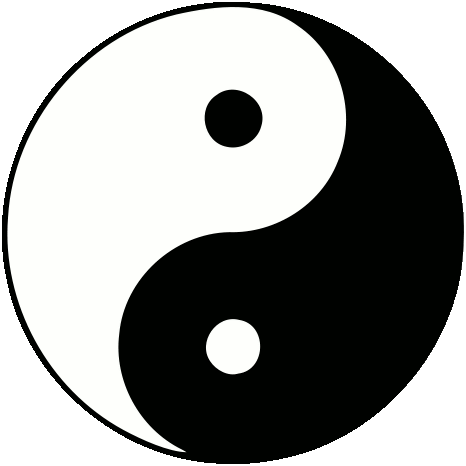
These principles are symbolized by what is know in our society as the Yin-Yang as shown here:

yinYang

In the yin-yang, as I perceive it, the eternal circle of the universe is formed by the interaction of opposites, here symbolized by light and dark, but while they are opposites, a little of each exists in the other.

For a very short book, the Tao Teh Ching is filled with incredible depth and meaning.  For me, in the few translations I have read, the Tao makes perfect sense, and I understand the world a little better each time I read it.    However, others may read it and just be confused or frustrated.   The Tao Teh Ching is something that will either speak to you personally and enlighten your world, or it will not.

But what has all this to do with writing?

I see the Tao at work whenever I write anything.  I see it in what I consider to be some of the basic principles of writing: less is more, what is not said is often more important than what is said, and so forth.  For me, this makes writing almost a form of magic, not in the sense of illusion, but true magic where one creates something  out of nothing by using as few components as possible, by making something complex by keeping everything as simple as possible.

I will give one example and then I will close this article for the day and pick it up when I can sometime in the hopefully near future.

One of the first principles of writing I learned was to use as few words as possible.  Strunk and White, in The Elements of Style, say to “Omit unnecessary words”, which in itself is a perfect example of omitting unnecessary words.  How much more concise can that one sentence be?  It contains absolutely no unnecessary words.  If one word is omitted, the sentence ceases to have meaning.   The virtue of this is that, if done properly, the work becomes much more powerful because each word carries more weight.

To do this, a writer needs to use words precisely.  Try to find a word that captures the exact meaning of the idea you are trying to express–and the shorter the word the better.  After all, you are trying to communicate an idea to the largest possible audience.  Why use big words that will send readers scurrying to the nearest dictionary, thus interrupting their chain of thought and perhaps tainting their reading experience, when you can use words that everyone understands and keep their experience free from interruptions?

An example of using words precisely would be revising the sentence “A man went quickly to the store.”

Now, shorten it by replacing “went quickly” with “ran”.  While you are at it, replace the other general terms with more precise ones.   The sentence becomes “John ran to Walmart.” Now, if you have had any background information on John, you know who he is, what he is like, his possible motivations, and that he is in a hurry for some reason to get something from Walmart, knowing the kind of products Walmart has, you may have an idea of why he is going there.   If we changed the sentence to “John ran to the Red Dot Liquor Store” we have an even better idea of his motivation.   If we said, “John sped to Red Dot Liquors in his brand-new corvette”, we know even more about John:  we know he can afford a brand-new corvette.   If you have ever been in Red Dot Liquors, you know something of the products they carry and that may say something to you about John’s decision to purchase them.

So, how much more excitement and power does the sentence “John sped to Red Dot Liquors in his brand-new corvette” have versus “a man went quickly to the store”.   The final version packs a lot more information in almost the same space.

So that is part of the magic of writing for me:  using as few words as possible to create a work.  On the surface, it seem to go against logic.  How can you build something by using as few components as possible and deleting the ones you do have whenever possible?

Try an experiment, take the first page of any run of the mill romance novel and draw a line through every word you consider unnecessary while keeping the meaning of the sentence.   Then take your final product and do it again.  Do it a third time if you like.  How much were you able to reduce without changing its meaning?

Now take the first page of a novel by Hemingway, someone known for his lean, muscular writing.  How far were you able to reduce it before changing the meaning?

Someone once said, “draw a line through every third word and you will be surprised at how much it improves your writing.”  I have tried that and it works wonderfully.  Of course, you can’t arbitrarily omit every third word, or the work may become nonsense, but it does cause one to question whether that word is necessary.

I have always marveled at the idea that one can write something by omitting words. It goes against my standard, American, public school education, where teachers give a mininum number of words to an assignment and one is forced to insert as many words as possible just to meet the requirement. But can you blame them? If you told the average American high school student to tell what he did over the summer in as few words as possible, he would say, “I had fun” or “I worked.” Good luck teaching him to write.

Anyway, I am rambling once again.  I will close for now and pick this up at some later date.

Thoughts?  Comments?
Dark but interesting thoughts

I was watching the video above earlier because I love the native American flute and this is a particularly beautiful visual.

But then my darker nature took over and I thought “what if the bear suddenly bit off the girl’s head?”

Then my dark humor took over and I thought “what if the girl suddenly bit off the bear’s head?”

Then the literary side of my nature stepped up and noted, “if the bear bites off the girl’s head, then that’s either drama, adventure, or horror. But if the girl bites off the bear’s head that is either exceptional horror, supernatural horror, or fantasy.”

These are my musings after very little sleep over the past few days and very little coffee so far today (as of 7:52 a.m.).

Thoughts like this are not just why I write, but why I need to write.

Updates to YouTube Channel, Dec. 15, 2024

Today, I changed several of my playlists (Classical Music, Books, Fleur-de-Lis, Dark Ambience, Poetry, General Relaxing Ambience, Authors, and Plays) from private to public on my YouTube channel @philslattery1241. The subjects of each are obvious, with the exception of Fleur-de-Lis, which is a soundtrack I am developing for inspiration as I finish up a novella set in February 1986.

Stories vs. Story Lines

An idea occurred to me just now. I was scheduling the story “A Finger in the Stream of Time” by Mike Lee to appear later today in The Chamber. In one phase of the story, the main character and others are shooting pool. I used a photo of a pool player lining up a shot of the eight-ball into a corner pocket as the usual illustration. I was thinking about stories and time and how the balls bounce around on a pool table. Then something occurred to me.

Imagine our lives as balls bouncing around on a pool table as shown by the squiggly lines in the diagram above. A story is a section removed from that diagram (the red box) showing where the lives (or story lines) of the characters intersect.

In many instances, the trick of an excellent story is to show how the lives inside the box connect to their courses and their progression outside the box.

Too simplistic? Granted, I have only just now come up with this idea, but some vague feeling in the back of my head intuitively tells me that the more one thinks about it, the more profound it will become. For example, how would you connect the events in the left end of the purple line to the events in the right end of the dark blue line without leaving the confines of the red box? How would you connect the events in the right end of the cyan line to the events in the right end of the brown line? That would be a parallel storyline, right? But you must stay within the confines of your story in the red box.

Confused? I am too. But I have a nagging feeling that there is more to this than meets the eye. So, I had to get it out of my system and write it up.

Of course, maybe all this means is that I haven’t had enough coffee this morning or enough sleep last night.

What do you think? What ideas does this diagram stimulate in your head?

Historical Accuracy in Works of Fiction

Historical Accuracy in Works of Fiction--PhilSlattery.org

A week or so ago, a contributor submitted a work of historical fiction that had an error in it that was obvious to me, though it probably wasn’t to a lot of readers. I replied that I would reconsider the work (it was nicely written and had a good plot and ending) if he would change that error into something more plausible, which he did and I accepted his work.

I feel it is necessary to be as historically accurate as possible in the details of a work, even if the entire point of the plot is a theoretical scenario, as in Quentin Tarantino’s Inglourious Basterds, in which Hitler and his retinue are assassinated in a French theatre in 1944. Although this premise is fantasy, details as to uniforms, equipment, accents, were meticulous. The one detail that impressed me the most was when toward the end of the movie, two of the Basterds (Donowitz and Utivich) kill the guards outside Hitler’s theatre box. Utivich (the “little man” as he is called elsewhere) uses a glove-gun, which is a single-shot .22 caliber pistol attached to the back of a leather glove and fired by punching someone. This was a little known assassination weapon used during WWII. I happen to know, because during summer breaks at college, I worked at the Kentucky Military History Museum, which happened to have one identical to the one Utivich uses. To know that Tarantino watched his details to such a meticulous degree, helped me enjoy the movie.

On the other hand, I have often gone to movies with friends who could not enjoy the movie because some detail was inconsistent. For example, the patches on Tom Cruise’s flight jacket in Top Gun were not ones a true Naval aviator would wear. I know because I used to wear a flight jacket when I served in an A-6 squadron (VA-95, the Green Lizards) aboard the Enterprise as did most of my squadron mates, and I, as everyone else did, had lots of patches on my jacket to commemorate various operations or units I was in. This kind of inconsistency can ruin a movie for a lot of meticulous people, which is bad for the movie.

Another movie that is guilty of this and with which I have an indirect connection is An Officer and a Gentleman, in which a young man (Richard Gere) goes through naval aviator basic training at the Navy’s Aviation Officer Candidate School (AOCS). The movie was released in 1982 and I graduated from AOCS in May 1985. It sometimes annoys me that the movie received as much critical acclaim as it did, even though much of what occurred was preposterous. For example, AOCS, when I attended it, was in Pensacola, Florida. The movie was set in Port Townsend, Washington. I know because my first duty station, once out of training, was at Whidbey Island, Washington, a few miles across Puget Sound from Port Townsend. I would go drinking occasionally in Port Townsend and I have a t-shirt from the bar where Richard Gere had a fight with the locals. I have passed by the hotel where Gere’s friend hung himself several times, and I once went up to the Coast Guard station a few miles north, where the base scenes were filmed. Combined with the other errors in the film, for me watching An Officer and a Gentleman is more comedy than drama.

The magic of writing a story is to have the reader become so immersed in it that they mentally and emotionally become part of the story. They lose themselves in the story. This cannot happen if some detail is out of sync with the rest of the story. I don’t want this to happen in any of the stories I write, and I don’t want it to happen in any of the stories I publish. If I were to make a lot of mistakes in my details, I would garner a reputation as a sloppy, careless author which might inhibit me from being published in finer magazines or in having a book published. I can no more afford to neglect the details in my stories (or in those of my contributors) than I can in my grammar, spelling, or punctuation.

Here is an example of the lengths to which I like to go to ensure my stories cover their details and are as meticulously crafted as I can make them. Several years ago, I wrote a story called “Shapeshifter” about an alleged werewolf in early 17th century France. When I finished the final draft of the story, I sent it to a friend of mine who is well-read in history. In one scene the protagonist, a wolf falsely accused of being a werewolf, hides in a cathedral. He enters through an open door, runs down the aisle between the pews, and hides in the choir box. On reading this, my friend asked, “did they have pews in France at that time?” This is something I had never thought of. I researched it and found that by the time the story was set, pews had been appearing in churches for about fifty years.

I learned a lesson from that experience, because I always want to be taken seriously as a writer and no one will take me seriously, if I am careless about details. The more careless I am, the less seriously they will take me, but the more careful I am, the more seriously they will take me. This is true of any endeavor.

Thank you for taking the time to read this and I hope that you enjoyed reading it as much as I enjoyed writing it.

Hasta luego.

Please leave any comments or questions below.


If you enjoyed this article, you might enjoy some of my stories, which can be found around the Internet and on this page.

Connie Nielsen as Karen Blixen in Upcoming Danish Mini-Series”The Dreamer”

A quick post on Connie Nielsen portraying Karen Blixen in an upcoming Danish mini-series.

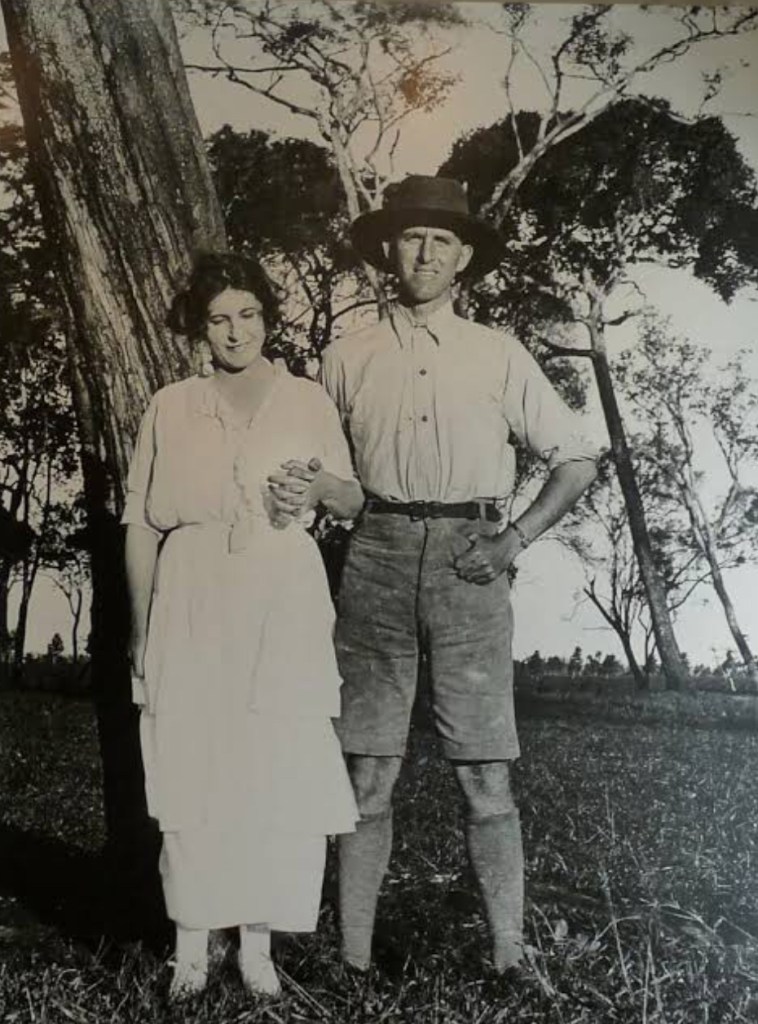
Karen Blixen and (possibly) Denys Finch-Hatton in the 1920’s

If you are a fan of the Danish actress Connie Nielsen or the Danish writer Karen Blixen (on whose experiences the movie Out of Africa was based, follow this link to an article, “MIPTV: Connie Nielsen on Becoming Karen Blixen in ‘The Dreamer'” by Scott Roxborough. The article discusses the challenges Nielsen faced in portraying Karen Blixen and how her portrayal differs radically from that by Meryl Streep in Out of Africa. Streep’s portrayal was of a young woman engaged in a passionate love affair, whereas Nielsen’s is that of a broken woman who has returned to Denmark penniless having lost her farm and her lover.

One note about the photo above: in trying to find a photo to accompany this article, I ran across this one. There are two copies of this photo on Wikimedia Commons. One identifies the man as Denys Finch-Hatton, (Blixen’s lover portrayed by Robert Redford in Out of Africa). Another identifies the man as Thomas Dinesen, Karen’s brother. Its source is supposed to be the Danish Royal Library. The source of the first is not identified. However, a quick search on Google resulted in a lot of photos of Denys Finch-Hatton, most of which (in my opinion) look like the man above. If you enjoy detective work, do the research and let me know what you come up with.

Hasta luego.