
Good article on a technical aspect of writing: Standard Manuscript Format.

Good article on a technical aspect of writing: Standard Manuscript Format.

Here’s the second batch of writing tips from Open Culture. They include tidbits from Neil Gaiman, Henry Miller, Elmore Leonard, George Orwell, and Margaret Atwood. Enjoy.

Great article. Over the next week I hope to post more writing tips from great authors as they appeared in Open Culture. They have a wealth of good advice that I would like to share.
http://www.businessinsider.com/stephen-king-on-how-to-write-2014-7
Follow the above link to advice on writing from Stephen King.
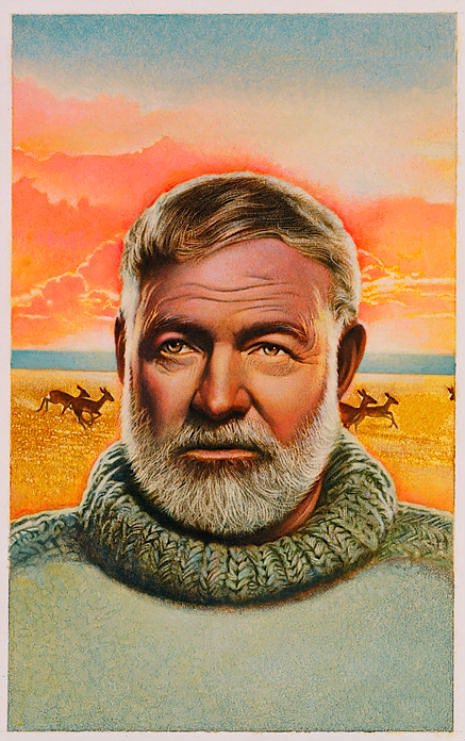
There is a story that Ernest Hemingway wrote the following to win a bet with other writers that he could write the shortest story:
“For sale: baby shoes. Never worn.”
Even a little research on the Internet shows that there is considerable doubt that Hemingway wrote this story, with the earliest reference to it as a Hemingway work not appearing until 1991. There is also considerable evidence that the story existed in various forms as early as 1910, when Hemingway was 11 and well before his writing career began. Whatever the facts, it is an extreme example of the lean, muscular writing for which Hemingway was famous.
In an interview with The Paris Review (see The Writer’s Chapbook, 1989, pp. 120-121), Hemingway did say:
“If it is any use to know it, I always try to write on the principle of the iceberg. There is seven-eighths of it underwater for every part that shows. Anything you know you can eliminate and it only strengthens your iceberg. It is the part that doesn’t show. If a writer omits something because he does not know it then there is a hole in the story…First I have tried to eliminate everything unnecessary to conveying experience to the reader so that after he or she has read something it will become a part of his or her experience and seem actually to have happened. This is very hard to do and I’ve worked at it very hard.”
So “Baby Shoes” is a good example of Hemingway’s iceberg principle, even if he didn’t write it.
“Baby Shoes” is also a good example of what I like to think of as the Tao of writing (see my earlier posts): creating a story by a careful, strategic use of what is not said. No where in the story does it state that a couple had apparently been expecting a baby, that they bought shoes for it, but then something happened to the baby to cause its death, and now the parents want to sell the shoes. None of that is stated. It is all implied, but yet we know what happened–or at least we have a good idea of what happened, even if we do not know the concrete facts of the matter.
There are also other facets of the story that we can infer, albeit tenuously. From the fact that they bought baby shoes we can infer that the parents were probably eager to have the child. From the fact that the parents want to sell the shoes we can infer that they probably don’t want them around any more as a remainder of a painful experience, but at the same time they may want to see someone else make good use of them or that they are hard up for money.
But one question I have that concerns human psychology is why is it that most people can read these same six words and come away with the same perception of what occurred? Does it have to do with Jungian Archetypes floating around in each of us or is it that each of us has had the same broad experience(s) so that we can interpret these six words in a very similar way?
In the art of sculpture, those areas of a work that are empty, yet give the work its form, are called “negative space”. An example is the space between each of your fingers. If there were no space, there would be no individual fingers. In that sense, a story like “Baby Shoes” makes maximum use of what might be termed “literary negative space”.
It is not really the words that give this story its power, but how we psychologically connect the ideas behind the words that fuel this extremely brief, but epic and poignant tale.
This is part of the magic of writing: conjuring worlds out of nothing.
Thoughts? Comments?

Guest Blog: ‘The Raven’ – Nevermore.
Interesting article, though I tend to disagree with his descriptions of what was going through Poe’s mind when he wrote this. Though I am not a skeptic, I tend to be skeptical when someone tells me in effect “yes, that is what he says, but this is what he meant…” Poe definitely hyped the bejeezus out of the poem (and his ego) by calling it the best poem ever written, but as for the rest…who knows?
Thoughts? Comments?
I was just sitting here trying to choose one of my many first drafts to work on for tonight, when I started thinking about the different “approaches” (for lack of a better term at the moment) to horror. By “approaches” I mean a very brief synopsis of a writer’s general outlook on or method of writing horror. Maybe a better way to express it would be to say the way the author approaches his genre (still not quite right, but I am getting closer to the idea).
An example would be to say that Poe’s approach was to bring out the horror in realistic situations (mostly, he did dabble in the fantastic occasionally). “The Black Cat” is about a murderer who unknowingly seals up a cat with the corpse of his victim. Nothing fantastic there. “The Tell-Tale Heart” is about a murderer whose conscience drives him to confession. “The Fall of the House of Usher” is about a family with an inherited genetic trait of hypersensitivity. So forth and so on.
Lovecraft’s approach was to spin tales of the fantastic, especially about a race of elder gods who once dominated the planet millions of years ago and of which mankind encounters remnants on rare occasion.
Stephen King’s approach is to plant an element of the fantastic among ordinary people in ordinary places and watch them react to it.
Clive Barker’s approach seems to be to take something that is fantastic, bloody, cruel, evil and gruesome and either drop it somewhere a single character can deal with it or bring it out of the shadows where a character can deal with it.
Seeing these different approaches in relation to each other makes me think about how do I want to approach an idea or a draft I have of a story. Do I want to drop the fantastic into the real or bring out the horror in the everyday or in realistic situations or can I come up with something else, my own approach, that is none of these? That is the challenge of creativity: to come up with something no one else has done. Maybe I can just go with the purely fantastic. Maybe I can try to find the real in the fantastic.
How many different ways are there to horrify an audience?
There is the real and the fantastic and all those subtle shades of gray in between the two. Can there be anything else?
Thoughts? Comments?

Here’s an interesting article for those writing a story and are trying to find a way to negate a cell phone. You probably won’t want to use these (that runs counter to being creative), but these methods may point you in the right direction: http://mentalfloss.com/article/56842/7-creative-ways-modern-horror-films-get-rid-cell-phones.

Tonight I updated my page “The Lexicon of Horror” with ghoul, goblin, horror, Malleus Maleficarum, and oppression.
I just finished watching an episode of the X-Files entitled “Chinga” [note to Spanish-speakers out there: I don’t know who chose the title, so please forgive my language] from Season Five and I noticed that it was written by Stephen King and Chris Carter (the creator of the X-Files). The story’s antagonist is a talking doll that can force people to injure or kill themselves in gruesome ways. Like many, if not most, of King’s stories, there is no explanation of how the came to exist. All the viewer finds out about it is that a lobsterman pulled it up one night in a lobster trap and his daughter comes to possess it after he meets his own gruesome fate.
I find in my own writing that I like to provide an explanation or background as to how things originate. This is just my nature. I like to know the origins of things. However, I have come to believe of late that, in terms of horror, that is a very nineteenth century concept.
Lovecraft said in his essay “Supernatural Horror in Literature”:
“A certain atmosphere of breathless and unexplainable dread of outer, unknown forces must be present; and there must be a hint, expressed with a seriousness and protentiousness becoming its subject, of that most terrible conception of the human brain — a malign and particular suspension or defeat of those fixed laws of Nature which are our only daily safeguard against the assaults of chaos and the daemons of unplumbed space.”
For me, what Lovecraft is saying is that if the laws of nature are negated, then anything is possible and monsters like Cthulhu really could exist and are capable of doing us harm at any moment. Combine this with his statement that “The oldest and strongest emotion of mankind is fear and the oldest and strongest kind of fear is fear of the unknown” and it becomes apparent that stories like “Chinga” derive much of their horror effect from the fact that the origin of the threat to a story’s protagonist(s) is unknown or that there is no explanation for the threat.
This would mean that one of things that provides to “Chinga” the element of horror that it has, is the fact that origin of the doll is unknown. Therefore, any of us when we are fishing or scuba diving or swimming in any body of water, could discover a doll that would turn his/her life into a nightmare. That is a scary thought.
Of course, this means that Stephen King would be one of the greatest practitioners of this technique, which I believe he is.
I think I shall try to experiment with this in the near future.
Thoughts? Comments?
I was searching for a market for one of my stories today, when I came across “Strange Horizons”‘s list of stories they see too often (http://www.strangehorizons.com/guidelines/fiction-common.shtml). This is an interesting and entertaining article on (in my humble opinion) not only the types of fiction that “Strange Horizons” prefers not to see, but also the types of stories not to submit to any quality magazine: the tired, the clichéd, the preaching, the didactic, the sugary-sweet, the unprofessional, the polemic, the ranting, and the diatribes among a host of others. The list is so extensive, one could almost create a list of the characteristics of good literature by simply listing the antitheses of the types listed here. Yes, this list is oriented toward sci-fi writers, but if one were to replace the sci-fi specific terms with those of another genre, one would have a list of examples of mediocre to poor writing for that genre. Of course, neither this list nor any other can be completely exhaustive of all examples of either good or bad writing, but it would be an interesting mental exercise.
Thoughts? Comments?
If you are an avid reader (of anything) and are not familiar with Project Gutenberg (http://www.gutenberg.org/wiki/Main_Page), you are doing yourself a great disservice. As they state on their homepage:
“Project Gutenberg offers over 46,000 free ebooks: choose among free epub books, free kindle books, download them or read them online.
We carry high quality ebooks: All our ebooks were previously published by bona fide publishers. We digitized and diligently proofread them with the help of thousands of volunteers.
No fee or registration is required, but if you find Project Gutenberg useful, we kindly ask you to donate a small amount so we can buy and digitize more books. Other ways to help include digitizing more books,recording audio books, or reporting errors.
Over 100,000 free ebooks are available through our Partners, Affiliates and Resources…Our ebooks may be freely used in the United States because most are not protected by U.S. copyright law, usually because their copyrights have expired. They may not be free of copyright in other countries. Readers outside of the United States must check the copyright laws of their countries before downloading or redistributing our ebooks. We also have a number of copyrighted titles, for which the copyright holder has given permission for unlimited non-commercial worldwide use.”
As they state, most of these books are available because their copyrights have expired, making them usually quite dated. However, for anyone with a bent for the historical, Project Gutenberg is a gold mine. I did a quick search for “horror” on their website and received 169 titles in response. For a few, the only relation to the horror genre was the word “horror” in the title (such as “Southern Horrors: Lynch Law in All its Phases–which is a horrible subject, but is non-fiction vs. horror fiction). However, many are the classics or founding works of the horror genre, such as Frankenstein by Mary Shelley, Dracula by Bram Stoker, The Vampyre: a Tale by John William Polidori, The Castle of Otranto by Horace Walpole, The Strange Case of Dr. Jekyll and Mr. Hyde by Robert Louis Stevenson, Fantome de’l Opera (Phantom of the Opera) by Gaston Leroux, many works by Edgar Allan Poe, The Great God Pan by Arthur Machen, The King in Yellow by Robert W. Chambers, The Shunned House by H.P. Lovecraft, and many others.
Please take the time to visit this treasure trove of literature and of the horror genre, and if you are so inclined, please consider making a donation (via their website) to support their worthy cause.
Thoughts? Comments?
I have been surfing the net over lumch and ran across this site with 16 fun very, very (micro?) horror stories. Check it out: http://www.dumpaday.com/random-pictures/funny-pictures/short-horror-stories-will-send-chills-spine-16-pics/. Here’s the first one as a quick sample (all were submitted by “Jon” on January 28, 2015):
“Growing up with cats and dogs, I got used to the sounds of scratching at my door while I slept. Now that I live alone, it is much more unsettling.”

After I lay down in bed last night, I had one of those thoughts that just pops up in the middle of the night, particularly after writing for a while in the evening (which I had been). I write this now more for my own memory than anything, but I hope it will be of some use to someone else out there.
The thought was that the purpose of every word in a horror story should be to make that story scarier.
This is a very simple idea that may be patently obvious to most of you, but it may not be to some. In any case, my intuition suggested that I publish it.
Thoughts? Comments?
Perhaps this is patently obvious to everyone except me, but it seems to me that one of the keys of showing a character’s inner workings is by placing him/her in difficult situation and showing how they either solve the problem or extricate themselves from it. After all, this is one of the critical ways we learn about a person’s true nature in real life. The classic example of this of probably all English literature is Hamlet. A more recent example is that of Captain Kirk n the Kobayashi Maru scenario at Starfleet Academy (the simulation was programmed as a no-win scenario to test a cadet’s character, but the night before his test Kirk secretly re-programmed the simulation so that he could win). When I have tried writing this type, I have found it much more difficult than simply getting the character out of a sticky situation by a stroke or luck or something deus ex machina. It becomes a test of my own genius and my own character, because I find I can often much more easily land a character in an impossible situation than I can extricate him from it.
Thoughts? Comments?
 Phil Slattery, Writer, Publisher