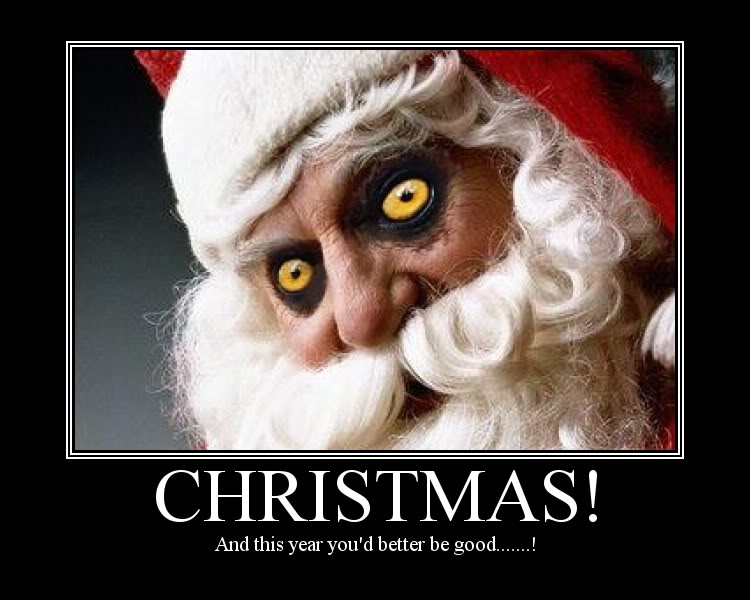
‘Tis the Season to be Scared!

From Ottawahorror.com

Just a little Christmas fun from Ottawahorror.com.  Follow this link to their site and you can post this on Facebook, Twitter, Stumbleupon, and others.Check out the following note to be found on their About Us Page:

Started in 2008, we are a blog and portal dedicated to all things horror in our nation’s [Canada] capital. If you are a filmmaker, musician, artist, or fan, this is the place for you. Also, recruit minions! When we travel out of town, we bump into more people and artists from home than we do when we hang around the batcave. It’s kinda cool, but kinda creepy. While we appreciate finding you wherever you are, finding you here is easier… because then we can send reporters and photographers after you easier.

Want to contribute? Check out the ‘submit’ page above. It’s new~
You can follow us on blogger, twitter, facebook or link to us with a groovy badge!
They accept submissions for their blog!  Maybe you have something you would like to contribute.  The site looks pretty cool.
Thoughts?  Comments?

The Good, The Bad and The Terrible ; Zombies | The Horror Online

130218_0002Still more from The Horror Online:  The Good, The Bad and The Terrible ; Zombies | The Horror Online.

Hopefully, I will find the time to sit down and write another extensive post, but unfortunately, these days I seem inundated with personal and professional tasks.  I try to read when I have the opportunity.  When I do have some time free, I have been watching horror films and I have several which I recommend and on which I hope to be writing posts before long.  I also hope to establish a webpage for a nascent lexicon of horror.

Thoughts?  Comments?

11 “Real” Haunted Houses to Visit—If You Dare! | 11 “Real” Haunted Houses to Visit—If You Dare! – Yahoo Homes

Here is another interesting bit of trivia for Halloween.   Maybe one of these is in your neighborhood:  11 “Real” Haunted Houses to Visit—If You Dare! | 11 “Real” Haunted Houses to Visit—If You Dare! – Yahoo Homes.

Dictionary.com – Monsters of Literature and Folklore

Bela Lugosi as Count Dracula 1931
Bela Lugosi
as Count Dracula
1931

Here is an interesting bit of trivia:  “8 Monsters of Literature and Folklore” at Dictionary.com – Free Online English Dictionary.  You may have to wait a second or two for the slide show to pop up.

Movie Review: “The ABC’s of Death”


I watched “The ABC’s of Death” about a couple of weeks ago on Netflix.   This is a bizarre, mind-blowing film that is not for the squeamish and definitely not for children.  Though I had to turn my face a couple of times when the gore and violence becaume more than I could stomach, I found it a fun, fascinating film to watch late on a Saturday night particularly as Halloween approaches.

The link above to the Internet Movie Database (IMDb)will give you the vital details, including the following excellent synopsis:

The ABC’s OF DEATH is an ambitious anthology film featuring segments directed by over two dozen of the world’s leading talents in contemporary genre film. Inspired by children’s educational ABC books, the motion picture is comprised of 26 individual chapters, each helmed by a different director assigned a letter of the alphabet. The directors were then given free reign in choosing a word to create a story involving death. Provocative, shocking, funny and ultimately confrontational; THE ABC’s OF DEATH is the definitive snapshot of the diversity of modern horror. Drafthouse Films, Magnet Pictures and Timpson Films are proud to present this alphabetical arsenal of destruction orchestrated by what Fangoria calls “a stunning roll call of some of the most exciting names in horror across the world.”                Written byAnonymous

No matter what your favorite horror subgenre, I would wager there is something in this film for you:  from suspense to gore to horror with an outlandish fantasy twist to shock to nudity to humor to…whatever.

One of the most entertaining aspects to me was to see how a director, once given a letter, used his/her creativity to develop a story based around that letter.  On the surface, this is easy when one is dealing with a common letter like “M” (murder of course springs to mind immediately or mayhem) or “H” (for hell, horror, etc.), but what do you do with “Q” (“Q is for Quack” was my favorite) or “Z” ?   Just watching creative genius at work was a blast for me.

Though I watched it on Netflix, if it was out at theatres, I would say pay full price on a Saturday night to see this.  It is a great date movie–so long as your date has a taste for the bizarre.

Lovecraft on the Supernatural

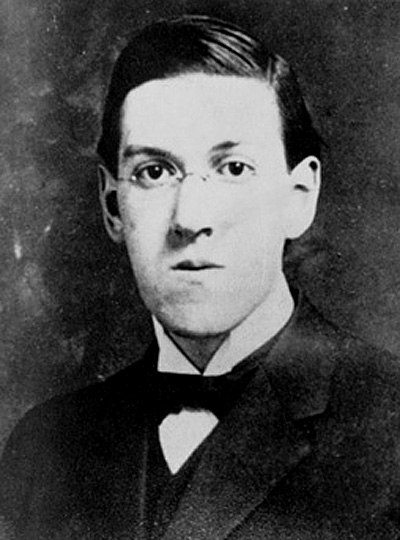
H.P. Lovecraft, 1915


I was reading Lovecraft’s “Supernatural Horror in Literature” the other day when I came across this line concerning the nature of  the “weird tale”:

“A certain atmosphere of breathless and unexplainable dread of outer, unknown forces must be present; and there must be a hint, expressed with a seriousness and protentiousness becoming its subject, of that most terrible conception of the human brain — a malign and particular suspension or defeat of those fixed laws of Nature which are our only daily safeguard against the assaults of chaos and the daemons of unplumbed space.”

With me, this idea hit home.  I have always thought that the more realistic I could make a story, the more frightening it would be for the reader, because it could possibly happen. Lovecraft takes the complete opposite approach.  In essence, he says let’s dispense with the chains of our preconceptions of reality then see what could happen.   He is right.  If anything can happen, the horrors that could happen to humanity are limitless and unimaginable.

Now let’s take this line of thought a step or two further philosophically.  Perhaps our concept of reality is really a sort of protective shell, a defense mechanism created by our minds that shields us from being overwhelmed by the thousands of possible ways we could meet our ends.  If a person tried to conceive of all the ways he/she might die at any moment, no matter how miniscule the odds, his/her mind might be overwhelmed and paralyzed by fear or destroyed by paranoia and madness.   The only way the mind could survive would then be to limit the possibilities to only those with the greatest probability of happening at that moment, in essence, wrapping itself in a protective cocoon of denial.

If there are any philosophy majors out there reading this, please feel free to bring up this idea in class.  I would love to hear the arguments for and against this.

Now, let’s go a step even further.   If we start to see our perception of reality as only a concept, as only a protective shell in a much greater universe, as only one alternative among thousands or millions of possibilities, then the possibility of creatures like Cthulhu, Shoggoth, Nylarhotep, the “ancient ones”, and all the other monsters contained in Lovecraft’s vivid imagination becomes very real.

Lovecraft’s world of the “ancient ones” is frightening enough when we think it has no chance of happening, but it becomes truly terrifying if we think it has even the slightest chance of actually happening.

Thoughts?  Comments?

“Murder by Plastic” To Be Published


Today, I received an e-mail from the folks at Every Day Fiction saying that they will publish my story “Murder by Plastic”  either next month or the following month.  Please watch the table of contents on their site for when it appears.   I will post an update on my blog as soon as they notify me that it is up.

“Murder by Plastic” is flash fiction (about 998 words) that I can most accurately describe as on the border between crime thriller and horror.   Please watch for it and visit Every Day Fiction often.

Really, what is horror?

H_P__Lovecraft_by_MirrorCradle -- resized

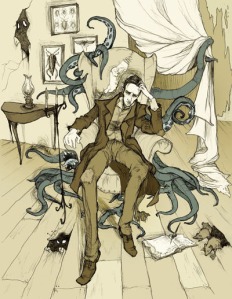
H.P. Lovecraft by Mirror Cradle

I like the illustration above, not only because it shows Lovecraft in the throes of creation, but also because it can be a metaphor for anyone in the deepest and darkest of contemplations or beset with a multitude of woes.  For now, though, I will say that it represents Lovecraft contemplating today’s question which is:  forget everything you have ever read about horror, what is horror to you?

Stephen King made this comment (I found it on goodreads.com):

“The 3 types of terror: The Gross-out: the sight of a severed head tumbling down a flight of stairs, it’s when the lights go out and something green and slimy splatters against your arm. The Horror: the unnatural, spiders the size of bears, the dead waking up and walking around, it’s when the lights go out and something with claws grabs you by the arm. And the last and worse one: Terror, when you come home and notice everything you own had been taken away and replaced by an exact substitute. It’s when the lights go out and you feel something behind you, you hear it, you feel its breath against your ear, but when you turn around, there’s nothing there…”

To me, these seem to be the superficialities of terror and horror.   If we use disease as a metaphor for horror, then these are its symptoms.   The virus lying at the root of horror is man’s inhumanity to man.   Seeing a severed head tumbling down stairs is indeed horrible;  seeing the murderer sever the head would be even worse, but being able to look into the soul of the murderer and see that the motive for the act stems from the murderer’s complete indifference to the suffering of others would be even worse.   Perhaps even worse than that would be seeing that that indifference to others is not uncommon.

Many have speculated on what fascinates people about horror.   Why would anyone enjoy being frightened?   An article I read last night (I think from Wikipedia) says essentially (I am summarizing in my own words) that it is because the security our civilization our modern society affords us has eliminated the need for the primal fear that developed as a survival mechanism during the early days of evolution.    That may be true to some degree, but if society eliminated some fears, it instilled others.    How many have seen the movie “Candyman”?   How many have seen “I am Legend?” or “The Omega Man” (both derive from the novel “I am Legend” by Richard Matheson), which is only one example of post-apocalyptic literature that would have been inconceivable in primeval times.

Instead of some overreaching drive extending throughout mankind, it may be that the need simply stems from the fact that the adrenaline rush, the focus on the moment, the muscle tension, and all the other physical sensations experienced during fright are the same or very similar to those experienced during sex, but without the sexual arousal itself.   These are also similar to the sensations experienced during peaks of athletic activity.    I was in the martial arts for many years and I can testify that the adrenaline rush experienced during sparring matches or when one is performing at peak ability can be addicting.   Being frightened puts one on a similar level of physical and mental awareness, because it is an instinctual preparation to fight as if one is actually being threatened.  The great thing about horror though is that while one enjoys all the physical highs of one’s body revving up for action, there is no actual threat.  Everyone is safe.   Candyman is not actually going to come out of the screen and track you down (though your subsequent nightmares may tell you otherwise).

So, please put yourself in Mr. Lovecraft’s place in the illustration above and ask yourself, what is horror?
“The Terror” from the Wen Fu

Here is an interesting section/stanza from the ancient Chinese work Wen Fu (The Art of Writing).  It is entitled “The Terror”.

I worry that my ink well will run dry, that right words cannot be found ; I want to respond to the moment’s inspiration.

I work with what is given ; that which passes cannot be detained.

Things move into shadows & they vanish ; things return in the shape of an echo.

When Spring arrives, we understand that Nature has its own reason.

Thoughts are lifted from the heart on breezes, and language finds its speaker.

Yesterday’s buds are this morning’s blossoms which we draw with a brush on silk.

Every eye knows a pattern, every ear hears a distant music.

Wen Fu was written by Lu Chi (261 AD – 300 AD), who was a scholar, a military leader, and the the Literary Secretary in the the Emperor’s court.  It is very short and may take an average reader 15-20 minutes to complete.  The hardcopy  translation I have was written by Sam Hamill and published by Breitenbush Books in 1987.   A far more poetic version can be found at http://web.mnstate.edu/gracyk/courses/web%20publishing/LuChi.htm.

I like to peruse Wen Fu occasionally, because the language is simple yet mystical while the ideas are straightforward yet metaphorical.   What fascinates me most about the work is that the principles it expresses are eternal and universal.   The underlying principles that guided Lu Chi’s art are the same ones that underlie ours nearly two thousand years later and in a society (and language!) that would have been completely alien to Lu Chi.  What’s more, Lu Chi describes the experience of writing from a very intimate standpoint to which any author who is passionate about his art could relate.

What are your thoughts?  What principles of writing are eternal and universal?  What do you see in the stanza above?