Check out these six books on events forming the basis for some well-known fictional horror. Good recommendations for reading over the holidays, particularly Halloween.
Forgive me for loving you, I didn’t mean to. It was your smile that made my heart skip a beat, and your eyes that made my back shiver. I held you in my arms, and you warmed my soul. I talked to you, and my mindset broadened. You entered my dreams, and freed me from the nightmares. Your touch made me smile, and your kiss froze time. You gave me hope, and I could give you nothing. I am sorry.Those were the words on the yellow note.
I observed the attached box curiously, it was small and plain. Suddenly, it trembled, once. I dropped it, I ran away. Blood dripped off of it. Now, it was constantly moving; beating. I approached it again, cowardly. I hadn’t heard from him in days; last time I saw him, I told him I couldn’t be with him. I still loved him, but I needed time to figure out myself. The box stood still. I took a few hesitant steps towards it. I had abandoned everything for him; then I abandoned him. The box trembled again, but only once. I opened it. I burst out in muffled tears. I was looking at his broken heart, and it was all my doing.
George Gad Economou, born in 1990 in Athens, Greece, is currently a Master’s student at Aarhus University, working on his thesis on social epistemology. His first novel, “The Elixir of Youth” was published in 2010 by Lefki Selida Publications, whilst his English short fiction has appeared in various horror magazines, such as Black Petals and Blood Moon Rising Magazine.
Today I received word that my flash suspense/crime drama/horror/thriller story “Murder by Plastic” will be re-printed on Fiction on the Web on November 17. Set in the modern day, “Murder by Plastic” is story about what happens when someone pisses off the wrong gangster.
Many thanks to Charlie Fish and his crew at Fiction on the Web for re-printing another of my personal favorites.
“Murder by Plastic” was first printed by Everyday Fiction on March 24, 2013.
Go to 15 Creepy Two-Sentence Horror Stories for a few quick thrills. Some of these have been floating around the Internet in different forms for a while, but some are original. All demonstrate how to pack a lot of meaning in a very small amount of space. See my article on “Baby Shoes” for a lengthier discussion on the art of compressing meaning into as few words as possible. While you’re visiting “15 Creepy…Stories” compliment the editor for selecting some truly creepy photos to accompany the article.
Working on a play in Hasting’s Hardback Café, late evening, October 16, 2015.
As I was preparing to go to the local theatre this evening, I was thinking about how I can improve my writing and what distinguishes the great writers of horror. Of course, the first two that came into my mind as being easily discernible from all others were Poe and Lovecraft. Obviously, what distinguishes them is their use of language. Both use very intense, muscular language with a distinctly archaic tone. Not knowing if there a precise term already exists for this style, I decided to call it “the dark language”, because of its tight connection with the horror genre and with the horrifying in general. For me, there seems to be something archetypal about this, arising out of the Jungian collective unconscious. Perhaps it is just that Poe bound the Dark Language so intimately with scenes of horror, terror, and suspense, which is also bound with genres such as the Gothic novel, that the sound of it automatically brings forth societal memories of dread.
I need to finish dressing if I am to dine at my favorite local sushi restaurant before heading to the play. Somehow, I just have the taste for something raw tonight.
Just now, I created a facebook page for the Art of Horror at https://www.facebook.com/slatterysartofhorror. Drop by, check it out, and friend me. Posts from this blog should feed automatically to Facebook as well as from my Twitter account.
Just now, I finished pasting Stephen King’s famous quotation on the three types of terror into my page on “Thoughts on Horror from the Masters” and I remembered that yesterday I was trying to remember the quotation, but could only recall a vague impression of it. Thinking on that impression now, I think that it was just as valid and true a one as the one by Mr. King, but simpler, more compact, and easier to remember. The concept is (I’ll refine this a little for the sake of clarity):
The three most common types of horror are: suspense (knowing someone runs the risk of decapitation at any moment), terror (seeing him/her being decapitated), and disgust (watching the head roll down the stairs).
I don’t think this idea should replace Mr. King’s by any means, but should probably be viewed as a simplification of his rather lengthy statement.
There are also probably a hundred more different flavors (i.e. variations of the sensation) of horror but these are the three that seem to me to be the most common, at least in movies and other popular media.
With Iced Tea, Farmington, New Mexico, March 20, 2015
I am now seeking a publisher for a collection of my short stories that have been published to date and also one for poetry I published back in the 80’s and 90’s. If anyone familiar with my works has a recommendation for one or both, I would love to hear it. All my published prose is listed on my Published Works page as is most of my published poetry. However, I do have a lot of unpublished poems I would like to include in the poetry collection for a total of about 80-90 poems. Of course, I have several as yet unpublished short stories that I can include in the short story collection, if I need to beef up the word count for the collection.
Please contact me via this website, if you know of a potential publisher or if you are a publisher and might have an interest in publishing my works.
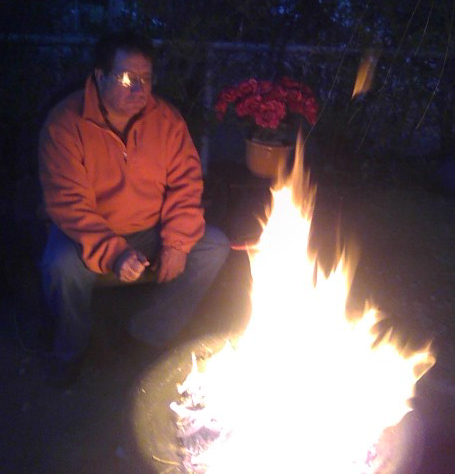
Relaxing by the front yard firepit on a chilly New Mexico evening circa 2013.
I picked up a copy of the latest issue of “Cemetery Dance” this evening and read the Stephen King short story “Summer Thunder”. This is a very interesting piece. I won’t spoil the ending for you, but the story is about a man, his dog, and his neighbor, who have survived a nuclear holocaust and are slowly succumbing to radiation poisoning.
This story was quite different from the other Stephen King stories I have read (which have been quite a few, though not all by any means). There is no supernatural factor in the story. There are also no twists or surprises. The story maintains the same pace throughout, just as the protagonists face the same things day in and day out until they die.
I would classify this story as horror-tragedy, because, even though it has very little of the blood and gore normally associated with the horror genre, it definitely has a horror “feel” to it, but that horror is subtle and understated. “Summer Thunder” sets up a tragic scenario and the horror finds its basis in watching these people suffer through no fault of their own. They were not involved in starting the war in any way; that was done by world leaders thousands of miles away. These are the common citizens, the “Everymen” that normally populate King’s works as protagonists, and who must pay the horrific price for their government’s actions. That is the tragedy and that is a large part of the horror.
What is also horrifying about the story is not the action described in it, but the scenario it describes, because this scenario is definitely one that could literally happen to each of us, should our government and/or other governments decide for whatever reason, to push the proverbial button. Each of us can (or perhaps should) see ourselves as the main character, who will be forced to watch his or her world disintegrate after a nuclear apocalypse.
That concept alone should be enough to bring the true horror of this story: that this scenario is, and has been for a long time, a real possibility for each of us.
Interesting article, though I tend to disagree with his descriptions of what was going through Poe’s mind when he wrote this. Though I am not a skeptic, I tend to be skeptical when someone tells me in effect “yes, that is what he says, but this is what he meant…” Poe definitely hyped the bejeezus out of the poem (and his ego) by calling it the best poem ever written, but as for the rest…who knows?
I just finished watching an episode of the X-Files entitled “Chinga” [note to Spanish-speakers out there: I don’t know who chose the title, so please forgive my language] from Season Five and I noticed that it was written by Stephen King and Chris Carter (the creator of the X-Files). The story’s antagonist is a talking doll that can force people to injure or kill themselves in gruesome ways. Like many, if not most, of King’s stories, there is no explanation of how the came to exist. All the viewer finds out about it is that a lobsterman pulled it up one night in a lobster trap and his daughter comes to possess it after he meets his own gruesome fate.
I find in my own writing that I like to provide an explanation or background as to how things originate. This is just my nature. I like to know the origins of things. However, I have come to believe of late that, in terms of horror, that is a very nineteenth century concept.
Lovecraft said in his essay “Supernatural Horror in Literature”:
“A certain atmosphere of breathless and unexplainable dread of outer, unknown forces must be present; and there must be a hint, expressed with a seriousness and protentiousness becoming its subject, of that most terrible conception of the human brain — a malign and particular suspension or defeat of those fixed laws of Nature which are our only daily safeguard against the assaults of chaos and the daemons of unplumbed space.”
For me, what Lovecraft is saying is that if the laws of nature are negated, then anything is possible and monsters like Cthulhu really could exist and are capable of doing us harm at any moment. Combine this with his statement that “The oldest and strongest emotion of mankind is fear and the oldest and strongest kind of fear is fear of the unknown” and it becomes apparent that stories like “Chinga” derive much of their horror effect from the fact that the origin of the threat to a story’s protagonist(s) is unknown or that there is no explanation for the threat.
This would mean that one of things that provides to “Chinga” the element of horror that it has, is the fact that origin of the doll is unknown. Therefore, any of us when we are fishing or scuba diving or swimming in any body of water, could discover a doll that would turn his/her life into a nightmare. That is a scary thought.
Of course, this means that Stephen King would be one of the greatest practitioners of this technique, which I believe he is.
I think I shall try to experiment with this in the near future.
The blogger on the banks of the San Juan River, Farmington, New Mexico, 2013
If you are an avid reader (of anything) and are not familiar with Project Gutenberg (http://www.gutenberg.org/wiki/Main_Page), you are doing yourself a great disservice. As they state on their homepage:
“Project Gutenberg offers over 46,000 free ebooks: choose among free epub books, free kindle books, download them or read them online.
We carry high quality ebooks: All our ebooks were previously published by bona fide publishers. We digitized and diligently proofread them with the help of thousands of volunteers.
Over 100,000 free ebooks are available through our Partners, Affiliates and Resources…Our ebooks may be freely used in the United States because most are not protected by U.S. copyright law, usually because their copyrights have expired. They may not be free of copyright in other countries. Readers outside of the United States must check the copyright laws of their countries before downloading or redistributing our ebooks. We also have a number of copyrighted titles, for which the copyright holder has given permission for unlimited non-commercial worldwide use.”
As they state, most of these books are available because their copyrights have expired, making them usually quite dated. However, for anyone with a bent for the historical, Project Gutenberg is a gold mine. I did a quick search for “horror” on their website and received 169 titles in response. For a few, the only relation to the horror genre was the word “horror” in the title (such as “Southern Horrors: Lynch Law in All its Phases–which is a horrible subject, but is non-fiction vs. horror fiction). However, many are the classics or founding works of the horror genre, such as Frankenstein by Mary Shelley, Dracula by Bram Stoker, The Vampyre: a Tale by John William Polidori, The Castle of Otranto by Horace Walpole, The Strange Case of Dr. Jekyll and Mr. Hyde by Robert Louis Stevenson, Fantome de’l Opera (Phantom of the Opera) by Gaston Leroux, many works by Edgar Allan Poe, The Great God Pan by Arthur Machen, The King in Yellow by Robert W. Chambers, The Shunned House by H.P. Lovecraft, and many others.
Please take the time to visit this treasure trove of literature and of the horror genre, and if you are so inclined, please consider making a donation (via their website) to support their worthy cause.
Herman Webster Mudgett a.k.a. H.H. Holmes. From Wikipedia.
I am having troubling sleeping tonight and thought I would continue with our tour of the world’s horror locales. [I am not having nightmares about H.H. Holmes, if that is what you are thinking or even about any other horror topic.]
One of America’s first and most prolific serial killers was Herman Webster Mudgett, who went by his now better known alias of H.H. Holmes (1861-1896). Although his life has been recently documented in a few films and books, Holmes is still perhaps one of America’s lesser known serial killers. Most of the following information is taken from the Wikipedia article on Holmes, which supports my previous readings on Holmes in several sources. Please go to Wikipedia for more details than my brief synopsis provides. It is a well-written article and I rely on it here, only because I wish to provide a brief introduction to Holmes to support the photos and visual record I am providing.
Holmes started his criminal career while attending the University of Michigan Medical School, where he would steal cadavers from the laboratory, disfigure them, and then try to collect on insurance policies he had taken out on them after claiming they had been killed in accidents. After graduation, Mudgett moved to Chicago to pursue a career in pharmaceuticals, but also began conducting many shady business deals while being a bigamist and philanderer in his private life.
After moving to Chicago in 1886, Holmes took a job at Dr. Elizabeth Holton’s drugstore. After her husband’s death, Holmes
Holmes’s Castle from Wikipedia
bought the business and the lot across the street at 601-603 West 63rd Street. [I had not noticed this before, but if one takes the first digit in each number of the address and combines them, the result is 666.] In the lot he built what would become known as his murder castle.
Wikipedia provides a nice synopsis of what happened there:
“Holmes purchased a lot across from the drugstore where he built his three-story, block-long “castle” as it was dubbed by those in the neighborhood. The address of the Castle was 601-603 W. 63rd St.[16] It was called the World’s Fair Hotel and opened as a hostelry for the World’s Columbian Exposition in 1893, with part of the structure devoted to commercial space. The ground floor of the Castle contained Holmes’ own relocated drugstore and various shops, while the upper two floors contained his personal office and a maze of over 100 windowless rooms with doorways opening to brick walls, oddly-angled hallways, stairways to nowhere, doors openable only from the outside, and a host of other strange and labyrinthine constructions. Holmes repeatedly changed builders during the construction of the Castle, so only he fully understood the design of the house.[3]
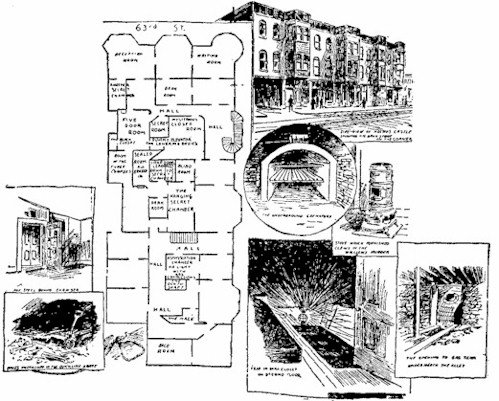
A diagram of Holmes’s Castle from weirdchicago.com (originally from the Chicago Tribune)
“During the period of building construction in 1889, Holmes met Benjamin Pitezel, a carpenter with a past of lawbreaking, whom Holmes exploited as a stooge for his criminal schemes. A district attorney later described Pitezel as Holmes’ “tool… his creature.”[17]
“After the completion of the hotel, Holmes selected mostly female victims from among his employees (many of whom were required as a condition of employment to take out life insurance policies, for which Holmes would pay the premiums but was also the beneficiary), as well as his lovers and hotel guests, whom he would later kill.[14] Some were locked in soundproof bedrooms fitted with gas lines that let him asphyxiate them at any time. Other victims were locked in a huge soundproof bank vault near his office, where they were left to suffocate.[8] The victims’ bodies were dropped by secret chute to the basement,[3] where some were meticulously dissected, stripped of flesh, crafted into skeleton models, and then sold to medical schools. Holmes also cremated some of the bodies or placed them in lime pits for destruction. Holmes had two giant furnaces as well as pits of acid, bottles of various poisons, and even a stretching rack.[3] Through the connections he had gained in medical school, he sold skeletons and organs with little difficulty.”
After the World’s Columbian Exposition ended, Holmes moved out of Chicago to evade creditors and continued pursuing his
Plans of Floors 2 and 3 from steampunkchicago.com
various nefarious trades throughout the country. Eventually, he was arrested by the Pinkertons for an insurance scam. While Holmes was in prison awaiting trial, authorities interviewed the former janitor at Holmes’s castle and found out that he had never been allowed entry to the upper floors. Upon further investigation, the real purpose behind Holmes’s castle was discovered.
Estimates of the number of Holmes’s victims range from 20-200, with 27 being the only number verified by any means. Most of his victims were women, though a few were men and children. Holmes confessed to murdering thirty people in Chicago, Indianapolis, and Toronto, though some of the people he claimed to have killed were later found to still be alive.
Holmes was put on trial for the murder of his partner-in-crime, Benjamin Pitezel, in October, 1895. He was hanged in Philadelphia’s Moyamensing Prison on May 7, 1896, for Pitezel’s murder. Holmes’s castle was mysteriously gutted by fire in August, 1895, two months before his trial began. The building was finally razed in 1938.
Holmes being executed. From jesslb6.blogspot,com
The site is now the location of the US Post Office’s Englewood Branch.
I have included a few photos of the castle and the Englewood Post Office for your viewing pleasure.
By coincidence, while gathering photos for this article, I found a statement on Cragin Spring’s Flickr page that a movie on Holmes called “Devil in the White City” was due out in 2013 and was to star Leonardo DiCaprio. A Wikipedia article on it states that it is based on a 2003 book by Erik Larson and Leonardo DiCaprio bought the film rights in 2010. Imdb states only that it is in development.
The Englewood post office now at the site of Holmes’s Castle, November 5, 2011. Photo by Malcolm Logan from myamericanodyssey.com
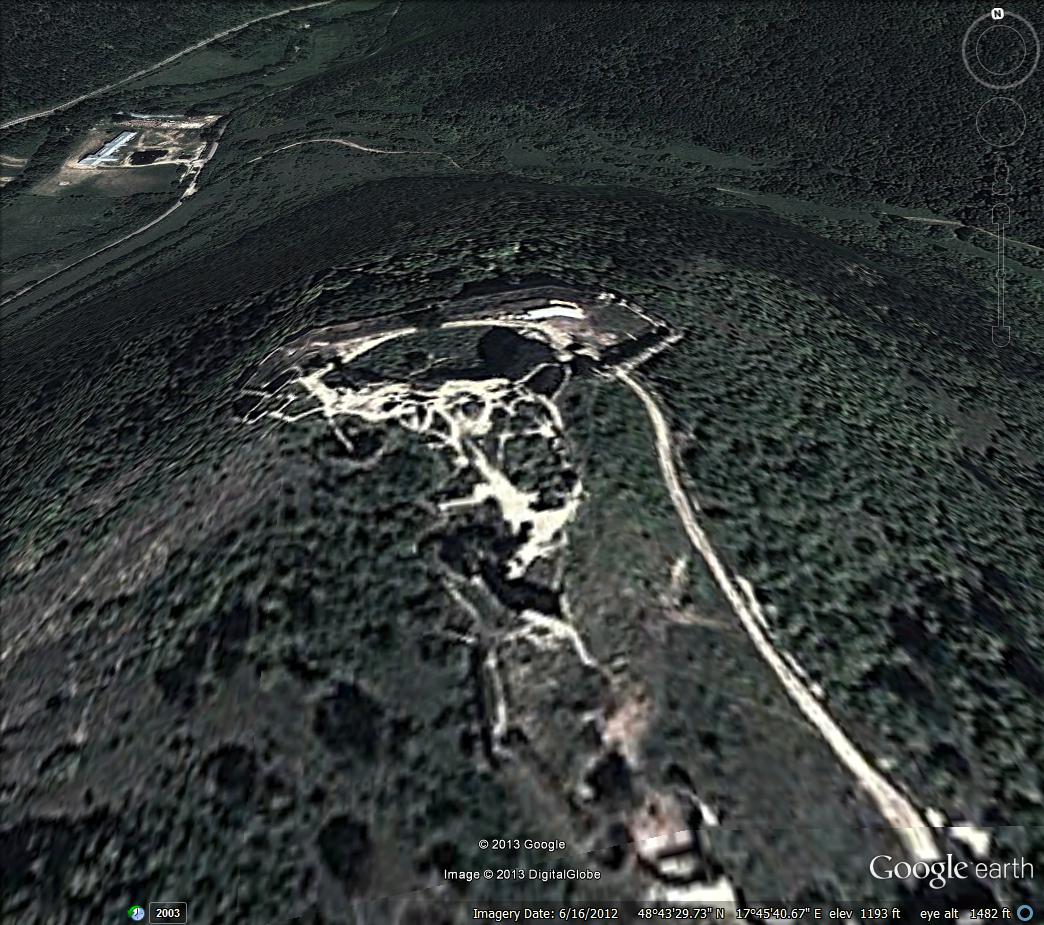
Cachtice Castle, home of Elizabeth Bathory, “the Blood Countess” from Google Earth Dec. 2013
A few days ago, I was just relaxing after a heavy meal and was starting to surf Google Earth, when I hit upon an idea that might be entertaining to my followers in the blogosphere. Why not visit the locations of famous horror novels or historical figures via Google Earth? I would only be trying to fool myself and you if I were to say that I would do this with any regularity. I can say that I shall do it as the spirit moves me, which may or not be frequently. Let me know what you think of the idea. I encourage you to try the same with the horror locations that you know. My first stop is at Cachtice (pronounced Chahk-teet-se) Castle, in present-day Slovakia, which was the home of the “Blood Countess”, Elizabeth Bathory, who is said to have tortured and murdered around 650 young girls circa 1600-1610. I won’t go into a detailed biography of her here. I have mentioned her in at least a couple of posts already and her biography can easily be found by surfing the Internet. I do caution you to try to find good, authoritative sources of information about her. Unfortunately, crap is pervasive throughout the “net” and a legendary figure from 400 years ago is apt to have more than the average share of strange ideas, rumors, falsehoods, mistakes, and outright lies. The Google image above is not of the highest quality. I think this one has recently replaced one that was much better. For a better view of the castle, I am providing this terrific view by Civertan from Wikimedia Commons:
Cachtice Castle From Wikimedia Commons Photo by Civertan
The advantage of Google Earth though is that you can view a location from an infinite number of angles and even from street level (unfortunately this option is not available for Cachtice) and view photos visitors have taken of the location. To find Cachtice, you will, of course, have to search for “Cachtice”. This will take you to the village of Cachtice. Look to the Northwest and you will find a smaller village called “Visnove”. Just southeast of Visnove is a hill with a castle. That’s it. See the diagram I have attached below for more details.
I hope you enjoy your virtual visit to one the world’s more infamous hellholes.














 Phil Slattery, Writer, Publisher