I just finished watching an episode of the X-Files entitled “Chinga” [note to Spanish-speakers out there: I don’t know who chose the title, so please forgive my language] from Season Five and I noticed that it was written by Stephen King and Chris Carter (the creator of the X-Files). The story’s antagonist is a talking doll that can force people to injure or kill themselves in gruesome ways. Like many, if not most, of King’s stories, there is no explanation of how the came to exist. All the viewer finds out about it is that a lobsterman pulled it up one night in a lobster trap and his daughter comes to possess it after he meets his own gruesome fate.
I find in my own writing that I like to provide an explanation or background as to how things originate. This is just my nature. I like to know the origins of things. However, I have come to believe of late that, in terms of horror, that is a very nineteenth century concept.
Lovecraft said in his essay “Supernatural Horror in Literature”:
“A certain atmosphere of breathless and unexplainable dread of outer, unknown forces must be present; and there must be a hint, expressed with a seriousness and protentiousness becoming its subject, of that most terrible conception of the human brain — a malign and particular suspension or defeat of those fixed laws of Nature which are our only daily safeguard against the assaults of chaos and the daemons of unplumbed space.”
For me, what Lovecraft is saying is that if the laws of nature are negated, then anything is possible and monsters like Cthulhu really could exist and are capable of doing us harm at any moment. Combine this with his statement that “The oldest and strongest emotion of mankind is fear and the oldest and strongest kind of fear is fear of the unknown” and it becomes apparent that stories like “Chinga” derive much of their horror effect from the fact that the origin of the threat to a story’s protagonist(s) is unknown or that there is no explanation for the threat.
This would mean that one of things that provides to “Chinga” the element of horror that it has, is the fact that origin of the doll is unknown. Therefore, any of us when we are fishing or scuba diving or swimming in any body of water, could discover a doll that would turn his/her life into a nightmare. That is a scary thought.
Of course, this means that Stephen King would be one of the greatest practitioners of this technique, which I believe he is.
I think I shall try to experiment with this in the near future.
I happened across an excellent roundtable on Horror History 101 at the Horror Writer’s Association (http://horror.org/horror-roundtable-16-horror-history-101/) today while at lunch. Check it out. It has a great panel of experts and a wide-ranging discussion of the great horror writers of the past from the beginning of horror with Horace Walpole up to Lovecraft and more.
The blogger on the banks of the San Juan River, Farmington, New Mexico, 2013
If you are an avid reader (of anything) and are not familiar with Project Gutenberg (http://www.gutenberg.org/wiki/Main_Page), you are doing yourself a great disservice. As they state on their homepage:
“Project Gutenberg offers over 46,000 free ebooks: choose among free epub books, free kindle books, download them or read them online.
We carry high quality ebooks: All our ebooks were previously published by bona fide publishers. We digitized and diligently proofread them with the help of thousands of volunteers.
Over 100,000 free ebooks are available through our Partners, Affiliates and Resources…Our ebooks may be freely used in the United States because most are not protected by U.S. copyright law, usually because their copyrights have expired. They may not be free of copyright in other countries. Readers outside of the United States must check the copyright laws of their countries before downloading or redistributing our ebooks. We also have a number of copyrighted titles, for which the copyright holder has given permission for unlimited non-commercial worldwide use.”
As they state, most of these books are available because their copyrights have expired, making them usually quite dated. However, for anyone with a bent for the historical, Project Gutenberg is a gold mine. I did a quick search for “horror” on their website and received 169 titles in response. For a few, the only relation to the horror genre was the word “horror” in the title (such as “Southern Horrors: Lynch Law in All its Phases–which is a horrible subject, but is non-fiction vs. horror fiction). However, many are the classics or founding works of the horror genre, such as Frankenstein by Mary Shelley, Dracula by Bram Stoker, The Vampyre: a Tale by John William Polidori, The Castle of Otranto by Horace Walpole, The Strange Case of Dr. Jekyll and Mr. Hyde by Robert Louis Stevenson, Fantome de’l Opera (Phantom of the Opera) by Gaston Leroux, many works by Edgar Allan Poe, The Great God Pan by Arthur Machen, The King in Yellow by Robert W. Chambers, The Shunned House by H.P. Lovecraft, and many others.
Please take the time to visit this treasure trove of literature and of the horror genre, and if you are so inclined, please consider making a donation (via their website) to support their worthy cause.
Please respect any copyrights pertaining to this cover.
One of the best gifts I received this Christmas was Best New Horror 25 (for the year 2013) edited by Stephen Jones. I consider this book a must-have for any serious horror aficionado.
In addition to having 21 stories by such icons as Clive Barker, Ramsey Campbell, and Neil Gaiman (among others), Mr. Jones provides a ninety page synopsis of horror in 2013, a “necrology” (list of those having died) in 2013, and a list of useful addresses for the horrorphile of small press publishers, websites, organizations, and magazines.
I had not heard of Mr. Jones before receiving this book, but the biography the book provides shows him to a well-respected editor of horror in many genres and a recipient of many awards, some a few times over, including the Bram Stoker Award, Horror Guild awards, British Fantasy awards, and other. For those desiring more background on Mr. Jones, please visit his website at http://www.stephenjoneseditor.com.
Of course, I have not had the time in the past two days to start reading this volume in any depth, but I have skimmed through it and found it to be very informative. As you who follow my blog can guess, I love the ninety-page intro, because it gives a thorough overview of what happened in 2013 from something of a historian’s viewpoint.
The only downside I have found, so far, is that the Necrology includes several non-horror entertainers and figures, which are superfluous to the work’s theme. For example, Mr. Jones mentions the death of Annette Funicello, who, so far as I know, was never in a horror film. If anyone knows of a horror film she was in, please let me know so that I can post an apology to Mr. Jones.
This 592-page volume is a welcome addition to my horror library and I look forward to exploring it in great depth as it will help me catch up on the current state of affairs in horror (which some of you no doubt know that I seriously need as I tend to focus on classic horror of the 20th and 19th centuries). I recommend this book to anyone else who has a serious desire to survey the current state of the art.
I finished reading The Hellbound Heart several weeks ago. As noted previously, it is a truly terrific read. I suggest reading it after seeing the movie (if you have somehow repeatedly missed your chances of seeing “Hellraiser” over the last twenty or so years). Reading it beforehand will just spoil the movie, whereas reading it afterwards may enlighten parts of the movie.
I don’t have much to add to what I have previously stated, except that, if you are a student of storytelling, the book warrants a detailed examination for narrative technique as it exhibits some basic techniques of storytelling that Mr. Barker carries out very well. I could go through the book page by page and expound on each ad nauseam, but instead I will focus now on one that sticks in my mind.
I do not recall if this is in the movie, but toward the end where Kirsty is trapped in the “damp room” by Frank, she slips on a bit of preserved ginger lying on the floor enabling Frank to catch her. The method by which Barker establishes why that ginger is on the floor fascinates me.
Although I have one or two dictionaries of literary terms, I do not recall the name for this technique and I think of it as simply setting the stage for a future scene. It shows the foresight, planning, and attention to detail that must go into any good story.
Earlier in the story, after Julia has released Frank from the Cenobite hell and he has regained enough flesh that he can once again eat, he asks Julia for a few of his favorite victuals, including preserved ginger. At the moment I read this, I thought it was simply a natural but insignificant detail. Of course, I could not know then that that bit of ginger would skyrocket the dramatic tension later on in one of the novel’s most important scenes.
Anyway, that’s my post for the day.
I have been very negligent in posting anything over the last months, my daytime job and personal matters consuming much more of my time than usual. I have recently come to find out though, that many more people in my home town of Frankfort, KY, were enjoying my postings than I had known or even believed possible and sorely missed it during this hiatus. For them and all the others who silently enjoy my works, I shall endeavor to pick up the thread.
I have not lost my desire to write fiction, however, and I am currently trying to finish a sci-fi/horror novella that I started sometime back. The work is going well, but I am having to change some of my original concept to make it more exciting. I would like to make it as gripping as some have found my “Murder by Plastic” (published at www.everydayfiction.com), but that will be quite difficult for something as long as a novella. The part I find most challenging is to coordinate the details much as Barker did in the example I give above. I would expound on the subject, but I do not want to give away the plot or run the risk of some unscrupulous cur stealing my idea and publishing it before I do–particularly as I am so close to finishing it. After this I have another three or four unfinished works to bring to a close. I could probably write eight hours a day like Thomas Mann and still not be finished by spring.
I am just past the halfway point in Clive Barker’s The Hellbound Heart, the novella upon which the orginal “Hellraiser” movie was based. This is one really terrific read. It is one of those that is hard to put down, even though you know what happens next, because the movie, which you saw twenty years ago and have seen periodically since then, so closely resembles the book.
Clive Barker, Seattle, 2007 by Steven Friederich
The prose is simple, but not Hemingway simple, and there are moments of actual narrative beauty (such as when Barker poignantly describes the passing of seasons in the beginning of one chapter) that seem to be glimpses of insight into a latent aspect of Barker’s immense talent: that he is able to write actually artistic prose that captures a moment, an emotion, or a sensation with a light touch that carries over to the reader. I have read the first two volumes (so far) of Barker’s Books of Blood and this quality seems to be lacking in them. In Books of Blood, he writes splendidly, but not beautifully, not poignantly.
I also love the way he keeps his characters to a minimum, so that seeing the complex relationships between them is easy.
Another fascinating aspect of Barker’s storytelling in this instance is that he can put his characters in horrifying situations, yet he does not try to be any more graphic than is necessary to invoke an emotional response in the ready. The few truly graphic scenes I have encountered so far are graphic, but not gratuitously graphic. An example would be when the recently-resurrected Frank starts to have sex with with brother’s wife Julia. He shows the act beginning and ends the chapter leaving what happens up to the reader’s imagination. Yes, this is an old trick straight out of made-for-TV movies, but do you really need to visualize every gory detail of a woman having sex with someone who is still half-corpse? I didn’t. And seeing that would not have helped the storytelling and if anything, it would have only detracted from it. Besides, if someone wants to visualize that unnerving scene for themselves, they are going to whether or not Barker describes it for them. All that is necessary to show the development of the characters and the plot is to show that they did have sex, because that act in itself shows something about them. About Frank it show how incredibly callous he is to Julia and how centered he is in the world of his own pleasure. About Julia, it shows her love for Frank is so self-sacrificing that she is willing to commit the most vile acts for him while taking obscene pleasure in them in her own way.
Anyway, those are just a few notes so far. I need to have dinner and do some housework and to read more of this fascinating work. Hopefully, I will be able to write more soon.
Ray Bradbury in 1950 (age 30), the year he published “The Martian Chronicles”
Someone once told Ray Bradbury that “The Martian Chronicles” was not prose, but poetry. Technically, he was probably wrong, but in spirit truer words were probably never spoken.
I have a habit of reading several books at once. I will pick up one, read a few pages (unless it is so engrossing that I cannot put it down), then later pick up another and read a few pages or so of it, then still later read a few pages of another and so forth until I may be reading half a dozen books a few pages at a time. Then I may finish one and pick up another, something like the juggler who keeps the china plates spinning on sticks.
I picked up “The Martian Chronicles” while on a trip to Santa Fe in December, 2012 at The Collected Works bookstore. Since then it has stayed in my suitcase and I pick it up and read more every time I travel.
I have not read much of late and have written less, but on trip last week, I made use of my relatively new Kindle for the first time and read three stories of Poe’s (“A Descent into the Maelstrom”, “The Facts in the Case of M. Valdemar”, and “The Imp of the Perverse”) along with the original German version of “Little Red Riding Hood” by the Brothers Grimm. This has started my interest in literature and writing to smoulder once again. After I returned home, I decided to take “The Martian Chronicles” out of the suitcase and reluctantly finish it.
I say “reluctantly” because, while reading it, it is one of those beautifully eloquent novels that you don’t want to put down much less ever see come to an end. On those nights I read a few chapters at a time in the comfort of a well-kept hotel, I never really wanted to put it down and only did so when the hour was late and I was struggling to stay awake after a long day, a good suppper, and a few glasses of wine.
The stories are always poignant, captivating, and sometimes heart-rending. The characters have a depth that draws you in as if you could step inside their bodies and see their world from their perspectives. Of course, your tendency is to side with the humans as they colonize the red planet, but at the same time you sympathize with the Martians as they watch their civilization dwindle and gradually vanish under the onslaught of alien explorers and settlers. However, what is the most beautiful facet of the novel is its use of English.
Bradbury’s nascent style (as I understand from one website, he had been writing seriously only seven years when he
Ray Bradbury by Lou Romano
published this, his first novel) uses simple, clear, easy-to-understand prose that highlights only enough important details to enable the reader to vicariously experience the story. The fact that the prose is very simple and lacking in needlessly ostentatious words helps the reader to see clearly the interaction of the characters and their mindsets and the underlying motivations and plots. For me, if a work is full of big words, I spend too much time either trying to decipher them or running to the dictionary that I lose the tenuous feeling for what is happening in the story. His use of language clarifies rather than obscures. The sentences are generally of medium length and this helps the story to flow without becoming monotonous.
The plots of the stories are deceptively simple in design, but most still manage to have an unexpected denouement that leaves the reader feeling like a simpleton that he did not see it coming. Some, though, have such completely unexpected endings that there is no way they could be anticipated but in retrospect the denouement is incredibly logical. The first chapters describing explorer’s first encounters with the Martians are wonderful examples of this while the story I read only last night, “The Off Season”, has such a brilliantly ironic twist that it has to be a prime example of Bradbury’s genius.
I suppose I could continue on for a while raving about Bradbury’s art, but it is getting late and I have had a long day and still have dinner and drinks awaiting my arrival at home.
But what has any of this admiration for a science-fiction writer’s skill have to do with the art of writing?
Beauty is beauty no matter what the genre. Skill in writing is skill in writing.
I wish I had at least a smidgen of Bradbury’s talent so that I could make use of it in the field of horror. What depths of emotion and terror could I then reach?
Having read “Fahrenheit 451” many years ago, next on my list of Bradbury works is “The Illustrated Man”. I can hardly wait, but will probably have to–having five or six other books that I am currently reading. Still…that hasn’t stopped me yet from picking up a novel to be explored.
Please, even if you are a diehard horror aficianado, read “The Martian Chronicles” to learn something about writing as an art that you can apply to your own endeavors. The experience will definitely be rewarding and perhaps even enlightening.
The first thing you learn about the historical Castle Dracula is that it is a fictional location from Bram Stoker’s imagination. The Wikipedia article does a nice job of summarizing the history of the fictional abode and of analyzing the novel for clues to its supposed locale. The most precise it comes to identifying the spot of Dracula’s Castle is:
“The site of the Vampire’s home has always been one of the greatest mysteries of the novel. The route descriptions hardly mention any recognisable landmarks, but focus on evocations of a wild and snow-covered landscape, haunted by howling wolves and lit by supernatural blue flames at night. Because of this conspicuous vagueness, the annotated Dracula editions by Leonard Wolf,[6] Clive Leatherdale[7] and Leslie Klinger[8] simply assume Bram Stoker had no specific location in mind and place the Castle in or immediately next to the Borgo Pass. As a consequence, these editions take for granted that the Count’s men, pursued by Harker, Holmwood, Morris and Seward, follow the Bistrița River all the way up to Vatra Dornei and then travel the route through the Borgo Pass already taken by Van Helsing and Mina. The same view is adopted by Andrew Connell in his Google Map mark-ups.[9] These theories ignore or misinterpret Stoker’s hint that around the 47th Parallel, the Count’s men are supposed to leave the river and cross-over to Transylvanian territory:
We took it, that somewhere about the 47th degree, north latitude, would be the place chosen for crossing the country between the river and the Carpathians. (Chapter 26, Jonathan Harker’s Journal, Entry for 30 October)[10]
“Only recently, the Dutch author Hans Corneel de Roos discovered the site the Irish novelist really had in mind while shaping his narrative: an empty mountain top in the Transylvanian Kelemen Alps near the former border with Moldavia, ca. 20 miles south-east of the Borgo Pass.[11] De Roos also explains why Stoker chose to obscure this location in his novel and compares the vampire’s fortress to the Grail Castle as its anti-Christian antipole: It cannot be found on purpose, only by guidance. Harker is brought there by the Count himself, while Van Helsing and Mina – equally nodding off – rely on the instinct of their horses and the mounted men arrive there by following the Gypsies.”
If you have read the book and have seen at least the original film version of Dracula with Bela Lugosi, you know at least one place they have in common is Borgo Pass. This is where Jonathan Harker disembarks from a coach to wait in an inn for the Count’s own carriage to come and fetch him and the village people try unsuccessfully to warn him away.
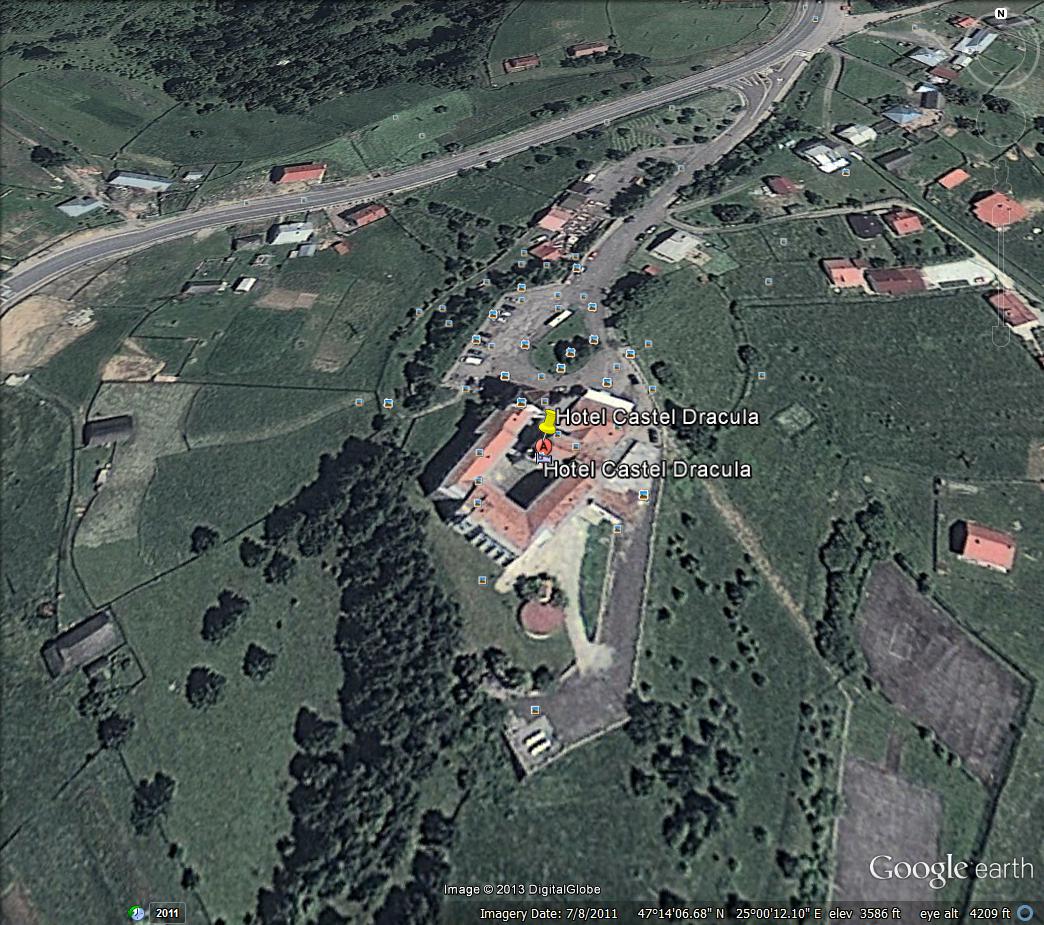
Aerial view of the Hotel Castel Dracula in the Borgo Pass from Google Earth
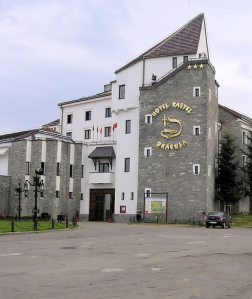
What you will learn from a few places on the Internet is that a hotel has been built on the spot in the Borgo Pass where Harker is supposed to have changed rides. Romanian Tourism describes it so:
Borgo Pass
(Pasul Tihuta) Where: 277 miles northwest of Bucharest / 12 miles northeast of Bistrita Note: Access by car only
Borgo Pass (Bargau in Romanian), made famous in the opening chapter of Bram Stoker’s Dracula, is an oft-trod passageway through the Carpathian Mountains in northern Transylvania. Located near the small township of Tihuta, the pass peaks at 3,840 feet.
The Bargau Valley encompasses some of the most beautiful unspoiled mountain scenery in the Carpathians with picturesque traditional villages located in valleys and on hillsides, ideal bases for hiking, riding or discovering their vivid tapestry of old customs, handicrafts and folklore.
Here, you will step into a realm that the fictional Mina Harker described in her diary as “a lovely county; full of beauties of all imaginable kinds, and the people are brave, and strong, and simple, and seem full of nice qualities.”
If you travel via Google Earth, if you search for “Borgo Pass”, you will find the location, but the name for it on Google Earth is “Pasul Tihuta”, the Romanian name, not the Hungarian “Borgo Pass” that Bram Stoker used. Once in Pasul Tihuta, search for Hotel Castel Dracula. That’s the spot where Harker is supposed to have changed carriages. Don’t be surprised that the modern hotel looks nothing like the quaint hamlet of the movie. The Wikipedia article on Tihuta Pass states:
The pass was made famous by Bram Stoker‘s novel Dracula, where, termed as “the Borgo Pass”, it was the gateway to the realm of Count Dracula. Stoker most likely found the name on a contemporary map. He never actually visited the area.
Today the pass is home to Hotel “Castel Dracula”. The hotel was built in 1974 and is located at an altitude of
Hotel Castel Dracula Borgo Pass, Romania
1,116 m (3,661 ft). The hotel has become quite an attraction due to its architectural style of a medieval villa, as well as the sheer beauty of the location.
That being said, the next question that arises is if there is no Castle Dracula, but there was a historical figure on which was based, where did the historical figure, Vlad the Impaler, actually live?
A woodcut of the historical Vlad Tepes from about the sixteenth century
If you read any summary of his life, you will find that Vlad the Impaler was constantly on the move, either attacking his enemies or running from them. Pinning down his abode to a single spot is difficult. A good, brief summary of the most famous can be found at Romania Tourism. You will note that most of the popular tourist sites have at best a tenuous connection to Vlad Tepes. This is probably similar to the number of places along the US east coast that claim to be where George Washington slept during his campaigns in the American Revolution.
From what I have found during my Internet searches one of the best and probably most reliable articles on the places associated with Vlad Tepes is this one entitled “Dracula’s Homepage” written by a man who has apparently conducted extensive research into Vlad Tepes and the places associated with him. The author describes for us which spots were locations where Vlad Tepes actually lived as opposed to ones that the tourism industry identifies with him, but which in fact may have little, if anything at all, to do with the bloodthirsty ruler. The two locations described in this article as where Vlad Tepes spent a significant amount of time are Tirgoviste Palace and Cetatea Poenari.
The Tirgoviste palace is actually called “Curtea Palace”, where Vlad Tepes built the Chindia Tower. If you search for “Chindia Tower” on Google Earth, you can hover just over Vlad Tepes’s Tirgoviste Palace and even go to street level to view the tower as if you were walking past it.
Tirgoviste Palace today (from Google Earth)
Chindia Tower from the street (from Google Earth)
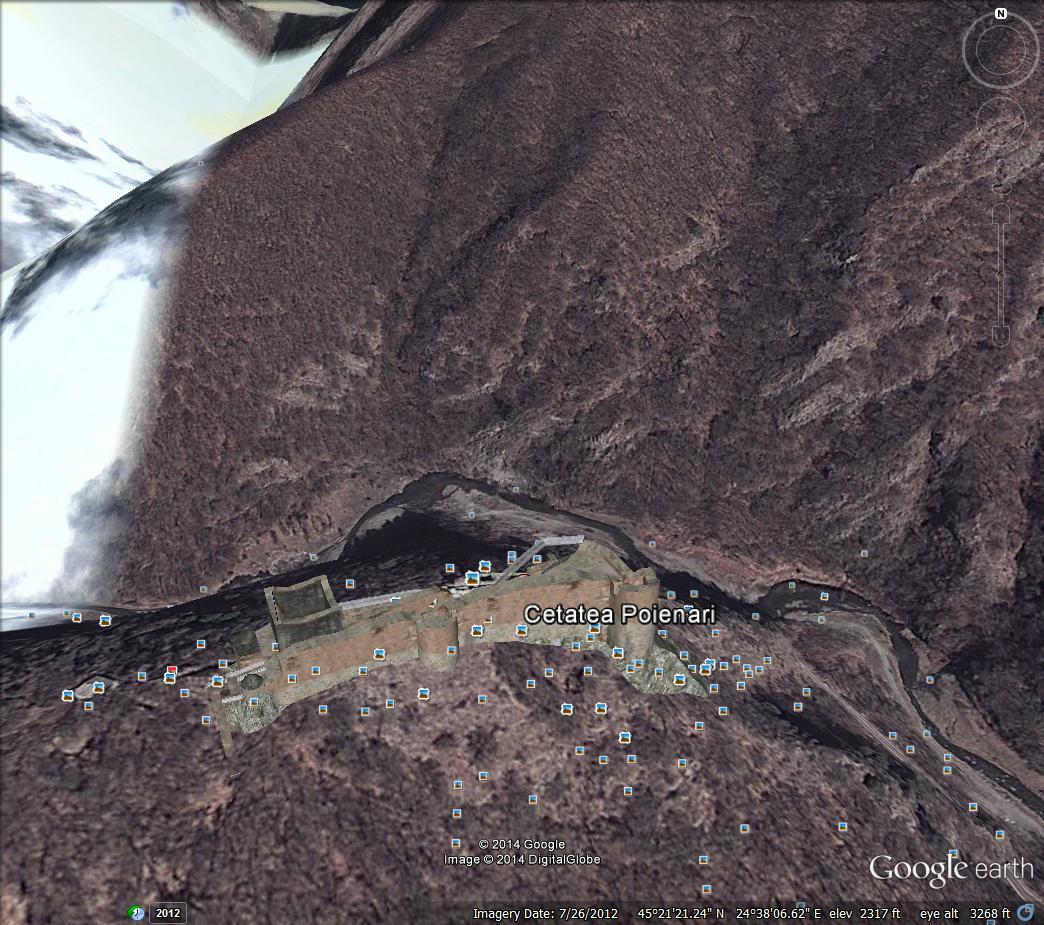
Search Google Earth for “Cetatea Poenari” and you will be taken to a secluded mountaintop over a narrow pass. This place probably captures the eerie spirit of the novel more than any other place you will find. If you have the Google Earth 3D buildings feature on (as I do in the photo below), you will see a 3D virtual representation of the castle, though the best views of it are from the dozens of photos tourists have attached to the location via Panaramio.
Cetatea Poenari (from Google Earth)
The website “Dracula’s Homepage” mentioned previously has a beautiful description of what it must be like to travel to the castle along with some of its historically horrific background:
“If there is an edifice that can be labelled Vlad Dracula’s castle, it is the ruins of Poenari. Actually, this is a fortress (“cetate” in Romanian) rather than a castle, located at the entrance to the gorge of the Arges River, north of the town of Curtea de Arges. As you leave Curtea de Arges (itself an interesting town with fortifications dating back to the 13th century and Basarab 1), you drive over a secondary road through several little villages, proceeding up the Arges valley towards the base of the Carpathian range.The road reaches the base of a group of high, heavily wooded mountains and there on the rocky top of one of them is Cetatea Poenari – Dracula’s Castle. Even from the road below it is a forbidding sight. What strikes one is its inaccessibility, high on a mountain top and the entrance to the gorges of the river (the river, by the way, has been diverted by a hydro-electric project). Poenari was the castle fortification that Vlad Tepes forced the nobles of Tirgoviste to build. The nobles were forced to walk the distance from Tirgoviste to the Arges (quite considerable by road – probably about 60 km overland) and then drag the material up that mountain to build the castle.
“To get to the top, one has to walk up almost 1500 steps. But the effort is certainly worth it. As you approach the magnificent ruin (last 50 steps or so) the scene is totally Gothic. There is the outline of the castle perched on the top of this rock, seeming to grow out of the very mountain itself. It covers the full space at the top, has a sheer drop on three sides, and is barely accessible by a small bridge near the top of the steps.
“I have returned to this site three times, as it is one of my favorite places in Romania: not only because of the sense of history but the magnificent scenery. One particular view (looking northwest) is spectacular – just the way you might picture the landscape around Dracula’s Castle in Stoker’s novel (though Stoker knew nothing about this place).
“This is the route that, according to local legend, Vlad took in order to escape into Transylvania from the Turks in 1462. He was assisted in his efforts by the villagers of nearby Arefu, where many narratives about Vlad still live in their oral culture.
“Then there is the southern wall of the castle – a sheer drop!
“This is where, according to another local legend, Vlad Tepes’ first wife flung herself, committing suicide rather than being taken captive by the advancing Turks. This castle is where Vlad would go for refuge in the face of advancing enemies. And from its towers he had a commanding view of anyone approaching from any direction. It was practically impenetrable.”
If you like horror, I highly recommend reading up on the historical Vlad Tepes and his reign. You will find actual terrors that would make any of the ficitional Draculas look like TV’s Mr. Rogers in comparison.
If, during your virtual journeys through the worlds of the fictional Count Dracula and his historical counterpart, Vlad Tepes, encounter any fascinating places or adventures, please feel free to share them via the comments section below.
Hopefully, I will find the time to sit down and write another extensive post, but unfortunately, these days I seem inundated with personal and professional tasks. I try to read when I have the opportunity. When I do have some time free, I have been watching horror films and I have several which I recommend and on which I hope to be writing posts before long. I also hope to establish a webpage for a nascent lexicon of horror.
Robert Louis Stevenson Portrait by Girolamo Nerli (1860-1926)
If you are having problems meeting a deadline or dealing with the demon of writer’s block the following article may help you feel not so alone. Some, if not all, of the world’s most famous had to deal with one or both and often did so in novel ways: NaNoWriMo: Classic Novels Written in a Month | Interesting Literature.
Note, horror fans, that of the authors mentioned here only one was an author of horror. Of course, I mean the gentleman to the left, the author of Dr. Jekyll and Mr. Hyde, which he apparently drafted at the Nineteenth century equivalent of warp speed.
The Works of Edgar Allan Poe, Volume 1. Yes, this link takes you to a collection of Poe’s works, but the reason I am mentioning it here is because the preface to this particular volume includes fascinating biographical notes and insight into the character of this master of horror that may help you understand the roots of his creative genius and how art sometimes came close to imitating life for Mr. Poe.
When you open the page, you may find yourself a little distance from the top of the article at the beginning of a section entitled “The Death of Edgar Allan Poe”. While this section is fascinating in its own right, scroll to the top for the entire preface. The works of Poe, beginning with the story of Hans Pfall, begin a bit down from “The Death…”
Detail of Madonna des Kanonikus Georg van der Paele by Jan van Eyck, 1436
Purely for your entertainment, here are 28 Totally Relatable Quotes About Books. I know I can relate to a lot of them. I’m sure you will find a few for yourself. One reason I find these interesting is because many of them show me how intensely involved readers will become with a book. As I have mentioned in previous posts, I believe that people live a vicarious existence through a story. When we write, we are not just writing a book or a story, we are creating a universe in which people will hopefully want to, not just visit, but dwell. All of the writer’s art should therefore focus on creating a virtual reality for one’s readers. To do that, we need a good grounding in, or at least a good feel for, human psychology, because we have to shape our creations to fit the human psyche. How do thoughts come into being? How do they lead from one to another? How do images form in the mind? No, I am not saying that we need Ph.D.’s in psychology to be good writers, but I think we need some sort of archetypal insight into human nature if we are to be the great writers we hope to be. Darn. I’m rambling again. 🙂

 I just finished watching an episode of the X-Files entitled “Chinga” [note to Spanish-speakers out there: I don’t know who chose the title, so please forgive my language] from Season Five and I noticed that it was written by Stephen King and Chris Carter (the creator of the X-Files). The story’s antagonist is a talking doll that can force people to injure or kill themselves in gruesome ways. Like many, if not most, of King’s stories, there is no explanation of how the came to exist. All the viewer finds out about it is that a lobsterman pulled it up one night in a lobster trap and his daughter comes to possess it after he meets his own gruesome fate.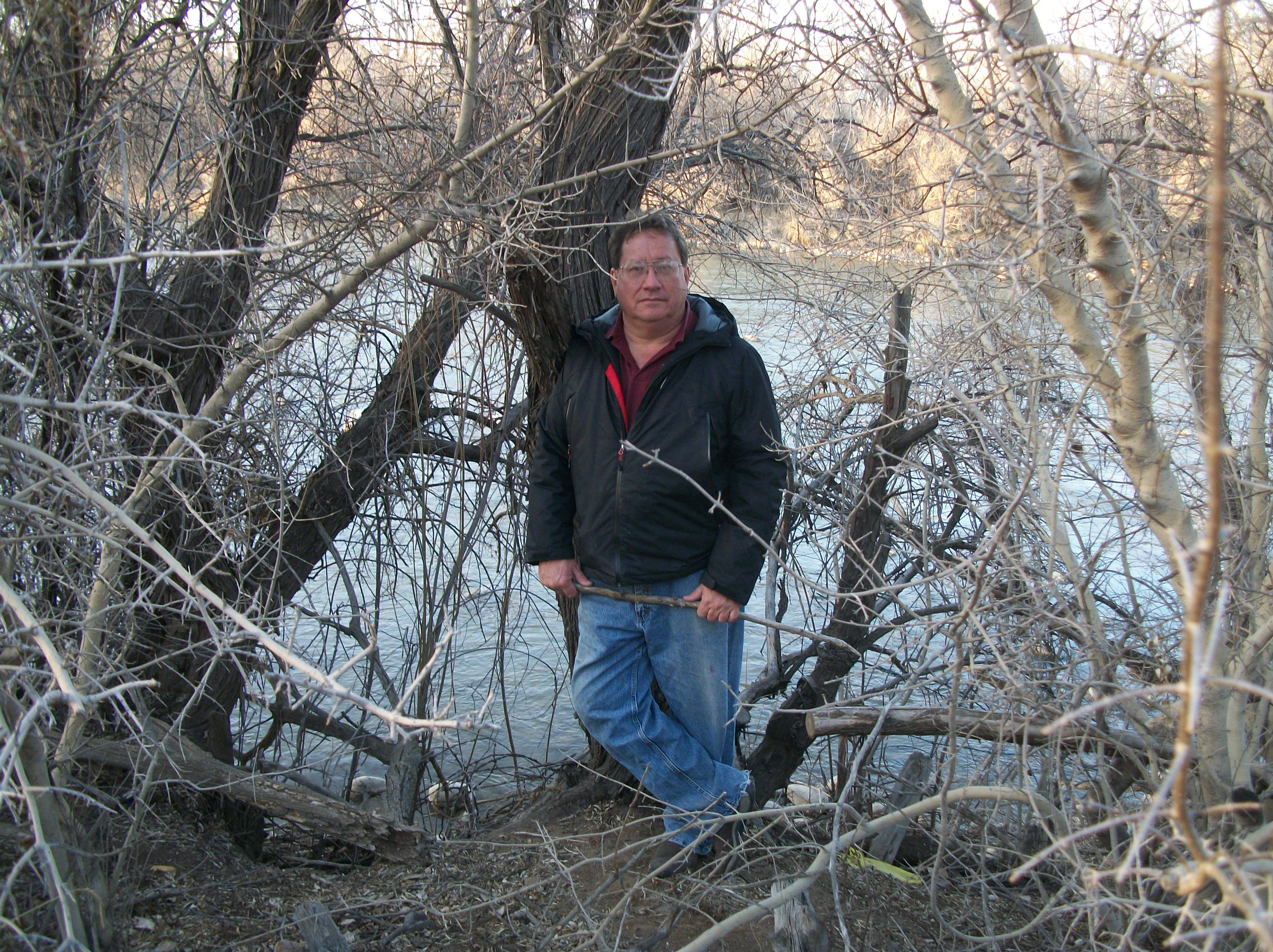







 To get to the top, one has to walk up almost 1500 steps. But the effort is certainly worth it. As you approach the magnificent ruin (last 50 steps or so) the scene is totally Gothic. There is the outline of the castle perched on the top of this rock, seeming to grow out of the very mountain itself. It covers the full space at the top, has a sheer drop on three sides, and is barely accessible by a small bridge near the top of the steps.




 Phil Slattery, Writer, Publisher