Tag: horror
Issue #13 of The Literary Hatchet will be late.

I found out yesterday that Issue #13 of The Literary Hatchet, containing my poem “Faust”, will be late by a few days because of the holidays. That staff knows how to build suspense. I will post an announcement when Issue #13 is up. In the meantime, check out their Issues page. They have consistently beautiful cover art. I also like the way they came up with their publication’s name. The Literary Hatchet is located in Fall River, Massachusetts, the hometown of Lizzie Borden.
Review of Guillermo Amoedo’s Film “The Stranger”
“The Stranger” is a 2014 Chilean film directed by Guillermo Amoedo and produced by Eli Roth and Nicolas Lopez.

Although most critics gave this low ratings in spite of citing some good aspects, I found this movie to be much better than average because of its thoughtful, understated style which is a relief from so many vampire films in which the violence hides the subtler qualities. This film does have its violent moments (I thought the death of Caleb was one of the more interesting ways I have seen one vampire kill another), but they support the storyline instead of overwhelming it.
The best quality I found in “The Stranger” was its way of continually maintaining a haunting, eerie suspense without letting it flag. I never knew exactly what was going to happen next or to where the film was leading me, although this is easier to see in hindsight of course. I also thought its minimalist approach to the portrayal of vampires as average people afflicted with a horrific, contagious disease was a refreshing relief from the clichéd motif of vampires as hyper-erotic, ultraviolent superhumans. The vampires here are average people tormented by an ailment that forces them to kill for blood while constantly threatened by incineration by the sun. The vampires here do not revel in evil and, other than being able to heal very quickly from mortal wounds, do not have supernatural abilities. This allows the viewer to become more sympathetic to their plight and to root for them when threatened by the antagonists.
The plot is not overly innovative, but it manages to be a decent vehicle for the suspense.
I give this 3.75 out of five stars.
Thoughts? Comments?
The Saturday Night Special: “The Case of Lady Sannox”
The Case of Lady Sannox
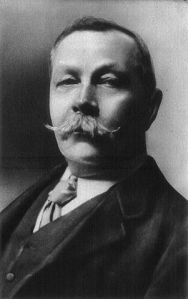
by Sir Arthur Conan Doyle
(1922)
from Tales of Terror and Mystery
The Project Gutenberg E-text
This eBook is for the use of anyone anywhere at no cost and with
almost no restrictions whatsoever. You may copy it, give it away or
re-use it under the terms of the Project Gutenberg License included
with this eBook or online at http://www.gutenberg.net
The relations between Douglas Stone and the notorious Lady Sannox were very well known both among the fashionable circles of which she was a brilliant member, and the scientific bodies which numbered him among their most illustrious confreres. There was naturally, therefore, a very widespread interest when it was announced one morning that the lady had absolutely and for ever taken the veil, and that the world would see her no more. When, at the very tail of this rumour, there came the assurance that the celebrated operating surgeon, the man of steel nerves, had been found in the morning by his valet, seated on one side of his bed, smiling pleasantly upon the universe, with both legs jammed into one side of his breeches and his great brain about as valuable as a cap full of porridge, the matter was strong enough to give quite a little thrill of interest to folk who had never hoped that their jaded nerves were capable of such a sensation.
Douglas Stone in his prime was one of the most remarkable men in England. Indeed, he could hardly be said to have
ever reached his prime, for he was but nine-and-thirty at the time of this little incident. Those who knew him best were aware that famous as he was as a surgeon, he might have succeeded with even greater rapidity in any of a dozen lines of life. He could have cut his way to fame as a soldier, struggled to it as an explorer, bullied for it in the courts, or built it out of stone and iron as an engineer. He was born to be great, for he could plan what another man dare not do, and he could do what another man dare not plan. In surgery none could follow him. His nerve, his judgement, his intuition, were things apart. Again and again his knife cut away death, but grazed the very springs of life in doing it, until his assistants were as white as the patient. His energy, his audacity, his full-blooded self-confidence—does not the memory of them still linger to the south of Marylebone Road and the north of Oxford Street?
His vices were as magnificent as his virtues, and infinitely more picturesque. Large as was his income, and it was the third largest of all professional men in London, it was far beneath the luxury of his living. Deep in his complex nature lay a rich vein of sensualism, at the sport of which he placed all the prizes of his life. The eye, the ear, the touch, the palate, all were his masters. The bouquet of old vintages, the scent of rare exotics, the curves and tints of the daintiest potteries of Europe, it was to these that the quick-running stream of gold was transformed. And then there came his sudden mad passion for Lady Sannox, when a single interview with two challenging glances and a whispered word set him ablaze. She was the loveliest woman in London and the only one to him. He was one of the handsomest men in London, but not the only one to her. She had a liking for new experiences, and was gracious to most men who wooed her. It may have been cause or it may have been effect that Lord Sannox looked fifty, though he was but six-and-thirty.
He was a quiet, silent, neutral-tinted man, this lord, with thin lips and heavy eyelids, much given to gardening, and full of home-like habits. He had at one time been fond of acting, had even rented a theatre in London, and on its boards had first seen Miss Marion Dawson, to whom he had offered his hand, his title, and the third of a county. Since his marriage his early hobby had become distasteful to him. Even in private theatricals it was no longer possible to persuade him to exercise the talent which he had often showed that he possessed. He was happier with a spud and a watering-can among his orchids and chrysanthemums.
It was quite an interesting problem whether he was absolutely devoid of sense, or miserably wanting in spirit. Did he know his lady’s ways and condone them, or was he a mere blind, doting fool? It was a point to be discussed over the teacups in snug little drawing-rooms, or with the aid of a cigar in the bow windows of clubs. Bitter and plain were the comments among men upon his conduct. There was but one who had a good word to say for him, and he was the most silent member in the smoking-room. He had seen him break in a horse at the University, and it seemed to have left an impression upon his mind.
But when Douglas Stone became the favourite all doubts as to Lord Sannox’s knowledge or ignorance were set for ever at rest. There was no subterfuge about Stone. In his high-handed, impetuous fashion, he set all caution and discretion at defiance. The scandal became notorious. A learned body intimated that his name had been struck from the list of its vice-presidents. Two friends implored him to consider his professional credit. He cursed them all three, and spent forty guineas on a bangle to take with him to the lady. He was at her house every evening, and she drove in his carriage in the afternoons. There was not an attempt on either side to conceal their relations; but there came at last a little incident to interrupt them.
It was a dismal winter’s night, very cold and gusty, with the wind whooping in the chimneys and blustering against the window-panes. A thin spatter of rain tinkled on the glass with each fresh sough of the gale, drowning for the instant the dull gurgle and drip from the eaves. Douglas Stone had finished his dinner, and sat by his fire in the study, a glass of rich port upon the malachite table at his elbow. As he raised it to his lips, he held it up against the lamplight, and watched with the eye of a connoisseur the tiny scales of beeswing which floated in its rich ruby depths. The fire, as it spurted up, threw fitful lights upon his bald, clear-cut face, with its widely-opened grey eyes, its thick and yet firm lips, and the deep, square jaw, which had something Roman in its strength and its animalism. He smiled from time to time as he nestled back in his luxurious chair. Indeed, he had a right to feel well pleased, for, against the advice of six colleagues, he had performed an operation that day of which only two cases were on record, and the result had been brilliant beyond all expectation. No other man in London would have had the daring to plan, or the skill to execute, such a heroic measure.
But he had promised Lady Sannox to see her that evening and it was already half-past eight. His hand was outstretched to the bell to order the carriage when he heard the dull thud of the knocker. An instant later there was the shuffling of feet in the hall, and the sharp closing of a door.
“A patient to see you, sir, in the consulting room,” said the butler.
“About himself?”
“No, sir; I think he wants you to go out.”
“It is too late,” cried Douglas Stone peevishly. “I won’t go.”
“This is his card, sir.”
The butler presented it upon the gold salver which had been given to his master by the wife of a Prime Minister.
“‘Hamil Ali, Smyrna.’ Hum! The fellow is a Turk, I suppose.”
“Yes, sir. He seems as if he came from abroad, sir. And he’s in a terrible way.”
“Tut, tut! I have an engagement. I must go somewhere else. But I’ll see him. Show him in here, Pim.”
A few moments later the butler swung open the door and ushered in a small and decrepit man, who walked with a bent back and with the forward push of the face and blink of the eyes which goes with extreme short sight. His face was swarthy, and his hair and beard of the deepest black. In one hand he held a turban of white muslin striped with red, in the other a small chamois-leather bag.
“Good evening,” said Douglas Stone, when the butler had closed the door. “You speak English, I presume?”
“Yes, sir. I am from Asia Minor, but I speak English when I speak slow.”
“You wanted me to go out, I understand?”
“Yes, sir. I wanted very much that you should see my wife.”
“I could come in the morning, but I have an engagement which prevents me from seeing your wife tonight.”
The Turk’s answer was a singular one. He pulled the string which closed the mouth of the chamois-leather bag, and poured a flood of gold on to the table.
“There are one hundred pounds there,” said he, “and I promise you that it will not take you an hour. I have a cab ready at the door.”
Douglas Stone glanced at his watch. An hour would not make it too late to visit Lady Sannox. He had been there later. And the fee was an extraordinarily high one. He had been pressed by his creditors lately, and he could not afford to let such a chance pass. He would go.
“What is the case?” he asked.
“Oh, it is so sad a one! So sad a one! You have not, perhaps heard of the daggers of the Almohades?”
“Never.”
“Ah, they are Eastern daggers of a great age and of a singular shape, with the hilt like what you call a stirrup. I am a curiosity dealer, you understand, and that is why I have come to England from Smyrna, but next week I go back once more. Many things I brought with me, and I have a few things left, but among them, to my sorrow, is one of these daggers.”
“You will remember that I have an appointment, sir,” said the surgeon, with some irritation; “pray confine yourself to the necessary details.”
“You will see that it is necessary. Today my wife fell down in a faint in the room in which I keep my wares, and she cut her lower lip upon this cursed dagger of Almohades.”
“I see,” said Douglas Stone, rising. “And you wish me to dress the wound?”
“No, no, it is worse than that.”
“What then?”
“These daggers are poisoned.”
“Poisoned!”
“Yes, and there is no man, East or West, who can tell now what is the poison or what the cure. But all that is known I know, for my father was in this trade before me, and we have had much to do with these poisoned weapons.”
“What are the symptoms?”
“Deep sleep, and death in thirty hours.”
“And you say there is no cure. Why then should you pay me this considerable fee?”
“No drug can cure, but the knife may.”
“And how?”
“The poison is slow of absorption. It remains for hours in the wound.”
“Washing, then, might cleanse it?”
“No more than in a snake bite. It is too subtle and too deadly.”
“Excision of the wound, then?”
“That is it. If it be on the finger, take the finger off. So said my father always. But think of where this wound is, and that it is my wife. It is dreadful!”
But familiarity with such grim matters may take the finer edge from a man’s sympathy. To Douglas Stone this was already an interesting case, and he brushed aside as irrelevant the feeble objections of the husband.
“It appears to be that or nothing,” said he brusquely. “It is better to lose a lip than a life.”
“Ah, yes, I know that you are right. Well, well, it is kismet, and it must be faced. I have the cab, and you will come with me and do this thing.”
Douglas Stone took his case of bistouries from a drawer, and placed it with a roll of bandage and a compress of lint in his pocket. He must waste no more time if he were to see Lady Sannox.
“I am ready,” said he, pulling on his overcoat. “Will you take a glass of wine before you go out into this cold air?”
His visitor shrank away, with a protesting hand upraised.
“You forget that I am a Mussulman, and a true follower of the Prophet,” said he. “But tell me what is the bottle of green glass which you have placed in your pocket?”
“It is chloroform.”
“Ah, that also is forbidden to us. It is a spirit, and we make no use of such things.”
“What! You would allow your wife to go through an operation without an anaesthetic?”
“Ah! she will feel nothing, poor soul. The deep sleep has already come on, which is the first working of the poison. And then I have given her of our Smyrna opium. Come, sir, for already an hour has passed.”
As they stepped out into the darkness, a sheet of rain was driven in upon their faces, and the hall lamp, which dangled from the arm of a marble Caryatid, went out with a fluff. Pim, the butler, pushed the heavy door to, straining hard with his shoulder against the wind, while the two men groped their way towards the yellow glare which showed where the cab was waiting. An instant later they were rattling upon their journey.
“Is it far?” asked Douglas Stone.
“Oh, no. We have a very little quiet place off the Euston Road.”
The surgeon pressed the spring of his repeater and listened to the little tings which told him the hour. It was a quarter past nine. He calculated the distances, and the short time which it would take him to perform so trivial an operation. He ought to reach Lady Sannox by ten o’clock. Through the fogged windows he saw the blurred gas lamps dancing past, with occasionally the broader glare of a shop front. The rain was pelting and rattling upon the leathern top of the carriage, and the wheels swashed as they rolled through puddle and mud. Opposite to him the white headgear of his companion gleamed faintly through the obscurity. The surgeon felt in his pockets and arranged his needles, his ligatures and his safety-pins, that no time might be wasted when they arrived. He chafed with impatience and drummed his foot upon the floor.
But the cab slowed down at last and pulled up. In an instant Douglas Stone was out, and the Smyrna merchant’s toe was at his very heel.
“You can wait,” said he to the driver.
It was a mean-looking house in a narrow and sordid street. The surgeon, who knew his London well, cast a swift glance into the shadows, but there was nothing distinctive—no shop, no movement, nothing but a double line of dull, flat-faced houses, a double stretch of wet flagstones which gleamed in the lamplight, and a double rush of water in the gutters which swirled and gurgled towards the sewer gratings. The door which faced them was blotched and discoloured, and a faint light in the fan pane above, it served to show the dust and the grime which covered it. Above in one of the bedroom windows, there was a dull yellow glimmer. The merchant knocked loudly, and, as he turned his dark face towards the light, Douglas Stone could see that it was contracted with anxiety. A bolt was drawn, and an elderly woman with a taper stood in the doorway, shielding the thin flame with her gnarled hand.
“Is all well?” gasped the merchant.
“She is as you left her, sir.”
“She has not spoken?”
“No, she is in a deep sleep.”
The merchant closed the door, and Douglas Stone walked down the narrow passage, glancing about him in some surprise as he did so. There was no oil-cloth, no mat, no hat-rack. Deep grey dust and heavy festoons of cobwebs met his eyes everywhere. Following the old woman up the winding stair, his firm footfall echoed harshly through the silent house. There was no carpet.
The bedroom was on the second landing. Douglas Stone followed the old nurse into it, with the merchant at his heels. Here, at least, there was furniture and to spare. The floor was littered and the corners piled with Turkish cabinets, inlaid tables, coats of chain mail, strange pipes, and grotesque weapons. A single small lamp stood upon a bracket on the wall. Douglas Stone took it down, and picking his way among the lumber, walked over to a couch in the corner, on which lay a woman dressed in the Turkish fashion, with yashmak and veil. The lower part of the face was exposed, and the surgeon saw a jagged cut which zigzagged along the border of the under lip.
“You will forgive the yashmak,” said the Turk. “You know our views about women in the East.”
But the surgeon was not thinking about the yashmak. This was no longer a woman to him. It was a case. He stooped and examined the wound carefully.
“There are no signs of irritation,” said he. “We might delay the operation until local symptoms develop.”
The husband wrung his hands in uncontrollable agitation.
“Oh! sir, sir,” he cried. “Do not trifle. You do not know. It is deadly. I know, and I give you my assurance that an operation is absolutely necessary. Only the knife can save her.”
“And yet I am inclined to wait,” said Douglas Stone.
“That is enough,” the Turk cried, angrily. “Every minute is of importance, and I cannot stand here and see my wife allowed to sink. It only remains for me to give you my thanks for having come, and to call in some other surgeon before it is too late.”
Douglas Stone hesitated. To refund that hundred pounds was no pleasant matter. But of course if he left the case he must return the money. And if the Turk were right and the woman died, his position before a coroner might be an embarrassing one.
“You have had personal experience of this poison?” he asked.
“I have.”
“And you assure me that an operation is needful.”
“I swear it by all that I hold sacred.”
“The disfigurement will be frightful.”
“I can understand that the mouth will not be a pretty one to kiss.”
Douglas Stone turned fiercely upon the man. The speech was a brutal one. But the Turk has his own fashion of talk and of thought, and there was no time for wrangling. Douglas Stone drew a bistoury from his case, opened it and felt the keen straight edge with his forefinger. Then he held the lamp closer to the bed. Two dark eyes were gazing up at him through the slit in the yashmak. They were all iris, and the pupil was hardly to be seen.
“You have given her a very heavy dose of opium.”
“Yes, she has had a good dose.”
He glanced again at the dark eyes which looked straight at his own. They were dull and lustreless, but, even as he gazed, a little shifting sparkle came into them, and the lips quivered.
“She is not absolutely unconscious,” said he.
“Would it not be well to use the knife while it will be painless?”
The same thought had crossed the surgeon’s mind. He grasped the wounded lip with his forceps, and with two swift cuts he took out a broad V-shaped piece. The woman sprang up on the couch with a dreadful gurgling scream. Her covering was torn from her face. It was a face that he knew. In spite of that protruding upper lip and that slobber of blood, it was a face that he knew, She kept on putting her hand up to the gap and screaming. Douglas Stone sat down at the foot of the couch with his knife and his forceps. The room was whirling round, and he had felt something go like a ripping seam behind his ear. A bystander would have said that his face was the more ghastly of the two. As in a dream, or as if he had been looking at something at the play, he was conscious that the Turk’s hair and beard lay upon the table, and that Lord Sannox was leaning against the wall with his hand to his side, laughing silently. The screams had died away now, and the dreadful head had dropped back again upon the pillow, but Douglas Stone still sat motionless, and Lord Sannox still chuckled quietly to himself.
“It was really very necessary for Marion, this operation,” said he, “not physically, but morally, you know, morally.”
Douglas Stone stooped for yards and began to play with the fringe of the coverlet. His knife tinkled down upon the ground, but he still held the forceps and something more.
“I had long intended to make a little example,” said Lord Sannox, suavely. “Your note of Wednesday miscarried, and I have it here in my pocket-book. I took some pains in carrying out my idea. The wound, by the way, was from nothing more dangerous than my signet ring.”
He glanced keenly at his silent companion, and cocked the small revolver which he held in his coat pocket. But Douglas Stone was still picking at the coverlet.
“You see you have kept your appointment after all,” said Lord Sannox.
And at that Douglas Stone began to laugh. He laughed long and loudly. But Lord Sannox did not laugh now. Something like fear sharpened and hardened his features. He walked from the room, and he walked on tiptoe. The old woman was waiting outside.
“Attend to your mistress when she awakes,” said Lord Sannox.
Then he went down to the street. The cab was at the door, and the driver raised his hand to his hat.
“John,” said Lord Sannox, “you will take the doctor home first. He will want leading downstairs, I think. Tell his butler that he has been taken ill at a case.”
“Very good, sir.”
“Then you can take Lady Sannox home.”
“And how about yourself, sir?”
“Oh, my address for the next few months will be Hotel di Roma, Venice. Just see that the letters are sent on. And tell Stevens to exhibit all the purple chrysanthemums next Monday, and to wire me the result.”
The Hallow (2015)
Source: The Hallow (2015) Check out David Sharp’s review of the The Hallow at Beneaththeunderground. Here’s a quick summary of the movie from the review:
The Hallow (2015)
IFC Midnight
Director: Corin Hardy

In this British and Irish co-production, a British conservationist moves his family to a small town in Ireland, a town that borders a forest that the man is tasked with surveying for land prospectors. In a very Straw Dogs or Wicker Man sort of way, after ignoring the warnings of locals, the family finds themselves in a battle of survival with a group of ancient creatures that reside in the old forest.
CHRISTMAS HORROR READING LIST 2015
 Source: CHRISTMAS HORROR READING LIST 2015
Check out Horror Delve’s recommended reading for the holidays.
Mark Allan Gunnells, master of the short story, releases a collection that even has Clive Barker smiling
 Source:
 Publication Announcement: “Faust” to appear in The Literary Hatchet

My horror poem “Faust” has been accepted by The Literary Hatchet and will appear in their next issue, which is slated for December 15.
“Faust” is my take on a moment in the story of Faust, the legendary professor and scientist of medieval Germany, who sold his soul to the devil in return for all knowledge. I examine Faust’s feelings in that moment just after he has sold his soul and the devil (Mephisto) has vanished, when he is left to contemplate in solitude the consequences of his decision.
I would like to thank Stefani Koorey, Michael Brimbau, and the staff of The Literary Hatchet, for reprinting this, my favorite of all the poems I have written to date. “Faust” has previously appeared in The Hollins Critic (1992) and Blood Moon Rising (2013).
Please feel free to visit The Literary Hatchet on December 15 or purchase a hard copy and check out “Faust” on December 15, or at any time for that matter.
Thoughts? Comments?
Bloody Good Writing Volume #5: Writing A Novel In A Month
 Source: Bloody Good Writing Volume #5: Writing A Novel In A Month
Another excellent article by Tom Leveen. This one is on the rewarding hard work associated with the challenge of writing 50,000 words in one month.
Interview from Horror Underground: Glenn Rolfe
 Source: Interview: Glenn Rolfe
Follow the link to David Sharp’s interview with Glenn Rolfe at Horror Underground. Interesting article.
The Saturday Night Special: “The Monkey’s Paw”
The Monkey’s Paw
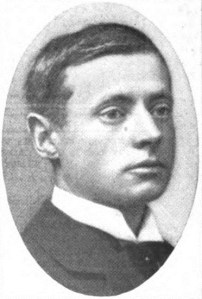
by W.W. Jacobs
(1902)
The Project Gutenberg E-text
This eBook is for the use of anyone anywhere at no cost and with
almost no restrictions whatsoever. You may copy it, give it away or
re-use it under the terms of the Project Gutenberg License included
with this eBook or online at http://www.gutenberg.net
I.
Without, the night was cold and wet, but in the small parlour of Laburnam Villa the blinds were drawn and the fire burned brightly. Father and son were at chess, the former, who possessed ideas about the game involving radical changes, putting his king into such sharp and unnecessary perils that it even provoked comment from the white-haired old lady knitting placidly by the fire.
“Hark at the wind,” said Mr. White, who, having seen a fatal mistake after it was too late, was amiably desirous of preventing his son from seeing it.
“I’m listening,” said the latter, grimly surveying the board as he stretched out his hand. “Check.”
“I should hardly think that he’d come to-night,” said his father, with his hand poised over the board.
(1903 or before)
“Mate,” replied the son.
“That’s the worst of living so far out,” bawled Mr. White, with sudden and unlooked-for violence; “of all the beastly, slushy, out-of-the-way places to live in, this is the worst. Pathway’s a bog, and the road’s a torrent. I don’t know what people are thinking about. I suppose because only two houses in the road are let, they think it doesn’t matter.”
“Never mind, dear,” said his wife, soothingly; “perhaps you’ll win the next one.”
Mr. White looked up sharply, just in time to intercept a knowing glance between mother and son. The words died away on his lips, and he hid a guilty grin in his thin grey beard.
“There he is,” said Herbert White, as the gate banged to loudly and heavy footsteps came toward the door.
The old man rose with hospitable haste, and opening the door, was heard condoling with the new arrival. The new arrival also condoled with himself, so that Mrs. White said, “Tut, tut!” and coughed gently as her husband entered the room, followed by a tall, burly man, beady of eye and rubicund of visage.
“Sergeant-Major Morris,” he said, introducing him.
The sergeant-major shook hands, and taking the proffered seat by the fire, watched contentedly while his host got out whiskey and tumblers and stood a small copper kettle on the fire.
At the third glass his eyes got brighter, and he began to talk, the little family circle regarding with eager interest this visitor from distant parts, as he squared his broad shoulders in the chair and spoke of wild scenes and doughty deeds; of wars and plagues and strange peoples.
“Twenty-one years of it,” said Mr. White, nodding at his wife and son. “When he went away he was a slip of a youth in the warehouse. Now look at him.”
“He don’t look to have taken much harm,” said Mrs. White, politely.
“I’d like to go to India myself,” said the old man, “just to look round a bit, you know.”
“Better where you are,” said the sergeant-major, shaking his head. He put down the empty glass, and sighing softly, shook it again.
“I should like to see those old temples and fakirs and jugglers,” said the old man. “What was that you started telling me the other day about a monkey’s paw or something, Morris?”
“Nothing,” said the soldier, hastily. “Leastways nothing worth hearing.”
“Monkey’s paw?” said Mrs. White, curiously.
“Well, it’s just a bit of what you might call magic, perhaps,” said the sergeant-major, offhandedly.
His three listeners leaned forward eagerly. The visitor absent-mindedly put his empty glass to his lips and then set it down again. His host filled it for him.
“To look at,” said the sergeant-major, fumbling in his pocket, “it’s just an ordinary little paw, dried to a mummy.”
He took something out of his pocket and proffered it. Mrs. White drew back with a grimace, but her son, taking it, examined it curiously.
“And what is there special about it?” inquired Mr. White as he took it from his son, and having examined it, placed it upon the table.
“It had a spell put on it by an old fakir,” said the sergeant-major, “a very holy man. He wanted to show that fate ruled people’s lives, and that those who interfered with it did so to their sorrow. He put a spell on it so that three separate men could each have three wishes from it.”
His manner was so impressive that his hearers were conscious that their light laughter jarred somewhat.
“Well, why don’t you have three, sir?” said Herbert White, cleverly.
The soldier regarded him in the way that middle age is wont to regard presumptuous youth. “I have,” he said, quietly, and his blotchy face whitened.
“And did you really have the three wishes granted?” asked Mrs. White.
“I did,” said the sergeant-major, and his glass tapped against his strong teeth.
“And has anybody else wished?” persisted the old lady.
“The first man had his three wishes. Yes,” was the reply; “I don’t know what the first two were, but the third was for death. That’s how I got the paw.”
His tones were so grave that a hush fell upon the group.
“If you’ve had your three wishes, it’s no good to you now, then, Morris,” said the old man at last. “What do you keep it for?”
The soldier shook his head. “Fancy, I suppose,” he said, slowly. “I did have some idea of selling it, but I don’t think I will. It has caused enough mischief already. Besides, people won’t buy. They think it’s a fairy tale; some of them, and those who do think anything of it want to try it first and pay me afterward.”
“If you could have another three wishes,” said the old man, eyeing him keenly, “would you have them?”
“I don’t know,” said the other. “I don’t know.”
He took the paw, and dangling it between his forefinger and thumb, suddenly threw it upon the fire. White, with a slight cry, stooped down and snatched it off.
“Better let it burn,” said the soldier, solemnly.
“If you don’t want it, Morris,” said the other, “give it to me.”
“I won’t,” said his friend, doggedly. “I threw it on the fire. If you keep it, don’t blame me for what happens. Pitch it on the fire again like a sensible man.”
The other shook his head and examined his new possession closely. “How do you do it?” he inquired.
“Hold it up in your right hand and wish aloud,” said the sergeant-major, “but I warn you of the consequences.”
“Sounds like the Arabian Nights,” said Mrs. White, as she rose and began to set the supper. “Don’t you think you might wish for four pairs of hands for me?”
Her husband drew the talisman from pocket, and then all three burst into laughter as the sergeant-major, with a look of alarm on his face, caught him by the arm.
“If you must wish,” he said, gruffly, “wish for something sensible.”
Mr. White dropped it back in his pocket, and placing chairs, motioned his friend to the table. In the business of supper the talisman was partly forgotten, and afterward the three sat listening in an enthralled fashion to a second instalment of the soldier’s adventures in India.
“If the tale about the monkey’s paw is not more truthful than those he has been telling us,” said Herbert, as the door closed behind their guest, just in time for him to catch the last train, “we sha’nt make much out of it.”
“Did you give him anything for it, father?” inquired Mrs. White, regarding her husband closely.
“A trifle,” said he, colouring slightly. “He didn’t want it, but I made him take it. And he pressed me again to throw it away.”
“Likely,” said Herbert, with pretended horror. “Why, we’re going to be rich, and famous and happy. Wish to be an emperor, father, to begin with; then you can’t be henpecked.”
He darted round the table, pursued by the maligned Mrs. White armed with an antimacassar.
Mr. White took the paw from his pocket and eyed it dubiously. “I don’t know what to wish for, and that’s a fact,” he said, slowly. “It seems to me I’ve got all I want.”
“If you only cleared the house, you’d be quite happy, wouldn’t you?” said Herbert, with his hand on his shoulder. “Well, wish for two hundred pounds, then; that ‘ll just do it.”
His father, smiling shamefacedly at his own credulity, held up the talisman, as his son, with a solemn face, somewhat marred by a wink at his mother, sat down at the piano and struck a few impressive chords.
“I wish for two hundred pounds,” said the old man distinctly.
A fine crash from the piano greeted the words, interrupted by a shuddering cry from the old man. His wife and son ran toward him.
“It moved,” he cried, with a glance of disgust at the object as it lay on the floor.
“As I wished, it twisted in my hand like a snake.”
“Well, I don’t see the money,” said his son as he picked it up and placed it on the table, “and I bet I never shall.”
“It must have been your fancy, father,” said his wife, regarding him anxiously.
He shook his head. “Never mind, though; there’s no harm done, but it gave me a shock all the same.”
They sat down by the fire again while the two men finished their pipes. Outside, the wind was higher than ever, and the old man started nervously at the sound of a door banging upstairs. A silence unusual and depressing settled upon all three, which lasted until the old couple rose to retire for the night.
“I expect you’ll find the cash tied up in a big bag in the middle of your bed,” said Herbert, as he bade them good-night, “and something horrible squatting up on top of the wardrobe watching you as you pocket your ill-gotten gains.”
He sat alone in the darkness, gazing at the dying fire, and seeing faces in it. The last face was so horrible and so simian that he gazed at it in amazement. It got so vivid that, with a little uneasy laugh, he felt on the table for a glass containing a little water to throw over it. His hand grasped the monkey’s paw, and with a little shiver he wiped his hand on his coat and went up to bed.
II.
In the brightness of the wintry sun next morning as it streamed over the breakfast table he laughed at his fears. There was an air of prosaic wholesomeness about the room which it had lacked on the previous night, and the dirty, shrivelled little paw was pitched on the sideboard with a carelessness which betokened no great belief in its virtues.
“I suppose all old soldiers are the same,” said Mrs. White. “The idea of our listening to such nonsense! How could wishes be granted in these days? And if they could, how could two hundred pounds hurt you, father?”
“Might drop on his head from the sky,” said the frivolous Herbert.
“Morris said the things happened so naturally,” said his father, “that you might if you so wished attribute it to coincidence.”
“Well, don’t break into the money before I come back,” said Herbert as he rose from the table. “I’m afraid it’ll turn you into a mean, avaricious man, and we shall have to disown you.”
His mother laughed, and following him to the door, watched him down the road; and returning to the breakfast table, was very happy at the expense of her husband’s credulity. All of which did not prevent her from scurrying to the door at the postman’s knock, nor prevent her from referring somewhat shortly to retired sergeant-majors of bibulous habits when she found that the post brought a tailor’s bill.
“Herbert will have some more of his funny remarks, I expect, when he comes home,” she said, as they sat at dinner.
“I dare say,” said Mr. White, pouring himself out some beer; “but for all that, the thing moved in my hand; that I’ll swear to.”
“You thought it did,” said the old lady soothingly.
“I say it did,” replied the other. “There was no thought about it; I had just—- What’s the matter?”
His wife made no reply. She was watching the mysterious movements of a man outside, who, peering in an undecided fashion at the house, appeared to be trying to make up his mind to enter. In mental connection with the two hundred pounds, she noticed that the stranger was well dressed, and wore a silk hat of glossy newness. Three times he paused at the gate, and then walked on again. The fourth time he stood with his hand upon it, and then with sudden resolution flung it open and walked up the path. Mrs. White at the same moment placed her hands behind her, and hurriedly unfastening the strings of her apron, put that useful article of apparel beneath the cushion of her chair.
She brought the stranger, who seemed ill at ease, into the room. He gazed at her furtively, and listened in a preoccupied fashion as the old lady apologized for the appearance of the room, and her husband’s coat, a garment which he usually reserved for the garden. She then waited as patiently as her sex would permit, for him to broach his business, but he was at first strangely silent.
“I—was asked to call,” he said at last, and stooped and picked a piece of cotton from his trousers. “I come from ‘Maw and Meggins.'”
The old lady started. “Is anything the matter?” she asked, breathlessly. “Has anything happened to Herbert? What is it? What is it?”
Her husband interposed. “There, there, mother,” he said, hastily. “Sit down, and don’t jump to conclusions. You’ve not brought bad news, I’m sure, sir;” and he eyed the other wistfully.
“I’m sorry—” began the visitor.
“Is he hurt?” demanded the mother, wildly.
The visitor bowed in assent. “Badly hurt,” he said, quietly, “but he is not in any pain.”
“Oh, thank God!” said the old woman, clasping her hands. “Thank God for that! Thank—”
She broke off suddenly as the sinister meaning of the assurance dawned upon her and she saw the awful confirmation of her fears in the other’s averted face. She caught her breath, and turning to her slower-witted husband, laid her trembling old hand upon his. There was a long silence.
“He was caught in the machinery,” said the visitor at length in a low voice.
“Caught in the machinery,” repeated Mr. White, in a dazed fashion, “yes.”
He sat staring blankly out at the window, and taking his wife’s hand between his own, pressed it as he had been wont to do in their old courting-days nearly forty years before.
“He was the only one left to us,” he said, turning gently to the visitor. “It is hard.”
The other coughed, and rising, walked slowly to the window. “The firm wished me to convey their sincere sympathy with you in your great loss,” he said, without looking round. “I beg that you will understand I am only their servant and merely obeying orders.”
There was no reply; the old woman’s face was white, her eyes staring, and her breath inaudible; on the husband’s face was a look such as his friend the sergeant might have carried into his first action.
“I was to say that ‘Maw and Meggins’ disclaim all responsibility,” continued the other. “They admit no liability at all, but in consideration of your son’s services, they wish to present you with a certain sum as compensation.”
Mr. White dropped his wife’s hand, and rising to his feet, gazed with a look of horror at his visitor. His dry lips shaped the words, “How much?”
“Two hundred pounds,” was the answer.
Unconscious of his wife’s shriek, the old man smiled faintly, put out his hands like a sightless man, and dropped, a senseless heap, to the floor.
III.
In the huge new cemetery, some two miles distant, the old people buried their dead, and came back to a house steeped in shadow and silence. It was all over so quickly that at first they could hardly realize it, and remained in a state of expectation as though of something else to happen —something else which was to lighten this load, too heavy for old hearts to bear.
But the days passed, and expectation gave place to resignation—the hopeless resignation of the old, sometimes miscalled, apathy. Sometimes they hardly exchanged a word, for now they had nothing to talk about, and their days were long to weariness.
It was about a week after that the old man, waking suddenly in the night, stretched out his hand and found himself alone. The room was in darkness, and the sound of subdued weeping came from the window. He raised himself in bed and listened.
“Come back,” he said, tenderly. “You will be cold.”
“It is colder for my son,” said the old woman, and wept afresh.
The sound of her sobs died away on his ears. The bed was warm, and his eyes heavy with sleep. He dozed fitfully, and then slept until a sudden wild cry from his wife awoke him with a start.
“The paw!” she cried wildly. “The monkey’s paw!”
He started up in alarm. “Where? Where is it? What’s the matter?”
She came stumbling across the room toward him. “I want it,” she said, quietly. “You’ve not destroyed it?”
“It’s in the parlour, on the bracket,” he replied, marvelling. “Why?”
She cried and laughed together, and bending over, kissed his cheek.
“I only just thought of it,” she said, hysterically. “Why didn’t I think of it before? Why didn’t you think of it?”
“Think of what?” he questioned.
“The other two wishes,” she replied, rapidly. “We’ve only had one.”
“Was not that enough?” he demanded, fiercely.
“No,” she cried, triumphantly; “we’ll have one more. Go down and get it quickly, and wish our boy alive again.”
The man sat up in bed and flung the bedclothes from his quaking limbs. “Good God, you are mad!” he cried, aghast.
“Get it,” she panted; “get it quickly, and wish—Oh, my boy, my boy!”
Her husband struck a match and lit the candle. “Get back to bed,” he said, unsteadily. “You don’t know what you are saying.”
“We had the first wish granted,” said the old woman, feverishly; “why not the second?”
“A coincidence,” stammered the old man.
“Go and get it and wish,” cried his wife, quivering with excitement.
The old man turned and regarded her, and his voice shook. “He has been dead ten days, and besides he—I would not tell you else, but—I could only recognize him by his clothing. If he was too terrible for you to see then, how now?”
“Bring him back,” cried the old woman, and dragged him toward the door. “Do you think I fear the child I have nursed?”
He went down in the darkness, and felt his way to the parlour, and then to the mantelpiece. The talisman was in its place, and a horrible fear that the unspoken wish might bring his mutilated son before him ere he could escape from the room seized upon him, and he caught his breath as he found that he had lost the direction of the door. His brow cold with sweat, he felt his way round the table, and groped along the wall until he found himself in the small passage with the unwholesome thing in his hand.
Even his wife’s face seemed changed as he entered the room. It was white and expectant, and to his fears seemed to have an unnatural look upon it. He was afraid of her.
“Wish!” she cried, in a strong voice.
“It is foolish and wicked,” he faltered.
“Wish!” repeated his wife.
He raised his hand. “I wish my son alive again.”
The talisman fell to the floor, and he regarded it fearfully. Then he sank trembling into a chair as the old woman, with burning eyes, walked to the window and raised the blind.
He sat until he was chilled with the cold, glancing occasionally at the figure of the old woman peering through the window. The candle-end, which had burned below the rim of the china candlestick, was throwing pulsating shadows on the ceiling and walls, until, with a flicker larger than the rest, it expired. The old man, with an unspeakable sense of relief at the failure of the talisman, crept back to his bed, and a minute or two afterward the old woman came silently and apathetically beside him.
Neither spoke, but lay silently listening to the ticking of the clock. A stair creaked, and a squeaky mouse scurried noisily through the wall. The darkness was oppressive, and after lying for some time screwing up his courage, he took the box of matches, and striking one, went downstairs for a candle.
At the foot of the stairs the match went out, and he paused to strike another; and at the same moment a knock, so quiet and stealthy as to be scarcely audible, sounded on the front door.
The matches fell from his hand and spilled in the passage. He stood motionless, his breath suspended until the knock was repeated. Then he turned and fled swiftly back to his room, and closed the door behind him. A third knock sounded through the house.

“What’s that?” cried the old woman, starting up.
“A rat,” said the old man in shaking tones—”a rat. It passed me on the stairs.”
His wife sat up in bed listening. A loud knock resounded through the house.
“It’s Herbert!” she screamed. “It’s Herbert!”
She ran to the door, but her husband was before her, and catching her by the arm, held her tightly.
“What are you going to do?” he whispered hoarsely.
“It’s my boy; it’s Herbert!” she cried, struggling mechanically. “I forgot it was two miles away. What are you holding me for? Let go. I must open the door.”
“For God’s sake don’t let it in,” cried the old man, trembling.
“You’re afraid of your own son,” she cried, struggling. “Let me go. I’m coming, Herbert; I’m coming.”
There was another knock, and another. The old woman with a sudden wrench broke free and ran from the room. Her husband followed to the landing, and called after her appealingly as she hurried downstairs. He heard the chain rattle back and the bottom bolt drawn slowly and stiffly from the socket. Then the old woman’s voice, strained and panting.
“The bolt,” she cried, loudly. “Come down. I can’t reach it.”
But her husband was on his hands and knees groping wildly on the floor in search of the paw. If he could only find it before the thing outside got in. A perfect fusillade of knocks reverberated through the house, and he heard the scraping of a chair as his wife put it down in the passage against the door. He heard the creaking of the bolt as it came slowly back, and at the same moment he found the monkey’s paw, and frantically breathed his third and last wish.
The knocking ceased suddenly, although the echoes of it were still in the house. He heard the chair drawn back, and the door opened. A cold wind rushed up the staircase, and a long loud wail of disappointment and misery from his wife gave him courage to run down to her side, and then to the gate beyond. The street lamp flickering opposite shone on a quiet and deserted road.
Good story from The Drabble: “His Passing”

Source: His Passing
Here’s a neat little bit of black humor from The Drabble to start your literary day.
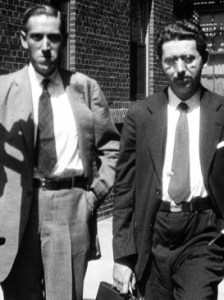
Frank Belknap Long
Source: Frank Belknap Long
Here’s a glimpse into the life and works of horror great Frank Belknap Long.
The Russian Sleep Experiment
 Source: The Russian Sleep Experiment
Good review of a book that while a good concept, according to the reviewer, could have been carried out better.
Maila Nurmi aka Vampira – actress
Source: Maila Nurmi aka Vampira – actress
Follow this link for a quick, interesting look at one of the top pop horror icons of the past few decades.
 Phil Slattery, Writer, Publisher