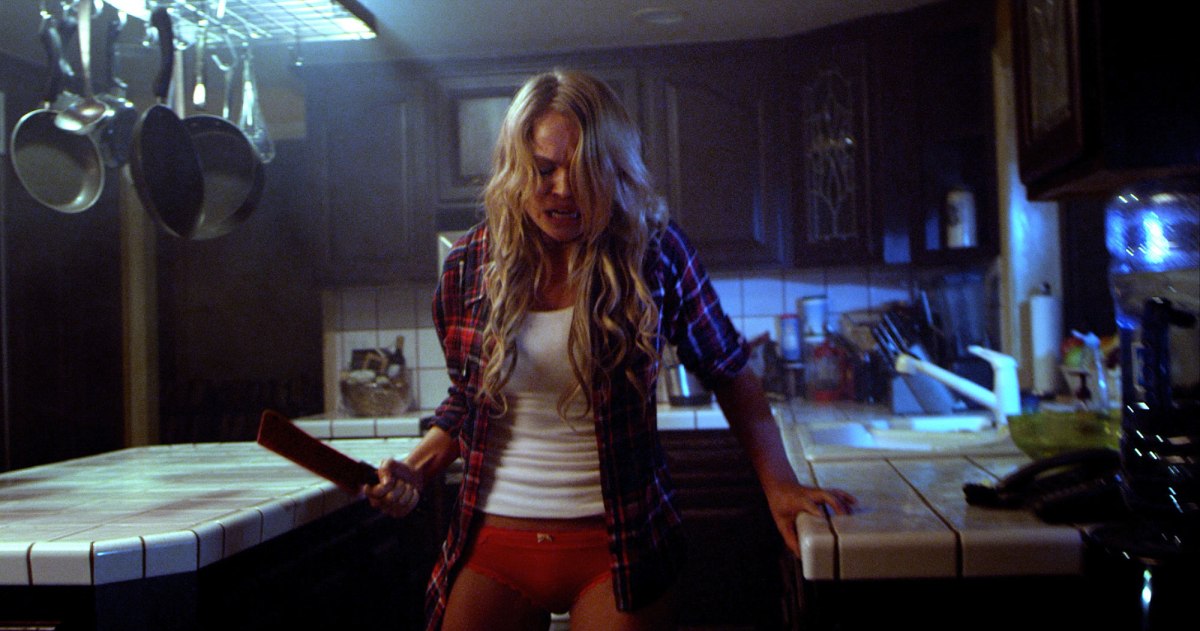
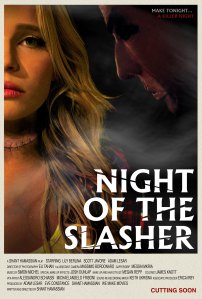
(Hollywood, CA) – November 2nd, 2015 – Multi award-winning short film, Night of the Slasher, written and directed by , competes for Best Narrative Short at two Oscar® qualifying festivals; the St. Louis International Film Festival in Missouri, USA and the Foyle Film Festival in Ireland. If it wins, it becomes eligible for an Oscar® nomination.
Henry Selick (Director of Nightmare Before Christmas and Coraline) saw the film at the Telluride Horror Show and said, “I really loved ‘Night of the Slasher’! It’s smart, clever, and funny!”
“Drafthouse Films will release Tetsuya Nakashima’s acclaimed thriller The World of Kanako in select theaters on December 4th, as well as making it available on multiple digital VOD platforms including Amazon Instant, iTunes, Vimeo, and VHX. A home video release on Blu-ray and DVD is slated for early 2016.
“An uncompromising revenge thriller of operatic scope, The World of Kanako is a non-stop visual and emotional assault to the senses as it follows troubled ex-detective Akikazu (Kôji Yakusho, 13 Assassins, Babel) on the hunt for his missing teenage daughter, Kanako. What he discovers in his search is an unsettling and harrowing web of depravity––surrounding both Kanako and himself. As Akizaku stumbles along a shocking trail of drugs, sex and violence, he finds himself woefully unprepared for the revelations that affect all he holds dear.” (Description from horrorunderground.org)
Drop over to horrorunderground.org and check out what promises to be first-rate Japanese horror.
The Quick 10: 10 Unexpected Horror Writers. Here is an interesting article I ran across at Mentalfloss.com. I would never have suspected most of these of ever having even an interest in horror. Stacey Conradt wrote the article in 2009.
Herman Webster Mudgett a.k.a. H.H. Holmes. From Wikipedia.
I am having troubling sleeping tonight and thought I would continue with our tour of the world’s horror locales. [I am not having nightmares about H.H. Holmes, if that is what you are thinking or even about any other horror topic.]
One of America’s first and most prolific serial killers was Herman Webster Mudgett, who went by his now better known alias of H.H. Holmes (1861-1896). Although his life has been recently documented in a few films and books, Holmes is still perhaps one of America’s lesser known serial killers. Most of the following information is taken from the Wikipedia article on Holmes, which supports my previous readings on Holmes in several sources. Please go to Wikipedia for more details than my brief synopsis provides. It is a well-written article and I rely on it here, only because I wish to provide a brief introduction to Holmes to support the photos and visual record I am providing.
Holmes started his criminal career while attending the University of Michigan Medical School, where he would steal cadavers from the laboratory, disfigure them, and then try to collect on insurance policies he had taken out on them after claiming they had been killed in accidents. After graduation, Mudgett moved to Chicago to pursue a career in pharmaceuticals, but also began conducting many shady business deals while being a bigamist and philanderer in his private life.
After moving to Chicago in 1886, Holmes took a job at Dr. Elizabeth Holton’s drugstore. After her husband’s death, Holmes
Holmes’s Castle from Wikipedia
bought the business and the lot across the street at 601-603 West 63rd Street. [I had not noticed this before, but if one takes the first digit in each number of the address and combines them, the result is 666.] In the lot he built what would become known as his murder castle.
Wikipedia provides a nice synopsis of what happened there:
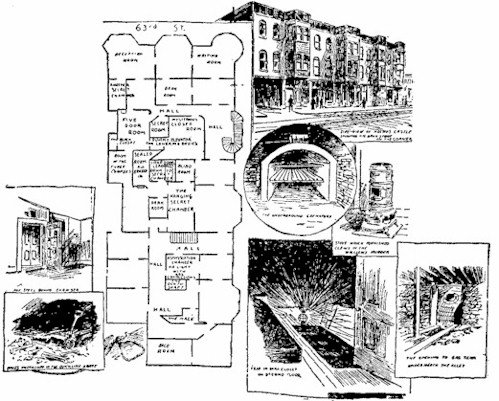
“Holmes purchased a lot across from the drugstore where he built his three-story, block-long “castle” as it was dubbed by those in the neighborhood. The address of the Castle was 601-603 W. 63rd St.[16] It was called the World’s Fair Hotel and opened as a hostelry for the World’s Columbian Exposition in 1893, with part of the structure devoted to commercial space. The ground floor of the Castle contained Holmes’ own relocated drugstore and various shops, while the upper two floors contained his personal office and a maze of over 100 windowless rooms with doorways opening to brick walls, oddly-angled hallways, stairways to nowhere, doors openable only from the outside, and a host of other strange and labyrinthine constructions. Holmes repeatedly changed builders during the construction of the Castle, so only he fully understood the design of the house.[3]
A diagram of Holmes’s Castle from weirdchicago.com (originally from the Chicago Tribune)
“During the period of building construction in 1889, Holmes met Benjamin Pitezel, a carpenter with a past of lawbreaking, whom Holmes exploited as a stooge for his criminal schemes. A district attorney later described Pitezel as Holmes’ “tool… his creature.”[17]
“After the completion of the hotel, Holmes selected mostly female victims from among his employees (many of whom were required as a condition of employment to take out life insurance policies, for which Holmes would pay the premiums but was also the beneficiary), as well as his lovers and hotel guests, whom he would later kill.[14] Some were locked in soundproof bedrooms fitted with gas lines that let him asphyxiate them at any time. Other victims were locked in a huge soundproof bank vault near his office, where they were left to suffocate.[8] The victims’ bodies were dropped by secret chute to the basement,[3] where some were meticulously dissected, stripped of flesh, crafted into skeleton models, and then sold to medical schools. Holmes also cremated some of the bodies or placed them in lime pits for destruction. Holmes had two giant furnaces as well as pits of acid, bottles of various poisons, and even a stretching rack.[3] Through the connections he had gained in medical school, he sold skeletons and organs with little difficulty.”
After the World’s Columbian Exposition ended, Holmes moved out of Chicago to evade creditors and continued pursuing his
Plans of Floors 2 and 3 from steampunkchicago.com
various nefarious trades throughout the country. Eventually, he was arrested by the Pinkertons for an insurance scam. While Holmes was in prison awaiting trial, authorities interviewed the former janitor at Holmes’s castle and found out that he had never been allowed entry to the upper floors. Upon further investigation, the real purpose behind Holmes’s castle was discovered.
Estimates of the number of Holmes’s victims range from 20-200, with 27 being the only number verified by any means. Most of his victims were women, though a few were men and children. Holmes confessed to murdering thirty people in Chicago, Indianapolis, and Toronto, though some of the people he claimed to have killed were later found to still be alive.
Holmes was put on trial for the murder of his partner-in-crime, Benjamin Pitezel, in October, 1895. He was hanged in Philadelphia’s Moyamensing Prison on May 7, 1896, for Pitezel’s murder. Holmes’s castle was mysteriously gutted by fire in August, 1895, two months before his trial began. The building was finally razed in 1938.
Holmes being executed. From jesslb6.blogspot,com
The site is now the location of the US Post Office’s Englewood Branch.
I have included a few photos of the castle and the Englewood Post Office for your viewing pleasure.
By coincidence, while gathering photos for this article, I found a statement on Cragin Spring’s Flickr page that a movie on Holmes called “Devil in the White City” was due out in 2013 and was to star Leonardo DiCaprio. A Wikipedia article on it states that it is based on a 2003 book by Erik Larson and Leonardo DiCaprio bought the film rights in 2010. Imdb states only that it is in development.
The Englewood post office now at the site of Holmes’s Castle, November 5, 2011. Photo by Malcolm Logan from myamericanodyssey.com
I finished reading The Hellbound Heart several weeks ago. As noted previously, it is a truly terrific read. I suggest reading it after seeing the movie (if you have somehow repeatedly missed your chances of seeing “Hellraiser” over the last twenty or so years). Reading it beforehand will just spoil the movie, whereas reading it afterwards may enlighten parts of the movie.
I don’t have much to add to what I have previously stated, except that, if you are a student of storytelling, the book warrants a detailed examination for narrative technique as it exhibits some basic techniques of storytelling that Mr. Barker carries out very well. I could go through the book page by page and expound on each ad nauseam, but instead I will focus now on one that sticks in my mind.
I do not recall if this is in the movie, but toward the end where Kirsty is trapped in the “damp room” by Frank, she slips on a bit of preserved ginger lying on the floor enabling Frank to catch her. The method by which Barker establishes why that ginger is on the floor fascinates me.
Although I have one or two dictionaries of literary terms, I do not recall the name for this technique and I think of it as simply setting the stage for a future scene. It shows the foresight, planning, and attention to detail that must go into any good story.
Earlier in the story, after Julia has released Frank from the Cenobite hell and he has regained enough flesh that he can once again eat, he asks Julia for a few of his favorite victuals, including preserved ginger. At the moment I read this, I thought it was simply a natural but insignificant detail. Of course, I could not know then that that bit of ginger would skyrocket the dramatic tension later on in one of the novel’s most important scenes.
Anyway, that’s my post for the day.
I have been very negligent in posting anything over the last months, my daytime job and personal matters consuming much more of my time than usual. I have recently come to find out though, that many more people in my home town of Frankfort, KY, were enjoying my postings than I had known or even believed possible and sorely missed it during this hiatus. For them and all the others who silently enjoy my works, I shall endeavor to pick up the thread.
I have not lost my desire to write fiction, however, and I am currently trying to finish a sci-fi/horror novella that I started sometime back. The work is going well, but I am having to change some of my original concept to make it more exciting. I would like to make it as gripping as some have found my “Murder by Plastic” (published at www.everydayfiction.com), but that will be quite difficult for something as long as a novella. The part I find most challenging is to coordinate the details much as Barker did in the example I give above. I would expound on the subject, but I do not want to give away the plot or run the risk of some unscrupulous cur stealing my idea and publishing it before I do–particularly as I am so close to finishing it. After this I have another three or four unfinished works to bring to a close. I could probably write eight hours a day like Thomas Mann and still not be finished by spring.
I am just past the halfway point in Clive Barker’s The Hellbound Heart, the novella upon which the orginal “Hellraiser” movie was based. This is one really terrific read. It is one of those that is hard to put down, even though you know what happens next, because the movie, which you saw twenty years ago and have seen periodically since then, so closely resembles the book.
Clive Barker, Seattle, 2007 by Steven Friederich
The prose is simple, but not Hemingway simple, and there are moments of actual narrative beauty (such as when Barker poignantly describes the passing of seasons in the beginning of one chapter) that seem to be glimpses of insight into a latent aspect of Barker’s immense talent: that he is able to write actually artistic prose that captures a moment, an emotion, or a sensation with a light touch that carries over to the reader. I have read the first two volumes (so far) of Barker’s Books of Blood and this quality seems to be lacking in them. In Books of Blood, he writes splendidly, but not beautifully, not poignantly.
I also love the way he keeps his characters to a minimum, so that seeing the complex relationships between them is easy.
Another fascinating aspect of Barker’s storytelling in this instance is that he can put his characters in horrifying situations, yet he does not try to be any more graphic than is necessary to invoke an emotional response in the ready. The few truly graphic scenes I have encountered so far are graphic, but not gratuitously graphic. An example would be when the recently-resurrected Frank starts to have sex with with brother’s wife Julia. He shows the act beginning and ends the chapter leaving what happens up to the reader’s imagination. Yes, this is an old trick straight out of made-for-TV movies, but do you really need to visualize every gory detail of a woman having sex with someone who is still half-corpse? I didn’t. And seeing that would not have helped the storytelling and if anything, it would have only detracted from it. Besides, if someone wants to visualize that unnerving scene for themselves, they are going to whether or not Barker describes it for them. All that is necessary to show the development of the characters and the plot is to show that they did have sex, because that act in itself shows something about them. About Frank it show how incredibly callous he is to Julia and how centered he is in the world of his own pleasure. About Julia, it shows her love for Frank is so self-sacrificing that she is willing to commit the most vile acts for him while taking obscene pleasure in them in her own way.
Anyway, those are just a few notes so far. I need to have dinner and do some housework and to read more of this fascinating work. Hopefully, I will be able to write more soon.
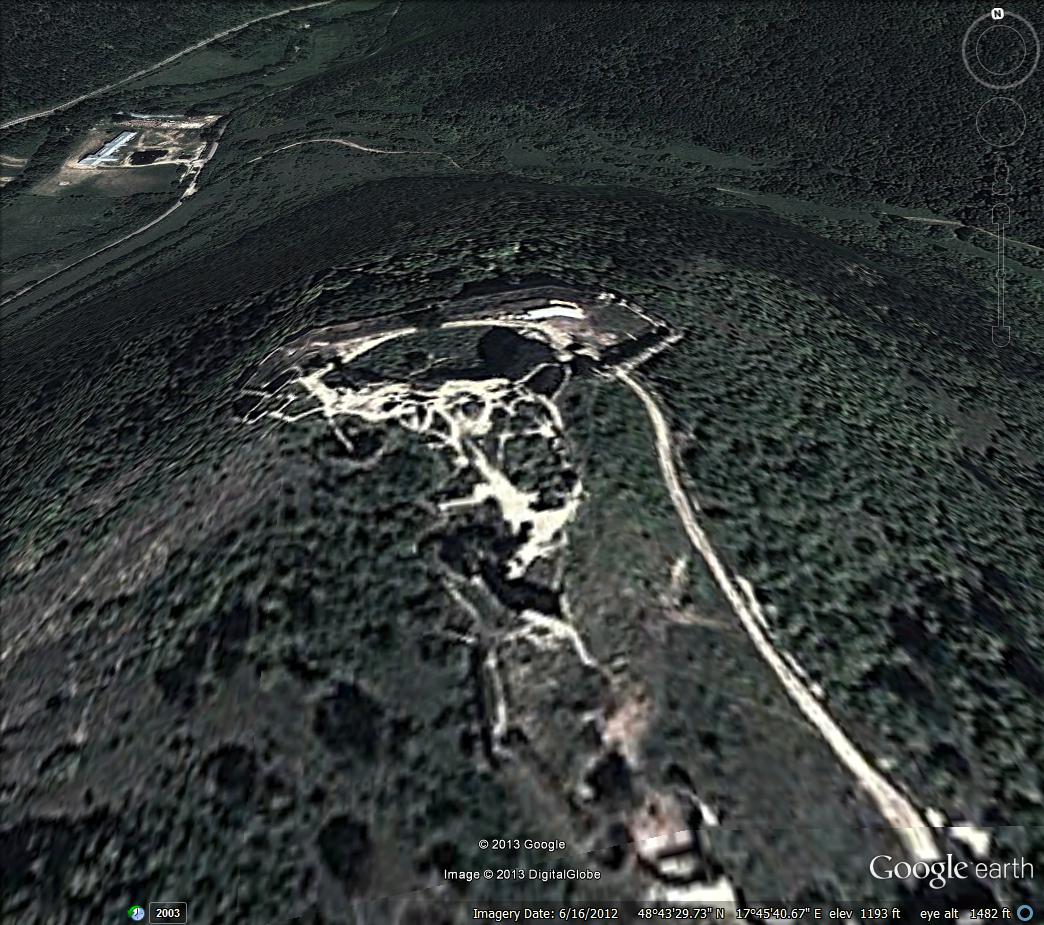
Cachtice Castle, home of Elizabeth Bathory, “the Blood Countess” from Google Earth Dec. 2013
A few days ago, I was just relaxing after a heavy meal and was starting to surf Google Earth, when I hit upon an idea that might be entertaining to my followers in the blogosphere. Why not visit the locations of famous horror novels or historical figures via Google Earth? I would only be trying to fool myself and you if I were to say that I would do this with any regularity. I can say that I shall do it as the spirit moves me, which may or not be frequently. Let me know what you think of the idea. I encourage you to try the same with the horror locations that you know. My first stop is at Cachtice (pronounced Chahk-teet-se) Castle, in present-day Slovakia, which was the home of the “Blood Countess”, Elizabeth Bathory, who is said to have tortured and murdered around 650 young girls circa 1600-1610. I won’t go into a detailed biography of her here. I have mentioned her in at least a couple of posts already and her biography can easily be found by surfing the Internet. I do caution you to try to find good, authoritative sources of information about her. Unfortunately, crap is pervasive throughout the “net” and a legendary figure from 400 years ago is apt to have more than the average share of strange ideas, rumors, falsehoods, mistakes, and outright lies. The Google image above is not of the highest quality. I think this one has recently replaced one that was much better. For a better view of the castle, I am providing this terrific view by Civertan from Wikimedia Commons:
Cachtice Castle From Wikimedia Commons Photo by Civertan
The advantage of Google Earth though is that you can view a location from an infinite number of angles and even from street level (unfortunately this option is not available for Cachtice) and view photos visitors have taken of the location. To find Cachtice, you will, of course, have to search for “Cachtice”. This will take you to the village of Cachtice. Look to the Northwest and you will find a smaller village called “Visnove”. Just southeast of Visnove is a hill with a castle. That’s it. See the diagram I have attached below for more details.
I hope you enjoy your virtual visit to one the world’s more infamous hellholes.
Hopefully, I will find the time to sit down and write another extensive post, but unfortunately, these days I seem inundated with personal and professional tasks. I try to read when I have the opportunity. When I do have some time free, I have been watching horror films and I have several which I recommend and on which I hope to be writing posts before long. I also hope to establish a webpage for a nascent lexicon of horror.
On a side note, I find werewolves a fascinating fictional creature with a lot of as yet unexplored literary possibilities. I love them as a symbol of the dual nature of humanity: civilized person under most circumstances, but with the possibility of releasing, whether willingly or not, a dark, inner animalistic nature and suddenly converting into a horrific, bloodthirsty monster. I started a werewolf/lycanthrope novel of my own many years ago, and perhaps one day I will complete it.
Those of you unfamiliar with the distinction between a werewolf and a lycanthrope please note the following. A werewolf is a man (or woman) that actually changes into a wolf. Werewolves exist only in fiction. A lycanthrope is a person who believes that he or she changes into a wolf. These do exist, but are rare. For more information on this condition, please visit the Wikipedia article on Clinical Lycanthropy.










 Phil Slattery, Writer, Publisher