

as Count Dracula
1931
The first thing you learn about the historical Castle Dracula is that it is a fictional location from Bram Stoker’s imagination. The Wikipedia article does a nice job of summarizing the history of the fictional abode and of analyzing the novel for clues to its supposed locale. The most precise it comes to identifying the spot of Dracula’s Castle is:
“The site of the Vampire’s home has always been one of the greatest mysteries of the novel. The route descriptions hardly mention any recognisable landmarks, but focus on evocations of a wild and snow-covered landscape, haunted by howling wolves and lit by supernatural blue flames at night. Because of this conspicuous vagueness, the annotated Dracula editions by Leonard Wolf,[6] Clive Leatherdale[7] and Leslie Klinger[8] simply assume Bram Stoker had no specific location in mind and place the Castle in or immediately next to the Borgo Pass. As a consequence, these editions take for granted that the Count’s men, pursued by Harker, Holmwood, Morris and Seward, follow the Bistrița River all the way up to Vatra Dornei and then travel the route through the Borgo Pass already taken by Van Helsing and Mina. The same view is adopted by Andrew Connell in his Google Map mark-ups.[9] These theories ignore or misinterpret Stoker’s hint that around the 47th Parallel, the Count’s men are supposed to leave the river and cross-over to Transylvanian territory:
We took it, that somewhere about the 47th degree, north latitude, would be the place chosen for crossing the country between the river and the Carpathians. (Chapter 26, Jonathan Harker’s Journal, Entry for 30 October)[10]
“Only recently, the Dutch author Hans Corneel de Roos discovered the site the Irish novelist really had in mind while shaping his narrative: an empty mountain top in the Transylvanian Kelemen Alps near the former border with Moldavia, ca. 20 miles south-east of the Borgo Pass.[11] De Roos also explains why Stoker chose to obscure this location in his novel and compares the vampire’s fortress to the Grail Castle as its anti-Christian antipole: It cannot be found on purpose, only by guidance. Harker is brought there by the Count himself, while Van Helsing and Mina – equally nodding off – rely on the instinct of their horses and the mounted men arrive there by following the Gypsies.”
If you have read the book and have seen at least the original film version of Dracula with Bela Lugosi, you know at least one place they have in common is Borgo Pass. This is where Jonathan Harker disembarks from a coach to wait in an inn for the Count’s own carriage to come and fetch him and the village people try unsuccessfully to warn him away.
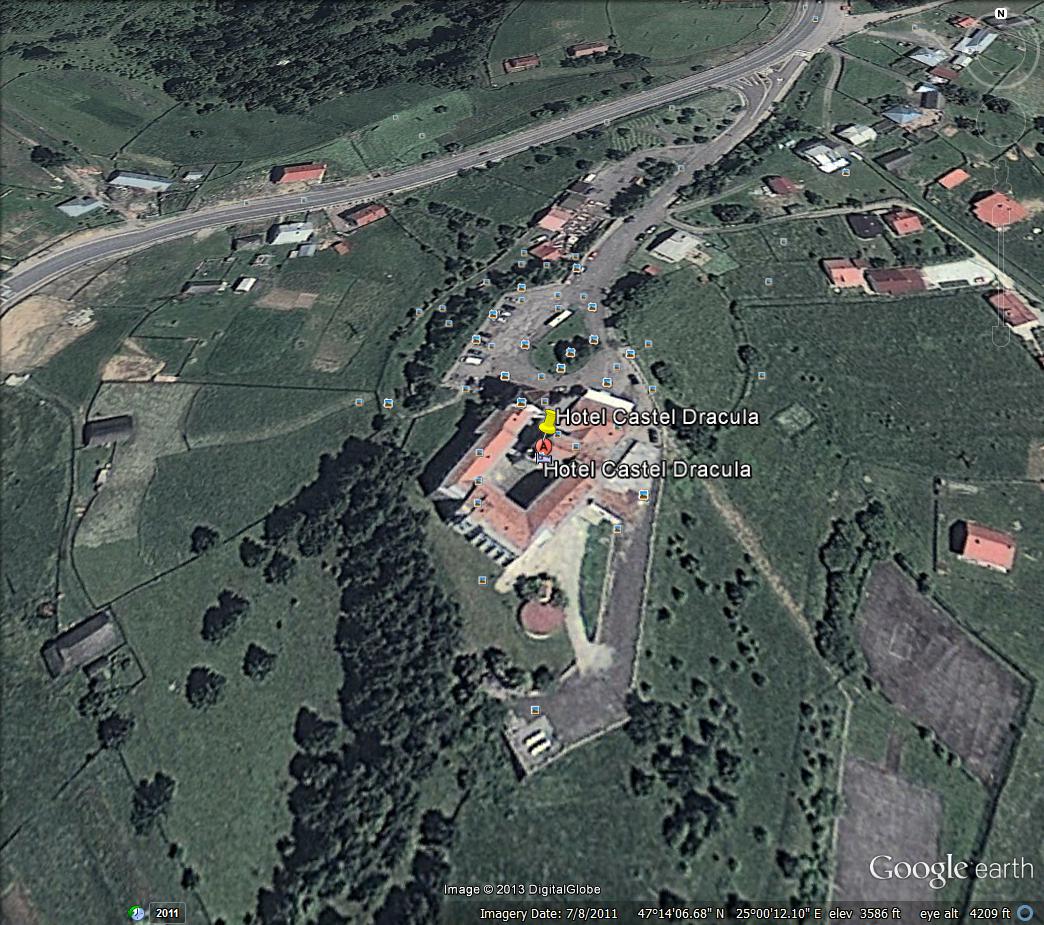
What you will learn from a few places on the Internet is that a hotel has been built on the spot in the Borgo Pass where Harker is supposed to have changed rides. Romanian Tourism describes it so:
Borgo Pass
Where: 277 miles northwest of Bucharest / 12 miles northeast of Bistrita
Note: Access by car only
Borgo Pass (Bargau in Romanian), made famous in the opening chapter of Bram Stoker’s Dracula, is an oft-trod passageway through the Carpathian Mountains in northern Transylvania. Located near the small township of Tihuta, the pass peaks at 3,840 feet.
The Bargau Valley encompasses some of the most beautiful unspoiled mountain scenery in the Carpathians with picturesque traditional villages located in valleys and on hillsides, ideal bases for hiking, riding or discovering their vivid tapestry of old customs, handicrafts and folklore.
Here, you will step into a realm that the fictional Mina Harker described in her diary as “a lovely county; full of beauties of all imaginable kinds, and the people are brave, and strong, and simple, and seem full of nice qualities.”
If you travel via Google Earth, if you search for “Borgo Pass”, you will find the location, but the name for it on Google Earth is “Pasul Tihuta”, the Romanian name, not the Hungarian “Borgo Pass” that Bram Stoker used. Once in Pasul Tihuta, search for Hotel Castel Dracula. That’s the spot where Harker is supposed to have changed carriages. Don’t be surprised that the modern hotel looks nothing like the quaint hamlet of the movie. The Wikipedia article on Tihuta Pass states:
Tihuţa Pass (Romanian: Pasul Tihuţa; Hungarian: Borgo or Burgo) is a high mountain pass in the Romanian Bârgău Mountains (Eastern Carpathian Mountains) connecting Bistriţa (Transylvania) with Vatra Dornei (Bukovina, Moldavia).
The pass was made famous by Bram Stoker‘s novel Dracula, where, termed as “the Borgo Pass”, it was the gateway to the realm of Count Dracula. Stoker most likely found the name on a contemporary map. He never actually visited the area.
Today the pass is home to Hotel “Castel Dracula”. The hotel was built in 1974 and is located at an altitude of
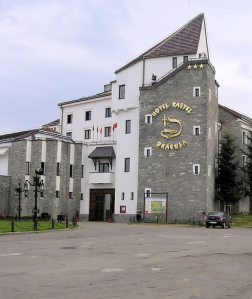
Borgo Pass, Romania
1,116 m (3,661 ft). The hotel has become quite an attraction due to its architectural style of a medieval villa, as well as the sheer beauty of the location.
That being said, the next question that arises is if there is no Castle Dracula, but there was a historical figure on which was based, where did the historical figure, Vlad the Impaler, actually live?
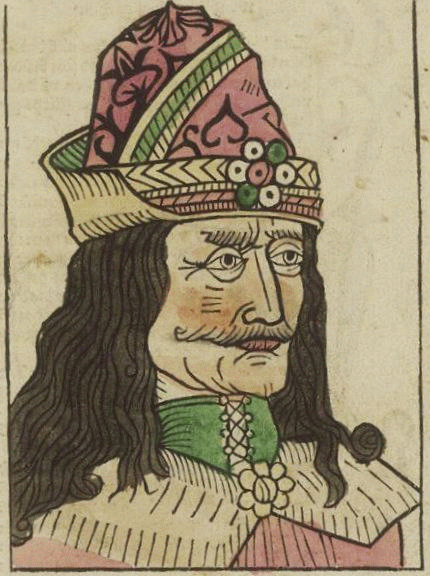
If you read any summary of his life, you will find that Vlad the Impaler was constantly on the move, either attacking his enemies or running from them. Pinning down his abode to a single spot is difficult. A good, brief summary of the most famous can be found at Romania Tourism. You will note that most of the popular tourist sites have at best a tenuous connection to Vlad Tepes. This is probably similar to the number of places along the US east coast that claim to be where George Washington slept during his campaigns in the American Revolution.
From what I have found during my Internet searches one of the best and probably most reliable articles on the places associated with Vlad Tepes is this one entitled “Dracula’s Homepage” written by a man who has apparently conducted extensive research into Vlad Tepes and the places associated with him. The author describes for us which spots were locations where Vlad Tepes actually lived as opposed to ones that the tourism industry identifies with him, but which in fact may have little, if anything at all, to do with the bloodthirsty ruler. The two locations described in this article as where Vlad Tepes spent a significant amount of time are Tirgoviste Palace and Cetatea Poenari.
The Tirgoviste palace is actually called “Curtea Palace”, where Vlad Tepes built the Chindia Tower. If you search for “Chindia Tower” on Google Earth, you can hover just over Vlad Tepes’s Tirgoviste Palace and even go to street level to view the tower as if you were walking past it.

(from Google Earth)

(from Google Earth)
Search Google Earth for “Cetatea Poenari” and you will be taken to a secluded mountaintop over a narrow pass. This place probably captures the eerie spirit of the novel more than any other place you will find. If you have the Google Earth 3D buildings feature on (as I do in the photo below), you will see a 3D virtual representation of the castle, though the best views of it are from the dozens of photos tourists have attached to the location via Panaramio.
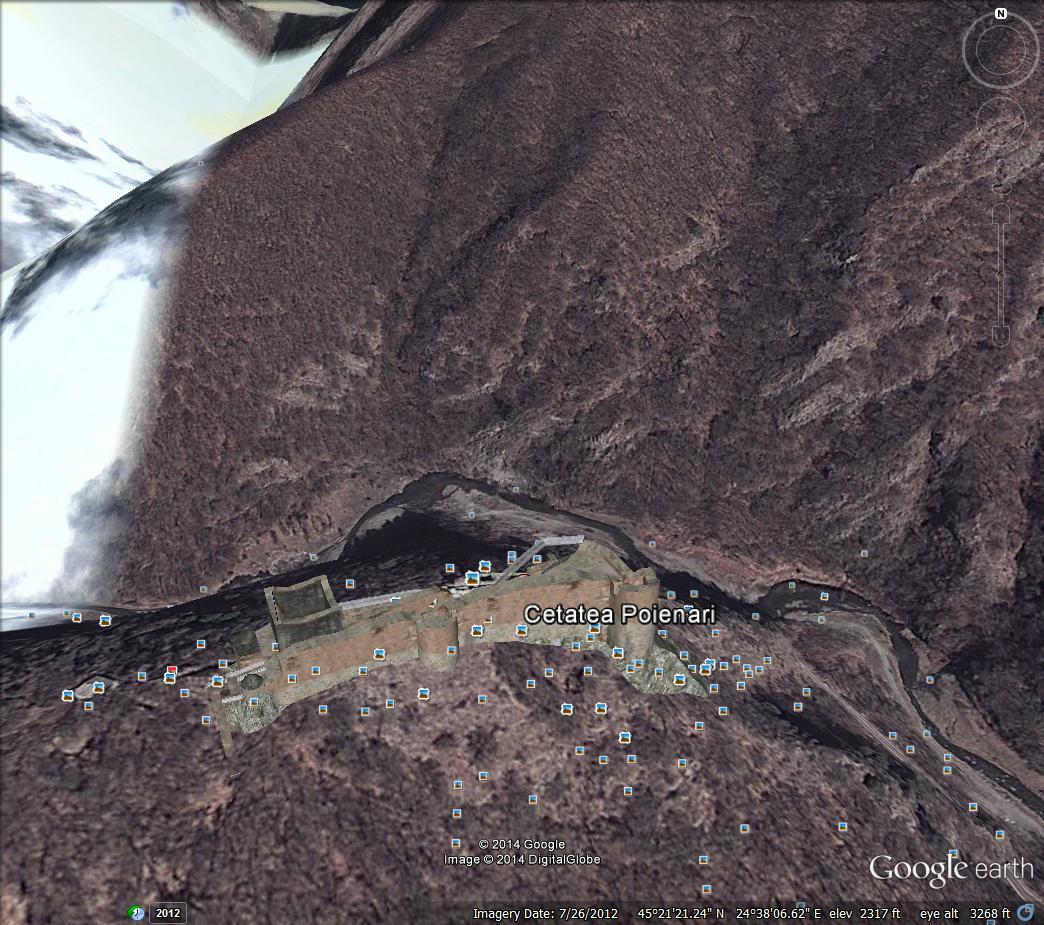
(from Google Earth)
The website “Dracula’s Homepage” mentioned previously has a beautiful description of what it must be like to travel to the castle along with some of its historically horrific background:
“If there is an edifice that can be labelled Vlad Dracula’s castle, it is the ruins of Poenari. Actually, this is a fortress (“cetate” in Romanian) rather than a castle, located at the entrance to the gorge of the Arges River, north of the town of Curtea de Arges. As you leave Curtea de Arges (itself an interesting town with fortifications dating back to the 13th century and Basarab 1), you drive over a secondary road through several little villages, proceeding up the Arges valley towards the base of the Carpathian range.The road reaches the base of a group of high, heavily wooded mountains and there on the rocky top of one of them is Cetatea Poenari – Dracula’s Castle. Even from the road below it is a forbidding sight. What strikes one is its inaccessibility, high on a mountain top and the entrance to the gorges of the river (the river, by the way, has been diverted by a hydro-electric project). Poenari was the castle fortification that Vlad Tepes forced the nobles of Tirgoviste to build. The nobles were forced to walk the distance from Tirgoviste to the Arges (quite considerable by road – probably about 60 km overland) and then drag the material up that mountain to build the castle.
“ To get to the top, one has to walk up almost 1500 steps. But the effort is certainly worth it. As you approach the magnificent ruin (last 50 steps or so) the scene is totally Gothic. There is the outline of the castle perched on the top of this rock, seeming to grow out of the very mountain itself. It covers the full space at the top, has a sheer drop on three sides, and is barely accessible by a small bridge near the top of the steps.
“I have returned to this site three times, as it is one of my favorite places in Romania: not only because of the sense of history but the magnificent scenery. One particular view (looking northwest) is spectacular – just the way you might picture the landscape around Dracula’s Castle in Stoker’s novel (though Stoker knew nothing about this place).
“This is the route that, according to local legend, Vlad took in order to escape into Transylvania from the Turks in 1462. He was assisted in his efforts by the villagers of nearby Arefu, where many narratives about Vlad still live in their oral culture.

“Then there is the southern wall of the castle – a sheer drop!

“This is where, according to another local legend, Vlad Tepes’ first wife flung herself, committing suicide rather than being taken captive by the advancing Turks. This castle is where Vlad would go for refuge in the face of advancing enemies. And from its towers he had a commanding view of anyone approaching from any direction. It was practically impenetrable.”
If you like horror, I highly recommend reading up on the historical Vlad Tepes and his reign. You will find actual terrors that would make any of the ficitional Draculas look like TV’s Mr. Rogers in comparison.
If, during your virtual journeys through the worlds of the fictional Count Dracula and his historical counterpart, Vlad Tepes, encounter any fascinating places or adventures, please feel free to share them via the comments section below.
Thoughts? Comments?





 Phil Slattery, Writer, Publisher