
Tag: fiction

Courting the Devil
 Reblogged on WordPress.com
Source: Courting the Devil
“A Good Man” Has Been Published at Fiction on the Web

Today, my short story, “A Good Man”, was published at http://www.fictionontheweb.co.uk. Many thanks to Charlie Fish at Fiction on the Web for publishing this, one of my best stories. “A Good Man” is not horror, but a modern crime drama. Mr. Fish describes the story thus: “On the day before her death from lung cancer, Christopher’s mother tells him a secret about his father that may change his perception of his parents forever…” Doug Hawley, in the first comment on the story notes: “Lots of detail examining an old question of how do you judge a person’s life. It left me wondering.”
Please drop by Fiction on the Web any time and check out “A Good Man”.
Wild Thing: On Writing and Not Writing
 By Andrea Jarrell After 30 years of sitting at a desk, making my living as a writer, I truly appreciate how physical writing is: pushing pen across paper, fingers tapping a keyboard, the trapezius …
African American Folklore, Magical Realism and Horror in Toni Morrison novels

Source: African American Folklore, Magical Realism and Horror in Toni Morrison novels
The Saturday Night Special: “Sredni Vashtar” by Saki (1911)
Conradin was ten years old, and the doctor had pronounced his professional opinion that the boy would not live another five years. The doctor was silky and effete, and counted for little, but his opinion was endorsed by Mrs. De Ropp, who

(Hector Hugh Munro)
1870-1916
counted for nearly everything. Mrs. De Ropp was Conradin’s cousin and guardian, and in his eyes she represented those three-fifths of the world that are necessary and disagreeable and real; the other two-fifths, in perpetual antagonism to the foregoing, were summed up in himself and his imagination. One of these days Conradin supposed he would succumb to the mastering pressure of wearisome necessary things—such as illnesses and coddling restrictions and drawn-out dullness. Without his imagination, which was rampant under the spur of loneliness, he would have succumbed long ago.
Mrs. De Ropp would never, in her honestest moments, have confessed to herself that she disliked Conradin, though she might have been dimly aware that thwarting him “for his good” was a duty which she did not find particularly irksome. Conradin hated her with a desperate sincerity which he was perfectly able to mask. Such few pleasures as he could contrive for himself gained an added relish from the likelihood that they would be displeasing to his guardian, and from the realm of his imagination she was locked out—an unclean thing, which should find no entrance.
In the dull, cheerless garden, overlooked by so many windows that were ready to open with a message not to do this or that, or a reminder that medicines were due, he found little attraction. The few fruit-trees that it contained were set jealously apart from his plucking, as though they were rare specimens of their kind blooming in an arid waste; it would probably have been difficult to find a market-gardener who would have offered ten shillings for their entire yearly produce. In a forgotten corner, however, almost hidden behind a dismal shrubbery, was a disused tool-shed of respectable proportions, and within its walls Conradin found a haven, something that took on the varying aspects of a playroom and a cathedral. He had peopled it with a legion of familiar phantoms, evoked partly from fragments of history and partly from his own brain, but it also boasted two inmates of flesh and blood. In one corner lived a ragged-

plumaged Houdan hen, on which the boy lavished an affection that had scarcely another outlet. Further back in the gloom stood a large hutch, divided into two compartments, one of which was fronted with close iron bars. This was the abode of a large polecat-ferret, which a friendly butcher-boy had once smuggled, cage and all, into its present quarters, in exchange for a long-secreted hoard of small silver. Conradin was dreadfully afraid of the lithe, sharp-fanged beast, but it was his most treasured possession. Its very presence in the tool-shed was a secret and fearful joy, to be kept scrupulously from the knowledge of the Woman, as he privately dubbed his cousin. And one day, out of Heaven knows what material, he spun the beast a wonderful name, and from that moment it grew into a god and a religion. The Woman indulged in religion once a week at a church near by, and took Conradin with her, but to him the church service was an alien rite in the House of Rimmon. Every Thursday, in the dim and musty silence of the tool-shed, he worshipped with mystic and elaborate ceremonial before the wooden hutch where dwelt Sredni Vashtar, the great

ferret. Red flowers in their season and scarlet berries in the winter-time were offered at his shrine, for he was a god who laid some special stress on the fierce impatient side of things, as opposed to the Woman’s religion, which, as far as Conradin could observe, went to great lengths in the contrary direction. And on great festivals powdered nutmeg was strewn in front of his hutch, an important feature of the offering being that the nutmeg had to be stolen. These festivals were of irregular occurrence, and were chiefly appointed to celebrate some passing event. On one occasion, when Mrs. De Ropp suffered from acute toothache for three days, Conradin kept up the festival during the entire three days, and almost succeeded in persuading himself that Sredni Vashtar was personally responsible for the toothache. If the malady had lasted for another day the supply of nutmeg would have given out.
The Houdan hen was never drawn into the cult of Sredni Vashtar. Conradin had long ago settled that she was an Anabaptist. He did not pretend to have the remotest knowledge as to what an Anabaptist was, but he privately hoped that it was dashing and not very respectable. Mrs. De Ropp was the ground plan on which he based and detested all respectability.
After a while Conradin’s absorption in the tool-shed began to attract the notice of his guardian. “It is not good for him to be pottering down there in all weathers,” she promptly decided, and at breakfast one morning she announced that the Houdan hen had been sold and taken away overnight. With her short-sighted eyes she peered at Conradin, waiting for an outbreak of rage and sorrow, which she was ready to rebuke with a flow of excellent precepts and reasoning. But Conradin said nothing: there was nothing to be said. Something perhaps in his white set face gave her a momentary qualm, for at tea that afternoon there was toast on the table, a delicacy which she usually banned on the ground that it was bad for him; also because the making of it “gave trouble,” a deadly offence in the middle-class feminine eye.
“I thought you liked toast,” she exclaimed, with an injured air, observing that he did not touch it.
“Sometimes,” said Conradin.
In the shed that evening there was an innovation in the worship of the hutch-god. Conradin had been wont to chant his praises, tonight be asked a boon.
“Do one thing for me, Sredni Vashtar.”
The thing was not specified. As Sredni Vashtar was a god he must be supposed to know. And choking back a sob as he looked at that other empty comer, Conradin went back to the world he so hated.
And every night, in the welcome darkness of his bedroom, and every evening in the dusk of the tool-shed, Conradin’s bitter litany went up: “Do one thing for me, Sredni Vashtar.”
Mrs. De Ropp noticed that the visits to the shed did not cease, and one day she made a further journey of inspection.
“What are you keeping in that locked hutch?” she asked. “I believe it’s guinea-pigs. I’ll have them all cleared away.”
Conradin shut his lips tight, but the Woman ransacked his bedroom till she found the carefully hidden key, and forthwith marched down to the shed to complete her discovery. It was a cold afternoon, and Conradin had been bidden to keep to the house. From the furthest window of the dining-room the door of the shed could just be seen beyond the corner of the shrubbery, and there Conradin stationed himself. He saw the Woman enter, and then be imagined her opening the door of the sacred hutch and peering down with her short-sighted eyes into the thick straw bed where his god lay hidden. Perhaps she would prod at the straw in her clumsy impatience. And Conradin fervently breathed his prayer for the last time. But he knew as he prayed that he did not believe. He knew that the Woman would come out presently with that pursed smile he loathed so well on her face, and that in an hour or two the gardener would carry away his wonderful god, a god no longer, but a simple brown ferret in a hutch. And he knew that the Woman would triumph always as she triumphed now, and that he would grow ever more sickly under her pestering and domineering and superior wisdom, till one day nothing would matter much more with him, and the doctor would be proved right. And in the sting and misery of his defeat, he began to chant loudly and defiantly the hymn of his threatened idol:
Sredni Vashtar went forth,
His thoughts were red thoughts and his teeth were white,
His enemies called for peace, but he brought them death.
Sredni Vashtar the beautiful.
And then of a sudden he stopped his chanting and drew closer to the window-pane. The door of the shed still stood ajar as it had been left, and the minutes were slipping by. They were long minutes, but they slipped by nevertheless. He watched the starlings running and flying in little parties across the lawn; he counted them over and over again, with one eye always on that swinging door. A sour-faced maid came in to lay the table for tea, and still Conradin stood and waited and watched. Hope had crept by inches into his heart, and now a look of triumph began to blaze in his eyes that had only known the wistful patience of defeat. Under his breath, with a furtive exultation, he began once again the pæan of victory and devastation. And presently his eyes were rewarded: out through that doorway came a long, low, yellow-and-brown beast, with eyes a-blink at the waning daylight, and dark wet stains around the fur of jaws and throat. Conradin dropped on his knees. The great polecat-ferret made its way down to a small brook at the foot of the garden, drank for a moment, then crossed a little plank bridge and was lost to sight in the bushes. Such was the passing of Sredni Vashtar.
“Tea is ready,” said the sour-faced maid; “where is the mistress?” “She went down to the shed some time ago,” said Conradin. And while the maid went to summon her mistress to tea, Conradin fished a toasting-fork out of the sideboard drawer and proceeded to toast himself a piece of bread. And during the toasting of it and the buttering of it with much butter and the slow enjoyment of eating it, Conradin listened to the noises and silences which fell in quick spasms beyond the dining-room door. The loud foolish screaming of the maid, the answering chorus of wondering ejaculations from the kitchen region, the scuttering footsteps and hurried embassies for outside help, and then, after a lull, the scared sobbings and the shuffling tread of those who bore a heavy burden into the house.
“Whoever will break it to the poor child? I couldn’t for the life of me!” exclaimed a shrill voice. And while they debated the matter among themselves, Conradin made himself another piece of toast.
Tananarive Due’s Work in Horror
 Source: Tananarive Due’s Work in Horror
Publication Announcement: “A Good Man” to Appear in Fiction on the Web, March 8

I just received word that my short story “A Good Man” will appear at www.fictionontheweb.co.uk on March 8. Many thanks to Charlie Fish for selecting one of my most recent and best stories.
“A Good Man” is not a horror story, but a violent drama of love and a spiraling cycle of revenge set in Farmington, New Mexico in the 1960’s.
Please drop by Fiction on the Web on Tuesday the 8th (or any time) and check out their wonderful selection of stories.
Beyond Castle Frankenstein – A Lump of Death

Mary Shelley, Queen of the Gothic Thriller (WIHM)

Portrait by Richard Rothwell
Walking in Lovecraft’s Shadow
 Source: Walking in Lovecraft’s Shadow
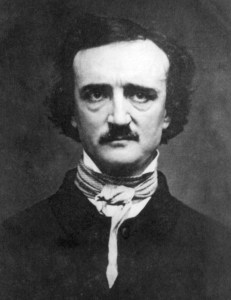
The Saturday Night Special: “The Facts in the Case of M. Valdemar” by E.A. Poe (1845)
OF course I shall not pretend to consider it any matter for wonder, that the extraordinary case of M. Valdemar has excited discussion. It would have been a miracle had it not — especially under the circumstances. Through the desire of all parties concerned, to keep the affair from the public, at least for the present, or until we had farther opportunities for investigation — through our endeavors to effect this — a garbled or exaggerated account made its way into society, and became the source of many unpleasant misrepresentations; and, very naturally, of a great deal of disbelief.
It is now rendered necessary that I give the facts — as far as I comprehend them myself. They are, succinctly, these:
My attention, for the last three years, had been repeatedly drawn to the subject of Mesmerism; and, about nine months ago, it occurred to me, quite suddenly, that in the series of experiments made hitherto, there had been a very remarkable and most unaccountable omission: — no person had as yet been mesmerized in articulo mortis. It remained to be seen, first, whether, in such condition, there existed in the patient any susceptibility to the magnetic influence; secondly, whether, if any existed, it was impaired or increased by the condition; thirdly, to what extent, or for how long a period, the encroachments of Death might be arrested by the process. There were other points to be ascertained, but these most excited my curiosity — the last in especial, from the immensely important character of its consequences.
In looking around me for some subject by whose means I might test these particulars, I was brought to think of my friend, M. Ernest Valdemar, the well-known compiler of the “Bibliotheca Forensica,” and author (under the nom de plume of Issachar Marx) of the Polish versions of “Wallenstein” and “Gargantua.” M. Valdemar, who has resided principally at Harlem, N. Y., since the year 1839, is (or was) particularly noticeable for the extreme spareness of his person — his lower limbs much resembling those of John Randolph; and, also, for the whiteness of his whiskers, in violent contrast to the blackness of his hair — the latter, in consequence, being very generally mistaken for a wig. His temperament was markedly nervous, and rendered him a good subject for mesmeric experiment. On two or three occasions I had put him to sleep with little difficulty, but was disappointed in other results which his peculiar constitution had naturally led me to anticipate. His will was at no period positively, or thoroughly, under my control, and in regard to clairvoyance, I could accomplish with him nothing to be relied upon. I always attributed my failure at these points to the disordered state of his health. For some months previous to my becoming acquainted with him, his physicians had declared him in a confirmed phthisis. It was his custom, indeed, to speak calmly of his approaching dissolution, as of a matter neither to be avoided nor regretted.
When the ideas to which I have alluded first occurred to me, it was of course very natural that I should think of M. Valdemar. I knew the steady philosophy of the man too well to apprehend any scruples from him; and he had no relatives in America who would be likely to interfere. I spoke to him frankly upon the subject; and, to my surprise, his interest seemed vividly excited. I say to my surprise; for, although he had always yielded his person freely to my experiments, he had never before given me any tokens of sympathy with what I did. His disease was of that character which would admit of exact calculation in respect to the epoch of its termination in death; and it was finally arranged between us that he would send for me about twenty-four hours before the period announced by his physicians as that of his decease.
It is now rather more than seven months since I received, from M. Valdemar himself, the subjoined note:
“MY DEAR P——,
“You may as well come now. D—— and F—— are agreed that I cannot hold out beyond to-morrow midnight; and I think they have hit the time very nearly.
“VALDEMAR.”
I received this note within half an hour after it was written, and in fifteen minutes more I was in the dying man’s chamber. I had not seen him for ten days, and was appalled by the fearful alteration which the brief interval had wrought in him. His face wore a leaden hue; the eyes were utterly lustreless; and the emaciation was so extreme, that the skin had been broken through by the cheek-bones. His expectoration was excessive. The pulse was barely perceptible. He retained, nevertheless, in a very remarkable manner, both his mental power and a certain degree of physical strength. He spoke with distinctness — took some palliative medicines without aid — and, when I entered the room, was occupied in penciling memoranda in a pocket-book. He was propped up in the bed by pillows. Doctors D—— and F—— were in attendance.
After pressing Valdemar’s hand, I took these gentlemen aside, and obtained from them a minute account of the patient’s condition. The left lung had been for eighteen months in a semi-osseous or cartilaginous state, and was, of course, entirely useless for all purposes of vitality. The right, in its upper portion, was also partially, if not thoroughly, ossified, while the lower region was merely a mass of purulent tubercles, running one into another. Several extensive perforations existed; and, at one point, permanent adhesion to the ribs had taken place. These appearances in the right lobe were of comparatively recent date. The ossification had proceeded with very unusual rapidity; no sign of it had been discovered a month before, and the adhesion had only been observed during the three previous days. Independently of the phthisis, the patient was suspected of aneurism of the aorta; but on this point the osseous symptoms rendered an exact diagnosis impossible. It was the opinion of both physicians that M. Valdemar would die about midnight on the morrow (Sunday.) It was then seven o’clock on Saturday evening.
On quitting the invalid’s bed-side to hold conversation with myself, Doctors D—— and F —— had bidden him a final farewell. It had not been their intention to return; but, at my request, they agreed to look in upon the patient about ten the next night.
When they had gone, I spoke freely with M. Valdemar on the subject of his approaching dissolution, as well as, more particularly, of the experiment proposed. He still professed himself quite willing and even anxious to have it made, and urged me to commence it at once. A male and a female nurse were in attendance; but I did not feel myself altogether at liberty to engage in a task of this character with no more reliable witnesses than these people, in case of sudden accident, might prove. I therefore postponed operations until about eight the next night, when the arrival of a medical student, with whom I had some acquaintance, (Mr. Theodore L —— l,) relieved me from farther embarrassment. It had been my design, originally, to wait for the physicians; but I was induced to proceed, first, by the urgent entreaties of M. Valdemar, and secondly, by my conviction that I had not a moment to lose, as he was evidently sinking fast.
Mr. L —— l was so kind as to accede to my desire that he would take notes of all that occurred; and it is from his memoranda that what I now have to relate is, for the most part, either condensed or copied verbatim.
It wanted about five minutes of eight when, taking the patient’s hand, I begged him to state, as distinctly as he could, to Mr. L —— l, whether he (M. Valdemar,) was entirely willing that I should make the experiment of mesmerizing him in his then condition.
He replied feebly, yet quite audibly, “Yes, I wish to be mesmerized” — adding immediately afterwards, “I fear you have deferred it too long.”
While he spoke thus, I commenced the passes which I had already found most effectual in subduing him. He was evidently influenced with the first lateral stroke of my hand across his forehead; but although I exerted all my powers, no farther perceptible effect was induced until some minutes after ten o’clock, when Doctors D—— and F—— called, according to appointment. I explained to them, in a few words, what I designed, and as they opposed no objection, saying that the patient was already in the death agony, I proceeded without hesitation — exchanging, however, the lateral passes for downward ones, and directing my gaze entirely into the right eye of the sufferer.
By this time his pulse was imperceptible and his breathing was stertorious, and at intervals of half a minute.
This condition was nearly unaltered for a quarter of an hour. At the expiration of this period, however, a natural although a very deep sigh escaped the bosom of the dying man, and the stertorious breathing ceased — that is to say, its stertoriousness was no longer apparent; the intervals were undiminished. The patient’s extremities were of an icy coldness.
At five minutes before eleven, I perceived unequivocal signs of the mesmeric influence. The glassy roll of the eye was changed for that expression of uneasy inward examination which is never seen except in cases of sleep-waking, and which it is quite impossible to mistake. With a few rapid lateral passes I made the lids quiver, as in incipient sleep, and with a few more I closed them altogether. I was not satisfied, however, with this, but continued the manipulations vigorously, and with the fullest exertion of the will, until I had completely stiffened the limbs of the slumberer, after placing them in a seemingly easy position. The legs were at full length; the arms were nearly so, and reposed on the bed at a moderate distance from the loins. The head was very slightly elevated.
When I had accomplished this, it was fully midnight, and I requested the gentlemen present to examine M. Valdemar’s condition. After a few experiments, they admitted him to be in an unusually perfect state of mesmeric trance. The curiosity of both the physicians was greatly excited. Dr. D—— resolved at once to remain with the patient all night, while Dr. F—— took leave with a promise to return at daybreak. Mr. L —— l and the nurses remained.
We left M. Valdemar entirely undisturbed until about three o’clock in the morning, when I approached him and found him in precisely the same condition as when Dr. F—— went away — that is to say, he lay in the same position; the pulse was imperceptible; the breathing was gentle (scarcely noticeable, unless through the application of a mirror to the lips;) the eyes were closed naturally; and the limbs were as rigid and as cold as marble. Still, the general appearance was certainly not that of death.
As I approached M. Valdemar I made a kind of half effort to influence his right arm into pursuit of my own, as I passed the latter gently to and fro above his person. In such experiments with this patient, I had never perfectly succeeded before, and assuredly I had little thought of succeeding now; but to my astonishment, his arm very readily, although feebly, followed every direction I assigned it with mine. I determined to hazard a few words of conversation.
“M. Valdemar,” I said, “are you asleep?” He made no answer, but I perceived a tremor about the lips, and was thus induced to repeat the question, again and again. At its third repetition, his whole frame was agitated by a very slight shivering; the eye-lids unclosed themselves so far as to display a white line of a ball; the lips moved sluggishly, and from between them, in a barely audible whisper, issued the words:
“Yes; — asleep now. Do not wake me! — let me die so!”
I here felt the limbs and found them as rigid as ever. The right arm, as before, obeyed the direction of my hand. I questioned the sleep-waker again:
“Do you still feel pain in the breast, M. Valdemar?”
The answer now was immediate, but even less audible than before:
“No pain — I am dying.”
I did not think it advisable to disturb him farther just then, and nothing more was said or done until the arrival of Dr. F—— , who came a little before sunrise, and expressed unbounded astonishment at finding the patient still alive. After feeling the pulse and applying a mirror to the lips, he requested me to speak to the sleep-waker again. I did so, saying:
“M. Valdemar, do you still sleep?”
As before, some minutes elapsed ere a reply was made; and during the interval the dying man seemed to be collecting his energies to speak. At my fourth repetition of the question, he said very faintly, almost inaudibly:
“Yes; still asleep — dying.”
It was now the opinion, or rather the wish, of the physicians, that M. Valdemar should be suffered to remain undisturbed in his present apparently tranquil condition, until death should supervene — and this, it was generally agreed, must now take place within a few minutes. I concluded, however, to speak to him once more, and merely repeated my previous question.
While I spoke, there came a marked change over the countenance of the sleep-waker. The eyes rolled themselves slowly open, the pupils disappearing upwardly; the skin generally assumed a cadaverous hue, resembling not so much parchment as white paper; and the circular hectic spots which, hitherto, had been strongly defined in the centre of each cheek, went out at once. I use this expression, because the suddenness of their departure put me in mind of nothing so much as the extinguishment of a candle by a puff of the breath. The upper lip, at the same time, writhed itself away from the teeth, which it had previously covered completely; while the lower jaw fell with an audible jerk, leaving the mouth widely extended, and disclosing in full view the swollen and blackened tongue. I presume that no member of the party then present had been unaccustomed to death-bed horrors; but so hideous beyond conception was the appearance of M. Valdemar at this moment, that there was a general shrinking back from the region of the bed.
I now feel that I have reached a point of this narrative at which every reader will be startled into positive disbelief. It is my business, however, simply to proceed.
There was no longer the faintest sign of vitality in M. Valdemar; and concluding him to be dead, we were consigning him to the charge of the nurses, when a strong vibratory motion was observable in the tongue. This continued for perhaps a minute. At the expiration of this period, there issued from the distended and motionless jaws a voice — such as it would be madness in me to attempt describing. There are, indeed, two or three epithets which might be considered as applicable to it in part; I might say, for example, that the sound was harsh, and broken and hollow; but the hideous whole is indescribable, for the simple reason that no similar sounds have ever jarred upon the ear of humanity. There were two particulars, nevertheless, which I thought then, and still think, might fairly be stated as characteristic of the intonation — as well adapted to convey some idea of its unearthly peculiarity. In the first place, the voice seemed to reach our ears — at least mine — from a vast distance, or from some deep cavern within the earth. In the second place, it impressed me (I fear, indeed, that it will be impossible to make myself comprehended) as gelatinous or glutinous matters impress the sense of touch.
I have spoken both of “sound” and of “voice.” I mean to say that the sound was one of distinct — of even wonderfully, thrillingly distinct — syllibification. M. Valdemar spoke — obviously in reply to the question I had propounded to him a few minutes before. I had asked him, it will be remembered, if he still slept. He now said:
“Yes; — no; — I have been sleeping — and now — now — I am dead.”
No person present even affected to deny, or attempted to repress, the unutterable, shuddering horror which these few words, thus uttered, were so well calculated to convey. Mr. L —— l (the student) swooned. The nurses immediately left the chamber, and could not be induced to return. My own impressions I would not pretend to render intelligible to the reader. For nearly an hour, we busied ourselves, silently — without the utterance of a word — in endeavors to revive Mr. L —— l. When he came to himself, we addressed ourselves again to an investigation of M. Valdemar’s condition.
It remained in all respects as I have last described it, with the exception that the mirror no longer afforded evidence of respiration. An attempt to draw blood from the arm failed. I should mention, too, that this limb was no farther subject to my will. I endeavored in vain to make it follow the direction of my hand. The only real indication, indeed, of the mesmeric influence, was now found in the vibratory movement of the tongue, whenever I addressed M. Valdemar a question. He seemed to be making an effort to reply, but had no longer sufficient volition. To queries put to him by any other person than myself he seemed utterly insensible — although I endeavored to place each member of the company in mesmeric rapport with him. I believe that I have now related all that is necessary to an understanding of the sleep-waker’s state at this epoch. Other nurses were procured; and at ten o’clock I left the house in company with the two physicians and Mr. L —— l.
In the afternoon we all called again to see the patient. His condition remained precisely the same. We had now some discussion as to the propriety and feasibility of awakening him; but we had little difficulty in agreeing that no good purpose would be served by so doing. It was evident that, so far, death (or what is usually termed death) had been arrested by the mesmeric process. It seemed clear to us all that to awaken M. Valdemar would be merely to insure his instant, or at least his speedy dissolution.
From this period until the close of last week — an interval of nearly seven months — we continued to make daily calls at M. Valdemar’s house, accompanied, now and then, by medical and other friends. All this time the sleeper-waker remained exactly as I have last described him. The nurses’ attentions were continual.
It was on Friday last that we finally resolved to make the experiment of awakening, or attempting to awaken him; and it is the (perhaps) unfortunate result of this latter experiment which has given rise to so much discussion in private circles — to so much of what I cannot help thinking unwarranted popular feeling.
For the purpose of relieving M. Valdemar from the mesmeric trance, I made use of the customary passes. These, for a time, were unsuccessful. The first indication of revival was afforded by a partial descent of the iris. It was observed, as especially remarkable, that this lowering of the pupil was accompanied by the profuse out-flowing of a yellowish ichor (from beneath the lids) of a pungent and highly offensive odor.
It was now suggested that I should attempt to influence the patient’s arm, as heretofore. I made the attempt and failed. Dr. F—— then intimated a desire to have me put a question. I did so, as follows:
“M. Valdemar, can you explain to us what are your feelings or wishes now?”
There was an instant return of the hectic circles on the cheeks; the tongue quivered, or rather rolled violently in the mouth (although the jaws and lips remained rigid as before;) and at length the same hideous voice which I have already described, broke forth:
“For God’s sake! — quick! — quick! — put me to sleep — or, quick! — waken me! — quick! — I say to you that I am dead! “
I was thoroughly unnerved, and for an instant remained undecided what to do. At first I made an endeavor to re-compose the patient; but, failing in this through total abeyance of the will, I retraced my steps and as earnestly struggled to awaken him. In this attempt I soon saw that I should be successful — or at least I soon fancied that my success would be complete — and I am sure that all in the room were prepared to see the patient awaken.
For what really occurred, however, it is quite impossible that any human being could have been prepared.
As I rapidly made the mesmeric passes, amid ejaculations of “dead! dead!” absolutely bursting from the tongue and not from the lips of the sufferer, his whole frame at once — within the space of a single minute, or even less, shrunk — crumbled — absolutely rotted away beneath my hands. Upon the bed, before that whole company, there lay a nearly liquid mass of loathsome — of detestable putrescence.
###
This text is taken from http://www.eapoe.org/works/info/pt061.htm#worksg.
Real World Zombies
 Source: Real World Zombies
Weekend Edition – Accomplishing Your Writing Goals with the Eisenhower Decision Matrix

The Herd Short by Ed Pope
 Source: The Herd Short by Ed Pope
 Phil Slattery, Writer, Publisher