Written by: Matt Molgaard Gregory Lamberson is one of those authors that grows on you. He’s like a tumor of perfection. Yeah, he really grows on you! On a serious note, Lamberson has been an establ…
Tag: fiction
Morbid Meals – Tribute to The Exorcist – Split Pea Soup
 Split Pea Soup EXAMINATION Linda Blair plays a child possessed by the devil in The Exorcist, the classic horror flick from 1973. In what is probably the most memorable scene in cinema, horror or ot…
Source: Morbid Meals – Tribute to The Exorcist – Split Pea Soup
The Saturday Night Special: “What was it?” by Fitz-James O’Brien (1859)
It is, I confess, with considerable diffidence that I approach the strange narrative which I am about to relate. The events which I purpose detailing are of so extraordinary a character that I am quite prepared to meet with an unusual amount of incredulity and scorn. I accept all such beforehand. I have, I trust, the literary courage to face unbelief. I have, after mature consideration, resolved to narrate, in as simple and straightforward a manner as I can compass, some facts that passed under my observation, in the month of July last, and which, in the annals of the mysteries of physical science, are wholly unparalleled.
I live at No. — Twenty-sixth Street, in New York. The house is in some respects a curious one. It has enjoyed for the last two years the reputation of being haunted. It is a large and stately residence, surrounded by what was once a garden, but which is now only a green enclosure used for bleaching clothes. The dry basin of what has been a fountain, and a few fruit trees ragged and unpruned, indicate that this spot in past days was a pleasant, shady retreat, filled with fruits and flowers and the sweet murmur of waters.
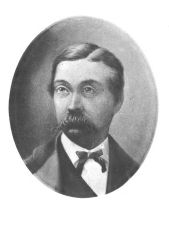
1828-1862
The house is very spacious. A hall of noble size leads to a large spiral staircase winding through its centre, while the various apartments are of imposing dimensions. It was built some fifteen or twenty years since by Mr. A——, the well-known New York merchant, who five years ago threw the commercial world into convulsions by a stupendous bank fraud. Mr. A——, as every one knows, escaped to Europe, and died not long after, of a broken heart. Almost immediately after the news of his decease reached this country and was verified, the report spread in Twenty-sixth Street that No. — was haunted. Legal measures had dispossessed the widow of its former owner, and it was inhabited merely by a caretaker and his wife, placed there by the house agent into whose hands it had passed for the purposes of renting or sale. These people declared that they were troubled with unnatural noises. Doors were opened without any visible agency. The remnants of furniture scattered through the various rooms were, during the night, piled one upon the other by unknown hands. Invisible feet passed up and down the stairs in broad daylight, accompanied by the rustle of unseen silk dresses, and the gliding of viewless hands along the massive balusters. The caretaker and his wife declared they would live there no longer. The house agent laughed, dismissed them, and put others in their place. The noises and supernatural manifestations continued. The neighbourhood caught up the story, and the house remained untenanted for three years. Several persons negotiated for it; but, somehow, always before the bargain was closed they heard the unpleasant rumours and declined to treat any further.
It was in this state of things that my landlady, who at that time kept a boarding-house in Bleecker Street, and who wished to move further up town, conceived the bold idea of renting No. — Twenty-sixth Street. Happening to have in her house rather a plucky and philosophical set of boarders, she laid her scheme before us, stating candidly everything she had heard respecting the ghostly qualities of the establishment to which she wished to remove us. With the exception of two timid persons,—a sea-captain and a returned Californian, who immediately gave notice that they would leave,—all of Mrs. Moffat’s guests declared that they would accompany her in her chivalric incursion into the abode of spirits.
Our removal was effected in the month of May, and we were charmed with our new residence. The portion of Twenty-sixth Street where our house is situated, between Seventh and Eighth avenues, is one of the pleasantest localities in New York. The gardens back of the houses, running down nearly to the Hudson, form, in the summer time, a perfect avenue of verdure. The air is pure and invigorating, sweeping, as it does, straight across the river from the Weehawken heights, and even the ragged garden which surrounded the house, although displaying on washing days rather too much clothesline, still gave us a piece of greensward to look at, and a cool retreat in the summer evenings, where we smoked our cigars in the dusk, and watched the fireflies flashing their dark lanterns in the long grass.
Of course we had no sooner established ourselves at No. — than we began to expect ghosts. We absolutely awaited their advent with eagerness. Our dinner conversation was supernatural. One of the boarders, who had purchased Mrs. Crowe’s “Night Side of Nature” for his own private delectation, was regarded as a public enemy by the entire household for not having bought twenty copies. The man led a life of supreme wretchedness while he was reading this volume. A system of espionage was established, of which he was the victim. If he incautiously laid the book down for an instant and left the room, it was immediately seized and read aloud in secret places to a select few. I found myself a person of immense importance, it having leaked out that I was tolerably well versed in the history of supernaturalism, and had once written a story the foundation of which was a ghost. If a table or a wainscot panel happened to warp when we were assembled in the large drawing-room, there was an instant silence, and every one was prepared for an immediate clanking of chains and a spectral form.
After a month of psychological excitement, it was with the utmost dissatisfaction that we were forced to acknowledge that nothing in the remotest degree approaching the supernatural had manifested itself. Once the black butler asseverated that his candle had been blown out by some invisible agency while he was undressing himself for the night; but as I had more than once discovered this coloured gentleman in a condition when one candle must have appeared to him like two, I thought it possible that, by going a step further in his potations, he might have reversed this phenomenon, and seen no candle at all where he ought to have beheld one.
Things were in this state when an accident took place so awful and inexplicable in its character that my reason fairly reels at the bare memory of the occurrence. It was the tenth of July. After dinner was over I repaired, with my friend Dr. Hammond, to the garden to smoke my evening pipe. Independent of certain mental sympathies which existed between the Doctor and myself, we were linked together by a vice. We both smoked opium. We knew each other’s secret, and respected it. We enjoyed together that wonderful expansion of thought, that marvellous intensifying of the perceptive faculties, that boundless feeling of existence when we seem to have points of contact with the whole universe,—in short, that unimaginable spiritual bliss, which I would not surrender for a throne, and which I hope you, reader, will never—never taste.
Those hours of opium happiness which the Doctor and I spent together in secret were regulated with a scientific accuracy. We did not blindly smoke the drug of paradise, and leave our dreams to chance. While smoking, we carefully steered our conversation through the brightest and calmest channels of thought. We talked of the East, and endeavoured to recall the magical panorama of its glowing scenery. We criticized the most sensuous poets,—those who painted life ruddy with health, brimming with passion, happy in the possession of youth and strength and beauty. If we talked of Shakespeare’s “Tempest,” we lingered over Ariel, and avoided Caliban. Like the Guebers, we turned our faces to the East, and saw only the sunny side of the world.
This skilful colouring of our train of thought produced in our subsequent visions a corresponding tone. The splendours of Arabian fairyland dyed our dreams. We paced the narrow strip of grass with the tread and port of kings. The song of the rana arborea, while he clung to the bark of the ragged plum-tree, sounded like the strains of divine musicians. Houses, walls, and streets melted like rain clouds, and vistas of unimaginable glory stretched away before us. It was a rapturous companionship. We enjoyed the vast delight more perfectly because, even in our most ecstatic moments, we were conscious of each other’s presence. Our pleasures, while individual, were still twin, vibrating and moving in musical accord.
On the evening in question, the tenth of July, the Doctor and myself drifted into an unusually metaphysical mood. We lit our large meerschaums, filled with fine Turkish tobacco, in the core of which burned a little black nut of opium, that, like the nut in the fairy tale, held within its narrow limits wonders beyond the reach of kings; we paced to and fro, conversing. A strange perversity dominated the currents of our thought. They would not flow through the sun-lit channels into which we strove to divert them. For some unaccountable reason, they constantly diverged into dark and lonesome beds, where a continual gloom brooded. It was in vain that, after our old fashion, we flung ourselves on the shores of the East, and talked of its gay bazaars, of the splendours of the time of Haroun, of harems and golden palaces. Black afreets continually arose from the depths of our talk, and expanded, like the one the fisherman released from the copper vessel, until they blotted everything bright from our vision. Insensibly, we yielded to the occult force that swayed us, and indulged in gloomy speculation. We had talked some time upon the proneness of the human mind to mysticism, and the almost universal love of the terrible, when Hammond suddenly said to me, “What do you consider to be the greatest element of terror?”
The question puzzled me. That many things were terrible, I knew. Stumbling over a corpse in the dark; beholding, as I once did, a woman floating down a deep and rapid river, with wildly lifted arms, and awful, upturned face, uttering, as she drifted, shrieks that rent one’s heart while we, spectators, stood frozen at a window which overhung the river at a height of sixty feet, unable to make the slightest effort to save her, but dumbly watching her last supreme agony and her disappearance. A shattered wreck, with no life visible, encountered floating listlessly on the ocean, is a terrible object, for it suggests a huge terror, the proportions of which are veiled. But it now struck me, for the first time, that there must be one great and ruling embodiment of fear,—a King of Terrors, to which all others must succumb. What might it be? To what train of circumstances would it owe its existence?
“I confess, Hammond,” I replied to my friend, “I never considered the subject before. That there must be one Something more terrible than any other thing, I feel. I cannot attempt, however, even the most vague definition.”
“I am somewhat like you, Harry,” he answered. “I feel my capacity to experience a terror greater than anything yet conceived by the human mind;—something combining in fearful and unnatural amalgamation hitherto supposed incompatible elements. The calling of the voices in Brockden Brown’s novel of ‘Wieland’ is awful; so is the picture of the Dweller of the Threshold, in Bulwer’s ‘Zanoni’; but,” he added, shaking his head gloomily, “there is something more horrible still than those.”
“Look here, Hammond,” I rejoined, “let us drop this kind of talk, for Heaven’s sake! We shall suffer for it, depend on it.”
“I don’t know what’s the matter with me tonight,” he replied, “but my brain is running upon all sorts of weird and awful thoughts. I feel as if I could write a story like Hoffman, tonight, if I were only master of a literary style.”
“Well, if we are going to be Hoffmanesque in our talk, I’m off to bed. Opium and nightmares should never be brought together. How sultry it is! Good night, Hammond.”
“Good night, Harry. Pleasant dreams to you.”
“To you, gloomy wretch, afreets, ghouls, and enchanters.”
We parted, and each sought his respective chamber. I undressed quickly and got into bed, taking with me, according to my usual custom, a book, over which I generally read myself to sleep. I opened the volume as soon as I had laid my head upon the pillow, and instantly flung it to the other side of the room. It was Goudon’s “History of Monsters,”—a curious French work, which I had lately imported from Paris, but which, in the state of mind I had then reached, was anything but an agreeable companion. I resolved to go to sleep at once; so, turning down my gas until nothing but a little blue point of light glimmered on the top of the tube, I composed myself to rest.
The room was in total darkness. The atom of gas that still remained alight did not illuminate a distance of three inches round the burner. I desperately drew my arm across my eyes, as if to shut out even the darkness, and tried to think of nothing. It was in vain. The confounded themes touched on by Hammond in the garden kept obtruding themselves on my brain. I battled against them. I erected ramparts of would-be blankness of intellect to keep them out. They still crowded upon me. While I was lying still as a corpse, hoping that by a perfect physical inaction I should hasten mental repose, an awful incident occurred. A Something dropped, as it seemed, from the ceiling, plumb upon my chest, and the next instant I felt two bony hands encircling my throat, endeavouring to choke me.
I am no coward, and am possessed of considerable physical strength. The suddenness of the attack, instead of stunning me, strung every nerve to its highest tension. My body acted from instinct, before my brain had time to realize the terrors of my position. In an instant I wound two muscular arms around the creature, and squeezed it, with all the strength of despair, against my chest. In a few seconds the bony hands that had fastened on my throat loosened their hold, and I was free to breathe once more. Then commenced a struggle of awful intensity. Immersed in the most profound darkness, totally ignorant of the nature of the Thing by which I was so suddenly attacked, finding my grasp slipping every moment, by reason, it seemed to me, of the entire nakedness of my assailant, bitten with sharp teeth in the shoulder, neck, and chest, having every moment to protect my throat against a pair of sinewy, agile hands, which my utmost efforts could not confine,—these were a combination of circumstances to combat which required all the strength, skill, and courage that I possessed.
At last, after a silent, deadly, exhausting struggle, I got my assailant under by a series of incredible efforts of strength. Once pinned, with my knee on what I made out to be its chest, I knew that I was victor. I rested for a moment to breathe. I heard the creature beneath me panting in the darkness, and felt the violent throbbing of a heart. It was apparently as exhausted as I was; that was one comfort. At this moment I remembered that I usually placed under my pillow, before going to bed, a large yellow silk pocket handkerchief. I felt for it instantly; it was there. In a few seconds more I had, after a fashion, pinioned the creature’s arms.
I now felt tolerably secure. There was nothing more to be done but to turn on the gas, and, having first seen what my midnight assailant was like, arouse the household. I will confess to being actuated by a certain pride in not giving the alarm before; I wished to make the capture alone and unaided.
Never losing my hold for an instant, I slipped from the bed to the floor, dragging my captive with me. I had but a few steps to make to reach the gas-burner; these I made with the greatest caution, holding the creature in a grip like a vice. At last I got within arm’s length of the tiny speck of blue light which told me where the gas-burner lay. Quick as lightning I released my grasp with one hand and let on the full flood of light. Then I turned to look at my captive.
I cannot even attempt to give any definition of my sensations the instant after I turned on the gas. I suppose I must have shrieked with terror, for in less than a minute afterward my room was crowded with the inmates of the house. I shudder now as I think of that awful moment. I saw nothing! Yes; I had one arm firmly clasped round a breathing, panting, corporeal shape, my other hand gripped with all its strength a throat as warm, as apparently fleshy, as my own; and yet, with this living substance in my grasp, with its body pressed against my own, and all in the bright glare of a large jet of gas, I absolutely beheld nothing! Not even an outline,—a vapour!
I do not, even at this hour, realize the situation in which I found myself. I cannot recall the astounding incident thoroughly. Imagination in vain tries to compass the awful paradox.
It breathed. I felt its warm breath upon my cheek. It struggled fiercely. It had hands. They clutched me. Its skin was smooth, like my own. There it lay, pressed close up against me, solid as stone,—and yet utterly invisible!
I wonder that I did not faint or go mad on the instant. Some wonderful instinct must have sustained me; for, absolutely, in place of loosening my hold on the terrible Enigma, I seemed to gain an additional strength in my moment of horror, and tightened my grasp with such wonderful force that I felt the creature shivering with agony.
Just then Hammond entered my room at the head of the household. As soon as he beheld my face—which, I suppose, must have been an awful sight to look at—he hastened forward, crying, “Great heaven, Harry! what has happened?”
“Hammond! Hammond!” I cried, “come here. O, this is awful! I have been attacked in bed by something or other, which I have hold of; but I can’t see it,—I can’t see it!”
Hammond, doubtless struck by the unfeigned horror expressed in my countenance, made one or two steps forward with an anxious yet puzzled expression. A very audible titter burst from the remainder of my visitors. This suppressed laughter made me furious. To laugh at a human being in my position! It was the worst species of cruelty. Now, I can understand why the appearance of a man struggling violently, as it would seem, with an airy nothing, and calling for assistance against a vision, should have appeared ludicrous. Then, so great was my rage against the mocking crowd that had I the power I would have stricken them dead where they stood.
“Hammond! Hammond!” I cried again, despairingly, “for God’s sake come to me. I can hold the—the thing but a short while longer. It is overpowering me. Help me! Help me!”
“Harry,” whispered Hammond, approaching me, “you have been smoking too much opium.”
“I swear to you, Hammond, that this is no vision,” I answered, in the same low tone. “Don’t you see how it shakes my whole frame with its struggles? If you don’t believe me, convince yourself. Feel it,—touch it.”
Hammond advanced and laid his hand in the spot I indicated. A wild cry of horror burst from him. He had felt it!
In a moment he had discovered somewhere in my room a long piece of cord, and was the next instant winding it and knotting it about the body of the unseen being that I clasped in my arms.
“Harry,” he said, in a hoarse, agitated voice, for, though he preserved his presence of mind, he was deeply moved, “Harry, it’s all safe now. You may let go, old fellow, if you’re tired. The Thing can’t move.”
I was utterly exhausted, and I gladly loosed my hold.
Hammond stood holding the ends of the cord that bound the Invisible, twisted round his hand, while before him, self-supporting as it were, he beheld a rope laced and interlaced, and stretching tightly around a vacant space. I never saw a man look so thoroughly stricken with awe. Nevertheless his face expressed all the courage and determination which I knew him to possess. His lips, although white, were set firmly, and one could perceive at a glance that, although stricken with fear, he was not daunted.
The confusion that ensued among the guests of the house who were witnesses of this extraordinary scene between Hammond and myself,—who beheld the pantomime of binding this struggling Something,—who beheld me almost sinking from physical exhaustion when my task of jailer was over,—the confusion and terror that took possession of the bystanders, when they saw all this, was beyond description. The weaker ones fled from the apartment. The few who remained clustered near the door and could not be induced to approach Hammond and his Charge. Still incredulity broke out through their terror. They had not the courage to satisfy themselves, and yet they doubted. It was in vain that I begged of some of the men to come near and convince themselves by touch of the existence in that room of a living being which was invisible. They were incredulous, but did not dare to undeceive themselves. How could a solid, living, breathing body be invisible, they asked. My reply was this. I gave a sign to Hammond, and both of us—conquering our fearful repugnance to touch the invisible creature—lifted it from the ground, manacled as it was, and took it to my bed. Its weight was about that of a boy of fourteen.
“Now, my friends,” I said, as Hammond and myself held the creature suspended over the bed, “I can give you self-evident proof that here is a solid, ponderable body, which, nevertheless, you cannot see. Be good enough to watch the surface of the bed attentively.”
I was astonished at my own courage in treating this strange event so calmly; but I had recovered from my first terror, and felt a sort of scientific pride in the affair, which dominated every other feeling.
The eyes of the bystanders were immediately fixed on my bed. At a given signal Hammond and I let the creature fall. There was a dull sound of a heavy body alighting on a soft mass. The timbers of the bed creaked. A deep impression marked itself distinctly on the pillow, and on the bed itself. The crowd who witnessed this gave a low cry, and rushed from the room. Hammond and I were left alone with our Mystery.
We remained silent for some time, listening to the low, irregular breathing of the creature on the bed, and watching the rustle of the bed-clothes as it impotently struggled to free itself from confinement. Then Hammond spoke.
“Harry, this is awful.”
“Ay, awful.”
“But not unaccountable.”
“Not unaccountable! What do you mean? Such a thing has never occurred since the birth of the world. I know not what to think, Hammond. God grant that I am not mad, and that this is not an insane fantasy!”
“Let us reason a little, Harry. Here is a solid body which we touch, but which we cannot see. The fact is so unusual that it strikes us with terror. Is there no parallel, though, for such a phenomenon? Take a piece of pure glass. It is tangible and transparent. A certain chemical coarseness is all that prevents its being so entirely transparent as to be totally invisible. It is not theoretically impossible, mind you, to make a glass which shall not reflect a single ray of light,—a glass so pure and homogeneous in its atoms that the rays from the sun will pass through it as they do through the air, refracted but not reflected. We do not see the air, and yet we feel it.”
“That’s all very well, Hammond, but these are inanimate substances. Glass does not breathe, air does not breathe. This thing has a heart that palpitates,—a will that moves it,—lungs that play, and inspire and respire.”
“You forget the phenomena of which we have so often heard of late,” answered the Doctor, gravely. “At the meetings called ‘spirit circles,’ invisible hands have been thrust into the hands of those persons round the table,—warm, fleshly hands that seemed to pulsate with mortal life.”
“What? Do you think, then, that this thing is——”
“I don’t know what it is,” was the solemn reply; “but please the gods I will, with your assistance, thoroughly investigate it.”
We watched together, smoking many pipes, all night long, by the bedside of the unearthly being that tossed and panted until it was apparently wearied out. Then we learned by the low, regular breathing that it slept.
The next morning the house was all astir. The boarders congregated on the landing outside my room, and Hammond and myself were lions. We had to answer a thousand questions as to the state of our extraordinary prisoner, for as yet not one person in the house except ourselves could be induced to set foot in the apartment.
The creature was awake. This was evidenced by the convulsive manner in which the bed-clothes were moved in its efforts to escape. There was something truly terrible in beholding, as it were, those second-hand indications of the terrible writhings and agonized struggles for liberty which themselves were invisible.
Hammond and myself had racked our brains during the long night to discover some means by which we might realize the shape and general appearance of the Enigma. As well as we could make out by passing our hands over the creature’s form, its outlines and lineaments were human. There was a mouth; a round, smooth head without hair; a nose, which, however, was little elevated above the cheeks; and its hands and feet felt like those of a boy. At first we thought of placing the being on a smooth surface and tracing its outlines with chalk, as shoemakers trace the outline of the foot. This plan was given up as being of no value. Such an outline would give not the slightest idea of its conformation.
A happy thought struck me. We would take a cast of it in plaster of Paris. This would give us the solid figure, and satisfy all our wishes. But how to do it? The movements of the creature would disturb the setting of the plastic covering, and distort the mould. Another thought. Why not give it chloroform? It had respiratory organs,—that was evident by its breathing. Once reduced to a state of insensibility, we could do with it what we would. Doctor X—— was sent for; and after the worthy physician had recovered from the first shock of amazement, he proceeded to administer the chloroform. In three minutes afterward we were enabled to remove the fetters from the creature’s body, and a modeller was busily engaged in covering the invisible form with the moist clay. In five minutes more we had a mould, and before evening a rough facsimile of the Mystery. It was shaped like a man,—distorted, uncouth, and horrible, but still a man. It was small, not over four feet and some inches in height, and its limbs revealed a muscular development that was unparalleled. Its face surpassed in hideousness anything I had ever seen. Gustav Doré, or Callot, or Tony Johannot, never conceived anything so horrible. There is a face in one of the latter’s illustrations to Un Voyage où il vous plaira, which somewhat approaches the countenance of this creature, but does not equal it. It was the physiognomy of what I should fancy a ghoul might be. It looked as if it was capable of feeding on human flesh.
Having satisfied our curiosity, and bound every one in the house to secrecy, it became a question what was to be done with our Enigma? It was impossible that we should keep such a horror in our house; it was equally impossible that such an awful being should be let loose upon the world. I confess that I would have gladly voted for the creature’s destruction. But who would shoulder the responsibility? Who would undertake the execution of this horrible semblance of a human being? Day after day this question was deliberated gravely. The boarders all left the house. Mrs. Moffat was in despair, and threatened Hammond and myself with all sorts of legal penalties if we did not remove the Horror. Our answer was, “We will go if you like, but we decline taking this creature with us. Remove it yourself if you please. It appeared in your house. On you the responsibility rests.” To this there was, of course, no answer. Mrs. Moffat could not obtain for love or money a person who would even approach the Mystery.
The most singular part of the affair was that we were entirely ignorant of what the creature habitually fed on. Everything in the way of nutriment that we could think of was placed before it, but was never touched. It was awful to stand by, day after day, and see the clothes toss, and hear the hard breathing, and know that it was starving.
Ten, twelve days, a fortnight passed, and it still lived. The pulsations of the heart, however, were daily growing fainter, and had now nearly ceased. It was evident that the creature was dying for want of sustenance. While this terrible life-struggle was going on, I felt miserable. I could not sleep. Horrible as the creature was, it was pitiful to think of the pangs it was suffering.
At last it died. Hammond and I found it cold and stiff one morning in the bed. The heart had ceased to beat, the lungs to inspire. We hastened to bury it in the garden. It was a strange funeral, the dropping of that viewless corpse into the damp hole. The cast of its form I gave to Doctor X——, who keeps it in his museum in Tenth Street.
As I am on the eve of a long journey from which I may not return, I have drawn up this narrative of an event the most singular that has ever come to my knowledge.
###
This eBook is for the use of anyone anywhere at no cost and with almost no restrictions whatsoever. You may copy it, give it away or re-use it under the terms of the Project Gutenberg License included with this eBook or online at http://www.gutenberg.org
Our Vampires, Ourselves
 The True Story of A Vampire by Count Eric Stanislaus Stenbock (Studies in Death, 1894) Tuesday’s Tale of Terror May 10, 2016 Our vampires, ourselves. All vampires are alike, yes or no? Do w…
Source: Our Vampires, Ourselves
The Farmington Writers Circle Meets Tonight at 7:00 at Hasting’s Hardback Café.
 The next meeting of the Farmington Writers Circle will be at 7:00 p.m. on Thursday, May 12, 2016, at Hastings Hardback Café on 20th Street. The topic of the evening will be a round table on contests and other publication opportunities. Participants are encouraged to bring information on contests and other publication opportunities to share with the other participants in an open discussion. The meeting is open to the general public.
The Farmington Writers Circle is a nascent organization of authors and writers, who are interested in publishing and marketing their works.
Please contact Phil Slattery via this website with any questions or comments.
The Clown Oroborus by Alex S. Johnson
 The Clown Oroborus by Alex S. Johnson Reginald Snubb was a man in his late forties, bald except for two cottony puffs of hair that simply resisted the barber’s scissors–sheered, they wo…
The Dim, Dark-Toned Room
The Shell of Sense by Olivia Howard Dunbar (1940s) Tuesday’s Tale of Terror April 26, 2016 If you’ve ever mused about what it’s like to be newly dead, here is a story about two sisters, …
Source: The Dim, Dark-Toned Room
New Flash Fiction by Alyson Faye: “Mother Love”
Edward suspects his Mama is mad. Every afternoon they withdraw to the parlour overlooking the garden—Edward shoulder to shoulder with the pianoforte—as they jostle next to chairs arrayed for guests. No one presents calling cards at our door anymore. Papa has left for the City ‘on business.’ The servants, departed.
Mama sits, gazing at my baby brother, Ernest. “Do you think he looks a little pallid today?”
I nod sagely, “Yes, Mama. A little.”
Mama reaches over with her rouge to rub more colour into Ernest’s flaccid cheeks.
The vicar is still striving to give him a Christian burial.
The Saturday Night Special: “The Street of the Four Winds” by Robert W. Chambers (1895)
| “Ferme tes yeux à demi, |
| Croise tes bras sur ton sein, |
| Et de ton cœur endormi |
| Chasse à jamais tout dessein.” |
| “Je chante la nature, |
| Les étoiles du soir, les larmes du matin, |
| Les couchers de soleil à l’horizon lointain, |
| Le ciel qui parle au cœur d’existence future!” |
I
The animal paused on the threshold, interrogative alert, ready for flight if necessary. Severn laid down his palette, and held out a hand of welcome. The cat remained motionless, her yellow eyes fastened upon Severn.
“Puss,” he said, in his low, pleasant voice, “come in.”
The tip of her thin tail twitched uncertainly.
“Come in,” he said again.
Apparently she found his voice reassuring, for she slowly settled upon all fours, her eyes still fastened upon him, her tail tucked under her gaunt flanks.
He rose from his easel smiling. She eyed him quietly, and when he walked toward her she watched him bend above her without a wince; her eyes followed his hand until it touched her head. Then she uttered a ragged mew.
It had long been Severn’s custom to converse with animals, probably because he lived so much alone; and now he said, “What’s the matter, puss?”
Her timid eyes sought his.
“I understand,” he said gently, “you shall have it at once.”
Then moving quietly about he busied himself with the duties of a host, rinsed a saucer, filled it with the rest of the milk from the bottle on the window-sill, and kneeling down, crumbled a roll into the hollow of his hand.
The creature rose and crept toward the saucer.
With the handle of a palette-knife he stirred the crumbs and milk together and stepped back as she thrust her nose into the mess. He watched her in silence. From time to time the saucer clinked upon the tiled floor as she reached for a morsel on the rim; and at last the bread was all gone, and her purple tongue travelled over every unlicked spot until the saucer shone like polished marble. Then she sat up, and coolly turning her back to him, began her ablutions.
“Keep it up,” said Severn, much interested, “you need it.”
She flattened one ear, but neither turned nor interrupted her toilet. As the grime was slowly removed Severn observed that nature had intended her for a white cat. Her fur had disappeared in patches, from disease or the chances of war, her tail was bony and her spine sharp. But what charms she had were becoming apparent under vigorous licking, and he waited until she had finished before re-opening the conversation. When at last she closed her eyes and folded her forepaws under her breast, he began again very gently: “Puss, tell me your troubles.”
At the sound of his voice she broke into a harsh rumbling which he recognized as an attempt to purr. He bent over to rub her cheek and she mewed again, an amiable inquiring little mew, to which he replied, “Certainly, you are greatly improved, and when you recover your plumage you will be a gorgeous bird.” Much flattered, she stood up and marched around and around his legs, pushing her head between them and making pleased remarks, to which he responded with grave politeness.
“Now, what sent you here,” he said—”here into the Street of the Four Winds, and up five flights to the very door where you would be welcome? What was it that prevented your meditated flight when I turned from my canvas to encounter your yellow eyes? Are you a Latin Quarter cat as I am a Latin Quarter man? And why do you wear a rose-coloured flowered garter buckled about your neck?” The cat had climbed into his lap, and now sat purring as he passed his hand over her thin coat.
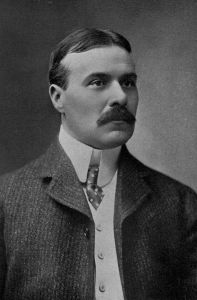
1903
“Excuse me,” he continued in lazy soothing tones, harmonizing with her purring, “if I seem indelicate, but I cannot help musing on this rose-coloured garter, flowered so quaintly and fastened with a silver clasp. For the clasp is silver; I can see the mint mark on the edge, as is prescribed by the law of the French Republic. Now, why is this garter woven of rose silk and delicately embroidered,—why is this silken garter with its silver clasp about your famished throat? Am I indiscreet when I inquire if its owner is your owner? Is she some aged dame living in memory of youthful vanities, fond, doting on you, decorating you with her intimate personal attire? The circumference of the garter would suggest this, for your neck is thin, and the garter fits you. But then again I notice—I notice most things—that the garter is capable of being much enlarged. These small silver-rimmed eyelets, of which I count five, are proof of that. And now I observe that the fifth eyelet is worn out, as though the tongue of the clasp were accustomed to lie there. That seems to argue a well-rounded form.”
The cat curled her toes in contentment. The street was very still outside.
He murmured on: “Why should your mistress decorate you with an article most necessary to her at all times? Anyway, at most times. How did she come to slip this bit of silk and silver about your neck? Was it the caprice of a moment,—when you, before you had lost your pristine plumpness, marched singing into her bedroom to bid her good-morning? Of course, and she sat up among the pillows, her coiled hair tumbling to her shoulders, as you sprang upon the bed purring: ‘Good-day, my lady.’ Oh, it is very easy to understand,” he yawned, resting his head on the back of the chair. The cat still purred, tightening and relaxing her padded claws over his knee.
“Shall I tell you all about her, cat? She is very beautiful—your mistress,” he murmured drowsily, “and her hair is heavy as burnished gold. I could paint her,—not on canvas—for I should need shades and tones and hues and dyes more splendid than the iris of a splendid rainbow. I could only paint her with closed eyes, for in dreams alone can such colours as I need be found. For her eyes, I must have azure from skies untroubled by a cloud—the skies of dreamland. For her lips, roses from the palaces of slumberland, and for her brow, snow-drifts from mountains which tower in fantastic pinnacles to the moons;—oh, much higher than our moon here,—the crystal moons of dreamland. She is—very—beautiful, your mistress.”
The words died on his lips and his eyelids drooped.
The cat, too, was asleep, her cheek turned up upon her wasted flank, her paws relaxed and limp.
II
“It is fortunate,” said Severn, sitting up and stretching, “that we have tided over the dinner hour, for I have nothing to offer you for supper but what may be purchased with one silver franc.”
The cat on his knee rose, arched her back, yawned, and looked up at him.
“What shall it be? A roast chicken with salad? No? Possibly you prefer beef? Of course,—and I shall try an egg and some white bread. Now for the wines. Milk for you? Good. I shall take a little water, fresh from the wood,” with a motion toward the bucket in the sink.
He put on his hat and left the room. The cat followed to the door, and after he had closed it behind him, she settled down, smelling at the cracks, and cocking one ear at every creak from the crazy old building.
The door below opened and shut. The cat looked serious, for a moment doubtful, and her ears flattened in nervous expectation. Presently she rose with a jerk of her tail and started on a noiseless tour of the studio. She sneezed at a pot of turpentine, hastily retreating to the table, which she presently mounted, and having satisfied her curiosity concerning a roll of red modelling wax, returned to the door and sat down with her eyes on the crack over the threshold. Then she lifted her voice in a thin plaint.
When Severn returned he looked grave, but the cat, joyous and demonstrative, marched around him, rubbing her gaunt body against his legs, driving her head enthusiastically into his hand, and purring until her voice mounted to a squeal.
He placed a bit of meat, wrapped in brown paper, upon the table, and with a penknife cut it into shreds. The milk he took from a bottle which had served for medicine, and poured it into the saucer on the hearth.
The cat crouched before it, purring and lapping at the same time.
He cooked his egg and ate it with a slice of bread, watching her busy with the shredded meat, and when he had finished, and had filled and emptied a cup of water from the bucket in the sink, he sat down, taking her into his lap, where she at once curled up and began her toilet. He began to speak again, touching her caressingly at times by way of emphasis.
“Cat, I have found out where your mistress lives. It is not very far away;—it is here, under this same leaky roof, but in the north wing which I had supposed was uninhabited. My janitor tells me this. By chance, he is almost sober this evening. The butcher on the rue de Seine, where I bought your meat, knows you, and old Cabane the baker identified you with needless sarcasm. They tell me hard tales of your mistress which I shall not believe. They say she is idle and vain and pleasure-loving; they say she is hare-brained and reckless. The little sculptor on the ground floor, who was buying rolls from old Cabane, spoke to me to-night for the first time, although we have always bowed to each other. He said she was very good and very beautiful. He has only seen her once, and does not know her name. I thanked him;—I don’t know why I thanked him so warmly. Cabane said, ‘Into this cursed Street of the Four Winds, the four winds blow all things evil.’ The sculptor looked confused, but when he went out with his rolls, he said to me, ‘I am sure, Monsieur, that she is as good as she is beautiful.'”
The cat had finished her toilet, and now, springing softly to the floor, went to the door and sniffed. He knelt beside her, and unclasping the garter held it for a moment in his hands. After a while he said: “There is a name engraved upon the silver clasp beneath the buckle. It is a pretty name, Sylvia Elven. Sylvia is a woman’s name, Elven is the name of a town. In Paris, in this quarter, above all, in this Street of the Four Winds, names are worn and put away as the fashions change with the seasons. I know the little town of Elven, for there I met Fate face to face and Fate was unkind. But do you know that in Elven Fate had another name, and that name was Sylvia?”
He replaced the garter and stood up looking down at the cat crouched before the closed door.
“The name of Elven has a charm for me. It tells me of meadows and clear rivers. The name of Sylvia troubles me like perfume from dead flowers.”
The cat mewed.
“Yes, yes,” he said soothingly, “I will take you back. Your Sylvia is not my Sylvia; the world is wide and Elven is not unknown. Yet in the darkness and filth of poorer Paris, in the sad shadows of this ancient house, these names are very pleasant to me.”
He lifted her in his arms and strode through the silent corridors to the stairs. Down five flights and into the moonlit court, past the little sculptor’s den, and then again in at the gate of the north wing and up the worm-eaten stairs he passed, until he came to a closed door. When he had stood knocking for a long time, something moved behind the door; it opened and he went in. The room was dark. As he crossed the threshold, the cat sprang from his arms into the shadows. He listened but heard nothing. The silence was oppressive and he struck a match. At his elbow stood a table and on the table a candle in a gilded candlestick. This he lighted, then looked around. The chamber was vast, the hangings heavy with embroidery. Over the fireplace towered a carved mantel, grey with the ashes of dead fires. In a recess by the deep-set windows stood a bed, from which the bedclothes, soft and fine as lace, trailed to the polished floor. He lifted the candle above his head. A handkerchief lay at his feet. It was faintly perfumed. He turned toward the windows. In front of them was a canapé and over it were flung, pell-mell, a gown of silk, a heap of lace-like garments, white and delicate as spiders’ meshes, long, crumpled gloves, and, on the floor beneath, the stockings, the little pointed shoes, and one garter of rosy silk, quaintly flowered and fitted with a silver clasp. Wondering, he stepped forward and drew the heavy curtains from the bed. For a moment the candle flared in his hand; then his eyes met two other eyes, wide open, smiling, and the candle-flame flashed over hair heavy as gold.
She was pale, but not as white as he; her eyes were untroubled as a child’s; but he stared, trembling from head to foot, while the candle flickered in his hand.
At last he whispered: “Sylvia, it is I.”
Again he said, “It is I.”
Then, knowing that she was dead, he kissed her on the mouth. And through the long watches of the night the cat purred on his knee, tightening and relaxing her padded claws, until the sky paled above the Street of the Four Winds.
Canapés
By Matthew Wong The Guitarist strummed his out of tune guitar. The Chef carved slices of meat from the ham in the center of the table as the Guitarist kept on strumming a tuneless Tears in Heaven. …
Source: Canapés
Next Meeting of Farmington Writers Circle Set for May 12, 2016

The next meeting of the Farmington Writers Circle will be at 7:00 p.m. on May 12, 2016, at Hastings Hardback Café on 20th Street. The topic of the evening will be a round table on contests and other publication opportunities. Participants are encouraged to bring information on contests and other publication opportunities to share with the other participants in an open discussion. The meeting is open to the general public.
The Farmington Writers Circle is a nascent organization of authors and writers, who are interested in publishing and marketing their works.
Please contact Phil Slattery via this website with any questions or comments.
Blood Of Socorro County
 Interview With Sean Young, Author of Blood Of Socorro County For season 11 of the HorrorAddicts.net podcast, we will once again feature an 11 episode audio drama. Our latest ongoing story started …
Source: Blood Of Socorro County
Horroraddicts.net Publishing presents: Plague Master: Sanctuary Dome
 On February 29th Horroraddicts.net publishing released its newest book: Plague Master: Sanctuary Dome by H.E. Roulo. She has had stories in other Horroraddicts.net publications such as: The Wicke…
Source: Horroraddicts.net Publishing presents: Plague Master: Sanctuary Dome
The Saturday Night Special: “The Fearsome Touch of Death” by Robert E. Howard (1930)
_As long as midnight cloaks the earth_
_With shadows grim and stark,_
_God save us from the Judas kiss_
_Of a dead man in the dark._
_Old Adam Farrel lay dead in the house wherein he had lived alone
for the last twenty years. A silent, churlish recluse, in his life he
had known no friends, and only two men had watched his passing._
Dr. Stein rose and glanced out the window into the gathering dusk.
“You think you can spend the night here, then?” he asked his
companion.
This man, Falred by name, assented.
“Yes, certainly. I guess it’s up to me.”
“Rather a useless and primitive custom, sitting up with the dead,”
commented the doctor, preparing to depart, “but I suppose in common
decency we will have to bow to precedence. Maybe I can find someone
who’ll come over here and help you with your vigil.”
Falred shrugged his shoulders. “I doubt it. Farrel wasn’t liked–
wasn’t known by many people. I scarcely knew him myself, but I don’t
mind sitting up with the corpse.”
Dr. Stein was removing his rubber gloves and Falred watched the
process with an interest that almost amounted to fascination. A
slight, involuntary shudder shook him at the memory of touching these
gloves–slick, cold, clammy things, like the touch of death.
“You may get lonely tonight, if I don’t find anyone,” the doctor
remarked as he opened the door. “Not superstitious, are you?”
Falred laughed. “Scarcely. To tell the truth, from what I hear of
Farrel’s disposition, I’d rather be watching his corpse than have been
his guest in life.”
The door closed and Falred took up his vigil. He seated himself in
the only chair the room boasted, glanced casually at the formless,
sheeted bulk on the bed opposite him, and began to read by the light
of the dim lamp which stood on the rough table.
Outside, the darkness gathered swiftly, and finally Falred laid
down his magazine to rest his eyes. He looked again at the shape which
had, in life, been the form of Adam Farrel, wondering what quirk in
the human nature made the sight of a corpse not so unpleasant, but
such an object of fear to man. Unthinking ignorance, seeing in dead
things a reminder of death to come, he decided lazily, and began idly
contemplating as to what life had held for this grim and crabbed old
man, who had neither relatives nor friends, and who had seldom left
the house wherein he had died. The usual tales of miser-hoarded wealth
had accumulated, but Falred felt so little interest in the whole
matter that it was not even necessary for him to overcome any
temptation to prey about the house for possible hidden treasure.
He returned to his reading with a shrug. The task was more
boresome than he had thought for. After a while he was aware that
every time he looked up from his magazine and his eyes fell upon the
bed with its grim occupant, he started involuntarily as if he had, for
an instant, forgotten the presence of the dead man and was
unpleasantly reminded of the fact. The start was slight and
instinctive, but he felt almost angered at himself. He realized, for
the first time, the utter and deadening silence which enwrapped the
house–a silence apparently shared by the night, for no sound came
through the window. Adam Farrel lived as far apart from his neighbors
as possible, and there was no other house within hearing distance.
Falred shook himself as if to rid his mind of unsavory
speculations, and went back to his reading. A sudden vagrant gust of
wind whipped through the window, in which the light in the lamp
flickered and went out suddenly. Falred, cursing softly, groped in the
darkness for matches, burning his fingers on the lamp chimney. He
struck a match, relighted the lamp, and glancing over at the bed, got
a horrible mental jolt. Adam Farrel’s face stared blindly at him, the
dead eyes wide and blank, framed in the gnarled gray features. Even as
Falred instinctively shuddered, his reason explained the apparent
phenomenon: the sheet that covered the corpse had been carelessly
thrown across the face and the sudden puff of wind had disarranged and
flung it aside.
Yet there was something grisly about the thing, something
fearsomely suggestive–as if, in the cloaking dark, a dead hand had
flung aside the sheet, just as if the corpse were about to rise….
Falred, an imaginative man, shrugged his shoulders at these
ghastly thoughts and crossed the room to replace the sheet. The dead
eyes seemed to stare malevolently, with an evilness that transcended
the dead man’s churlishness in life. The workings of a vivid
imagination, Falred knew, and he re-covered the gray face, shrinking
as his hand chanced to touch the cold flesh–slick and clammy, the
touch of death. He shuddered with the natural revulsion of the living
for the dead, and went back to his chair and magazine.
At last, growing sleepy, he lay down upon a couch which, by some
strange whim of the original owner, formed part of the room’s scant
furnishings, and composed himself for slumber. He decided to leave the
light burning, telling himself that it was in accordance with the
usual custom of leaving lights burning for the dead; for he was not
willing to admit to himself that already he was conscious of a dislike
for lying in the darkness with the corpse. He dozed, awoke with a
start and looked at the sheeted form of the bed. Silence reigned over
the house, and outside it was very dark.
The hour was approaching midnight, with its accompanying eerie
domination over the human mind. Falred glanced again at the bed where
the body lay and found the sight of the sheeted object most repellent.
A fantastic idea had birth in his mind, and grew, that beneath the
sheet, the mere lifeless body had become a strange, monstrous thing, a
hideous, conscious being, that watched him with eyes which burned
through the fabric of the cloth. This thought–a mere fantasy, of
course–he explained to himself by the legends of vampires, undead
ghosts and such like–the fearsome attributes with which the living
have cloaked the dead for countless ages, since primitive man first
recognized in death something horrid and apart from life. Man feared
death, thought Falred, and some of this fear of death took hold on the
dead so that they, too, were feared. And the sight of the dead
engendered grisly thoughts, gave rise to dim fears of hereditary
memory, lurking back in the dark corners of the brain.
At any rate, that silent, hidden thing was getting on his nerves.
He thought of uncovering the face, on the principle that familiarity
breeds contempt. The sight of the features, calm and still in death,
would banish, he thought, all such wild conjectures as were haunting
him in spite of himself. But the thought of those dead eyes staring in
the lamplight was intolerable; so at last he blew out the light and
lay down. This fear had been stealing upon him so insidiously and
gradually that he had not been aware of its growth.
With the extinguishing of the light, however, and the blotting out
of the sight of the corpse, things assumed their true character and
proportions, and Falred fell asleep almost instantly, on his lips a
faint smile for his previous folly.
He awakened suddenly. How long he had been asleep he did not know.
He sat up, his pulse pounding frantically, the cold sweat beading his
forehead. He knew instantly where he was, remembered the other
occupant of the room. But what had awakened him? A dream–yes, now he
remembered–a hideous dream in which the dead man had risen from the
bed and stalked stiffly across the room with eyes of fire and a horrid
leer frozen on his gray lips. Falred had seemed to lie motionless,
helpless; then as the corpses reached a gnarled and horrible hand, he
had awakened.
He strove to pierce the gloom, but the room was all blackness and
all without was so dark that no gleam of light came through the
window. He reached a shaking hand toward the lamp, then recoiled as if
from a hidden serpent. Sitting here in the dark with a fiendish corpse
was bad enough, but he dared not light the lamp, for fear that his
reason would be snuffed out like a candle at what he might see.
Horror, stark and unreasoning, had full possession of his soul; he no
longer questioned the instinctive fears that rose in him. All those
legends he had heard came back to him and brought a belief in them.
Death was a hideous thing, a brain-shattering horror, imbuing lifeless
men with a horrid malevolence. Adam Farrel in his life had been simply
a churlish but harmless man; now he was a terror, a monster, a fiend
lurking in the shadows of fear, ready to leap on mankind with talons
dipped deep in death and insanity.
Falred sat there, his blood freezing, and fought out his silent
battle. Faint glimmerings of reason had begun to touch his fright when
a soft, stealthy sound again froze him. He did not recognize it as the
whisper of the night wind across the windowsill. His frenzied fancy
knew it only as the tread of death and horror. He sprang from the
couch, then stood undecided. Escape was in his mind but he was too
dazed to even try to formulate a plan of escape. Even his sense of
direction was gone. Fear had so stultified his mind that he was not
able to think consciously. The blackness spread in long waves about
him and its darkness and void entered into his brain. His motions,
such as they were, were instinctive. He seemed shackled with mighty
chains and his limbs responded sluggishly, like an imbecile’s.
A terrible horror grew up in him and reared its grisly shape, that
the dead man was behind him, was stealing upon him from the rear. He
no longer thought of lighting the lamp; he no longer thought of
anything. Fear filled his whole being; there was room for nothing
else.
He backed slowly away in the darkness, hands behind him,
instinctively feeling the way. With a terrific effort he partly shook
the clinging mists of horror from him, and, the cold sweat clammy upon
his body, strove to orient himself. He could see nothing, but the bed
was across the room, in front of him. He was backing away from it.
There was where the dead man was lying, according to all rules of
nature; if the thing were, as he felt, behind him, then the old tales
were true: death did implant in lifeless bodies an unearthly
animation, and dead men did roam the shadows to work their ghastly and
evil will upon the sons of men. Then–great God!–what was man but a
wailing infant, lost in the night and beset by frightful things from
the black abysses and the terrible unknown voids of space and time?
These conclusions he did not reach by any reasoning process; they
leaped full-grown into his terror-dazed brain. He worked his way
slowly backward, groping, clinging to the thought that the dead man
must be in front of him.
Then his back-flung hands encountered something–something slick,
cold and clammy–like the touch of death. A scream shook the echoes,
followed by the crash of a falling body.
The next morning they who came to the house of death found two
corpses in the room. Adam Farrel’s sheeted body lay motionless upon
the bed, and across the room lay the body of Falred, beneath the shelf
where Dr. Stein had absent-mindedly left his gloves–rubber gloves,
slick and clammy to the touch of a hand groping in the dark–a hand of
one fleeing his own fear–rubber gloves, slick and clammy and cold,
like the touch of death.
###
This eBook is made available at no cost and with almost no restrictions
whatsoever. You may copy it, give it away or re-use it under the terms
of the Project Gutenberg of Australia License which may be viewed online at
http://gutenberg.net.au/licence.html
Nocturna Review
 Nocturna Trailer Starring Mike Doyle, Estella Warren, Danny Agha, Billy Blair and Jonathan Schaech Written & Directed by Buz Alexander “Two New Orleans detectives become embroiled in a centurie…
Source: Nocturna Review
 Phil Slattery, Writer, Publisher