OF course I shall not pretend to consider it any matter for wonder, that the extraordinary case of M. Valdemar has excited discussion. It would have been a miracle had it not — especially under the circumstances. Through the desire of all parties concerned, to keep the affair from the public, at least for the present, or until we had farther opportunities for investigation — through our endeavors to effect this — a garbled or exaggerated account made its way into society, and became the source of many unpleasant misrepresentations; and, very naturally, of a great deal of disbelief.
It is now rendered necessary that I give the facts — as far as I comprehend them myself. They are, succinctly, these:
My attention, for the last three years, had been repeatedly drawn to the subject of Mesmerism; and, about nine months ago, it occurred to me, quite suddenly, that in the series of experiments made hitherto, there had been a very remarkable and most unaccountable omission: — no person had as yet been mesmerized in articulo mortis. It remained to be seen, first, whether, in such condition, there existed in the patient any susceptibility to the magnetic influence; secondly, whether, if any existed, it was impaired or increased by the condition; thirdly, to what extent, or for how long a period, the encroachments of Death might be arrested by the process. There were other points to be ascertained, but these most excited my curiosity — the last in especial, from the immensely important character of its consequences.
Edgar Allan Poe, 1848
In looking around me for some subject by whose means I might test these particulars, I was brought to think of my friend, M. Ernest Valdemar, the well-known compiler of the “Bibliotheca Forensica,” and author (under the nom de plume of Issachar Marx) of the Polish versions of “Wallenstein” and “Gargantua.” M. Valdemar, who has resided principally at Harlem, N. Y., since the year 1839, is (or was) particularly noticeable for the extreme spareness of his person — his lower limbs much resembling those of John Randolph; and, also, for the whiteness of his whiskers, in violent contrast to the blackness of his hair — the latter, in consequence, being very generally mistaken for a wig. His temperament was markedly nervous, and rendered him a good subject for mesmeric experiment. On two or three occasions I had put him to sleep with little difficulty, but was disappointed in other results which his peculiar constitution had naturally led me to anticipate. His will was at no period positively, or thoroughly, under my control, and in regard to clairvoyance, I could accomplish with him nothing to be relied upon. I always attributed my failure at these points to the disordered state of his health. For some months previous to my becoming acquainted with him, his physicians had declared him in a confirmed phthisis. It was his custom, indeed, to speak calmly of his approaching dissolution, as of a matter neither to be avoided nor regretted.
When the ideas to which I have alluded first occurred to me, it was of course very natural that I should think of M. Valdemar. I knew the steady philosophy of the man too well to apprehend any scruples from him; and he had no relatives in America who would be likely to interfere. I spoke to him frankly upon the subject; and, to my surprise, his interest seemed vividly excited. I say to my surprise; for, although he had always yielded his person freely to my experiments, he had never before given me any tokens of sympathy with what I did. His disease was of that character which would admit of exact calculation in respect to the epoch of its termination in death; and it was finally arranged between us that he would send for me about twenty-four hours before the period announced by his physicians as that of his decease.
It is now rather more than seven months since I received, from M. Valdemar himself, the subjoined note:
“MY DEAR P——,
“You may as well come now. D—— and F—— are agreed that I cannot hold out beyond to-morrow midnight; and I think they have hit the time very nearly.
“VALDEMAR.”
I received this note within half an hour after it was written, and in fifteen minutes more I was in the dying man’s chamber. I had not seen him for ten days, and was appalled by the fearful alteration which the brief interval had wrought in him. His face wore a leaden hue; the eyes were utterly lustreless; and the emaciation was so extreme, that the skin had been broken through by the cheek-bones. His expectoration was excessive. The pulse was barely perceptible. He retained, nevertheless, in a very remarkable manner, both his mental power and a certain degree of physical strength. He spoke with distinctness — took some palliative medicines without aid — and, when I entered the room, was occupied in penciling memoranda in a pocket-book. He was propped up in the bed by pillows. Doctors D—— and F—— were in attendance.
After pressing Valdemar’s hand, I took these gentlemen aside, and obtained from them a minute account of the patient’s condition. The left lung had been for eighteen months in a semi-osseous or cartilaginous state, and was, of course, entirely useless for all purposes of vitality. The right, in its upper portion, was also partially, if not thoroughly, ossified, while the lower region was merely a mass of purulent tubercles, running one into another. Several extensive perforations existed; and, at one point, permanent adhesion to the ribs had taken place. These appearances in the right lobe were of comparatively recent date. The ossification had proceeded with very unusual rapidity; no sign of it had been discovered a month before, and the adhesion had only been observed during the three previous days. Independently of the phthisis, the patient was suspected of aneurism of the aorta; but on this point the osseous symptoms rendered an exact diagnosis impossible. It was the opinion of both physicians that M. Valdemar would die about midnight on the morrow (Sunday.) It was then seven o’clock on Saturday evening.
On quitting the invalid’s bed-side to hold conversation with myself, Doctors D—— and F —— had bidden him a final farewell. It had not been their intention to return; but, at my request, they agreed to look in upon the patient about ten the next night.
When they had gone, I spoke freely with M. Valdemar on the subject of his approaching dissolution, as well as, more particularly, of the experiment proposed. He still professed himself quite willing and even anxious to have it made, and urged me to commence it at once. A male and a female nurse were in attendance; but I did not feel myself altogether at liberty to engage in a task of this character with no more reliable witnesses than these people, in case of sudden accident, might prove. I therefore postponed operations until about eight the next night, when the arrival of a medical student, with whom I had some acquaintance, (Mr. Theodore L —— l,) relieved me from farther embarrassment. It had been my design, originally, to wait for the physicians; but I was induced to proceed, first, by the urgent entreaties of M. Valdemar, and secondly, by my conviction that I had not a moment to lose, as he was evidently sinking fast.
Mr. L —— l was so kind as to accede to my desire that he would take notes of all that occurred; and it is from his memoranda that what I now have to relate is, for the most part, either condensed or copied verbatim.
It wanted about five minutes of eight when, taking the patient’s hand, I begged him to state, as distinctly as he could, to Mr. L —— l, whether he (M. Valdemar,) was entirely willing that I should make the experiment of mesmerizing him in his then condition.
He replied feebly, yet quite audibly, “Yes, I wish to be mesmerized” — adding immediately afterwards, “I fear you have deferred it too long.”
While he spoke thus, I commenced the passes which I had already found most effectual in subduing him. He was evidently influenced with the first lateral stroke of my hand across his forehead; but although I exerted all my powers, no farther perceptible effect was induced until some minutes after ten o’clock, when Doctors D—— and F—— called, according to appointment. I explained to them, in a few words, what I designed, and as they opposed no objection, saying that the patient was already in the death agony, I proceeded without hesitation — exchanging, however, the lateral passes for downward ones, and directing my gaze entirely into the right eye of the sufferer.
By this time his pulse was imperceptible and his breathing was stertorious, and at intervals of half a minute.
This condition was nearly unaltered for a quarter of an hour. At the expiration of this period, however, a natural although a very deep sigh escaped the bosom of the dying man, and the stertorious breathing ceased — that is to say, its stertoriousness was no longer apparent; the intervals were undiminished. The patient’s extremities were of an icy coldness.
At five minutes before eleven, I perceived unequivocal signs of the mesmeric influence. The glassy roll of the eye was changed for that expression of uneasy inward examination which is never seen except in cases of sleep-waking, and which it is quite impossible to mistake. With a few rapid lateral passes I made the lids quiver, as in incipient sleep, and with a few more I closed them altogether. I was not satisfied, however, with this, but continued the manipulations vigorously, and with the fullest exertion of the will, until I had completely stiffened the limbs of the slumberer, after placing them in a seemingly easy position. The legs were at full length; the arms were nearly so, and reposed on the bed at a moderate distance from the loins. The head was very slightly elevated.
When I had accomplished this, it was fully midnight, and I requested the gentlemen present to examine M. Valdemar’s condition. After a few experiments, they admitted him to be in an unusually perfect state of mesmeric trance. The curiosity of both the physicians was greatly excited. Dr. D—— resolved at once to remain with the patient all night, while Dr. F—— took leave with a promise to return at daybreak. Mr. L —— l and the nurses remained.
We left M. Valdemar entirely undisturbed until about three o’clock in the morning, when I approached him and found him in precisely the same condition as when Dr. F—— went away — that is to say, he lay in the same position; the pulse was imperceptible; the breathing was gentle (scarcely noticeable, unless through the application of a mirror to the lips;) the eyes were closed naturally; and the limbs were as rigid and as cold as marble. Still, the general appearance was certainly not that of death.
As I approached M. Valdemar I made a kind of half effort to influence his right arm into pursuit of my own, as I passed the latter gently to and fro above his person. In such experiments with this patient, I had never perfectly succeeded before, and assuredly I had little thought of succeeding now; but to my astonishment, his arm very readily, although feebly, followed every direction I assigned it with mine. I determined to hazard a few words of conversation.
“M. Valdemar,” I said, “are you asleep?” He made no answer, but I perceived a tremor about the lips, and was thus induced to repeat the question, again and again. At its third repetition, his whole frame was agitated by a very slight shivering; the eye-lids unclosed themselves so far as to display a white line of a ball; the lips moved sluggishly, and from between them, in a barely audible whisper, issued the words:
“Yes; — asleep now. Do not wake me! — let me die so!”
I here felt the limbs and found them as rigid as ever. The right arm, as before, obeyed the direction of my hand. I questioned the sleep-waker again:
“Do you still feel pain in the breast, M. Valdemar?”
The answer now was immediate, but even less audible than before:
“No pain — I am dying.”
I did not think it advisable to disturb him farther just then, and nothing more was said or done until the arrival of Dr. F—— , who came a little before sunrise, and expressed unbounded astonishment at finding the patient still alive. After feeling the pulse and applying a mirror to the lips, he requested me to speak to the sleep-waker again. I did so, saying:
“M. Valdemar, do you still sleep?”
As before, some minutes elapsed ere a reply was made; and during the interval the dying man seemed to be collecting his energies to speak. At my fourth repetition of the question, he said very faintly, almost inaudibly:
“Yes; still asleep — dying.”
It was now the opinion, or rather the wish, of the physicians, that M. Valdemar should be suffered to remain undisturbed in his present apparently tranquil condition, until death should supervene — and this, it was generally agreed, must now take place within a few minutes. I concluded, however, to speak to him once more, and merely repeated my previous question.
While I spoke, there came a marked change over the countenance of the sleep-waker. The eyes rolled themselves slowly open, the pupils disappearing upwardly; the skin generally assumed a cadaverous hue, resembling not so much parchment as white paper; and the circular hectic spots which, hitherto, had been strongly defined in the centre of each cheek, went out at once. I use this expression, because the suddenness of their departure put me in mind of nothing so much as the extinguishment of a candle by a puff of the breath. The upper lip, at the same time, writhed itself away from the teeth, which it had previously covered completely; while the lower jaw fell with an audible jerk, leaving the mouth widely extended, and disclosing in full view the swollen and blackened tongue. I presume that no member of the party then present had been unaccustomed to death-bed horrors; but so hideous beyond conception was the appearance of M. Valdemar at this moment, that there was a general shrinking back from the region of the bed.
I now feel that I have reached a point of this narrative at which every reader will be startled into positive disbelief. It is my business, however, simply to proceed.
There was no longer the faintest sign of vitality in M. Valdemar; and concluding him to be dead, we were consigning him to the charge of the nurses, when a strong vibratory motion was observable in the tongue. This continued for perhaps a minute. At the expiration of this period, there issued from the distended and motionless jaws a voice — such as it would be madness in me to attempt describing. There are, indeed, two or three epithets which might be considered as applicable to it in part; I might say, for example, that the sound was harsh, and broken and hollow; but the hideous whole is indescribable, for the simple reason that no similar sounds have ever jarred upon the ear of humanity. There were two particulars, nevertheless, which I thought then, and still think, might fairly be stated as characteristic of the intonation — as well adapted to convey some idea of its unearthly peculiarity. In the first place, the voice seemed to reach our ears — at least mine — from a vast distance, or from some deep cavern within the earth. In the second place, it impressed me (I fear, indeed, that it will be impossible to make myself comprehended) as gelatinous or glutinous matters impress the sense of touch.
I have spoken both of “sound” and of “voice.” I mean to say that the sound was one of distinct — of even wonderfully, thrillingly distinct — syllibification. M. Valdemar spoke — obviously in reply to the question I had propounded to him a few minutes before. I had asked him, it will be remembered, if he still slept. He now said:
“Yes; — no; — I have been sleeping — and now — now — I am dead.”
No person present even affected to deny, or attempted to repress, the unutterable, shuddering horror which these few words, thus uttered, were so well calculated to convey. Mr. L —— l (the student) swooned. The nurses immediately left the chamber, and could not be induced to return. My own impressions I would not pretend to render intelligible to the reader. For nearly an hour, we busied ourselves, silently — without the utterance of a word — in endeavors to revive Mr. L —— l. When he came to himself, we addressed ourselves again to an investigation of M. Valdemar’s condition.
It remained in all respects as I have last described it, with the exception that the mirror no longer afforded evidence of respiration. An attempt to draw blood from the arm failed. I should mention, too, that this limb was no farther subject to my will. I endeavored in vain to make it follow the direction of my hand. The only real indication, indeed, of the mesmeric influence, was now found in the vibratory movement of the tongue, whenever I addressed M. Valdemar a question. He seemed to be making an effort to reply, but had no longer sufficient volition. To queries put to him by any other person than myself he seemed utterly insensible — although I endeavored to place each member of the company in mesmeric rapport with him. I believe that I have now related all that is necessary to an understanding of the sleep-waker’s state at this epoch. Other nurses were procured; and at ten o’clock I left the house in company with the two physicians and Mr. L —— l.
In the afternoon we all called again to see the patient. His condition remained precisely the same. We had now some discussion as to the propriety and feasibility of awakening him; but we had little difficulty in agreeing that no good purpose would be served by so doing. It was evident that, so far, death (or what is usually termed death) had been arrested by the mesmeric process. It seemed clear to us all that to awaken M. Valdemar would be merely to insure his instant, or at least his speedy dissolution.
From this period until the close of last week — an interval of nearly seven months — we continued to make daily calls at M. Valdemar’s house, accompanied, now and then, by medical and other friends. All this time the sleeper-waker remained exactly as I have last described him. The nurses’ attentions were continual.
It was on Friday last that we finally resolved to make the experiment of awakening, or attempting to awaken him; and it is the (perhaps) unfortunate result of this latter experiment which has given rise to so much discussion in private circles — to so much of what I cannot help thinking unwarranted popular feeling.
For the purpose of relieving M. Valdemar from the mesmeric trance, I made use of the customary passes. These, for a time, were unsuccessful. The first indication of revival was afforded by a partial descent of the iris. It was observed, as especially remarkable, that this lowering of the pupil was accompanied by the profuse out-flowing of a yellowish ichor (from beneath the lids) of a pungent and highly offensive odor.
It was now suggested that I should attempt to influence the patient’s arm, as heretofore. I made the attempt and failed. Dr. F—— then intimated a desire to have me put a question. I did so, as follows:
“M. Valdemar, can you explain to us what are your feelings or wishes now?”
There was an instant return of the hectic circles on the cheeks; the tongue quivered, or rather rolled violently in the mouth (although the jaws and lips remained rigid as before;) and at length the same hideous voice which I have already described, broke forth:
“For God’s sake! — quick! — quick! — put me to sleep — or, quick! — waken me! — quick! — I say to you that I am dead! “
I was thoroughly unnerved, and for an instant remained undecided what to do. At first I made an endeavor to re-compose the patient; but, failing in this through total abeyance of the will, I retraced my steps and as earnestly struggled to awaken him. In this attempt I soon saw that I should be successful — or at least I soon fancied that my success would be complete — and I am sure that all in the room were prepared to see the patient awaken.
For what really occurred, however, it is quite impossible that any human being could have been prepared.
As I rapidly made the mesmeric passes, amid ejaculations of “dead! dead!” absolutely bursting from the tongue and not from the lips of the sufferer, his whole frame at once — within the space of a single minute, or even less, shrunk — crumbled — absolutely rotted away beneath my hands. Upon the bed, before that whole company, there lay a nearly liquid mass of loathsome — of detestable putrescence.
Today I have been contemplating several things including what makes for a fascinating character in a story. To me, it is the same as what would make for a fascinating person that I meet in my day-to-day life. I thought about this for a while and decided that what makes a person fascinating for me is their way of thinking, how they handled any unusual situations they encountered, and the experiences they have had. However, what is fascinating for me, may not be fascinating for the readers of my stories. So I thought I would post a quick survey tonight and ask my blog audience: just what is it that you find fascinating about people in your lives and how does it differ from what you would consider a fascinating character in a work of literature, if it is different. Please feel free to post as long a response as you want in the comments section to this article. If you prefer, if you know of a good article on the subject, please include a link to it in your comment. I am eager to hear any new perspectives on this.
Do not judge this article by its title; it’s not what you expect. Check out this neat article from The Stockholm Review of Literature on publication, rejection, and J.D. Salinger (pictured).
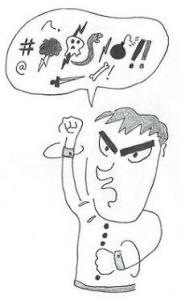
Here’s an interesting with an interesting perspective. It discusses all the non-verbal obscenities that appear in film, such as obscenities on t-shirts or in graffiti in the background. I am not a prude by any stretch of the imagination, but I believe that too much obscenity turns off a certain portion of a writer’s readership. On the other hand, sometimes a scene is of such intensity that it demands obscenities just to keep it plausible (e.g. some of the stories I am working on are set in hell, where obscenity-littered speech would be the norm). As is said in Ecclesiastes: “For everything there is a season.”
What this article inspires in me though, is not half-assed prudery or some type of literary caution or self-imposed censorship, but it opens up my mind to subtle places where I might place obscenities to express some subtlety of meaning or atmosphere.
I received this writing prompt from The Daily Post on November 8: “What’s the date today? Write it down, remove all dashes and slashes, and write a post that mentions that number.”
I started to write a glib response about numerology, but then a bell went off in the back of my mind.
While I don’t believe in numerology, I do like to toy with things like this in my writing for the enjoyment of people who do. Having been a graduate student at one time, I know how grad students and other literati like to analyze a text to the nth degree, searching for hidden but profound meaning in every nuanced word or misplaced comma. I seldom do this with the intent of relaying some arcane theme (people will interpret stories however best fits their worldview anyway), but just so the literati will have some fun analyzing and arguing about the story. For me, this is part of the fun of writing. But the more practical side of me also sees it as a way to build up a readership.
One way for a story to become known is via word of mouth. They will discuss the book if they find it interesting or they find something in it to argue about with their colleagues in the English Department or with friends at work or with like-minded enthusiasts at the local book club. So I give them something to debate.
Mostly, the understated connections I use are meaningless. For example, I have been working on a sci-fi short story in which I wanted to mention a sidearm astronauts 200 years from now might carry, but I did not want to use a type of space weapon that has become a cliché in the sci-fi world like a Star Trek phaser or a Star Wars blaster or a Flash Gordon ray gun. I named it the Hawking S-505 Black Particle sidearm. Hawking, obviously, for Stephen Hawking, who I am sure will have tons of scientific stuff named for him in the future including spaceports and starships. “Black Particle” as a form of dark energy relating to dark matter, which is cutting edge science these days, but will probably be trite in two centuries. S-550: the “S” is for sidearm; 550 is a US highway that runs through the town where I live currently. If I need a number, such as a serial number, I often use an old phone number or my birthdate or some other useless bit of trivia. As the original post from The Daily Post suggested, I might use a form of today’s date or some other date with meaning in my life. If the subject relates to magic(k), I might consult a book on numerology and choose/compose something appropriate. For example, in one horror story I have been writing for a long time, the protagonist walks through a tunnel under a dilapidated castle, where black magick was once practiced. The sides of the tunnel are covered in symbols and numbers including the number “4”, which symbolizes evil in some traditions.
For the names of characters, I frequently glance at the bookshelf to the right of my easy chair, where I write on my laptop, and combine the names of two authors to produce a name that has the right “sound” for the character or I might combine names from history or art or some other field. For example, I see I have one book by Bill Moyers and another by George Plimpton. I might name a character Bill Plimpton. In another sci-fi work (yet to be published) I needed the names for a nine man reconnaissance team to go aboard a derelict starship. I went to Google Translate and took the word for “warrior” from nine languages ranging from Gaelic to Swahili, so none would be immediately recognizable as a word for warrior (at least in the US), yet the names would express the cultural diversity of the crew.
Anyway, for me that is part of the fun of writing. How do you have fun with your writing?
As a new feature, I will endeavor each Saturday to post a work of horror from its long past. Horror, as a recognized genre, has existed less than a century. Before that, it was known by several names or vague references, such asv”weird fiction” or “ghost stories” or “gothic tales”. Many tales from these earlier eras are forgotten, but many are still well-known, having withstood the test of time, because they contained some element(s) that made them worthy of being remembered. It is to our advantage to study these memorable works and to discern what it is about them that speaks to the human psyche so intensely that they are remembered. However, just because a work is not well-known today, does not mean it does not merit study. There are many tales that were popular or highly acclaimed in their time, that should be remembered today, but sadly are not. We can learn much from these as well.
My intent with this new, (hopefully) regular feature is to bring to the world’s attention once again, stories that warrant study and remembrance. Too often in our modern world we become so lost among fads, trends, sound bytes, and the often ill-advised advice of pundits and critics, that we lose sight of the entirety of our lives and of our art. As someone once said, “when you’re up to your ass in alligators, it’s hard to remember your mission was to drain the swamp.” Maintaining a good, solid overview of one’s art is one means of maintaining a good, solid perspective, and probably the most basic overview is the historical perspective.
For these reasons, every Saturday I would like to bring you a story from horror’s long past, one that is worthy of study and remembrance. I shall try to keep them brief, but I will have to balance that with each one’s own merits. I hope you enjoy them all. This Saturday’s selection is:
The Damned Thing
by Ambrose Bierce
1898
(The Project Gutenberg Text)
Ambrose Bierce October 7, 1892
By THE light of a tallow candle, which had been placed on one end of a rough table, a man was reading something written in a book. It was an old account book, greatly worn; and the writing was not, apparently, very legible, for the man sometimes held the page close to the flame of the candle to get a stronger light upon it. The shadow of the book would then throw into obscurity a half of the room, darkening a number of faces and figures; for besides the reader, eight other men were present. Seven of them sat against the rough log walls, silent and motionless, and, the room being small, not very far from the table. By extending an arm any one of them could have touched the eighth man, who lay on the table, face upward, partly covered by a sheet, his arms at his sides. He was dead.
The man with the book was not reading aloud, and no one spoke; all seemed to be waiting for something to occur; the dead man only was without expectation. From the blank darkness outside came in, through the aperture that served for a window, all the ever unfamiliar noises of night in the wilderness—the long, nameless note of a distant coyote; the stilly pulsing thrill of tireless insects in trees; strange cries of night birds, so different from those of the birds of day; the drone of great blundering beetles, and all that mysterious chorus of small sounds that seem always to have been but half heard when they have suddenly ceased, as if conscious of an indiscretion. But nothing of all this was noted in that company; its members were not overmuch addicted to idle interest in matters of no practical importance; that was obvious in every line of their rugged faces—obvious even in the dim light of the single candle. They were evidently men of the vicinity—farmers and woodmen.
The person reading was a trifle different; one would have said of him that he was of the world, worldly, albeit there was that in his attire which attested a certain fellowship with the organisms of his environment. His coat would hardly have passed muster in San Francisco: his footgear was not of urban origin, and the hat that lay by him on the floor (he was the only one uncovered) was such that if one had considered it as an article of mere personal adornment he would have missed its meaning. In countenance the man was rather prepossessing, with just a hint of sternness; though that he may have assumed or cultivated, as appropriate to one in authority. For he was a coroner. It was by virtue of his office that he had possession of the book in which he was reading; it had been found among the dead man’s effects—in his cabin, where the inquest was now taking place.
When the coroner had finished reading he put the book into his breast pocket. At that moment the door was pushed open and a young man entered. He, clearly, was not of mountain birth and breeding: he was clad as those who dwell in cities. His clothing was dusty, however, as from travel. He had, in fact, been riding hard to attend the inquest.
The coroner nodded; no one else greeted him.
“We have waited for you,” said the coroner. “It is necessary to have done with this business to-night.”
The young man smiled. “I am sorry to have kept you,” he said. “I went away, not to evade your summons, but to post to my newspaper an account of what I suppose I am called back to relate.”
The coroner smiled.
“The account that you posted to your newspaper,” he said, “differs probably from that which you will give here under oath.”
“That,” replied the other, rather hotly and with a visible flush, “is as you choose. I used manifold paper and have a copy of what I sent. It was not written as news, for it is incredible, but as fiction. It may go as a part of my testimony under oath.”
“But you say it is incredible.”
“That is nothing to you, sir, if I also swear that it is true.”
The coroner was apparently not greatly affected by the young man’s manifest resentment. He was silent for some moments, his eyes upon the floor. The men about the sides of the cabin talked in whispers, but seldom withdrew their gaze from the face of the corpse. Presently the coroner lifted his eyes and said: “We will resume the inquest.”
The men removed their hats. The witness was sworn.
“What is your name?” the coroner asked.
“William Harker.”
“Age?”
“Twenty-seven.”
“You knew the deceased, Hugh Morgan?”
“Yes.”
“You were with him when he died?”
“Near him.”
“How did that happen—your presence, I mean?”
“I was visiting him at this place to shoot and fish. A part of my purpose, however, was to study him, and his odd, solitary way of life. He seemed a good model for a character in fiction. I sometimes write stories.”
“I sometimes read them.”
“Thank you.”
“Stories in general—not yours.”
Some of the jurors laughed. Against a sombre background humor shows high lights. Soldiers in the intervals of battle laugh easily, and a jest in the death chamber conquers by surprise.
“Relate the circumstances of this man’s death,” said the coroner. “You may use any notes or memoranda that you please.”
The witness understood. Pulling a manuscript from his breast pocket he held it near the candle, and turning the leaves until he found the passage that he wanted, began to read.
II
“…The sun had hardly risen when we left the house. We were looking for quail, each with a shotgun, but we had only one dog. Morgan said that our best ground was beyond a certain ridge that he pointed out, and we crossed it by a trail through the chaparral. On the other side was comparatively level ground, thickly covered with wild oats. As we emerged from the chaparral, Morgan was but a few yards in advance. Suddenly, we heard, at a little distance to our right, and partly in front, a noise as of some animal thrashing about in the bushes, which we could see were violently agitated.
“‘We’ve started a deer,’ said. ‘I wish we had brought a rifle.’
“Morgan, who had stopped and was intently watching the agitated chaparral, said nothing, but had cocked both barrels of his gun, and was holding it in readiness to aim. I thought him a trifle excited, which surprised me, for he had a reputation for exceptional coolness, even in moments of sudden and imminent peril.
“‘O, come!’ I said. ‘You are not going to fill up a deer with quail-shot, are you?’
“Still he did not reply; but, catching a sight of his face as he turned it slightly toward me, I was struck by the pallor of it. Then I understood that we had serious business on hand, and my first conjecture was that we had ‘jumped’ a grizzly. I advanced to Morgan’s side, cocking my piece as I moved.
“The bushes were now quiet, and the sounds had ceased, but Morgan was as attentive to the place as before.
“‘What is it? What the devil is it?’ I asked.
“‘That Damned Thing!’ he replied, without turning his head. His voice was husky and unnatural. He trembled visibly.
“I was about to speak further, when I observed the wild oats near the place of the disturbance moving in the most inexplicable way. I can hardly describe it. It seemed as if stirred by a streak of wind, which not only bent it, but pressed it down—crushed it so that it did not rise, and this movement was slowly prolonging itself directly toward us.
“Nothing that I had ever seen had affected me so strangely as this unfamiliar and unaccountable phenomenon, yet I am unable to recall any sense of fear. I remember—and tell it here because, singularly enough, I recollected it then—that once, in looking carelessly out of an open window, I momentarily mistook a small tree close at hand for one of a group of larger trees at a little distance away. It looked the same size as the others, but, being more distinctly and sharply defined in mass and detail, seemed out of harmony with them. It was a mere falsification of the law of aerial perspective, but it startled, almost terrified me. We so rely upon the orderly operation of familiar natural laws that any seeming suspension of them is noted as a menace to our safety, a warning of unthinkable calamity. So now the apparently causeless movement of the herbage, and the slow, undeviating approach of the line of disturbance were distinctly disquieting. My companion appeared actually frightened, and I could hardly credit my senses when I saw him suddenly throw his gun to his shoulders and fire both barrels at the agitated grass! Before the smoke of the discharge had cleared away I heard a loud savage cry—a scream like that of a wild animal—and, flinging his gun upon the ground, Morgan sprang away and ran swiftly from the spot. At the same instant I was thrown violently to the ground by the impact of something unseen in the smoke—some soft, heavy substance that seemed thrown against me with great force.
“Before I could get upon my feet and recover my gun, which seemed to have been struck from my hands, I heard Morgan crying out as if in mortal agony, and mingling with his cries were such hoarse savage sounds as one hears from fighting dogs. Inexpressibly terrified, I struggled to my feet and looked in the direction of Morgan’s retreat; and may heaven in mercy spare me from another sight like that! At a distance of less than thirty yards was my friend, down upon one knee, his head thrown back at a frightful angle, hatless, his long hair in disorder and his whole body in violent movement from side to side, backward and forward. His right arm was lifted and seemed to lack the hand—at least, I could see none. The other arm was invisible. At times, as my memory now reports this extraordinary scene, I could discern but a part of his body; it was as if he had been partly blotted out—I can not otherwise express it—then a shifting of his position would bring it all into view again.
“All this must have occurred within a few seconds, yet in that time Morgan assumed all the postures of a determined wrestler vanquished by superior weight and strength. I saw nothing but him, and him not always distinctly. During the entire incident his shouts and curses were heard, as if through an enveloping uproar of such sounds of rage and fury as I had never heard from the throat of man or brute!
“For a moment only I stood irresolute, then, throwing down my gun, I ran forward to my friend’s assistance. I had a vague belief that he was suffering from a fit or some form of convulsion. Before I could reach his side he was down and quiet. All sounds had ceased, but, with a feeling of such terror as even these awful events had not inspired, I now saw the same mysterious movement of the wild oats prolonging itself from the trampled area about the prostrate man toward the edge of a wood. It was only when it had reached the wood that I was able to withdraw my eyes and look at my companion. He was dead.”
III
The coroner rose from his seat and stood beside the dead man. Lifting an edge of the sheet he pulled it away, exposing the entire body, altogether naked and showing in the candle light a clay-like yellow. It had, however, broad maculations of bluish-black, obviously caused by extravasated blood from contusions. The chest and sides looked as if they had been beaten with a bludgeon. There were dreadful lacerations; the skin was torn in strips and shreds.
The coroner moved round to the end of the table and undid a silk handkerchief, which had been passed under the chin and knotted on the top of the head. When the handkerchief was drawn away it exposed what had been the throat. Some of the jurors who had risen to get a better view repented their curiosity, and turned away their faces. Witness Harker went to the open window and leaned out across the sill, faint and sick. Dropping the handkerchief upon the dead man’s neck, the coroner stepped to an angle of the room, and from a pile of clothing produced one garment after another, each of which he held up a moment for inspection. All were torn, and stiff with blood. The jurors did not make a closer inspection. They seemed rather uninterested. They had, in truth, seen all this before; the only thing that was new to them being Harker’s testimony.
“Gentlemen,” the coroner said, “we have no more evidence, I think. Your duty has been already explained to you; if there is nothing you wish to ask you may go outside and consider your verdict.”
The foreman rose—a tall, bearded man of sixty, coarsely clad.
“I should like to ask one question, Mr. Coroner,” he said. “What asylum did this yer last witness escape from?”
“Mr. Harker,” said the coroner, gravely and tranquilly, “from what asylum did you last escape?”
Harker flushed crimson again, but said nothing, and the seven jurors rose and solemnly filed out of the cabin.
“If you have done insulting me, sir,” said Harker, as soon as he and the officer were left alone with the dead man, “I suppose I am at liberty to go?”
“Yes.”
Harker started to leave, but paused, with his hand on the door latch. The habit of his profession was strong in him—stronger than his sense of personal dignity. He turned about and said:
“The book that you have there—I recognize it as Morgan’s diary. You seemed greatly interested in it; you read in it while I was testifying. May I see it? The public would like—”
“The book will cut no figure in this matter,” replied the official, slipping it into his coat pocket; “all the entries in it were made before the writer’s death.”
As Harker passed out of the house the jury reentered and stood about the table on which the now covered corpse showed under the sheet with sharp definition. The foreman seated himself near the candle, produced from his breast pocket a pencil and scrap of paper, and wrote rather laboriously the following verdict, which with various degrees of effort all signed:
“We, the jury, do find that the remains come to their death at the hands of a mountain lion, but some of us thinks, all the same, they had fits.”
IV
In the diary of the late Hugh Morgan are certain interesting entries having, possibly, a scientific value as suggestions. At the inquest upon his body the book was not put in evidence; possibly the coroner thought it not worth while to confuse the jury. The date of the first of the entries mentioned can not be ascertained; the upper part of the leaf is torn away; the part of the entry remaining is as follows:
“… would run in a half circle, keeping his head turned always toward the centre and again he would stand still, barking furiously. At last he ran away into the brush as fast as he could go. I thought at first that he had gone mad, but on returning to the house found no other alteration in his manner than what was obviously due to fear of punishment.
“Can a dog see with his nose? Do odors impress some olfactory centre with images of the thing emitting them? . . .
“Sept 2.—Looking at the stars last night as they rose above the crest of the ridge east of the house, I observed them successively disappear—from left to right. Each was eclipsed but an instant, and only a few at the same time, but along the entire length of the ridge all that were within a degree or two of the crest were blotted out. It was as if something had passed along between me and them; but I could not see it, and the stars were not thick enough to define its outline. Ugh! I don’t like this. . . .”
Several weeks’ entries are missing, three leaves being torn from the book.
“Sept. 27.—It has been about here again—I find evidences of its presence every day. I watched again all of last night in the same cover, gun in hand, double-charged with buckshot. In the morning the fresh footprints were there, as before. Yet I would have sworn that I did not sleep—indeed, I hardly sleep at all. It is terrible, insupportable! If these amazing experiences are real I shall go mad; if they are fanciful I am mad already.
“Oct. 3.—I shall not go—it shall not drive me away. No, this is my house, my land. God hates a coward….
“Oct. 5.—I can stand it no longer; I have invited Harker to pass a few weeks with me—he has a level head. I can judge from his manner if he thinks me mad.
“Oct. 7.—I have the solution of the problem; it came to me last night—suddenly, as by revelation. How simple—how terribly simple!
“There are sounds that we can not hear. At either end of the scale are notes that stir no chord of that imperfect instrument, the human ear. They are too high or too grave. I have observed a flock of blackbirds occupying an entire treetop—the tops of several trees—and all in full song. Suddenly—in a moment—at absolutely the same instant—all spring into the air and fly away. How? They could not all see one another—whole treetops intervened. At no point could a leader have been visible to all. There must have been a signal of warning or command, high and shrill above the din, but by me unheard. I have observed, too, the same simultaneous flight when all were silent, among not only blackbirds, but other birds—quail, for example, widely separated by bushes—even on opposite sides of a hill.
“It is known to seamen that a school of whales basking or sporting on the surface of the ocean, miles apart, with the convexity of the earth between them, will sometimes dive at the same instant—all gone out of sight in a moment. The signal has been sounded—too grave for the ear of the sailor at the masthead and his comrades on the deck—who nevertheless feel its vibrations in the ship as the stones of a cathedral are stirred by the bass of the organ.
“As with sounds, so with colors. At each end of the solar spectrum the chemist can detect the presence of what are known as ‘actinic’ rays. They represent colors—integral colors in the composition of light—which we are unable to discern. The human eye is an imperfect instrument; its range is but a few octaves of the real ‘chromatic scale’ I am not mad; there are colors that we can not see.
“And, God help me! the Damned Thing is of such a color!”
Writing at Starbuck’s in Farmington, circa October 12, 2015.
Here’s a link to an neat, entertaining article on Timothy McSweeney’s Internet Tendency about some good, sound,basic advice on how to write anything better. I recommend printing these out and sticking them on your refrigerator, stapling them to your forehead, or tattooing them to your forearm.
Good story from The Drabble. If you are not familiar with them, they are dedicated to publishing fiction and non-fiction of 100 words or less. They occasionally post a story that breaks into horror, such as this one (reminiscent of the French conte cruel), but the site is definitely worth visiting just to see how writers handle the challenge of extreme brevity. The Drabble generally publishes one story per day, and you can be included in their feed to have it sent to you. You can find them at https://thedrabble.wordpress.com.
Working on a play in Hasting’s Hardback Café, late evening, October 16, 2015.
As I was preparing to go to the local theatre this evening, I was thinking about how I can improve my writing and what distinguishes the great writers of horror. Of course, the first two that came into my mind as being easily discernible from all others were Poe and Lovecraft. Obviously, what distinguishes them is their use of language. Both use very intense, muscular language with a distinctly archaic tone. Not knowing if there a precise term already exists for this style, I decided to call it “the dark language”, because of its tight connection with the horror genre and with the horrifying in general. For me, there seems to be something archetypal about this, arising out of the Jungian collective unconscious. Perhaps it is just that Poe bound the Dark Language so intimately with scenes of horror, terror, and suspense, which is also bound with genres such as the Gothic novel, that the sound of it automatically brings forth societal memories of dread.
I need to finish dressing if I am to dine at my favorite local sushi restaurant before heading to the play. Somehow, I just have the taste for something raw tonight.

 Source: Walking in Lovecraft’s Shadow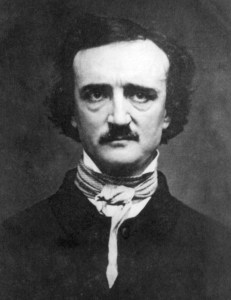




 Source: Weekend Edition – Top Ten Reasons I Love Writing
 Source: From creative writers to creative readers: Why it takes two to build a “hydrogen jukebox”
 Source: With your heart fixed on the Supreme Lord: Foreword, issue the 11th
 Source: Visual swears in film


 Source: Victim/Victor
 Phil Slattery, Writer, Publisher