Robert Louis Stevenson Portrait by Girolamo Nerli (1860-1926)
[From The Writer’s Home Companion, 1987]
“Robert Louis Stevenson was thrashing about in his bed one night, greatly alarming his wife. She woke him up, infuriating Stevenson, who yelled, “I was dreaming a fine bogey tale!” The nightmare from which he had been unwillingly extracted was the premise for the story of Dr. Jekyll and Mr. Hyde.“
EXAMINATION In the cult classic black comedy, Attack of the Killer Tomatoes, one of the random acts of violence perpetrated by these deadly nightshades was that a man was attacked by a BLT sandwich…
Split Pea Soup EXAMINATION Linda Blair plays a child possessed by the devil in The Exorcist, the classic horror flick from 1973. In what is probably the most memorable scene in cinema, horror or ot…
I received this writing prompt from The Daily Post on November 8: “What’s the date today? Write it down, remove all dashes and slashes, and write a post that mentions that number.”
I started to write a glib response about numerology, but then a bell went off in the back of my mind.
While I don’t believe in numerology, I do like to toy with things like this in my writing for the enjoyment of people who do. Having been a graduate student at one time, I know how grad students and other literati like to analyze a text to the nth degree, searching for hidden but profound meaning in every nuanced word or misplaced comma. I seldom do this with the intent of relaying some arcane theme (people will interpret stories however best fits their worldview anyway), but just so the literati will have some fun analyzing and arguing about the story. For me, this is part of the fun of writing. But the more practical side of me also sees it as a way to build up a readership.
One way for a story to become known is via word of mouth. They will discuss the book if they find it interesting or they find something in it to argue about with their colleagues in the English Department or with friends at work or with like-minded enthusiasts at the local book club. So I give them something to debate.
Mostly, the understated connections I use are meaningless. For example, I have been working on a sci-fi short story in which I wanted to mention a sidearm astronauts 200 years from now might carry, but I did not want to use a type of space weapon that has become a cliché in the sci-fi world like a Star Trek phaser or a Star Wars blaster or a Flash Gordon ray gun. I named it the Hawking S-505 Black Particle sidearm. Hawking, obviously, for Stephen Hawking, who I am sure will have tons of scientific stuff named for him in the future including spaceports and starships. “Black Particle” as a form of dark energy relating to dark matter, which is cutting edge science these days, but will probably be trite in two centuries. S-550: the “S” is for sidearm; 550 is a US highway that runs through the town where I live currently. If I need a number, such as a serial number, I often use an old phone number or my birthdate or some other useless bit of trivia. As the original post from The Daily Post suggested, I might use a form of today’s date or some other date with meaning in my life. If the subject relates to magic(k), I might consult a book on numerology and choose/compose something appropriate. For example, in one horror story I have been writing for a long time, the protagonist walks through a tunnel under a dilapidated castle, where black magick was once practiced. The sides of the tunnel are covered in symbols and numbers including the number “4”, which symbolizes evil in some traditions.
For the names of characters, I frequently glance at the bookshelf to the right of my easy chair, where I write on my laptop, and combine the names of two authors to produce a name that has the right “sound” for the character or I might combine names from history or art or some other field. For example, I see I have one book by Bill Moyers and another by George Plimpton. I might name a character Bill Plimpton. In another sci-fi work (yet to be published) I needed the names for a nine man reconnaissance team to go aboard a derelict starship. I went to Google Translate and took the word for “warrior” from nine languages ranging from Gaelic to Swahili, so none would be immediately recognizable as a word for warrior (at least in the US), yet the names would express the cultural diversity of the crew.
Anyway, for me that is part of the fun of writing. How do you have fun with your writing?
In response to The Daily Post’s writing prompt: “Truth Serum”:
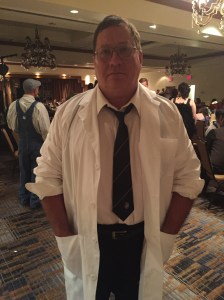
Phil Slattery at a literary costume part for charity in 2015, dressed as Lovecraft’s Herbert West, Re-animator
Ben Huberman poses an interesting question: “You’ve come into possession of one vial of truth serum. Who would you give it to (with the person’s consent, of course) — and what questions would you ask?”
I would not give it to anyone with their consent. Their permission implies they are telling me the truth anyway or would if I asked for it.
For a blog specializing in horror, It would be better to ask the following:
Who would you give it to without their knowledge, and by implication, without their consent?
Who would you give it to, without their consent, but with their knowledge? For example, the s.o.b. you hold in the most contempt is duct-taped in a chair or is strapped onto a surgical table under blinding lights.
Now, under these conditions, what questions would you ask?
In this article from mentalfloss.com Stacy Conradt tells us about ten renown figures from literature and history who had brief, quirky flings with the horror genre. Some of these you would probably never suspect of even hearing about the horror genre. One aspect that may be of interest to writers of horror is the minimal experience each author had with horror before dreaming up the concept for his/her foray into the genre.
The blogger on the banks of the San Juan River, Farmington, NM.
I study other languages and generally do well in them, but today (October 3, 2015) I realized that I had never researched the word “horror” in other languages. Therefore, I will start researching it and other horror-related terms today and either post my findings or add them to the Lexicon of Horror. Be aware, that each word in each language has its own nuances, even if it is identical to a word in another language, and that I cannot possibly be completely thorough in defining each one.
At least initially, my published research will be limited to only those languages that use a Roman alphabet. I am not familiar at this time with how to use non-Roman alphabets in WordPress.
Most of the dictionaries I am using as of this posting are somewhat dated.
German: (from The New Cassell’s German Dictionary, 1971) das Entsetzen, Grausen, der Abscheu, Schauder; Schrecken, Greuel…[Note that “horror” in the sense of the literary genre is the same as in English: “Horror”. For example, Horrorfilm is a horror movie.]
French: (from The Bantam New College French and English Dictinary, 1991) lahorreur; avoir horreur de to have a horror of; commettre des horreurs to commit atrocities; dire des horreurs to say obscene things; dire des horreurs de to say shocking things about.Finally, [from the Internet] horror film is film d’horreur.
Spanish: (from The University of Chicago Spanish Dictionary, 1971) horror [looking up the Spanish definition from the Spanish-English section, it notes that it is a masculine noun (el horror), and it can also mean atrocity. Dar horror is to cause fright or to terrify. Tenerle horror a uno is to have a strong dislike for someone. The Random House Latin American Spanish Dictionary (1997) adds enormity to its possible meanings.
Latin: (from Cassell’s Latin & English Dictionary, 2002) horror ~oris, bristling, shuddering; roughness of speech; dread, fright, especially religious dread, awe, by metonymy object of dread; a terror
Follow the link to a Huffington Post article detailing the naming of features on Pluto as it comes into view. Apparently, Cthulhu made the list. http://www.huffingtonpost.com/entry/pluto-cthulhu_55a5dda9e4b0896514cfbc06?
With Iced Tea, Farmington, New Mexico, March 20, 2015
As you may already know, I am on Goodreads quote of the day mailing list. Today’s I found particularly interesting on a couple of levels:
“Atticus told me to delete the adjectives and I’d have the facts.” Harper Lee
First, there is the literary perspective. Eliminating the adjectives and other modifiers from a story leaves you with the simple, cold hard facts, the bones, of the story. I have read several bits of writing advice that advocate keeping modifiers to a minimum and using nouns and verbs to their fullest by using them precisely, trying to match the exact word to its underlying concept. To my mind, that leaves one with the essence of the story.
Second, there is the deeper, philosophical perspective. Like with the literary perspective above, if you observe or learn of an event, if you cut away all the extraneous opinions and descriptors and other crap, you will have the cold, hard facts of the matter. This is echoed in Hannibal Lecter’s famous quote from Marcus Aurelius (though this is actually a paraphrase…at least in my copy of Meditations of Marcus Aurelius): “Read Marcus Aurelius. Of each particular thing ask: what is it in itself? What is its nature?”. It is also echoed in Hemingway’s remark made during an interview in The Paris Review: “The most essential gift for a good writer is a built-in, shockproof, shit detector.”
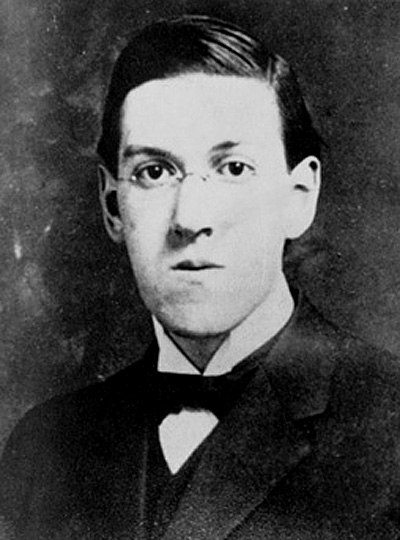
April 17, 1926: On this day, H.P Lovecraft returned to his home in Providence, Rhode Island after suffering a few years in the “hateful chaos” of Brooklyn. He never moved away again
Check out the cool covers in this article from the folks over at Rare Horror. These remind me of ones I see going through those second-rate, family-run, second-hand bookstores that you find in side streets and back alleys (if you are lucky enough to find ones with the covers intact and not torn off): 5 Awesome Horror Book Covers.
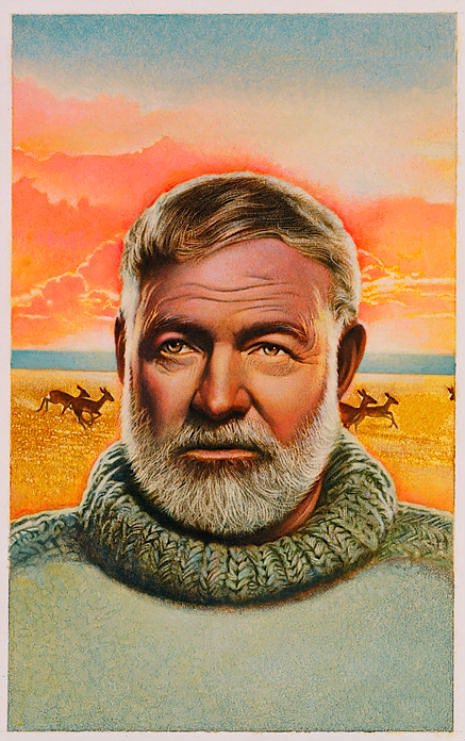
Ernest Hemingway (Though I do not know who the creator of this work is, I must ask that you respect their copyright.)
There is a story that Ernest Hemingway wrote the following to win a bet with other writers that he could write the shortest story:
“For sale: baby shoes. Never worn.”
Even a little research on the Internet shows that there is considerable doubt that Hemingway wrote this story, with the earliest reference to it as a Hemingway work not appearing until 1991. There is also considerable evidence that the story existed in various forms as early as 1910, when Hemingway was 11 and well before his writing career began. Whatever the facts, it is an extreme example of the lean, muscular writing for which Hemingway was famous.
In an interview with The Paris Review (see The Writer’s Chapbook, 1989, pp. 120-121), Hemingway did say:
“If it is any use to know it, I always try to write on the principle of the iceberg. There is seven-eighths of it underwater for every part that shows. Anything you know you can eliminate and it only strengthens your iceberg. It is the part that doesn’t show. If a writer omits something because he does not know it then there is a hole in the story…First I have tried to eliminate everything unnecessary to conveying experience to the reader so that after he or she has read something it will become a part of his or her experience and seem actually to have happened. This is very hard to do and I’ve worked at it very hard.”
So “Baby Shoes” is a good example of Hemingway’s iceberg principle, even if he didn’t write it.
“Baby Shoes” is also a good example of what I like to think of as the Tao of writing (see my earlier posts): creating a story by a careful, strategic use of what is not said. No where in the story does it state that a couple had apparently been expecting a baby, that they bought shoes for it, but then something happened to the baby to cause its death, and now the parents want to sell the shoes. None of that is stated. It is all implied, but yet we know what happened–or at least we have a good idea of what happened, even if we do not know the concrete facts of the matter.
There are also other facets of the story that we can infer, albeit tenuously. From the fact that they bought baby shoes we can infer that the parents were probably eager to have the child. From the fact that the parents want to sell the shoes we can infer that they probably don’t want them around any more as a remainder of a painful experience, but at the same time they may want to see someone else make good use of them or that they are hard up for money.
But one question I have that concerns human psychology is why is it that most people can read these same six words and come away with the same perception of what occurred? Does it have to do with Jungian Archetypes floating around in each of us or is it that each of us has had the same broad experience(s) so that we can interpret these six words in a very similar way?
In the art of sculpture, those areas of a work that are empty, yet give the work its form, are called “negative space”. An example is the space between each of your fingers. If there were no space, there would be no individual fingers. In that sense, a story like “Baby Shoes” makes maximum use of what might be termed “literary negative space”.
It is not really the words that give this story its power, but how we psychologically connect the ideas behind the words that fuel this extremely brief, but epic and poignant tale.
This is part of the magic of writing: conjuring worlds out of nothing.





 Phil Slattery, Writer, Publisher