Horror and Imagination

"The Pit and the Pendulum" Illustration by Arthur Rackham, 1935
“The Pit and the Pendulum”
Illustration by Arthur Rackham, 1935

A day or two ago, I finished reading volume 1 of Clive Barker’s Books of Blood.   His style is beautiful; his choice of words is meticulous; his characters are carefully interwoven; and his imagination is mind-boggling.  If you haven’t read this and you call yourself a fan of horror, you should probably be ashamed (I feel ashamed that I have not read him before now).   You are missing out on some terrific stories.  Now I understand why Stephen King called him “the future of horror”.

But of all his praiseworthy attributes, the one that stands out from all the others is his imagination.   I cannot even imagine how he formulates his ideas.   For “Midnight Meat Train”, was he just riding a subway and wonder “where does this go? What’s at the end of the line? Maybe there are cannibals at the end of the line?  Where did they come from?”  How did he associate cannibals with a subway?  [Of course, this is all speculation I am just pulling out of the air.  I have read nothing about Barker’s gifted imagination.  I am using my own imagination and my experience in developing stories to speculate about his methods.]

I heard some place many years ago that genius is not seeing the similarities between apples and oranges (anyone can see the differences), but seeing the similarities between apples and tractors–or in this case, seeing the possible connections between cannibals and subways.

In “In the Hills, the Cities” How did he come up with the concept of giants made of tens of thousands of people functioning together as a single entity?  Was he thinking of the original druid burning men and wonder, “what if they were bigger and could come alive?”

To come up with stories such as these, one must think completely out of the box, out of the established paradigm (per Robert Pirsig’s Zen and the Art of Motorcycle Maintenance).

The more I read of works like this, the more I take to heart the advice I see occasionally from publishers that they do not want to see more werewolf-vampire-zombie (wvz) stories or that wvz stories must be very well done to be published.  I enjoy wvz stories as much as the next reader, but if I were a publisher, I do not know if I could stomach seeing hundreds come across my desk in a month for years on end.

In his work “Supernatural Horror in Literature”, Lovecraft stresses the importance of an element of the supernatural being present in what he then termed “weird fiction” because if anything is possible, then there are no longer any physical laws of reality to shield us from the horrors that may actually be in the universe.  Barker does exactly that.  In his writing, there are no limits to what may happen to any one at any time.  We are all under the threat of horrific annihilation at any moment.

Likewise, another of Lovecraft’s bits of advice is that characters must be ordinary people so that the appearance of the supernatural will be obvious and stronger than if the characters were all super characters.   This makes sense.  Superman is only super when he is on earth;  he would be just another overworked taxpayer on Krypton.  From what I have seen so far in volume 1 of Books of Blood, all of Barker’s characters are quite ordinary people caught up in quite extraordinary and horrible circumstances.  Perhaps his way of characterization is genius in itself.   I think anyone can make up a fantastic character, but to make someone real, to make a genuine person and have their character show through, when it is easier to make up a shallow one or two dimensional stick figure…isn’t that a form of genius in its own right?   In terms of characterization, Barker’s imagination does not tend to the supernatural, but to the perceptive and to the meticulous.  [No, I haven’t read The Hellbound Heart yet but I have read “The Yattering and Jack”, and I feel confident that when I do finally encounter Pinhead (I have seen a few of the Hellraiser series), he will certainly not be two-dimensional even though he is definitely supernatural.]

But I digress.

The upshot of all this is that as writers we should push our imaginations to the limits, exploring new ways of coming up with ideas, and disdain themes and motifs that have been worked to death for decades.  That is a great part of the challenge of writing.  Though I love classic literature such as that by Hemingway and Fitzgerald, their works do not push the limits of the imagination as do the writers of speculative fiction such as Barker and Lovecraft or Bradbury and Asimov.  Writers of speculative fiction are explorers of the imagination.

But of the subgenres of speculative fiction, where does that leave writers of horror?

It leaves us as explorers of the dark arts of the imagination.  Whereas writers of science fiction and fantasy may push into better worlds like Magellan sailing around the globe, we authors of horror push into the dark, threatening, forbidding areas of the imagination, much as the conquistadors pushed into the Central American jungles or intrepid British explorers pushed along the Congo or Amazon in search of wealth or lost cities.  Indeed, it could be said that we are searching for metaphorical lost cities in the recesses of the mind,  seeking long-hidden worlds surrounded by mystery and horror.

If life is a journey, then we, as writers of horror are choosing the most terrifying journey through the imagination that we can, because we love the thrill of being faced with horror on every side.

Thoughts?  Comments?

Recommendation: The Popular Uncanny

I found a fascinating article just now that I highly recommend visiting:  “Winter Chills with Mike Arnzen”.  You can find it at http://nonhorrorreadersurvey.wordpress.com/2010/12/21/winter-chills-with-mike-arnzen/.  It is a fascinating look into how Freud’s concept of the Uncanny can be found in modern horror and in popular culture.    It is worth checking out.

What music inspires you to horror?

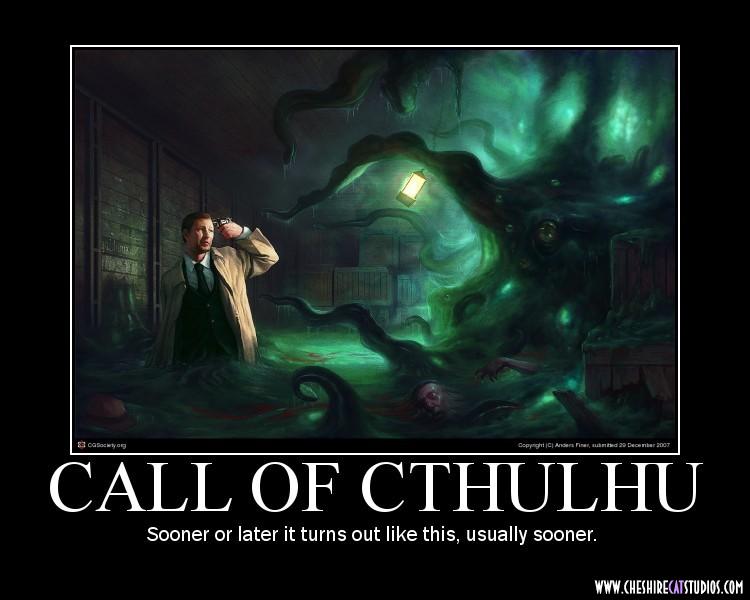
Poster from Johannascheezburger.com via Halloween Mike's Horror Everyday on Facebook.
Poster from Johannascheezburger.com via Halloween Mike’s Horror Everyday on Facebook.

For the first time in a long time, I was listening to CDs on the car stereo as I drove back from Farmington (New Mexico) on the 14th, when I started feeling once again the latent but powerful emotions I associate with certain songs.  The songs in question were Puddle of Mudd’s “Spaceship” from Songs in the Key of Love and Hate and “Would?” from Alice in Chains’s Dirt.  When I was not that much younger than I am now, I used to listen to a broad range of music (from classical to hard rock to New Age and more) almost constantly.  Therefore it will not be surprising if I state that others that stir me range from ACDC’s “Back in Black” and Nirvana’s “Smells Like Teen Spirit” to  Mussorgsky’s “Night on Bald Mountain” and Beethoven’s Ninth Symphony, and, for a complete change of pace, to Enya’s “Orinoco Flow” and Michael Gettel’s San Juan Suite, both of which seem to stir not a tumult of emotions, but instead have the opposite effect and cause me to almost drift away on a sea of tranquility.

As I am sure is the case with most people, I find all my favorite songs enjoyable, but there were, and still are, some that stir me deeply and can even now resurrect feelings of intense excitement and passion as if I were reliving my “Glory Days” (which, by the way, is an excellent Springsteen tune that really hits home these days).

Out of those that stir my emotions the most, are a select group that have a certain je ne sais quois, a combination of primal rhythm, deep-toned vocalization, and soul-stirring guitar riffs,  that do not stimulate the intellect as much as they instigate remote, subconscious parts of the mind to coalesce into a riot of images shaping themselves into the essential kernel of some grim tale that I know I can nurture, expand, and carefully, painstakingly mold into a narrative that would enthrall Dante or Milton–had I the time or unswerving diligence to concentrate on its writing.

“Enter Sandman” by Metallica is an excellent example of this.  Even though the song is about the destruction of a family (according to Wikipedia), something about it compels me to write an intricate novel of espionage, assassination, betrayal, deception, and the inner horrors of the human psyche that paces back and forth in the recesses of my mind like a tiger in a cage, watching for an opportunity to spring forth into the light of day upon an unsuspecting yet willing audience.   I have probably  20,000-30,000 or more words in the current draft of this story and I will probably trash most of these the next time I sit down to tackle this task.    One day I will have to dedicate myself to finishing the story, because this is the only way I know I will be able to rid myself of the tiger’s pacing and of his relentless stare that bores into the back of my neocortex.  As my life stands now, between chores at home and working 50-60 hours per week at my day job, I can find little time during an average week to work on the various short stories, novelettes, and novellas I have started over the past year.

Sad to say, I have two or three good novels that have been waiting over a decade or more for their genesis.  Probably with each of them I associate some tune from my more turbulent past, if not with the entire work, then with at least some scene that plays over and over in my head like a teaser clip from a movie trailer.

For me, this is one of the delicious agonies of being a writer.  I have so many fascinating concepts whirling through my head that I just know instinctively can be great works and that I enjoy revisiting whenever I have a few seconds to daydream but the lack of time in my daily life stymies their creation.

My question to you tonight, is are there musical works that inspire you to create works of horror and terror?

Lovecraft on the Supernatural

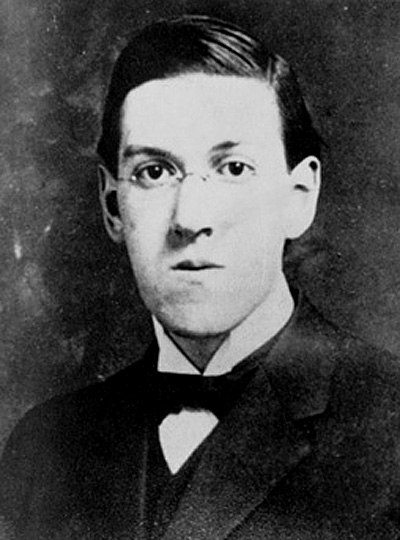
H.P. Lovecraft, 1915


I was reading Lovecraft’s “Supernatural Horror in Literature” the other day when I came across this line concerning the nature of  the “weird tale”:

“A certain atmosphere of breathless and unexplainable dread of outer, unknown forces must be present; and there must be a hint, expressed with a seriousness and protentiousness becoming its subject, of that most terrible conception of the human brain — a malign and particular suspension or defeat of those fixed laws of Nature which are our only daily safeguard against the assaults of chaos and the daemons of unplumbed space.”

With me, this idea hit home.  I have always thought that the more realistic I could make a story, the more frightening it would be for the reader, because it could possibly happen. Lovecraft takes the complete opposite approach.  In essence, he says let’s dispense with the chains of our preconceptions of reality then see what could happen.   He is right.  If anything can happen, the horrors that could happen to humanity are limitless and unimaginable.

Now let’s take this line of thought a step or two further philosophically.  Perhaps our concept of reality is really a sort of protective shell, a defense mechanism created by our minds that shields us from being overwhelmed by the thousands of possible ways we could meet our ends.  If a person tried to conceive of all the ways he/she might die at any moment, no matter how miniscule the odds, his/her mind might be overwhelmed and paralyzed by fear or destroyed by paranoia and madness.   The only way the mind could survive would then be to limit the possibilities to only those with the greatest probability of happening at that moment, in essence, wrapping itself in a protective cocoon of denial.

If there are any philosophy majors out there reading this, please feel free to bring up this idea in class.  I would love to hear the arguments for and against this.

Now, let’s go a step even further.   If we start to see our perception of reality as only a concept, as only a protective shell in a much greater universe, as only one alternative among thousands or millions of possibilities, then the possibility of creatures like Cthulhu, Shoggoth, Nylarhotep, the “ancient ones”, and all the other monsters contained in Lovecraft’s vivid imagination becomes very real.

Lovecraft’s world of the “ancient ones” is frightening enough when we think it has no chance of happening, but it becomes truly terrifying if we think it has even the slightest chance of actually happening.

Thoughts?  Comments?

Jorge Oscar Rossi’s “Archetypal Horror: H.P. Lovecraft and Carl Gustav Jung”

Cthulhu

I ran across an interesting article today at http://www.quintadimension.com/article66.html, entitled “Archetypal Horror:  H.P. Lovecraft and Carl Gustav Jung”.  It was written by Jorge Oscar Rossi, an Argentinian writer of science fiction (and fantastic literature in general), and published on December, 8, 2000.  Please note that the article and his autobiography are in Spanish.

I am no master of Spanish, having had only two years in college and some practical, albeit frequent, experience in Texas and Mexico over the last twenty years.   However, Señor Rossi’s article is well-written and relatively easy reading, so that I feel I caught the gist of it, if not all the nuances.

His main point (and anyone with a better knowledge of Spanish than I, including Señor Rossi, may correct me if I am wrong) is that Lovecraft’s ancient gods of the Cthulhu mythos represent archetypal forms of horror in the Jungian sense of “archetype”.

If you have a basic comprehension of Spanish, the article is quite intriguing and worth taking a shot at reading.

If nothing esle, the article will help you view the poster above from another perspective: what is the meaning of the poster if the creature above symbolizes archetypal fears shared by everyone?

Thoughts?  Comments?

Freud’s View of Fear

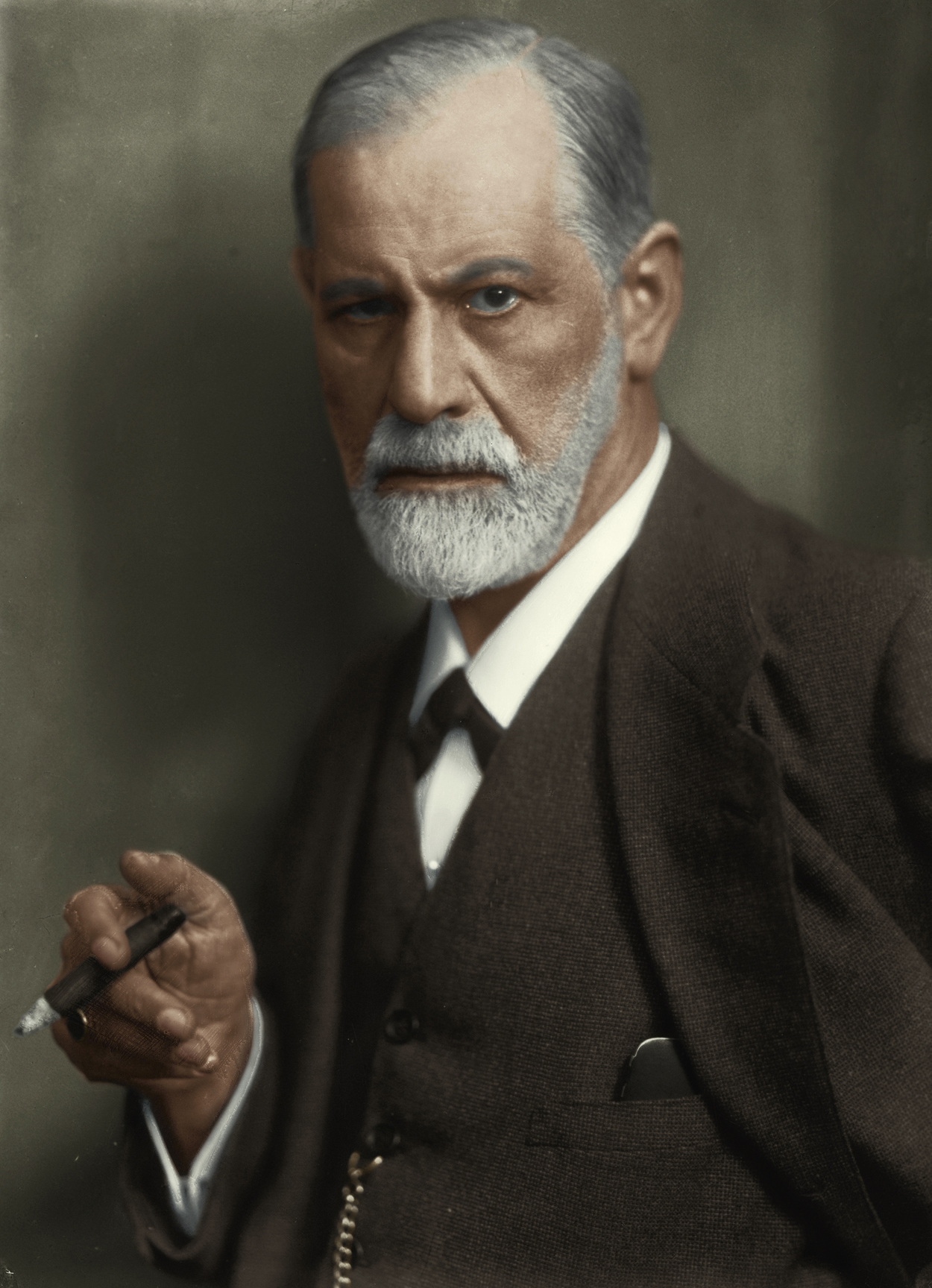
Sigmund FreudIllustration by FlyBit43
Sigmund Freud
Illustration by FlyBit43

While many people can write a horror story, those who have a profound understanding of the emotions associated with horror will have a greater chance of writing a truly great horror story.  With that in mind, as tonight’s post I offer a comment from Dr. C. George Boeree on Freud’s view of fear, which he termed “anxiety”.   This quote is part of a longer articles which can be found at http://webspace.ship.edu/cgboer/freud.html.  I like the quote, because it explains Freud’s concept in a straightforward, simple, clear way that I can grasp easily.   I also like the quote because it gives me three different types of fear to instill in my audience vicariously.  As I have mentioned in previous posts, when someone reads a story, they are experiencing the events of that story vicariously.  As writers of horror, one of the primary emotions we want to instill is fear.   In this short comment, Dr. Boeree provides us with three flavors of fear we can instill in our audiences.

“The ego — the “I” — sits at the center of some pretty powerful forces: reality; society, as represented by the superego; biology, as represented by the id. When these make conflicting demands upon the poor ego, it is understandable if it — if you — feel threatened, feel overwhelmed, feel as if it were about to collapse under the weight of it all. This feeling is called anxiety, and it serves as a signal to the ego that its survival, and with it the survival of the whole organism, is in jeopardy.

“Freud mentions three different kind of anxieties: The first is realistic anxiety, which you and I would call fear. Actually Freud did, too, in German. But his translators thought “fear” too mundane! Nevertheless, if I throw you into a pit of poisonous snakes, you might experience realistic anxiety.

“The second is moral anxiety. This is what we feel when the threat comes not from the outer, physical world, but from the internalized social world of the superego. It is, in fact, just another word for feelings like shame and guilt and the fear of punishment.

“The last is neurotic anxiety. This is the fear of being overwhelmed by impulses from the id. If you have ever felt like you were about to “lose it,” lose control, your temper, your rationality, or even your mind, you have felt neurotic anxiety. Neurotic is actually the Latin word for nervous, so this is nervous anxiety. It is this kind of anxiety that intrigued Freud most, and we usually just call it anxiety, plain and simple.”

Undoubtedly, Jung had his own views of fear, with which I am not familiar, and other psychiatrists have theirs, and Freud’s views may well be outdated, or even proven wrong.  However, if we are to understand the nature of fear, Freud is a good a place to start as any.

Thoughts?  Comments?

Notes on “I am Legend”

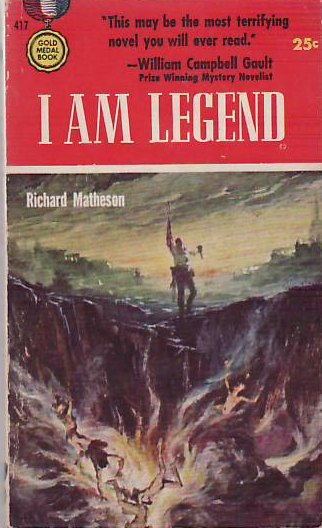
Cover of First Edition, 1954(Please note that this cover is protected by copyright; please refer to Wikipedia for details on permissible use)
Cover of First Edition, 1954
(Please note that this cover is protected by copyright; please refer to Wikipedia for details on permissible use)

I have been reading Richard Matheson’s I am Legend recently whenever I have the opportunity.  I would not say it is a fascinating book, but it is interesting.   One particularly interesting aspect is that the book is not just about one man’s fight against zombies (which he terms “vampires”, but which fit better into the modern concept of zombies) , but that it also deals extensively with his fight against depression and loneliness in a post-apocalyptic future.   Today, I happened to look up the work on Wikipedia and found the following interesting review written by Dan Schneider of International Writers Magazine:  Book Review n 2005:

“…despite having vampires in it, [the novel] is not a novel on vampires, nor even a horror nor sci-fi novel at all, in the deepest sense. Instead, it is perhaps the greatest novel written on human loneliness. It far surpasses Daniel Defoe’s Robinson Crusoe in that regard. Its insights into what it is to be human go far beyond genre, and is all the more surprising because, having read his short stories – which range from competent but simplistic, to having classic Twilight Zone twists (he was a major contributor to the original TV series) there is nothing within those short stories that suggests the supreme majesty of the existential masterpiece I Am Legend was aborning.”

Mr. Schneider may very well be right that it may be the greatest novel written on human loneliness.  If it is not, it is very close to the top.  I have read Robinson Crusoe and my impression is that I am Legend surpasses that in describing the mental and emotional anguish of loneliness and bringing that inner struggle home to the modern reader.

In my view, one reason I am Legend is important to the horror genre, is because it shows another aspect of horror: personal, inner anguish and turmoil, which probably should be classified as a form of horror, if no one has done so yet.  Anyone who has suffered extreme inner turmoil would probably agree that it is worthy of being termed horror.  It may even be the most common form of real-life horror.  I do not know the statistics for how many people are tortured at the hands of serial killers or executioners or other true-to-life monsters, but I would guess that it is far less than the number of people experiencing extreme negative emotions without actually having been physically tormented.

This aspect of inner horror can add another dimension to the otherwise average horror novel or movie, which, based on what I have seen, tends to emphasize physical violence or the threat of physical violence.   In those works, the inner horror of the protagonists is usually assumed, but not examined in detail.   Examining the inner emotions of protagonists and antagonists will help form empathy and sympathy for the characters within readers, particularly in those who have experienced a similar emotion, and will help form a tighter emotional connection between work and audience.  

I recommend reading the Wikipedia article on I am Legend.  It is quite fascinating.  However, do not do as I have done and read it before completing the book.  You will only spoil the ending for yourself.

Thoughts?  Comments?

Beyond the Veil of Reality

Face of Horror Houseby Horror House
Face of Horror House
by Horror House

Last night, I watched an adaptation of Lovecraft’s “Dreams in the Witch House” on the Masters of Horror series (season 1, episode 2) on Netflix .   Afterwards, being late and time for bed, instead of finding the story on Project Gutenberg or some other cost-free source so that I could read it firsthand, I read a summary of the story on Wikipedia to see if the adaptation was at least reasonably accurate.  It seemed to be, even though the story was set in the modern day and the ending varied significantly from the original.  But, in accordance with today’s tastes, it was rather bloody and cruel in ways I am sure Lovecraft never intended (I say this after having read a considerable amount of his most famous works).

The most interesting aspect of the story to me was not the story itself, but speculating on how Lovecraft came up with the story’s concept.

I understand from the Wikipedia article that Lovecraft had recently attended a lecture and read up somewhat on non-Euclidean space.   Apparently, he was intrigued with the idea of existence on different planes.  Somehow he came up with the idea that the different planes of existence might intersect and beings would be able to move from one plane to the next.  This is the concept that the protagonist of the story, Walter Gilman (a graduate student in Physics) is studying when he moves into the Witch house, which was a boarding house in the fictional town of Arkham, Massachusetts, but three hundred years ago was the residence of a witch.  Gilman, as I interpret the TV story, notices that the corner formed by the intersection of two walls and the ceiling in his room coincides with the intersection of three dimensions.  It is this intersection that the witch who previously resided in the house and her familiar (a really nasty creature combining a rat with the face of a man) uses to re-enter the house in the modern day and create havoc for Gilman and the other residents.   I won’t give away the ending, but it is a good story and probably one of the more reasonably accurate adaptations of a Lovecraft story that you are likely to find.

What I found most interesting was speculating if  how Lovecraft came up with the story was to be looking at the intersection of three walls in his house and wonder if different planes of existence could intersect like that and, if they could, could creatures use the intersection to move from one plane to the other?   I am always fascinated by how writers come up with ideas for their works.   Did you ever wonder what spurred Richard Matheson to write I am Legend or Stephen King to write Carrie?

I know that some authors of Horror  (such as Algernon Blackwood, Lord Dunsany, and Arthur Machen) were intrigued by the idea of a plane of existence beyond what we take for reality, that what we perceive as reality may actually just mask the true reality.  Apparently, Lovecraft was thus intrigued as well and used his ideas of a possible alternative reality as the foundation for what others would later term “the Cthulhu Mythos”.

After having contemplated this since last night, I have been asking myself, what did these intelligent men see in their interpretations of the everyday world that would lead them to believe in the possible existence of an alternative reality?    Based upon my experience with humanity, I have come to realize that some people have some downright bizarre concepts of the world around them, but how did these concepts originate?  What causes their perceptions to be so radically different from mine?  Is it a matter of genetics that causes their synapses to be linked together differently?  Do they have slightly different body chemistries influencing their thoughts?  Is it that they simply encountered different views of the world as they grew up?  Is there a reality that they can perceive but I cannot–in the same way as I can see the workings of God in everything about me, but others do not and thus call themselves atheists and agnostics?

What are your thoughts?

David Cronenberg on Art and Horror

450px-David_Cronenberg_-200

David Cronenberg, 2012

Photo by Alan Langford

“I think of horror films as art, as films of confrontation.  Films that make you confront aspects of your own life that are difficult to face.  Just because you’re making a horror film doesn’t mean you can’t make an artful film.”  

–David Cronenberg

I found the quote above at Quotationsbook.com.   I have linked David Cronenberg’s name to the Internet Movie Database for those of you not familiar with his works as a director of horror movies (The Fly, Scanners, etc.)

I think the statement is important for two reasons.

First, as I mentioned in my post on Carl Jung and the Creative Subconscious, authors do put something of themselves into their work.   Personally, I had never recognized this about my own writing until I had the conversation I described in my post, though I had always known that each work of art is a reflection of the artist in some way.   Therefore, up to that point, I cannot say I consciously confronted anything about myself.   Since then, though I do not intentionally orient my stories toward self-revelation, I do occasionally recognize some internal bone of contention in a way that could probably best be described as “confrontation”.    Writing then becomes a process of self-awareness, of self-knowledge, a type of self-therapy.

More importantly that the author’s own self-therapy, once these works are published, they become a sort of self-awarenes and therapy for the audience who can relate to them.   We are all human; we all have the same basic drives and desires.   If one individual experiences an internal confrontation, then many others have likely experienced it as well (perhaps this is the mechanism behnd living vicariously).   Then the process of confrontation and self-awareness for the author becomes a process of confrontation and self-awareness for his audience as well–whether on a conscious or subconscious level.   Then the horror genre  becomes  a form of self-therapy for society so that society can confront its dark side while experiencing our suppressed primal natures (as I mentioned in an earlier post).

The second important point about this statement is alluded to in the final sentence, that just because one is making a horror film, doesn’t mean one can’t make an artful film.   On its surface, this is obviously true.   There is no reason anyone cannot make a horror film with the same artistic feeling as David McLean did in Lawrence of Arabia or Stanley Kubrick did in 2001:  A Space Odyssey.    But beneath this surface lies another point.  In the first two sentences, Mr. Cronenberg defines horror films as films of self-confrontation.  In the last sentence he equates horror films with artful films.   He is equating artful films with being films of self-confrontation.   A=B=C.   Art equating to self-confrontation could easily be the subject of a thesis, if not of an exceptionally thick textbook.    Therefore, in my limited time and space available I will not even begin to delve into it here.  Please explore it on your own, however.  I think it would be a fascinating venture.

Any thoughts or comments?

Quote for February 7, 2013

ADORNO_by_LGdL

Theodor Adorno

by Aleandro Gonzalez de Leon

I found the following quotation from the German sociologist, philosopher, and musicologist Theodor Adorno at BrainyQuote.com and thought I might share it.  I am often dubious of using a quote from a website, because I have seen a few that are obviously wrongly attributed, but whether or not Adorno actually said this, it is still interesting in its own right.  However, if he did say it, which is quite likely, it becomes even more interesting because of his background as a sociologist and philosopher.

“Horror is beyond the reach of psychology.”

I admit I am not familiar with Adorno or his works, but in light of the pyschological bent of my previous posts,  I am sure you will understand why I find it interesting.   Please let me know your thoughts on the quotation, on Adorno, and on whether this is actually one of his statements.

Really, what is horror?

H_P__Lovecraft_by_MirrorCradle -- resized

H.P. Lovecraft by Mirror Cradle

I like the illustration above, not only because it shows Lovecraft in the throes of creation, but also because it can be a metaphor for anyone in the deepest and darkest of contemplations or beset with a multitude of woes.  For now, though, I will say that it represents Lovecraft contemplating today’s question which is:  forget everything you have ever read about horror, what is horror to you?

Stephen King made this comment (I found it on goodreads.com):

“The 3 types of terror: The Gross-out: the sight of a severed head tumbling down a flight of stairs, it’s when the lights go out and something green and slimy splatters against your arm. The Horror: the unnatural, spiders the size of bears, the dead waking up and walking around, it’s when the lights go out and something with claws grabs you by the arm. And the last and worse one: Terror, when you come home and notice everything you own had been taken away and replaced by an exact substitute. It’s when the lights go out and you feel something behind you, you hear it, you feel its breath against your ear, but when you turn around, there’s nothing there…”

To me, these seem to be the superficialities of terror and horror.   If we use disease as a metaphor for horror, then these are its symptoms.   The virus lying at the root of horror is man’s inhumanity to man.   Seeing a severed head tumbling down stairs is indeed horrible;  seeing the murderer sever the head would be even worse, but being able to look into the soul of the murderer and see that the motive for the act stems from the murderer’s complete indifference to the suffering of others would be even worse.   Perhaps even worse than that would be seeing that that indifference to others is not uncommon.

Many have speculated on what fascinates people about horror.   Why would anyone enjoy being frightened?   An article I read last night (I think from Wikipedia) says essentially (I am summarizing in my own words) that it is because the security our civilization our modern society affords us has eliminated the need for the primal fear that developed as a survival mechanism during the early days of evolution.    That may be true to some degree, but if society eliminated some fears, it instilled others.    How many have seen the movie “Candyman”?   How many have seen “I am Legend?” or “The Omega Man” (both derive from the novel “I am Legend” by Richard Matheson), which is only one example of post-apocalyptic literature that would have been inconceivable in primeval times.

Instead of some overreaching drive extending throughout mankind, it may be that the need simply stems from the fact that the adrenaline rush, the focus on the moment, the muscle tension, and all the other physical sensations experienced during fright are the same or very similar to those experienced during sex, but without the sexual arousal itself.   These are also similar to the sensations experienced during peaks of athletic activity.    I was in the martial arts for many years and I can testify that the adrenaline rush experienced during sparring matches or when one is performing at peak ability can be addicting.   Being frightened puts one on a similar level of physical and mental awareness, because it is an instinctual preparation to fight as if one is actually being threatened.  The great thing about horror though is that while one enjoys all the physical highs of one’s body revving up for action, there is no actual threat.  Everyone is safe.   Candyman is not actually going to come out of the screen and track you down (though your subsequent nightmares may tell you otherwise).

So, please put yourself in Mr. Lovecraft’s place in the illustration above and ask yourself, what is horror?

Carl Jung and the Creative Subconscious

Carl_Jung_(1912)

Carl Gustav Jung, 1912

Someone told me recently that the pyschologist Carl Jung believed the work reveals something about the author.  We discussed this idea for a few minutes before it hit home in a very scary fashion, because we were discussing my works of horror.  I realized that at least sometimes my own subconscious fears may influence, if not determine, the course of my stories.  Storylines reflecting the subconscious fears of the author makes a lot of sense, because, to my mind at least, dreams and nightmares also originate in and reflect the undercurrents of the subconscious.

So, what do you think?   Is the subconscious wellspring responsible for the creation of dreams the same one responsible for creative works?  What does this say about authors like Yann Martel who wrote “Life of Pi”?   What does it say about authors like Clive Barker and H.P. Lovecraft and even myself?

While we are at it, here are three quotes from Jung to provide additional food for thought.  What do they say about writers of horror?   I found them at The Painter’s Keys:  Art Quotes from Carl Gustav Jung.

“Often the hands will solve a mystery that the intellect has struggled with in vain.”

“The secret of artistic creation and the effectiveness of art is to be found in a return to the state of ‘participation mystique’ – to that level of experience at which it is man who lives, and not the individual…”

“The creation of something new is not accomplished by the intellect but by the play instinct acting from inner necessity. The creative mind plays with the objects it loves.”