
 Don’t Lose Your Writing Groove This week I’ve been restarting my work-related writing engines. After a temporary slow down of client projects, the machine of my copywriting and marketin…
Category: Fiction
Interview with Dr. Kinitra D. Brooks, Horror Scholar by Nicole Kurtz
Interview with Dr. Kinitra D. Brooks, Horror Scholar by Nicole Kurtz Introduction: I sat down with Dr. Kinitra D. Brooks and discussed her approach to academic discourse on black women and w…
Source: Interview with Dr. Kinitra D. Brooks, Horror Scholar by Nicole Kurtz
The Saturday Night Special: “Sredni Vashtar” by Saki (1911)
Conradin was ten years old, and the doctor had pronounced his professional opinion that the boy would not live another five years. The doctor was silky and effete, and counted for little, but his opinion was endorsed by Mrs. De Ropp, who

(Hector Hugh Munro)
1870-1916
counted for nearly everything. Mrs. De Ropp was Conradin’s cousin and guardian, and in his eyes she represented those three-fifths of the world that are necessary and disagreeable and real; the other two-fifths, in perpetual antagonism to the foregoing, were summed up in himself and his imagination. One of these days Conradin supposed he would succumb to the mastering pressure of wearisome necessary things—such as illnesses and coddling restrictions and drawn-out dullness. Without his imagination, which was rampant under the spur of loneliness, he would have succumbed long ago.
Mrs. De Ropp would never, in her honestest moments, have confessed to herself that she disliked Conradin, though she might have been dimly aware that thwarting him “for his good” was a duty which she did not find particularly irksome. Conradin hated her with a desperate sincerity which he was perfectly able to mask. Such few pleasures as he could contrive for himself gained an added relish from the likelihood that they would be displeasing to his guardian, and from the realm of his imagination she was locked out—an unclean thing, which should find no entrance.
In the dull, cheerless garden, overlooked by so many windows that were ready to open with a message not to do this or that, or a reminder that medicines were due, he found little attraction. The few fruit-trees that it contained were set jealously apart from his plucking, as though they were rare specimens of their kind blooming in an arid waste; it would probably have been difficult to find a market-gardener who would have offered ten shillings for their entire yearly produce. In a forgotten corner, however, almost hidden behind a dismal shrubbery, was a disused tool-shed of respectable proportions, and within its walls Conradin found a haven, something that took on the varying aspects of a playroom and a cathedral. He had peopled it with a legion of familiar phantoms, evoked partly from fragments of history and partly from his own brain, but it also boasted two inmates of flesh and blood. In one corner lived a ragged-

plumaged Houdan hen, on which the boy lavished an affection that had scarcely another outlet. Further back in the gloom stood a large hutch, divided into two compartments, one of which was fronted with close iron bars. This was the abode of a large polecat-ferret, which a friendly butcher-boy had once smuggled, cage and all, into its present quarters, in exchange for a long-secreted hoard of small silver. Conradin was dreadfully afraid of the lithe, sharp-fanged beast, but it was his most treasured possession. Its very presence in the tool-shed was a secret and fearful joy, to be kept scrupulously from the knowledge of the Woman, as he privately dubbed his cousin. And one day, out of Heaven knows what material, he spun the beast a wonderful name, and from that moment it grew into a god and a religion. The Woman indulged in religion once a week at a church near by, and took Conradin with her, but to him the church service was an alien rite in the House of Rimmon. Every Thursday, in the dim and musty silence of the tool-shed, he worshipped with mystic and elaborate ceremonial before the wooden hutch where dwelt Sredni Vashtar, the great

ferret. Red flowers in their season and scarlet berries in the winter-time were offered at his shrine, for he was a god who laid some special stress on the fierce impatient side of things, as opposed to the Woman’s religion, which, as far as Conradin could observe, went to great lengths in the contrary direction. And on great festivals powdered nutmeg was strewn in front of his hutch, an important feature of the offering being that the nutmeg had to be stolen. These festivals were of irregular occurrence, and were chiefly appointed to celebrate some passing event. On one occasion, when Mrs. De Ropp suffered from acute toothache for three days, Conradin kept up the festival during the entire three days, and almost succeeded in persuading himself that Sredni Vashtar was personally responsible for the toothache. If the malady had lasted for another day the supply of nutmeg would have given out.
The Houdan hen was never drawn into the cult of Sredni Vashtar. Conradin had long ago settled that she was an Anabaptist. He did not pretend to have the remotest knowledge as to what an Anabaptist was, but he privately hoped that it was dashing and not very respectable. Mrs. De Ropp was the ground plan on which he based and detested all respectability.
After a while Conradin’s absorption in the tool-shed began to attract the notice of his guardian. “It is not good for him to be pottering down there in all weathers,” she promptly decided, and at breakfast one morning she announced that the Houdan hen had been sold and taken away overnight. With her short-sighted eyes she peered at Conradin, waiting for an outbreak of rage and sorrow, which she was ready to rebuke with a flow of excellent precepts and reasoning. But Conradin said nothing: there was nothing to be said. Something perhaps in his white set face gave her a momentary qualm, for at tea that afternoon there was toast on the table, a delicacy which she usually banned on the ground that it was bad for him; also because the making of it “gave trouble,” a deadly offence in the middle-class feminine eye.
“I thought you liked toast,” she exclaimed, with an injured air, observing that he did not touch it.
“Sometimes,” said Conradin.
In the shed that evening there was an innovation in the worship of the hutch-god. Conradin had been wont to chant his praises, tonight be asked a boon.
“Do one thing for me, Sredni Vashtar.”
The thing was not specified. As Sredni Vashtar was a god he must be supposed to know. And choking back a sob as he looked at that other empty comer, Conradin went back to the world he so hated.
And every night, in the welcome darkness of his bedroom, and every evening in the dusk of the tool-shed, Conradin’s bitter litany went up: “Do one thing for me, Sredni Vashtar.”
Mrs. De Ropp noticed that the visits to the shed did not cease, and one day she made a further journey of inspection.
“What are you keeping in that locked hutch?” she asked. “I believe it’s guinea-pigs. I’ll have them all cleared away.”
Conradin shut his lips tight, but the Woman ransacked his bedroom till she found the carefully hidden key, and forthwith marched down to the shed to complete her discovery. It was a cold afternoon, and Conradin had been bidden to keep to the house. From the furthest window of the dining-room the door of the shed could just be seen beyond the corner of the shrubbery, and there Conradin stationed himself. He saw the Woman enter, and then be imagined her opening the door of the sacred hutch and peering down with her short-sighted eyes into the thick straw bed where his god lay hidden. Perhaps she would prod at the straw in her clumsy impatience. And Conradin fervently breathed his prayer for the last time. But he knew as he prayed that he did not believe. He knew that the Woman would come out presently with that pursed smile he loathed so well on her face, and that in an hour or two the gardener would carry away his wonderful god, a god no longer, but a simple brown ferret in a hutch. And he knew that the Woman would triumph always as she triumphed now, and that he would grow ever more sickly under her pestering and domineering and superior wisdom, till one day nothing would matter much more with him, and the doctor would be proved right. And in the sting and misery of his defeat, he began to chant loudly and defiantly the hymn of his threatened idol:
Sredni Vashtar went forth,
His thoughts were red thoughts and his teeth were white,
His enemies called for peace, but he brought them death.
Sredni Vashtar the beautiful.
And then of a sudden he stopped his chanting and drew closer to the window-pane. The door of the shed still stood ajar as it had been left, and the minutes were slipping by. They were long minutes, but they slipped by nevertheless. He watched the starlings running and flying in little parties across the lawn; he counted them over and over again, with one eye always on that swinging door. A sour-faced maid came in to lay the table for tea, and still Conradin stood and waited and watched. Hope had crept by inches into his heart, and now a look of triumph began to blaze in his eyes that had only known the wistful patience of defeat. Under his breath, with a furtive exultation, he began once again the pæan of victory and devastation. And presently his eyes were rewarded: out through that doorway came a long, low, yellow-and-brown beast, with eyes a-blink at the waning daylight, and dark wet stains around the fur of jaws and throat. Conradin dropped on his knees. The great polecat-ferret made its way down to a small brook at the foot of the garden, drank for a moment, then crossed a little plank bridge and was lost to sight in the bushes. Such was the passing of Sredni Vashtar.
“Tea is ready,” said the sour-faced maid; “where is the mistress?” “She went down to the shed some time ago,” said Conradin. And while the maid went to summon her mistress to tea, Conradin fished a toasting-fork out of the sideboard drawer and proceeded to toast himself a piece of bread. And during the toasting of it and the buttering of it with much butter and the slow enjoyment of eating it, Conradin listened to the noises and silences which fell in quick spasms beyond the dining-room door. The loud foolish screaming of the maid, the answering chorus of wondering ejaculations from the kitchen region, the scuttering footsteps and hurried embassies for outside help, and then, after a lull, the scared sobbings and the shuffling tread of those who bore a heavy burden into the house.
“Whoever will break it to the poor child? I couldn’t for the life of me!” exclaimed a shrill voice. And while they debated the matter among themselves, Conradin made himself another piece of toast.
New Fiction by George Gad Economou: “It Was Raining…”

by Phil Slattery
It was raining, and it was night; I remember it perfectly, as if it was yesterday, although it was a long time ago. Or was it? I don’t know any longer. Time has stopped being important. I was sitting there in the mud, crying. No flowers, only a few trees, and it was gloomy. I had just buried her…for the third time. The sky mourned for her loss and for my soul. I wanted to open the grave, and bury myself next to her, but I couldn’t. Doing so would mean seeing her. I got up, wishing to run away.
#
How did I let it happen? I can’t even remember. It seems like yesterday I saw her for the very first time, but when time stops, everything is yesterday. There is no timeline. Her smile was so perfect, it warmed my heart. Just watching her smile, and I knew I would die a happy man. There was someone else enjoying her smile. I stayed, because we fell in love. When did it happen? Was it when we first kissed? Or was it before? She kissed me, because I was important. And then, something happened.
#
Her hand was raised from the ground. Again. She refused to stay down. Too much fight in her. I couldn’t move. The earth trembled–it always did. I saw her. She wasn’t smiling. She was furious. She stared at me, and despite the coldness of death, her dark eyes were still beautiful. She sat up, covered in wet dirt, rotting away. She got up, walked towards me. I was motionless, I couldn’t do it again. I was exhausted.
#
We said goodbye; I did nothing but cry and drink. For so long…yet it seems like a brief second. She returned to the life she knew, to what was familiar. And I cried. Then she returned. The gleam in her eyes. The promises in her kisses. I was alive. I was happy. I held her close in the nights. I offered her comfort. She warmed my heart. She made me smile. She left…again.
#
She was coming towards me. I raised the shovel. My tears mingled with the rain. I was covered in dirt. I hit her in the head. And she fell down. Stopped moving. She would get up again, I knew it. It wasn’t the first time. I dug the grave…a new one. She deserved a new place. Maybe there she’d finally rest. I started digging. The rain got worse. The wind was howling. I was all alone with her. It didn’t feel right.
#
She had regretted her decision; I wanted to rip my heart out and give it to her. It belonged to her, I had no use for my heart anymore. She didn’t want me in her life. There was living without her. I tried, but I couldn’t. The knife wasn’t so sharp, so I failed. She laughed at me. Was it then that it happened for the first time?
#
The grave was ready. I stood in the hole. Perhaps, I thought, I should lay myself down, and let her find me. She’d come and destroy me, just as I had destroyed her. I climbed out of the grave. I placed her carefully into the new resting place. I found a few flowers. She always loved flowers. I planted them above her. Maybe they’ll keep her company, I said to myself. I cried.
#
She didn’t laugh at me nor did she wish to say farewell. She wanted time to think. She thought it wrong, because she had left someone for me. And she couldn’t bear the guilt. I still wanted to give her my heart. I tried–no, I didn’t try to rip my heart out. I swallowed a lot of pills. Who saved me? I don’t remember who found me. I hate whoever he was, ’cause he didn’t let me die. If I had, she’d be alive.
#
I watched the flowers, they grew. With every visit, they’d get even bigger, even more beautiful. She didn’t get up again. Maybe, she needed a place to call home, and the flowers did the job. I returned every night; sometimes, I wished she’d get up, because I wanted to see her. She never did. I never saw her again. Only in dreams…and they would often turn into nightmares.
#
She came to see me. I was in a white room, and people in white robes were always talking to me. She cried, asked me why. I told her. She cried some more. I couldn’t cry, I had shed all the tears I had in me. She walked out when I asked her if she wanted my heart.
#
The Saturday Night Special: “In the Court of the Dragon” by Robert W. Chambers (1895)
“Oh, thou who burn’st in heart for those who burn
In Hell, whose fires thyself shall feed in turn;
How long be crying—’Mercy on them.’ God!
Why, who art thou to teach and He to learn?”
In the Church of St. Barnabé vespers were over; the clergy left the altar; the little choir-boys flocked across the chancel and settled in the stalls. A Suisse in rich uniform marched down the south aisle, sounding his staff at every fourth step on the stone pavement; behind him came that eloquent preacher and good man, Monseigneur C——.
My chair was near the chancel rail, I now turned toward the west end of the church. The other people between the altar and the pulpit turned too. There was a little scraping and rustling while the congregation seated itself again; the preacher mounted the pulpit stairs, and the organ voluntary ceased.
I had always found the organ-playing at St. Barnabé highly interesting. Learned and scientific it was, too much so for my small knowledge, but expressing a vivid if cold intelligence. Moreover, it possessed the French quality of taste: taste reigned supreme, self-controlled, dignified and reticent.
To-day, however, from the first chord I had felt a change for the worse, a sinister change. During vespers it had been chiefly the chancel organ which supported the beautiful choir, but now and again, quite wantonly as it seemed, from the west gallery where the great organ stands, a heavy hand had struck across the church at the serene peace of those clear voices. It was something more than harsh and dissonant, and it betrayed no lack of skill. As it recurred again and again, it set me thinking of what my architect’s books say about the custom in early times to consecrate the choir as soon as it was built, and that the nave, being finished sometimes half a century later, often did not get any blessing at all: I wondered idly if that had been the case at St. Barnabé, and whether something not usually supposed to be at home in a Christian church might have entered undetected and taken possession of the west gallery. I had read of such things happening, too, but not in works on architecture.
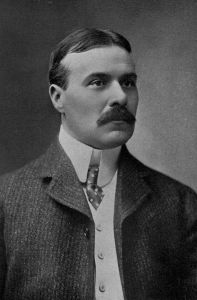
1903
Then I remembered that St. Barnabé was not much more than a hundred years old, and smiled at the incongruous association of mediaeval superstitions with that cheerful little piece of eighteenth-century rococo.
But now vespers were over, and there should have followed a few quiet chords, fit to accompany meditation, while we waited for the sermon. Instead of that, the discord at the lower end of the church broke out with the departure of the clergy, as if now nothing could control it.
I belong to those children of an older and simpler generation who do not love to seek for psychological subtleties in art; and I have ever refused to find in music anything more than melody and harmony, but I felt that in the labyrinth of sounds now issuing from that instrument there was something being hunted. Up and down the pedals chased him, while the manuals blared approval. Poor devil! whoever he was, there seemed small hope of escape!
My nervous annoyance changed to anger. Who was doing this? How dare he play like that in the midst of divine service? I glanced at the people near me: not one appeared to be in the least disturbed. The placid brows of the kneeling nuns, still turned towards the altar, lost none of their devout abstraction under the pale shadow of their white head-dress. The fashionable lady beside me was looking expectantly at Monseigneur C——. For all her face betrayed, the organ might have been singing an Ave Maria.
But now, at last, the preacher had made the sign of the cross, and commanded silence. I turned to him gladly. Thus far I had not found the rest I had counted on when I entered St. Barnabé that afternoon.
I was worn out by three nights of physical suffering and mental trouble: the last had been the worst, and it was an exhausted body, and a mind benumbed and yet acutely sensitive, which I had brought to my favourite church for healing. For I had been reading The King in Yellow.
“The sun ariseth; they gather themselves together and lay them down in their dens.” Monseigneur C—— delivered his text in a calm voice, glancing quietly over the congregation. My eyes turned, I knew not why, toward the lower end of the church. The organist was coming from behind his pipes, and passing along the gallery on his way out, I saw him disappear by a small door that leads to some stairs which descend directly to the street. He was a slender man, and his face was as white as his coat was black. “Good riddance!” I thought, “with your wicked music! I hope your assistant will play the closing voluntary.”
With a feeling of relief—with a deep, calm feeling of relief, I turned back to the mild face in the pulpit and settled myself to listen. Here, at last, was the ease of mind I longed for.
“My children,” said the preacher, “one truth the human soul finds hardest of all to learn: that it has nothing to fear. It can never be made to see that nothing can really harm it.”
“Curious doctrine!” I thought, “for a Catholic priest. Let us see how he will reconcile that with the Fathers.”
“Nothing can really harm the soul,” he went on, in, his coolest, clearest tones, “because——”
But I never heard the rest; my eye left his face, I knew not for what reason, and sought the lower end of the church. The same man was coming out from behind the organ, and was passing along the gallery the same way. But there had not been time for him to return, and if he had returned, I must have seen him. I felt a faint chill, and my heart sank; and yet, his going and coming were no affair of mine. I looked at him: I could not look away from his black figure and his white face. When he was exactly opposite to me, he turned and sent across the church straight into my eyes, a look of hate, intense and deadly: I have never seen any other like it; would to God I might never see it again! Then he disappeared by the same door through which I had watched him depart less than sixty seconds before.
I sat and tried to collect my thoughts. My first sensation was like that of a very young child badly hurt, when it catches its breath before crying out.
To suddenly find myself the object of such hatred was exquisitely painful: and this man was an utter stranger. Why should he hate me so?—me, whom he had never seen before? For the moment all other sensation was merged in this one pang: even fear was subordinate to grief, and for that moment I never doubted; but in the next I began to reason, and a sense of the incongruous came to my aid.
As I have said, St. Barnabé is a modern church. It is small and well lighted; one sees all over it almost at a glance. The organ gallery gets a strong white light from a row of long windows in the clerestory, which have not even coloured glass.
The pulpit being in the middle of the church, it followed that, when I was turned toward it, whatever moved at the west end could not fail to attract my eye. When the organist passed it was no wonder that I saw him: I had simply miscalculated the interval between his first and his second passing. He had come in that last time by the other side-door. As for the look which had so upset me, there had been no such thing, and I was a nervous fool.
I looked about. This was a likely place to harbour supernatural horrors! That clear-cut, reasonable face of Monseigneur C——, his collected manner and easy, graceful gestures, were they not just a little discouraging to the notion of a gruesome mystery? I glanced above his head, and almost laughed. That flyaway lady supporting one corner of the pulpit canopy, which looked like a fringed damask table-cloth in a high wind, at the first attempt of a basilisk to pose up there in the organ loft, she would point her gold trumpet at him, and puff him out of existence! I laughed to myself over this conceit, which, at the time, I thought very amusing, and sat and chaffed myself and everything else, from the old harpy outside the railing, who had made me pay ten centimes for my chair, before she would let me in (she was more like a basilisk, I told myself, than was my organist with the anaemic complexion): from that grim old dame, to, yes, alas! Monseigneur C—— himself. For all devoutness had fled. I had never yet done such a thing in my life, but now I felt a desire to mock.
As for the sermon, I could not hear a word of it for the jingle in my ears of
“The skirts of St. Paul has reached.
Having preached us those six Lent lectures,
More unctuous than ever he preached,”
keeping time to the most fantastic and irreverent thoughts.
It was no use to sit there any longer: I must get out of doors and shake myself free from this hateful mood. I knew the rudeness I was committing, but still I rose and left the church.
A spring sun was shining on the Rue St. Honoré, as I ran down the church steps. On one corner stood a barrow full of yellow jonquils, pale violets from the Riviera, dark Russian violets, and white Roman hyacinths in a golden cloud of mimosa. The street was full of Sunday pleasure-seekers. I swung my cane and laughed with the rest. Some one overtook and passed me. He never turned, but there was the same deadly malignity in his white profile that there had been in his eyes. I watched him as long as I could see him. His lithe back expressed the same menace; every step that carried him away from me seemed to bear him on some errand connected with my destruction.
I was creeping along, my feet almost refusing to move. There began to dawn in me a sense of responsibility for something long forgotten. It began to seem as if I deserved that which he threatened: it reached a long way back—a long, long way back. It had lain dormant all these years: it was there, though, and presently it would rise and confront me. But I would try to escape; and I stumbled as best I could into the Rue de Rivoli, across the Place de la Concorde and on to the Quai. I looked with sick eyes upon the sun, shining through the white foam of the fountain, pouring over the backs of the dusky bronze river-gods, on the far-away Arc, a structure of amethyst mist, on the countless vistas of grey stems and bare branches faintly green. Then I saw him again coming down one of the chestnut alleys of the Cours la Reine.
I left the river-side, plunged blindly across to the Champs Elysées and turned toward the Arc. The setting sun was sending its rays along the green sward of the Rond-point: in the full glow he sat on a bench, children and young mothers all about him. He was nothing but a Sunday lounger, like the others, like myself. I said the words almost aloud, and all the while I gazed on the malignant hatred of his face. But he was not looking at me. I crept past and dragged my leaden feet up the Avenue. I knew that every time I met him brought him nearer to the accomplishment of his purpose and my fate. And still I tried to save myself.
The last rays of sunset were pouring through the great Arc. I passed under it, and met him face to face. I had left him far down the Champs Elysées, and yet he came in with a stream of people who were returning from the Bois de Boulogne. He came so close that he brushed me. His slender frame felt like iron inside its loose black covering. He showed no signs of haste, nor of fatigue, nor of any human feeling. His whole being expressed one thing: the will, and the power to work me evil.
In anguish I watched him where he went down the broad crowded Avenue, that was all flashing with wheels and the trappings of horses and the helmets of the Garde Republicaine.
He was soon lost to sight; then I turned and fled. Into the Bois, and far out beyond it—I know not where I went, but after a long while as it seemed to me, night had fallen, and I found myself sitting at a table before a small café. I had wandered back into the Bois. It was hours now since I had seen him. Physical fatigue and mental suffering had left me no power to think or feel. I was tired, so tired! I longed to hide away in my own den. I resolved to go home. But that was a long way off.
I live in the Court of the Dragon, a narrow passage that leads from the Rue de Rennes to the Rue du Dragon.
It is an “impasse”; traversable only for foot passengers. Over the entrance on the Rue de Rennes is a balcony, supported by an iron dragon. Within the court tall old houses rise on either side, and close the ends that give on the two streets. Huge gates, swung back during the day into the walls of the deep archways, close this court, after midnight, and one must enter then by ringing at certain small doors on the side. The sunken pavement collects unsavoury pools. Steep stairways pitch down to doors that open on the court. The ground floors are occupied by shops of second-hand dealers, and by iron workers. All day long the place rings with the clink of hammers and the clang of metal bars.
Unsavoury as it is below, there is cheerfulness, and comfort, and hard, honest work above.
Five flights up are the ateliers of architects and painters, and the hiding-places of middle-aged students like myself who want to live alone. When I first came here to live I was young, and not alone.
I had to walk a while before any conveyance appeared, but at last, when I had almost reached the Arc de Triomphe again, an empty cab came along and I took it.
From the Arc to the Rue de Rennes is a drive of more than half an hour, especially when one is conveyed by a tired cab horse that has been at the mercy of Sunday fête-makers.
There had been time before I passed under the Dragon’s wings to meet my enemy over and over again, but I never saw him once, and now refuge was close at hand.
Before the wide gateway a small mob of children were playing. Our concierge and his wife walked among them, with their black poodle, keeping order; some couples were waltzing on the sidewalk. I returned their greetings and hurried in.
All the inhabitants of the court had trooped out into the street. The place was quite deserted, lighted by a few lanterns hung high up, in which the gas burned dimly.
My apartment was at the top of a house, halfway down the court, reached by a staircase that descended almost into the street, with only a bit of passage-way intervening, I set my foot on the threshold of the open door, the friendly old ruinous stairs rose before me, leading up to rest and shelter. Looking back over my right shoulder, I saw him, ten paces off. He must have entered the court with me.
He was coming straight on, neither slowly, nor swiftly, but straight on to me. And now he was looking at me. For the first time since our eyes encountered across the church they met now again, and I knew that the time had come.
Retreating backward, down the court, I faced him. I meant to escape by the entrance on the Rue du Dragon. His eyes told me that I never should escape.
It seemed ages while we were going, I retreating, he advancing, down the court in perfect silence; but at last I felt the shadow of the archway, and the next step brought me within it. I had meant to turn here and spring through into the street. But the shadow was not that of an archway; it was that of a vault. The great doors on the Rue du Dragon were closed. I felt this by the blackness which surrounded me, and at the same instant I read it in his face. How his face gleamed in the darkness, drawing swiftly nearer! The deep vaults, the huge closed doors, their cold iron clamps were all on his side. The thing which he had threatened had arrived: it gathered and bore down on me from the fathomless shadows; the point from which it would strike was his infernal eyes. Hopeless, I set my back against the barred doors and defied him.
There was a scraping of chairs on the stone floor, and a rustling as the congregation rose. I could hear the Suisse’s staff in the south aisle, preceding Monseigneur C—— to the sacristy.
The kneeling nuns, roused from their devout abstraction, made their reverence and went away. The fashionable lady, my neighbour, rose also, with graceful reserve. As she departed her glance just flitted over my face in disapproval.
Half dead, or so it seemed to me, yet intensely alive to every trifle, I sat among the leisurely moving crowd, then rose too and went toward the door.
I had slept through the sermon. Had I slept through the sermon? I looked up and saw him passing along the gallery to his place. Only his side I saw; the thin bent arm in its black covering looked like one of those devilish, nameless instruments which lie in the disused torture-chambers of mediaeval castles.
But I had escaped him, though his eyes had said I should not. Had I escaped him? That which gave him the power over me came back out of oblivion, where I had hoped to keep it. For I knew him now. Death and the awful abode of lost souls, whither my weakness long ago had sent him—they had changed him for every other eye, but not for mine. I had recognized him almost from the first; I had never doubted what he was come to do; and now I knew while my body sat safe in the cheerful little church, he had been hunting my soul in the Court of the Dragon.
I crept to the door: the organ broke out overhead with a blare. A dazzling light filled the church, blotting the altar from my eyes. The people faded away, the arches, the vaulted roof vanished. I raised my seared eyes to the fathomless glare, and I saw the black stars hanging in the heavens: and the wet winds from the lake of Hali chilled my face.
And now, far away, over leagues of tossing cloud-waves, I saw the moon dripping with spray; and beyond, the towers of Carcosa rose behind the moon.
Death and the awful abode of lost souls, whither my weakness long ago had sent him, had changed him for every other eye but mine. And now I heard his voice, rising, swelling, thundering through the flaring light, and as I fell, the radiance increasing, increasing, poured over me in waves of flame. Then I sank into the depths, and I heard the King in Yellow whispering to my soul: “It is a fearful thing to fall into the hands of the living God!”
Free Fiction Friday: Burning from the Inside (Envy) by Alex Johnson
Photo by Phil Slattery
2015
Source: Free Fiction Friday: Burning from the Inside (Envy) by Alex Johnson
New Fiction by George Gad Economou: “A Shot of Normalcy”

by Catlovers, 2007
Common sense was telling me no, don’t go, but, I couldn’t resist the temptation. A damn Halloween party in the middle of a ferocious civil war sounded like an extremely bad idea, yet, some escape from the horrors was more than just needed. Warfare was raging on the streets, bodies were lying anywhere, yet, at the University campus it was peaceful; at least, for the time being.
Hence why they decided to throw the party; we didn’t even know if it, indeed, was Halloween, or if it was too early, or late. It was winter, it was snowing, and it was all that mattered. Besides, we didn’t really care about dressing up, we just needed a moment of normalcy, a way out of Hell.
Dressed like Jesus, I went. The alcohol was running plentifully- how it was acquired I never learned, although wild rumors were being thrown around- and we all drank, while remaining inside the small room, falsely believing in strength and safety in numbers. At first, the music was low, barely audible; we were terrified of being heard by the soldiers that sometimes patrolled the streets of the campus. However, as we all became more and more intoxicated- and blissfully oblivious to the gunshots that were disturbing the otherwise silent night- we turned the music higher. AC/DC’s “Highway to Hell” was blasting loudly inside the room, and we all danced like everything had gotten back to normal.
I was dancing with a girl, a philosophy major, whose name I didn’t ask. When you know any day can be your last, you stop caring about etiquette and norms become nonsensical. Thus, the nameless woman and I kissed passionately on the dance floor, as our bodies moved rhythmically to the music, which was getting louder and louder. Equally louder became the gunshots and screams of anguish and despair, but none of us paid any attention to it.
Eventually, the girl and I walked outside, for some fresh air. We were both cheerfully dizzy, happily ignorant of the devastation all around us. The party’s goal was accomplished; for a few hours, we were living like normal citizens, there was no civil war, no unreasonable deaths, no meaningless suffering. We lit a joint- the girl and I- to take the edge off, to relax even further. Our minds were engulfed in a delightful mist, we were atop Cloud Number Nine, as we continued to kiss and share the strong blunt. Laughing, we wished upon a falling star for the end of the war, as soon as possible; yet, as I stared at the falling star, I noticed, horrified, its rapid approach. The hissing sound reached my ears and purely out of instinct I grabbed my companion’s hand and dragged her, violently and ignoring her cries, away.
Moments later, the missile found its target; the former cafeteria of the campus had turned into a pile of debris and a cold grave for dozens of nameless, unfortunate souls.
Keep It Simple
 Streamline your writing style by keeping your language simple and placing your story center stage.
Source: Keep It Simple
Here’s some good, practical advice on writing.
The Saturday Night Special: “One Summer Night” by Ambrose Bierce
The fact that Henry Armstrong was buried did not seem to him to prove that he was dead: he had always been a hard man to convince. That he really was buried, the testimony of his senses compelled him to admit. His posture — flat upon his back, with his hands crossed upon his stomach and tied with something that he easily broke without profitably altering the situation — the strict confinement of his entire person, the black darkness and profound silence, made a body of evidence impossible to controvert and he accepted it without cavil.
But dead — no; he was only very, very ill. He had, withal, the invalid’s apathy and did not greatly concern himself about the uncommon

October 7, 1892
fate that had been allotted to him. No philosopher was he — just a plain, commonplace person gifted, for the time being, with a pathological indifference: the organ that he feared consequences with was torpid. So, with no particular apprehension for his immediate future, he fell asleep and all was peace with Henry Armstrong.
But something was going on overhead. It was a dark summer night, shot through with infrequent shimmers of lightning silently firing a cloud lying low in the west and portending a storm. These brief, stammering illuminations brought out with ghastly distinctness the monuments and headstones of the cemetery and seemed to set them dancing. It was not a night in which any credible witness was likely to be straying about a cemetery, so the three men who were there, digging into the grave of Henry Armstrong, felt reasonably secure.
Two of them were young students from a medical college a few miles away; the third was a gigantic negro known as Jess. For many years Jess had been employed about the cemetery as a man-of-all-work and it was his favourite pleasantry that he knew ‘every soul in the place.’ From the nature of what he was now doing it was inferable that the place was not so populous as its register may have shown it to be.
Outside the wall, at the part of the grounds farthest from the public road, were a horse and a light wagon, waiting.
The work of excavation was not difficult: the earth with which the grave had been loosely filled a few hours before offered little resistance and was soon thrown out. Removal of the casket from its box was less easy, but it was taken out, for it was a perquisite of Jess, who carefully unscrewed the cover and laid it aside, exposing the body in black trousers and white shirt. At that instant the air sprang to flame, a cracking shock of thunder shook the stunned world and Henry Armstrong tranquilly sat up. With inarticulate cries the men fled in terror, each in a different direction. For nothing on earth could two of them have been persuaded to return. But Jess was of another breed.
In the grey of the morning the two students, pallid and haggard from anxiety and with the terror of their adventure still beating tumultuously in their blood, met at the medical college.
‘You saw it?’ cried one.
‘God! yes — what are we to do?’
They went around to the rear of the building, where they saw a horse, attached to a light wagon, hitched to a gatepost near the door of the dissecting-room. Mechanically they entered the room. On a bench in the obscurity sat the negro Jess. He rose, grinning, all eyes and teeth.
‘I’m waiting for my pay,’ he said.
Stretched naked on a long table lay the body of Henry Armstrong, the head defiled with blood and clay from a blow with a spade.
###
Text from www.eastoftheweb.com
Stephen King Fans. Rankings From the Worst to the First
 Source:
 10 Awesome Short Films Based on Scary Stories to Tell in the Dark!

Free Fiction Friday: Gluttony by Jesse Orr

by Georg Emanuel Opiz, 1804
Source: Free Fiction Friday: Gluttony by Jesse Orr
No, it is Sunday, but this was originally posted at Horror Addicts on Friday, January 15, 2016.
Thriller of the Day at Kindle Nation Daily: Night Sea Journey

New Fiction: Lodgers
Lodgers
by Timothy C. Hobbs
The hotel swallowed them. All thirty five occupants and the staff.
It was a record winter that year. The guests had tightly closed the windows to their rooms. No one could have anticipated the slow gas leak that was inhaled by sleeping lungs.
The building fell into ruin after that. The place just “Went bad” most people said, those rumors started by the few who did stay there after the misfortune. They said they heard things in the night. Bad things that groped for something beyond the cold destiny given them. Hungry things that wailed to be fed. Things better separated from the living.
There were a few failed attempts to sweep the tragedy away and reopen with glamour and style. The mayor came and offered a hopeful dedication. The ballroom was resurrected and a gala ball held. But the guests soon became uncomfortable at the fleeting touch of an icy hand or the ephemeral kiss from unseen lips. So the building died, left only with its ghosts and their grumblings.
Years passed. It was never torn down, only deserted to the elements that wore and scarred its exterior. Left to its occupants of tortured souls.
But it was really just waiting all those years, patiently waiting for people like me. People who dwell in the shadows of the hotel’s empty rooms. People who occupy its grand, desolate foyers. The hotel has become quite a refuge for those of us who snort poison into our noses or inhale the smoke of it into our lungs. Those of us who night after night, day after day inject liquid death into our veins.
We are not bothered by the apparitions who live beyond the pale of the grave. We pass each other in silence. We embrace those who inhabit this ruin of brick and mortar, glass and steel. Our cries of desolation blend with theirs in a symphony for the macabre. Our graveyard gazes down through the broken panes of its windows on the empty courtyard below, waiting for others to come into its embrace of emptiness and certain death.
Living or dead. Dying or undead. It matters not. We all share the same table; eat of the same rotten fruit. Dancing with the dead is an anticipated high just as much as their ballet with our withering flesh.
We are all specters here.
We are all willingly haunted.
Timothy Hobbs is a retired medical technologist. His flash fiction piece Luna appeared in the Deep Water Literary Journal. His anthology Mothertrucker and Other Stories and novel Veils were published through Publish America. Novels The Pumpkin Seed and Music Box Sonata and a novella, The Smell of Ginger, were published by Vamplit Publishing in the United Kingdom and republished by Visionary Press Collaborative. Netherworld Books published his novel Maiden Fair. A collection of flash and short fiction, In the Blink of a Wicked Eye, was published in 2015 by Sirens Call Publications.
Twitter handle: Timothy Hobbs@TimothyHobbs8
Facebook link: https://www.facebook.com/timothy.hobbs.92
Amazon author page link: http://www.amazon.com/Timothy-C.-Hobbs/e/B00A603SWG/ref=sr_ntt_srch_lnk_2?qid=1450328988&sr=8-2
The Saturday Night Special: “The Case of Lady Sannox”
The Case of Lady Sannox
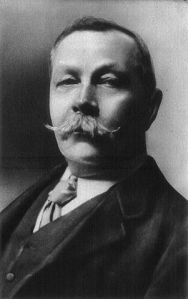
by Sir Arthur Conan Doyle
(1922)
from Tales of Terror and Mystery
The Project Gutenberg E-text
This eBook is for the use of anyone anywhere at no cost and with
almost no restrictions whatsoever. You may copy it, give it away or
re-use it under the terms of the Project Gutenberg License included
with this eBook or online at http://www.gutenberg.net
The relations between Douglas Stone and the notorious Lady Sannox were very well known both among the fashionable circles of which she was a brilliant member, and the scientific bodies which numbered him among their most illustrious confreres. There was naturally, therefore, a very widespread interest when it was announced one morning that the lady had absolutely and for ever taken the veil, and that the world would see her no more. When, at the very tail of this rumour, there came the assurance that the celebrated operating surgeon, the man of steel nerves, had been found in the morning by his valet, seated on one side of his bed, smiling pleasantly upon the universe, with both legs jammed into one side of his breeches and his great brain about as valuable as a cap full of porridge, the matter was strong enough to give quite a little thrill of interest to folk who had never hoped that their jaded nerves were capable of such a sensation.
Douglas Stone in his prime was one of the most remarkable men in England. Indeed, he could hardly be said to have
ever reached his prime, for he was but nine-and-thirty at the time of this little incident. Those who knew him best were aware that famous as he was as a surgeon, he might have succeeded with even greater rapidity in any of a dozen lines of life. He could have cut his way to fame as a soldier, struggled to it as an explorer, bullied for it in the courts, or built it out of stone and iron as an engineer. He was born to be great, for he could plan what another man dare not do, and he could do what another man dare not plan. In surgery none could follow him. His nerve, his judgement, his intuition, were things apart. Again and again his knife cut away death, but grazed the very springs of life in doing it, until his assistants were as white as the patient. His energy, his audacity, his full-blooded self-confidence—does not the memory of them still linger to the south of Marylebone Road and the north of Oxford Street?
His vices were as magnificent as his virtues, and infinitely more picturesque. Large as was his income, and it was the third largest of all professional men in London, it was far beneath the luxury of his living. Deep in his complex nature lay a rich vein of sensualism, at the sport of which he placed all the prizes of his life. The eye, the ear, the touch, the palate, all were his masters. The bouquet of old vintages, the scent of rare exotics, the curves and tints of the daintiest potteries of Europe, it was to these that the quick-running stream of gold was transformed. And then there came his sudden mad passion for Lady Sannox, when a single interview with two challenging glances and a whispered word set him ablaze. She was the loveliest woman in London and the only one to him. He was one of the handsomest men in London, but not the only one to her. She had a liking for new experiences, and was gracious to most men who wooed her. It may have been cause or it may have been effect that Lord Sannox looked fifty, though he was but six-and-thirty.
He was a quiet, silent, neutral-tinted man, this lord, with thin lips and heavy eyelids, much given to gardening, and full of home-like habits. He had at one time been fond of acting, had even rented a theatre in London, and on its boards had first seen Miss Marion Dawson, to whom he had offered his hand, his title, and the third of a county. Since his marriage his early hobby had become distasteful to him. Even in private theatricals it was no longer possible to persuade him to exercise the talent which he had often showed that he possessed. He was happier with a spud and a watering-can among his orchids and chrysanthemums.
It was quite an interesting problem whether he was absolutely devoid of sense, or miserably wanting in spirit. Did he know his lady’s ways and condone them, or was he a mere blind, doting fool? It was a point to be discussed over the teacups in snug little drawing-rooms, or with the aid of a cigar in the bow windows of clubs. Bitter and plain were the comments among men upon his conduct. There was but one who had a good word to say for him, and he was the most silent member in the smoking-room. He had seen him break in a horse at the University, and it seemed to have left an impression upon his mind.
But when Douglas Stone became the favourite all doubts as to Lord Sannox’s knowledge or ignorance were set for ever at rest. There was no subterfuge about Stone. In his high-handed, impetuous fashion, he set all caution and discretion at defiance. The scandal became notorious. A learned body intimated that his name had been struck from the list of its vice-presidents. Two friends implored him to consider his professional credit. He cursed them all three, and spent forty guineas on a bangle to take with him to the lady. He was at her house every evening, and she drove in his carriage in the afternoons. There was not an attempt on either side to conceal their relations; but there came at last a little incident to interrupt them.
It was a dismal winter’s night, very cold and gusty, with the wind whooping in the chimneys and blustering against the window-panes. A thin spatter of rain tinkled on the glass with each fresh sough of the gale, drowning for the instant the dull gurgle and drip from the eaves. Douglas Stone had finished his dinner, and sat by his fire in the study, a glass of rich port upon the malachite table at his elbow. As he raised it to his lips, he held it up against the lamplight, and watched with the eye of a connoisseur the tiny scales of beeswing which floated in its rich ruby depths. The fire, as it spurted up, threw fitful lights upon his bald, clear-cut face, with its widely-opened grey eyes, its thick and yet firm lips, and the deep, square jaw, which had something Roman in its strength and its animalism. He smiled from time to time as he nestled back in his luxurious chair. Indeed, he had a right to feel well pleased, for, against the advice of six colleagues, he had performed an operation that day of which only two cases were on record, and the result had been brilliant beyond all expectation. No other man in London would have had the daring to plan, or the skill to execute, such a heroic measure.
But he had promised Lady Sannox to see her that evening and it was already half-past eight. His hand was outstretched to the bell to order the carriage when he heard the dull thud of the knocker. An instant later there was the shuffling of feet in the hall, and the sharp closing of a door.
“A patient to see you, sir, in the consulting room,” said the butler.
“About himself?”
“No, sir; I think he wants you to go out.”
“It is too late,” cried Douglas Stone peevishly. “I won’t go.”
“This is his card, sir.”
The butler presented it upon the gold salver which had been given to his master by the wife of a Prime Minister.
“‘Hamil Ali, Smyrna.’ Hum! The fellow is a Turk, I suppose.”
“Yes, sir. He seems as if he came from abroad, sir. And he’s in a terrible way.”
“Tut, tut! I have an engagement. I must go somewhere else. But I’ll see him. Show him in here, Pim.”
A few moments later the butler swung open the door and ushered in a small and decrepit man, who walked with a bent back and with the forward push of the face and blink of the eyes which goes with extreme short sight. His face was swarthy, and his hair and beard of the deepest black. In one hand he held a turban of white muslin striped with red, in the other a small chamois-leather bag.
“Good evening,” said Douglas Stone, when the butler had closed the door. “You speak English, I presume?”
“Yes, sir. I am from Asia Minor, but I speak English when I speak slow.”
“You wanted me to go out, I understand?”
“Yes, sir. I wanted very much that you should see my wife.”
“I could come in the morning, but I have an engagement which prevents me from seeing your wife tonight.”
The Turk’s answer was a singular one. He pulled the string which closed the mouth of the chamois-leather bag, and poured a flood of gold on to the table.
“There are one hundred pounds there,” said he, “and I promise you that it will not take you an hour. I have a cab ready at the door.”
Douglas Stone glanced at his watch. An hour would not make it too late to visit Lady Sannox. He had been there later. And the fee was an extraordinarily high one. He had been pressed by his creditors lately, and he could not afford to let such a chance pass. He would go.
“What is the case?” he asked.
“Oh, it is so sad a one! So sad a one! You have not, perhaps heard of the daggers of the Almohades?”
“Never.”
“Ah, they are Eastern daggers of a great age and of a singular shape, with the hilt like what you call a stirrup. I am a curiosity dealer, you understand, and that is why I have come to England from Smyrna, but next week I go back once more. Many things I brought with me, and I have a few things left, but among them, to my sorrow, is one of these daggers.”
“You will remember that I have an appointment, sir,” said the surgeon, with some irritation; “pray confine yourself to the necessary details.”
“You will see that it is necessary. Today my wife fell down in a faint in the room in which I keep my wares, and she cut her lower lip upon this cursed dagger of Almohades.”
“I see,” said Douglas Stone, rising. “And you wish me to dress the wound?”
“No, no, it is worse than that.”
“What then?”
“These daggers are poisoned.”
“Poisoned!”
“Yes, and there is no man, East or West, who can tell now what is the poison or what the cure. But all that is known I know, for my father was in this trade before me, and we have had much to do with these poisoned weapons.”
“What are the symptoms?”
“Deep sleep, and death in thirty hours.”
“And you say there is no cure. Why then should you pay me this considerable fee?”
“No drug can cure, but the knife may.”
“And how?”
“The poison is slow of absorption. It remains for hours in the wound.”
“Washing, then, might cleanse it?”
“No more than in a snake bite. It is too subtle and too deadly.”
“Excision of the wound, then?”
“That is it. If it be on the finger, take the finger off. So said my father always. But think of where this wound is, and that it is my wife. It is dreadful!”
But familiarity with such grim matters may take the finer edge from a man’s sympathy. To Douglas Stone this was already an interesting case, and he brushed aside as irrelevant the feeble objections of the husband.
“It appears to be that or nothing,” said he brusquely. “It is better to lose a lip than a life.”
“Ah, yes, I know that you are right. Well, well, it is kismet, and it must be faced. I have the cab, and you will come with me and do this thing.”
Douglas Stone took his case of bistouries from a drawer, and placed it with a roll of bandage and a compress of lint in his pocket. He must waste no more time if he were to see Lady Sannox.
“I am ready,” said he, pulling on his overcoat. “Will you take a glass of wine before you go out into this cold air?”
His visitor shrank away, with a protesting hand upraised.
“You forget that I am a Mussulman, and a true follower of the Prophet,” said he. “But tell me what is the bottle of green glass which you have placed in your pocket?”
“It is chloroform.”
“Ah, that also is forbidden to us. It is a spirit, and we make no use of such things.”
“What! You would allow your wife to go through an operation without an anaesthetic?”
“Ah! she will feel nothing, poor soul. The deep sleep has already come on, which is the first working of the poison. And then I have given her of our Smyrna opium. Come, sir, for already an hour has passed.”
As they stepped out into the darkness, a sheet of rain was driven in upon their faces, and the hall lamp, which dangled from the arm of a marble Caryatid, went out with a fluff. Pim, the butler, pushed the heavy door to, straining hard with his shoulder against the wind, while the two men groped their way towards the yellow glare which showed where the cab was waiting. An instant later they were rattling upon their journey.
“Is it far?” asked Douglas Stone.
“Oh, no. We have a very little quiet place off the Euston Road.”
The surgeon pressed the spring of his repeater and listened to the little tings which told him the hour. It was a quarter past nine. He calculated the distances, and the short time which it would take him to perform so trivial an operation. He ought to reach Lady Sannox by ten o’clock. Through the fogged windows he saw the blurred gas lamps dancing past, with occasionally the broader glare of a shop front. The rain was pelting and rattling upon the leathern top of the carriage, and the wheels swashed as they rolled through puddle and mud. Opposite to him the white headgear of his companion gleamed faintly through the obscurity. The surgeon felt in his pockets and arranged his needles, his ligatures and his safety-pins, that no time might be wasted when they arrived. He chafed with impatience and drummed his foot upon the floor.
But the cab slowed down at last and pulled up. In an instant Douglas Stone was out, and the Smyrna merchant’s toe was at his very heel.
“You can wait,” said he to the driver.
It was a mean-looking house in a narrow and sordid street. The surgeon, who knew his London well, cast a swift glance into the shadows, but there was nothing distinctive—no shop, no movement, nothing but a double line of dull, flat-faced houses, a double stretch of wet flagstones which gleamed in the lamplight, and a double rush of water in the gutters which swirled and gurgled towards the sewer gratings. The door which faced them was blotched and discoloured, and a faint light in the fan pane above, it served to show the dust and the grime which covered it. Above in one of the bedroom windows, there was a dull yellow glimmer. The merchant knocked loudly, and, as he turned his dark face towards the light, Douglas Stone could see that it was contracted with anxiety. A bolt was drawn, and an elderly woman with a taper stood in the doorway, shielding the thin flame with her gnarled hand.
“Is all well?” gasped the merchant.
“She is as you left her, sir.”
“She has not spoken?”
“No, she is in a deep sleep.”
The merchant closed the door, and Douglas Stone walked down the narrow passage, glancing about him in some surprise as he did so. There was no oil-cloth, no mat, no hat-rack. Deep grey dust and heavy festoons of cobwebs met his eyes everywhere. Following the old woman up the winding stair, his firm footfall echoed harshly through the silent house. There was no carpet.
The bedroom was on the second landing. Douglas Stone followed the old nurse into it, with the merchant at his heels. Here, at least, there was furniture and to spare. The floor was littered and the corners piled with Turkish cabinets, inlaid tables, coats of chain mail, strange pipes, and grotesque weapons. A single small lamp stood upon a bracket on the wall. Douglas Stone took it down, and picking his way among the lumber, walked over to a couch in the corner, on which lay a woman dressed in the Turkish fashion, with yashmak and veil. The lower part of the face was exposed, and the surgeon saw a jagged cut which zigzagged along the border of the under lip.
“You will forgive the yashmak,” said the Turk. “You know our views about women in the East.”
But the surgeon was not thinking about the yashmak. This was no longer a woman to him. It was a case. He stooped and examined the wound carefully.
“There are no signs of irritation,” said he. “We might delay the operation until local symptoms develop.”
The husband wrung his hands in uncontrollable agitation.
“Oh! sir, sir,” he cried. “Do not trifle. You do not know. It is deadly. I know, and I give you my assurance that an operation is absolutely necessary. Only the knife can save her.”
“And yet I am inclined to wait,” said Douglas Stone.
“That is enough,” the Turk cried, angrily. “Every minute is of importance, and I cannot stand here and see my wife allowed to sink. It only remains for me to give you my thanks for having come, and to call in some other surgeon before it is too late.”
Douglas Stone hesitated. To refund that hundred pounds was no pleasant matter. But of course if he left the case he must return the money. And if the Turk were right and the woman died, his position before a coroner might be an embarrassing one.
“You have had personal experience of this poison?” he asked.
“I have.”
“And you assure me that an operation is needful.”
“I swear it by all that I hold sacred.”
“The disfigurement will be frightful.”
“I can understand that the mouth will not be a pretty one to kiss.”
Douglas Stone turned fiercely upon the man. The speech was a brutal one. But the Turk has his own fashion of talk and of thought, and there was no time for wrangling. Douglas Stone drew a bistoury from his case, opened it and felt the keen straight edge with his forefinger. Then he held the lamp closer to the bed. Two dark eyes were gazing up at him through the slit in the yashmak. They were all iris, and the pupil was hardly to be seen.
“You have given her a very heavy dose of opium.”
“Yes, she has had a good dose.”
He glanced again at the dark eyes which looked straight at his own. They were dull and lustreless, but, even as he gazed, a little shifting sparkle came into them, and the lips quivered.
“She is not absolutely unconscious,” said he.
“Would it not be well to use the knife while it will be painless?”
The same thought had crossed the surgeon’s mind. He grasped the wounded lip with his forceps, and with two swift cuts he took out a broad V-shaped piece. The woman sprang up on the couch with a dreadful gurgling scream. Her covering was torn from her face. It was a face that he knew. In spite of that protruding upper lip and that slobber of blood, it was a face that he knew, She kept on putting her hand up to the gap and screaming. Douglas Stone sat down at the foot of the couch with his knife and his forceps. The room was whirling round, and he had felt something go like a ripping seam behind his ear. A bystander would have said that his face was the more ghastly of the two. As in a dream, or as if he had been looking at something at the play, he was conscious that the Turk’s hair and beard lay upon the table, and that Lord Sannox was leaning against the wall with his hand to his side, laughing silently. The screams had died away now, and the dreadful head had dropped back again upon the pillow, but Douglas Stone still sat motionless, and Lord Sannox still chuckled quietly to himself.
“It was really very necessary for Marion, this operation,” said he, “not physically, but morally, you know, morally.”
Douglas Stone stooped for yards and began to play with the fringe of the coverlet. His knife tinkled down upon the ground, but he still held the forceps and something more.
“I had long intended to make a little example,” said Lord Sannox, suavely. “Your note of Wednesday miscarried, and I have it here in my pocket-book. I took some pains in carrying out my idea. The wound, by the way, was from nothing more dangerous than my signet ring.”
He glanced keenly at his silent companion, and cocked the small revolver which he held in his coat pocket. But Douglas Stone was still picking at the coverlet.
“You see you have kept your appointment after all,” said Lord Sannox.
And at that Douglas Stone began to laugh. He laughed long and loudly. But Lord Sannox did not laugh now. Something like fear sharpened and hardened his features. He walked from the room, and he walked on tiptoe. The old woman was waiting outside.
“Attend to your mistress when she awakes,” said Lord Sannox.
Then he went down to the street. The cab was at the door, and the driver raised his hand to his hat.
“John,” said Lord Sannox, “you will take the doctor home first. He will want leading downstairs, I think. Tell his butler that he has been taken ill at a case.”
“Very good, sir.”
“Then you can take Lady Sannox home.”
“And how about yourself, sir?”
“Oh, my address for the next few months will be Hotel di Roma, Venice. Just see that the letters are sent on. And tell Stevens to exhibit all the purple chrysanthemums next Monday, and to wire me the result.”
 Phil Slattery, Writer, Publisher