
as Count Dracula
1931
Here is an interesting bit of trivia: “8 Monsters of Literature and Folklore” at Dictionary.com – Free Online English Dictionary. You may have to wait a second or two for the slide show to pop up.

Here is an interesting bit of trivia: “8 Monsters of Literature and Folklore” at Dictionary.com – Free Online English Dictionary. You may have to wait a second or two for the slide show to pop up.
Here are some intriguing words that may be of interest to writers of horror or to writers in general. Most come from Dictionary.com. I hope to be posting more from time to time. Every field has its own jargon. The writing of horror should have its own. I have taken these from two or three sources.
hadal: adjective: 1. of or pertaining to the greatest ocean depths, below approximately 20,000 feet (6500 meters). 2. of or pertaining to the biogeographic region of the ocean bottom below the abyssal zone. Hadal entered English in the mid-1900s, and comes from the name Hades, the Greek god of the underworld.
de profundis adverb: out of the depths (of sorrow, despair, etc.). De profundis means “out of the depths” in Latin. It is the opening of Latin translation of Psalm 130 which continues “Out of the depths I cry to you.” Today the term can be used as a phrase to convey sadness or as an adverb.
isolato noun: a person who is spiritually isolated from or out of sympathy with his or her times or society.
mordacious adjective: 1. sharp or caustic in style, tone, etc. 2. biting or given to biting.
topos noun: a convention or motif, especially in a literary work; a rhetorical convention.
Anacoluthon (an-uh-kuh-LOO-thon) noun: 1. A construction involving a break in grammatical sequence, as It makes me so—I just get angry. 2. An instance of anacoluthia.
Catachresis (kat-uh-KREE-sis) noun: Misuse or strained use of words, as in a mixed metaphor, occurring either in error or for rhetorical effect.
Apophasis (uh-POF-uh-sis), noun: Denial of one’s intention to speak of a subject that is at the same time named or insinuated, as “I shall not mention Caesar’s avarice, nor his cunning, nor his morality.”
Palter (PAWL-ter) verb: 1. To talk or act insincerely or deceitfully; lie or use trickery. 2. To bargain with; haggle. 3. To act carelessly; trifle.
Questions? Comments?

Here is a fascinating article about the founding father of modern horror: Edgar Allan Poe: Poet and Prophet | Interesting Literature. Interestingly, it states that the story about Edgar Allan Poe in his white belt and gloves at West Point, which I quoted in an earlier post from The Writer’s Home Companion, is urban legend. It goes on to state several fascinating bits of trivia about Poe including his involvement in the development of the detective story and the short story, the backgrounds of some of his most famous works, his passion for cryptography, his foreshadowing of the Big Bang Theory, criticisms of his work by William Butler Yeats and T.S. Eliot, and some insights on his personal and financial life.

The other day I happened to find my copy of The Writer’s Home Companion (by James Charlton and Lisbeth Mark, 1987), which I had lost/forgotten some time back. I have been perusing it since and have found several anecdotes on various authors of horror, which had not captured my attention when I purchased the book, because I was not interested in writing horror at the time. I am quoting them below for your entertainment and consideration. They provide a few insights and lessons into the art and business of writing as well as into the lives of writers, if not in the art of horror specifically. If you would like to read more of the book, you can probably find a copy at your local library or half-price bookstore.
“Edgar Allan Poe opted to self-publish Tamerlane and Other Poems. He was able to sell only forty copies and made less than a dollar after expenses. Ironically, over a century later, one of his self-published copies sold at auction for over $11,000.”

“Stephen King sent his first novel to the editor of the suspense novel The Parallax View. William G. Thompson rejected that submission and several subsequent manuscripts until King sent along Carrie. Years later some of those earlier projects were published under King’s pseudonym Richard Bachmann, and one was affectionately dedicated to ‘W.G.T.'”
“Edgar Allan Poe perpetrated a successful hoax in the New York Sun with an article he wrote in the April 13, 1844 edition of the paper. He described the arrival, near Charleston, South Carolina, of a group of English ‘aeronauts’ who, as he told the story, had crossed the Atlantic in a dirigible in just seventy-five hours. Poe had cribbed most of his narrative from an account by Monck Mason of an actual balloon trip he and his companions had made from London to Germany in November 1836. Poe’s realistically detailed fabrication fooled everyone.”

“Robert Louis Stevenson was thrashing about in his bed one night, greatly alarming his wife. She woke him up, infuriating Stevenson, who yelled, ‘I was dreaming a fine bogey tale!’ The nightmare from which he had been unwillingly extracted was the premise for the story of Dr. Jekyll and Mr. Hyde.”
“Amiably discussing the validity of ghosts, Lord Byron and Percy Bysshe Shelley decided to try their poetic skills at writing the perfect horror story. While nothing came of their efforts, Shelley’s young wife, Mary Wollstonecroft, overheard the challenge and went about telling her own. It began ‘It was on a dreary night of November that I beheld the Accomplishment of my toils.’ Her work was published in 1818, when she was twenty-one, and was titled Frankenstein.”
“Edgar Allan Poe was expelled from West Point in 1831 for ‘gross neglect of duty’. The explanation for his dismissal had to do with his following, to the letter, with an order to appear on the parade grounds in parade dress, which, according to the West Point rule book, consisted of ‘white belt and gloves.’ Poe reportedly arrived with his rifle, dressed in his belt and gloves–and nothing else.”

“Traveling along the Italian Riviera, Lord Bulwer-Lytton, done up in an embarrassingly elaborate outfit, acknowledged the stares of passersby. Lady Lytton, amused at his vanity, suggested that it was not admiration, but ‘that ridiculous dress’ that caught people’s eyes. Lytton responded, ‘You think that people stare at my dress and not at me? I will give you the most absolute and convincing proof that your theory has no foundation.’ Keeping on only his hat and boots, Lytton removed every other article of clothing and rode in his open carriage for ten miles to prove his point.”
If you have anecdotes about your favorite authors that you would like to share, please do.
Questions? Comments?

Yesterday, I happened across a good article at Vocabulary.com that cleared up something for me and so I thought I would pass along the info. Have you ever wondered about the difference between assure, ensure, and insure? Here is the answer: Assure/Ensure/Insure.
Here is another blog post that I happened across recently. You may find it of interest with regards to writing in general.
The Importance of Being Interesting | READ | Research in English at Durham.

Here are a few delightful bits about the author of The Picture of Dorian Gray.
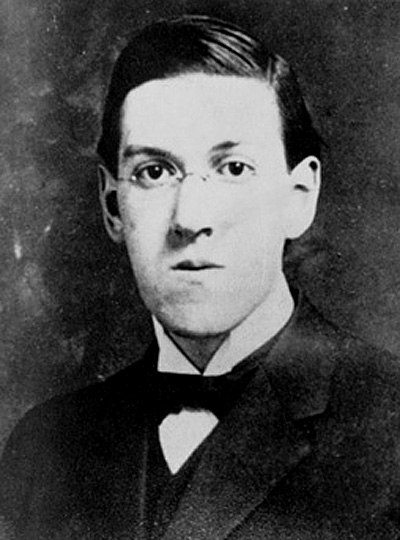
Here’s a nice bit of humor for the day: McSweeney’s Internet Tendency: Selections From H.P. Lovecraft’s Brief Tenure as a Whitman’s Sampler Copywriter..
Five Reasons Everyone Should Know Sir Edward Bulwer-Lytton | Interesting Literature.
I found this article at http://www.interestingliterature.wordpress.com just a few minutes ago. Though the article does not deal with horror per se, the article will be of interest to horror aficionados (especially horror-historians) because for a short time Sir Edward Bulwer-Lytton was one of the more famous writers of horror during the nineteenth century. His work of horror, “The House and the Brain”, is mentioned in Lovecraft’s famous essay “Supernatural Horror in Literature”. Lovecraft said of Bulwer-Lytton:
“At this time a wave of interest in spiritualistic charlatanry, mediumism, Hindoo theosophy, and such matters, much like that of the present day, was flourishing; so that the number of weird tales with a ‘psychic” or pseudoscientific basis became very considerable. For a number of these the prolific and popular Edward Bulwer-Lytton was responsible; and despite the large doses of turgid rhetoric and empty romanticism in his products, his success in the weaving of a certain kind of bizarre charm cannot be denied.”
Lovecraft goes on to discuss with some degree of praise three of Bulwer-Lytton’s works: the short story “The House and the Brain” and the novels Zanoni and A Strange Story. I read “The House and the Brain” some time back and found it an interesting story (though a little long) and even riveting in some parts. It is about a man who decides to spend the night in a haunted house where no one has been able to stay for very long because it is inhabited by terrifying apparitions. True to the style of many nineteenth-century stories, the intrepid protagonist finds something of a scientific explanation behind the haunting. It is definitely worth reading.
I have mentioned Bulwer-Lytton and some of the things for which he is famous in my previous post “The Best Literary Facts from the Twitterverse”, which was also reposted from http://www.interestingliterature.wordpress.com. You might want to check it out for a few additional facts.
Thoughts? Comments?
One of the several books I am reading currently is an anthology of Lovecraft’s dream cycle. Its story that I am reading now is “The Dream-Quest of the Unknown Kadath”. I wrote up my views on the work today for Goodreads.com and thought I would share them here as well (though in a slightly modified version):
I am a Lovecraft fan, but I find “The Dream-Quest…” very tough reading. I want to finish it, if for no other reason than to be able to say I managed to struggle my way through it and achieve my goal in spite of the hardships I encountered like the explorer of a literary Amazon.
The language is cumbersome and the plot is just Randolph Carter escaping one bad situation after another by luck. Still, I am only about half-way through, and the optimistic side of me keeps hoping it gets better. I don’t have much hope though, particularly after reading part of the Wikipedia article on it, which gives Lovecraft’s own views, which echo my own:
“Lovecraft himself declared that ‘it isn’t much good; but forms useful practice for later and more authentic attempts in the novel form.’ He expressed concern while writing it that ‘Randolph Carter’s adventures may have reached the point of palling on the reader; or that the very plethora of weird imagery may have destroyed the power of any one image to produce the desired impression of strangeness.”[8]
In the paragraph preceding this one in Wikipedia, Joanna Russ sums up the work nicely:
“The Dream-Quest has evoked a broad range of reactions, “some HPL enthusiasts finding it almost unreadable and others…comparing it to the Alice books and the fantasies of George MacDonald.[6] Joanna Russ referred to The Dream-Quest as “charming…but alas, never rewritten or polished”. [7]
Count me among the ones who find it almost unreadable, with its awkward, first-draft phrasing and its confused attempt to set a tone using an imagined scholarly, courtly language somewhere between Shakespeare and Poe.
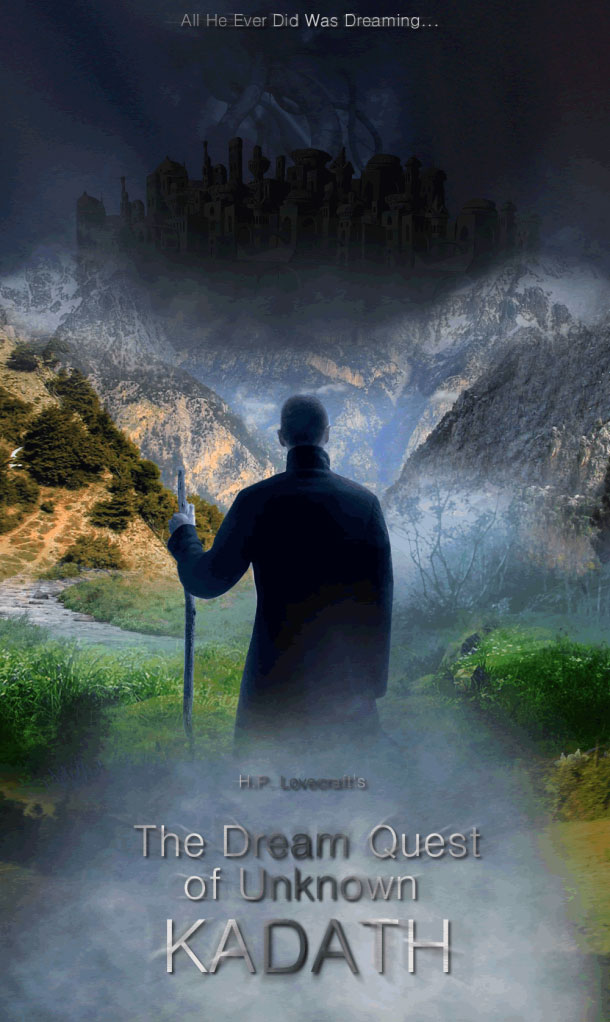
However, I do love this awesome poster, which I found at http://gatostudio.wordpress.com/2009/03/21/the-dream-quest-of-unknown-kadath-poster/. Please visit this beautiful site. If you decide you would like to use this poster, please check with gatostudio and adhere to all copyright restrictions.
I just wish Lovecraft had written the story as masterfully as Mr. Gonzalez drew his poster and H.P. had lived up to the promise of the fantastic adventure to which the poster alludes. The poster really outshines the story. Given another two or three drafts, this story may have outshone all of Lovecraft’s other works.
Thoughts? Comments?
Here’s a good review of one of the forgotten masters: Joseph Sheridan Le Fanu. For more on Le Fanu, check out my previous post on him.

In A Glass Darkly
By Sheridan Le Fanu
Format: Paperback, 272 pages.
Publisher: Wordsworth Editions, 2007.
What are the chances of two horror novels being reviewed in the space of a couple of weeks with titles based on 1 Corinthians 13 (“For now we see through a glass, darkly”), kind of slim, but that’s the kind of joined up thinking you get at Highlanders Book Reviews (or pure jammy fluke as they say round these parts!). Perhaps what’s more fascinating is that without Sheridan Le Fanu’s misquote it is highly unlikely that we would have ever arrived at Bill Hussey’s Through A Glass Darkly despite the 136 year gap, let me explain.
Joseph Thomas Sheridan Le Fanu was an Irish writer who, during the 19th C, was one of the founders of the written ghost story. For a more detailed biography have a look here or here but bear…
View original post 505 more words
http://interestingliterature.wordpress.com/2013/09/06/the-best-literary-facts-from-the-twitterverse/
Follow the link above for some fascinating literary tidbits. If you don’t have the time to wade through all for the horror triva, here they are:
Bram Stoker’s wife, Florence Balcombe, was previously suitored by Oscar Wilde. (@l0lhey)
In 1862, Sir Edward Bulwer-Lytton was offered the chance to be King of Greece. (@LeighaMcR)
Dickens & Poe were friends. 3 letters between them survive (alas, letters don’t mention of the death of Dickens’ pet raven). (@LauraShovan)
Sir Edward Bulwer-Lytton, for those of you not into horror esoterica, was a well-known writer of the nineteenth century who dabbled in a variety of genres. H.P. Lovecraft thought highly of his story “The House and the Brain”, which is included in the collection The World’s Greatest Horror Stories (2004, edited by Stephen Jones and Dave Carson). According to Wikipedia, Bulwer-Lytton was the originator of some very famous and very frequently coined phrases that are still around: “the pen is mightier than the sword”, “the great unwashed”, and “the almighty dollar”. Bulwer-Lytton also invented that well-known line with which Snoopy invariably starts his novel in “Peanuts”: “it was a dark and stormy night…”
Thoughts? Comments?

Elmore Leonard passed away the other day and today a friend of mine posted this on Facebook in his honor. It contains some great tips on writing in general. Enjoy. Mr. Leonard will be sorely missed. Unfortunately, I have read only a small fraction of his works, but I do have one or two of his books on my shelves waiting to be read.
These are rules I’ve picked up along the way to help me remain invisible when I’m writing a book, to help me show rather than tell what’s taking place in the story. If you have a facility for language and imagery and the sound of your voice pleases you, invisibility is not what you are after, and you can skip the rules. Still, you might look them over.
1. Never open a book with weather.
If it’s only to create atmosphere, and not a character’s reaction to the weather, you don’t want to go on too long. The reader is apt to leaf ahead looking for people. There are exceptions. If you happen to be Barry Lopez, who has more ways to describe ice and snow than an Eskimo, you can do all the weather reporting you want.
2. Avoid prologues.
They can be annoying, especially a prologue following an introduction that comes after a foreword. But these are ordinarily found in nonfiction. A prologue in a novel is backstory, and you can drop it in anywhere you want.
There is a prologue in John Steinbeck’s ”Sweet Thursday,” but it’s O.K. because a character in the book makes the point of what my rules are all about. He says: ”I like a lot of talk in a book and I don’t like to have nobody tell me what the guy that’s talking looks like. I want to figure out what he looks like from the way he talks. . . . figure out what the guy’s thinking from what he says. I like some description but not too much of that. . . . Sometimes I want a book to break loose with a bunch of hooptedoodle. . . . Spin up some pretty words maybe or sing a little song with language. That’s nice. But I wish it was set aside so I don’t have to read it. I don’t want hooptedoodle to get mixed up with the story.”
3. Never use a verb other than ”said” to carry dialogue.
The line of dialogue belongs to the character; the verb is the writer sticking his nose in. But said is far less intrusive than grumbled, gasped, cautioned, lied. I once noticed Mary McCarthy ending a line of dialogue with ”she asseverated,” and had to stop reading to get the dictionary.
4. Never use an adverb to modify the verb ”said” . . .
. . . he admonished gravely. To use an adverb this way (or almost any way) is a mortal sin. The writer is now exposing himself in earnest, using a word that distracts and can interrupt the rhythm of the exchange. I have a character in one of my books tell how she used to write historical romances ”full of rape and adverbs.”
5. Keep your exclamation points under control.
You are allowed no more than two or three per 100,000 words of prose. If you have the knack of playing with exclaimers the way Tom Wolfe does, you can throw them in by the handful.
6. Never use the words ”suddenly” or ”all hell broke loose.”
This rule doesn’t require an explanation. I have noticed that writers who use ”suddenly” tend to exercise less control in the application of exclamation points.
7. Use regional dialect, patois, sparingly.
Once you start spelling words in dialogue phonetically and loading the page with apostrophes, you won’t be able to stop. Notice the way Annie Proulx captures the flavor of Wyoming voices in her book of short stories ”Close Range.”
8. Avoid detailed descriptions of characters.
Which Steinbeck covered. In Ernest Hemingway’s ”Hills Like White Elephants” what do the ”American and the girl with him” look like? ”She had taken off her hat and put it on the table.” That’s the only reference to a physical description in the story, and yet we see the couple and know them by their tones of voice, with not one adverb in sight.
9. Don’t go into great detail describing places and things.
Unless you’re Margaret Atwood and can paint scenes with language or write landscapes in the style of Jim Harrison. But even if you’re good at it, you don’t want descriptions that bring the action, the flow of the story, to a standstill.
And finally:
10. Try to leave out the part that readers tend to skip.
A rule that came to mind in 1983. Think of what you skip reading a novel: thick paragraphs of prose you can see have too many words in them. What the writer is doing, he’s writing, perpetrating hooptedoodle, perhaps taking another shot at the weather, or has gone into the character’s head, and the reader either knows what the guy’s thinking or doesn’t care. I’ll bet you don’t skip dialogue.
My most important rule is one that sums up the 10.
If it sounds like writing, I rewrite it.
Or, if proper usage gets in the way, it may have to go. I can’t allow what we learned in English composition to disrupt the sound and rhythm of the narrative. It’s my attempt to remain invisible, not distract the reader from the story with obvious writing. (Joseph Conrad said something about words getting in the way of what you want to say.)
If I write in scenes and always from the point of view of a particular character — the one whose view best brings the scene to life — I’m able to concentrate on the voices of the characters telling you who they are and how they feel about what they see and what’s going on, and I’m nowhere in sight.
What Steinbeck did in ”Sweet Thursday” was title his chapters as an indication, though obscure, of what they cover. ”Whom the Gods Love They Drive Nuts” is one, ”Lousy Wednesday” another. The third chapter is titled ”Hooptedoodle 1” and the 38th chapter ”Hooptedoodle 2” as warnings to the reader, as if Steinbeck is saying: ”Here’s where you’ll see me taking flights of fancy with my writing, and it won’t get in the way of the story. Skip them if you want.”
”Sweet Thursday” came out in 1954, when I was just beginning to be published, and I’ve never forgotten that prologue.
Did I read the hooptedoodle chapters? Every word.
Writers on Writing
This article is part of a series in which writers explore literary themes. Previous contributions, including essays by John Updike, E. L. Doctorow, Ed McBain, Annie Proulx, Jamaica Kincaid, Saul Bellow and others, can be found with this article at The New York Times on the Web:
For those of you dealing with the demon of literary Rejection right now, please follow the link to a nice, very concise article by Rachael Stanford by on the same. Once you have finished, follow the link at the bottom of the article to a fascinating article by Stephanie Ostroff about how nine famous authors (C.S. Lewis, Anne Frank, Rudyard Kipling, Jack Kerouac, H.G. Wells, Louisa May Alcott, George Orwell, Sylvia Plath, and William Golding) were rejected often hundreds of time, often quite rudely or in a demeaning fashion, yet persevered to become some of the world’s best known writers.
I like stories of rejection like these, because they remind me that not all publishers are as insightful as we writers hope they are. As with all other occupations, there are publishers who are better or worse at their jobs than others. Therefore, if one of my works is rejected, even numerous times, it does not mean that the work is necessarily a stinker. On the other hand, I must confess to have written at least a few stinkers, and therefore I cannot in all good conscience blame publishers for all my bad luck either.
For me, being honest with myself and critically looking at a work that has been rejected several times to determine whether I have honestly done my best with it or if it simply didn’t meet the publisher’s needs at the moment or if the publisher has sufficient I.Q. points to function reasonably well in human society is one of the hardest parts of writing (not writing rambling, run-on sentences like this one is another challenge).
Now I submit everything electronically. Twenty years ago, when I first started writing, I submitted everything by mail. I always kept a file of the rejection slips I collected, so I would always have a working list of who would be eating a heaping dish of crow when I became famous. In fact, for several years I used to pin them to a bulletin board so I could look at them and smirk now and then. I still keep my electronic rejections, though I still need to create a file for them, for the same reason.
I have yet to become famous and the list is still growing, but having all those rejections gives me something to which I can look forward. At least they serve a purpose, which they would not if I took them seriously and let them drag me down: they give me encouragement and they help me persevere by instilling a spirit to prevail.
Thoughts? Comments?
Padre Island, January, 2011.
I read “The Illustrated Man” for the first time yesterday. I have been interested in reading it for many years now, after having seen the movie starring Rod Steiger as a television re-run perhaps as far back as the 70’s. But recently I have been reading “The Martian Chronicles” and when I found myself over the last few days in the Midland, TX public library with time to kill, I thought I would investigate other Bradbury works (even though I have “The Martian Chronicles” in the car).
The movie bears little resemblance to the short story. In the movie a young man (as best I recall) is camping in the woods as he travels across country, when Rod Steiger staggers into the man’s campsite. Somehow (my memory is vague) Steiger reveals his body is covered with tattoos and tells the camper that the future can be seen in the empty spaces on his chest and back. At this point, the spaces on his chest and back form the framework for a series of four short tales, which, if I recall correctly, are other Ray Bradbury stories. I will not reveal the end, which I recall as being quite good.
The actual story is not a collection of four stories, but a single tale of a man, William Philippus Phelps, who works erecting tents for a circus, but volunteers to become the tattooed man for the carnival sideshow after his weight balloons up to 300 pounds after he “stress-eats” because of the problems between himself and his new bride and he can no longer perform his job for the circus. Desperate to have any job at the circus, Phelps volunteers to have himself covered in tattoos. Someone steers him in the direction of an old woman who lives in the nearby woods and who does tattoos for free. He finds her and from her descrition (aged with eyes, nostrils, and ears sewn shut and living in a shack), she sounds very much like a witch. She inks the tattoos, which seem magically alive and writhing, but she also places a large bandage in the center of his chest and one in the center of his back and makes him swear not to remove the one on his chest for a week and the one on his back a week after that that. When Phelps does remove the one on his chest during the course of a show, it shows him strangling his wife, whom the tattoo witch had never seen. I won’t spoil the ending for you, which is quite enjoyable and reveals what is under the bandage on his back, because I strongly recommend that you read the story, which is only a few pages long.
Though Bradbury is, of course, world renown for his science fiction, this story falls much better into the horror genre. There is no science anywhere in story, only carnival folk, magical tattoos inked by a frightening witch, suspense, anger, and, ultimately, violence. The story is beautifully written with the language clear, concise, flowing, and simple yet powerful. I felt emotionally and intellectually drawn into the story and into Phelps’s life and felt empathy for his plight. This is an excellent work of horror, though its author’s fame as a demigod of science fiction undoubtedly has most people classify it erroneously.
Thoughts? Comments?

 Phil Slattery, Writer, Publisher