Story Review: Ray Bradbury’s “The Illustrated Man”

The blogger on Padre Island, January, 2011.

 Padre Island, January, 2011.

I read “The Illustrated Man” for the first time yesterday.  I have been interested in reading it for many years now, after having seen the movie starring Rod Steiger as a television re-run perhaps as far back as the 70’s.    But recently I have been reading “The Martian Chronicles” and when I found myself over the last few days in the Midland, TX public library with time to kill, I thought I would investigate other Bradbury works (even though I have “The Martian Chronicles” in the car).

The movie bears little resemblance to the short story.  In the movie a young man (as best I recall) is camping in the woods as he travels across country, when Rod Steiger staggers into the man’s campsite.  Somehow (my memory is vague) Steiger reveals his body is covered with tattoos and tells the camper that the future can be seen in the empty spaces on his chest and back.  At this point, the spaces on his chest and back form the framework for a series of four short tales, which, if I recall correctly, are other Ray Bradbury stories.    I will not reveal the end, which I recall as being quite good.

The actual story is not a collection of four stories, but a single tale of a man, William Philippus Phelps, who works erecting tents for a circus, but volunteers to become the tattooed man for the carnival sideshow after his weight balloons up to 300 pounds after he “stress-eats” because of the problems between himself and his new bride and he can no longer perform his job for the circus.  Desperate to have any job at the circus, Phelps volunteers to have himself covered in tattoos.   Someone steers him in the direction of an old woman who lives in the nearby woods and who does tattoos for free.   He finds her and from her descrition (aged with eyes, nostrils, and ears sewn shut and living in a shack), she sounds very much like a witch.    She inks the tattoos, which seem magically alive and writhing, but she also places a large bandage in the center of his chest and one in the center of his back and makes him swear not to remove the one on his chest for a week and the one on his back a week after that that.   When Phelps does remove the one on his chest during the course of a show, it shows him strangling his wife, whom the tattoo witch had never seen.  I won’t spoil the ending for you, which is quite enjoyable and reveals what is under the bandage on his back, because I strongly recommend that you read the story, which is only a few pages long.

Though Bradbury is, of course, world renown for his science fiction, this story falls much better into the horror genre.  There is no science anywhere in story, only carnival folk, magical tattoos inked by a frightening witch, suspense, anger, and, ultimately, violence.  The story is beautifully written with the language clear, concise, flowing, and simple yet powerful.  I felt emotionally and intellectually drawn into the story and into Phelps’s life and felt empathy for his plight.  This is an excellent work of horror, though its author’s fame as a demigod of science fiction undoubtedly has most people classify it erroneously.

Thoughts?  Comments?
Impressions of Five Writing Styles

I was in the Farmington public library yesterday trying to pull together some ideas for a story, but I could not concentrate long enough to formulate many good thoughts, because I felt more in a mood to receive information rather than to transmit.

Within the last few days I have started reading a collection of Lovecraft stories entitled The Dream Cycle of H.P. Lovecraft:  Dreams of Terror and Death (an excellent work; read it if you get the chance), edited by Neil Gaiman.  While wandering through the stacks, I pulled out a copy of Stephen King’s From a Buick 8 and took it back to my seat.  I had started reading it several years ago, but never finished it.  I thought I would review it and maybe start on it again soon.   As I read it, I noticed an interesting difference between King’s style and Lovecraft’s. Lovecraft gives a lot more of the backstory of a work in a few pages than King does.

As it so happens, I had also passed by the John Updike section a little earlier in the library and I have a few of his novels, which I have never read.  I went back and picked up his Rabbit, Run for comparison.  I thought about the differences between these three and a couple of other famous writers and came up with what I consider to be an interesting observation  (though it might bore those of you who are more advanced in the craft of writing than I am):  it is fascinating to see how much information about a work’s backstory or the larger setting of a story an author can put in the first 2-3 pages or so of a work.  For what it’s worth, here are my initial subjective impressions of the five writers under consideration yesterday.

In the first few pages of Rabbit, Run Updike details how Rabbit Angstrom happens to walk upon a basketball game among six kids in an alleyway (circa 1960). He watches and then joins the game, and impresses them with his basketball prowess, having been a high school basketball star about 8-9 years earlier.  He then goes home to where his wife is contemplating cooking dinner.   Updike takes us through this step by step and we don’t learn a lot other than Rabbit was a basketball star in high school several years back  and at 26 he has a middle class life now with a job for which he wears a suit to work.  I know that Updike is a very respected writer with two Pulitzers to his credit, but this story gets off to a very slow start for me and I learn very little about Rabbit Angstrom in the opening pages.  There is also very little emotional pull in these opening pages to draw me into the story.

In the opening chapter of A Farewell to Arms, Hemingway describes the scene from the window of an Italian house used as a hospital as troops pass en route to the Austrian front over the course of about a year.   He also describes how the leaves fall from a nearby tree and how the dust during the summers turns everything bone white, both of which (to me) symbolize the deaths of myriad troops on the front.   In maybe 2-3 pages, Hemingway not only gives us the overall setting of being at the Italo-Austrian front, he also draws us in with considerable emotional impact of the tragedy of the watching thousands of weary troops slogging through rain and mud or trudging through dust and heat on their way to their deaths.

In Quiet Flows the Don (1940), Soviet author Mikhail Sholokhov (winner of the 1965 Nobel prize for literature) describes the lives of Don Cossacks from before the First World War up to the Russian Revolution.  In its first few pages, Sholokhov describes life in a village of Cossacks, describes the relationship between father and son, shows how the son is having an affair with another Cossack’s wife, and shows the history and underlying peccadilloes of the family back for circa 200 years.  While his style is non-emotional, one cannot help but to feel for the family and to be drawn into the story.  It is a hard book to put down.

In From a Buick 8, Stephen King tells the story of a mysterious car that is kept in storage at a Pennsylvania State Troopers’ post.  In his first few pages, King describes the main characters and how they interrelate and how they all fit into the world of that post.  King makes the reader feel as if he were seeing the post from the perspective from one of its members.  You know the same things about all the members of that tight-knit community as if you were one of them.   Though the opening is not on the grand scale of A Farewell to Arms or Quiet Flows the Don, one feels the story on a much more intimate level while on a larger scale than in Rabbit, Run.    In the opening pages of From a Buick 8, King makes the reader feel as if he were part of a small community, while Sholokhov makes the reader feel as if he were part of a village, and Hemingway makes the reader feel a part of an entire battle front.

Dreams of Terror and Death is a collection of short stories, but in it the unfinished tale “The Descendant” stands out as an example of Lovecraft’s ability to an enormous backstory/setting into a few pages.  In these few pages, Lovecraft describes how a young man brings a copy of the dread Necronomicon to an aging scholar and how the scholar begins to relate the history of a millennia-old castle on the Yorkshire coast that hides the entrance to the elder world.  The story, even in its few pages touches on black magic; ancient, forgotten civilizations; other dimensions; and probably a dozen other mysterious subjects that instill the sort of eerie curiosity into a reader that compels a person into the black recesses of an unexplored cave. You sense something dangerous is lurking just out of sight, but you cannot contain the urge to find out what it is.

The instilling of this eerie curiosity that keeps one on the edge of the movie theater seat or turning the pages of the novel is a hallmark of all good horror and of all good horror writers.

Thoughts?  Comments?

Your Beast, By Any Other Name

Surfing the ‘net today I found an interesting article at davidsearls.com on  the art of writing novel titles:  Your Beast, By Any Other Name.  If you are in the process of writing a story or novel, it will probably be worth a few minutes of your time to check out this article.  In it, Mr. Searls gives his thoughts and a list of examples of what are excellent titles.  I posted a lengthy comment to it, which I will quote here for your convenience:

Excellent list of titles!  Though I have few published works, from all those I have in the works, I know it is difficult finding exactly the right title that intrigues the passerby while giving something of a clue as to the nature of the story.  My paltry four published stories I think meet this criteria, but I would like to hear your opinion of them:  “Dream Warrior”, “Wolfsheim”, “A Tale of Hell”, and “Murder by Plastic”.

As a bit of trivia, Hemingway had an interesting way of choosing titles.  He would search the Bible for catchy lines under he had a list of a hundred, and then would start crossing them off as he searched for the best one.

As I think of it, having an emotionally-charged verb in the title, such as “murder” or “dying” or “rampage” in the title would be a good idea, because of the sudden, visceral impact it would carry.  Though not a horror novel, Faulkner’s “As I Lay Dying” would be a good example.  A good emotionally-charged noun and/or adjective would be a good second choice.  Some examples of these are Clive Barker’s “The Hellbound Heart” or “The Damnation Game” or “Books of Blood”.  “Psycho” is another good example.  “Hell House” is a good one; “Interview with a Vampire” is another.

And a mysterious title that needs explanation thus drawing the reader into reading the work out of sheer curiosity is another good technique.  “The Call of Cthulhu” is the prime example of this to my mind.

Thoughts?  Comments?

Poets and Writers: Authors on Short Stories

By chance, I surfed my way into Poets and Writers online today and was very fortunate to fall into their videos of “Authors on Short Stories”.    I was pleasantly surprised to find that perhaps the author who is the subject of many, if not most, of the videos is Stephen King, who answers questions, discusses the craft of writing short stories, and reads from his works.  You should not miss his talk on the difficulty of writing short stories and the trickiness of writing novellas.  There is also a video with comments by several current short story writers on the difficulty of writing short stories, which echoes Mr. King’s comments on the difficulty in writing short stories.

I was surprised, though I probably shouldn’t have been, to hear Mr. King talk about the artistry of Raymond Carver in writing short stories.  I have read one collection of Carver’s short stories (Where I’m Calling From) and they are nowhere near the horror genre, though they are great examples of mainstream literary storytelling as an art form.   

Mr. King’s point about Carver’s stories is that he was a master of keeping stories short, which Mr. King finds difficult to do.  He says that he often starts a story and before long it is ballooning into a novel.   Raymond Carver had a great ability to keep his stories very short.   As I mentioned, I have read a Where I’m Calling From and all the stories in it tend to be very short.  I am guessing in the 2,000 -5,000 word range at most.   Although I tended to find them boring at the time I read them in the mid-eighties, I have to admit that when I look back on them now, I am amazed at the depth contained in each.

Though I am only a fledgling writer with few stories to my credit, I am already learning that I share one thing in common with Mr. King:   I find that I often start writing a short story and before I am very far along with it, it balloons into a potential novel, of which I have about three or four that I work on from time to time.   In fact, as I have mentioned in a previous post, I have started exploring the distinctions between short stories, novelettes, novellas, and novels, because so many of my planned short stories are developing into novelettes and novellas.

It is amazing how a story seems to take on a life of its own and grow whether you want it to or not.  It is very difficult to keep a story to within a limited number of words.   King mentions that this is one thing at which Carver excelled.  As I said, when I read Carver’s stories, I found them boring.  But now that I am pursuing the craft of writing much more seriously than I did then and I  reflect on King’s statement, I can appreciate the enormous difficulty Carver must have had in keeping his tales so compact.  I am only now starting to appreciate Carver’s artistry.  I should probably go back and read more of his works just to better my own writing.  I guess I am maturing in my art.

However, just because this post is turning out to be longer than I had intended does not mean that I am maturing in my art.  It just means that once again I am being longwinded and that I have a tendency to ramble.

If you have a chance, it would be worth your while as well to check out the works of Raymond Carver.  Though he is not an author of horror, he has a lot to offer to the study of writing as an art.

Thoughts?  Comments?

Review: The Worlds’ Greatest Horror Stories


Last night I finished The World’s Greatest Horror Stories, published in 2004 by Magpie Books and edited by Stephen Jones and Dave Carson.  This is a collection of stories mentioned in Lovecraft’s essay “Supernatural Horror in Literature”, which is included in the collection.  Reading this book gives one a good foundation in the history of the horror genre up to Lovecraft’s time.   It includes such masterworks as Poe’s “The Fall of the House of Usher”, Machen’s “The Great God Pan”, M.R. James’s “Count Magnus”, Charles Dickens’s “The Signalman”, Guy de Maupassant’s “The Horla”, Rudyard Kipling’s “The Mark of the Beast”, and Robert Louis Stevenson’s “The Bodysnatcher” along with many others.

Though a couple may be a little long-winded by today’s standards, overall these are wonderful stories, classic supernatural tales demonstrating what horror should be that were lauded by none other than the father of modern supernatural horror himself!  I highly recommend this to anyone with an interest in literature in general though particularly of course to those with an interest in the horror genre. The beauty of these tales is their ability to keep the reader in edge-of-your-seat suspense,terrified and spellbound, without resorting to the more-often-than-not overdone and too often appalling gimmicks of gore and shock. These tales show that grisly details are not needed to enthrall an audience, but that imagination and craftsmanship are.

Thoughts?  Comments?

“Fishhead” by Irvin S. Cobb

FISH HEAD   Irvin S. Cobb (1876-1944) © 1985 Necronomicon Press   cover art by Robert H. Knox
FISH HEAD
Irvin S. Cobb (1876-1944)
© 1985 Necronomicon Press
cover art by Robert H. Knox

Yesterday I read “Fish Head” by Irvin S. Cobb in The World’s Greatest Horror Stories, edited by Stephen Jones and Dave Carson.  Though the cover above is from a 1985 chapbook, the story was originally published in 1913 in The Cavalier and was one of Lovecraft’s favorites.  The link above will take you to the Gaslight text.

I highly recommend reading the story.  Although there is little action and what little there is is contained in the last two pages, the story is very effective at setting up a suspenseful mood just in telling the telling the story of Reelfoot Lake and its mysterious inhabitant called “Fish Head” because of his resemblance to a catfish.

I suspect that Cobb, who was a native of Paducah, Kentucky situated near Reelfoot Lake, probably drew upon actual visits to Reelfoot to describe the atmosphere and environment in such realistic detail that, to me, almost seems to reverberate with a sense that one is experiencing the lake as vicariously as one can.

“Fish Head” is an interesting study in the use of language creating atmosphere, mystery, and suspense by the use of description alone.   Please read it at your first opportunity.  You won’t regret it.

Thoughts?  Comments?

Crazy Accordion Skills and the Art of Writing

I just saw this video on a man with Crazy Accordion Skills on Amazing and Crazy Videos on Facebook and it started me thinking.  If literature is living vicariously for both writer and audience, how could I describe the experience this gentleman is having so that my readers live it?  What is he feeling emotionally, psychologically, and physically?  What drives him to spend long hours at practice so that he can perform like this?  What does it feel like for his hands and fingers to fly up and down the keyboard?  There are probably a thousand questions like this that I could ask, but you get the idea.    How could you describe something like this and make it seem as magical as this performance?

Thoughts?  Comments?

Idiolects

Calvin and Hobbles--Tumblr

According to the Wikipedia definition (as of April 21, 2013), an idiolect is “…a variety of language that is unique to a person, as manifested by the patterns of vocabulary, grammar, and pronunciation that he or she uses.”  This accords to the definition I learned in graduate school many years ago.

In my writing, I try to make as much use of idiolects and personal speech patterns as possible in order to distinguish speakers in sometimes lengthy conversations so that I can omit boring, repetitious attributions such as  “he said”.  I feel this also adds a sort of flavor to the story, because the way a person speaks tells something about the speaker in terms of emotions, psychology, and background among other things.   Using idiolects adds a layer of subtle complexity to a story.

An example of this from my past is that of a college friend named Mike.  One of Mike’s pet expressions was “Whatever!”, which he used often in a sort of sympathetic exasperation when someone persisted in doing something Mike thought stupid in spite of his advice to the contrary.  On those occasions, he would chuckle and say “Whatever!” and walk away with a grin that said he would have fun seeing the outcome.  If I were to write down a conversation between myself, Mike, and several of our friends, you could tell when Mike was speaking by his frequent use of the “Whatever!”, which the rest of us seldom used.

Used carefully and sparingly, an idiolect can be a subtle motif about each character that the author can use to remind the reader of some facet of the character at critical moments.

Thoughts?  Comments?

Conflict or Struggle?

Higuchi Jiro Kanemitsu on a wooded mountainside struggling with a giant Monkey which grips his sword-blade between its teeth. Painting by Utagawa Kuniyoshi, 1798 - 1861
Higuchi Jiro Kanemitsu on a wooded mountainside struggling with a giant Monkey which grips his sword-blade between its teeth. Painting by Utagawa Kuniyoshi, 1798 – 1861


If a work of fiction is to succeed in entertaining its audience, there must be conflict.  As this conflict pertains to the horror genre, it may be best to think of it as a struggle.

I think of a conflict as something that can happen over a very short to a very long period of time and may or may not contain any substantial action.  Conflict is a very broad term and can apply to any work of literature or film.   Conflict can apply to Tracy Chevalier’s mind-numbingly boring novel Girl with Pearl Earring as it can to Clive Barker’s The Hellbound Heart.   Struggle connotates not only a protracted conflict, which is necessary if the work (or anything involving conflict for that matter) is to have any subtantial length.  A boxing match that goes the full fifteen rounds is much more entertaining than one in which one contender is suddenly floored in the first half of the first round.

Struggle connotates action as well, which is as essential for any work of the horror genre as it is to boxing.  In the most entertaining works of horror that come to my mind, the struggle usually begins on or close to the first page and continues on to or close to the last page.  Usually the struggle is between two or more characters, though it can be against inanimate forces (such as surviving a storm) or it can be against inner drives or forces in which the protagonist struggles against himself.

What are your thoughts?  Which term is more suitable for the horror genre:  struggle or conflict?

Thoughts on Speculative Fiction

Lovecraft in the Agony of ContemplationIllustration by MirrorCradle
Lovecraft in the Agony of Contemplation
Illustration by MirrorCradle

As I was driving about town today, I started reflecting on the difference between mainstream, so-to-speak literary fiction and speculative fiction (usually defined as consisting of the science-fiction, fantasy, and horror genres).  I recall reading somewhere, years ago, in the submissions guidelines for a mainstream fiction magazine, that mainstream fiction consisted of whatever did not fit into a genre.  Then, I considered that accurate and reasonable;  now I consider it somewhat snobbish.  In fact, the more I think about it, the more short-sighted and narrow-minded that statement becomes.

Speculative fiction, including the horror genre, deals with fantastic, often surreal, situations.  Mainstream fiction, if you go by the definition above, deals with anything not fantastic, not surreal, i.e. the real, events that could happen in the real world.  It would seem to me that the truly gifted writer would be the one with the greater imagination, the one who can conjure entire civilizations and fantastic creatures out of his mind alone.  My favorite authors for many years have been, and continue to be, Hemingway and Fitzgerald, based on their styles and how their stories can touch me.  However, if had to state who had the greatest imagination out of the history of writers, Tolkien would be at the top, simply because he was able to create an entire world out of his imagination (granted most of the ideas were based in Nordic mythology) and make it and his characters believeable.  Lovecraft and his Cthulhu mythos would be a close second.

Reading the guidelines of horror publications, I find that many of them do not want werewolf/vampire/zombie (w/v/z)stories.  They want something different, original.   That is a difficult challenge.   I could dream up w/v/z stories all day long, but creating something out of thin air, like Stephen King or Clive Barker does,  and to do it consistenly, is truly admirable. I have written one or two stories along the w/v/z line, but now I am taking up the challenge of writing something truly imaginative.    I have no good ideas just yet, but I am examining how horror authors of the past came up with ideas and what were their inspirations.

So now here is a question of the night:  if you are trying to write material outside the w/v/z tradition, how are you coming up with ideas?  Have you put any new slant on horror?  Do your inspirations come from dreams or from looking at real-world object and then allowing yourself to explore the possibities if something about that scene was just a little bit different?

Thoughts?  Comments?


Slattery’s Tao of Writing, Part 6: Profanity

Profanity

“There is a time for everything,  and a season for every activity under the heavens:..”  Ecclesiastes 3:1 (New International Version)

So when is the right time for profanity in literature?  I have my beliefs, but I thought it would be interesting in finding some quotations from more respected writers (and entertainers) other than myself, so I went quote-shopping through BrainyQuotes.com and Goodreads.com.

“Under certain circumstances, profanity provides a relief denied even to prayer.”   –Mark Twain

“I’ve tried to reduce profanity but I reduced so much profanity when writing the book that I’m afraid not much could come out. Perhaps we will have to consider it simply as a profane book and hope that the next book will be less profane or perhaps more sacred.”  –Ernest Hemingway

“There was certainly less profanity in the Godfather than in the Sopranos. There was a kind of respect. It’s not that I totally agreed with it, but it was a great piece of art.”  –Danny Aiello

“profanity and obscenity entitle people who don’t want unpleasant information to close their ears and eyes to you.”  ― Kurt Vonnegut, Hocus Pocus

“Never use a big word when a little filthy one will do.” ― Johnny Carson

“What I’m saying might be profane, but it’s also profound.” ― Richard Pryor, Pryor Convictions: and Other Life Sentences

All make excellent points.

My personal belief is best summarized by Ecclesiastes 3:1 above, with the following addenda:

  1. A  word is either the expression of an idea or of an emotion and should be used accordingly.  Profanity is therefore the expression of profane ideas or of intense emotions and should be used accordingly.
  2. Profanity is by nature shocking to most of the general public.  If used too frequently, it loses its effect and becomes tiresome.  I have known people who have used profanity to excess and although they shock and offend on first meeting, they quickly become tiresome and annoying and their limited vocabulary quickly shows their narrow intellect (with few exceptions–I have heard some respected authors have had colorful vocabularies).    Thus profanity is useful as a literary device only if it is used to show a person of that low character or to indicate irony.   An example of the latter would be a person who is superficially of low character, but on closer examination is more profound and intelligent than expected–there are a few people like that.   If profanity is to retain its shock value within a story, its use must be limited (the more limited the better), otherwise the story becomes tiresome and annoying.
  3. Vonnegut makes an excellent point above.   The more profanity one uses in a story, the less readers one will have–for whatever reason.  This parallels Stephen Hawking’s experience as a writer.  In the introduction of A Brief History of Time, Hawking says that someone told him that for every number used in a book, he would lose one reader.  Therefore, in A Brief History of Time Hawking uses only one number in describing one of the most profound and complex scientific theories of history.   An example from cinema would be the single profanity used in Gone with the Wind.  That profanity was used at a critical moment and because it expressed so much at the right time, it was memorable and powerful.  That moment would have lost much of its impact, if the movie had been as laced with profanity as Pulp Fiction (admittedly, I am a big fan of Pulp Fiction).  For those reasons, I believe profanity in literature should be kept to an absolute minimum.  
  4. When used, profanity should have a definite purpose:  to say something about a character, their emotional state, their state of mind, or their environment (e.g. in my story “A Tale of Hell”, the main character has problems with intense anger and actually ends up in hell.  Profanity is part of his character on earth and part of his surroundings in hell, where, understandably, it would be constant and ubiquitous.  
  5. Profanity has only been commonly accepted in literature since the early Twentieth Century at best.  Probably the foremost example of this would be Henry Miller’s Tropic of Cancer, which was first published in France in 1934, but which was banned in the U.S.   Its publication by Grove Press in 1961 led to a series of obscenity trials ending in the Supreme Court finally declaring it non-obscene in 1964.   Many, if not most, of the recognized masters of the horror genre wrote around or prior to 1934 and never used a single profanity, e.g. Lovecraft, Poe, Machen, Lord Dunsany, M.R. James, Sheridan Le Fanu, Blackwood, Ambrose Bierce, et cetera.  Profanity is not necessary to achieve a horrifying effect.  In fact, it becomes more of an artistic challenge to write something horrifying without profanity.  Shock may be part of horror, but horror is much more than shock.

The upshot of all this for the contemporary writer is that, like everything else, profanity has its place, but its use must be balanced against what the author wishes to achieve while bearing in mind that its careless overuse can severely damage the reader’s experience and taint that reader’s perception of the author.

Thoughts?  Comments?

Notes on “I am Legend”

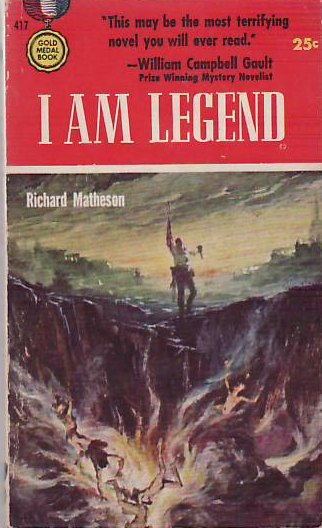
Cover of First Edition, 1954(Please note that this cover is protected by copyright; please refer to Wikipedia for details on permissible use)
Cover of First Edition, 1954
(Please note that this cover is protected by copyright; please refer to Wikipedia for details on permissible use)

I have been reading Richard Matheson’s I am Legend recently whenever I have the opportunity.  I would not say it is a fascinating book, but it is interesting.   One particularly interesting aspect is that the book is not just about one man’s fight against zombies (which he terms “vampires”, but which fit better into the modern concept of zombies) , but that it also deals extensively with his fight against depression and loneliness in a post-apocalyptic future.   Today, I happened to look up the work on Wikipedia and found the following interesting review written by Dan Schneider of International Writers Magazine:  Book Review n 2005:

“…despite having vampires in it, [the novel] is not a novel on vampires, nor even a horror nor sci-fi novel at all, in the deepest sense. Instead, it is perhaps the greatest novel written on human loneliness. It far surpasses Daniel Defoe’s Robinson Crusoe in that regard. Its insights into what it is to be human go far beyond genre, and is all the more surprising because, having read his short stories – which range from competent but simplistic, to having classic Twilight Zone twists (he was a major contributor to the original TV series) there is nothing within those short stories that suggests the supreme majesty of the existential masterpiece I Am Legend was aborning.”

Mr. Schneider may very well be right that it may be the greatest novel written on human loneliness.  If it is not, it is very close to the top.  I have read Robinson Crusoe and my impression is that I am Legend surpasses that in describing the mental and emotional anguish of loneliness and bringing that inner struggle home to the modern reader.

In my view, one reason I am Legend is important to the horror genre, is because it shows another aspect of horror: personal, inner anguish and turmoil, which probably should be classified as a form of horror, if no one has done so yet.  Anyone who has suffered extreme inner turmoil would probably agree that it is worthy of being termed horror.  It may even be the most common form of real-life horror.  I do not know the statistics for how many people are tortured at the hands of serial killers or executioners or other true-to-life monsters, but I would guess that it is far less than the number of people experiencing extreme negative emotions without actually having been physically tormented.

This aspect of inner horror can add another dimension to the otherwise average horror novel or movie, which, based on what I have seen, tends to emphasize physical violence or the threat of physical violence.   In those works, the inner horror of the protagonists is usually assumed, but not examined in detail.   Examining the inner emotions of protagonists and antagonists will help form empathy and sympathy for the characters within readers, particularly in those who have experienced a similar emotion, and will help form a tighter emotional connection between work and audience.  

I recommend reading the Wikipedia article on I am Legend.  It is quite fascinating.  However, do not do as I have done and read it before completing the book.  You will only spoil the ending for yourself.

Thoughts?  Comments?

Slattery’s Tao of Writing, Part 5: Illumination of the Particular

ScorpionPhoto by Phil Slattery
Scorpion
Photo by Phil Slattery

Someone once said that poetry is the “illumination of the particular”.

In 1992, when I was enamored of poetry and was striving to become a serious poet, I took that advice to heart and wrote the poem “Faust“, which describes the thoughts of the infamous Dr. Faust immediately after signing over his soul to Mephistopholes  in exchange for all knowledge.  What I describe there is everything that is going through Faust’s mind in a few seconds, the amount of time it takes to actually read the poem.   The hardest part for me was to choose the right moment to illuminate.  I could have chosen the moment before signing or a moment a year later or the moment when he first met Mephistopholes or an infinite amount of others. But that second seemed the most pregnant with meaning, because it is the moment realizes that what he has done can never be undone and that he has lost everything meaningful as a result.   After that I just had to work out the details of what he had lost, the sensations he was experiencing, the future consequences, and the wording, all of  which took about a solid eight hours.   Choosing the particular moment to illuminate was the critical decision in construction of the poem.

Good prose is often compared to poetry.  When Ray Bradbury was introduced to Aldous Huxley at tea after publication of The Martian Chronicles in 1950, Huxley leaned forward and asked Bradbury, “do you know what you are?  You are a poet.”  “I’ll be damned,” responded Bradbury.

I believe that good writing (both prose and poetry) is like good photography: it illuminates the particulars in the subject so that the viewer sees them in their abundant wonder for the first time, though he may have seen that scene a thousand times before.  Take the photo at the top of the page for example.  I happened to see a scorpion crawling across a floor one day (when I was heavy into nature and wildlife photography), grabbed the nearest camera, lined up the shot as best I could, and snapped it.   To my surprise, the focus and lighting came off better than I had planned, and thousands of details popped out in the photo that I had never anticipated.   I had walked across that floor tile I do not know how many thousands of times previously and I had never noticed the texture in its surface.   I had never been as close to a scorpion before either and I was amazed at the details that popped out in it.

Great writers seem to have an innate sense for the proper amount of details and how to use them.   Among writers of horror, Poe springs to mind immediately as a master of detail with “The Tell-Tale Heart” as a prime example of how he used details.  Poe seems to string together a series of moments (describing the old man’s eye, creeping through the door to the old man’s bed, killing him, listening to the heart as it beats beneath his floorboards) and illuminates the details in each to produce a story of tremendous power.  But among all these, is there a single, superfluous detail that does not heighten the drama?  No.  Poe knew which details to illuminate and how to illuminate the details in each of those.

Several years ago, I saw a biography of Napoleon Bonaparte on A&E.  One of the speakers was an instructor at the U.S. Military Academy at West Point.  He said that one thing Bonaparte recognized was that “while details are important, not all details are important.”  I found this a fascinating point as the speaker went on to point out that Bonaparte had a incredible memory for details.   For example, every two weeks he had the roster of the entire French army (about 200,000 troops) read out to him.  He could remember from sitting to sitting who was sick, dead, missing, and so forth.  He could ask detailed questions about the state of repair of equipment such as “last time the second gun of the third battery at Cherbourg had broken spokes in its left wheel, has that been fixed yet?”

I try to remember that these days as I write, so that I weed out the important details from the unimportant ones.

“But which details are important?” you ask.  I wish I could give a quick and easy answer on that.  At this point in my development as a writer (I may give a completely different answer years from now when my learning has progressed further), I would say:  (1) details that help the reader live the story vicariously, such as sensations, (2) details that help the reader understand the current situation and its implications, and (3) details to help the reader understand the characters, their thoughts, their perspectives, and their reactions, (4) details that tie the parts of the story together, such as a motif, and create unity, and (5) details that point toward a denouement.

Details can be critical in writing, but as with all other things, there must be a balance.    Drown the reader in details and the story becomes tedious.  Provide too few details, and the story becomes monotonous.   Choose the wrong details, and the story is boring.  Choose the right details and the reader can step into another world.

Thoughts?  Comments?

Slattery’s Tao of Writing, Part 4: “Warehouses and All”

Lovecraft in the Agony of ContemplationIllustration by MirrorCradle
Lovecraft in the Depths of Contemplation
Illustration by MirrorCradle

 A problem I have encountered over the last few months is that most of the short stories on which I am working are too long for most publications, but too short to publish as novels.

Most magazines accept short stories of about 2,000 words.  Above that, there seems to be a law of inverse proportions :  the more words your short story has, the fewer publishers who will take it.  Unfortunately,  lately I find it difficult to write a story in less than 10,000 words.   

Usually, I start with a simple concept for a story, but as I write, I see more and more details coming to light, details I think are important to understand what is happening in the story.  I keep whittling down the words, contracting here, expanding there, omitting this and that, keeping the story as lean and muscular as possible while fleshing out the story enough so that the reader can live the story vicariously, but somehow the story keeps growing.

There is a school of thought that stories are out there in the literary ether, just waiting for the right author to come along and give them birth.   That is certainly the way it seems at times.  We could expand that comparison even further and say that stories are also like babies after birth and each will eventually grow to a certain size–whether we want it to or not.   But we have much more control over the size of a short story than we do the size of a baby. 

Here is a link to one of my earliest stories, “Sudan“, which was published by Ascent Aspirations several years ago.  It has 2,095 words.  It is not a work of horror.  It is by my current standards rather amateurish.   I based the story on a rather poignant story told to me by a former US assistant agricultural attache to Sudan, whom I met in Luxor, Egypt in 1989.   That story lingered in the back of my mind for some time, almost haunting me, as if it had always been waiting to be told to the world and it refused to pass up this chance, before I finally wrote it down.   It was published by Ascent Aspirations in August, 2002. 

In 2009, I came across www.sixsentences.blogspot.com, which challenges writers to tell a story in six sentences or less.   The assistant attache’s story still touched me after twenty years, so I decided to see if I could tell it in six sentences.  I did.  I changed the title and location and submitted it as “Warehouses and All“. 

While the original Ascent Aspirations version was good, I believe the Six Sentences version is much better, more powerful, more poignant, perhaps because it is more compact. 

Both these stories have exactly the same meaning.   Which length suits it best?    It is hard to say.  Ultimately, deciding the length of a story depends upon the effect the writer wishes to instill in the reader.   I do not think there is any way to concoct a rule of thumb about how to determine the length of short story.   The writer must simply have a subjective feel for what length is appropriate.   That is part of the art of writing.

There are probably many wonderful stories out there that cannot find a publisher because they do not fit the space constraints of most publications.   The reality of the literary world is that publishers do have space constraints and if a writer wishes to be published, he will have to conform to those constraints.  But this should not be seen as a brutal, demeaning demand for an author to butcher one of his stories as if he were a literary Abraham about to sacrifice Isaac on a stone altar.  It should be seen as a challenge, an opportunity for personal growth as a writer, because then one is forced to look seriously, impartially, critically, and clincally at the work, and to ask oneself, “What is it that I really want to say?  What do I want the reader to experience?  How can I make this more powerful, more meaningful?  What is the essence of this story?” 

You may find that while it is challenging, it is not impossible to pack the meaning of 2,095 words into six sentences and still achieve the effect you wish to impart.

Now, if you will pardon me, I have to go listen to my own advice.

Thoughts?  Comments?