Written by: Matt Molgaard The horror genre can be an interesting and fickle animal. Do right by your fans and play faithful to terror and the obsessed viewer will walk with you through Hell, whethe…
Written by Cedric G! Bacon The grand conclusion to Joe’s next adventure, it doesn’t quite build on the tension as the first issue illustrated. In this case, the problem could be that th…
On February 29th Horroraddicts.net publishing released its newest book: Plague Master: Sanctuary Dome by H.E. Roulo. She has had stories in other Horroraddicts.net publications such as: The Wicke…
It was a little after half-past nine when the man fell overboard. The mail steamer was hurrying through the Red Sea in the hope of making up the time which the currents of the Indian Ocean had stolen.
The night was clear, though the moon was hidden behind clouds. The warm air was laden with
Winston Churchill in 1898 Age: 24
moisture. The still surface of the waters was only broken by the movement of the great ship, from whose quarter the long, slanting undulations struck out like the feathers from an arrow shaft, and in whose wake the froth and air bubbles churned up by the propeller trailed in a narrowing line to the darkness of the horizon.
There was a concert on board. All the passengers were glad to break the monotony of the voyage and gathered around the piano in the companion-house. The decks were deserted. The man had been listening to the music and joining in the songs, but the room was hot and he came out to smoke a cigarette and enjoy a breath of the wind which the speedy passage of the liner created. It was the only wind in the Red Sea that night.
The accommodation-ladder had not been unshipped since leaving Aden and the man walked out on to the platform, as on to a balcony. He leaned his back against the rail and blew a puff of smoke into the air reflectively. The piano struck up a lively tune and a voice began to sing the first verse of “The Rowdy Dowdy Boys.” The measured pulsations of the screw were a subdued but additional accompaniment.
The man knew the song, it had been the rage at all the music halls when he had started for India seven years before. It reminded him of the brilliant and busy streets he had not seen for so long, but was soon to see again. He was just going to join in the chorus when the railing, which had been insecurely fastened, gave way suddenly with a snap and he fell backwards into the warm water of the sea amid a great splash.
For a moment he was physically too much astonished to think. Then he realized he must shout. He began to do this even before he rose to the surface. He achieved a hoarse, inarticulate, half-choked scream. A startled brain suggested the word, “Help!” and he bawled this out lustily and with frantic effort six or seven times without stopping. Then he listened.
“Hi! hi! clear the way For the Rowdy Dowdy Boys.” The chorus floated back to him across the smooth water for the ship had already completely passed by. And as he heard the music, a long stab of terror drove through his heart. The possibility that he would not be picked up dawned for the first time on his consciousness. The chorus started again:
“Then–I–say–boys, Who’s for a jolly spree? Rum–tum–tiddley–um, Who’ll have a drink with me?” “Help! Help! Help!” shrieked the man, now in desperate fear.
“Fond of a glass now and then, Fond of a row or noise; Hi! hi! clear the way For the Rowdy Dowdy Boys!”
The last words drawled out fainter and fainter. The vessel was steaming fast. The beginning of the second verse was confused and broken by the ever-growing distance. The dark outline of the great hull was getting blurred. The stern light dwindled.
Then he set out to swim after it with furious energy, pausing every dozen strokes to shout long wild shouts. The disturbed waters of the sea began to settle again to their rest and widening undulations became ripples. The aerated confusion of the screw fizzed itself upwards and out. The noise of motion and the sounds of life and music died away.
The liner was but a single fading light on the blackness of the waters and a dark shadow against the paler sky.
At length full realization came to the man and he stopped swimming. He was alone — abandoned. With the understanding the brain reeled. He began again to swim, only now instead of shouting he prayed — mad, incoherent prayers, the words stumbling into one another.
Suddenly a distant light seemed to flicker and brighten.
A surge of joy and hope rushed through his mind. They were going to stop — to turn the ship and come back. And with the hope came gratitude. His prayer was answered. Broken words of thanksgiving rose to his lips. He stopped and stared after the light — his soul in his eyes. As he watched it, it grew gradually but steadily smaller. Then the man knew that his fate was certain. Despair succeeded hope; gratitude gave place to curses. Beating the water with his arms, he raved impotently. Foul oaths burst from him, as broken as his prayers — and as unheeded.
The fit of passion passed, hurried by increasing fatigue. He became silent — silent as was the sea, for even the ripples were subsiding into the glassy smoothness of the surface. He swam on mechanically along the track of the ship, sobbing quietly to himself in the misery of fear. And the stern light became a tiny speck, yellower but scarcely bigger than some of the stars, which here and there shone between the clouds.
Nearly twenty minutes passed and the man’s fatigue began to change to exhaustion. The overpowering sense of the inevitable pressed upon him. With the weariness came a strange comfort — he need not swim all the long way to Suez. There was another course. He would die. He would resign his existence since he was thus abandoned. He threw up his hands impulsively and sank.
Down, down he went through the warm water. The physical death took hold of him and he began to drown. The pain of that savage grip recalled his anger. He fought with it furiously. Striking out with arms and legs he sought to get back to the air. It was a hard struggle, but he escaped victorious and gasping to the surface. Despair awaited him. Feebly splashing with his hands, he moaned in bitter misery:
“I can’t — I must. O God! Let me die.”
The moon, then in her third quarter, pushed out from behind the concealing clouds and shed a pale, soft glitter upon the sea. Upright in the water, fifty yards away, was a black triangular object. It was a fin. It approached him slowly.
By Martin Pallot Nothing moved; but something waited. The longest night would soon begin. The hollow tree was consumed by shadows as the last light of day bled into the western horizon. The black…
The Dead Smile by Francis Marion Crawford (1899) Tuesday’s Tale of Terror March 15, 2015 Let’s go to Ireland for the month of March as we near St. Patrick’s Day. Come to this Irish cas…
By DMG Byrnes The doll stood upon the bookshelf; piercing eyes in a cold China face overseeing the room from this royal perch. Light from the streetlamp cast a golden glow over the painted face and…
SOME time ago I believe I had the pleasure of telling you the story of an adventure which happened to a friend of mine by the name of Dennistoun, during his pursuit of objects of art for the museum at Cambridge.
He did not publish his experiences very widely upon his return to England; but they could not fail
M.R. James 1900
to become known to a good many of his friends, and among others to the gentleman who at that time presided over an art museum at another University. It was to be expected that the story should make a considerable impression on the mind of a man whose vocation lay in lines similar to Dennistoun’s, and that he should be eager to catch at any explanation of the matter which tended to make it seem improbable that he should ever be called upon to deal with so agitating an emergency. It was, indeed, somewhat consoling to him to reflect that he was not expected to acquire ancient MSS. for his institution; that was the business of the Shelburnian Library. The authorities of that might, if they pleased, ransack obscure corners of the Continent for such matters. He was glad to be obliged at the moment to confine his attention to enlarging the already unsurpassed collection of English topographical drawings and engravings possessed by his museum. Yet, as it turned out, even a department so homely and familiar as this may have its dark corners, and to one of these Mr. Williams was unexpectedly introduced.
Those who have taken even the most limited interest in the acquisition of topographical pictures are aware that there is one London dealer whose aid is indispensable to their researches. Mr. J.W. Britnell publishes at short intervals very admirable catalogues of a large and constantly changing stock of engravings, plans, and old sketches of mansions, churches, and towns in England and Wales. These catalogues were, of course, the ABC of his subject to Mr. Williams: but as his museum already contained an enormous accumulation of topographical pictures, he was a regular, rather than a copious, buyer; and he rather looked to Mr. Britnell to fill up gaps in the rank and file of his collection than to supply him with rarities.
Now, in February of last year there appeared upon Mr. Williams’s desk at the museum a catalogue from Mr. Britnell’s emporium, and accompanying it was a typewritten communication from the dealer himself. This latter ran as follows:
DEAR SIR,–
We beg to call your attention to No. 978 in our accompanying catalogue, which we shall be glad to send on approval.
Yours faithfully,
J. W. BRITNELL.
To turn to No. 978 in the accompanying catalogue was with Mr. Williams (as he observed to himself) the work of a moment, and in the place indicated he found the following entry:
“978.–Unknown. Interesting mezzotint: View of a manor-house, early part of the century. 15 by 10 inches; black frame. £2 2s.
It was not specially exciting, and the price seemed high. However, as Mr. Britnell, who knew his business and his customer, seemed to set store by it, Mr. Williams wrote a postcard asking for the article to be sent on approval, along with some other engravings and sketches which appeared in the same catalogue. And so he passed without much excitement of anticipation to the ordinary labours of the day.
A parcel of any kind always arrives a day later than you expect it, and that of Mr. Britnell proved, as I believe the right phrase goes, no exception to the rule. It was delivered at the museum by the afternoon post of Saturday, after Mr. Williams had left his work, and it was accordingly brought round to his rooms in college by the attendant, in order that he might not have to wait over Sunday before looking through it and returning such of the contents as he did not propose to keep. And here he found it when he came in to tea, with a friend.
The only item with which I am concerned was the rather large, black-framed mezzotint of which I have already quoted the short description given in Mr. Britnell’s catalogue. Some more details of it will have to be given, though I cannot hope to put before you the look of the picture as clearly as it is present to my own eye. Very nearly the exact duplicate of it may be seen in a good many old inn parlours, or in the passages of undisturbed country mansions at the present moment. It was a rather indifferent mezzotint, and an indifferent mezzotint is, perhaps, the worst form of engraving known. It presented a full-face view of a not very large manor-house of the last century, with three rows of plain sashed windows with rusticated masonry about them, a parapet with balls or vases at the angles, and a small portico in the centre. On either side were trees, and in front a considerable expanse of lawn. The legend “A.W.F. sculpsit” was engraved on the narrow margin; and there was no further inscription. The whole thing gave the impression that it was the work of an amateur. What in the world Mr. Britnell could mean by affixing the price of £2 2s. to such an object was more than Mr. Williams could imagine. He turned it over with a good deal of contempt; upon the back was a paper label, the left-hand half of which had been torn off. All that remained were the ends of two lines of writing: the first had the letters –ngley Hall; the second, –ssex.
It would, perhaps, be just worth while to identify the place represented, which he could easily do with the help of a gazetteer, and then he would send it back to Mr. Britnell, with some remarks reflecting upon the judgment of that gentleman.
He lighted the candles, for it was now dark, made the tea, and supplied the friend with whom he had been playing golf (for I believe the authorities of the University I write of indulge in that pursuit by way of relaxation); and tea was taken to the accompaniment of a discussion which golfing persons can imagine for themselves, but which the conscientious writer has no right to inflict upon any non-golfing persons.
The conclusion arrived at was that certain strokes might have been better, and that in certain emergencies neither player had experienced that amount of luck which a human being has a right to expect. It was now that the friend–let us call him Professor Binks–took up the framed engraving, and said:
“What’s this place, Williams?”
“Just what I am going to try to find out,” said Williams, going to the shelf for a gazetteer. “Look at the back. Somethingley Hall, either in Sussex or Essex. Half the name’s gone, you see. You don’t happen to know it, I suppose?”
“It’s from that man Britnell, I suppose, isn’t it?” said Binks. “Is it for the museum?”
“Well, I think I should buy it if the price was five shillings,” said Williams; “but for some unearthly reason he wants two guineas for it. I can’t conceive why. It’s a wretched engraving, and there aren’t even any figures to give it life.”
“It’s not worth two guineas, I should think,” said Binks; “but I don’t think it’s so badly done. The moonlight seems rather good to me; and I should have thought there were figures, or at least a figure just on the edge in front.”
“Let’s look,” said Williams. “Well, it’s true the light is rather cleverly given. Where’s your figure? Oh yes! Just the head, in the very front of the picture.”
And indeed there was–hardly more than a black blot on the extreme edge of the engraving–the head of a man or woman, a good deal muffled up, the back turned to the spectator, and looking towards the house.
Williams had not noticed it before.
“Still,” he said, “though it’s a cleverer thing than I thought, I can’t spend two guineas of museum money on a picture of a place I don’t know.”
Professor Binks had his work to do, and soon went; and very nearly up to Hall time Williams was engaged in a vain attempt to identify the subject of his picture. “If the vowel before the ng had only been left, it would have been easy enough,” he thought; “but as it is, the name may be anything from Guestingley to Langley, and there are many more names ending like this than I thought; and this rotten book has no index of terminations.”
Hall in Mr. Williams’s college was at seven. It need not be dwelt upon; the less so as he met there colleagues who had been playing golf during the afternoon, and words with which we have no concern were freely bandied across the table–merely golfing words, I would hasten to explain.
I suppose an hour or more to have been spent in what is called common-room after dinner. Later in the evening some few retired to Williams’s rooms, and I have little doubt that whist was played and tobacco smoked. During a lull in these operations Williams picked up the mezzotint from the table without looking at it, and handed it to a person mildly interested in art, telling him where it had come from, and the other particulars which we already know.
The gentleman took it carelessly, looked at it, then said, in a tone of some interest:
“It’s really a very good piece of work, Williams; it has quite a feeling of the romantic period. The light is admirably managed, it seems to me, and the figure, though it’s rather too grotesque, is somehow very impressive.”
“Yes, isn’t it?” said Williams, who was just then busy giving whisky-and-soda to others of the company, and was unable to come across the room to look at the view again.
It was by this time rather late in the evening, and the visitors were on the move. After they went Williams was obliged to write a letter or two and clear up some odd bits of work. At last, some time past midnight, he was disposed to turn in, and he put out his lamp after lighting his bedroom candle. The picture lay face upwards on the table where the last man who looked at it had put it, and it caught his eye as he turned the lamp down. What he saw made him very nearly drop the candle on the floor, and he declares now that if he had been left in the dark at that moment he would have had a fit. But, as that did not happen he was able to put down the light on the table and take a good look at the picture. It was indubitable–rankly impossible, no doubt, but absolutely certain. In the middle of the lawn in front of the unknown house there was a figure where no figure had been at five o’clock that afternoon. It was crawling on all-fours towards the house, and it was muffled in a strange black garment with a white cross on the back.
I do not know what is the ideal course to pursue in a situation of this kind. I can only tell you what Mr. Williams did. He took the picture by one corner and carried it across the passage to a second set of rooms which he possessed. There he locked it up in a drawer, sported the doors of both sets of rooms, and retired to bed; but first he wrote out and signed an account of the extraordinary change which the picture had undergone since it had come into his possession.
Sleep visited him rather late; but it was consoling to reflect that the behaviour of the picture did not depend upon his own unsupported testimony. Evidently the man who had looked at it the night before had seen something of the same kind as he had, otherwise he might have been tempted to think that something gravely wrong was happening either to his eyes or his mind. This possibility being fortunately precluded, two matters awaited him on the morrow. He must take stock of the picture very carefully, and call in a witness for the purpose, and he must make a determined effort to ascertain what house it was that was represented. He would therefore ask his neighbour Nisbet to breakfast with him, and he would subsequently spend a morning over the gazetteer.
Nisbet was disengaged, and arrived about 9.30. His host was not quite dressed, I am sorry to say, even at this late hour. During breakfast nothing was said about the mezzotint by Williams, save that he had a picture on which he wished for Nisbet’s opinion. But those who are familiar with University life can picture for themselves the wide and delightful range of subjects over which the conversation of two Fellows of Canterbury College is likely to extend during a Sunday morning breakfast. Hardly a topic was left unchallenged, from golf to lawn-tennis. Yet I am bound to say that Williams was rather distraught; for his interest naturally centred in that very strange picture which was now reposing, face downwards, in the drawer in the room opposite.
The morning pipe was at last lighted, and the moment had arrived for which he looked. With very considerable–almost tremulous–excitement, he ran across, unlocked the drawer, and, extracting the picture–still face downwards–ran back, and put it into Nisbet’s hands.
“Now,” he said, “Nisbet, I want you to tell me exactly what you see in that picture. Describe it, if you don’t mind, rather minutely. I’ll tell you why afterwards.”
“Well,” said Nisbet, “I have here a view of a country-house–English, I presume–by moonlight.
“Moonlight? You’re sure of that?”
“Certainly. The moon appears to be on the wane, if you wish for details, and there are clouds in the sky.”
“All right. Go on. I’ll swear,” added Williams in an aside, “there was no moon when I saw it first.”
“Well, there’s not much more to be said,” Nisbet continued. “The house has one–two–three rows of windows, five in each row, except at the bottom, where there’s a porch instead of the middle one, and—-”
“But what about figures?” said Williams, with marked interest.
“There aren’t any,” said Nisbet; “but—-”
“What! No figure on the grass in front?”
“Not a thing.”
“You’ll swear to that?”
“Certainly I will. But there’s just one other thing.”
“What?”
“Why, one of the windows on the ground-floor–left of the door–is open.”
“Is it really? My goodness! he must have got in,” said Williams, with great excitement; and he hurried to the back of the sofa on which Nisbet was sitting, and, catching the picture from him, verified the matter for himself.
It was quite true. There was no figure, and there was the open window. Williams, after a moment of speechless surprise, went to the writing-table and scribbled for a short time. Then he brought two papers to Nisbet, and asked him first to sign one–it was his own description of the picture, which you have just heard–and then to read the other which was Williams’s statement written the night before.
“What can it all mean?” said Nisbet.
“Exactly,” said Williams. “Well, one thing I must do–or three things, now I think of it. I must find out from Garwood”–this was his last night’s visitor–“what he saw, and then I must get the thing photographed before it goes further, and then I must find out what the place is.”
“I can do the photographing myself,” said Nisbet, “and I will. But, you know, it looks very much as if we were assisting at the working out of a tragedy somewhere. The question is, Has it happened already, or is it going to come off? You must find out what the place is. Yes,” he said, looking at the picture again, “I expect you’re right: he has got in. And if I don’t mistake there’ll be the devil to pay in one of the rooms upstairs.”
“I’ll tell you what,” said Williams: “I’ll take the picture across to old Green” (this was the senior Fellow of the College, who had been Bursar for many years). “It’s quite likely he’ll know it. We have property in Essex and Sussex, and he must have been over the two counties a lot in his time.”
“Quite likely he will,” said Nisbet; “but just let me take my photograph first. But look here, I rather think Green isn’t up to-day. He wasn’t in Hall last night, and I think I heard him say he was going down for the Sunday.”
“That’s true, too,” said Williams; “I know he’s gone to Brighton. Well, if you’ll photograph it now, I’ll go across to Garwood and get his statement, and you keep an eye on it while I’m gone. I’m beginning to think two guineas is not a very exorbitant price for it now.”
In a short time he had returned, and brought Mr. Garwood with him. Garwood’s statement was to the effect that the figure, when he had seen it, was clear of the edge of the picture, but had not got far across the lawn. He remembered a white mark on the back of its drapery, but could not have been sure it was a cross. A document to this effect was then drawn up and signed, and Nisbet proceeded to photograph the picture.
“Now what do you mean to do?” he said. “Are you going to sit and watch it all day?”
“Well, no, I think not,” said Williams. “I rather imagine we’re meant to see the whole thing. You see, between the time I saw it last night and this morning there was time for lots of things to happen, but the creature only got into the house. It could easily have got through its business in the time and gone to its own place again; but the fact of the window being open, I think, must mean that it’s in there now. So I feel quite easy about leaving it. And, besides, I have a kind of idea that it wouldn’t change much, if at all, in the daytime. We might go out for a walk this afternoon, and come in to tea, or whenever it gets dark. I shall leave it out on the table here, and sport the door. My skip can get in, but no one else.”
The three agreed that this would be a good plan; and, further, that if they spent the afternoon together they would be less likely to talk about the business to other people; for any rumour of such a transaction as was going on would bring the whole of the Phasmatological Society about their ears.
We may give them a respite until five o’clock.
At or near that hour the three were entering Williams’s staircase. They were at first slightly annoyed to see that the door of his rooms was unsported; but in a moment it was remembered that on Sunday the skips came for orders an hour or so earlier than on week-days. However, a surprise was awaiting them. The first thing they saw was the picture leaning up against a pile of books on the table, as it had been left, and the next thing was Williams’s skip, seated on a chair opposite, gazing at it with undisguised horror. How was this? Mr. Filcher (the name is not my own invention) was a servant of considerable standing, and set the standard of etiquette to all his own college and to several neighbouring ones, and nothing could be more alien to his practice than to be found sitting on his master’s chair, or appearing to take any particular notice of his master’s furniture or pictures. Indeed, he seemed to feel this himself. He started violently when the three men came into the room, and got up with a marked effort. Then he said:
“I ask your pardon, sir, for taking such a freedom as to set down.”
“Not at all, Robert,” interposed Mr. Williams. “I was meaning to ask you some time what you thought of that picture.”
“Well, sir, of course I don’t set up my opinion again yours, but it ain’t the pictur I should ‘ang where my little girl could see it, sir.”
“Wouldn’t you, Robert? Why not?”
“No, sir. Why, the pore child, I recollect once she see a Door Bible, with pictures not ‘alf what that is, and we ‘ad to set up with her three or four nights afterwards, if you’ll believe me; and if she was to ketch a sight of this skelinton here, or whatever it is, carrying off the pore baby, she would be in a taking. You know ‘ow it is with children; ‘ow nervish they git with a little thing and all. But what I should say, it don’t seem a right pictur to be laying about, sir, not where anyone that’s liable to be startled could come on it. Should you be wanting anything this evening sir? Thank you, sir.”
With these words the excellent man went to continue the round of his masters, and you may be sure the gentlemen whom he left lost no time in gathering round the engraving. There was the house, as before, under the waning moon and the drifting clouds. The window that had been open was shut, and the figure was once more on the lawn: but not this time crawling cautiously on hands and knees. Now it was erect and stepping swiftly, with long strides, towards the front of the picture. The moon was behind it, and the black drapery hung down over its face so that only hints of that could be seen, and what was visible made the spectators profoundly thankful that they could see no more than a white dome-like forehead and a few straggling hairs. The head was bent down, and the arms were tightly clasped over an object which could be dimly seen and identified as a child, whether dead or living it was not possible to say. The legs of the appearance alone could be plainly discerned, and they were horribly thin.
From five to seven the three companions sat and watched the picture by turns. But it never changed. They agreed at last that it would be safe to leave it, and that they would return after Hall and await further developments.
When they assembled again, at the earliest possible moment, the engraving was there, but the figure was gone, and the house was quiet under the moonbeams. There was nothing for it but to spend the evening over gazetteers and guide-books. Williams was the lucky one at last, and perhaps he deserved it. At 11.30 p.m. he read from Murray’s Guide to Essex the following lines:
“16½ miles, Anningley. The church has been an interesting building of Norman date, but was extensively classicized in the last century. It contains the tombs of the family of Francis, whose mansion, Anningley Hall, a solid Queen Anne house, stands immediately beyond the churchyard in a park of about 80 acres. The family is now extinct, the last heir having disappeared mysteriously in infancy in the year 1802. The father, Mr. Arthur Francis, was locally known as a talented amateur engraver in mezzotint. After his son’s disappearance he lived in complete retirement at the Hall, and was found dead in his studio on the third anniversary of the disaster, having just completed an engraving of the house, impressions of which are of considerable rarity.”
This looked like business, and, indeed, Mr. Green on his return at once identified the house as Anningley Hall.
“Is there any kind of explanation of the figure Green?” was the question which Williams naturally asked.
“I don’t know, I’m sure, Williams. What used to be said in the place when I first knew it, which was before I came up here, was just this: old Francis was always very much down on these poaching fellows, and whenever he got a chance he used to get a man whom he suspected of it turned off the estate, and by degrees he got rid of them all but one. Squires could do a lot of things then that they daren’t think of now. Well, this man that was left was what you find pretty often in that country–the last remains of a very old family. I believe they were Lords of the Manor at one time. I recollect just the same thing in my own parish.”
“What, like the man in Tess of the D’Urbervilles?” Williams put in.
“Yes, I dare say; it’s not a book I could ever read myself. But this fellow could show a row of tombs in the church there that belonged to his ancestors, and all that went to sour him a bit; but Francis, they said, could never get at him–he always kept just on the right side of the law–until one night the keepers found him at it in a wood right at the end of the estate. I could show you the place now; it marches with some land that used to belong to an uncle of mine. And you can imagine there was a row; and this man Gawdy (that was the name, to be sure–Gawdy; I thought I should get it–Gawdy), he was unlucky enough, poor chap! to shoot a keeper. Well, that was what Francis wanted, and grand juries–you know what they would have been then–and poor Gawdy was strung up in double-quick time; and I’ve been shown the place he was buried in, on the north side of the church–you know the way in that part of the world: anyone that’s been hanged or made away with themselves, they bury them that side. And the idea was that some friend of Gawdy’s–not a relation, because he had none, poor devil! he was the last of his line: kind of spes ultima gentis–must have planned to get hold of Francis’s boy and put an end to his line, too. I don’t know–it’s rather an out-of-the-way thing for an Essex poacher to think of–but, you know, I should say now it looks more as if old Gawdy had managed the job himself. Booh! I hate to think of it! have some whisky, Williams!”
The facts were communicated by Williams to Dennistoun, and by him to a mixed company, of which I was one, and the Sadducean Professor of Ophiology another. I am sorry to say that the latter when asked what he thought of it, only remarked: “Oh, those Bridgeford people will say anything”– a sentiment which met with the reception it deserved.
I have only to add that the picture is now in the Ashleian Museum; that it has been treated with a view to discovering whether sympathetic ink has been used in it, but without effect; that Mr. Britnell knew nothing of it save that he was sure it was uncommon; and that, though carefully watched, it has never been known to change again.
OF course I shall not pretend to consider it any matter for wonder, that the extraordinary case of M. Valdemar has excited discussion. It would have been a miracle had it not — especially under the circumstances. Through the desire of all parties concerned, to keep the affair from the public, at least for the present, or until we had farther opportunities for investigation — through our endeavors to effect this — a garbled or exaggerated account made its way into society, and became the source of many unpleasant misrepresentations; and, very naturally, of a great deal of disbelief.
It is now rendered necessary that I give the facts — as far as I comprehend them myself. They are, succinctly, these:
My attention, for the last three years, had been repeatedly drawn to the subject of Mesmerism; and, about nine months ago, it occurred to me, quite suddenly, that in the series of experiments made hitherto, there had been a very remarkable and most unaccountable omission: — no person had as yet been mesmerized in articulo mortis. It remained to be seen, first, whether, in such condition, there existed in the patient any susceptibility to the magnetic influence; secondly, whether, if any existed, it was impaired or increased by the condition; thirdly, to what extent, or for how long a period, the encroachments of Death might be arrested by the process. There were other points to be ascertained, but these most excited my curiosity — the last in especial, from the immensely important character of its consequences.
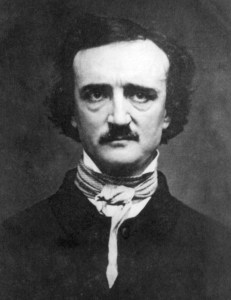
Edgar Allan Poe, 1848
In looking around me for some subject by whose means I might test these particulars, I was brought to think of my friend, M. Ernest Valdemar, the well-known compiler of the “Bibliotheca Forensica,” and author (under the nom de plume of Issachar Marx) of the Polish versions of “Wallenstein” and “Gargantua.” M. Valdemar, who has resided principally at Harlem, N. Y., since the year 1839, is (or was) particularly noticeable for the extreme spareness of his person — his lower limbs much resembling those of John Randolph; and, also, for the whiteness of his whiskers, in violent contrast to the blackness of his hair — the latter, in consequence, being very generally mistaken for a wig. His temperament was markedly nervous, and rendered him a good subject for mesmeric experiment. On two or three occasions I had put him to sleep with little difficulty, but was disappointed in other results which his peculiar constitution had naturally led me to anticipate. His will was at no period positively, or thoroughly, under my control, and in regard to clairvoyance, I could accomplish with him nothing to be relied upon. I always attributed my failure at these points to the disordered state of his health. For some months previous to my becoming acquainted with him, his physicians had declared him in a confirmed phthisis. It was his custom, indeed, to speak calmly of his approaching dissolution, as of a matter neither to be avoided nor regretted.
When the ideas to which I have alluded first occurred to me, it was of course very natural that I should think of M. Valdemar. I knew the steady philosophy of the man too well to apprehend any scruples from him; and he had no relatives in America who would be likely to interfere. I spoke to him frankly upon the subject; and, to my surprise, his interest seemed vividly excited. I say to my surprise; for, although he had always yielded his person freely to my experiments, he had never before given me any tokens of sympathy with what I did. His disease was of that character which would admit of exact calculation in respect to the epoch of its termination in death; and it was finally arranged between us that he would send for me about twenty-four hours before the period announced by his physicians as that of his decease.
It is now rather more than seven months since I received, from M. Valdemar himself, the subjoined note:
“MY DEAR P——,
“You may as well come now. D—— and F—— are agreed that I cannot hold out beyond to-morrow midnight; and I think they have hit the time very nearly.
“VALDEMAR.”
I received this note within half an hour after it was written, and in fifteen minutes more I was in the dying man’s chamber. I had not seen him for ten days, and was appalled by the fearful alteration which the brief interval had wrought in him. His face wore a leaden hue; the eyes were utterly lustreless; and the emaciation was so extreme, that the skin had been broken through by the cheek-bones. His expectoration was excessive. The pulse was barely perceptible. He retained, nevertheless, in a very remarkable manner, both his mental power and a certain degree of physical strength. He spoke with distinctness — took some palliative medicines without aid — and, when I entered the room, was occupied in penciling memoranda in a pocket-book. He was propped up in the bed by pillows. Doctors D—— and F—— were in attendance.
After pressing Valdemar’s hand, I took these gentlemen aside, and obtained from them a minute account of the patient’s condition. The left lung had been for eighteen months in a semi-osseous or cartilaginous state, and was, of course, entirely useless for all purposes of vitality. The right, in its upper portion, was also partially, if not thoroughly, ossified, while the lower region was merely a mass of purulent tubercles, running one into another. Several extensive perforations existed; and, at one point, permanent adhesion to the ribs had taken place. These appearances in the right lobe were of comparatively recent date. The ossification had proceeded with very unusual rapidity; no sign of it had been discovered a month before, and the adhesion had only been observed during the three previous days. Independently of the phthisis, the patient was suspected of aneurism of the aorta; but on this point the osseous symptoms rendered an exact diagnosis impossible. It was the opinion of both physicians that M. Valdemar would die about midnight on the morrow (Sunday.) It was then seven o’clock on Saturday evening.
On quitting the invalid’s bed-side to hold conversation with myself, Doctors D—— and F —— had bidden him a final farewell. It had not been their intention to return; but, at my request, they agreed to look in upon the patient about ten the next night.
When they had gone, I spoke freely with M. Valdemar on the subject of his approaching dissolution, as well as, more particularly, of the experiment proposed. He still professed himself quite willing and even anxious to have it made, and urged me to commence it at once. A male and a female nurse were in attendance; but I did not feel myself altogether at liberty to engage in a task of this character with no more reliable witnesses than these people, in case of sudden accident, might prove. I therefore postponed operations until about eight the next night, when the arrival of a medical student, with whom I had some acquaintance, (Mr. Theodore L —— l,) relieved me from farther embarrassment. It had been my design, originally, to wait for the physicians; but I was induced to proceed, first, by the urgent entreaties of M. Valdemar, and secondly, by my conviction that I had not a moment to lose, as he was evidently sinking fast.
Mr. L —— l was so kind as to accede to my desire that he would take notes of all that occurred; and it is from his memoranda that what I now have to relate is, for the most part, either condensed or copied verbatim.
It wanted about five minutes of eight when, taking the patient’s hand, I begged him to state, as distinctly as he could, to Mr. L —— l, whether he (M. Valdemar,) was entirely willing that I should make the experiment of mesmerizing him in his then condition.
He replied feebly, yet quite audibly, “Yes, I wish to be mesmerized” — adding immediately afterwards, “I fear you have deferred it too long.”
While he spoke thus, I commenced the passes which I had already found most effectual in subduing him. He was evidently influenced with the first lateral stroke of my hand across his forehead; but although I exerted all my powers, no farther perceptible effect was induced until some minutes after ten o’clock, when Doctors D—— and F—— called, according to appointment. I explained to them, in a few words, what I designed, and as they opposed no objection, saying that the patient was already in the death agony, I proceeded without hesitation — exchanging, however, the lateral passes for downward ones, and directing my gaze entirely into the right eye of the sufferer.
By this time his pulse was imperceptible and his breathing was stertorious, and at intervals of half a minute.
This condition was nearly unaltered for a quarter of an hour. At the expiration of this period, however, a natural although a very deep sigh escaped the bosom of the dying man, and the stertorious breathing ceased — that is to say, its stertoriousness was no longer apparent; the intervals were undiminished. The patient’s extremities were of an icy coldness.
At five minutes before eleven, I perceived unequivocal signs of the mesmeric influence. The glassy roll of the eye was changed for that expression of uneasy inward examination which is never seen except in cases of sleep-waking, and which it is quite impossible to mistake. With a few rapid lateral passes I made the lids quiver, as in incipient sleep, and with a few more I closed them altogether. I was not satisfied, however, with this, but continued the manipulations vigorously, and with the fullest exertion of the will, until I had completely stiffened the limbs of the slumberer, after placing them in a seemingly easy position. The legs were at full length; the arms were nearly so, and reposed on the bed at a moderate distance from the loins. The head was very slightly elevated.
When I had accomplished this, it was fully midnight, and I requested the gentlemen present to examine M. Valdemar’s condition. After a few experiments, they admitted him to be in an unusually perfect state of mesmeric trance. The curiosity of both the physicians was greatly excited. Dr. D—— resolved at once to remain with the patient all night, while Dr. F—— took leave with a promise to return at daybreak. Mr. L —— l and the nurses remained.
We left M. Valdemar entirely undisturbed until about three o’clock in the morning, when I approached him and found him in precisely the same condition as when Dr. F—— went away — that is to say, he lay in the same position; the pulse was imperceptible; the breathing was gentle (scarcely noticeable, unless through the application of a mirror to the lips;) the eyes were closed naturally; and the limbs were as rigid and as cold as marble. Still, the general appearance was certainly not that of death.
As I approached M. Valdemar I made a kind of half effort to influence his right arm into pursuit of my own, as I passed the latter gently to and fro above his person. In such experiments with this patient, I had never perfectly succeeded before, and assuredly I had little thought of succeeding now; but to my astonishment, his arm very readily, although feebly, followed every direction I assigned it with mine. I determined to hazard a few words of conversation.
“M. Valdemar,” I said, “are you asleep?” He made no answer, but I perceived a tremor about the lips, and was thus induced to repeat the question, again and again. At its third repetition, his whole frame was agitated by a very slight shivering; the eye-lids unclosed themselves so far as to display a white line of a ball; the lips moved sluggishly, and from between them, in a barely audible whisper, issued the words:
“Yes; — asleep now. Do not wake me! — let me die so!”
I here felt the limbs and found them as rigid as ever. The right arm, as before, obeyed the direction of my hand. I questioned the sleep-waker again:
“Do you still feel pain in the breast, M. Valdemar?”
The answer now was immediate, but even less audible than before:
“No pain — I am dying.”
I did not think it advisable to disturb him farther just then, and nothing more was said or done until the arrival of Dr. F—— , who came a little before sunrise, and expressed unbounded astonishment at finding the patient still alive. After feeling the pulse and applying a mirror to the lips, he requested me to speak to the sleep-waker again. I did so, saying:
“M. Valdemar, do you still sleep?”
As before, some minutes elapsed ere a reply was made; and during the interval the dying man seemed to be collecting his energies to speak. At my fourth repetition of the question, he said very faintly, almost inaudibly:
“Yes; still asleep — dying.”
It was now the opinion, or rather the wish, of the physicians, that M. Valdemar should be suffered to remain undisturbed in his present apparently tranquil condition, until death should supervene — and this, it was generally agreed, must now take place within a few minutes. I concluded, however, to speak to him once more, and merely repeated my previous question.
While I spoke, there came a marked change over the countenance of the sleep-waker. The eyes rolled themselves slowly open, the pupils disappearing upwardly; the skin generally assumed a cadaverous hue, resembling not so much parchment as white paper; and the circular hectic spots which, hitherto, had been strongly defined in the centre of each cheek, went out at once. I use this expression, because the suddenness of their departure put me in mind of nothing so much as the extinguishment of a candle by a puff of the breath. The upper lip, at the same time, writhed itself away from the teeth, which it had previously covered completely; while the lower jaw fell with an audible jerk, leaving the mouth widely extended, and disclosing in full view the swollen and blackened tongue. I presume that no member of the party then present had been unaccustomed to death-bed horrors; but so hideous beyond conception was the appearance of M. Valdemar at this moment, that there was a general shrinking back from the region of the bed.
I now feel that I have reached a point of this narrative at which every reader will be startled into positive disbelief. It is my business, however, simply to proceed.
There was no longer the faintest sign of vitality in M. Valdemar; and concluding him to be dead, we were consigning him to the charge of the nurses, when a strong vibratory motion was observable in the tongue. This continued for perhaps a minute. At the expiration of this period, there issued from the distended and motionless jaws a voice — such as it would be madness in me to attempt describing. There are, indeed, two or three epithets which might be considered as applicable to it in part; I might say, for example, that the sound was harsh, and broken and hollow; but the hideous whole is indescribable, for the simple reason that no similar sounds have ever jarred upon the ear of humanity. There were two particulars, nevertheless, which I thought then, and still think, might fairly be stated as characteristic of the intonation — as well adapted to convey some idea of its unearthly peculiarity. In the first place, the voice seemed to reach our ears — at least mine — from a vast distance, or from some deep cavern within the earth. In the second place, it impressed me (I fear, indeed, that it will be impossible to make myself comprehended) as gelatinous or glutinous matters impress the sense of touch.
I have spoken both of “sound” and of “voice.” I mean to say that the sound was one of distinct — of even wonderfully, thrillingly distinct — syllibification. M. Valdemar spoke — obviously in reply to the question I had propounded to him a few minutes before. I had asked him, it will be remembered, if he still slept. He now said:
“Yes; — no; — I have been sleeping — and now — now — I am dead.”
No person present even affected to deny, or attempted to repress, the unutterable, shuddering horror which these few words, thus uttered, were so well calculated to convey. Mr. L —— l (the student) swooned. The nurses immediately left the chamber, and could not be induced to return. My own impressions I would not pretend to render intelligible to the reader. For nearly an hour, we busied ourselves, silently — without the utterance of a word — in endeavors to revive Mr. L —— l. When he came to himself, we addressed ourselves again to an investigation of M. Valdemar’s condition.
It remained in all respects as I have last described it, with the exception that the mirror no longer afforded evidence of respiration. An attempt to draw blood from the arm failed. I should mention, too, that this limb was no farther subject to my will. I endeavored in vain to make it follow the direction of my hand. The only real indication, indeed, of the mesmeric influence, was now found in the vibratory movement of the tongue, whenever I addressed M. Valdemar a question. He seemed to be making an effort to reply, but had no longer sufficient volition. To queries put to him by any other person than myself he seemed utterly insensible — although I endeavored to place each member of the company in mesmeric rapport with him. I believe that I have now related all that is necessary to an understanding of the sleep-waker’s state at this epoch. Other nurses were procured; and at ten o’clock I left the house in company with the two physicians and Mr. L —— l.
In the afternoon we all called again to see the patient. His condition remained precisely the same. We had now some discussion as to the propriety and feasibility of awakening him; but we had little difficulty in agreeing that no good purpose would be served by so doing. It was evident that, so far, death (or what is usually termed death) had been arrested by the mesmeric process. It seemed clear to us all that to awaken M. Valdemar would be merely to insure his instant, or at least his speedy dissolution.
From this period until the close of last week — an interval of nearly seven months — we continued to make daily calls at M. Valdemar’s house, accompanied, now and then, by medical and other friends. All this time the sleeper-waker remained exactly as I have last described him. The nurses’ attentions were continual.
It was on Friday last that we finally resolved to make the experiment of awakening, or attempting to awaken him; and it is the (perhaps) unfortunate result of this latter experiment which has given rise to so much discussion in private circles — to so much of what I cannot help thinking unwarranted popular feeling.
For the purpose of relieving M. Valdemar from the mesmeric trance, I made use of the customary passes. These, for a time, were unsuccessful. The first indication of revival was afforded by a partial descent of the iris. It was observed, as especially remarkable, that this lowering of the pupil was accompanied by the profuse out-flowing of a yellowish ichor (from beneath the lids) of a pungent and highly offensive odor.
It was now suggested that I should attempt to influence the patient’s arm, as heretofore. I made the attempt and failed. Dr. F—— then intimated a desire to have me put a question. I did so, as follows:
“M. Valdemar, can you explain to us what are your feelings or wishes now?”
There was an instant return of the hectic circles on the cheeks; the tongue quivered, or rather rolled violently in the mouth (although the jaws and lips remained rigid as before;) and at length the same hideous voice which I have already described, broke forth:
“For God’s sake! — quick! — quick! — put me to sleep — or, quick! — waken me! — quick! — I say to you that I am dead! “
I was thoroughly unnerved, and for an instant remained undecided what to do. At first I made an endeavor to re-compose the patient; but, failing in this through total abeyance of the will, I retraced my steps and as earnestly struggled to awaken him. In this attempt I soon saw that I should be successful — or at least I soon fancied that my success would be complete — and I am sure that all in the room were prepared to see the patient awaken.
For what really occurred, however, it is quite impossible that any human being could have been prepared.
As I rapidly made the mesmeric passes, amid ejaculations of “dead! dead!” absolutely bursting from the tongue and not from the lips of the sufferer, his whole frame at once — within the space of a single minute, or even less, shrunk — crumbled — absolutely rotted away beneath my hands. Upon the bed, before that whole company, there lay a nearly liquid mass of loathsome — of detestable putrescence.
 Written by: Matt Molgaard The horror genre can be an interesting and fickle animal. Do right by your fans and play faithful to terror and the obsessed viewer will walk with you through Hell, whethe…



 Phil Slattery, Writer, Publisher