In Memory of Richard Matheson

Richard Matheson Photo by JaSunni, 2008
Richard Matheson
Photo by JaSunni, 2008

On Monday, I learned of the death of Richard Matheson, one of the great horror writers of the twentieth century.   As my tribute to him, here are a few quotations from and about him along with a few examples on how he generated his ideas.  There were a lot, so I picked the ones that seemed most philosophical about writing and life in general in order to get a feel for the man behind the writing.

From Goodreads:

“What condemnation could possibly be more harsh than one’s own, when self-pretense is no longer possible?” ― Richard Matheson, What Dreams May Come

“We’ve forgotten much. How to struggle, how to rise to dizzy heights and sink to unparalleled depths. We no longer aspire to anything. Even the finer shades of despair are lost to us. We’ve ceased to be runners. We plod from structure to conveyance to employment and back again. We live within the boundaries that science has determined for us. The measuring stick is short and sweet. The full gamut of life is a brief, shadowy continuum that runs from gray to more gray. The rainbow is bleached. We hardly know how to doubt anymore. (“The Thing”)” ― Richard Matheson, Collected Stories, Vol. 1    

“If men only felt about death as they do about sleep, all terrors would cease. . . Men sleep contentedly, assured that they will wake the following morning. They should feel the same about their lives.” ― Richard Matheson, What Dreams May Come

“In a world of monotonous horror there could be no salvation in wild dreaming.” ― Richard Matheson, I Am Legend    

“Now when I die, I shall only be dead.” ― Richard Matheson, I am Legend and Other Stories

 From Wikiquotes:

I think What Dreams May Come is the most important (read effective) book I’ve written. It has caused a number of readers to lose their fear of death — the finest tribute any writer could receive. … Somewhere In Time is my favorite novel.

“Ed Gorman Calling: We Talk to Richard Matheson” (2004).

From Uphillwriting.org:

If you go too far in fantasy and break the string of logic, and become nonsensical, someone will surely remind you of your dereliction…Pound for pound, fantasy makes a tougher opponent for the creative person.

Richard Matheson

And here are a couple of quote about Matheson–also from Wikiquotes:

Matheson gets closer to his characters than anyone else in the field of fantasy today. … You don’t read a Matheson story — you experience it.

Robert Bloch, as quoted in an address by Anthony Boucher (29 August 1958), at the “Solacon”, the 1958 Worldcon

He has many … virtues, notably an unusual agility in trick prose and trick construction and a too-little-recognized (or exercised) skill on offtrail humor; but his great strength is his power to take a reader inside a character or a situation.

Anthony Boucher in an address at the “Solacon”, the1958 Worldcon (29 August 1958)

Wikipedia offers an interesting paragraph on how Matheson came up with the ideas for some of his more famous works:

Matheson cited specific inspirations for many of his works. Duel derived from an incident in which he and a friend, Jerry Sohl, were dangerously tailgated by a large truck on the same day as the Kennedy assassination. (However, there are similarities with William M. Robson’s script of the July 15, 1962 episode of the radio drama, Suspense, “Snow on 66”.[citation needed]) A scene from the 1953 movie Let’s Do It Again in which Aldo Ray and Ray Milland put on each other’s hats, one of which is far too big for the other, sparked the thought “what if someone put on his own hat and that happened,” which became The Shrinking Man. Bid Time Return began when Matheson saw a movie poster featuring a beautiful picture of Maude Adams and wondered what would happen if someone fell in love with such an old picture. In the introduction to Noir: 3 Novels of Suspense (1997), which collects three of his early books, Matheson said that the first chapter of his suspense novel Someone is Bleeding (1953) describes exactly his meeting with his wife Ruth, and that in the case of What Dreams May Come, “the whole novel is filled with scenes from our past.”

Thoughts?  Comments?
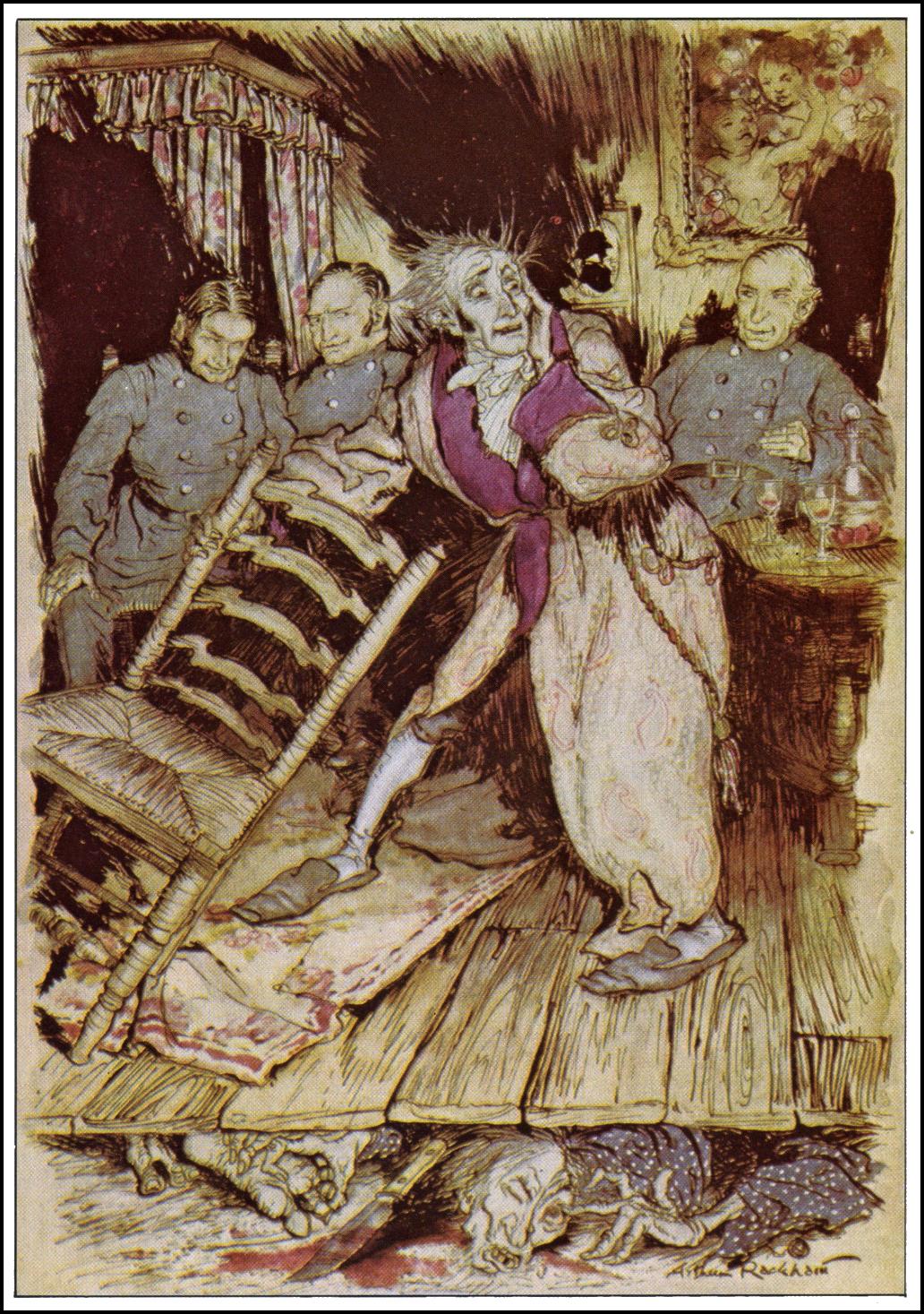
The Canon of Horror

"The Tell-Tale Heart" Illustration by Arthur Rackham, 1935
“The Tell-Tale Heart”
Illustration by Arthur Rackham, 1935

I was just musing that if a canon of horror literature could be developed, what should it include?   This would be a collection of say ten works that define horror literature and that everyone seriously interested in horror should read if he/she they wish to learn what horror is and should be.   This would not be a collection of the most popular works (whether novel, short story, essay, screenplay, theater, etc.) of horror, which would change constantly, but ten works which would define horror now and forever as the Bible does Christianity, as the Koran does Islam, and as the Analects of Confucius do Confucianism.   These should be eternal works that at the end of time, after the Zombie Apocalypse when no more books are written, the few remaining survivors of humanity can review all the literary works of all time and say, “These ten defined the horror genre.”  Of course, this canon will be forever debated, but lively, engaged discussion is the fun of a list like this.

To start off this conversation, here are my initial ten recommendations (subject to change as my reading progresses).  I will keep this list to one work from each of ten authors so that works by one author do not overwhelm the list.  This is not in any order of priority or preference–just as they pop into my mind.   Although these reflect my own reading (which tends to the past more than the present), I have added one or two authors I haven’t read, but from what I understand, have made significant contributions to the horror genre.

  1. “The Tell-Tale Heart” by Edgar Allen Poe
  2. Books of Blood by Clive Barker
  3. Carrie by Stephen King
  4. Frankenstein by Mary Shelley
  5. “The Shadow over Innsmouth” by H.P. Lovecraft
  6. “Lukundoo” by Edward Lucas White
  7. “The Sandman” by E.T. A. Hoffmann
  8. Dracula by Bram Stoker
  9. “The Willows” by Algernon Blackwood
  10. Psycho by Robert Bloch
  11. I am Legend by Richard Matheson

Beyond the Veil of Reality

Face of Horror Houseby Horror House
Face of Horror House
by Horror House

Last night, I watched an adaptation of Lovecraft’s “Dreams in the Witch House” on the Masters of Horror series (season 1, episode 2) on Netflix .   Afterwards, being late and time for bed, instead of finding the story on Project Gutenberg or some other cost-free source so that I could read it firsthand, I read a summary of the story on Wikipedia to see if the adaptation was at least reasonably accurate.  It seemed to be, even though the story was set in the modern day and the ending varied significantly from the original.  But, in accordance with today’s tastes, it was rather bloody and cruel in ways I am sure Lovecraft never intended (I say this after having read a considerable amount of his most famous works).

The most interesting aspect of the story to me was not the story itself, but speculating on how Lovecraft came up with the story’s concept.

I understand from the Wikipedia article that Lovecraft had recently attended a lecture and read up somewhat on non-Euclidean space.   Apparently, he was intrigued with the idea of existence on different planes.  Somehow he came up with the idea that the different planes of existence might intersect and beings would be able to move from one plane to the next.  This is the concept that the protagonist of the story, Walter Gilman (a graduate student in Physics) is studying when he moves into the Witch house, which was a boarding house in the fictional town of Arkham, Massachusetts, but three hundred years ago was the residence of a witch.  Gilman, as I interpret the TV story, notices that the corner formed by the intersection of two walls and the ceiling in his room coincides with the intersection of three dimensions.  It is this intersection that the witch who previously resided in the house and her familiar (a really nasty creature combining a rat with the face of a man) uses to re-enter the house in the modern day and create havoc for Gilman and the other residents.   I won’t give away the ending, but it is a good story and probably one of the more reasonably accurate adaptations of a Lovecraft story that you are likely to find.

What I found most interesting was speculating if  how Lovecraft came up with the story was to be looking at the intersection of three walls in his house and wonder if different planes of existence could intersect like that and, if they could, could creatures use the intersection to move from one plane to the other?   I am always fascinated by how writers come up with ideas for their works.   Did you ever wonder what spurred Richard Matheson to write I am Legend or Stephen King to write Carrie?

I know that some authors of Horror  (such as Algernon Blackwood, Lord Dunsany, and Arthur Machen) were intrigued by the idea of a plane of existence beyond what we take for reality, that what we perceive as reality may actually just mask the true reality.  Apparently, Lovecraft was thus intrigued as well and used his ideas of a possible alternative reality as the foundation for what others would later term “the Cthulhu Mythos”.

After having contemplated this since last night, I have been asking myself, what did these intelligent men see in their interpretations of the everyday world that would lead them to believe in the possible existence of an alternative reality?    Based upon my experience with humanity, I have come to realize that some people have some downright bizarre concepts of the world around them, but how did these concepts originate?  What causes their perceptions to be so radically different from mine?  Is it a matter of genetics that causes their synapses to be linked together differently?  Do they have slightly different body chemistries influencing their thoughts?  Is it that they simply encountered different views of the world as they grew up?  Is there a reality that they can perceive but I cannot–in the same way as I can see the workings of God in everything about me, but others do not and thus call themselves atheists and agnostics?

What are your thoughts?

Fascinating Habits of Writers of Horror

GRACIN~2

Some writers have interesting habits.

I have always found one of the most interesting aspects of studying the lives of famous writers to be the personal habits they have while writing.   The habits show the writer’s personal side and perhaps give an insight into how their creativity is ingrained in their natures. Following are some examples of the better known habits of mainstream authors (the few examples I have collected of “horror habits” follow these).

Hemingway said that he, at least in his Paris years, wrote for four hours each day before going to work at the Kansas City Star office, he wrote using pencils and a spiral bound notebook, and he started each days writing by sharpening twenty pencis.

F. Scott Fitzgerald never rewrote anything less than nine times.

Thomas Mann was very disciplined and rose and dressed in a suit each day as if he were going to work at a bank (even though he was going only so far as his living room), started each day at the same time (I think 8:00 a.m.), wrote for four hours, broke for lunch for an hour, wrote for another four hours, and then ended his day, by going back to his bedroom and taking off his suit.

Hunter Thompson and Henry Miller were at the opposite end of the discipline scale and might write for days, then not write again for days or weeks, before going on another binge of writing.  Thompson might write some lines on a napkin while having lunch at a restaurant, then take the napkin and force it through a fax to get the work to his editors at Rolling Stone.

 Here are the tidbits on writing habits by authors of horror.

Thomas Cotterill, another WordPress member, wrote this interesting article on the habits of Stephen King.  I have read elsewhere that Stephen King normally writes a first draft, which he runs past his wife, Tabitha, makes some changes and then sends it out to friends for their inputs, and then writes a final draft, which he sends to the publisher.

I have yet to find anything detailed about Poe’s habits, but I did find this general description on the website of the Edgar Allan Poe Society of Baltimore.

“Edgar A. Poe, one of the Editors of the Broadway Journal. He never rests. There is a small steam-engine in his brain, which not only sets the cerebral mass in motion, but keeps the owner in hot water. His face is a fine one, and well gifted with intellectual beauty. Ideality, with the power of analysis, is shown in his very broad, high and massive forehead — a forehead which would have delighted Gall beyond measure. He would have have [[sic]] made a capital lawyer — not a very good advocate, perhaps, but a famous unraveller of all subtleties. He can thread his way through a labyrinth of absurdities, and pick out the sound thread of sense from the tangled skein with which it is connected. He means to be candid, and labours under the strange hallucination that he is so;  but he has strong prejudices, and, without the least intention of irreverence, would wage war with the Deity, if the divine canons militated against his notions. His sarcasm is subtle and searching. He can do nothing in the common way; and buttons his coat after a fashion peculiarly his own. If we ever caught him doing a thing like any body else, or found him reading a book any other way than upside down, we should implore his friends to send for a straitjacket, and a Bedlam doctor. He were mad, then, to a certtainty.”               — (Thomas Dunn English, “Notes About Men of Note,” The Aristidean, April 1845, p. 153. At this time, Poe and English were still friends, and the tone of this item is happy and jocular. In reviewing this issue of the Aristidean in his own Broadway Journal, for May 3, 1845, Poe comments “. . . the ‘Notes about Men of Note’ are amusing” (BJ, 1845, p. 285, col. 1).)

Dean Koontz says this about his own writing habits on his website:

“I work 10- and 11-hour days because in long sessions I fall away more completely into story and characters than I would in, say, a six-hour day. On good days, I might wind up with five or six pages of finished work; on bad days, a third of a page. Even five or six is not a high rate of production for a 10- or 11-hour day, but there are more good days than bad. And the secret is doing it day after day, committing to it and avoiding distractions. A month–perhaps 22 to 25 work days–goes by and, as a slow drip of water can fill a huge cauldron in a month, so you discover that you have 75 polished pages. The process is slow, but that’s a good thing. Because I don’t do a quick first draft and then revise it, I have plenty of time to let the subconscious work; therefore, I am led to surprise after surprise that enriches story and deepens character. I have a low boredom threshold, and in part I suspect I fell into this method of working in order to keep myself mystified about the direction of the piece–and therefore entertained. A very long novel, like FROM THE CORNER OF HIS EYE can take a year. A book like THE GOOD GUY, six months.”

Here is an interesting interview by M.R. Hunter with Richard Matheson in Lastheplace.com.  Apparently, Mr. Matheson does not have a computer, but writes everything in longhand and then has it typed up.

I have yet to find anything on Lovecraft’s writing habits, but here is a link to HPLovecraft.com that details his personal interests including his unusual dietary habits.

Lord Dunsany had the most eccentric habits of which I have heard.  The Wikipedia article on Lord Dunsany states:

“Dunsany’s writing habits were considered peculiar by some. Lady Beatrice said that “He always sat on a crumpled old hat while composing his tales.” (The hat was eventually stolen by a visitor to Dunsany Castle.) Dunsany almost never rewrote anything; everything he ever published was a first draft.[7] Much of his work was penned with quill pens, which he made himself; Lady Beatrice was usually the first to see the writings, and would help type them. It has been said that Lord Dunsany would sometimes conceive stories while hunting, and would return to the Castle and draw in his family and servants to re-enact his visions before he set them on paper.[citation needed]”

If you know of a source for information on the work habits of one or more horror writers, please share it.   If you are searching for a topic of an article to write, I would like to suggest writing on the work habits (or interests) of horror writers.  It would be fascinating to see if there is a common thread among them or if they vary from the habits of mainstream authors.  For example, I have found out that Algernon Blackwood, Arthur Machen, and Bram Stoker were members of the Hermetic Order of the Golden Dawn.

Anyway, I am now officially rambling.

If you have any thoughts or comments on this article, please share them.

Really, what is horror?

H_P__Lovecraft_by_MirrorCradle -- resized

H.P. Lovecraft by Mirror Cradle

I like the illustration above, not only because it shows Lovecraft in the throes of creation, but also because it can be a metaphor for anyone in the deepest and darkest of contemplations or beset with a multitude of woes.  For now, though, I will say that it represents Lovecraft contemplating today’s question which is:  forget everything you have ever read about horror, what is horror to you?

Stephen King made this comment (I found it on goodreads.com):

“The 3 types of terror: The Gross-out: the sight of a severed head tumbling down a flight of stairs, it’s when the lights go out and something green and slimy splatters against your arm. The Horror: the unnatural, spiders the size of bears, the dead waking up and walking around, it’s when the lights go out and something with claws grabs you by the arm. And the last and worse one: Terror, when you come home and notice everything you own had been taken away and replaced by an exact substitute. It’s when the lights go out and you feel something behind you, you hear it, you feel its breath against your ear, but when you turn around, there’s nothing there…”

To me, these seem to be the superficialities of terror and horror.   If we use disease as a metaphor for horror, then these are its symptoms.   The virus lying at the root of horror is man’s inhumanity to man.   Seeing a severed head tumbling down stairs is indeed horrible;  seeing the murderer sever the head would be even worse, but being able to look into the soul of the murderer and see that the motive for the act stems from the murderer’s complete indifference to the suffering of others would be even worse.   Perhaps even worse than that would be seeing that that indifference to others is not uncommon.

Many have speculated on what fascinates people about horror.   Why would anyone enjoy being frightened?   An article I read last night (I think from Wikipedia) says essentially (I am summarizing in my own words) that it is because the security our civilization our modern society affords us has eliminated the need for the primal fear that developed as a survival mechanism during the early days of evolution.    That may be true to some degree, but if society eliminated some fears, it instilled others.    How many have seen the movie “Candyman”?   How many have seen “I am Legend?” or “The Omega Man” (both derive from the novel “I am Legend” by Richard Matheson), which is only one example of post-apocalyptic literature that would have been inconceivable in primeval times.

Instead of some overreaching drive extending throughout mankind, it may be that the need simply stems from the fact that the adrenaline rush, the focus on the moment, the muscle tension, and all the other physical sensations experienced during fright are the same or very similar to those experienced during sex, but without the sexual arousal itself.   These are also similar to the sensations experienced during peaks of athletic activity.    I was in the martial arts for many years and I can testify that the adrenaline rush experienced during sparring matches or when one is performing at peak ability can be addicting.   Being frightened puts one on a similar level of physical and mental awareness, because it is an instinctual preparation to fight as if one is actually being threatened.  The great thing about horror though is that while one enjoys all the physical highs of one’s body revving up for action, there is no actual threat.  Everyone is safe.   Candyman is not actually going to come out of the screen and track you down (though your subsequent nightmares may tell you otherwise).

So, please put yourself in Mr. Lovecraft’s place in the illustration above and ask yourself, what is horror?