Through the ghoul-guarded gateways of slumber,
Past the wan-mooned abysses of night,
I have lived o’er my lives without number,
I have sounded all things with my sight;
And I struggle and shriek ere the daybreak, being driven to madness with fright.
I have whirled with the earth at the dawning,
When the sky was a vaporous flame;
I have seen the dark universe yawning
Where the black planets roll without aim,
Where they roll in their horror unheeded, without knowledge or lustre or name.
I had drifted o’er seas without ending,
Under sinister grey-clouded skies,
That the many-forked lightning is rending,
That resound with hysterical cries;
With the moans of invisible daemons, that out of the green waters rise.
I have plunged like a deer through the arches
Of the hoary primoridal grove,
Where the oaks feel the presence that marches,
And stalks on where no spirit dares rove,
And I flee from a thing that surrounds me, and leers through dead branches above.
I have stumbled by cave-ridden mountains
That rise barren and bleak from the plain,
I have drunk of the fog-foetid fountains
That ooze down to the marsh and the main;
And in hot cursed tarns I have seen things, I care not to gaze on again.
I have scanned the vast ivy-clad palace,
I have trod its untenanted hall,
Where the moon rising up from the valleys
Shows the tapestried things on the wall;
Strange figures discordantly woven, that I cannot endure to recall.
I have peered from the casements in wonder
At the mouldering meadows around,
At the many-roofed village laid under
The curse of a grave-girdled ground;
And from rows of white urn-carven marble, I listen intently for sound.
I have haunted the tombs of the ages,
I have flown on the pinions of fear,
Where the smoke-belching Erebus rages;
Where the jokulls loom snow-clad and drear:
And in realms where the sun of the desert consumes what it never can cheer.
I was old when the pharaohs first mounted
The jewel-decked throne by the Nile;
I was old in those epochs uncounted
When I, and I only, was vile;
And Man, yet untainted and happy, dwelt in bliss on the far Arctic isle.
Oh, great was the sin of my spirit,
And great is the reach of its doom;
Not the pity of Heaven can cheer it,
Nor can respite be found in the tomb:
Down the infinite aeons come beating the wings of unmerciful gloom.
Through the ghoul-guarded gateways of slumber,
Past the wan-mooned abysses of night,
I have lived o’er my lives without number,
I have sounded all things with my sight;
And I struggle and shriek ere the daybreak, being driven to madness with fright.
In my tortured ears there sounds unceasingly a nightmare whirring and flapping, and a faint distant baying as of some gigantic hound. It is not dream – it is not, I fear, even madness – for too much has already happened to give me these merciful doubts.
St John is a mangled corpse; I alone know why, and such is my knowledge that I am about to blow out my brains for fear I shall be mangled in the same way. Down unlit and illimitable corridors of eldrith phantasy sweeps the black, shapeless Nemesis that drives me to self-annihilation.
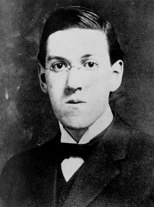
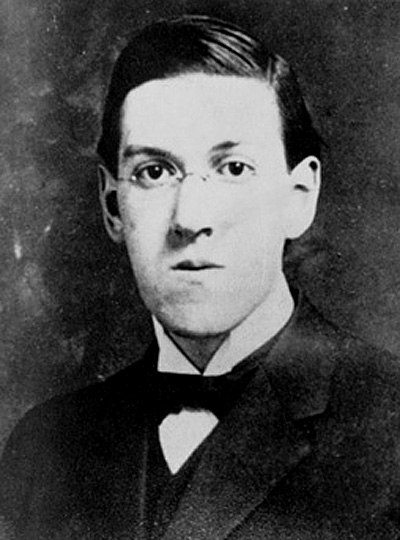
H.P. Lovecraft, 1915
May heaven forgive the folly and morbidity which led us both to so monstrous a fate! Wearied with the commonplaces of a prosaic world; where even the joys of romance and adventure soon grow stale, St John and I had followed enthusiastically every aesthetic and intellectual movement which promised respite from our devastating ennui. The enigmas of the symbolists and the ecstasies of the pre-Raphaelites all were ours in their time, but each new mood was drained too soon, of its diverting novelty and appeal.
Only the somber philosophy of the decadents could help us, and this we found potent only by increasing gradually the depth and diabolism of our penetrations. Baudelaire and Huysmans were soon exhausted of thrills, till finally there remained for us only the more direct stimuli of unnatural personal experiences and adventures. It was this frightful emotional need which led us eventually to that detestable course which even in my present fear I mention with shame and timidity – that hideous extremity of human outrage, the abhorred practice of grave-robbing.
I cannot reveal the details of our shocking expeditions, or catalogue even partly the worst of the trophies adorning the nameless museum we prepared in the great stone house where we jointly dwelt, alone and servantless. Our museum was a blasphemous, unthinkable place, where with the satanic taste of neurotic virtuosi we had assembled an universe of terror and decay to excite our jaded sensibilities. It was a secret room, far, far, underground; where huge winged daemons carven of basalt and onyx vomited from wide grinning mouths weird green and orange light, and hidden pneumatic pipes ruffled into kaleidoscopic dances of death the lines of red charnel things hand in hand woven in voluminous black hangings. Through these pipes came at will the odors our moods most craved; sometimes the scent of pale funeral lilies; sometimes the narcotic incense of imagined Eastern shrines of the kingly dead, and sometimes – how I shudder to recall it! – the frightful, soul-upheaving stenches of the uncovered-grave.
Around the walls of this repellent chamber were cases of antique mummies alternating with comely, lifelike bodies perfectly stuffed and cured by the taxidermist’s art, and with headstones snatched from the oldest churchyards of the world. Niches here and there contained skulls of all shapes, and heads preserved in various stages of dissolution. There one might find the rotting, bald pates of famous noblemen, and the fresh and radiantly golden heads of new-buried children.
Statues and paintings there were, all of fiendish subjects and some executed by St John and myself. A locked portfolio, bound in tanned human skin, held certain unknown and unnameable drawings which it was rumored Goya had perpetrated but dared not acknowledge. There were nauseous musical instruments, stringed, brass, and wood-wind, on which St John and I sometimes produced dissonances of exquisite morbidity and cacodaemoniacal ghastliness; whilst in a multitude of inlaid ebony cabinets reposed the most incredible and unimaginable variety of tomb-loot ever assembled by human madness and perversity. It is of this loot in particular that I must not speak – thank God I had the courage to destroy it long before I thought of destroying myself!
The predatory excursions on which we collected our unmentionable treasures were always artistically memorable events. We were no vulgar ghouls, but worked only under certain conditions of mood, landscape, environment, weather, season, and moonlight. These pastimes were to us the most exquisite form of aesthetic expression, and we gave their details a fastidious technical care. An inappropriate hour, a jarring lighting effect, or a clumsy manipulation of the damp sod, would almost totally destroy for us that ecstatic titillation which followed the exhumation of some ominous, grinning secret of the earth. Our quest for novel scenes and piquant conditions was feverish and insatiate – St John was always the leader, and he it was who led the way at last to that mocking, accursed spot which brought us our hideous and inevitable doom.
By what malign fatality were we lured to that terrible Holland churchyard? I think it was the dark rumor and legendry, the tales of one buried for five centuries, who had himself been a ghoul in his time and had stolen a potent thing from a mighty sepulchre. I can recall the scene in these final moments – the pale autumnal moon over the graves, casting long horrible shadows; the grotesque trees, drooping sullenly to meet the neglected grass and the crumbling slabs; the vast legions of strangely colossal bats that flew against the moon; the antique ivied church pointing a huge spectral finger at the livid sky; the phosphorescent insects that danced like death-fires under the yews in a distant corner; the odors of mould, vegetation, and less explicable things that mingled feebly with the night-wind from over far swamps and seas; and, worst of all, the faint deep-toned baying of some gigantic hound which we could neither see nor definitely place. As we heard this suggestion of baying we shuddered, remembering the tales of the peasantry; for he whom we sought had centuries before been found in this self same spot, torn and mangled by the claws and teeth of some unspeakable beast.
I remember how we delved in the ghoul’s grave with our spades, and how we thrilled at the picture of ourselves, the grave, the pale watching moon, the horrible shadows, the grotesque trees, the titanic bats, the antique church, the dancing death-fires, the sickening odors, the gently moaning night-wind, and the strange, half-heard directionless baying of whose objective existence we could scarcely be sure.
Then we struck a substance harder than the damp mould, and beheld a rotting oblong box crusted with mineral deposits from the long undisturbed ground. It was incredibly tough and thick, but so old that we finally pried it open and feasted our eyes on what it held.
Much – amazingly much – was left of the object despite the lapse of five hundred years. The skeleton, though crushed in places by the jaws of the thing that had killed it, held together with surprising firmness, and we gloated over the clean white skull and its long, firm teeth and its eyeless sockets that once had glowed with a charnel fever like our own. In the coffin lay an amulet of curious and exotic design, which had apparently been worn around the sleeper’s neck. It was the oddly conventionalised figure of a crouching winged hound, or sphinx with a semi-canine face, and was exquisitely carved in antique Oriental fashion from a small piece of green jade. The expression of its features was repellent in the extreme, savoring at once of death, bestiality and malevolence. Around the base was an inscription in characters which neither St John nor I could identify; and on the bottom, like a maker’s seal, was graven a grotesque and formidable skull.
Immediately upon beholding this amulet we knew that we must possess it; that this treasure alone was our logical pelf from the centuried grave. Even had its outlines been unfamiliar we would have desired it, but as we looked more closely we saw that it was not wholly unfamiliar. Alien it indeed was to all art and literature which sane and balanced readers know, but we recognized it as the thing hinted of in the forbidden Necronomicon of the mad Arab Abdul Alhazred; the ghastly soul-symbol of the corpse-eating cult of inaccessible Leng, in Central Asia. All too well did we trace the sinister lineaments described by the old Arab daemonologist; lineaments, he wrote, drawn from some obscure supernatural manifestation of the souls of those who vexed and gnawed at the dead.
Seizing the green jade object, we gave a last glance at the bleached and cavern-eyed face of its owner and closed up the grave as we found it. As we hastened from the abhorrent spot, the stolen amulet in St John’s pocket, we thought we saw the bats descend in a body to the earth we had so lately rifled, as if seeking for some cursed and unholy nourishment. But the autumn moon shone weak and pale, and we could not be sure.
So, too, as we sailed the next day away from Holland to our home, we thought we heard the faint distant baying of some gigantic hound in the background. But the autumn wind moaned sad and wan, and we could not be sure.
Less than a week after our return to England, strange things began to happen. We lived as recluses; devoid of friends, alone, and without servants in a few rooms of an ancient manor-house on a bleak and unfrequented moor; so that our doors were seldom disturbed by the knock of the visitor.
Now, however, we were troubled by what seemed to be a frequent fumbling in the night, not only around the doors but around the windows also, upper as well as lower. Once we fancied that a large, opaque body darkened the library window when the moon was shining against it, and another time we thought we heard a whirring or flapping sound not far off. On each occasion investigation revealed nothing, and we began to ascribe the occurrences to imagination which still prolonged in our ears the faint far baying we thought we had heard in the Holland churchyard. The jade amulet now reposed in a niche in our museum, and sometimes we burned a strangely scented candle before it. We read much in Alhazred’s Necronomicon about its properties, and about the relation of ghosts’ souls to the objects it symbolized; and were disturbed by what we read.
Then terror came.
On the night of September 24, 19–, I heard a knock at my chamber door. Fancying it St John’s, I bade the knocker enter, but was answered only by a shrill laugh. There was no one in the corridor. When I aroused St John from his sleep, he professed entire ignorance of the event, and became as worried as I. It was the night that the faint, distant baying over the moor became to us a certain and dreaded reality.
Four days later, whilst we were both in the hidden museum, there came a low, cautious scratching at the single door which led to the secret library staircase. Our alarm was now divided, for, besides our fear of the unknown, we had always entertained a dread that our grisly collection might be discovered. Extinguishing all lights, we proceeded to the door and threw it suddenly open; whereupon we felt an unaccountable rush of air, and heard, as if receding far away, a queer combination of rustling, tittering, and articulate chatter. Whether we were mad, dreaming, or in our senses, we did not try to determine. We only realized, with the blackest of apprehensions, that the apparently disembodied chatter was beyond a doubt in the Dutch language.
After that we lived in growing horror and fascination. Mostly we held to the theory that we were jointly going mad from our life of unnatural excitements, but sometimes it pleased us more to dramatize ourselves as the victims of some creeping and appalling doom. Bizarre manifestations were now too frequent to count. Our lonely house was seemingly alive with the presence of some malign being whose nature we could not guess, and every night that daemoniac baying rolled over the wind-swept moor, always louder and louder. On October 29 we found in the soft earth underneath the library window a series of footprints utterly impossible to describe. They were as baffling as the hordes of great bats which haunted the old manor-house in unprecedented and increasing numbers.
The horror reached a culmination on November 18, when St John, walking home after dark from the dismal railway station, was seized by some frightful carnivorous thing and torn to ribbons. His screams had reached the house, and I had hastened to the terrible scene in time to hear a whir of wings and see a vague black cloudy thing silhouetted against the rising moon.
My friend was dying when I spoke to him, and he could not answer coherently. All he could do was to whisper, “The amulet – that damned thing -”
Then he collapsed, an inert mass of mangled flesh.
I buried him the next midnight in one of our neglected gardens, and mumbled over his body one of the devilish rituals he had loved in life. And as I pronounced the last daemoniac sentence I heard afar on the moor the faint baying of some gigantic hound. The moon was up, but I dared not look at it. And when I saw on the dim-lighted moor a wide-nebulous shadow sweeping from mound to mound, I shut my eyes and threw myself face down upon the ground. When I arose, trembling, I know not how much later, I staggered into the house and made shocking obeisances before the enshrined amulet of green jade.
Being now afraid to live alone in the ancient house on the moor, I departed on the following day for London, taking with me the amulet after destroying by fire and burial the rest of the impious collection in the museum. But after three nights I heard the baying again, and before a week was over felt strange eyes upon me whenever it was dark. One evening as I strolled on Victoria Embankment for some needed air, I saw a black shape obscure one of the reflections of the lamps in the water. A wind, stronger than the night-wind, rushed by, and I knew that what had befallen St John must soon befall me.
The next day I carefully wrapped the green jade amulet and sailed for Holland. What mercy I might gain by returning the thing to its silent, sleeping owner I knew not; but I felt that I must try any step conceivably logical. What the hound was, and why it had pursued me, were questions still vague; but I had first heard the baying in that ancient churchyard, and every subsequent event including St John’s dying whisper had served to connect the curse with the stealing of the amulet. Accordingly I sank into the nethermost abysses of despair when, at an inn in Rotterdam, I discovered that thieves had despoiled me of this sole means of salvation.
The baying was loud that evening, and in the morning I read of a nameless deed in the vilest quarter of the city. The rabble were in terror, for upon an evil tenement had fallen a red death beyond the foulest previous crime of the neighborhood. In a squalid thieves’ den an entire family had been torn to shreds by an unknown thing which left no trace, and those around had heard all night a faint, deep, insistent note as of a gigantic hound.
So at last I stood again in the unwholesome churchyard where a pale winter moon cast hideous shadows and leafless trees drooped sullenly to meet the withered, frosty grass and cracking slabs, and the ivied church pointed a jeering finger at the unfriendly sky, and the night-wind howled maniacally from over frozen swamps and frigid seas. The baying was very faint now, and it ceased altogether as I approached the ancient grave I had once violated, and frightened away an abnormally large horde of bats which had been hovering curiously around it.
I know not why I went thither unless to pray, or gibber out insane pleas and apologies to the calm white thing that lay within; but, whatever my reason, I attacked the half frozen sod with a desperation partly mine and partly that of a dominating will outside myself. Excavation was much easier than I expected, though at one point I encountered a queer interruption; when a lean vulture darted down out of the cold sky and pecked frantically at the grave-earth until I killed him with a blow of my spade. Finally I reached the rotting oblong box and removed the damp nitrous cover. This is the last rational act I ever performed.
For crouched within that centuried coffin, embraced by a closepacked nightmare retinue of huge, sinewy, sleeping bats, was the bony thing my friend and I had robbed; not clean and placid as we had seen it then, but covered with caked blood and shreds of alien flesh and hair, and leering sentiently at me with phosphorescent sockets and sharp ensanguined fangs yawning twistedly in mockery of my inevitable doom. And when it gave from those grinning jaws a deep, sardonic bay as of some gigantic hound, and I saw that it held in its gory filthy claw the lost and fateful amulet of green jade, I merely screamed and ran away idiotically, my screams soon dissolving into peals of hysterical laughter.
Madness rides the star-wind… claws and teeth sharpened on centuries of corpses… dripping death astride a bacchanale of bats from nigh-black ruins of buried temples of Belial… Now, as the baying of that dead fleshless monstrosity grows louder and louder, and the stealthy whirring and flapping of those accursed web-wings closer and closer, I shall seek with my revolver the oblivion which is my only refuge from the unnamed and unnameable.
On a verdant slope of Mount Maenalus, in Arcadia, there stands an olive grove about the ruins of a villa. Close by is a tomb, once beautiful with the sublimest sculptures, but now fallen into as great decay as the house. At one end of that tomb, its curious roots displacing the time-stained blocks of Pentelic marble, grows an unnaturally large olive tree of oddly repellent shape; so like to some grotesque man, or death-distorted body of a man, that the country folk fear to pass it at night when the moon shines faintly through the crooked boughs. Mount Maenalus is a chosen haunt of dreaded Pan, whose queer companions are many, and simple swains believe that the tree must have some hideous kinship to these weird Panisci; but an old bee-keeper who lives in the neighbouring cottage told me a different story.
H.P. Lovecraft, 1915
Many years ago, when the hillside villa was new and resplendent, there dwelt within it the two sculptors Kalos and Musides. From Lydia to Neapolis the beauty of their work was praised, and none dared say that the one excelled the other in skill. The Hermes of Kalos stood in a marble shrine in Corinth, and the Pallas of Musides surmounted a pillar in Athens, near the Parthenon. All men paid homage to Kalos and Musides, and marvelled that no shadow of artistic jealousy cooled the warmth of their brotherly friendship. But though Kalos and Musides dwelt in unbroken harmony, their natures were not alike. Whilst Musides revelled by night amidst the urban gaieties of Tegea, Kalos would remain at home; stealing away from the sight of his slaves into the cool recesses of the olive grove. There he would meditate upon the visions that filled his mind, and there devise the forms of beauty which later became immortal in breathing marble. Idle folk, indeed, said that Kalos conversed with the spirits of the grove, and that his statues were but images of the fauns and dryads he met there—for he patterned his work after no living model. So famous were Kalos and Musides, that none wondered when the Tyrant of Syracuse sent to them deputies to speak of the costly statue of Tyché which he had planned for his city. Of great size and cunning workmanship must the statue be, for it was to form a wonder of nations and a goal of travellers. Exalted beyond thought would be he whose work should gain acceptance, and for this honour Kalos and Musides were invited to compete. Their brotherly love was well known, and the crafty Tyrant surmised that each, instead of concealing his work from the other, would offer aid and advice; this charity producing two images of unheard-of beauty, the lovelier of which would eclipse even the dreams of poets. With joy the sculptors hailed the Tyrant’s offer, so that in the days that followed their slaves heard the ceaseless blows of chisels. Not from each other did Kalos and Musides conceal their work, but the sight was for them alone. Saving theirs, no eyes beheld the two divine figures released by skilful blows from the rough blocks that had imprisoned them since the world began. At night, as of yore, Musides sought the banquet halls of Tegea whilst Kalos wandered alone in the olive grove. But as time passed, men observed a want of gaiety in the once sparkling Musides. It was strange, they said amongst themselves, that depression should thus seize one with so great a chance to win art’s loftiest reward. Many months passed, yet in the sour face of Musides came nothing of the sharp expectancy which the situation should arouse. Then one day Musides spoke of the illness of Kalos, after which none marvelled again at his sadness, since the sculptors’ attachment was known to be deep and sacred. Subsequently many went to visit Kalos, and indeed noticed the pallor of his face; but there was about him a happy serenity which made his glance more magical than the glance of Musides—who was clearly distracted with anxiety, and who pushed aside all the slaves in his eagerness to feed and wait upon his friend with his own hands. Hidden behind heavy curtains stood the two unfinished figures of Tyché, little touched of late by the sick man and his faithful attendant. As Kalos grew inexplicably weaker and weaker despite the ministrations of puzzled physicians and of his assiduous friend, he desired to be carried often to the grove which he so loved. There he would ask to be left alone, as if wishing to speak with unseen things. Musides ever granted his requests, though his eyes filled with visible tears at the thought that Kalos should care more for the fauns and the dryads than for him. At last the end drew near, and Kalos discoursed of things beyond this life. Musides, weeping, promised him a sepulchre more lovely than the tomb of Mausolus; but Kalos bade him speak no more of marble glories. Only one wish now haunted the mind of the dying man; that twigs from certain olive trees in the grove be buried by his resting-place—close to his head. And one night, sitting alone in the darkness of the olive grove, Kalos died. Beautiful beyond words was the marble sepulchre which stricken Musides carved for his beloved friend. None but Kalos himself could have fashioned such bas-reliefs, wherein were displayed all the splendours of Elysium. Nor did Musides fail to bury close to Kalos’ head the olive twigs from the grove. As the first violence of Musides’ grief gave place to resignation, he laboured with diligence upon his figure of Tyché. All honour was now his, since the Tyrant of Syracuse would have the work of none save him or Kalos. His task proved a vent for his emotion, and he toiled more steadily each day, shunning the gaieties he once had relished. Meanwhile his evenings were spent beside the tomb of his friend, where a young olive tree had sprung up near the sleeper’s head. So swift was the growth of this tree, and so strange was its form, that all who beheld it exclaimed in surprise; and Musides seemed at once fascinated and repelled. Three years after the death of Kalos, Musides despatched a messenger to the Tyrant, and it was whispered in the agora at Tegea that the mighty statue was finished. By this time the tree by the tomb had attained amazing proportions, exceeding all other trees of its kind, and sending out a singularly heavy branch above the apartment in which Musides laboured. As many visitors came to view the prodigious tree, as to admire the art of the sculptor, so that Musides was seldom alone. But he did not mind his multitude of guests; indeed, he seemed to dread being alone now that his absorbing work was done. The bleak mountain wind, sighing through the olive grove and the tomb-tree, had an uncanny way of forming vaguely articulate sounds. The sky was dark on the evening that the Tyrant’s emissaries came to Tegea. It was definitely known that they had come to bear away the great image of Tyché and bring eternal honour to Musides, so their reception by the proxenoi was of great warmth. As the night wore on, a violent storm of wind broke over the crest of Maenalus, and the men from far Syracuse were glad that they rested snugly in the town. They talked of their illustrious Tyrant, and of the splendour of his capital; and exulted in the glory of the statue which Musides had wrought for him. And then the men of Tegea spoke of the goodness of Musides, and of his heavy grief for his friend; and how not even the coming laurels of art could console him in the absence of Kalos, who might have worn those laurels instead. Of the tree which grew by the tomb, near the head of Kalos, they also spoke. The wind shrieked more horribly, and both the Syracusans and the Arcadians prayed to Aiolos. In the sunshine of the morning the proxenoi led the Tyrant’s messengers up the slope to the abode of the sculptor, but the night-wind had done strange things. Slaves’ cries ascended from a scene of desolation, and no more amidst the olive grove rose the gleaming colonnades of that vast hall wherein Musides had dreamed and toiled. Lone and shaken mourned the humble courts and the lower walls, for upon the sumptuous greater peristyle had fallen squarely the heavy overhanging bough of the strange new tree, reducing the stately poem in marble with odd completeness to a mound of unsightly ruins. Strangers and Tegeans stood aghast, looking from the wreckage to the great, sinister tree whose aspect was so weirdly human and whose roots reached so queerly into the sculptured sepulchre of Kalos. And their fear and dismay increased when they searched the fallen apartment; for of the gentle Musides, and of the marvellously fashioned image of Tyché, no trace could be discovered. Amidst such stupendous ruin only chaos dwelt, and the representatives of two cities left disappointed; Syracusans that they had no statue to bear home, Tegeans that they had no artist to crown. However, the Syracusans obtained after a while a very splendid statue in Athens, and the Tegeans consoled themselves by erecting in the agora a marble temple commemorating the gifts, virtues, and brotherly piety of Musides. But the olive grove still stands, as does the tree growing out of the tomb of Kalos, and the old bee-keeper told me that sometimes the boughs whisper to one another in the night-wind, saying over and over again, “Οἶδα! Οἶδα!—I know! I know!”
I am not going to attempt to copy and paste this story here, because it is too beautifully formatted in it original form. Follow the link to a short story by Neil Gaiman. Scott Meslow in his article “9 contemporary horror stories you can read right now” (which I recommend reading) at The Week says about it:
Neil Gaiman won a Hugo Award for this clever pastiche, which blends together the best of both H.P. Lovecraft and Arthur Conan Doyle’s Sherlock Holmes for a case about a mysterious and disturbing death in London. As a bonus, the PDF copy of the story available online is a winking mockup of a 1914 newspaper story, with era-appropriate “ads” to match.
“It is the immensity, I believe. The hugeness of things below. The darkness of dreams.
“But I am woolgathering. Forgive me. I am not a literary man.
“I had been in need of lodgings. That was how I met him. I wanted someone to share the cost of rooms with me. We were introduced by a mutual acquaintance, in the chemical laboratories of St. Bart’s. “You have been in Afghanistan, I perceive,” that was what he said to me, and my mouth fell open and my eyes opened very wide…”
Working on a play in Hasting’s Hardback Café, late evening, October 16, 2015.
As I was preparing to go to the local theatre this evening, I was thinking about how I can improve my writing and what distinguishes the great writers of horror. Of course, the first two that came into my mind as being easily discernible from all others were Poe and Lovecraft. Obviously, what distinguishes them is their use of language. Both use very intense, muscular language with a distinctly archaic tone. Not knowing if there a precise term already exists for this style, I decided to call it “the dark language”, because of its tight connection with the horror genre and with the horrifying in general. For me, there seems to be something archetypal about this, arising out of the Jungian collective unconscious. Perhaps it is just that Poe bound the Dark Language so intimately with scenes of horror, terror, and suspense, which is also bound with genres such as the Gothic novel, that the sound of it automatically brings forth societal memories of dread.
I need to finish dressing if I am to dine at my favorite local sushi restaurant before heading to the play. Somehow, I just have the taste for something raw tonight.
I was surfing the Internet just now, looking for websites where I can comment, and came across The Guardian’s “Comment is Free” section filtered down to their comments on horror movies (http://www.theguardian.com/commentisfree/commentisfree+film/horror). They seem to produce an article on horror films about every 5-10 months, but the articles are interesting and are worth checking out for a different perspective than what one usually encounters (at least in the articles I read). The two articles I read today from The Guardian are “Why Zombies are the Coldest Comfort” by Catherine Shoard and “Why the Human Centipede II bugs me” by Sarah Ditum. Unfortunately, the replies for both were closed, so I will state my opinions here.
As a novice writer of horror and as someone who has read a considerable amount of what might be termed “classic horror tales” back to its beginnings as a genre, Shoard’s article puzzles me. She seems to take the viewpoint that what makes a horror movie enjoyable is that we can feel safe while watching it. She states near the beginning of her article:
Zombies are a threat it’s easy to rationalise. They are unlikely. For this reason, plus issues with speed and intelligence, they are not especially scary. They are essentially a pest control problem with metaphor potential. Even squirrels run quicker… So their presence as a backdrop in a soap such as The Walking Dead provides just the right boost in tension for viewers to convince themselves they’re a long way from Emmerdale (or whatever the Mexican equivalent might be). The Walking Dead is a show that – like Pret a Manger – innovates exactly the right amount within a set formula.
Later, she adds:
More even than with comedy, the director encourages the audience into a specific response; if they don’t elicit it, they have failed. So those who are best at scaring us also make us feel we’re in a safe pair of hands.
And then there’s her conclusion:
Life is frightening. Horror works because it gives us something quantifiable to battle: you know where you are with a zombie.
It seems that Ms. Shoard is saying that the reason we can enjoy zombie movies is because we can feel safe in watching them, because zombies obviously don’t exist and are therefore not a threat and because we are so far removed from them. The second statement is perplexing as well when she states “that those who are best at scaring us also make us feel we’re in a safe pair of hands.”
Ms. Shoard doesn’t seem to understand that one of the basic principles of horror according to H.P. Lovecraft, a universally recognized master of horror of the last 200 years is “The oldest and strongest emotion of mankind is fear, and the oldest and strongest kind of fear is fear of the unknown.” This is a consistent theme in the horror genre since the days Horace Walpole and the beginnings of the gothic novel. What makes for great horror is a blending of suspense and fear. A writer of horror, be it short story or novel or a movie, does not want his audience to feel safe. He wants them to feel that if they put down the book and walk out of the building, they may be snatched up by Cthulhu or encounter their former neighbors rising from their graves with a ravenous hunger for the living. It’s been a long time since I have read an article this inane. I hope it is a long time before I read another.
I will agree with her on one point: more than with comedy, the director does encourage the audience into a specific response and if they don’t elicit it, they have failed. However, Ms. Shoard doesn’t seem to know what that response is or how to go about achieving it.
I could go on deconstructing this article ad nauseum and reducing it ad absurdam, but I have better things to do with my morning than to antagonize Ms. Shoard. I have nothing against her personally; I just find her opinion in this instance to be off-base and out of touch with the basics of the horror genre.
The second article I read was Sarah Ditum’s “Why the Human Centipede II bugs me”. The teaser to this article sums up the paradox Ms. Ditums explores nicely:
The horror-porn sequel dampens my anti-censorship urges, but banning such films risks losing more intelligent offerings.
I could go into an extensive examination of this article line by line, but, as much as I would love to do that, as I said earlier I have other things I have to accomplish today. However, I encourage everyone with an interest in or an opinion on the extremes of gore and bad taste in horror films today to read this article. It is quite well-written and it does a good job of getting to the essence of the problem: yes, there are films out there today that are so vile and repulsive that we would be better off to ban them for the good of society, but by limiting what is available to the public, we run the risk of losing more intelligent fare that has to deal with these issues.
Personally, I have never seen any of the human centipede films, because the concept is so obscene that I cannot bring myself to watch them and I cannot see any reward or point in forcing myself to do so. As anyone who reads my blog with any regularity knows, I am not a fan of gore for its own sake and I am not a fan of anything tasteless. A lot of people would probably see a vague hypocrisy in this, but those people are ones who perceive horror only as sensationalist, teenage slasher films and do not have a profound knowledge of its history and of its breadth or of the underlying, eternal principles of great horror as in the quotation above from Lovecraft. But that is my taste in what I feed to my mind via my eyes. I will not apologize for it, because I have nothing for which to apologize.
Contemplating what I said in the previous paragraph brings me to another interesting perspective. Perhaps examining the wide range of opinions and viewpoints on this controversial topic reveals something about human psychology. I am not sure of what that would be, but I am sure it would make for an interesting thesis for someone’s Master’s degree. A line and motif from one of my favorite TV shows of all time, “Millennium” (starring Lance Henriksen, ran from about 1998-2000) is “This is who we are.” Somehow, thinking about the ongoing discussion on this controversial topic, I get a subjective feeling that, for better or worse, this is who we are.
The bottom line for this portion of today’s blog is that I find myself of the same viewpoint as Ms. Ditum and I encourage everyone to read her article, whatever your viewpoint on gore in modern cinema (whether of the horror genre or not). It may just broaden your perspective.
Follow the link to a Huffington Post article detailing the naming of features on Pluto as it comes into view. Apparently, Cthulhu made the list. http://www.huffingtonpost.com/entry/pluto-cthulhu_55a5dda9e4b0896514cfbc06?
I was sitting on my sofa just now, contemplating various matters, one of which reminded me of Lovecraft’s “Shadow over Innsmouth”. I started thinking about how Lovecraft describe it and all his locations eerily. It occurred to me that he lived almost his entire life in Providence and seldom went out of its vicinity. In fact, most of the settings for his stories occur relatively near to Rhode Island. Apparently, he did not travel or often from his home. I started thinking that if he traveled little and only to nearby areas and if he saw the few places he went as spooky or eerie (which would explain why he could describe places so eerily), then maybe he was uncomfortable or had a fear of going outside his physical comfort zone. From what little I know of his day-to-day life, I have the impression that he probably did not leave his home very often and probably spent his time in his room writing or editing stories and writing tons of correspondence to his friends and colleagues.
This makes me wonder if Lovecraft had at least a touch of agoraphobia, a fear of public places.
He seems to have been fascinated with architecture and is very descriptive of it, but I have to wonder if that isn’t because if he was fascinated with it because it frightened him. If something frightens me, I watch it very closely and find out what I can about it in order to alleviate my fears.
I have never read anything about Lovecraft having agoraphobia and I am no psychologist. If anyone knows of an article on this subject, please let me know. I would also love to hear your thoughts and comments on this topic.
While over at Hastings tonight (not much to do in Farmington on a Monday night), I saw a new book entitled “The Annotated Lovecraft” (I hope I have the title right). It’s about 8″ x 10″ x 2-3″ thick. It contains a lot, if not all, of Lovecraft’s works with copious notes and illustrations, including photos of his home area. It sells for about $25 and would a terrific gift for any Lovecraft aficionado. I looked at it only briefly, but it did not occur to me until I arrived at home that I should write up a few notes on it for those who may not have encountered it.
April 17, 1926: On this day, H.P Lovecraft returned to his home in Providence, Rhode Island after suffering a few years in the “hateful chaos” of Brooklyn. He never moved away again
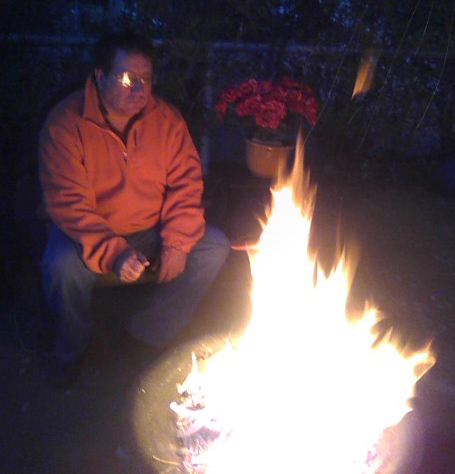
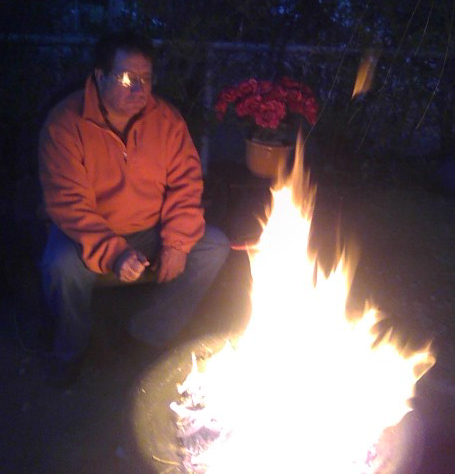
Relaxing by the front yard firepit on a chilly New Mexico evening circa 2013.
I recently purchased seasons 8 and 9 of the X-Files to complete my collection of the entire series. As you can note above, I am up to episode 6 of season 8: Redrum. No, it’s not based on The Shining or the famous line that sprang from there. This is a completely original script and I think one of the best X-Files. Why am I mentioning a Sci-Fi series in an article that should be about horror? This article is about good writing, whatever the genre.
I will endeavor to avoid spoiling the story for you.
As we all know, “redrum” is murder spelled backwards. This story is about a murder, but the alleged murderer finds himself traveling back in time to the day of the murder with the knowledge of how to prevent it.
I find the plot’s basic concept fascinating. A prosecutor (and friend of Agent Doggett) wakes up one morning to find himself in prison for the murder of his wife, about which he remembers nothing. As he is transferred to another facility for his safekeeping, he is assassinated. However, at that point time starts to flow backwards for him. Each morning he wakes up another day in the past (first he wakes up on Saturday, then on Friday, then on Thursday, etc.). With each day he learns a bit more about his predicament until finally he wakes up on the day of the murder and he has an opportunity to prevent it.
Unexpectedly traveling back in time is not a common theme, but it’s not rare either. I have to ask myself how Maeda and Arkin came up with the idea for this episode. Maybe it was based on amnesia; someone can’t recall his crime or immediate past and has to learn about it bit by bit, day by day, as the prosecutor does here. Maybe it arose out of a philosophical question such as “if we could travel back in time, we could change our future but would the ultimate destination be the same and all we change is the route we take to get there?” Maybe it was a thought that most stories show a protagonist going back in time to a certain point in time and then returning to the present; what if going back in time was not one big step, but several little steps. How could we change our lives in that case? What if as we traveled back in time, we knew as little about the past as we do about the future? We wouldn’t be able to convince those around us that we are traveling back in time, because we wouldn’t know any history to prove our story. They would believe us to be insane.
The whole scenario intrigues me. One man goes back in time for unknown reasons while the rest of the world around him proceeds as normal.
I have to ask myself what their creative process was.
This scenario opens up so many questions and possibilities. I love its originality. If you haven’t seen it, I recommend renting it as soon as possible.
We never find out what causes the protagonist to travel back in time. Like in a Stephen King novel, paranormal events happen out of the blue and at random. But according to Lovecraft’s theories of weird fiction, not knowing the cause/origin of a horrible event, makes the event more horrifying, because the event could happen to any one of us at any time.
A common principle of writing is “to suspend belief” (some say “to suspend disbelief”). In stories like this though, it is the natural laws of the universe that are suspended. Everything else, all the world/universe surrounding the event. is quite believable, which emphasizes just how weird the event is.
The story was written by Steven Maeda and Daniel Arkin. A quick search in Imdb shows that Steven Maeda has an extensive list of credits as either a writer or producer for such television series as X-Files, Lost, CSI:Miami, Helix, Lie to Me, and many others. Likewise Daniel Arkin has an extensive list of credits as a writer or producer for such shows as X-Files, Suits, Las Vegas, Alias, Medical Investigation, and others. I will have to watch for more shows with which either one is involved.
The blogger relaxing by the front yard firepit on a chilly New Mexico evening.
I was just sitting here trying to choose one of my many first drafts to work on for tonight, when I started thinking about the different “approaches” (for lack of a better term at the moment) to horror. By “approaches” I mean a very brief synopsis of a writer’s general outlook on or method of writing horror. Maybe a better way to express it would be to say the way the author approaches his genre (still not quite right, but I am getting closer to the idea).
An example would be to say that Poe’s approach was to bring out the horror in realistic situations (mostly, he did dabble in the fantastic occasionally). “The Black Cat” is about a murderer who unknowingly seals up a cat with the corpse of his victim. Nothing fantastic there. “The Tell-Tale Heart” is about a murderer whose conscience drives him to confession. “The Fall of the House of Usher” is about a family with an inherited genetic trait of hypersensitivity. So forth and so on.
Lovecraft’s approach was to spin tales of the fantastic, especially about a race of elder gods who once dominated the planet millions of years ago and of which mankind encounters remnants on rare occasion.
Stephen King’s approach is to plant an element of the fantastic among ordinary people in ordinary places and watch them react to it.
Clive Barker’s approach seems to be to take something that is fantastic, bloody, cruel, evil and gruesome and either drop it somewhere a single character can deal with it or bring it out of the shadows where a character can deal with it.
Seeing these different approaches in relation to each other makes me think about how do I want to approach an idea or a draft I have of a story. Do I want to drop the fantastic into the real or bring out the horror in the everyday or in realistic situations or can I come up with something else, my own approach, that is none of these? That is the challenge of creativity: to come up with something no one else has done. Maybe I can just go with the purely fantastic. Maybe I can try to find the real in the fantastic.
How many different ways are there to horrify an audience?
There is the real and the fantastic and all those subtle shades of gray in between the two. Can there be anything else?
I just finished watching an episode of the X-Files entitled “Chinga” [note to Spanish-speakers out there: I don’t know who chose the title, so please forgive my language] from Season Five and I noticed that it was written by Stephen King and Chris Carter (the creator of the X-Files). The story’s antagonist is a talking doll that can force people to injure or kill themselves in gruesome ways. Like many, if not most, of King’s stories, there is no explanation of how the came to exist. All the viewer finds out about it is that a lobsterman pulled it up one night in a lobster trap and his daughter comes to possess it after he meets his own gruesome fate.
I find in my own writing that I like to provide an explanation or background as to how things originate. This is just my nature. I like to know the origins of things. However, I have come to believe of late that, in terms of horror, that is a very nineteenth century concept.
Lovecraft said in his essay “Supernatural Horror in Literature”:
“A certain atmosphere of breathless and unexplainable dread of outer, unknown forces must be present; and there must be a hint, expressed with a seriousness and protentiousness becoming its subject, of that most terrible conception of the human brain — a malign and particular suspension or defeat of those fixed laws of Nature which are our only daily safeguard against the assaults of chaos and the daemons of unplumbed space.”
For me, what Lovecraft is saying is that if the laws of nature are negated, then anything is possible and monsters like Cthulhu really could exist and are capable of doing us harm at any moment. Combine this with his statement that “The oldest and strongest emotion of mankind is fear and the oldest and strongest kind of fear is fear of the unknown” and it becomes apparent that stories like “Chinga” derive much of their horror effect from the fact that the origin of the threat to a story’s protagonist(s) is unknown or that there is no explanation for the threat.
This would mean that one of things that provides to “Chinga” the element of horror that it has, is the fact that origin of the doll is unknown. Therefore, any of us when we are fishing or scuba diving or swimming in any body of water, could discover a doll that would turn his/her life into a nightmare. That is a scary thought.
Of course, this means that Stephen King would be one of the greatest practitioners of this technique, which I believe he is.
I think I shall try to experiment with this in the near future.
I happened across an excellent roundtable on Horror History 101 at the Horror Writer’s Association (http://horror.org/horror-roundtable-16-horror-history-101/) today while at lunch. Check it out. It has a great panel of experts and a wide-ranging discussion of the great horror writers of the past from the beginning of horror with Horace Walpole up to Lovecraft and more.








 Phil Slattery, Writer, Publisher