Freud’s View of Fear

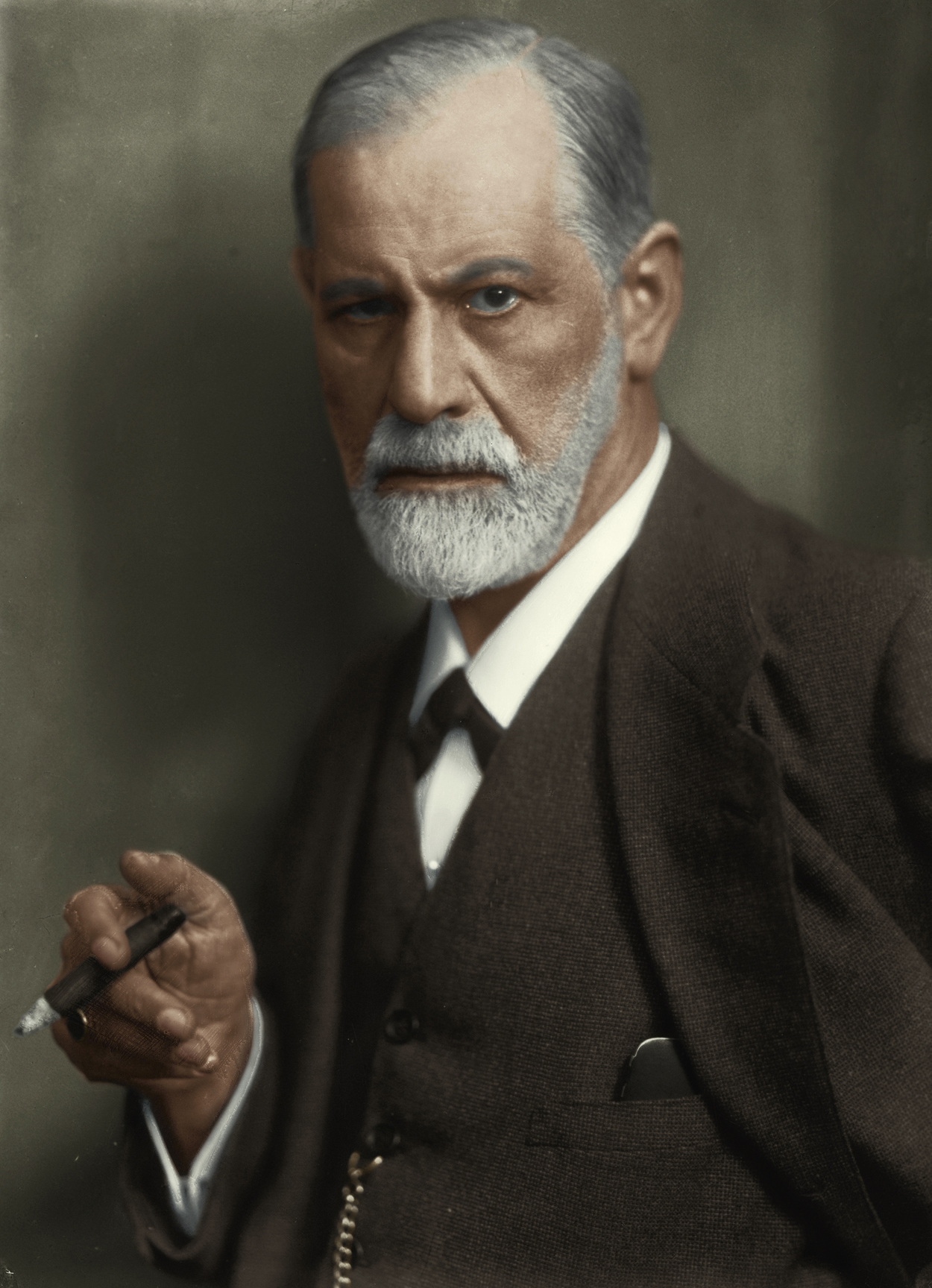
Sigmund FreudIllustration by FlyBit43
Sigmund Freud
Illustration by FlyBit43

While many people can write a horror story, those who have a profound understanding of the emotions associated with horror will have a greater chance of writing a truly great horror story.  With that in mind, as tonight’s post I offer a comment from Dr. C. George Boeree on Freud’s view of fear, which he termed “anxiety”.   This quote is part of a longer articles which can be found at http://webspace.ship.edu/cgboer/freud.html.  I like the quote, because it explains Freud’s concept in a straightforward, simple, clear way that I can grasp easily.   I also like the quote because it gives me three different types of fear to instill in my audience vicariously.  As I have mentioned in previous posts, when someone reads a story, they are experiencing the events of that story vicariously.  As writers of horror, one of the primary emotions we want to instill is fear.   In this short comment, Dr. Boeree provides us with three flavors of fear we can instill in our audiences.

“The ego — the “I” — sits at the center of some pretty powerful forces: reality; society, as represented by the superego; biology, as represented by the id. When these make conflicting demands upon the poor ego, it is understandable if it — if you — feel threatened, feel overwhelmed, feel as if it were about to collapse under the weight of it all. This feeling is called anxiety, and it serves as a signal to the ego that its survival, and with it the survival of the whole organism, is in jeopardy.

“Freud mentions three different kind of anxieties: The first is realistic anxiety, which you and I would call fear. Actually Freud did, too, in German. But his translators thought “fear” too mundane! Nevertheless, if I throw you into a pit of poisonous snakes, you might experience realistic anxiety.

“The second is moral anxiety. This is what we feel when the threat comes not from the outer, physical world, but from the internalized social world of the superego. It is, in fact, just another word for feelings like shame and guilt and the fear of punishment.

“The last is neurotic anxiety. This is the fear of being overwhelmed by impulses from the id. If you have ever felt like you were about to “lose it,” lose control, your temper, your rationality, or even your mind, you have felt neurotic anxiety. Neurotic is actually the Latin word for nervous, so this is nervous anxiety. It is this kind of anxiety that intrigued Freud most, and we usually just call it anxiety, plain and simple.”

Undoubtedly, Jung had his own views of fear, with which I am not familiar, and other psychiatrists have theirs, and Freud’s views may well be outdated, or even proven wrong.  However, if we are to understand the nature of fear, Freud is a good a place to start as any.

Thoughts?  Comments?

St. Patrick’s Day Fun

Bram Stoker1847-1912
Bram Stoker
1847-1912
Joseph Thomas Sheridan Le Fanu1814-1873
Joseph Thomas Sheridan Le Fanu
1814-1873

For St. Patrick’s Day, I thought I would bring up just a couple of tidbits.

First of all, the first two Irish horror authors who spring to mind are Joseph Thomas Sheridan Le Fanu (born at 45 Lower Dominick Street, Dublin, according to Wikipedia) and Bram Stoker (born in Clontarf, north of Dublim (also according to Wikipedia).   Follow the links to my articles on each.

Second, I did a quick search for “Irish horror humor” on Google and found reviews for Grabbers.  I haven’t seen the movie yet myself, but it looks like fun.  I will definitely check it out at my first opportunity and I recommend that you do too.

Third, never drink and blog.  If you have ever seen the movie Sideways starring Paul Giamatti and Thomas Haden Church, you know the dangers of drinking and dialing.  The dangers of drinking and blogging are similar, but on an international scale.   🙂

Conflict or Struggle?

Higuchi Jiro Kanemitsu on a wooded mountainside struggling with a giant Monkey which grips his sword-blade between its teeth. Painting by Utagawa Kuniyoshi, 1798 - 1861
Higuchi Jiro Kanemitsu on a wooded mountainside struggling with a giant Monkey which grips his sword-blade between its teeth. Painting by Utagawa Kuniyoshi, 1798 – 1861


If a work of fiction is to succeed in entertaining its audience, there must be conflict.  As this conflict pertains to the horror genre, it may be best to think of it as a struggle.

I think of a conflict as something that can happen over a very short to a very long period of time and may or may not contain any substantial action.  Conflict is a very broad term and can apply to any work of literature or film.   Conflict can apply to Tracy Chevalier’s mind-numbingly boring novel Girl with Pearl Earring as it can to Clive Barker’s The Hellbound Heart.   Struggle connotates not only a protracted conflict, which is necessary if the work (or anything involving conflict for that matter) is to have any subtantial length.  A boxing match that goes the full fifteen rounds is much more entertaining than one in which one contender is suddenly floored in the first half of the first round.

Struggle connotates action as well, which is as essential for any work of the horror genre as it is to boxing.  In the most entertaining works of horror that come to my mind, the struggle usually begins on or close to the first page and continues on to or close to the last page.  Usually the struggle is between two or more characters, though it can be against inanimate forces (such as surviving a storm) or it can be against inner drives or forces in which the protagonist struggles against himself.

What are your thoughts?  Which term is more suitable for the horror genre:  struggle or conflict?

Shades of Countess Bathory

Elizabeth, Countess Bathory

I confess.  I don’t know how to begin tonight’s article.  It is just so weird that it boggles the mind.

If you are a fan of horror, you may know of Elizabeth, Countess Bathory, the infamous “Blood Countess” and the subject of many books and at least 2-3 movies.   I happen to have a modicum of knowledge about the Countess, because some time back I researched her for a short story for which I am now trying to find a publisher.  The Countess is alleged to have killed perhaps as many as 600 young women in what is now the Czech Republic from about 1604-1610 just to bathe in their blood in order to preserve her beauty.  If you are not familiar with her, just Google “Elizabeth Bathory”.  There are a lot of good articles on her and the one in Wikipedia is a good synopsis of her life.

Fast forward to 2012.

I am sitting at my desk, surfing the net while talking to my mom on the phone, and I come across an article on Yahoo News about Kim Kardashian having a blood facial!

Let me be the first to note that the major difference between the Countess’s and Kim’s blood treatments is that Kim uses her own blood (let me repeat that for the benefit of any unscrupulous lawyers looking for a case:  the Yahoo article states that Kim Kardashian uses her own blood) and not the blood of innocents like the Countess is alleged to have done.

What more can I say?  I could probably write an extensive article just on whether bathing in blood has any actual value as a beauty treatment or whether the charges of bathing in blood put forth by her accusers and detractors have any merit or if it was just a form of black magic practiced by the Countess, but, as fascinating a subject as it is, I unfortunately don’t have the time to pursue it.  Please feel free to conduct your own research though.  I found out some fascinating things during my own and put as many as I could into the aforementioned story.   If and when it is published, I will announce it in this blog.

By the way, one thing I found out about the Countess is that while many people believe the worst about her, there are many who believe that she was innocent. Their opinion tends to be that the vicious stories about her were simply inventions of her enemies to justify their seizing of her land or they were written by gullible historians believing local legends a hundred or more years after her death.  Usually I find the truth of any issue is somewhere between the two extremes of viewpoints.

If you would like an alternate view on the Countess, I would like to recommend a movie entitled “Bathory”, which stars Anna Friel and Karel Roden.  I believe it is a Czech production.  It gives a good, plausible alternative to the legends about the Countess, and in my humble opinion, is probably much closer to the truth than the usual blood-soaked splatterfests you may find.

Horror Humor

From horrorhumor.com

As you have probably surmised by now, occasionally I like to surf the net looking for the humorous side of horror.  Today,  I found a website called appropriately horrorhumor.com.  From what I can see, they have only been up since February of this year and have only a few posts, but if you like the sample above, they are worth checking out.

Thoughts?  Comments?


Notes on “I am Legend”

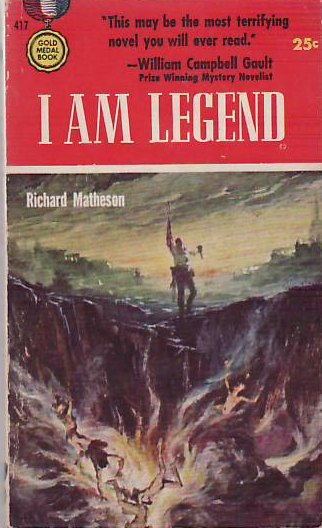
Cover of First Edition, 1954(Please note that this cover is protected by copyright; please refer to Wikipedia for details on permissible use)
Cover of First Edition, 1954
(Please note that this cover is protected by copyright; please refer to Wikipedia for details on permissible use)

I have been reading Richard Matheson’s I am Legend recently whenever I have the opportunity.  I would not say it is a fascinating book, but it is interesting.   One particularly interesting aspect is that the book is not just about one man’s fight against zombies (which he terms “vampires”, but which fit better into the modern concept of zombies) , but that it also deals extensively with his fight against depression and loneliness in a post-apocalyptic future.   Today, I happened to look up the work on Wikipedia and found the following interesting review written by Dan Schneider of International Writers Magazine:  Book Review n 2005:

“…despite having vampires in it, [the novel] is not a novel on vampires, nor even a horror nor sci-fi novel at all, in the deepest sense. Instead, it is perhaps the greatest novel written on human loneliness. It far surpasses Daniel Defoe’s Robinson Crusoe in that regard. Its insights into what it is to be human go far beyond genre, and is all the more surprising because, having read his short stories – which range from competent but simplistic, to having classic Twilight Zone twists (he was a major contributor to the original TV series) there is nothing within those short stories that suggests the supreme majesty of the existential masterpiece I Am Legend was aborning.”

Mr. Schneider may very well be right that it may be the greatest novel written on human loneliness.  If it is not, it is very close to the top.  I have read Robinson Crusoe and my impression is that I am Legend surpasses that in describing the mental and emotional anguish of loneliness and bringing that inner struggle home to the modern reader.

In my view, one reason I am Legend is important to the horror genre, is because it shows another aspect of horror: personal, inner anguish and turmoil, which probably should be classified as a form of horror, if no one has done so yet.  Anyone who has suffered extreme inner turmoil would probably agree that it is worthy of being termed horror.  It may even be the most common form of real-life horror.  I do not know the statistics for how many people are tortured at the hands of serial killers or executioners or other true-to-life monsters, but I would guess that it is far less than the number of people experiencing extreme negative emotions without actually having been physically tormented.

This aspect of inner horror can add another dimension to the otherwise average horror novel or movie, which, based on what I have seen, tends to emphasize physical violence or the threat of physical violence.   In those works, the inner horror of the protagonists is usually assumed, but not examined in detail.   Examining the inner emotions of protagonists and antagonists will help form empathy and sympathy for the characters within readers, particularly in those who have experienced a similar emotion, and will help form a tighter emotional connection between work and audience.  

I recommend reading the Wikipedia article on I am Legend.  It is quite fascinating.  However, do not do as I have done and read it before completing the book.  You will only spoil the ending for yourself.

Thoughts?  Comments?

Slattery’s Tao of Writing, Part 5: Illumination of the Particular

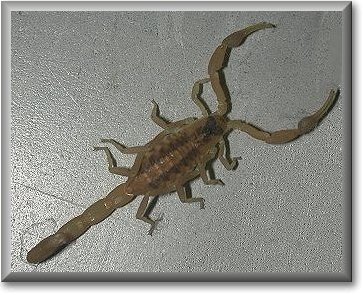
ScorpionPhoto by Phil Slattery
Scorpion
Photo by Phil Slattery

Someone once said that poetry is the “illumination of the particular”.

In 1992, when I was enamored of poetry and was striving to become a serious poet, I took that advice to heart and wrote the poem “Faust“, which describes the thoughts of the infamous Dr. Faust immediately after signing over his soul to Mephistopholes  in exchange for all knowledge.  What I describe there is everything that is going through Faust’s mind in a few seconds, the amount of time it takes to actually read the poem.   The hardest part for me was to choose the right moment to illuminate.  I could have chosen the moment before signing or a moment a year later or the moment when he first met Mephistopholes or an infinite amount of others. But that second seemed the most pregnant with meaning, because it is the moment realizes that what he has done can never be undone and that he has lost everything meaningful as a result.   After that I just had to work out the details of what he had lost, the sensations he was experiencing, the future consequences, and the wording, all of  which took about a solid eight hours.   Choosing the particular moment to illuminate was the critical decision in construction of the poem.

Good prose is often compared to poetry.  When Ray Bradbury was introduced to Aldous Huxley at tea after publication of The Martian Chronicles in 1950, Huxley leaned forward and asked Bradbury, “do you know what you are?  You are a poet.”  “I’ll be damned,” responded Bradbury.

I believe that good writing (both prose and poetry) is like good photography: it illuminates the particulars in the subject so that the viewer sees them in their abundant wonder for the first time, though he may have seen that scene a thousand times before.  Take the photo at the top of the page for example.  I happened to see a scorpion crawling across a floor one day (when I was heavy into nature and wildlife photography), grabbed the nearest camera, lined up the shot as best I could, and snapped it.   To my surprise, the focus and lighting came off better than I had planned, and thousands of details popped out in the photo that I had never anticipated.   I had walked across that floor tile I do not know how many thousands of times previously and I had never noticed the texture in its surface.   I had never been as close to a scorpion before either and I was amazed at the details that popped out in it.

Great writers seem to have an innate sense for the proper amount of details and how to use them.   Among writers of horror, Poe springs to mind immediately as a master of detail with “The Tell-Tale Heart” as a prime example of how he used details.  Poe seems to string together a series of moments (describing the old man’s eye, creeping through the door to the old man’s bed, killing him, listening to the heart as it beats beneath his floorboards) and illuminates the details in each to produce a story of tremendous power.  But among all these, is there a single, superfluous detail that does not heighten the drama?  No.  Poe knew which details to illuminate and how to illuminate the details in each of those.

Several years ago, I saw a biography of Napoleon Bonaparte on A&E.  One of the speakers was an instructor at the U.S. Military Academy at West Point.  He said that one thing Bonaparte recognized was that “while details are important, not all details are important.”  I found this a fascinating point as the speaker went on to point out that Bonaparte had a incredible memory for details.   For example, every two weeks he had the roster of the entire French army (about 200,000 troops) read out to him.  He could remember from sitting to sitting who was sick, dead, missing, and so forth.  He could ask detailed questions about the state of repair of equipment such as “last time the second gun of the third battery at Cherbourg had broken spokes in its left wheel, has that been fixed yet?”

I try to remember that these days as I write, so that I weed out the important details from the unimportant ones.

“But which details are important?” you ask.  I wish I could give a quick and easy answer on that.  At this point in my development as a writer (I may give a completely different answer years from now when my learning has progressed further), I would say:  (1) details that help the reader live the story vicariously, such as sensations, (2) details that help the reader understand the current situation and its implications, and (3) details to help the reader understand the characters, their thoughts, their perspectives, and their reactions, (4) details that tie the parts of the story together, such as a motif, and create unity, and (5) details that point toward a denouement.

Details can be critical in writing, but as with all other things, there must be a balance.    Drown the reader in details and the story becomes tedious.  Provide too few details, and the story becomes monotonous.   Choose the wrong details, and the story is boring.  Choose the right details and the reader can step into another world.

Thoughts?  Comments?

“Murder by Plastic” To Be Published


Today, I received an e-mail from the folks at Every Day Fiction saying that they will publish my story “Murder by Plastic”  either next month or the following month.  Please watch the table of contents on their site for when it appears.   I will post an update on my blog as soon as they notify me that it is up.

“Murder by Plastic” is flash fiction (about 998 words) that I can most accurately describe as on the border between crime thriller and horror.   Please watch for it and visit Every Day Fiction often.

How about a bit of horror in your humor?

Tonight, I thought I would just do a quick Google search for “horror” and “humor”.   Here are my favorites from among the many results.

From theghoulzone.com
From theeternalloop.com
From 30characters.com
From Favim.com
From Favim.com
From alphacoders.com

Thoughts?  Comments?

Addendum:

Follow this link to view a demonstration of the waterphone, the device responsible for the majority of eerie sounds and music in horror movies.  This clip is from wimp.com (a very entertaining and often intellectually intriguing site).

Is “The Epic of Gilgamesh” the first work of horror?

GilgameshPhoto by Samantha from Indonesia, Sydney Uni., 2006
Gilgamesh
Photo by Samantha from Indonesia, Sydney Uni., 2006

I have been wondering about what the first work of horror actually is.  The standard answer I find on the Internet is, of course, that the first horror novel is The Castle of Otranto by Horace Walpole in 1764, but that doesn’t satisfy me.  I have read a lot of Greek mythology since my early teens and I know they are filled with the kinds of horror that would make Clive Barker shudder and they were written probably 2,000 years before Walpole.    Then I recalled The Epic of Gilgamesh. 

The Epic of Gilgamesh is perhaps the oldest written story in any language.  It is a long poem, probably written about the 18th century B.C.    I read The Epic of Gilgamesh a few years ago, and although not lengthy, it is difficult to summarize.  In essence, it is the story of a Mesopotamian king named Gilgamesh who builds many wonders but is cruel to his people.  To teach him a lesson, the gods create a wild man named Enkidu in the wilderness who later becomes a close friend of Gilgamesh and with whom Gilgamesh goes on many adventures fighting demons and monsters only to lose Enkidu to disease later.   After Enkidu’s demise, Gilgamesh seeks out Utnapishtim (the Mesopotamian version of Noah) to see if he (Gilgamesh) can have eternal life, but the answer is no.  Gilgamesh returns to his kingdom a wiser man.   Here is a link to a more detailed summary at Spark Notes.   There are several translations in hard copy, but if you are curious about the original form, here is one that can be found at ancienttexts.org.

The Epic of Gilgamesh could perhaps best be described as a myth expressed as an epic poem with elements of horror.  It was probably written more to express a certain philosophy or to record a myth than to entertain, which is the ultimate goal of horror novels and films.    Nonetheless, it does contain elements of horror, particularly supernatural horror, and in the modern age, if it is read outside of a classroom, I think it will be read mostly for entertainment.   So, while it was not written as a novel, would it be accurate to say that The Epic of Gilgamesh is the first work of horror?    If it is, then aficianados of the horror genre could state with pride that the first written work in any language was a work of horror.

What do you think?

Beyond the Veil of Reality

Face of Horror Houseby Horror House
Face of Horror House
by Horror House

Last night, I watched an adaptation of Lovecraft’s “Dreams in the Witch House” on the Masters of Horror series (season 1, episode 2) on Netflix .   Afterwards, being late and time for bed, instead of finding the story on Project Gutenberg or some other cost-free source so that I could read it firsthand, I read a summary of the story on Wikipedia to see if the adaptation was at least reasonably accurate.  It seemed to be, even though the story was set in the modern day and the ending varied significantly from the original.  But, in accordance with today’s tastes, it was rather bloody and cruel in ways I am sure Lovecraft never intended (I say this after having read a considerable amount of his most famous works).

The most interesting aspect of the story to me was not the story itself, but speculating on how Lovecraft came up with the story’s concept.

I understand from the Wikipedia article that Lovecraft had recently attended a lecture and read up somewhat on non-Euclidean space.   Apparently, he was intrigued with the idea of existence on different planes.  Somehow he came up with the idea that the different planes of existence might intersect and beings would be able to move from one plane to the next.  This is the concept that the protagonist of the story, Walter Gilman (a graduate student in Physics) is studying when he moves into the Witch house, which was a boarding house in the fictional town of Arkham, Massachusetts, but three hundred years ago was the residence of a witch.  Gilman, as I interpret the TV story, notices that the corner formed by the intersection of two walls and the ceiling in his room coincides with the intersection of three dimensions.  It is this intersection that the witch who previously resided in the house and her familiar (a really nasty creature combining a rat with the face of a man) uses to re-enter the house in the modern day and create havoc for Gilman and the other residents.   I won’t give away the ending, but it is a good story and probably one of the more reasonably accurate adaptations of a Lovecraft story that you are likely to find.

What I found most interesting was speculating if  how Lovecraft came up with the story was to be looking at the intersection of three walls in his house and wonder if different planes of existence could intersect like that and, if they could, could creatures use the intersection to move from one plane to the other?   I am always fascinated by how writers come up with ideas for their works.   Did you ever wonder what spurred Richard Matheson to write I am Legend or Stephen King to write Carrie?

I know that some authors of Horror  (such as Algernon Blackwood, Lord Dunsany, and Arthur Machen) were intrigued by the idea of a plane of existence beyond what we take for reality, that what we perceive as reality may actually just mask the true reality.  Apparently, Lovecraft was thus intrigued as well and used his ideas of a possible alternative reality as the foundation for what others would later term “the Cthulhu Mythos”.

After having contemplated this since last night, I have been asking myself, what did these intelligent men see in their interpretations of the everyday world that would lead them to believe in the possible existence of an alternative reality?    Based upon my experience with humanity, I have come to realize that some people have some downright bizarre concepts of the world around them, but how did these concepts originate?  What causes their perceptions to be so radically different from mine?  Is it a matter of genetics that causes their synapses to be linked together differently?  Do they have slightly different body chemistries influencing their thoughts?  Is it that they simply encountered different views of the world as they grew up?  Is there a reality that they can perceive but I cannot–in the same way as I can see the workings of God in everything about me, but others do not and thus call themselves atheists and agnostics?

What are your thoughts?

Edward Lucas White

Edward Lucas White 1866-1934
Edward Lucas White
1866-1934

If you have never heard of Edward Lucas White (as I had not until recently), do yourself a favor and look up his short story “Lukundoo” (1925).   This is probably one of the best and most terrifying horror stories I have ever read and it is the story for which White is best known.  Probably his next best known story is “The House of Nightmare” (1906), though it is not nearly as good as ‘Luknudoo” and by today’s standards of horror would be considered more of a quaint tale told by children around a campfire than true horror.  Nonetheless, Lovecraft considered White to be one of the masters of “weird fiction” and mentions him in his treatise “Supernatural Horror in Literature.”

One interesting aspect of White is that he based at least some of his stories on his nightmares, which is not uncommon among horror authors, but after reading “Lukundoo” I had to ask myself, “what was going on in this guy’s psyche?”

Do you base any of your works on dreams or nightmares?   Write in and let us know.

Who influenced Edgar Allan Poe?

Edgar Allan Poe, circa 1849

Over the last couple of hours I have been wandering the Internet, searching for interesting tidbits about writers of horror to post on my blog.  I have been noting how Algernon Blackwood, Arthur Machen, Lord Dunsany, and M.R. James and a host of others influenced Lovecraft, who in turn influenced Stephen King along with generations of writers and film producers, and how Poe influenced them all.  Of course, the next question that came to me was “who influenced Poe?”

I did a quick, cursory search of the Internet and found no good answer.   A few speculated that he was influenced by the events of his life (duh, aren’t we all?), while a few others speculated that he was influenced by other prominent authors of his time (again:  duh, aren’t we all).   No one I found yet seems to be able to cite Poe’s influences like they can of Lovecraft, King, or others.

Does anyone know of a reliable source that cites the authors that Poe read?

Addendum:

(February 17, 2013) Here is the beginning of an answer to my question.  Follow this link to the article “The Influence of E.T.A. Hoffmann on the Tales of Edgar Allan Poe” by Palmer Cobb, in Volume III of Studies in Philology, The University Press, Chapel Hill, 1908.

Algernon Blackwood

Blackwood by Ianus

Algernon Blackwood

Illustration by Ianus

Algernon Blackwood (1869-1951) was a prolific writer and is probably one of the forgotten masters of the horror genre.  He was a favorite of H.P. Lovecraft as the three quotes below (from www.hplovecraft.com) illustrate:

“Aside from Poe, I think Algernon Blackwood touches me most closely—& this in spite of the oceans of unrelieved puerility which he so frequently pours forth. I am dogmatic enough to call The Willows the finest weird story I have ever read, & I find in the Incredible Adventures & John Silence material a serious & sympathetic understanding of the human illusion-weaving process which makes Blackwood rate far higher as a creative artist than many another craftsman of mountainously superior word-mastery & general technical ability…” (to Vincent Starrett, 6 December 1927)

“He actually analyses and reproduces faithfully the details of the persistent human illusion of—and out-reaching toward—a misty world of vari-coloured wonders, transcended natural laws, limitless possibilities, delighted discoveries, and ceaseless adventurous expentancy…. Of all Blackwood’s voluminous output, only a golden minimum represents him at his best—but that is such a marvellous best that we can well forgive him all his slush and prattle. It is my firm opinion that his longish short story The Willows is the greatest weird tale ever written. (with Machen’s The White People as a good second.) Little is said—everything is suggested!” (to Fritz Leiber, 9 November 1936)

“It is safe to say that Blackwood is the greatest living weirdist despite unevenness and a poor prose style.” (to Willis Conover, 10 January 1937)

Blackwood pursued a variety of jobs and careers during his lifetime, but based on the current Wikipedia article about him, his two main passions seem to have been writing and mysticism.  According to this article, Blackwood once wrote to Peter Penzoldt:

“My fundamental interest, I suppose, is signs and proofs of other powers that lie hidden in us all; the extension, in other words, of human faculty. So many of my stories, therefore, deal with extension of consciousness; speculative and imaginative treatment of possibilities outside our normal range of consciousness. … Also, all that happens in our universe is natural; under Law; but an extension of our so limited normal consciousness can reveal new, extra-ordinary powers etc., and the word “supernatural” seems the best word for treating these in fiction. I believe it possible for our consciousness to change and grow, and that with this change we may become aware of a new universe. A “change” in consciousness, in its type, I mean, is something more than a mere extension of what we already possess and know.”

His two best known stories are The Willows and The Wendigo.  I have not read The Wendigo yet, but I started The Willows two days ago and am into Chapter II currently.  So far, it is very well written with a beautiful description of a canoe trip down the Danube.  Towards the end of Chapter I, Blackwood begins to slowly bring out some eerie aspects of an island on which the narrator and his Swedish traveling companion have pitched camp for the night.  With the beginning of Chapter II, the supernatural element begins to build ominously in a way that somehow reminds me of Mussorgsky’s symphony “Night on Bald Mountain”.  If you are familiar with Mussorgsky’s opus, you know how I suspect the story will develop.    I look forward to finishing The Willows as soon as possible and beginning The Wendigo shortly thereafter.

Thoughts?  Comments?

Okay…just one more addendum to German Horror

Skinner

I saw another really cool post on the photos of the German Horror Writers Circle that I just had to share.   The book cover above is of the novel “Meeting with Skinner” by Harald A. Weissen posted on Facebook on May 7, 2010.  The accompanying summary reads:

“Imagine, that everything great that has occurred in the world since the beginning of time has been steered from a control room – discoveries, wars, political reversals, poverty, and prosperity.

Imagine that a single person has been sitting in this control room for several decades and the fortunes of the human collective has been influenced at his own discretion.

Imagine that the next person in this room is crazy.

The search for the control room draws together a traumatised young woman by the name of Laika, Elendes Biest, and Skinner , the last illusionist.”

I just think it’s an awesome post and a fascinating concept.  The artwork is great too.

Thoughts?  Comments?