Today I finished reading “The Vampyre” by John William Polidori. Polidori was a friend of Lord Byron and wrote this story during the famous writing contest between Byron, Polidori, Percy Bysshe Shelley, and Mary Shelley, in which Mary Shelley wrote the initial draft of “Frankenstein” (see my post on Polidori and “The Vampyre” dated July 12, 2013). Tonight I wrote up a quick review for Goodreads, which I have pasted here for your enjoyment. I gave the story three stars out of five.
“The action was somewhat fast moving and the ending unexpected, but the plot is rather simple and the narration is hampered by a lack of dialog. There are probably less than five lines of dialog in the entire story of 9,223 words (I copied and pasted the story from the Project Gutenberg version minus the “Extract of a Letter from Geneva” and the “Extract of a Letter Containing an Account of Lord Byron’s Residence in the Island of Mitylene” into Word then used their word count feature). One interesting aspect of Lord Ruthven’s (the vampire) character is that he cannot survive on just anyone’s blood; he has to feed only on the blood of those he loves. That would make an interesting twist to any vampire tale. As the Goodreads summary notes, this is also the start of the motif of the vampire as aristocratic seducer. While this story is probably of mediocre quality at best for today’s literary audiences, it is interesting from the perspective of literary history as the origin of today’s vampire stories and all the cultural offshoots that have sprung from those (such as the Goth movement). Bottom line: it’s worth taking the time to read, especially if one has an interest in the historical basis for today’s horror literature and the vampire subculture.”
Relaxing by the front yard firepit on a chilly New Mexico evening circa 2013.
I was sitting here writing a short story when it occurred to me that most characters in classic fiction seldom have detailed descriptions of their physical characteristics. In fact, many have none at all. If they are described, it is usually in a broad, general way, unless there is some detail the author wants to bring out that reveals something about the character. While this is a good technique for lean, muscular writing, it also has the benefit of not limiting how the character appears in the reader’s mind. For example, here is the initial description of Victor Frankenstein when the narrator’s ship rescues him in the arctic in letter 4 (which functions in essence as part of a preface):
“Upon hearing this he appeared satisfied and consented to come on board. Good God! Margaret, if you had seen the man who thus capitulated for his safety, your surprise would have been boundless. His limbs were nearly frozen, and his body dreadfully emaciated by fatigue and suffering. I never saw a man in so wretched a condition. We attempted to carry him into the cabin, but as soon as he had quitted the fresh air he fainted. We accordingly brought him back to the deck and restored him to animation by rubbing him with brandy and forcing him to swallow a small quantity. As soon as he showed signs of life we wrapped him up in blankets and placed him near the chimney of the kitchen stove. By slow degrees he recovered and ate a little soup, which restored him wonderfully.
“Two days passed in this manner before he was able to speak, and I often feared that his sufferings had deprived him of understanding. When he had in some measure recovered, I removed him to my own cabin and attended on him as much as my duty would permit. I never saw a more interesting creature: his eyes have generally an expression of wildness, and even madness, but there are moments when, if anyone performs an act of kindness towards him or does him any the most trifling service, his whole countenance is lighted up, as it were, with a beam of benevolence and sweetness that I never saw equalled. But he is generally melancholy and despairing, and sometimes he gnashes his teeth, as if impatient of the weight of woes that oppresses him.”
Very little is said about Frankenstein’s physical state except where it reveals something about his state of mind or gives an idea of the hardships he has suffered in pursuit of his creation. Because the physical description is so minimal, the reader may envision Frankenstein in any physical form that he wants or whatever is easiest for him to envision (there is a difference between what we may want to envision and what is easiest or most natural for us to envision). Frankenstein could be short and dark-haired and dark-complected or tall and blonde and sunburned. Later on, we learn his family is from Geneva, therefore the reader could envision him as whatever his stereotype of a Swiss man from Geneva happens to be.
Using minimal physical description is therefore an advantage to the author, because it allows the reader to more easily visualize and thus more easily experience the story vicariously, i.e., it allows the reader to more easily immerse himself in the story. We have all experienced the feeling of being completely immersed in the world of a novel, what Henry James called “the atmosphere of the mind” (see the definition in the Lexicon of Horror) and that is a feeling I want my readers to experience.
The blogger hiking in the Bisti Wilderness near Farmington, NM.
I am very pleased to announce that my short story “The View from the Apex of Civilization” will be re-printed in about a week by Through the Gaps at http://www.throughthegaps.com. Though set in a dungeon of the Spanish Inquisition, the story is an indirect comment on our own society. It is mainstream literature/facetious black humor rather than horror, though it does have a touch of suspense. The story was first published in Mobius Magazine in 2004. Once again, my thanks go out to Benjamin Choi and the staff at Through the Gaps for publishing another of my stories. “The View from the Apex…” will be my fourth story re-printed by Through the Gaps.
Current headline at Through the Gaps showing illustrations for “Shapeshifter”, “Decision”, and “Sudan”
Through the Gaps has just published my story “Shapeshifter” about a werewolf sighting in France in 1601. For the first time I have three stories appearing simultaneously in one magazine: “Shapeshifter”, “Decision”, and “Sudan”. All are reprints of early works. Many thanks once again to the wonderful folks at Through the Gaps. Shown is a snippet from their current front page.
With Iced Tea, Farmington, New Mexico, March 20, 2015
As you may already know, I am on Goodreads quote of the day mailing list. Today’s I found particularly interesting on a couple of levels:
“Atticus told me to delete the adjectives and I’d have the facts.” Harper Lee
First, there is the literary perspective. Eliminating the adjectives and other modifiers from a story leaves you with the simple, cold hard facts, the bones, of the story. I have read several bits of writing advice that advocate keeping modifiers to a minimum and using nouns and verbs to their fullest by using them precisely, trying to match the exact word to its underlying concept. To my mind, that leaves one with the essence of the story.
Second, there is the deeper, philosophical perspective. Like with the literary perspective above, if you observe or learn of an event, if you cut away all the extraneous opinions and descriptors and other crap, you will have the cold, hard facts of the matter. This is echoed in Hannibal Lecter’s famous quote from Marcus Aurelius (though this is actually a paraphrase…at least in my copy of Meditations of Marcus Aurelius): “Read Marcus Aurelius. Of each particular thing ask: what is it in itself? What is its nature?”. It is also echoed in Hemingway’s remark made during an interview in The Paris Review: “The most essential gift for a good writer is a built-in, shockproof, shit detector.”
The blogger hiking in the Bisti Wilderness near Farmington, NM.
I just got the word that the wonderful folks at www.throughthegaps.com will re-print my story “Shapeshifter” in about a week. This is the third of my stories to be published by them in about a month. “Shapeshifter” is about a alleged werewolf sighting in France in 1601 during the height of the werewolf trials. I think it says something about human nature. The story was first published in 2003 by Ascent Magazine (www.ascentaspirations.ca). Please drop by Through the Gaps to add to their site visitation and readership.
Portrait of Nikolai Gogol circa 1840 from Wikipedia
This morning I have been going through all the daily updates I have been getting from Goodreads, but have not read. Here’s an interesting one.
“I am fated to journey hand in hand with my strange heroes and to survey the surging immensity of life, to survey it through the laughter that all can see and through the tears unseen and unknown by anyone.” –Nikolai Gogol
Goodreads notes: “Novelist and playwright Nikolai Gogol (born March 31, 1809) feared being buried alive. When his grave was exhumed, his body was lying face down, giving rise to the rumor that the author’s greatest fear had come to pass.” I read some of Gogol’s most famous works as an undergraduate and loved them. I need to re-read them just for the sheer pleasure of reading them. Gogol was an eccentric Russian (though born in the Ukraine) author/satirist of the early nineteenth century and is best known for his unfinished novel “Dead Souls” about a man who travels through the country buying up the dead. He is also known for his short stories, particularly “The Nose” a fantasy about a nose that detaches itself from its owner one day and takes on a life of its own and “The Overcoat”, a story about an impoverished government clerk (copyist, if I recall correctly), whose prize possession is a beautiful overcoat and who comes back from the dead to find it. He was known for being a satirist, rather than a writer of horror, but a few of his most famous works verge on what might be termed ghost stories or fantasy as can be seen above. He is a master author, however, and his works bear checking out no matter what your preferred modern genre is. Wikipedia has this to say about his style:
D.S. Mirsky characterized Gogol’s universe as “one of the most marvellous, unexpected – in the strictest sense, original[28] – worlds ever created by an artist of words.”[29] The other main characteristic of Gogol’s writing is his impressionist vision of reality and people. He saw the outer world romantically metamorphosed, a singular gift particularly evident from the fantastic spatial transformations in his Gothic stories, A Terrible Vengeance and A Bewitched Place. His pictures of nature are strange mounds of detail heaped on detail, resulting in an unconnected chaos of things. His people are caricatures, drawn with the method of the caricaturist – which is to exaggerate salient features and to reduce them to geometrical pattern. But these cartoons have a convincingness, a truthfulness, and inevitability – attained as a rule by slight but definitive strokes of unexpected reality – that seems to beggar the visible world itself.[30] The aspect under which the mature Gogol sees reality is expressed by the Russian word poshlost’, which means something similar to “triviality, banality, inferiority”, moral and spiritual, widespread in some group or society. Like Sterne before him, Gogol was a great destroyer of prohibitions and romantic illusions. It was he who undermined Russian Romanticism by making vulgarity reign where only the sublime and the beautiful had reigned.[31] “Characteristic of Gogol is a sense of boundless superfluity that is soon revealed as utter emptiness and a rich comedy that suddenly turns into metaphysical horror.”[32] His stories often interweave pathos and mockery, while “The Tale of How Ivan Ivanovich Quarreled with Ivan Nikiforovich” begins as a merry farce and ends with the famous dictum, “It is dull in this world, gentlemen!”
Relaxing by the front yard firepit on a chilly New Mexico evening circa 2013.
I recently purchased seasons 8 and 9 of the X-Files to complete my collection of the entire series. As you can note above, I am up to episode 6 of season 8: Redrum. No, it’s not based on The Shining or the famous line that sprang from there. This is a completely original script and I think one of the best X-Files. Why am I mentioning a Sci-Fi series in an article that should be about horror? This article is about good writing, whatever the genre.
I will endeavor to avoid spoiling the story for you.
As we all know, “redrum” is murder spelled backwards. This story is about a murder, but the alleged murderer finds himself traveling back in time to the day of the murder with the knowledge of how to prevent it.
I find the plot’s basic concept fascinating. A prosecutor (and friend of Agent Doggett) wakes up one morning to find himself in prison for the murder of his wife, about which he remembers nothing. As he is transferred to another facility for his safekeeping, he is assassinated. However, at that point time starts to flow backwards for him. Each morning he wakes up another day in the past (first he wakes up on Saturday, then on Friday, then on Thursday, etc.). With each day he learns a bit more about his predicament until finally he wakes up on the day of the murder and he has an opportunity to prevent it.
Unexpectedly traveling back in time is not a common theme, but it’s not rare either. I have to ask myself how Maeda and Arkin came up with the idea for this episode. Maybe it was based on amnesia; someone can’t recall his crime or immediate past and has to learn about it bit by bit, day by day, as the prosecutor does here. Maybe it arose out of a philosophical question such as “if we could travel back in time, we could change our future but would the ultimate destination be the same and all we change is the route we take to get there?” Maybe it was a thought that most stories show a protagonist going back in time to a certain point in time and then returning to the present; what if going back in time was not one big step, but several little steps. How could we change our lives in that case? What if as we traveled back in time, we knew as little about the past as we do about the future? We wouldn’t be able to convince those around us that we are traveling back in time, because we wouldn’t know any history to prove our story. They would believe us to be insane.
The whole scenario intrigues me. One man goes back in time for unknown reasons while the rest of the world around him proceeds as normal.
I have to ask myself what their creative process was.
This scenario opens up so many questions and possibilities. I love its originality. If you haven’t seen it, I recommend renting it as soon as possible.
We never find out what causes the protagonist to travel back in time. Like in a Stephen King novel, paranormal events happen out of the blue and at random. But according to Lovecraft’s theories of weird fiction, not knowing the cause/origin of a horrible event, makes the event more horrifying, because the event could happen to any one of us at any time.
A common principle of writing is “to suspend belief” (some say “to suspend disbelief”). In stories like this though, it is the natural laws of the universe that are suspended. Everything else, all the world/universe surrounding the event. is quite believable, which emphasizes just how weird the event is.
The story was written by Steven Maeda and Daniel Arkin. A quick search in Imdb shows that Steven Maeda has an extensive list of credits as either a writer or producer for such television series as X-Files, Lost, CSI:Miami, Helix, Lie to Me, and many others. Likewise Daniel Arkin has an extensive list of credits as a writer or producer for such shows as X-Files, Suits, Las Vegas, Alias, Medical Investigation, and others. I will have to watch for more shows with which either one is involved.
Neil Gaiman at the 2007 Scream Awards Photo by pinguino k
Here’s the second batch of writing tips from Open Culture. They include tidbits from Neil Gaiman, Henry Miller, Elmore Leonard, George Orwell, and Margaret Atwood. Enjoy.
Interesting article, though I tend to disagree with his descriptions of what was going through Poe’s mind when he wrote this. Though I am not a skeptic, I tend to be skeptical when someone tells me in effect “yes, that is what he says, but this is what he meant…” Poe definitely hyped the bejeezus out of the poem (and his ego) by calling it the best poem ever written, but as for the rest…who knows?
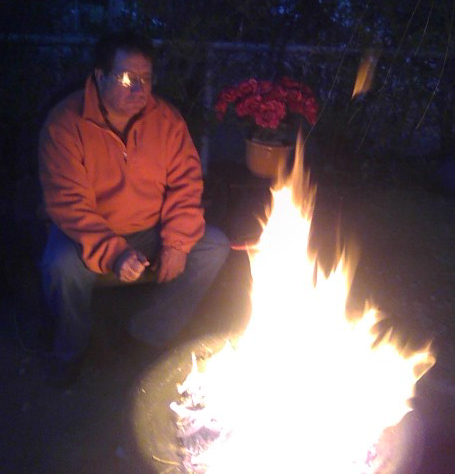
The blogger relaxing by the front yard firepit on a chilly New Mexico evening.
I was just sitting here trying to choose one of my many first drafts to work on for tonight, when I started thinking about the different “approaches” (for lack of a better term at the moment) to horror. By “approaches” I mean a very brief synopsis of a writer’s general outlook on or method of writing horror. Maybe a better way to express it would be to say the way the author approaches his genre (still not quite right, but I am getting closer to the idea).
An example would be to say that Poe’s approach was to bring out the horror in realistic situations (mostly, he did dabble in the fantastic occasionally). “The Black Cat” is about a murderer who unknowingly seals up a cat with the corpse of his victim. Nothing fantastic there. “The Tell-Tale Heart” is about a murderer whose conscience drives him to confession. “The Fall of the House of Usher” is about a family with an inherited genetic trait of hypersensitivity. So forth and so on.
Lovecraft’s approach was to spin tales of the fantastic, especially about a race of elder gods who once dominated the planet millions of years ago and of which mankind encounters remnants on rare occasion.
Stephen King’s approach is to plant an element of the fantastic among ordinary people in ordinary places and watch them react to it.
Clive Barker’s approach seems to be to take something that is fantastic, bloody, cruel, evil and gruesome and either drop it somewhere a single character can deal with it or bring it out of the shadows where a character can deal with it.
Seeing these different approaches in relation to each other makes me think about how do I want to approach an idea or a draft I have of a story. Do I want to drop the fantastic into the real or bring out the horror in the everyday or in realistic situations or can I come up with something else, my own approach, that is none of these? That is the challenge of creativity: to come up with something no one else has done. Maybe I can just go with the purely fantastic. Maybe I can try to find the real in the fantastic.
How many different ways are there to horrify an audience?
There is the real and the fantastic and all those subtle shades of gray in between the two. Can there be anything else?
I just finished watching an episode of the X-Files entitled “Chinga” [note to Spanish-speakers out there: I don’t know who chose the title, so please forgive my language] from Season Five and I noticed that it was written by Stephen King and Chris Carter (the creator of the X-Files). The story’s antagonist is a talking doll that can force people to injure or kill themselves in gruesome ways. Like many, if not most, of King’s stories, there is no explanation of how the came to exist. All the viewer finds out about it is that a lobsterman pulled it up one night in a lobster trap and his daughter comes to possess it after he meets his own gruesome fate.
I find in my own writing that I like to provide an explanation or background as to how things originate. This is just my nature. I like to know the origins of things. However, I have come to believe of late that, in terms of horror, that is a very nineteenth century concept.
Lovecraft said in his essay “Supernatural Horror in Literature”:
“A certain atmosphere of breathless and unexplainable dread of outer, unknown forces must be present; and there must be a hint, expressed with a seriousness and protentiousness becoming its subject, of that most terrible conception of the human brain — a malign and particular suspension or defeat of those fixed laws of Nature which are our only daily safeguard against the assaults of chaos and the daemons of unplumbed space.”
For me, what Lovecraft is saying is that if the laws of nature are negated, then anything is possible and monsters like Cthulhu really could exist and are capable of doing us harm at any moment. Combine this with his statement that “The oldest and strongest emotion of mankind is fear and the oldest and strongest kind of fear is fear of the unknown” and it becomes apparent that stories like “Chinga” derive much of their horror effect from the fact that the origin of the threat to a story’s protagonist(s) is unknown or that there is no explanation for the threat.
This would mean that one of things that provides to “Chinga” the element of horror that it has, is the fact that origin of the doll is unknown. Therefore, any of us when we are fishing or scuba diving or swimming in any body of water, could discover a doll that would turn his/her life into a nightmare. That is a scary thought.
Of course, this means that Stephen King would be one of the greatest practitioners of this technique, which I believe he is.
I think I shall try to experiment with this in the near future.
I happened across an excellent roundtable on Horror History 101 at the Horror Writer’s Association (http://horror.org/horror-roundtable-16-horror-history-101/) today while at lunch. Check it out. It has a great panel of experts and a wide-ranging discussion of the great horror writers of the past from the beginning of horror with Horace Walpole up to Lovecraft and more.






 Phil Slattery, Writer, Publisher