The Real Dracula’s Castle — Stop 2 of the World’s Greatest Horror Locales

Bela Lugosi as Count Dracula 1931
Bela Lugosi
as Count Dracula
1931

The first thing you learn about the historical Castle Dracula is that it is a fictional location from Bram Stoker’s imagination.  The Wikipedia article does a nice job of summarizing the history of the fictional abode and of analyzing the novel for clues to its supposed locale.   The most precise it comes to identifying the spot of Dracula’s Castle is:

“The site of the Vampire’s home has always been one of the greatest mysteries of the novel. The route descriptions hardly mention any recognisable landmarks, but focus on evocations of a wild and snow-covered landscape, haunted by howling wolves and lit by supernatural blue flames at night. Because of this conspicuous vagueness, the annotated Dracula editions by Leonard Wolf,[6] Clive Leatherdale[7] and Leslie Klinger[8] simply assume Bram Stoker had no specific location in mind and place the Castle in or immediately next to the Borgo Pass. As a consequence, these editions take for granted that the Count’s men, pursued by Harker, Holmwood, Morris and Seward, follow the Bistrița River all the way up to Vatra Dornei and then travel the route through the Borgo Pass already taken by Van Helsing and Mina. The same view is adopted by Andrew Connell in his Google Map mark-ups.[9] These theories ignore or misinterpret Stoker’s hint that around the 47th Parallel, the Count’s men are supposed to leave the river and cross-over to Transylvanian territory:

We took it, that somewhere about the 47th degree, north latitude, would be the place chosen for crossing the country between the river and the Carpathians. (Chapter 26, Jonathan Harker’s Journal, Entry for 30 October)[10]

“Only recently, the Dutch author Hans Corneel de Roos discovered the site the Irish novelist really had in mind while shaping his narrative: an empty mountain top in the Transylvanian Kelemen Alps near the former border with Moldavia, ca. 20 miles south-east of the Borgo Pass.[11] De Roos also explains why Stoker chose to obscure this location in his novel and compares the vampire’s fortress to the Grail Castle as its anti-Christian antipole: It cannot be found on purpose, only by guidance. Harker is brought there by the Count himself, while Van Helsing and Mina – equally nodding off – rely on the instinct of their horses and the mounted men arrive there by following the Gypsies.”

If you have read the book and have seen at least the original film version of Dracula with Bela Lugosi, you know at least one place they have in common is Borgo Pass.   This is where Jonathan Harker disembarks from a coach to wait in an inn for the Count’s own carriage to come and fetch him and the village people try unsuccessfully to warn him away.
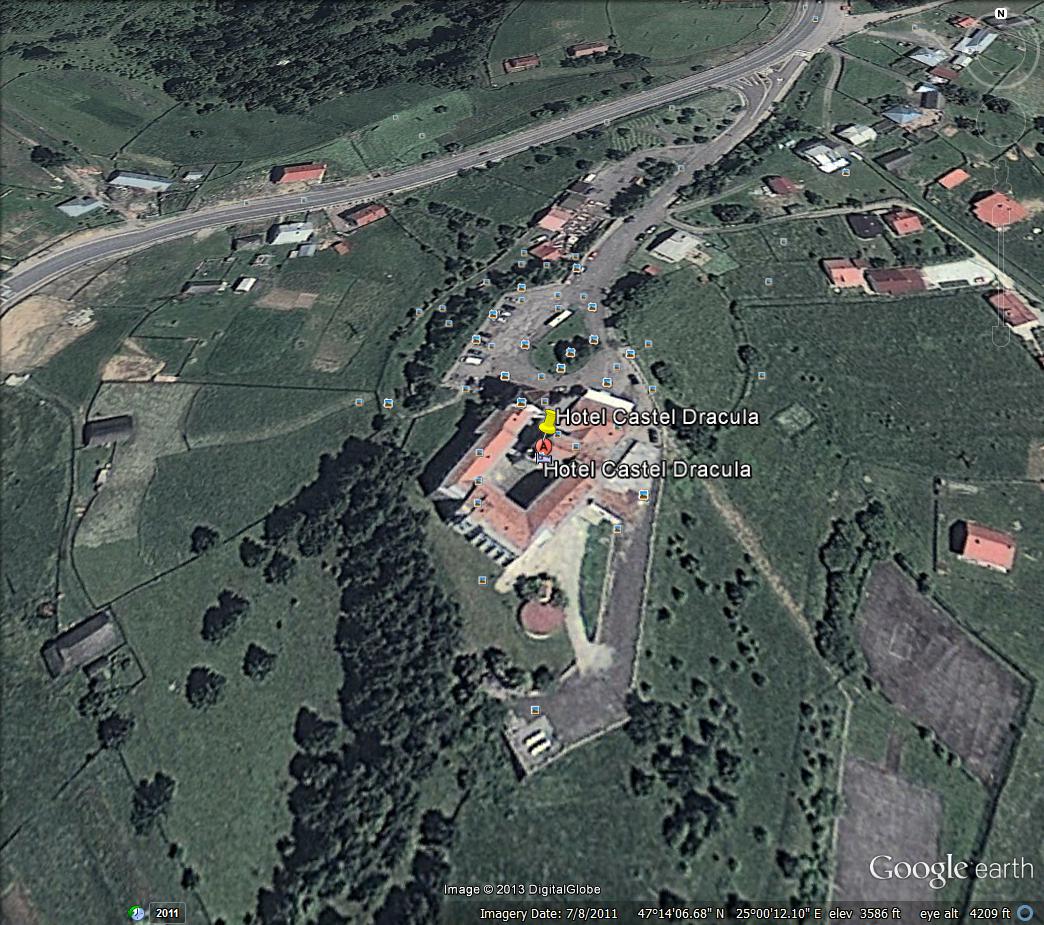
Aerial view of the Hotel Castel Dracula in the Borgo Pass from Google Earth

What you will learn from a few places on the Internet is that a hotel has been built on the spot in the Borgo Pass where Harker is supposed to have changed rides.  Romanian Tourism describes it so:


Borgo Pass

(Pasul Tihuta) 
Where: 277 miles northwest of Bucharest / 12 miles northeast of Bistrita

Note: Access by car only

 Borgo Pass (Bargau in Romanian), made famous in the opening chapter of Bram Stoker’s Dracula, is an oft-trod passageway through the Carpathian Mountains in northern Transylvania. Located near the small township of Tihuta, the pass peaks at 3,840 feet.

The Bargau Valley encompasses some of the most beautiful unspoiled mountain scenery in the Carpathians with picturesque traditional villages located in valleys and on hillsides, ideal bases for hiking, riding or discovering their vivid tapestry of old customs, handicrafts and folklore.

Here, you will step into a realm that the fictional Mina Harker described in her diary as “a lovely county; full of beauties of all imaginable kinds, and the people are brave, and strong, and simple, and seem full of nice qualities.”

If you travel via Google Earth, if you search for “Borgo Pass”, you will find the location, but the name for it on Google Earth is “Pasul Tihuta”, the Romanian name, not the Hungarian “Borgo Pass” that Bram Stoker used.  Once in Pasul Tihuta, search for Hotel Castel Dracula.  That’s the spot where Harker is supposed to have changed carriages.   Don’t be surprised that the modern hotel looks nothing like the quaint hamlet of the movie.  The Wikipedia article on Tihuta Pass states:

Tihuţa Pass (Romanian: Pasul Tihuţa; Hungarian: Borgo or Burgo) is a high mountain pass in the Romanian Bârgău Mountains (Eastern Carpathian Mountains) connecting Bistriţa (Transylvania) with Vatra Dornei (Bukovina, Moldavia).

The pass was made famous by Bram Stoker‘s novel Dracula, where, termed as “the Borgo Pass”, it was the gateway to the realm of Count Dracula. Stoker most likely found the name on a contemporary map. He never actually visited the area.

Today the pass is home to Hotel “Castel Dracula”. The hotel was built in 1974 and is located at an altitude of
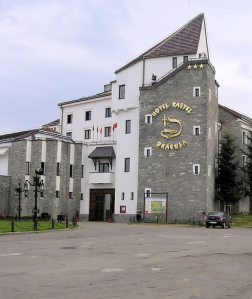
Hotel Castel Dracula Borgo Pass, Romania
Hotel Castel Dracula
Borgo Pass, Romania

1,116 m (3,661 ft). The hotel has become quite an attraction due to its architectural style of a medieval villa, as well as the sheer beauty of the location.


That being said, the next question that arises is if there is no Castle Dracula, but there was a historical figure on which was based, where did the historical figure, Vlad the Impaler, actually live?
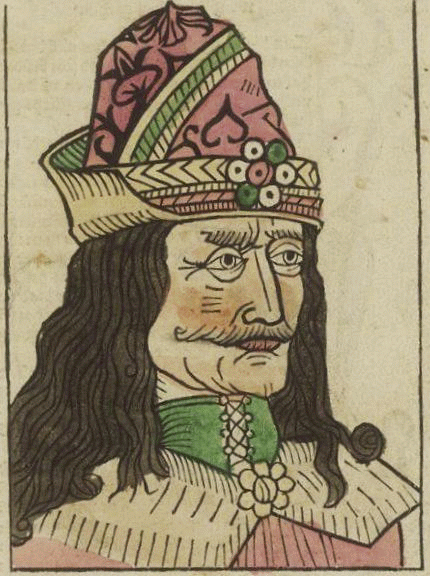
 

A woodcut of the historical Vlad Tepes from about the sixteenth century

If you read any summary of his life, you will find that Vlad the Impaler was constantly on the move, either attacking his enemies or running from them.  Pinning down his abode to a single spot is difficult.  A good, brief summary of the most famous can be found at Romania Tourism.  You will note that most of the popular tourist sites have at best a tenuous connection to Vlad Tepes.   This is probably similar to the number of places along the US east coast that claim to be where George Washington slept during his campaigns in the American Revolution.

From what I have found during my Internet searches one of the best and probably most reliable articles on the places associated with Vlad Tepes is this one entitled “Dracula’s Homepage” written by a man who has apparently conducted extensive research into Vlad Tepes and the places associated with him.   The author describes for us which spots were locations where Vlad Tepes actually lived as opposed to ones that the tourism industry identifies with him, but which in fact may have little, if anything at all, to do with the bloodthirsty ruler.     The two locations described in this article as where Vlad Tepes spent a significant amount of time are Tirgoviste Palace and Cetatea Poenari.  

The Tirgoviste palace is actually called “Curtea Palace”, where Vlad Tepes built the Chindia Tower.  If you search for “Chindia Tower” on Google Earth, you can hover just over Vlad Tepes’s Tirgoviste Palace and even go to street level to view the tower as if you were walking past it.

Tirgoviste Palace today  (from Google Earth)
Tirgoviste Palace today
(from Google Earth)


Chindia Tower from the street  (from Google Earth)
Chindia Tower from the street
(from Google Earth)


Search Google Earth for “Cetatea Poenari” and you will be taken to a secluded mountaintop over a narrow pass.   This place probably captures the eerie spirit of the novel more than any other place you will find.  If you have the Google Earth 3D buildings feature on (as I do in the photo below), you will see a 3D virtual representation of the castle, though the best views of it are from the dozens of photos tourists have attached to the location via Panaramio.
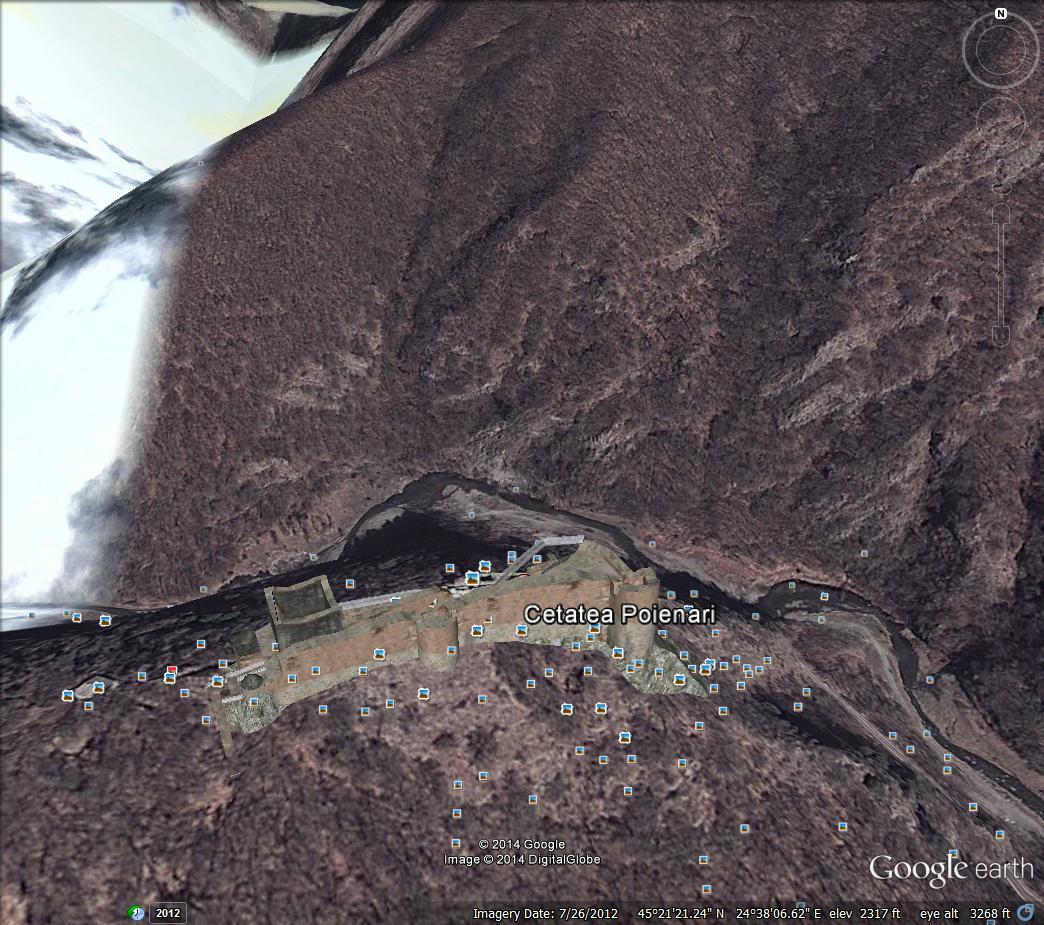
Cetatea Poenari (from Google Earth)
Cetatea Poenari
(from Google Earth)


The website “Dracula’s Homepage” mentioned previously has a beautiful description of what it must be like to travel to the castle along with some of its historically horrific background: 

“If there is an edifice that can be labelled Vlad Dracula’s castle, it is the ruins of Poenari. Actually, this is a fortress (“cetate” in Romanian) rather than a castle, located at the entrance to the gorge of the Arges River, north of the town of Curtea de Arges. As you leave Curtea de Arges (itself an interesting town with fortifications dating back to the 13th century and Basarab 1), you drive over a secondary road through several little villages, proceeding up the Arges valley towards the base of the Carpathian range.The road reaches the base of a group of high, heavily wooded mountains and there on the rocky top of one of them is Cetatea Poenari – Dracula’s Castle. Even from the road below it is a forbidding sight. What strikes one is its inaccessibility, high on a mountain top and the entrance to the gorges of the river (the river, by the way, has been diverted by a hydro-electric project). Poenari was the castle fortification that Vlad Tepes forced the nobles of Tirgoviste to build. The nobles were forced to walk the distance from Tirgoviste to the Arges (quite considerable by road – probably about 60 km overland) and then drag the material up that mountain to build the castle.

Foot BridgeTo get to the top, one has to walk up almost 1500 steps. But the effort is certainly worth it. As you approach the magnificent ruin (last 50 steps or so) the scene is totally Gothic. There is the outline of the castle perched on the top of this rock, seeming to grow out of the very mountain itself. It covers the full space at the top, has a sheer drop on three sides, and is barely accessible by a small bridge near the top of the steps.

“I have returned to this site three times, as it is one of my favorite places in Romania: not only because of the sense of history but the magnificent scenery. One particular view (looking northwest) is spectacular – just the way you might picture the landscape around Dracula’s Castle in Stoker’s novel (though Stoker knew nothing about this place).

“This is the route that, according to local legend, Vlad took in order to escape into Transylvania from the Turks in 1462. He was assisted in his efforts by the villagers of nearby Arefu, where many narratives about Vlad still live in their oral culture.
Pass

“Then there is the southern wall of the castle – a sheer drop!

Southern Wall

“This is where, according to another local legend, Vlad Tepes’ first wife flung herself, committing suicide rather than being taken captive by the advancing Turks. This castle is where Vlad would go for refuge in the face of advancing enemies. And from its towers he had a commanding view of anyone approaching from any direction. It was practically impenetrable.”

If you like horror, I highly recommend reading up on the historical Vlad Tepes and his reign.  You will find actual terrors that would make any of the ficitional Draculas look like TV’s Mr. Rogers in comparison. 

If, during your virtual journeys through the worlds of the fictional Count Dracula and his historical counterpart, Vlad Tepes, encounter any fascinating places or adventures, please feel free to share them via the comments section below.

Thoughts?  Comments?
A Virtual Journey through the World’s Horror Spots, Stop 1

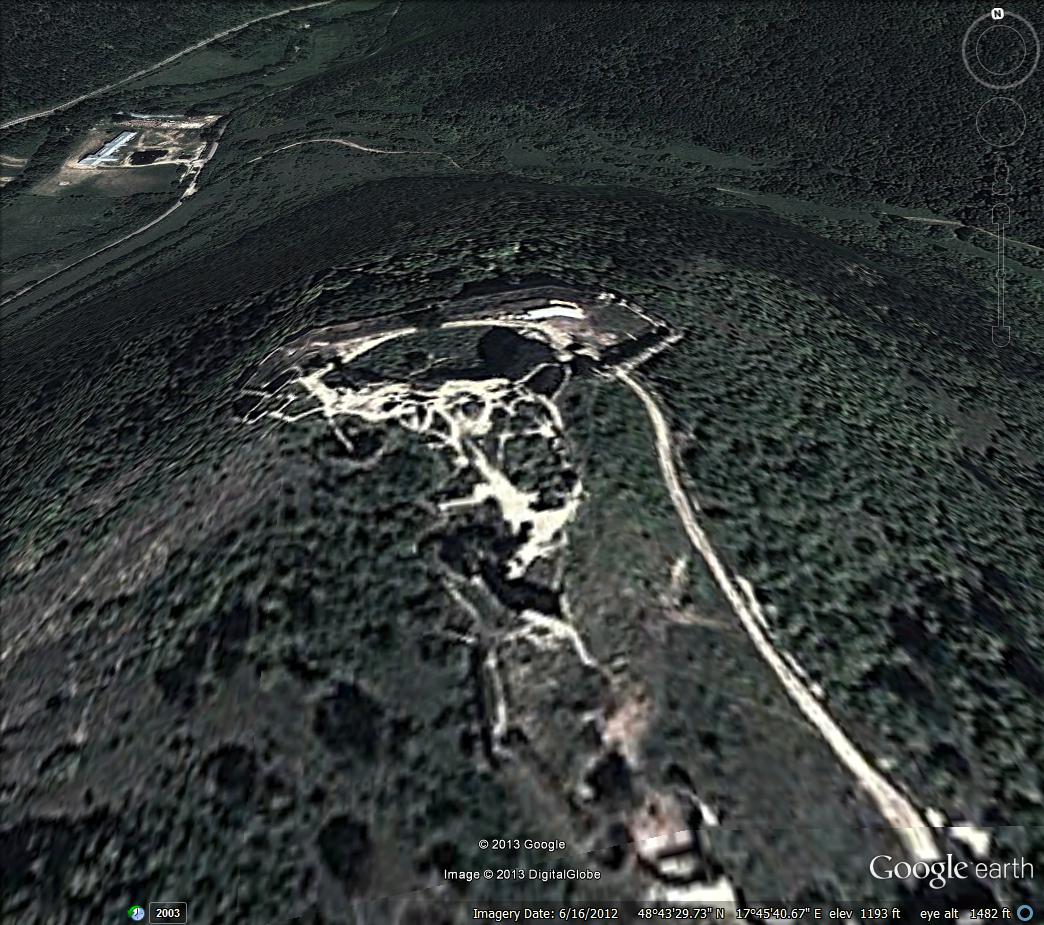
Cachtice Castle, home of Elizabeth Bathory, "the Blood Countess" from Google Earth Dec. 2013
Cachtice Castle, home of Elizabeth Bathory, “the Blood Countess”
from Google Earth Dec. 2013

A few days ago, I was just relaxing after a heavy meal and was starting to surf Google Earth, when I hit upon an idea that might be entertaining to my followers in the blogosphere.  Why not visit the locations of famous horror novels or historical figures via Google Earth?   I would only be trying to fool myself and you if I were to say that I would do this with any regularity.  I can say that I shall do it as the spirit moves me, which may or not be frequently.   Let me know what you think of the idea.  I encourage you to try the same with the horror locations that you know.   My first stop is at Cachtice (pronounced Chahk-teet-se) Castle, in present-day Slovakia, which was the home of the “Blood Countess”, Elizabeth Bathory, who is said to have tortured and murdered around 650 young girls circa 1600-1610.   I won’t go into a detailed biography of her here.  I have mentioned her in at least a couple of posts already and her biography can easily be found by surfing the Internet.  I do caution you to try to find good, authoritative sources of information about her.   Unfortunately, crap is pervasive throughout the “net” and a legendary figure from 400 years ago is apt to have more than the average share of strange ideas, rumors, falsehoods, mistakes, and outright lies. The Google image above is not of the highest quality.  I think this one has recently replaced one that was much better.  For a better view of the castle, I am providing this terrific view by Civertan from Wikimedia Commons:

Cachtice Castle From Wikimedia Commons Photo by Civertan
Cachtice Castle
From Wikimedia Commons
Photo by Civertan

The advantage of Google Earth though is that you can view a location from an infinite number of angles and even from street level (unfortunately this option is not available for Cachtice) and view photos visitors have taken of the location.  To find Cachtice, you will, of course, have to search for “Cachtice”.  This will take you to the village of Cachtice.  Look to the Northwest and you will find a smaller village called “Visnove”.  Just southeast of Visnove is a hill with a castle. That’s it.   See the diagram I have attached below for more details.

I hope you enjoy your virtual visit to one the world’s more infamous hellholes.

cachtice-annotated

NaNoWriMo: Classic Novels Written in a Month | Interesting Literature

Robert Louis Stevenson Portrait by Girolamo Nerli  (1860-1926)
Robert Louis Stevenson
Portrait by Girolamo Nerli
(1860-1926)

If you are having problems meeting a deadline or dealing with the demon of writer’s block the following article may help you feel not so alone.  Some, if not all, of the world’s most famous had to deal with one or both and often did so in novel ways:   NaNoWriMo: Classic Novels Written in a Month | Interesting Literature.

Note, horror fans, that of the authors mentioned here only one was an author of horror.  Of course, I mean the gentleman to the left, the author of Dr. Jekyll and Mr. Hyde, which he apparently drafted at the Nineteenth century equivalent of warp speed.

Thoughts?  Comments?

Visit “The Works of Edgar Allan Poe, Volume 1” but not for the obvious reason.

Edgar Allan Poe, 1848

The Works of Edgar Allan Poe, Volume 1.  Yes, this link takes you to a collection of Poe’s works, but the reason I am mentioning it here is because the preface to this particular volume includes fascinating biographical notes and insight into the character of this master of horror that may help you understand the roots of his creative genius and how art sometimes came close to imitating life for Mr. Poe.

When you open the page, you may find yourself a little distance from the top of the article at the beginning of a section entitled “The Death of Edgar Allan Poe”.  While this section is fascinating in its own right, scroll to the top for the entire preface.  The works of Poe, beginning with the story of Hans Pfall, begin a bit down from “The Death…”

28 Totally Relatable Quotes About Books

Detail of Madonna des Kanonikus Georg van der Paele by Jan van Eyck, 1436
Detail of Madonna des Kanonikus Georg van der Paele
by Jan van Eyck, 1436

Purely for your entertainment, here are 28 Totally Relatable Quotes About Books.  I know I can relate to a lot of them.  I’m sure you will find a few for yourself.  One reason I find these interesting is because many of them show me how intensely involved readers will become with a book.  As I have mentioned in previous posts, I believe that people live a vicarious existence through a story.  When we write, we are not just writing a book or a story, we are creating a universe in which people will hopefully want to, not just visit, but dwell.  All of the writer’s art should therefore focus on creating a virtual reality for one’s readers.  To do that, we need a good  grounding in, or at least a good feel for, human psychology, because we have to shape our creations to fit the human psyche.  How do thoughts come into being?  How do they lead from one to another?  How do images form in the mind?  No, I am not saying that we need Ph.D.’s in psychology to be good writers, but I think we need some sort of archetypal insight into human nature if we are to be the great writers we hope to be.  Darn.  I’m rambling again.  🙂

Dictionary.com – Monsters of Literature and Folklore

Bela Lugosi as Count Dracula 1931
Bela Lugosi
as Count Dracula
1931

Here is an interesting bit of trivia:  “8 Monsters of Literature and Folklore” at Dictionary.com – Free Online English Dictionary.  You may have to wait a second or two for the slide show to pop up.

Edgar Allan Poe: Poet and Prophet | Interesting Literature

Edgar Allan Poe, 1848

Here is a fascinating article about the founding father of modern horror:  Edgar Allan Poe: Poet and Prophet | Interesting Literature.  Interestingly, it states that the story about Edgar Allan Poe in his white belt and gloves at West Point, which I quoted in an earlier post from The Writer’s Home Companion, is urban legend.   It goes on to state several fascinating bits of trivia about Poe including his involvement in the development of the detective story and the short story, the backgrounds of some of his most famous works, his passion for cryptography, his foreshadowing of the Big Bang Theory, criticisms of his work by William Butler Yeats and T.S. Eliot, and some insights on his personal and financial life.

Selections from The Writer’s Home Companion

Edgar Allan Poe, circa 1849

The other day I happened to find my copy of The Writer’s Home Companion (by James Charlton and Lisbeth Mark, 1987), which I had lost/forgotten some time back. I have been perusing it since and have found several anecdotes on various authors of horror, which had not captured my attention when I purchased the book, because I was not interested in writing horror at the time.  I am quoting them below for your entertainment and consideration.   They provide a few insights and lessons into the art and business of writing as well as into the lives of writers, if not in the art of horror specifically.  If you would like to read more of the book, you can probably find a copy at your local library or half-price bookstore.

“Edgar Allan Poe opted to self-publish Tamerlane and Other Poems. He was able to sell only forty copies and made less than a dollar after expenses. Ironically, over a century later, one of his self-published copies sold at auction for over $11,000.”

Stephen King at Comicon, 2007 Photo by Penguino
Stephen King
at Comicon, 2007
Photo by Penguino

“Stephen King sent his first novel to the editor of the suspense novel The Parallax View. William G. Thompson rejected that submission and several subsequent manuscripts until King sent along Carrie. Years later some of those earlier projects were published under King’s pseudonym Richard Bachmann, and one was affectionately dedicated to ‘W.G.T.'”

“Edgar Allan Poe perpetrated a successful hoax in the New York Sun with an article he wrote in the April 13, 1844 edition of the paper.  He described the arrival, near Charleston, South Carolina, of a group of English ‘aeronauts’ who, as he told the story, had crossed the Atlantic in a dirigible in just seventy-five hours. Poe had cribbed most of his narrative from an account by Monck Mason of an actual balloon trip he and his companions had made from London to Germany in November 1836.  Poe’s realistically detailed fabrication fooled everyone.”

Robert Louis Stevenson Portrait by Girolamo Nerli  (1860-1926)
Robert Louis Stevenson
Portrait by Girolamo Nerli
(1860-1926)

“Robert Louis Stevenson was thrashing about in his bed one night, greatly alarming his wife.  She woke him up, infuriating Stevenson, who yelled, ‘I was dreaming a fine bogey tale!’  The nightmare from which he had been unwillingly extracted was the premise for the story of Dr. Jekyll and Mr. Hyde.”

“Amiably discussing the validity of ghosts, Lord Byron and Percy Bysshe Shelley decided to try their poetic skills at writing the perfect horror story.  While nothing came of their efforts, Shelley’s young wife, Mary Wollstonecroft, overheard the challenge and went about telling her own.  It began ‘It was on a dreary night of November that I beheld the Accomplishment of my toils.’  Her work was published in 1818, when she was twenty-one, and was titled Frankenstein.”

“Edgar Allan Poe was expelled from West Point in 1831 for ‘gross neglect of duty’.  The explanation for his dismissal had to do with his following, to the letter, with an order to appear on the parade grounds in parade dress, which, according to the West Point rule book, consisted of ‘white belt and gloves.’  Poe reportedly arrived with his rifle, dressed in his belt and gloves–and nothing else.”

Sir Edward Bulwer-Lytton, First Baron Lytton Portrait by Henry William Pickersgill
Sir Edward Bulwer-Lytton, First Baron Lytton
Portrait by Henry William Pickersgill

“Traveling along the Italian Riviera, Lord Bulwer-Lytton, done up in an embarrassingly elaborate outfit, acknowledged the stares of passersby.  Lady Lytton, amused at his vanity, suggested that it was not admiration, but ‘that ridiculous dress’ that caught people’s eyes.  Lytton responded, ‘You think that people stare at my dress and not at me?  I will give you the most absolute and convincing proof that your theory has no foundation.’  Keeping on only his hat and boots, Lytton removed every other article of clothing and rode in his open carriage for ten miles to prove his point.”

If you have anecdotes about your favorite authors that you would like to share, please do.

Questions?  Comments?

Guest Blog: Voivode vs. Vampire – Dracula in Modern Literature | Interesting Literature

Portrait of Vlad Tepes  (Vlad the Impaler)  from Ambras Castle, Austria, 16th century Believed to have been copied from a lost original. Source:  Wikimedia
Portrait of Vlad Tepes (Vlad the Impaler)
from Ambras Castle, Austria, 16th century
Probably copied from a lost original.
Source: Wikimedia


If you would like a look at the influence of the historical Dracula, Vlad the Impaler, upon modern literature as well as upon Bram Stoker’s novel, here is your article.  The author is Gemma Norman, a first-year PhD student in Ottoman studies at the University of Birmingham.

Guest Blog: Voivode vs. Vampire – Dracula in Modern Literature | Interesting Literature.

The Real-Life Murderess Behind the American Horror Story: Coven Character | Mental Floss


The blogger on Padre Island, January, 2011.


Here’s an interesting bit of history with an influence on modern American horror:

The Real-Life Murderess Behind the American Horror Story: Coven Character | Mental Floss.

Five Reasons Everyone Should Know Sir Edward Bulwer-Lytton | Interesting Literature

Sir Edward Bulwer-Lytton, First Baron Lytton Portrait by Henry William Pickersgill
Sir Edward Bulwer-Lytton, First Baron Lytton
Portrait by Henry William Pickersgill

Five Reasons Everyone Should Know Sir Edward Bulwer-Lytton | Interesting Literature.

I found this article at http://www.interestingliterature.wordpress.com just a few minutes ago.  Though the article does not deal with horror per se, the article will be of interest to horror aficionados (especially horror-historians) because for a short time Sir Edward Bulwer-Lytton was one of the more famous writers of horror during the nineteenth century.   His work of horror, “The House and the Brain”, is mentioned in Lovecraft’s famous essay “Supernatural Horror in Literature”.  Lovecraft said of Bulwer-Lytton:

“At this time a wave of interest in spiritualistic charlatanry, mediumism, Hindoo theosophy, and such matters, much like that of the present day, was flourishing; so that the number of weird tales with a ‘psychic” or pseudoscientific basis became very considerable.  For a number of these the prolific and popular Edward Bulwer-Lytton was responsible;  and despite the large doses of turgid rhetoric and empty romanticism in his products, his success in the weaving of a certain kind of bizarre charm cannot be denied.”

Lovecraft goes on to discuss with some degree of praise three of Bulwer-Lytton’s works:  the short story “The House and the Brain” and the novels Zanoni and A Strange Story.  I read “The House and the Brain” some time back and found it an interesting story (though a little long) and even riveting in some parts.  It is about a man who decides to spend the night in a haunted house where no one has been able to stay for very long because it is inhabited by terrifying apparitions.  True to the style of many nineteenth-century stories, the intrepid protagonist finds something of a scientific explanation behind the haunting.  It is definitely worth reading.

I have mentioned Bulwer-Lytton and some of the things for which he is famous in my previous post “The Best Literary Facts from the Twitterverse”, which was also reposted from http://www.interestingliterature.wordpress.com.   You might want to check it out for a few additional facts.

Thoughts?  Comments?

Live Science Article: ‘Vampire’ Graves Uncovered in Poland

In light of my most recent post on Dr. Polidori and The Vampyre, here is an interesting article from Live Science via Yahoo News on the discovery of a cemetery of bodies who were apparently suspected of being vampires:   “Vampire” Graves Uncovered in Poland.


Bela Lugosi as Count Dracula 1931
Bela Lugosi
as Count Dracula
1931

Dr. Polidori and “The Vampyre”

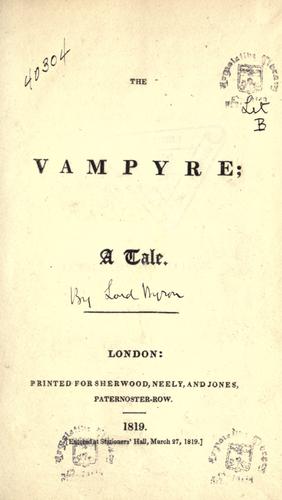
Title Page of Vampyre 1819 (Note handwritten attribution to Lord Byron)
Title Page of Vampyre
1819
(Note handwritten attribution to Lord Byron)

On June 22, I was continuing my reading of Lovecraft’s “Supernatural Horror in Literature” when I encountered an interesting tidbit.   When Mary Shelley was writing Frankenstein in the famous competition with her husband, Percy Shelley, and Lord Byron, another competitor was Dr. John William Polidori, whose story story from that competition, “The Vampyre”, went on to be the only other work of that competition that went on to achieve any sort of renown (according to Lovecraft).

Wikipedia has an interesting explanation for the title page above:

“The Vampyre” was first published on 1 April 1819 by Henry Colburn in the New Monthly Magazine with the false attribution “A Tale by Lord Byron“. The name of the work’s protagonist, “Lord Ruthven“, added to this assumption, for that name was originally used in Lady Caroline Lamb‘s novel Glenarvon (from the same publisher), in which a thinly-disguised Byron figure was also named Lord Ruthven. Despite repeated denials by Byron and Polidori, the authorship often went unclarified…Later printings removed Byron’s name and added Polidori’s name to the title page.

Go to this link for the Project Gutenberg etext of “Vampyre”.  Modern printings can be found at the Open Library.

John William Polidori 1795-1821 (from Wikimedia)
John William Polidori
1795-1821
(from Wikimedia)

Another couple of interesting notes from the Wikipedia article on The Vampyre:

“The story was an immediate popular success, partly because of the Byron attribution and partly because it exploited the gothic horror predilections of the public. Polidori transformed the vampire from a character in folklore into the form that is recognized today—an aristocratic fiend who preys among high society.[1]

“Polidori’s work had an immense impact on contemporary sensibilities and ran through numerous editions and translations. An adaptation appeared in 1820 with Cyprien Bérard’s novel, Lord Ruthwen ou les Vampires, falsely attributed to Charles Nodier, who himself then wrote his own version, Le Vampire, a play which had enormous success and sparked a “vampire craze” across Europe. This includes operatic adaptations by Heinrich Marschner (see Der Vampyr) and Peter Josef von Lindpaintner (see Der Vampyr), both published in the same year and called “The Vampire”. Nikolai Gogol, Alexandre Dumas, and Alexis Tolstoy all produced vampire tales, and themes in Polidori’s tale would continue to influence Bram Stoker‘s Dracula and eventually the whole vampire genre. Dumas makes explicit reference to Lord Ruthwen in The Count of Monte Cristo, going so far as to state that his character “The Comtesse G…” had been personally acquainted with Lord Ruthwen.[10]

I find it fascinating that possibly the two greatest motifs in the history of horror literature (Frankenstein and vampires) were started at the same friendly competition between four friends.

Unfortunately,  Dr. Polidori did not live to see the success of the literary phenomenon he created.   The article goes on to note:

“He [Polidori] died in London on 24 August 1821, weighed down by depression and gambling debts. Despite strong evidence that he committed suicide by means of prussic acid (cyanide), the coroner gave a verdict of death by natural causes.[3]

Continue reading “Dr. Polidori and “The Vampyre””