We all know and love them. We’ve been obsessed all our lives and can’t get enough of them. As children they frightened us to death. Every country, region, and town has their own urban legends…
I received this writing prompt from The Daily Post on November 8: “What’s the date today? Write it down, remove all dashes and slashes, and write a post that mentions that number.”
I started to write a glib response about numerology, but then a bell went off in the back of my mind.
While I don’t believe in numerology, I do like to toy with things like this in my writing for the enjoyment of people who do. Having been a graduate student at one time, I know how grad students and other literati like to analyze a text to the nth degree, searching for hidden but profound meaning in every nuanced word or misplaced comma. I seldom do this with the intent of relaying some arcane theme (people will interpret stories however best fits their worldview anyway), but just so the literati will have some fun analyzing and arguing about the story. For me, this is part of the fun of writing. But the more practical side of me also sees it as a way to build up a readership.
One way for a story to become known is via word of mouth. They will discuss the book if they find it interesting or they find something in it to argue about with their colleagues in the English Department or with friends at work or with like-minded enthusiasts at the local book club. So I give them something to debate.
Mostly, the understated connections I use are meaningless. For example, I have been working on a sci-fi short story in which I wanted to mention a sidearm astronauts 200 years from now might carry, but I did not want to use a type of space weapon that has become a cliché in the sci-fi world like a Star Trek phaser or a Star Wars blaster or a Flash Gordon ray gun. I named it the Hawking S-505 Black Particle sidearm. Hawking, obviously, for Stephen Hawking, who I am sure will have tons of scientific stuff named for him in the future including spaceports and starships. “Black Particle” as a form of dark energy relating to dark matter, which is cutting edge science these days, but will probably be trite in two centuries. S-550: the “S” is for sidearm; 550 is a US highway that runs through the town where I live currently. If I need a number, such as a serial number, I often use an old phone number or my birthdate or some other useless bit of trivia. As the original post from The Daily Post suggested, I might use a form of today’s date or some other date with meaning in my life. If the subject relates to magic(k), I might consult a book on numerology and choose/compose something appropriate. For example, in one horror story I have been writing for a long time, the protagonist walks through a tunnel under a dilapidated castle, where black magick was once practiced. The sides of the tunnel are covered in symbols and numbers including the number “4”, which symbolizes evil in some traditions.
For the names of characters, I frequently glance at the bookshelf to the right of my easy chair, where I write on my laptop, and combine the names of two authors to produce a name that has the right “sound” for the character or I might combine names from history or art or some other field. For example, I see I have one book by Bill Moyers and another by George Plimpton. I might name a character Bill Plimpton. In another sci-fi work (yet to be published) I needed the names for a nine man reconnaissance team to go aboard a derelict starship. I went to Google Translate and took the word for “warrior” from nine languages ranging from Gaelic to Swahili, so none would be immediately recognizable as a word for warrior (at least in the US), yet the names would express the cultural diversity of the crew.
Anyway, for me that is part of the fun of writing. How do you have fun with your writing?
Writing at Hasting’s Hardback Café in Farmington, NM, late evening of October 16, 2015 (self-portrait)
I would like to establish a writers’ circle for the Farmington, New Mexico area, including San Juan County, and anyone from the Four Corners area. I will he hosting a meeting on November 19 at 7:00 p.m. at the Farmington Hastings’ Hardback Cafe to establish how many people are interested. Everyone is welcome to attend. The mission of the Writers Circle will be to promote Farmington area writers of any genre and skill level, to advise each other on being published, and to establish useful contacts within the regional and national literary communities. If anyone in the Farmington/Four Corners has an interest, please contact me via this website by commenting below.
Good story from The Drabble. If you are not familiar with them, they are dedicated to publishing fiction and non-fiction of 100 words or less. They occasionally post a story that breaks into horror, such as this one (reminiscent of the French conte cruel), but the site is definitely worth visiting just to see how writers handle the challenge of extreme brevity. The Drabble generally publishes one story per day, and you can be included in their feed to have it sent to you. You can find them at https://thedrabble.wordpress.com.
Working on a play in Hasting’s Hardback Café, late evening, October 16, 2015.
As I was preparing to go to the local theatre this evening, I was thinking about how I can improve my writing and what distinguishes the great writers of horror. Of course, the first two that came into my mind as being easily discernible from all others were Poe and Lovecraft. Obviously, what distinguishes them is their use of language. Both use very intense, muscular language with a distinctly archaic tone. Not knowing if there a precise term already exists for this style, I decided to call it “the dark language”, because of its tight connection with the horror genre and with the horrifying in general. For me, there seems to be something archetypal about this, arising out of the Jungian collective unconscious. Perhaps it is just that Poe bound the Dark Language so intimately with scenes of horror, terror, and suspense, which is also bound with genres such as the Gothic novel, that the sound of it automatically brings forth societal memories of dread.
I need to finish dressing if I am to dine at my favorite local sushi restaurant before heading to the play. Somehow, I just have the taste for something raw tonight.
About. Here is an interesting blog on writing. As you can see by my comment on the About page, it delves into the essence of writing: communication, the clear transmission of an idea from one person to another.
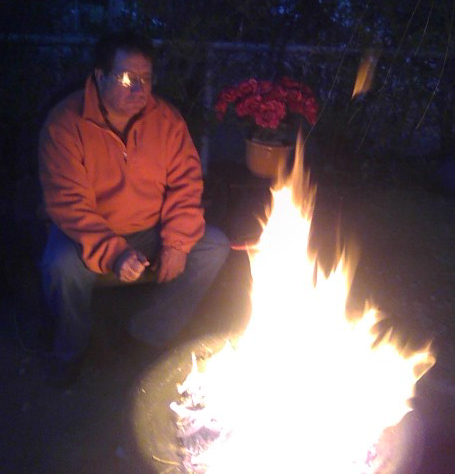
Relaxing by the front yard firepit on a chilly New Mexico evening circa 2013.
I recently purchased seasons 8 and 9 of the X-Files to complete my collection of the entire series. As you can note above, I am up to episode 6 of season 8: Redrum. No, it’s not based on The Shining or the famous line that sprang from there. This is a completely original script and I think one of the best X-Files. Why am I mentioning a Sci-Fi series in an article that should be about horror? This article is about good writing, whatever the genre.
I will endeavor to avoid spoiling the story for you.
As we all know, “redrum” is murder spelled backwards. This story is about a murder, but the alleged murderer finds himself traveling back in time to the day of the murder with the knowledge of how to prevent it.
I find the plot’s basic concept fascinating. A prosecutor (and friend of Agent Doggett) wakes up one morning to find himself in prison for the murder of his wife, about which he remembers nothing. As he is transferred to another facility for his safekeeping, he is assassinated. However, at that point time starts to flow backwards for him. Each morning he wakes up another day in the past (first he wakes up on Saturday, then on Friday, then on Thursday, etc.). With each day he learns a bit more about his predicament until finally he wakes up on the day of the murder and he has an opportunity to prevent it.
Unexpectedly traveling back in time is not a common theme, but it’s not rare either. I have to ask myself how Maeda and Arkin came up with the idea for this episode. Maybe it was based on amnesia; someone can’t recall his crime or immediate past and has to learn about it bit by bit, day by day, as the prosecutor does here. Maybe it arose out of a philosophical question such as “if we could travel back in time, we could change our future but would the ultimate destination be the same and all we change is the route we take to get there?” Maybe it was a thought that most stories show a protagonist going back in time to a certain point in time and then returning to the present; what if going back in time was not one big step, but several little steps. How could we change our lives in that case? What if as we traveled back in time, we knew as little about the past as we do about the future? We wouldn’t be able to convince those around us that we are traveling back in time, because we wouldn’t know any history to prove our story. They would believe us to be insane.
The whole scenario intrigues me. One man goes back in time for unknown reasons while the rest of the world around him proceeds as normal.
I have to ask myself what their creative process was.
This scenario opens up so many questions and possibilities. I love its originality. If you haven’t seen it, I recommend renting it as soon as possible.
We never find out what causes the protagonist to travel back in time. Like in a Stephen King novel, paranormal events happen out of the blue and at random. But according to Lovecraft’s theories of weird fiction, not knowing the cause/origin of a horrible event, makes the event more horrifying, because the event could happen to any one of us at any time.
A common principle of writing is “to suspend belief” (some say “to suspend disbelief”). In stories like this though, it is the natural laws of the universe that are suspended. Everything else, all the world/universe surrounding the event. is quite believable, which emphasizes just how weird the event is.
The story was written by Steven Maeda and Daniel Arkin. A quick search in Imdb shows that Steven Maeda has an extensive list of credits as either a writer or producer for such television series as X-Files, Lost, CSI:Miami, Helix, Lie to Me, and many others. Likewise Daniel Arkin has an extensive list of credits as a writer or producer for such shows as X-Files, Suits, Las Vegas, Alias, Medical Investigation, and others. I will have to watch for more shows with which either one is involved.
The article is brief, but I won’t copy it here, because everyone with an interest in the art of writing should watch the accompanying five minute video of Steinbeck’s profound acceptance speech of the 1962 Nobel Prize. I will, however, copy below a short paragraph immediately preceding his six tips (I also highly recommend following the link to an entertaining and insightful Paris Review article on his observations on the art of fiction):
And for insights into how Steinbeck reached that pinnacle, you can read a collection of his observations on the art of fiction from the Fall, 1975 edition of The Paris Review, including six writing tips jotted down in a letter to a friend the same year he won the Nobel Prize. “The following,” Steinbeck writes, “are some of the things I have had to do to keep from going nuts.”

 How to Write a Book In Your Spare Time – StumbleUpon
 We all know and love them. We’ve been obsessed all our lives and can’t get enough of them. As children they frightened us to death. Every country, region, and town has their own urban legends…
 Source: Black Creators in Horror Comics
 Source: Short and Sweet Advice for Writers: Take 10 from Live to Write – Write to Live.
 Source: Bloody Good Writing Volume #5: Writing A Novel In A Month

 Source: Victim/Victor



 Phil Slattery, Writer, Publisher