Rohwer Relocation Center: A Hidden History

Full resolution photos of the current Rohwer Relocation Center National Historic Landmark were taken by Phil Slattery at Rohwer on July 5, 2020, and are downloadable from Wikimedia Commons. If that link doesn’t work, search in Wikimedia Commons for “rohwer relocation center slattery”.


For several months, a lot of people were visiting my article on returning to Rohwer War Relocation Camp. I am not complaining. I am simply mystified that there is so much interest in it, much more than my other articles. I do not know if it is something I said about the camp itself or about the photography set-up for a YouTube video or what. I am sincerely grateful that one article of mine is getting so much attention for whatever reason. I am glad to have supplied something that apparently benefits so many people.

Today, I want to set down some thoughts on the Rohwer camp.

The township of Rohwer is very small. Very little information is available on it. Arkansas Tourism has a brief but enjoyable article on it, but Densho has an extensive article with an incredible amount of information on the camp.

Having originally been there in July 2020, my first impression of the location is that it was hot, empty, and lonely. The camp sat in the center of what are now hundreds of acres of cotton fields with trees along their distant perimeters. During the time of the Relocation Camp, it was quite different, but the overall condition remains much the same today with hot, muggy summers filled with mosquitoes and other insects.

The land and climate of the two Arkansas camps were fundamentally different from the barren, desert-like settings of the other WRA sites, in that it had dense vegetation, boggy soil, and was surrounded by trees, some of which extended into the inmate sections of the camp. The weather was hot and sticky in the summer and mosquitoes swarmed. Calling the area “low and badly drained and … typical malaria country,” a Malaria Control Program had to be started in the spring of 1943 that resulted in the spraying of breeding areas inside and outside the camp. Winter and spring rains (and occasional snow) brought slippery conditions and sticky mud. A 1990 Rohwer Reunion Booklet recalled how the “soil of the area turned to dust in the summer and into a gooey stick muddy mess during the winter.” In a 2011 interview, Takeshi Nakayama recalled mud that “was almost like quicksand” in which one of his brothers “got stuck and he couldn’t get out.” In reaction to the mud, wooden walkways were built, which addressed the mud, but exacerbated the slipperiness. Yoshie Ogata wrote in her diary in December 1942, “[t]he wood slate for walks are very dangerous—slippery when wet.” A diarist writing in January 1944 noted that “today was by far the most slippery on record” and reported seeing women “crossing narrow bridges on hands and knees” while others “tied pieces of rope or sacks around their shoes as ‘skid chains,’ and many women wore socks over their shoes.” [2]

Densho.org

The camp was modified to interface with the environment to some extent.

While the general layout of Rohwer was similar to most other WRA camps, the unique conditions at the Arkansas camps led to some interesting aspects of the physical setting. While most of Rohwer had been cleared of trees and other vegetation, nine or ten blocks in the southwest portion of the camp were built on a forested area and thus included numerous shade trees, something not found at the non-Arkansas WRA camps. The swampy conditions also required that special attention be paid to drainage. Thus, drainage ditches ran between barracks and along the roads that separated each block. These ditches drained to the southwest corner of the camp, where they extended 1½ miles to empty into Coon Bayou. Waste water from the camp sewage system also drained there. Being the lower end of the camp, the forested southwest corner of the camp was also prone to flooding. Sandbags were deployed to keep the entrances to the mess hall and latrine buildings from flooding. Other unique environmental hazards included numerous flies and mosquitoes, as well as biting insects known as “chiggers” that bored into the skin. The camp’s water supply was also contaminated into the spring of 1943; inmates had to boil water before drinking it. [5]

Densho.org

According to the Densho article, inmates had some degree of freedom, being allowed to have jobs outside the camp and to go shopping in nearby McGehee. However, there were some restrictions as Arkansas law prohibited them from working in the local agricultural industry (nonetheless, some inmates did find agricultural work–albeit illegally). Inmates were also granted honorary “white status” and were prohibited from interacting with the local African-Americans, which made up most of the local population. Buses that took the inmates to McGehee could take them only to places owned or operated by white people.

Could internment in southern Arkansas have actually prevented someone from spying for Japan? Definitely-if any of the occupants were spies. For one thing, it would have been easy for camp authorities to monitor inmate activities. Plus, there were no real opportunities for espionage in the vicinity of Rohwer. Even the closest military installations were at least a couple of hours by car from Rohwer and someone of Asian descent would readily stand out among the vastly predominant Caucasians and African-Americans who inhabited southern Arkansas at the time. Rohwer’s remoteness protected the military installations in the area, much as Alcatraz’s remoteness protected the nation from its inmates.

According to The Encyclopedia of Arkansas, there were six ordnance plants in Arkansas. The two closest to Rohwer were at Camden and Pine Bluff. Other relatively nearby military installations included: an Army Airfield at Stuttgart (now Stuttgart Municipal Airport), Grider Field in Pine Bluff (a training facility now used at Pine Bluff Regional Airport), and Camp Magnolia (a work camp for religious conscientious objectors who performed manual labor as had the Civilian Conservation Corps of earlier years and who participated in government controlled medical experiments involving disease and malnutrition)

Most of the facilities anywhere near Rohwer were training facilities of probably little intelligence value to the Japanese, except for one: the Pine Bluff Arsenal.

The Pine Bluff Arsenal was established on November 2, 1941, for the manufacture of incendiary grenades and bombs. 5,000 acres, purchased from local physician James W. John, Sr, served as the foundation for the site. It was originally named the Chemical Warfare Arsenal but was renamed four months later.[2] The mission expanded to include production and storage of pyrotechnic, riot control, and chemical-filled munitions. At the height of World War II, the plant expanded from making magnesium and thermite incendiary munitions to a chemical warfare manufacturing facility as well, producing lethal gases and chemical compounds installed in artillery shells and specifically designed bombs.[3]

From the Wikipedia entry on the Pine Bluff Arsenal

Per Google Earth, along today’s highways, the distance from Rohwer to White Hall (where the Pine Bluff arsenal is located) is about 72 miles. That’s easy to travel with today’s vehicles on today’s roads, but in the 1940’s, before there were freeways and most roads, if not dirt, would have probably been two-lane at best, it would have been a different matter.

But then, most of the inhabitants of Rohwer would have come from the west coast or other places outside Arkansas. Rohwer wasn’t established with the intent of protecting military facilities in Arkansas but in strategically valuable places like San Francisco or San Diego. Protecting military bases in Arkansas would have been a secondary aim, at best.

One question that I have not seen posed elsewhere is whether it was possible that some of the Rohwer inhabitants were actual spies? It is possible.

Wikipedia provides a list of Japanese spies during the Second World War. In it are noted the following intelligence organizations that operated in the US:

Since the 1920s, the intelligence services also used Doho or dokuku jin – (nikkei) cultural groups in the Pacific War as alternative secret agents. These were Japanese citizens with foreign nationality, with loyalty to the emperor and Japan; they lived around the world.

  • The Black Dragon Society, the Kaigun Kyokai (Navy League), or the Hoirusha Kai (Military Service Man’s League), and other similar societies. These Japanese secret groups were well known to the US Naval Intelligence Service and the Federal Bureau of Investigation for the subversive actions in the United States among some elements of Doho communities.
  • Other overseas Japanese agents of Black Dragon Society were the so-called “soshi” (Brave Knights). At the same time, referring to superior commander as the “Darkside Emperor” mentioned agents since the 1940s, operating worldwide, as far away as North America, South America, and Morocco. They formed covert ties with the Nazis.

However, spies can be expected to be a miniscule part of any populace. Do the odds of having a spy in a city justify rounding up everyone of a race, disrupting the innocents’ lives, and shipping them off to internment camps losing almost everything they have in the process?

We will never know. We don’t know what information one person might have collected. It might have been something of critical importance. Spies, even of those pre-satellite times, operate in different ways.

Some are given intelligence collection training and covertly inserted into a nation where they observe ports and bases and radio back to their agencies what they have seen or rumors that they have heard. Germany did this often in England and the US during the Second World War. One of the Rohwer inhabitants could have likewise been inserted into the US. Relocation to remote Arkansas could have interrupted such an operation.

Another way spies can collect information is not by observing it themselves, but by buying information from traitors in the country. It is not impossible that one of the Rohwer inhabitants might have operated in this fashion. Just as with spies who observe bases directly, relocation to Arkansas would have negated such an operation.

Another way spies can operate is by relaying information from an agent who collected it to the home agency. Again, relocation would have interrupted this type of operation.

We will never know the effect the relocation program had on Japanese intelligence collection operations.

However, I agree with what is probably the prevalent public opinion about the Rohwer, or any Japanese-American internment camp in the US, which is that it was an ugly chapter in American history, especially in the history of civil rights. The lives of thousands of innocents were needlessly ruined for the actions of a few and probably for the most part for what is termed today “optics”, known then simply as “appearances”, that the government was doing something to secure the nation against Japanese aggression.

Obviously, I do not know what opinions are held in private today. I feel certain that a few opinions might be in favor of such camps and probably a very few would like to have them for various races even today and very likely for immigrants (documented or not) from Central and South America.

The bottom line for any ugly issue is always the same: what can be done to rectify it or to prevent it from happening? I don’t know if anything has been done to compensate the Japanese-Americans who were interned at Rohwer or anywhere else in the US. I have yet to research that. But the bigger question in my mind is whether anything can be done to prevent it from happening again?

There are laws prohibiting this type of governmental action now. However, legislators can change laws on whatever they agree upon based upon the prevailing public opinion that elected them. If the prevailing public opinion is that a certain race should be interned, if enough legislators agree, that race will be interned though the arguments for it may be disingenuous or spurious. The critical element of such a situation is not that a government allowed it to happen, but that a section of humanity allowed it to happen. Rohwer Relocation Center is just another cold-blooded example of “man’s inhumanity to man”.

Can anything be done about humanity’s innate cruelty to those of its own species? I sincerely doubt it. Even if the nature of people allowed everyone to think reasonably as a mass, just as they can now be angry in great masses, people often need to control other people. This is not just a psychological quirk of humanity. Sometimes one segment of people needs to control another in a broad variety of ways out of the basic survival instinct or face extinction themselves.

Ostensibly, it seems these people were interned here out of that basic survival instinct. No one could be certain that any of these people were not spying for the new enemy of Japan. However, why weren’t people of German or Italian heritage interned? They had been enemies longer than the Japanese. Perhaps because it was easier to spot someone of Japanese descent in public than it was to spot someone of German or Italian descent. In those cases, it wouldn’t have been as easy for the government could make it appear as if they were doing something to root out spies and saboteurs.

Perhaps you have read about the scrap metal drives of the time. The government asked people to contribute their scrap pots and pans and other metal objects to scrap metal drives. The pots and pans would then be melted down and turned into bullets and other useful tools of war. Unfortunately, the technology to do that did not exist at the time. The pots and pans were simply hauled off to the nearest dump in secret. However, the drive’s value to the government was that it boosted national morale by making people feel as if they were contributing to the war effort. The benefit of Japanese-American internment camps to the government was probably along the same lines. It had no practical effect on the war, but it gave the public a good feeling that something was being done to root out potential saboteurs. No one would notice if someone of German descent was removed from the streets, but they would notice if someone of a different race was being hauled off.

Creepy Cabin in the Woods

As you may know, I live in house in the remote backwoods of Arkansas on what was once a civil war battlefield. A few thousand probably died here and my house is probably very near where the Union commanding officer stood while directing the fight, which was only a hundred yards or so away.

Being so solitary and the woods are often filled with strange noises, especially at night, this can be a spooky place to be at times, particularly at night when foxes scream searching for a mates while barn owls scream at nothing in particular. Both of these sound very much like human screams. Once when both were going on together, stepping out the back door was like listening to the screams from a not too distant torture chamber. Thankfully this doesn’t happen too often.

As you may also know, I am into ambience videos which run for hours on end and aim at setting a certain mood. There are some that set a happy or light mood or a fantasy mood like you might find in The Lord of the Rings or set in some idyllic medieval world or even on another planet. I like spooky ones or dark and mysterious one. There are a few that emulate the atmosphere of Blade Runner, which I have found recently and which I really enjoy.

I found this video today while searching for ones that set a “werewolf ambience” to play while I continue writing Lycanthrope.

Right now, it’s almost 5:00 p.m. and overcast and wet following a few days of rain. The temperature is near 60 (Fahrenheit). Twilight is coming soon. I stepped out the front door just now to check the outdoor temperature on our outdoor thermometer and I heard birds singing not too far off. There’s a slight wind blowing. Although gray and dreary, it’s rather pleasant.

If the wind picks up, as twilight encroaches, the atmosphere around my house (which is quite modern as opposed to the rundown one seen in this video) will be a lot like that in this video. I don’t hear the insects now as in this video, but they will come out as summer approaches. I hear owls like this often. There is an eerie, ghostly waver I hear in this that I don’t hear (of course) out here. Nonetheless, this video captures the spirit of what the woods around my house will be like in an hour or two. And it’s now February, not Halloween.

Enjoy.


July 5, 2020: A Visit to the Rohwer Relocation Center

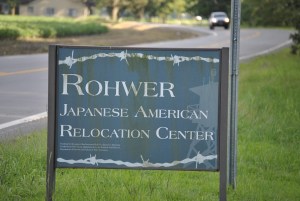
Sign on Arkansas Route 1 signaling the entrance to Rohwer Relocation Center.

On July 5, my family and I drove 28 miles to visit the Rohwer Relocation Center, the site of an internment camp where 8,275 Japanese-Americans lived from 1942 to 1945.

To stand now in the middle of the immense expanses of heat-soaked cotton fields surrounding the site and to imagine what life must have been like can be heart-rending.

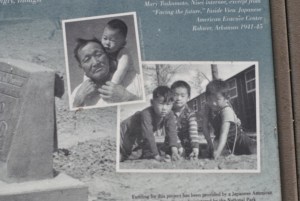
The wayside exhibits give a poignant portrayal of the harsh existence for these people, who happened to be of the wrong race when war came upon the US.  Many, if not most or maybe even all, of these people came from California, a much milder climate than that of southeast Arkansas (I now live in Arkansas but I have lived in Alameda and San Diego). Most of the waysides have a recording describing some aspect of camp life narrated by perhaps the most famous former resident of Rohwer Relocation Center, George Takei, a.k.a. Mr. Sulu of Star Trek fame. Born in 1937, Mr. Takei lived here from the time he was about five years old to when he was about eight.

The inhabitants of Rohwer Relocation Center lived in military-style barracks, modified somewhat to accommodate families, but still exceptionally Spartan for any family.   In one

Civilians arriving at Rohwer Relocation Center.

instance, Mr. Takei talks about his family’s arrival to find their new home a single room containing only a pot-bellied stove and five cots, one for each member of the family. Having been forced to leave their jobs behind, inhabitants struggled to find new ways to support themselves, because, while their former lives were left behind, their bills followed them. Most inhabitants found whatever jobs they could locally, maybe toiling on nearby farms or in other manual labor. Many jobs, even those within the camp, paid only $12-$19 per month, which was about half of what the non-Japanese staff of the camp was making. The move forced many people to sacrifice their life savings in order to survive. The few artists that were interned here were able to continue their professions, but I cannot say the market for art in rural southeast Arkansas during World War II was as lucrative as it might have been in California. Still, there was a hospital, so there was some medical care. And there was some schooling for the children, though I do not recall how this was arranged.

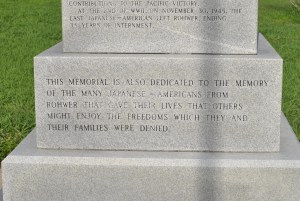
A few monuments exist today at the site, which honor the interned, along with the headstones of several that died here. The monuments honor the Japanese-Americans who served in the Second World War, with many of them coming from the Rohwer Relocation Center. Japanese-American soldiers were typically sent to the European front where, they would be less likely to side with or mix in with the enemy. In fact, Japanese-Americans made up the 442nd battalion and fought in some of the most vicious fighting experience by the US, specifically at Anzio, Salerno, and Monte Cassino. The names of those killed in action are listed on a few of the monuments along with memorable remarks about the Japanese-American experience at home and in war, fighting for the country that interned them and their families.

Visit the site if you have the opportunity. It can be found on Google Earth and Google Maps will give you the directions. Enjoy the photos here that I took during my visit and reflect upon the multi-layered composition of our nation as many of us struggle for a greater voice in the future of our nation during this time of racial unrest and political upheaval.


Photo of Monument of the Rohwer Relocation Center cemetery.
Monument at the Rohwer Relocation Center cemetery, which is designated a National Historic Landmark. Photo by Phil Slattery


Photo of Internees at Rohwer Relocation Center. Photo by Phil Slattery. Wayside Exhibit by the National Park Service.
Internees at Rohwer Relocation Center. Photo by Phil Slattery. Wayside Exhibit by the National Park Service.


Photo of monument to 442nd battalion, USA, made up of Japanese-Americans.
Monument to 100th battalion (442nd Regimental Combat Team) made up of Japanese-Americans. This unit saw action at Anzio, Monte Cassino, and Salerno. Photo by Phil Slattery


Photo of Monument to Japanese-Americans interned at Rohwer.
Monument to Japanese-Americans interned at Rohwer. Photo by Phil Slattery


Photo of monument section displaying the Japanese-American creed.
Monument section displaying the Japanese-American creed. Photo by Phil Slattery


Photo of headstones of some of the Japanese-Americans who died at rohwer.
Headstones of some of the Japanese-Americans who died at Rohwer Relocation Center. Photo by Phil Slattery


Map showing location of Rohwer Relocation Center in Arkansas.
Map showing location of Rohwer Relocation Center in Arkansas. Photo by Phil Slattery


Photo of monument section poignantly describing how many Japanese-Americans served their country despite their families being interned.
Photo of monument section poignantly describing how many Japanese-Americans served their country despite their families being interned. Photo by Phil Slattery


Photo of Monument section describing the Japanese-American experience during WWII.. Photo by Phil Slattery
Monument section describing the Japanese-American experience during WWII. Photo by Phil Slattery


Inscription on a monument at Rohwer Relocation Center. Photo by Phil Slattery


Now Taking Submissions and Announcements for the Arkansas Country Writers Circle Website

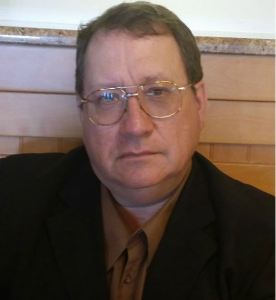
Phil Slattery portrait
Phil Slattery
March, 2015

I will consider articles, short stories, and poems for publication on the Arkansas County Writers Circle website. Please feel free to submit at any time. I will try to post your work as soon as I can. Of course, preference will be given to writers from Arkansas and particularly from Arkansas County. There is no pay other than having the distinction of being published and having another bullet for your writer’s resume.

I am looking for short, flash, or micro fiction that demonstrates the art of writing, whether it be prose, poetry, one-act plays, or any other form of literature of any genre.  I want to showcase literature in all its subtlety, beauty, intelligence, art, horror, terror, suspense, and gruesome detail.  I also want to push its limits with the challenge of staying under 2,500 words while making an intellectual and emotional connection with the reader. Do your best, most imaginative, most professional work.

I am also looking for non-fiction articles on the art of writing.   Please keep these to under 2,500 words as well. All rights will remain with the author. If you would like to submit an article or book/movie review on the art of writing horror fiction or just on the art of writing, please send it to philslattery87410@gmail.com.  Everything must be submitted by e-mail either in the body of the e-mail or a Word document (.doc or .docx).  There is no pay for any submission at this time (maybe after I win the Pulitzer or Nobel, but probably not before then).

In addition, I am taking announcements about works of literature of any genre.  If you are an author with a book-signing coming up or you will be giving a public talk somewhere or you have a book (or film) with a definite release date, announce it here.  If you have anything related to a creative work of literature that you would like to publicize, draft an announcement and send it in.  I reserve all editorial rights however to make any needed changes for clarity, etc, and to ask questions if the announcement isn’t clear on some point.  There will be no charge for this, at least initially, but I do reserve the right to charge fees later, if a lot of announcements start to flood my inbox.

Mark Twain

However, note that I will not do advertising for any product.  I want to publicize creative works and to help authors, poets, film makers, and others jump start their careers.  I am not a merchant.  As to where the line is between advertising a product and publicizing a work, that will be my subjective decision.  So if you want to sell pens, notebooks, software, or any other concrete product, try Amazon.com.

Fiction will probably be published on Fridays and articles on other nights as I feel appropriate.

You may submit stories and articles in languages besides English, but it must be in one of the languages in which I have at least some minimal ability. These are primarily German and Spanish, though I can read French to a degree. I need practice in all three.  Shorter articles will fare well here as I do not want to spend all day with a dictionary and grammar ensuring that the writing is up to par. Odds of these being accepted are sort of low, but if I can read them easily enough, I will consider them.

I reserve the right to change my mind as I develop this site.

Specifically, in terms of creative works, I am seeking:

  1. Articles under 2,500 words on the art of writing (fiction of any length, poetry, screenplays, etc.) or on writing in general  Articles on foreign literature are encouraged.
  2. Book and movie reviews, the more recently published or distributed the better.
  3. I will consider reviews of articles on literature in other countries.  These must also be under 2,500 words.
  4. Translations of articles, stories, or poems from French, German, or Spanish are considered, but the original article/story/poem and its translation must not exceed 2,500 words.
  5. Poetry (under 32 lines) or articles on poetry.
  6. Flash fiction (i.e. under 1,000 words).

Guidelines

  1. Be professional.
  2. Use standard manuscript format.  The easier it is for me to simply copy and paste into WordPress, the more likely you are to be published.
  3. Tennessee Williams, 1965
    Tennessee Williams, 1965

    With submissions include your website, twitter handle, or any other social media identification you like.  A short bio of 100 words or less (including a list of previous publications) is nice, but not required.   Knowing your publication history won’t influence whether or not you are accepted, but it might be nice for the readership to know.  If you don’t want to include any social media contact info, don’t include it.  Pseudonyms are fine, but please state them as the byline and include your actual name and contact info in the top left of the first page of the submission per standard manuscript format.

  4. In the subject line of your e-mail state whether this is an article or review or poetry of fiction submission, your name, and the work’s title.  For example:  Article by Phil Slattery  “Poe’s Raven: an Analysis”
  5. No hardcopy submissions.  Everything must be submitted by e-mail either in the body of the e-mail or attached as a Word document (.doc or .docx).
  6. I would like to reach as large an audience as possible, so please keep profanity to an absolute minimum.
  7. I will try to respond to submissions as quickly as possible, but please allow at least a couple of weeks before querying about your article/story.
  8. There is no pay other than the honor of being published on this website.
  9. I am not taking multiple submissions or simultaneous submissions.  Once you have submitted one article/story, please wait about a week before submitting another.
  10. You may submit on piece of artwork or a photo to accompany your article/story.  I will edit it (mainly re-sizing) as needed to fit the space available.  I will not publish any form of what I deem pornography or in bad taste.  If you do not submit artwork or a photo, I may select something appropriate.  JPEGs, TIFs and other formats accepted by WordPress are okay, but keep the number of bytes to a minimum.  I have only a limited amount of space available.
  11. Artwork and photos may be submitted on their own and you must own the copyright to them or they may be from the public domain (please state so if they are).  There is no pay for these either.  If I do not use these right away, I may keep them until a use arises, but please let me know if this is okay.  If you no longer wish me to use them, please let me know as soon as possible.
  12. Kate Chopin, 1894
    Kate Chopin, 1894

    Do not send advertising (no matter how cleverly veiled it is).  It won’t be published.

  13. Gratuitous sex, extreme violence, violence to children or animals, rape, excessive profanity, and anything else that offends my personal sensibilities will not be published.  Anything that seems to reflect an actual crime (past, present, or future) will be immediately turned over to the proper authorities.
  14. If I like your submission, I will publish it as soon as possible.  This will depend on the backlog of submissions and other factors.   Don’t ask for a time-frame.
  15. Reprints are okay, but you must tell me when and where the article/story/poem was first published.
  16. I do not want fan fiction.
  17. Always re-check the guidelines before submitting.  I may change them at any moment without prior notice.

I will update these guidelines as time allows and events warrant.  This page was last updated on June 4, 2019. Please contact me via philslattery87410@gmail.com with any questions. Thoughts?  Comments?

Update: November 12, 2019, Busy Weekend and Veteran’s Day

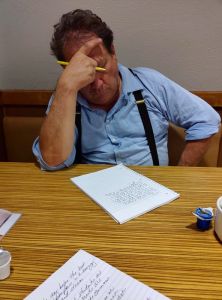
Writing at IHOP, 2019. Photo by Fran.
Working late at night at an IHOP in Midland, TX, May, 2019

Saturday and Sunday,  I spent a lot of time organizing my house after the recent move. I wanted to write, but as my wife notes, I feel more like writing in a clean environment. I had never noticed this until she mentioned it sometime back, but she is absolutely right.  I spent two days cleaning and organizing and come Monday evening, I really felt the drive to write.

During most of the day on Monday, however, I spent exploring the local area up to Stuttgart looking for places to hold writer circles meetings for the Arkansas Writers Circle that I am trying to establish. Not much luck on that front. No Starbuck’s in this area and the one coffee shop I found in DeWitt (420 and Turnrow is the name of the shop) closes at 7:00. It is a very nice place though and I hope to go there when I can. It is a nice, clean environment for relaxing and writing.  The arts center in Stuttgart was closed when I arrived. I will try contacting them later.

I did visit the Stuttgart and DeWitt campuses of the Philips Community College in DeWitt and Stuttgart. I hoped to contact their English professors, who I thought might know of any writers groups locally, if any one does. No one from the English department at either was there when I arrived, but I left a card. This afternoon Professor Liddell (of both campuses) called and left a message saying that there are no writers groups in the area to his knowledge. He also said that he would help spread the word about mine and that I could call him with questions. That is a big step for this project. Thanks, Professor Liddell.

I ran a couple of errands and ended up in Dumas. There I went to El Toro Mexican restaurant to write up some notes and get some delicious tortilla soup (the weather here was cold and rainy all day). I spent a couple of hours there and then went home. At home, I spent quite a few hours, typing up the new material I had concocted at El Toro into Shadows and Stars. I ended the night’s writing about 2:00 a.m., but still have a little to do when I go home tonight. My original goal was to make Shadows and Stars reach between 80,000 to 100,000 words. I am now over 91,000. I am trying to wrap this up. I will probably have between 100,000 to 110,000 by the time I finish. This will be the first draft. Then I polish the first draft until I am satisfied, which may be a while.

Also, yesterday I received an email from Austin Macauley publishers saying they had received Bobby the Brown Pelican.  It should be about three weeks before I hear something.

This morning as I was prepping for work, I came up with a few more ideas for children’s picture books. I remembered that I had started another call Alison the Odd Little Alien about a little girl named Alison, who travels to another planet, where she learns what it’s like to be the foreigner/alien in another land. I got the idea from one of my wife’s pupils, who suggested I write a story about aliens after I read Bobby the Brown Pelican to them. It shouldn’t take long to finish it. Probably less than three weeks. If Austin Macauley accepts my work, maybe I will submit Alison… next.

Update: November 5, 2019, Writing and Playlists

Working late at night in an IHOP in Midland, Texas, May 2019 (photo by Francene Kilgore-Slattery)

Yesterday and tonight, I have made some progress in critical plot junctures in Shadows and Stars.

I went to Dumas yesterday to pick up a prescription at the pharmacy. I stayed to have a good, tasty dinner of Enchiladas Verdes at El Toro. Afterwards, I stayed close to three hours to write. I got home around 9:30 or 10:00. I had a pain (muscle strain) in my right leg, so I took some Tylenol PM and lay down and listened to more of The Exorcist on audiobook until the pain went away and I could sleep.  I dozed off at some point, then finally rose and went to bed around 1:30. Then I had an idea pop up around 2:00, so I had to get up and write it down before it escaped. So I didn’t get to sleep until close to 3:00. I had to rise at 7:00 to go to work. It’s a good scene, a fun scene that will mix together comedy, drama, and suspense into a few tense minutes.  You’ll have to read the book to find out more. I don’t want to give away any spoilers.

Tonight, I went into Dumas to pick up some groceries. Afterwards, I had the special plate (chile relleno, tamale, enchilada, taco, chalupa, rice and beans) at El Toro, then stayed to write for a couple of hours. I made good progress jotting down ideas I have been having since this morning and filling plot holes in Shadows and Stars.

I decided to make a playlist for each of my works for sale on Amazon as well as for my works in progress. Though this will take some time, it will be interesting and fun…when I am not writing for whatever reason. I hope some of you have been listening to the playlists I already have up. I am really experimenting with trying to capture the mood of a work by producing a sort of soundtrack, hoping that if people listen to the soundtrack, they might become interested in the book. Sort of like when you buy a movie soundtrack at a store without having seen the movie. The soundtracks also help stimulate ideas or set the mood to work on Shadows and Stars. If you listen to any, let me know what you think. I am still tinkering with setting the tunes in an order that best captures the ebb and flow of the mood in the work.

I have only a couple of rudimentary test videos up now. I hope to make some headway soon in developing more professional ones.

I am really enjoying the audiobooks available on YouTube. I have really been catching up on my reading. I can turn on an audiobook, stretch out, and it’s like having someone read a long bedtime story to me. However, my bedtime stories tend to be quite serious in nature: works by Kafka, William Peter Blatty, Dostoevsky, Hesse, etc.

Although my website is not getting many views, the few I get are from all around the world. Today, I had visitors from:

Countries list
Visitors to my website on November 5, 2019, came from these nations.

The Arkansas County Writers Circle website had only three views today, all from Nigeria. Maybe someone from Arkansas is living in Nigeria. In any case, I am happy to have them visit me…unless it’s that phony prince that pesters people for money and promises them a fortune in return. I should find a spot in hell for him in The Man Who Escaped from Hell.

By the way, I am taking a break from reading Upton Sinclair’s The JungleIt’s too depressing. I am now focusing on finishing The Exorcist, which says something about The Jungle. Imagine a book so depressing that one reads The Exorcist for something more light-hearted and fun. After reading the first dozen or so chapters of The Jungle, I have to wonder how humanity has survived for all these millennia without cannibalizing itself. I know Sinclair worked in a stockyard as part of the research for the book, but after having done that and then sitting down to write it, it’s a wonder that Sinclair didn’t just hang himself or lose himself in alcoholism.

That’s all for tonight. Stay tuned. Hasta luego.

The Arkansas County Writers Circle Ad is Up

Selfie with Lotus in background near Arkansas Post, September 4, 2019

The ad announcing the Arkansas County Writers Circle on Arkansaswriters.com was posted on Monday.  Check it out at: https://arkansaswriters.com/new-writers-circle-forming-in-arkansas-county

Update: Arkansas County Writers Circle

Phil Slattery portrait
Phil Slattery
March, 2015

Just as I did in Farmington, NM, I am endeavoring to start a writers circle in my newly adopted home of Arkansas County, Arkansas.  Although I have not yet researched the local area thoroughly, it seems there are no writers’ organizations in Arkansas County. I have started a website for the new Writers Circle, which I call the Arkansas County Writers Circle. I chose to go with the county name vs. a town’s name, because the towns around here are rather small and to have a sizable group to make the effort worthwhile, I will need to invite people from all over the county.  We will probably meet in Stuttgart, the largest town in the county, but near the north end, or in DeWitt, which is in the center of the county. I reside near Gillette at the southern end of the county.

Of course, as no town for meetings have been determined, we have not had the first meeting. I hope to have the meetings as I did in Farmington, on the second Thursday of each month at about 6:30 pm. I will have to also determine the best places for posting flyers and notices as that seemed to work best in Farmington. I will also advertise on local community bulletin boards, with chambers of commerce, art organizations, etc.

I am also developing new social media accounts for the Writers Circle. I have one already on Twitter: @countywriters. I will probably also develop  a Facebook page and a Tumblr account as well. Of course, the WordPress website will connect to those.

Unfortunately, in order to have the Arkansas County Writers website, I had to sacrifice and overwrite my Jack Thurston website. It was not getting much attention or traffic anyway. It was fun though.  If you followed Jack Thurston, you were no doubt surprised to find your link to that was now the Arkansas County Writers Circle.  My apologies for that. I made the decision suddenly and acted on it quickly.

There are several writers organizations in Arkansas, but there don’t seem to be any in or near Arkansas County. I have contacted the Art Center in Stuttgart. They don’t know of any (or at least the lady I spoke to didn’t know of any).

I have contacted the Arkansas Writers website. They will post an announcement about the Arkansas County Writers Circle in their news section on Monday, November 4.

If you live in or near Arkansas County, please let me know if you would be interested in participating in our Writers Circle. There are no fees and writers of all genres (fiction, nonfiction, journalism, fantasy, comic books, graphic novels, romance, action, horror, etc.) are welcome.

Even if you don’t live in or near Arkansas County, feel free to follow the website. I hope to have some excellent news and articles up soon.

Update: Arkansas County Writers Circle

Phil Slattery portrait
Phil Slattery
March, 2015

Just as I did in Farmington, NM, I am endeavoring to start a writers circle in my newly adopted home of Arkansas County, Arkansas.  Although I have not yet researched the local area thoroughly, it seems there are no writers’ organizations in Arkansas County. I have started a website for the new Writers Circle, which I call the Arkansas County Writers Circle. I chose to go with the county name vs. a town’s name, because the towns around here are rather small and to have a sizable group to make the effort worthwhile, I will need to invite people from all over the county.  We will probably meet in Stuttgart, the largest town in the county, but near the north end, or in DeWitt, which is in the center of the county. I reside near Gillette at the southern end of the county.

Of course, as no town for meetings have been determined, we have not had the first meeting. I hope to have the meetings as I did in Farmington, on the second Thursday of each month at about 6:30 pm. I will have to also determine the best places for posting flyers and notices as that seemed to work best in Farmington. I will also advertise on local community bulletin boards, with chambers of commerce, art organizations, etc.

I am also developing new social media accounts for the Writers Circle. I have one already on Twitter: @countywriters. I will probably also develop  a Facebook page and a Tumblr account as well. Of course, the WordPress website will connect to those.

Unfortunately, in order to have the Arkansas County Writers website, I had to sacrifice and overwrite my Jack Thurston website. It was not getting much attention or traffic anyway. It was fun though.  If you followed Jack Thurston, you were no doubt surprised to find your link to that was now the Arkansas County Writers Circle.  My apologies for that. I made the decision suddenly and acted on it quickly.

There are several writers organizations in Arkansas, but there don’t seem to be any in or near Arkansas County. I have contacted the Art Center in Stuttgart. They don’t know of any (or at least the lady I spoke to didn’t know of any).

I have contacted the Arkansas Writers website. They will post an announcement about the Arkansas County Writers Circle in their news section on Monday, November 4.

If you live in or near Arkansas County, please let me know if you would be interested in participating in our Writers Circle. There are no fees and writers of all genres (fiction, nonfiction, journalism, fantasy, comic books, graphic novels, romance, action, horror, etc.) are welcome.

Even if you don’t live in or near Arkansas County, feel free to follow the website. I hope to have some excellent news and articles up soon.

Arkansas County Writers Circle

I am considering starting a Writers Circle for Arkansas County in Arkansas just as I did in Farmington, NM. That group is still thriving. Here is a link to the Farmington Writers Circle, so you can see how it is doing.

Just as in Farmington, the Arkansas County Writers Circle would focus on publicity and marketing of the participants’ works. Anyone involved in writing as an art or profession or as a hobby is invited. We would welcome writers of all genres and styles from non-fiction to horror fiction to science fiction to young adult to authors of children’s books to romances to poetry to comics to journalism to whatever you can imagine.

Most writers circles focus on the art of writing,  This group is for writers who are interested in marketing or publicizing their works. Each meeting would be a round table discussion preceded by a reading of 30 minutes or less from one of the members.  The group would then offer their constructive criticism on the work read.  The meetings would last however long they last, but in general they may last up to an hour or longer depending on how many people attend.

I have not decided upon a meeting location yet, though it would probably be in Stuttgart at a coffee shop or at the Arts Center or maybe in DeWitt.  The meeting times and dates would be set at the first meeting. In New Mexico, we met on the second Thursday of each month at 6:30 pm for the reading followed by the discussion at 7:00.

There would be no dues or cost to participate. All you need to do is show up and join the discussion.

The group might even develop their own networking events and participate as a group in local events such as readings, book signings, etc.  We did this in Farmington and it worked well.  During one Art Walk in Farmington, our members participated with  a local art gallery and read from their works, sold some of their books, signed several books and made contacts with other writers, both amateur and professional.

If you live in Arkansas County or its environs, please let me know if you would be interested in participating.

Update: September 6, 2019, Marketing and Publicity and other Writing Demons

Selfie with Lotus in background near Arkansas Post, September 4, 2019

So far I have spent a small part of the day posting ads for my works for every day up to October 6. I neglected to do so for August and the few sales I have had show that.

Last night I went to dinner at Hoot’s Barbecue in McGehee, AR. The food is good. Hoot’s seems to be the social navel of the county and surrounding area. It’s the hot spot on the weekends. I happened to be in Dumas running errands as the time for the dinner approached.  To go from Arkansas Post to McGehee, my co-workers had to pass through Dumas. We arranged to meet in the Mad Butcher (yes, that is a business. Inexpensive meat) parking lot. As I had about an hour to kill, I went to the nearby El Toro Mexican restaurant and had some iced tea and jotted down notes about Shadows and Stars. I think I came up with a really good twist for the end of the story. Something hopefully unpredictable and jaw-dropping that will make readers drop their margaritas and stand up to scream “Of course!” to the heavens.

I like El Toro. I may go there to write when I can. The food is also good. Surprisingly, there is a good Mexican restaurant called Ameca’s in DeWitt. If you find yourself in this area, I recommend it highly. I had the combo Fajitas Hawayanas (Hawaiian fajitas). It contains the usual beef, chicken, and shrimp plus pork and pineapple and a light cream-like sauce, whose name I don’t recall. It was really tasty and plentiful. Prices are reasonable.

Yesterday, I visited the public library in Dumas. It’s a very small affair behind the police station. It has maybe ten free-standing bookshelves at most, some bookshelves lining the walls, and about half a dozen computer terminals. It also has a small display of Egyptian statues that a deceased patron collected on her trips to Egypt and bequeathed/donated to the library. The labels were accurate as far as I could tell. However, the display also included some foreign currency.  One bill was a 100-drachma note from Greece (I read some Greek). However, it was labeled as one Egyptian pound. I found the Egyptian pound taped to the side window (of course inside the case). I told the librarian on duty about the mix up and she said she would mention it to someone. She seemed rather indolent to me.

I went to Stuttgart, AR, on Monday. It’s a nice little town about 40 miles from here. It has an active little arts center. I may get involved there and try to establish another writer’s circle. It’s a little closer than Pine Bluff.