Fiction from “The Drabble”: “Sleep on Needles” by Intrudesite

Slattery’s note:  This is not what most would consider “horror” per se, but the ending has such a chilling quality that might bring it into the realm of horror ultra-lite.

###

By intrudesite She was just a baby when they diagnosed her with acute leukemia. She did not understand all the words, she feared the pricks given countless times and drawing blood to see if cells s…

Source: Sleep on Needles

The Dark Language

Working on a play in Hasting's Hardback Café, late evening, October 16, 2015.
Working on a play in Hasting’s Hardback Café, late evening, October 16, 2015.

As I was preparing to go to the local theatre this evening, I was thinking about how I can improve my writing and what distinguishes the great writers of horror.  Of course, the first two that came into my mind as being easily discernible from all others were Poe and Lovecraft.  Obviously, what distinguishes them is their use of language.  Both use very intense, muscular language with a distinctly archaic tone.   Not knowing if there a precise term already exists for this style, I decided to call it “the dark language”, because of its tight connection with the horror genre and with the horrifying in general.   For me, there seems to be something archetypal about this, arising out of the Jungian collective unconscious.   Perhaps it is just that Poe bound the Dark Language so intimately with scenes of horror, terror, and suspense, which is also bound with genres such as the Gothic novel, that the sound of it automatically brings forth societal memories of dread.

I need to finish dressing if I am to dine at my favorite local sushi restaurant before heading to the play.  Somehow, I just have the taste for something raw tonight.

Thoughts?  Comments?

Physical Descriptions and the Atmosphere of the Mind

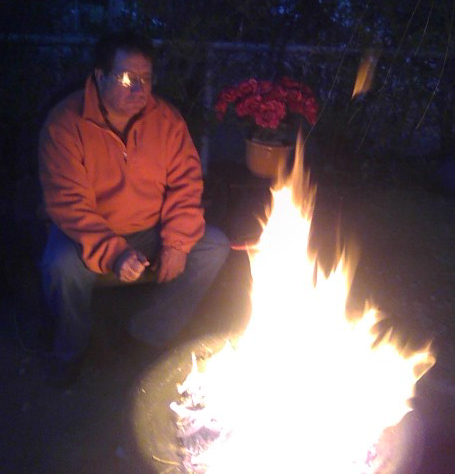
Relaxing by the front yard firepit on a chilly New Mexico evening circa 2013.

I was sitting here writing a short story when it occurred to me that most characters in classic fiction seldom have detailed descriptions of their physical characteristics.  In fact, many have none at all.   If they are described, it is usually in a broad, general way, unless there is some detail the author wants to bring out that reveals something about the character.   While this is a good technique for lean, muscular writing, it also has the benefit of not limiting how the character appears in the reader’s mind.   For example, here is the initial description of Victor Frankenstein when the narrator’s ship rescues him in the arctic in letter 4 (which functions in essence as part of a preface):

“Upon hearing this he appeared satisfied and consented to come on board. Good God! Margaret, if you had seen the man who thus capitulated for his safety, your surprise would have been boundless. His limbs were nearly frozen, and his body dreadfully emaciated by fatigue and suffering. I never saw a man in so wretched a condition. We attempted to carry him into the cabin, but as soon as he had quitted the fresh air he fainted. We accordingly brought him back to the deck and restored him to animation by rubbing him with brandy and forcing him to swallow a small quantity. As soon as he showed signs of life we wrapped him up in blankets and placed him near the chimney of the kitchen stove. By slow degrees he recovered and ate a little soup, which restored him wonderfully.

“Two days passed in this manner before he was able to speak, and I often feared that his sufferings had deprived him of understanding. When he had in some measure recovered, I removed him to my own cabin and attended on him as much as my duty would permit. I never saw a more interesting creature: his eyes have generally an expression of wildness, and even madness, but there are moments when, if anyone performs an act of kindness towards him or does him any the most trifling service, his whole countenance is lighted up, as it were, with a beam of benevolence and sweetness that I never saw equalled. But he is generally melancholy and despairing, and sometimes he gnashes his teeth, as if impatient of the weight of woes that oppresses him.”

Very little is said about Frankenstein’s physical state except where it reveals something about his state of mind or gives an idea of the hardships he has suffered in pursuit of his creation.    Because the physical description is so minimal,  the reader may envision Frankenstein in any physical form that he wants or whatever is easiest for him to envision (there is a difference between what we may want to envision and what is easiest or most natural for us to envision).  Frankenstein could be short and dark-haired and dark-complected or tall and blonde and sunburned.  Later on, we learn his family is from Geneva, therefore the reader could envision him as whatever his stereotype of a Swiss man from Geneva happens to be.

Using minimal physical description is therefore an advantage to the author, because it allows the reader to more easily visualize and thus more easily experience the story vicariously, i.e., it allows the reader to more easily immerse himself in the story.  We have all experienced the feeling of being completely immersed in the world of a novel, what Henry James called “the atmosphere of the mind” (see the definition in the Lexicon of Horror) and that is a feeling I want my readers to experience.

Thoughts?  Comments?

Types of Horror

Grand Guignol poster  from grandguignol.com
Grand Guignol poster
from grandguignol.com

Just now, I finished pasting Stephen King’s famous quotation on the three types of terror into my page on “Thoughts on Horror from the Masters” and I remembered that yesterday I was trying to remember the quotation, but could only recall a vague impression of it.   Thinking on that impression now, I think that it was just as valid and true a one as the one by Mr. King, but simpler, more compact, and easier to remember.  The concept is (I’ll refine this a little for the sake of clarity):

The three most common types of horror are:  suspense (knowing someone runs the risk of decapitation at any moment), terror (seeing him/her being decapitated), and disgust (watching the head roll down the stairs).

I don’t think this idea should replace Mr. King’s by any means, but should probably be viewed as a simplification of his rather lengthy statement.

There are also probably a hundred more different flavors (i.e. variations of the sensation) of horror but these are the three that seem to me to be the most common, at least in movies and other popular media.

Thoughts?  Comments?

Observations on “Baby Shoes” and Hemingway’s Iceberg Principle

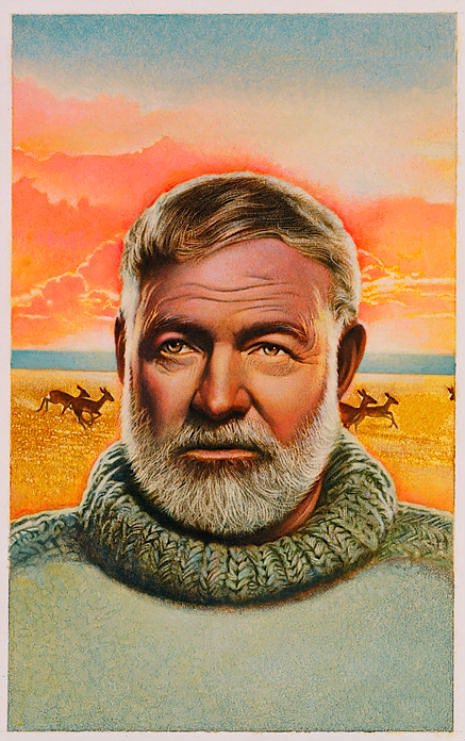
Ernest Hemingway Thought I do not know who the creator of this work is, I must ask that you respect their copyright.
Ernest Hemingway
(Though I do not know who the creator of this work is, I must ask that you respect their copyright.)

There is a story that Ernest Hemingway wrote the following to win a bet with other writers that he could write the shortest story:

“For sale:  baby shoes.  Never worn.”

Even a little research on the Internet shows that there is considerable doubt that Hemingway wrote this story, with the earliest reference to it as a Hemingway work not appearing until 1991.  There is also considerable evidence that the story existed in various forms as early as 1910, when Hemingway was 11 and well before his writing career began.   Whatever the facts, it is an extreme example of the lean, muscular writing for which Hemingway was famous.

In an interview with The Paris Review (see The Writer’s Chapbook, 1989, pp. 120-121), Hemingway did say:

“If it is any use to know it,  I always try to write on the principle of the iceberg.  There is seven-eighths of it underwater for every part that shows.  Anything you know you can eliminate and it only strengthens your iceberg.  It is the part that doesn’t show.  If a writer omits something because he does not know it then there is a hole in the story…First I have tried to eliminate everything unnecessary to conveying experience to the reader so that after he or she has read something it will become a part of his or her experience and seem actually to have happened.  This is very hard to do and I’ve worked at it very hard.”

So “Baby Shoes” is a good example of Hemingway’s iceberg principle, even if he didn’t write it.

“Baby Shoes” is also a good example of what I like to think of as the Tao of writing (see my earlier posts):  creating a story by a careful, strategic use of what is not said.  No where in the story does it state that a couple had apparently been expecting a baby, that they bought shoes for it, but then something happened to the baby to cause its death, and now the parents want to sell the shoes.    None of that is stated.  It is all implied, but yet we know what happened–or at least we have a good idea of what happened, even if we do not know the concrete facts of the matter.

There are also other facets of the story that we can infer, albeit tenuously.  From the fact that they bought baby shoes we can infer that the parents were probably eager to have the child.  From the fact that the parents want to sell the shoes we can infer that they probably don’t want them around any more as a remainder of a painful experience, but at the same time they may want to see someone else make good use of them or that they are hard up for money.

But one question I have that concerns human psychology is why is it that most people can read these same six words and come away with the same perception of what occurred?  Does it have to do with Jungian Archetypes floating around in each of us or is it that each of us has had the same broad experience(s) so that we can interpret these six words in a very similar way?

In the art of sculpture, those areas of a work that are empty, yet give the work its form, are called “negative space”.  An example is the space between each of your fingers.  If there were no space, there would be no individual fingers.   In that sense, a story like “Baby Shoes” makes maximum use of what might be termed “literary negative space”.

It is not really the words that give this story its power, but how we psychologically connect the ideas behind the words that fuel this extremely brief, but epic and poignant tale.

This is part of the magic of writing:  conjuring worlds out of nothing.

Thoughts?  Comments?


Stephen King, H.P. Lovecraft, and the X-files

mod 130419_0008I just finished watching an episode of the X-Files entitled “Chinga” [note to Spanish-speakers out there:  I don’t know who chose the title, so please forgive my language] from Season Five and I  noticed that it was written by Stephen King and Chris Carter (the creator of the X-Files).  The story’s antagonist is a talking doll that can force people to injure or kill themselves in gruesome ways.   Like many, if not most, of King’s stories, there is no explanation of how the came to exist.  All the viewer finds out about it is that a lobsterman pulled it up one night in a lobster trap and his daughter comes to possess it after he meets his own gruesome fate.

I find in my own writing that I like to provide an explanation or background as to how things originate.  This is just my nature.  I like to know the origins of things.  However, I have come to believe of late that, in terms of horror, that is a very nineteenth century  concept.

Lovecraft said in his essay “Supernatural Horror in Literature”:

“A certain atmosphere of breathless and unexplainable dread of outer, unknown forces must be present; and there must be a hint, expressed with a seriousness and protentiousness becoming its subject, of that most terrible conception of the human brain — a malign and particular suspension or defeat of those fixed laws of Nature which are our only daily safeguard against the assaults of chaos and the daemons of unplumbed space.”

For me, what Lovecraft is saying is that if the laws of nature are negated, then anything is possible and monsters like Cthulhu really could exist and are capable of doing us harm at any moment.  Combine this with his statement that “The oldest and strongest emotion of mankind is fear and the oldest and strongest kind of fear is fear of the unknown” and it becomes apparent that stories like “Chinga” derive much of their horror effect from the fact that the origin of the threat to a story’s protagonist(s) is unknown or that there is no explanation for the threat.

This would mean that one of  things that provides to “Chinga”  the element of horror that it has, is the fact that origin of the doll is unknown.  Therefore, any of us when we are fishing or scuba diving or swimming in any body of water, could discover a doll that would turn his/her life into a nightmare.   That is a scary thought.

Of course, this means that Stephen King would be one of the greatest practitioners of this technique, which I believe he is.

I think I shall try to experiment with this in the near future.

Thoughts?  Comments?


Notes on “The Hellbound Heart” Part 2 of 2

Clive Barker, Seattle, 2007 by Steven Friederich

I finished reading The Hellbound Heart several weeks ago.  As noted previously, it is a truly terrific read.    I suggest reading it after seeing the movie (if you have somehow repeatedly missed your chances of seeing “Hellraiser” over the last twenty or so years).   Reading it beforehand will just spoil the movie, whereas reading it afterwards may enlighten parts of the movie.

I don’t have much to add to what I have previously stated, except that, if you are a student of storytelling, the book warrants a detailed examination for narrative technique as it exhibits some basic techniques of storytelling that Mr. Barker carries out very well.   I could go through the book page by page and expound on each ad nauseam, but instead I will focus now on one that sticks in my mind.

I do not recall if this is in the movie, but toward the end where Kirsty is trapped in the “damp room” by Frank, she slips on a bit of preserved ginger lying on the floor enabling Frank to catch her.  The method by which Barker establishes why that ginger is on the floor fascinates me.

Although I have one or two dictionaries of literary terms, I do not recall the name for this technique and I think of it as simply setting the stage for a future scene.  It shows the foresight, planning, and attention to detail that must go into any good story.

Earlier in the story, after Julia has released Frank from the Cenobite hell and he has regained enough flesh that he can once again eat, he asks Julia for a few of his favorite victuals, including preserved ginger.   At the moment I read this, I thought it was simply a natural but insignificant detail.  Of course, I could not know then that that bit of ginger would  skyrocket the dramatic tension later on in one of the novel’s most important scenes.

Anyway, that’s my post for the day.

I have been very negligent in posting anything over the last months,  my daytime job and personal matters consuming much more of my time than usual.  I have recently come to find out though, that many more people in my home town of Frankfort, KY, were enjoying my postings than I had known or even believed possible and sorely missed it during this hiatus.  For them and all the others who silently enjoy my works, I shall endeavor to pick up the thread.

I have not lost my desire to write fiction, however, and I am currently trying to finish a sci-fi/horror novella that I started sometime back.  The work is going well, but I am having to change some of my original concept to make it more exciting.  I would like to make it as gripping as some have found my “Murder by Plastic” (published at www.everydayfiction.com), but that will be quite difficult for something as long as a novella.  The part I find most challenging is to coordinate the details much as Barker did in the example I give above.  I would expound on the subject, but I do not want to give away the plot or run the risk of some unscrupulous cur stealing my idea and publishing it before I do–particularly as I am so close to finishing it.  After this I have another three or four unfinished works to bring to a close.  I could probably write eight hours a day like Thomas Mann and still not be finished by spring.

Thoughts?  Comments?

Neil Gaiman: ‘Face facts: we need fiction’ | Books | The Guardian

Neil Gaiman at the 2007 Scream Awards Photo by pinguino k
Neil Gaiman
at the 2007 Scream Awards
Photo by pinguino k

Here is a fascinating perspective on fiction by Neil Gaiman: ‘Face facts: we need fiction’ | Books | The Guardian.

Visit “The Works of Edgar Allan Poe, Volume 1” but not for the obvious reason.

Edgar Allan Poe, 1848

The Works of Edgar Allan Poe, Volume 1.  Yes, this link takes you to a collection of Poe’s works, but the reason I am mentioning it here is because the preface to this particular volume includes fascinating biographical notes and insight into the character of this master of horror that may help you understand the roots of his creative genius and how art sometimes came close to imitating life for Mr. Poe.

When you open the page, you may find yourself a little distance from the top of the article at the beginning of a section entitled “The Death of Edgar Allan Poe”.  While this section is fascinating in its own right, scroll to the top for the entire preface.  The works of Poe, beginning with the story of Hans Pfall, begin a bit down from “The Death…”

28 Totally Relatable Quotes About Books

Detail of Madonna des Kanonikus Georg van der Paele by Jan van Eyck, 1436
Detail of Madonna des Kanonikus Georg van der Paele
by Jan van Eyck, 1436

Purely for your entertainment, here are 28 Totally Relatable Quotes About Books.  I know I can relate to a lot of them.  I’m sure you will find a few for yourself.  One reason I find these interesting is because many of them show me how intensely involved readers will become with a book.  As I have mentioned in previous posts, I believe that people live a vicarious existence through a story.  When we write, we are not just writing a book or a story, we are creating a universe in which people will hopefully want to, not just visit, but dwell.  All of the writer’s art should therefore focus on creating a virtual reality for one’s readers.  To do that, we need a good  grounding in, or at least a good feel for, human psychology, because we have to shape our creations to fit the human psyche.  How do thoughts come into being?  How do they lead from one to another?  How do images form in the mind?  No, I am not saying that we need Ph.D.’s in psychology to be good writers, but I think we need some sort of archetypal insight into human nature if we are to be the great writers we hope to be.  Darn.  I’m rambling again.  🙂

Impressions of Five Writing Styles

I was in the Farmington public library yesterday trying to pull together some ideas for a story, but I could not concentrate long enough to formulate many good thoughts, because I felt more in a mood to receive information rather than to transmit.

Within the last few days I have started reading a collection of Lovecraft stories entitled The Dream Cycle of H.P. Lovecraft:  Dreams of Terror and Death (an excellent work; read it if you get the chance), edited by Neil Gaiman.  While wandering through the stacks, I pulled out a copy of Stephen King’s From a Buick 8 and took it back to my seat.  I had started reading it several years ago, but never finished it.  I thought I would review it and maybe start on it again soon.   As I read it, I noticed an interesting difference between King’s style and Lovecraft’s. Lovecraft gives a lot more of the backstory of a work in a few pages than King does.

As it so happens, I had also passed by the John Updike section a little earlier in the library and I have a few of his novels, which I have never read.  I went back and picked up his Rabbit, Run for comparison.  I thought about the differences between these three and a couple of other famous writers and came up with what I consider to be an interesting observation  (though it might bore those of you who are more advanced in the craft of writing than I am):  it is fascinating to see how much information about a work’s backstory or the larger setting of a story an author can put in the first 2-3 pages or so of a work.  For what it’s worth, here are my initial subjective impressions of the five writers under consideration yesterday.

In the first few pages of Rabbit, Run Updike details how Rabbit Angstrom happens to walk upon a basketball game among six kids in an alleyway (circa 1960). He watches and then joins the game, and impresses them with his basketball prowess, having been a high school basketball star about 8-9 years earlier.  He then goes home to where his wife is contemplating cooking dinner.   Updike takes us through this step by step and we don’t learn a lot other than Rabbit was a basketball star in high school several years back  and at 26 he has a middle class life now with a job for which he wears a suit to work.  I know that Updike is a very respected writer with two Pulitzers to his credit, but this story gets off to a very slow start for me and I learn very little about Rabbit Angstrom in the opening pages.  There is also very little emotional pull in these opening pages to draw me into the story.

In the opening chapter of A Farewell to Arms, Hemingway describes the scene from the window of an Italian house used as a hospital as troops pass en route to the Austrian front over the course of about a year.   He also describes how the leaves fall from a nearby tree and how the dust during the summers turns everything bone white, both of which (to me) symbolize the deaths of myriad troops on the front.   In maybe 2-3 pages, Hemingway not only gives us the overall setting of being at the Italo-Austrian front, he also draws us in with considerable emotional impact of the tragedy of the watching thousands of weary troops slogging through rain and mud or trudging through dust and heat on their way to their deaths.

In Quiet Flows the Don (1940), Soviet author Mikhail Sholokhov (winner of the 1965 Nobel prize for literature) describes the lives of Don Cossacks from before the First World War up to the Russian Revolution.  In its first few pages, Sholokhov describes life in a village of Cossacks, describes the relationship between father and son, shows how the son is having an affair with another Cossack’s wife, and shows the history and underlying peccadilloes of the family back for circa 200 years.  While his style is non-emotional, one cannot help but to feel for the family and to be drawn into the story.  It is a hard book to put down.

In From a Buick 8, Stephen King tells the story of a mysterious car that is kept in storage at a Pennsylvania State Troopers’ post.  In his first few pages, King describes the main characters and how they interrelate and how they all fit into the world of that post.  King makes the reader feel as if he were seeing the post from the perspective from one of its members.  You know the same things about all the members of that tight-knit community as if you were one of them.   Though the opening is not on the grand scale of A Farewell to Arms or Quiet Flows the Don, one feels the story on a much more intimate level while on a larger scale than in Rabbit, Run.    In the opening pages of From a Buick 8, King makes the reader feel as if he were part of a small community, while Sholokhov makes the reader feel as if he were part of a village, and Hemingway makes the reader feel a part of an entire battle front.

Dreams of Terror and Death is a collection of short stories, but in it the unfinished tale “The Descendant” stands out as an example of Lovecraft’s ability to an enormous backstory/setting into a few pages.  In these few pages, Lovecraft describes how a young man brings a copy of the dread Necronomicon to an aging scholar and how the scholar begins to relate the history of a millennia-old castle on the Yorkshire coast that hides the entrance to the elder world.  The story, even in its few pages touches on black magic; ancient, forgotten civilizations; other dimensions; and probably a dozen other mysterious subjects that instill the sort of eerie curiosity into a reader that compels a person into the black recesses of an unexplored cave. You sense something dangerous is lurking just out of sight, but you cannot contain the urge to find out what it is.

The instilling of this eerie curiosity that keeps one on the edge of the movie theater seat or turning the pages of the novel is a hallmark of all good horror and of all good horror writers.

Thoughts?  Comments?