Publisher, Rural Fiction Magazine; publisher, The Chamber Magazine; founder, the Farmington Writers Circle. I have written short stories and poetry for many years. In my careers as a Naval officer and in the federal government, I have written thousands of documents of many types. I am currently working on a second edition for my poetry collection and a few novels.
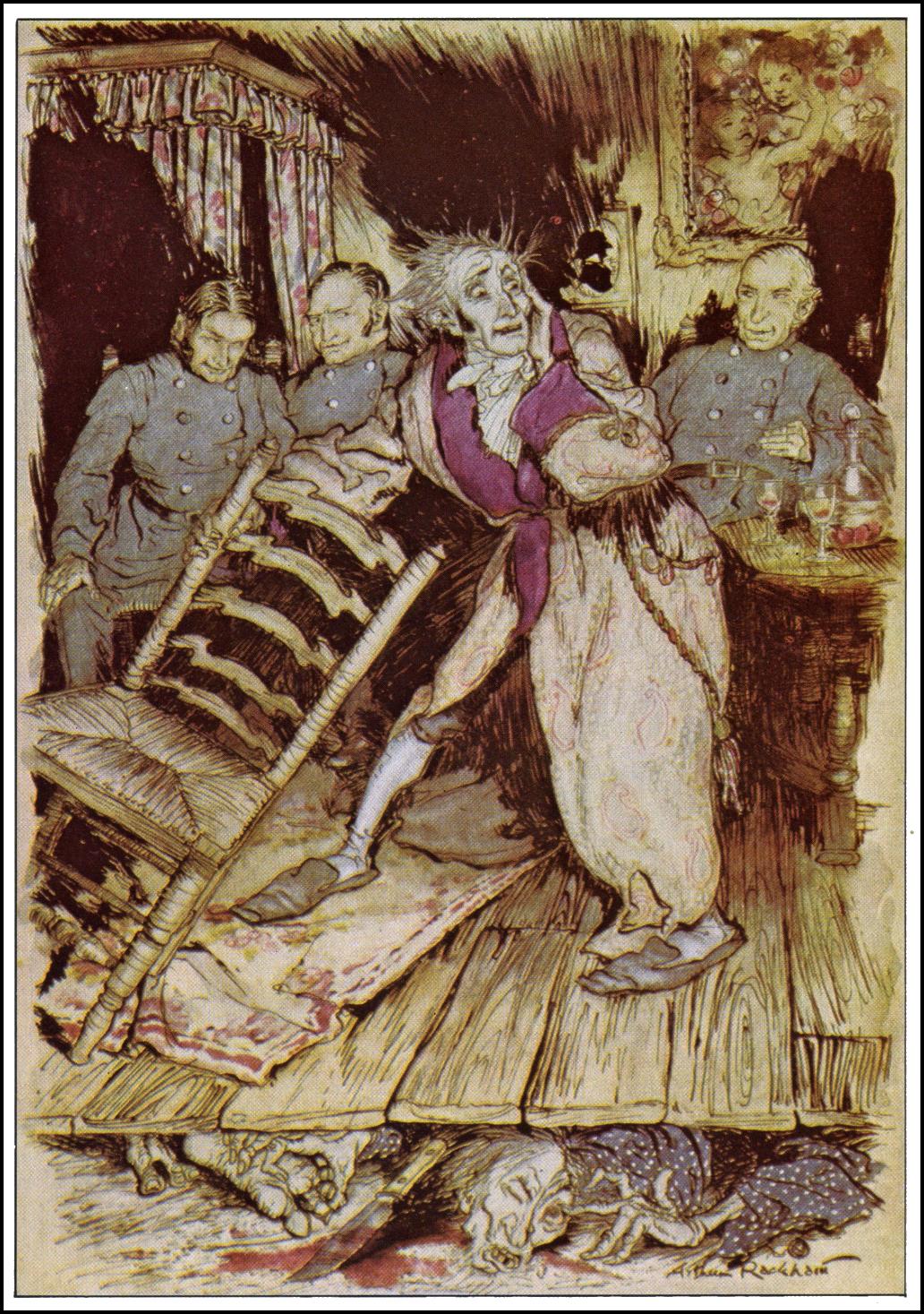
“The Tell-Tale Heart” Illustration by Arthur Rackham, 1935
I was just musing that if a canon of horror literature could be developed, what should it include? This would be a collection of say ten works that define horror literature and that everyone seriously interested in horror should read if he/she they wish to learn what horror is and should be. This would not be a collection of the most popular works (whether novel, short story, essay, screenplay, theater, etc.) of horror, which would change constantly, but ten works which would define horror now and forever as the Bible does Christianity, as the Koran does Islam, and as the Analects of Confucius do Confucianism. These should be eternal works that at the end of time, after the Zombie Apocalypse when no more books are written, the few remaining survivors of humanity can review all the literary works of all time and say, “These ten defined the horror genre.” Of course, this canon will be forever debated, but lively, engaged discussion is the fun of a list like this.
To start off this conversation, here are my initial ten recommendations (subject to change as my reading progresses). I will keep this list to one work from each of ten authors so that works by one author do not overwhelm the list. This is not in any order of priority or preference–just as they pop into my mind. Although these reflect my own reading (which tends to the past more than the present), I have added one or two authors I haven’t read, but from what I understand, have made significant contributions to the horror genre.
Based on my site stats, one of my most popular posts has been the one on the local Zombie Response Vehicle. What has been mind-blowing to me, is that “zombie response vehicle” is one of the most popular search terms people use to find their way to my humble blog. Out of curiosity, I went to Google images to see what other zombie response vehicles I could find. The results were even more mind-blowing. There are a LOT of zombie response vehicles out there. I heartily recommend a quick search to see what turns up. In the meantime, I have posted a few of the most interesting ones here. I have tried to limit my selection to ones you are most likely to see on the street (as opposed to artists’ conceptions, corporate advertising, antiquated military vehicles, etc.), with a few exceptions that I thought were too funny to pass up.
from zombiehunters.org
from ca.autoblog.com
from adadddyblog.com
from extraordinaryintelligence.com
zombie hunting vehicle 1 from blog.1aauto.com
zombie car from gravitysmacked.co.uk
Zombie Bus Mock Up warningsides from zombiehunters.org
from winblog.org
light cavalry zombie attack vehicle from forums.gunsandammo.com
If you would like a short trip to the weird side of the horror news, follow the link to a law article about a case in Romania in which a couple sued four priests for failing to rid their home of flatulent demons: Romanian Religious Malpractice.
I found a fascinating article just now that I highly recommend visiting: “Winter Chills with Mike Arnzen”. You can find it at http://nonhorrorreadersurvey.wordpress.com/2010/12/21/winter-chills-with-mike-arnzen/. It is a fascinating look into how Freud’s concept of the Uncanny can be found in modern horror and in popular culture. It is worth checking out.
According to the Wikipedia definition (as of April 21, 2013), an idiolect is “…a variety of language that is unique to a person, as manifested by the patterns of vocabulary, grammar, and pronunciation that he or she uses.” This accords to the definition I learned in graduate school many years ago.
In my writing, I try to make as much use of idiolects and personal speech patterns as possible in order to distinguish speakers in sometimes lengthy conversations so that I can omit boring, repetitious attributions such as “he said”. I feel this also adds a sort of flavor to the story, because the way a person speaks tells something about the speaker in terms of emotions, psychology, and background among other things. Using idiolects adds a layer of subtle complexity to a story.
An example of this from my past is that of a college friend named Mike. One of Mike’s pet expressions was “Whatever!”, which he used often in a sort of sympathetic exasperation when someone persisted in doing something Mike thought stupid in spite of his advice to the contrary. On those occasions, he would chuckle and say “Whatever!” and walk away with a grin that said he would have fun seeing the outcome. If I were to write down a conversation between myself, Mike, and several of our friends, you could tell when Mike was speaking by his frequent use of the “Whatever!”, which the rest of us seldom used.
Used carefully and sparingly, an idiolect can be a subtle motif about each character that the author can use to remind the reader of some facet of the character at critical moments.
Poster from Johannascheezburger.com via Halloween Mike’s Horror Everyday on Facebook.
For the first time in a long time, I was listening to CDs on the car stereo as I drove back from Farmington (New Mexico) on the 14th, when I started feeling once again the latent but powerful emotions I associate with certain songs. The songs in question were Puddle of Mudd’s “Spaceship” from Songs in the Key of Love and Hate and “Would?” from Alice in Chains’s Dirt. When I was not that much younger than I am now, I used to listen to a broad range of music (from classical to hard rock to New Age and more) almost constantly. Therefore it will not be surprising if I state that others that stir me range from ACDC’s “Back in Black” and Nirvana’s “Smells Like Teen Spirit” to Mussorgsky’s “Night on Bald Mountain” and Beethoven’s Ninth Symphony, and, for a complete change of pace, to Enya’s “Orinoco Flow” and Michael Gettel’s San Juan Suite, both of which seem to stir not a tumult of emotions, but instead have the opposite effect and cause me to almost drift away on a sea of tranquility.
As I am sure is the case with most people, I find all my favorite songs enjoyable, but there were, and still are, some that stir me deeply and can even now resurrect feelings of intense excitement and passion as if I were reliving my “Glory Days” (which, by the way, is an excellent Springsteen tune that really hits home these days).
Out of those that stir my emotions the most, are a select group that have a certain je ne sais quois, a combination of primal rhythm, deep-toned vocalization, and soul-stirring guitar riffs, that do not stimulate the intellect as much as they instigate remote, subconscious parts of the mind to coalesce into a riot of images shaping themselves into the essential kernel of some grim tale that I know I can nurture, expand, and carefully, painstakingly mold into a narrative that would enthrall Dante or Milton–had I the time or unswerving diligence to concentrate on its writing.
“Enter Sandman” by Metallica is an excellent example of this. Even though the song is about the destruction of a family (according to Wikipedia), something about it compels me to write an intricate novel of espionage, assassination, betrayal, deception, and the inner horrors of the human psyche that paces back and forth in the recesses of my mind like a tiger in a cage, watching for an opportunity to spring forth into the light of day upon an unsuspecting yet willing audience. I have probably 20,000-30,000 or more words in the current draft of this story and I will probably trash most of these the next time I sit down to tackle this task. One day I will have to dedicate myself to finishing the story, because this is the only way I know I will be able to rid myself of the tiger’s pacing and of his relentless stare that bores into the back of my neocortex. As my life stands now, between chores at home and working 50-60 hours per week at my day job, I can find little time during an average week to work on the various short stories, novelettes, and novellas I have started over the past year.
Sad to say, I have two or three good novels that have been waiting over a decade or more for their genesis. Probably with each of them I associate some tune from my more turbulent past, if not with the entire work, then with at least some scene that plays over and over in my head like a teaser clip from a movie trailer.
For me, this is one of the delicious agonies of being a writer. I have so many fascinating concepts whirling through my head that I just know instinctively can be great works and that I enjoy revisiting whenever I have a few seconds to daydream but the lack of time in my daily life stymies their creation.
My question to you tonight, is are there musical works that inspire you to create works of horror and terror?
Unfortunately, I have been so busy lately that I have not had very much time to write or to post anything new of any substance. However, to polish my writing skills I have been perusing The Most Common Mistakes in English Usage by Thomas Berry during some of my few free moments. Although the book is nearly ancient by today’s standards (first copyrighted in 1961) and some of the advice is certainly well behind the times, I find it is still quite a useful reference, because much of the advice focuses on the exact meaning of words as well as the basics of English.
Unless you are a grammar aficianado, the book is by no means an exciting read, and I would not call it entertaining, but it can pique one’s interest with discussions of the subtleties in the meanings of common words, words I normally take for granted. One word discussed that is undoubtedly used by writers of horror frequently is “sadistic”. In his chapter “Words Commonly Misused” Professor Berry notes:
“The word ‘sadistic” refers to a form of sexual perversion. Only careless writers and speakers use it to mean ‘strong interest in gory details’.”
Whether you agree with his assessment or not, it should be enough to pique one’s interest enough to ask yourself if you are using the nuances of the word to your advantage.
Another assessment I found interesting was that of “livid”. According to Professor Berry:
“The word ‘livid’ means ‘a bluish color,’ ‘of the color of lead’, or the ‘black and blue coloring of flesh that has received a contusion’. This word is commonly used to mean other colors. Also, the word ‘livid’ is absolute and consequently, one object cannot be ‘more livid’ than another.”
Other bits of sage advice that I find useful in giving my writing a poetic undercurrent concerns positioning modifiers in a sequence either by length or by logical order.
“Whenever possible, modifiers should be arranged according to length, with the shortest preceding the others.
Uneven: It was a battered, worn, broken desk.
Better: It was a worn, broken, battered desk. “
And
“Modifiers should always be arranged in a logical sequence.
Wrong: As the days wore on, he became tired, bored, and exhausted. (Wrong because he probably became bored before he became tired.)
Right: As the days wore on, he became bored, tired, and exhausted.
Even if Professor Berry’s advice or attitudes may be out of date or not in line with current thinking, I recommend reading The Most Common Mistakes in English Usage if for no other reason than just to start the creative juices flowing and to start one thinking about how to maximize the use of the subtleties of grammar and meaning to their fullest effects.
I just received word that my poem “Faust” will be reprinted in the July issue (#53) of Blood Moon Rising Magazine. My many heartfelt thanks go out to Daniel Jones and the staff at Blood Moon Rising for publishing one of my favorite works. Please visit their website whenever you have the opportunity.
Portrait of H.R. Giger copyright 1998 by Dana Frank/NYC from hrgiger.com
If you are not familiar with the works of Swiss artist Hans Rudolf Giger, you are probably familiar with movies that use his art: the Alien series, Poltergeist II, Batman Forever, and Prometheus among others. Though his works are considered surreal or of science fiction rather than horror, to me there seems to be something of an unstated horrific element to them and therefore I have included them as tonight’s post.
Perhaps a more tangible connection between Giger and the world of horror is that his book, upon which the original Alien design was based was entitled H.R. Giger’s Necronomicon, after, of course, the fictitious Necronomicon of H.P. Lovecraft. Here I quote a short article on it from Wikipedia:
“Necronomicon was the first major published compendium of images by Swiss artist H. R. Giger. Originally published in 1977, the book was given to director Ridley Scott during the pre-production of the film Alien, who then hired Giger to produce artwork and conceptual designs for the film.
“The book was originally published by Sphinx Verlag and was republished in 1993 by Morpheus International with additional artwork from Giger’s Alien designs. A subsequent collection of his images followed as H. R. Giger’s Necronomicon 2, printed in 1985 by Edition C of Switzerland.
“Giger’s Necronomicon is named for H. P. Lovecraft’s Necronomicon, a fictional grimoire Lovecraft invented and used as a plot device in his stories. Lovecraft’s Necronomicon was a compendium of pre-human lore compiled by the fictional mad Arab Abdul Alhazred, circa 700.[1]“
Giger’s works are a fascinating foray into the surreal, erotic, and horrifying possibilities of the world of biomechanics. A quick search in Google images for “Giger art” or a vist to hrgiger.com will prove quite rewarding. Here are a few examples to whet your appetite (please note that all images used in this post are copyrighted by the author/artist and are used here only under US “fair use” guidelines) .
The Garden of Earthly Delights by Hieronymus Bosch Museo del Prado, Madrid
Long before I developed an interest in the literature of horror, I developed an interest in painting (though I am not much of a painter myself). One of the painters who has always fascinated me is Hieronymus Bosch, a Dutch painter who lived from circa 1450 to 1516. The work above is typical of his style: surreal, fantastic, horrible. Bosch did many paintings of the horrors of hell as a consequence of sin.
Earlier tonight, I was searching for a subject for tonight’s quick post and I did a quick search in Google images for “horror art” thinking I would post some modern visual image of horror that captures what horror is for me. However, most of the images I found relied solely on the shock value of some singular instance of torment to communicate horror: the visual equivalent of a slasher flick. With one exception (which I did not post here tonight, but maybe will later) nothing captured the suspense that I feel is necessary in a work of horror.
Then I remembered Hieronymus Bosch.
Although I cannot say there is any inherent suspense in Bosch’s works, there are other, hard to verbalize, elements that seem to speak horror to me better than any depiction of a single, bloody act. One is the breadth of horror in his works. There is no single act, instead there may be a hundred or more monsters and terrifying horrors in a single painting, raising the horror from a personal one-on-one level with the viewer to that of a awe-inspiring spectacle. Second, there is a tremendous level of complexity in each work, which forces the viewer to examine the work in detail to dig out each individual torment and focus on it, thereby immersing the viewer in the infernal landscape as if he were a participant in it. Third, I sense a mystery in Bosch’s works that is hard to express. There is an extremely complex symbolism in each work, that I personally cannot fathom, but that intrigues me nonetheless, perhaps because I cannot fathom it. Perhaps an expert in symbols, such as the fictitious Robert Langdon in The Da Vinci Code, could understand the motifs at work in Bosch’s painting, but I can only catch a glimpse of something occasionally and realize that something well beyond my limited understanding is. To paraphrase the comedian Adam Carolla, I feel like “a baboon trying to understand a thesaurus.”
If you have an interest in the visual art of horror, please do a quick search on Google images for “Hieronymus Bosch”. You won’t be disappointed.
Though not actually horrific in itself, I thought this cartoon might have special meaning for aficianados of horror, suspense, mystery, or of speculative fiction in general. Enjoy.
The first paragraph of the Wikipedia article (as of April 17, 2013) gives a good, very basic introduction to Hanns Ewers:
“Hanns Heinz Ewers (3 November 1871 in Düsseldorf – 12 June 1943 in Berlin) was a Germanactor, poet, philosopher, and writer of short stories and novels. While he wrote on a wide range of subjects, he is now known mainly for his works of horror, particularly his trilogy of novels about the adventures of Frank Braun, a character modeled on himself. The best known of these is Alraune (1911).[1][2]“
The article continues on to describe some of his literary achievements:
“This was followed in 1911 by Alraune, a reworking of the Frankenstein myth, in which Braun collaborates in creating a female homunculus or android by impregnating a prostitute with the semen from an executed murderer. The result is a young woman without morals, who commits numerous monstrous acts. Alraune was influenced by the ideas of the eugenics movement, especially the book Degeneration by Max Nordau.[4]Alraune has been generally well received by historians of the horror genre; Mary Ellen Snodgrass describes Alraune as “Ewers’ decadent masterwork”,[2]Brian Stableford argues Alraune “deserves recognition as the most extreme of all “femme fatale” stories” [4] and E.F. Bleiler states the scenes in Alraune set in the Berlin underworld as among the best parts of the novel.[3] The novel was filmed several times, most recently by Erich von Stroheim in 1952.
Bleiler notes “Both Alraune and The Sorcerer’s Apprentice are remarkable for the emotion the author can arouse” and that Ewers’ writing is, at its best, “very effective”. However, Bleiler also argues Ewers’ work is marred by “annoying pretentiousness, vulgarity, and a very obtrusive and unpleasant author’s personality”.[3]“
So far I have read only two of Ewers’ short stories: “The Spider”, described as his “most anthologized work”, and “Fairyland”. I will need to read more of his works to be able to speak with some degree of confidence that I know what I am talking about, but my first impression of Ewers’ works is one of disappointment.
I read both works in English (though I speak German with moderate fluency), and his command of composition, organization, language, clarity, and suspense are competent enough, but at least the stories noted above seem to fall apart at having a comprehensible denouement, and in the area of having good taste.
“The Spider” starts off well enough with a great opening paragraph that sets the stage for suspense:
“When the student of medicine, Richard Bracquemont, decided to move
into room #7 of the small Hotel Stevens, Rue Alfred Stevens (Paris 6),
three persons had already hanged themselves from the cross-bar of the
window in that room on three successive Fridays.”
As the story develops, Bracquemont volunteers to work with the police in finding out why the three previous residents killed themselves by reporting what he sees during his stay. He records his observations in a diary. Over the next three or so weeks, Bracquemont begins observing a girl in another room across the street, who constantly spins at an old-fashioned spinning wheel. He begins to be attracted to her, he waves to her, they develop games to play over the distance (mimicking each other, etc.), he becomes infatuated with her, and obsession sets in all the while there are subtle hints of analogies between her and a female spider luring her mate to its death. I will not spoil the ending for you, if you want to read it (I read the version at Project Gutenberg Australia), but I will say that the story seemed rather drawn out and the ending was confusing with no real explanation as to why the story ends as it does. I suppose one could say it was “black magic”, as one critic noted, but there is nothing alluding to black magic anywhere previously in the story. The ending is sort of deus ex machina and very unsatisfying.
“Fairyland” is worse. It’s only virtue is that it is very short. It is the story of a cute little girl on a tramp steamer in Port-au-Prince who is the darling of the crew and who tells them of wonderful monsters she has seen ashore, monsters with enormous heads and limbs and scales. She offers to show them to the crew and the crew agrees to go along wondering what she has found. Not far from the docks, she shows them the local beggars who have enormous limbs from having contracted elephantiasis or scales from leprosy or a similar skin disease. While the crew is obviously overcome with disgust, the little girl prattles on about how cute the monsters are.
I am not one to berate anyone else over a lack of taste, but whoever published this deserved a good horsewhipping for deciding to put this atrocity in the public view. It is one of the more tasteless things I have ever seen. However, I will discourage anyone from reading it. After all, it is a matter of taste and we are dealing with matters of horror.
So far, Ewers is the one author of horror I have been most disappointed by. Still I will read at least a few more of his works before I solidify my opinion. At some point I may read Alraune only because it is his best known work, but from what I have seen of its reviews, it may be a struggle for me to wade through horrors which only the Marquis de Sade would appreciate.
Perhaps Ewers does deserve his accolades. I will only know by exploring his works further. So far though, I am not looking forward to the journey, which I make only out of intellectual curiosity.
There is one interesting sidelight about Ewers for fans of cinematic horror. One reviewer commented somewhere (I forget where) that Alraune was the original inspiration for genetically-mutated femme fatales like the alien in the Species trilogy.
























 Phil Slattery, Writer, Publisher