With Iced Tea, Farmington, New Mexico, March 20, 2015
I am now seeking a publisher for a collection of my short stories that have been published to date and also one for poetry I published back in the 80’s and 90’s. If anyone familiar with my works has a recommendation for one or both, I would love to hear it. All my published prose is listed on my Published Works page as is most of my published poetry. However, I do have a lot of unpublished poems I would like to include in the poetry collection for a total of about 80-90 poems. Of course, I have several as yet unpublished short stories that I can include in the short story collection, if I need to beef up the word count for the collection.
Please contact me via this website, if you know of a potential publisher or if you are a publisher and might have an interest in publishing my works.
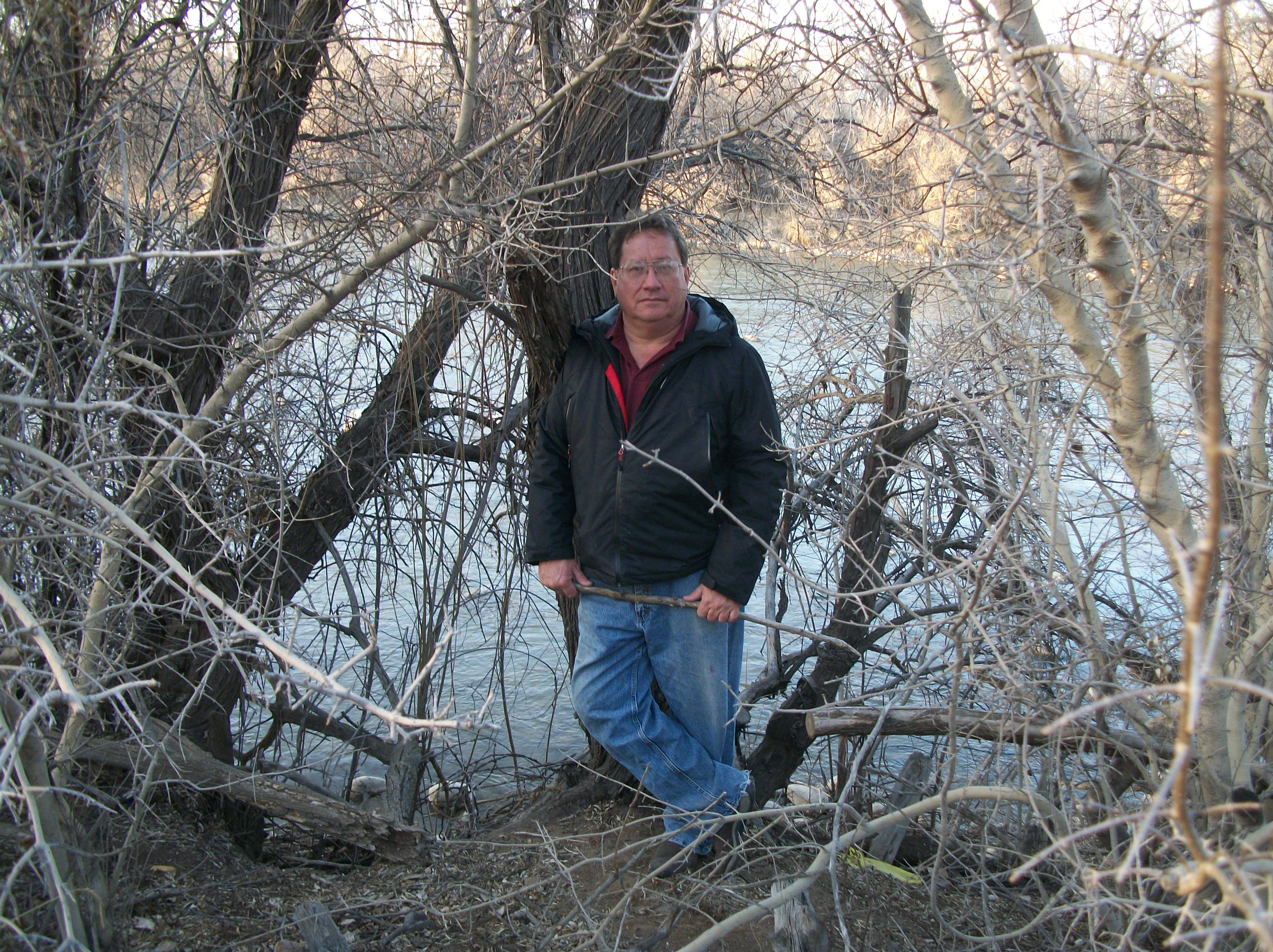
The blogger on the banks of the San Juan River, Farmington, NM, 2013
I ran across a good, common sense article on some publication basics today on the Fey Publishing blog. Please visit them at Fey Publishing Blog. The article is entitled “Advice Straight from a Publisher on Getting Your Book Published”. It was originally published on July 18, 2014. Also, Mr. Charles Shell makes a good point about publisher’s responses in the comments section, to which I added my own, of course.
With Iced Tea, Farmington, New Mexico, March 20, 2015
I just received word that my flash story “The Scent” will be re-printed by Fiction on the Web (fictionontheweb.co.uk) on July 17, 2015. “The Scent” is not horror, but rather a ghostly story about a young man waking up to memories of a past love. “The Scent” was first published by Futures Mysterious Anthology Magazine in 2001. Many thanks to Charlie Fish and his crew at Fiction on the Web for re-printing this, one of my favorites of my own short stories. “The Scent” was my first work of fiction and the first to be published. “The Scent” was previously only in print. This is its first appearance on the web.
I was just sitting here contemplating a couple of my stories and how I could improve them before I send them out for publication once again, when something occurred to me. At the moment I was thinking about what makes a satisfactory ending to a story for the general public. A story can be either simple or complex (in characterization, plot, backstory, all of the aforementioned, or whatever) and it can have either a simple or complex ending. How they are paired determines how the reader emotionally and intellectually responds to the story.
A simple story with a simple ending is probably the least satisfactory type of story. It is no challenge to most people and is not likely to stimulate interest. It is boring.
A simple story with a complex ending is probably not entertaining or satisfactory to most people, but it will stimulate the interest of a few. Not many people like or tolerate complex solutions to simple problems.
A complex story with a complex ending is satisfactory to some people, i.e. those intellectuals or faux intellectuals who enjoy complex matters, but these won’t be the majority.
A complex story with a simple denouement is probably the most satisfactory to most people. It stimulates the mind and enlightens the reader, helping him/her to see reality or the problems of reality in a new light. I have written often about a reader enjoying the vicarious experience of a story. It is the same with a complex story with a simple ending. The reader experiences the story vicariously; he/she feels the vicarious joy of having solved the problem along with the protagonist and any other characters accompanying the protagonist through the story.
About. Here is an interesting blog on writing. As you can see by my comment on the About page, it delves into the essence of writing: communication, the clear transmission of an idea from one person to another.
With Iced Tea, Farmington, New Mexico, March 20, 2015
I am pleased to announce that my short story, “The View from the Apex of Civilization” was reprinted on May 13 at www.throughthegaps.com, Once again, my thanks go out to Benjamin Choi and his staff at Through the Gaps.
“The View from the Apex…” is one of my earliest efforts and was published originally by Mobius Magazine in 2004. It is sort of horror lite. I wrote it to make a comment on our society. I hear often that our society is at the apex of civilization, or something else that implies that our society has learned all it can about certain subjects (granted there are some new ones like space travel or genetics that almost everyone will have to agree that we are struggling neophytes). To put things in perspective, I wrote this story in which, during the time of the Inquisition, an overly proud bishop brags to a local official about how their society is at the apex of civilization and there is nothing more to learn.
Please visit Through the Gaps and peruse all four of my stories that are now on their website.
Here is a superb explanation from http://grammar.about.com/od/alightersideofwriting/a/sensualgloss.htm of the distinction between two words I still confuse (no matter how many times I watch the supermarket scene from Animal House). Knowing the history of the two words helps. I stumbled across this article today while double-checking its usage for a story I am writing.
After reading this it occurred to me that a good mnemonic for the difference would be to remember that sensual and sexual both end in -ual. As a matter of fact, the only difference in pronunciation is that one has an x (a ks sound) and the other has ns.
The adjective sensual means affecting or gratifying the physical senses, especially in a sexual way.
Sensuous means pleasing to the senses, especially those involved in aesthetic pleasure, as of art or music.
But as explained in the usage notes below, this fine distinction is often overlooked.
Examples:
“If one wants another only for some self-satisfaction, usually in the form of sensual pleasure, that wrong desire takes the form of lust rather than love.” (Mortimer Adler)
Her first book of poems included several sensuous descriptions of flowers.
Usage Notes:
“The controversial 1969 bestseller The Sensuous Woman would have been more accurately titled The Sensual Woman because its explicit subject matter concerns the unabashed gratification of sexual desire.
“Here’s how you can keep the two words straight. If you mean lovely, pleasurable, or experienced through the senses, use sensuous; if you mean self-gratifying or pertaining to physical desires, use sensual. Sensuous thoughts have a pleasant effect on your senses as well as your mind. Sensual thoughts are erotic, sexually arousing, maybe even lewd.”
(Charles Harrington Elster, Verbal Advantage: Ten Easy Steps to a Powerful Vocabulary. Random House, 2009)
The Origins of Sensuous
“Sensuous is an interesting word. The OED says it was apparently invented by [John] Milton, because he wanted to avoid the sexual connotations of the word sensual (1641).
“The OED cannot find any evidence of the use of the word by any other writer for 173 years, not until [Samuel Taylor] Coleridge:
Thus, to express in one word what belongs to the senses, or the recipient and more passive faculty of the soul, I have reintroduced the word sensuous, used, among many others of our elder writers, by Milton. (Coleridge, “Principles of General Criticism,” in Farley’s Bristol Journal, August 1814)
“Coleridge put the word into ordinary circulation–and almost immediately it began to pick up those old sexual connotations that Milton and Coleridge wanted to avoid.”
(Jim Quinn, American Tongue and Cheek, Pantheon Books, 1980)
Overlapping Meanings“The consensus of the commentators, from Vizetelly 1906 to the present, is that sensuous emphasizes aesthetic pleasure while sensual emphasizes gratification or indulgence of the physical appetites.”The distinction is true enough within one range of meanings, and it is worth remembering. The difficulty is that both words have more than one sense, and they tend often to occur in contexts where the distinction between them is not as clear cut as the commentators would like it to be.”(Merriam-Webster’s Dictionary of English Usage, 1994)
The blogger hiking in the Bisti Wilderness near Farmington, NM.
I am very pleased to announce that my short story “The View from the Apex of Civilization” will be re-printed in about a week by Through the Gaps at http://www.throughthegaps.com. Though set in a dungeon of the Spanish Inquisition, the story is an indirect comment on our own society. It is mainstream literature/facetious black humor rather than horror, though it does have a touch of suspense. The story was first published in Mobius Magazine in 2004. Once again, my thanks go out to Benjamin Choi and the staff at Through the Gaps for publishing another of my stories. “The View from the Apex…” will be my fourth story re-printed by Through the Gaps.
Current headline at Through the Gaps showing illustrations for “Shapeshifter”, “Decision”, and “Sudan”
Through the Gaps has just published my story “Shapeshifter” about a werewolf sighting in France in 1601. For the first time I have three stories appearing simultaneously in one magazine: “Shapeshifter”, “Decision”, and “Sudan”. All are reprints of early works. Many thanks once again to the wonderful folks at Through the Gaps. Shown is a snippet from their current front page.
With Iced Tea, Farmington, New Mexico, March 20, 2015
As you may already know, I am on Goodreads quote of the day mailing list. Today’s I found particularly interesting on a couple of levels:
“Atticus told me to delete the adjectives and I’d have the facts.” Harper Lee
First, there is the literary perspective. Eliminating the adjectives and other modifiers from a story leaves you with the simple, cold hard facts, the bones, of the story. I have read several bits of writing advice that advocate keeping modifiers to a minimum and using nouns and verbs to their fullest by using them precisely, trying to match the exact word to its underlying concept. To my mind, that leaves one with the essence of the story.
Second, there is the deeper, philosophical perspective. Like with the literary perspective above, if you observe or learn of an event, if you cut away all the extraneous opinions and descriptors and other crap, you will have the cold, hard facts of the matter. This is echoed in Hannibal Lecter’s famous quote from Marcus Aurelius (though this is actually a paraphrase…at least in my copy of Meditations of Marcus Aurelius): “Read Marcus Aurelius. Of each particular thing ask: what is it in itself? What is its nature?”. It is also echoed in Hemingway’s remark made during an interview in The Paris Review: “The most essential gift for a good writer is a built-in, shockproof, shit detector.”
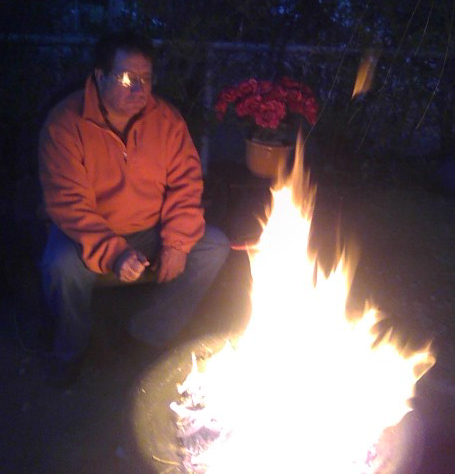
Relaxing by the front yard firepit on a chilly New Mexico evening circa 2013.
I just received word that my short horror story “A Tale of Hell” will be published by Fiction on the Web (www.fictionontheweb.co.uk) on May 24. Please check it out. “A Tale of Hell” is about a man who has a vivid dream of being in hell, but then strange things start to happen. Many thanks to Charlie Fish and all the other staff at Fiction on the Web who made this happen. “A Tale of Hell” was originally published by Midnight Times in 2006.
The blogger hiking in the Bisti Wilderness near Farmington, NM.
I just got the word that the wonderful folks at www.throughthegaps.com will re-print my story “Shapeshifter” in about a week. This is the third of my stories to be published by them in about a month. “Shapeshifter” is about a alleged werewolf sighting in France in 1601 during the height of the werewolf trials. I think it says something about human nature. The story was first published in 2003 by Ascent Magazine (www.ascentaspirations.ca). Please drop by Through the Gaps to add to their site visitation and readership.
“Through the Gaps” (http://throughthegaps.com/art/decision/) has published my short story “Decision” about love and racism in the mountains of 1970’s eastern Kentucky. Many sincere thanks to the “Through the Gaps” staff for re-printing this, one of my favorite and most poignant stories. I love the illustration they chose, which has considerable emotional impact once you have read the story.
This story is definitely literary drama, not horror, but it is one of the first stories I wrote when I started writing and it demonstrates some of my basic principles in writing.
The “Through the Gaps” staff seem to have a real knack for picking illustrations. They did a superb job in picking the illustration for my story “Sudan”, which was published last week and, like the illustration for “Decision”, is particularly poignant once you have read the story.
April 17, 1926: On this day, H.P Lovecraft returned to his home in Providence, Rhode Island after suffering a few years in the “hateful chaos” of Brooklyn. He never moved away again
Portrait of Nikolai Gogol circa 1840 from Wikipedia
This morning I have been going through all the daily updates I have been getting from Goodreads, but have not read. Here’s an interesting one.
“I am fated to journey hand in hand with my strange heroes and to survey the surging immensity of life, to survey it through the laughter that all can see and through the tears unseen and unknown by anyone.” –Nikolai Gogol
Goodreads notes: “Novelist and playwright Nikolai Gogol (born March 31, 1809) feared being buried alive. When his grave was exhumed, his body was lying face down, giving rise to the rumor that the author’s greatest fear had come to pass.” I read some of Gogol’s most famous works as an undergraduate and loved them. I need to re-read them just for the sheer pleasure of reading them. Gogol was an eccentric Russian (though born in the Ukraine) author/satirist of the early nineteenth century and is best known for his unfinished novel “Dead Souls” about a man who travels through the country buying up the dead. He is also known for his short stories, particularly “The Nose” a fantasy about a nose that detaches itself from its owner one day and takes on a life of its own and “The Overcoat”, a story about an impoverished government clerk (copyist, if I recall correctly), whose prize possession is a beautiful overcoat and who comes back from the dead to find it. He was known for being a satirist, rather than a writer of horror, but a few of his most famous works verge on what might be termed ghost stories or fantasy as can be seen above. He is a master author, however, and his works bear checking out no matter what your preferred modern genre is. Wikipedia has this to say about his style:
D.S. Mirsky characterized Gogol’s universe as “one of the most marvellous, unexpected – in the strictest sense, original[28] – worlds ever created by an artist of words.”[29] The other main characteristic of Gogol’s writing is his impressionist vision of reality and people. He saw the outer world romantically metamorphosed, a singular gift particularly evident from the fantastic spatial transformations in his Gothic stories, A Terrible Vengeance and A Bewitched Place. His pictures of nature are strange mounds of detail heaped on detail, resulting in an unconnected chaos of things. His people are caricatures, drawn with the method of the caricaturist – which is to exaggerate salient features and to reduce them to geometrical pattern. But these cartoons have a convincingness, a truthfulness, and inevitability – attained as a rule by slight but definitive strokes of unexpected reality – that seems to beggar the visible world itself.[30] The aspect under which the mature Gogol sees reality is expressed by the Russian word poshlost’, which means something similar to “triviality, banality, inferiority”, moral and spiritual, widespread in some group or society. Like Sterne before him, Gogol was a great destroyer of prohibitions and romantic illusions. It was he who undermined Russian Romanticism by making vulgarity reign where only the sublime and the beautiful had reigned.[31] “Characteristic of Gogol is a sense of boundless superfluity that is soon revealed as utter emptiness and a rich comedy that suddenly turns into metaphysical horror.”[32] His stories often interweave pathos and mockery, while “The Tale of How Ivan Ivanovich Quarreled with Ivan Nikiforovich” begins as a merry farce and ends with the famous dictum, “It is dull in this world, gentlemen!”






 ghthegaps.com/art/decision/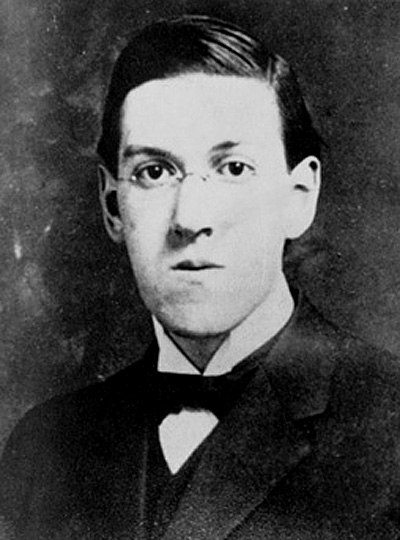

 Phil Slattery, Writer, Publisher