 Source: Bloody Good Writing Volume #5: Writing A Novel In A Month
Another excellent article by Tom Leveen. This one is on the rewarding hard work associated with the challenge of writing 50,000 words in one month.

Source: Bloody Good Writing Volume #5: Writing A Novel In A Month
Another excellent article by Tom Leveen. This one is on the rewarding hard work associated with the challenge of writing 50,000 words in one month.
 On Thursday, December 10, the Farmington Writers Circle had another productive meeting. Attending were myself, Linda Frederick, Yvonne Ravenwood, Vicki Holmsten, Cluff Eliott, Traci Hales-Vass (professor of creative writing at San Juan College), and Roberta Summers, who gave an informal talk on writing professional query letters. The next meeting will be on January 7, at 7:00 p.m. at Hastings Hardback Café, when Traci Hales-Vass will give an informal talk on writing pitches and hooks for novels. The date of the February meeting is yet to be determined, but at that one I will present a talk on establishing a blog.
Roberta, author of Pele’s Realm and judge in the Pike’s Peak Writers Conference, led an excellent discussion on writing a query letter, supported with two excellent examples of a query letter formatted for a letter and of one formatted for e-mail. She also provided a list of informal notes on the basics of writing a query letter, which I have provided here:
Query Letter
Comment: The query letter is a sales tool. If you don’t capture the agent/editor’s attention with it, they will not request pages or your manuscript. Make it the most professional and best writing you do.
Identify the genre, title and word count in the first paragraph.
Spend the next two paragraphs introducing your character and the conflict.
Summarize with a hook.
Next, say something about yourself. Do you have a creative writing degree? Are you published. Be brief.
Last a call to action, such as “My manuscript is complete and available to send upon request.” Then thank them.
A few of my own notes from conversations during the meeting:
It is best to make submissions in January-February, when agents/editors are making plans for the upcoming year; it is worst to submit in November and December.
The timing of your query must be good and you must establish some chemistry with the agent/editor.
A good quote from Roberta Summers that came out during the meeting was “You can write the most magnificent book on the planet, but if you can’t writer a query letter you’re dead in the water.”
Everyone is welcome to attend the next meeting of the Farmington Writers Circle on January 7 at 7:00 pm, which will once again be at the Farmington Hastings Hardback Café. Traci Hales-Vass will lead the discussion on writing pitches and hooks.
Thoughts? Comments?
 Source: Interview: Glenn Rolfe
Follow the link to David Sharp’s interview with Glenn Rolfe at Horror Underground. Interesting article.

Source: His Passing
Here’s a neat little bit of black humor from The Drabble to start your literary day.
 The Farmington Writers Circle will meet tonight, December 10, at 7:00 p.m. at Hastings Hardback Café on 20th Street. The topic of the evening will be query letters and will be led by Roberta Summers, author of Pele’s Realm. The meeting is open to the general public. Feel free to read up on the topic before coming (though this is not required) and contribute to the discussion.
The Farmington Writers Circle is a nascent organization of authors and writers, who are interested in publishing and marketing their works.
Please contact Phil Slattery via this website with any questions or comments.
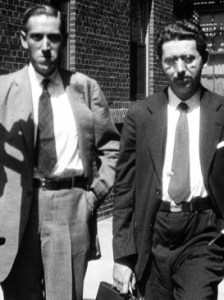
Source: Frank Belknap Long
Here’s a glimpse into the life and works of horror great Frank Belknap Long.
 Source: The Russian Sleep Experiment
Good review of a book that while a good concept, according to the reviewer, could have been carried out better.
 The next meeting of the Farmington Writers Circle will be at 7:00 p.m. on December 10 at Hastings Hardback Café on 20th Street. The topic of the evening will be query letters and will be led by Roberta Summers, author of Pele’s Realm. The meeting is open to the general public. Feel free to read up on the topic before coming (though this is not required) and contribute to the discussion.
The Farmington Writers Circle is a nascent organization of authors and writers, who are interested in publishing and marketing their works.
Please contact Phil Slattery via this website with any questions or comments.
 Source: Top 5 Christmas Horror Novels
Here are five suggestions for either your holiday reading or for Christmas gifts.
from Nouveux Contes Cruels, 1893
(the Gaslight etext)
BELOW the vaults of the Official of Saragossa one night-fall long ago, the venerable Pedro Arbuez d’Espila, sixth Prior of the Dominicans of Segovia, third Grand Inquisitor of Spain–followed by a fra redemptor (master-torturer), and preceded by two familiars of the Holy Office holding lanterns–descended towards a secret dungeon. The lock of a massive door creaked; they entered a stifling in pace, where the little light that came from above revealed an instrument of torture blackened with blood, a chafing-dish, and a pitcher. Fastened to the wall by heavy iron rings, on a mass of filthy straw, secured by fetters, an iron circlet about his neck, sat a man in rags: it was impossible to guess at his age.

This prisoner was no other than Rabbi Aser Abarbanel, a Jew of Aragon, who, on an accusation of usury and pitiless contempt of the poor, had for more than a year undergone daily torture. In spite of all, “his blind obstinacy being as tough as his skin,” he had refused to abjure.
Proud of his descent and his ancestors–for all Jews worthy of the name are jealous of their race–he was descended, according to the Talmud, from Othoniel, and consequently from Ipsiboe, wife of this last Judge of Israel, a circumstance which had sustained his courage under the severest of the incessant tortures.
It was, then, with tears in his eyes at the thought that so stedfast a soul was excluded from salvation, that the venerable Pedro Arbuez d’Espila, approaching the quivering Rabbi, pronounced the following words:–
“My son, be of good cheer; your trials here below are about to cease. If, in presence of such obstinacy, I have had to permit, though with sighs, the employment of severe measures, my task of paternal correction has its limits. You are the barren fig-tree, that, found so oft without fruit, incurs the danger of being dried up by the roots… but it is for God alone to decree concerning your soul. Perhaps the Infinite Mercy will shine upon you at the last moment! Let us hope so. There are instances. May it be so! Sleep, then, this evening in peace. To-morrow you will take part in the auto da fé, that is to say, you will be exposed to the quemadero, the brazier premonitory of the eternal flame. It burns, you are aware, at a certain distance, my son; and death takes, in coming, two hours at least, often three, thanks to the moistened and frozen clothes with which we take care to preserve the forehead and the heart of the holocausts. You will be only forty-three. Consider; then, that, placed in the last rank, you will have the time needful to invoke God, to offer unto Him that baptism of fire which is of the Holy Spirit. Hope, then, in the Light, and sleep.”
As he ended this discourse, Dom Arbuez–who had motioned the wretched man’s fetters to be removed–embraced him tenderly. Then came the turn of the fra redemptor, who, in a low voice, prayed the Jew to pardon what he had made him endure in the effort to redeem him; then the two familiars clasped him in their arms: their kiss, through their cowls, was as unheard. The ceremony at an end, the captive was left alone in the darkness.
Rabbi Aser Abarbanel, his lips parched, his face stupefied by suffering, stared, without any particular attention, at the closed door. Closed? The word, half unknown to himself, awoke a strange delusion in his confused thoughts. He fancied he had seen, for one second, the light of the lanterns through the fissure between the sides of this door. A morbid idea of hope, due to the enfeeblement of his brain, took hold on him. He dragged himself towards this strange thing he had seen; and, slowly inserting a finger, with infinite precautions, into the crack, he pulled the door towards him. Wonder of wonders! By some extraordinary chance the familiar who had closed it had turned the great key a little before it had closed upon its jambs of stone. So, the rusty bolt not having entered its socket, the door rolled back into the cell.
The Rabbi ventured to look out.
By means of a sort of livid obscurity he distinguished, first of all, a half-circle of earthy walls, pierced by spiral stairways, and, opposite to him, five or six stone steps, dominated by a sort of black porch, giving access to a vast corridor, of which he could only see, from below, the nearest arches.
Stretching himself along, he crawled to the level of this threshold. Yes, it was indeed a corridor, but of boundless length. A faint light–a sort of dream-light was cast over it; lamps suspended to the arched roof, turned, by intervals, the wan air blue; the far distance was lost in shadow. Not a door visible along all this length! On one side only, to the left, small holes, covered with a network of bars, let a feeble twilight through the depths of the wall–the light of sunset apparently, for red gleams fell at long intervals on the flag-stones. And how fearful a silence!… Yet there–there in the depths of the dim distance–the way might lead to liberty! The wavering hope of the Jew was dogged, for it was the last.
Without hesitation he ventured forth, keeping close to the side of the light-holes, hoping to render himself indistinguishable from the darksomc colour of the long walls. He advanced slowly, dragging himself along the ground, forcing himself not to cry out when one of his wounds, recently opened, sent a sharp pang through him.
All of a sudden the beat of a sandal, coming in his direction, echoed along the stone passage. A trembling fit seized him, he choked with anguish, his sight grew dim. So this, no doubt, was to be the end! He squeezed himself, doubled upon his hands and knees, into a recess, and half dead with terror, waited.
It was a familiar hurrying along. He passed rapidly, carrying an instrument for tearing out the muscles, his cowl lowered; he disappeared. The violent shock which the Rabbi had received had half suspended the functions of life; he remained for nearly an hour unable to make a single movement. In the fear of an increase of torments if he were caught, the idea came to him of returning to his cell. But the old hope chirped in his soul–the divine “Perhaps,” in the worst of distresses. A miracle had taken place! There was no more room for doubt. He began again to crawl towards the possible escape. Worn out with suffering and with hunger, trembling with anguish, he advanced. The sepulchral corridor seemed to lengthen out mysteriously. And he, never ceasing his slow advance gazed forward through the darkness, on, on, where there must be an outlet that should save him.
But, oh! steps sounding again; steps, this time, slower, more sombre. The forms of two Inquisitors, robed in black and white, and wearing their large hats with rounded brims, etnerged into the faint light. They talked in low voices, and seemed to be in controversy on some important point, for their hands gesticulated.
At this sight Rabbi Aser Abarbanel closed his eyes, his heart beat as if it would kill him, his rags were drenched with the cold sweat of agony; motionless, gasping, he lay stretched along the wall, under the light of one of the lamps–motionless, imploring the God of David.
As they came opposite to him the two Inquisitors stopped under the light of the lamp, through a mere chance, no doubt, in their discussion. One of them, listening to his interlocutor, looked straight at the Rabbi. Under this gaze–of which he did not at first notice the vacant expression–the wretched man seemed to feel the hot pincers biting into his poor flesh so he was again to become a living wound, a living woe! Fainting, scarce able to breathe, his eyelids quivering, he shuddered as the robe grazed him. But strange at once and natural–the eyes of the Inquistor were evidently the eyes of a man profoundly preoccupied with what he was going to say in reply, absorbed by what he was listening to; they were fixed, and seemed to look at the Jew without seeing him.
And indeed, in a few minutes, the two sinister talkers went on their way, slowly, still speaking in low voices, in the direction from which the prisoner had come. They had not seen him! And it was so, that, in the horrible disarray of his sensations, his brain was traversed by this thought: “Am I already dead, so that no one sees me?” A hideous impression drew him from his lethargy. On gazing at the wall, exactly opposite to his face, he fancied he saw, over against his, two ferocious eyes observing him! He flung back his head in a blind and sudden terror; the hair started upright upon his head. But no, no. He put out his hand, and felt along the stones. What he saw was the reflection of the eyes of the Inquisitor still left upon his pupils, and which he had refracted upon two spots of the wall.
Forward! He must hasten towards that end that he imagined (fondly, no doubt) to mean deliverance; towards those shadows from which he was no more than thirty paces, or so, distant. He started once more crawling on hands and knees and stomach–upon his dolorous way, and he was soon within the dark part of the fearful corridor.
All at once the wretched man felt the sensation of cold upon his hands that he placed on the flag-stones; it was a strong current which came from under a little door at the end of the passage. O God, if this door opened on the outer world! The whole being of the poor prisoner was overcome by a sort of vertigo of hope. He examined the door from top to bottom without: being able to distinguish it completely on account of the dimness around him. He felt over it. No lock, not a bolt! A latch! He rose to his feet: the latch yielded beneath his finger; the silent door opened before him.
“Hallelujah!” murrnured the Rabbi, in an immense sigh, as he gazed at what stood revealed to him from the threshold
The door opened upon gardens, under a night of star–upon spring, liberty, life! The gardens gave access to the neighhouring country that stretched away to the sierra!” Those sinuous white lines stood out in profile on the horizon. There lay liberty! Oh, to fly! He would run all night under those woods of citrons, whose perfume intoxicated him. Once among the mountains, he would be saved. He breathed the dear, holy air; the wind re-animated him, his lungs found free play. He heard, in his expanding heart, the “Lazarus, come forth!” And, to give thanks to God who had granted him this mercy, he stretched forth his arms before him, lifting his eyes to the firmament in an ecstasy.
And then he seemed to see the shadow of his arms returning upon himself; he seemed to feel those shadow-arms surround, enlace him, and himself pressed tenderly against some breast. A tall figure, indeed, was opposite to him. Confidently he lowered his eyes upon this figure, and remained gasping, stupefied, with staring eyes and mouth drivelling with fright.
Horror! He was in the arms of the Grand Inquisitor himself, the venerable Pedro Arbuez d’Espila, who gazed at him with eyes full of tears, like a good shepherd who has found the lost sheep.
The sombre priest clasped the wretched Jew against his heart with so fervent a transport of charity that the points of the monacal hair-cloth rasped against the chest of the Dominican. And, while the Rabbi Aser Abarbanel, his eyes convulsed beneath his eyelids, choked with anguish between the arms of the ascetic Dom Arbuez, realising confusedly that all the phases of the fatal evening had been only a calculated torture, that of Hope! the Grand Inquisitor, with a look of distress, an accent of poignant reproach, murmured in his ear, with the burning breath of much fasting:–“What! my child! on the eve, perhaps, of salvation…. you would then leave us?”
 Source: Guest Blog Post: Gothic Collaboration
Gothic horror lovers: Check out this interesting article on The Ghosts of Ravencrest, a new Gothic work.
The next meeting of the Farmington Writers Circle will be at 7:00 p.m. on December 10 at Hastings Hardback Café on 20th Street. The topic of the evening will be query letters and will be led by Roberta Summers, author of Pele’s Realm. The meeting is open to the general public. Feel free to read up on the topic before coming (though this is not required) and contribute to the discussion.
The Farmington Writers Circle is a nascent organization of authors and writers, who are interested in publishing and marketing their works.
Please contact Phil Slattery via this website with any questions or comments.
 Source: With your heart fixed on the Supreme Lord: Foreword, issue the 11th
Do not judge this article by its title; it’s not what you expect. Check out this neat article from The Stockholm Review of Literature on publication, rejection, and J.D. Salinger (pictured).
Thoughts? Comments?
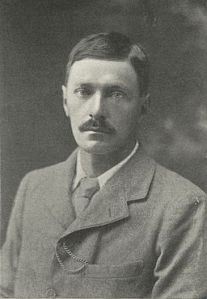
Source: 13 Haunting Tales by E.F. Benson
Follow the link to a selection of horror works by horror master E.F. Benson.

Source: “AT LORN HALL” BY RAMSEY CAMPBELL
Good story by one of the current masters of horror.
 Phil Slattery, Writer, Publisher