If you haven’t heard, LinkedIn is a powerful marketing and networking tool. It offers a lot of opportunities for writers of all calibers and in all industries.
You can be starting your own business or be self-employed for numerous years. You can be a multi-published author writing fiction or non-fiction; long or short. You can be any type of writer with any level of experience and benefit from the power of LinkedIn to find jobs, connections, and resources. Resources that can gain you new clients and help you improve your craft.
I posted about Getting Started with LinkedIn a few months ago. Check that post if you haven’t delved into LinkedIn yet.
Your profile is a powerful marketing tool. Make sure you have it as complete and relevant as possible — to the type of work you are seeking, skills you can offer, and connections you want to make. (Avoid diluting it…
I’ve neglected this blog, the antho (off and on), writing, and other things for the past couple of weeks. Work. Busy. Timing. That stuff. Not as many students this term thanks to a schedule that mainly consists of 12 week classes and two of them in the afternoon (NOTE: afternoon classes aren’t particularly popular when the local Chick Fil-A — or fill in the blank with other appropriate regional chain saturated in its own religopolitics — isn’t that far from school).
I’ve still managed to keep apprised of a few things and am quickly learning more about my aging self than I could ever expect:
The Walking Dead — I’m enjoying its parallel to the comic once again. Hey, I don’t mind when it strays from its original source material, but I don’t have time to think about originality right now, and I…
I WAS SITTING on the porch when my grandfather hobbled out and sank down on his favorite chair with the cushioned seat, and began to stuff tobacco in his old corncob-pipe.
“I thought you’d be goin’ to the dance,” he said.
“I’m waiting for Doc Blaine,” I answered. “I’m going over to old man Garfield’s with him.”
My grandfather sucked at his pipe awhile before he spoke again.
“Old Jim purty bad off?”
“Doc says he hasn’t a chance.”
“Who’s takin’ care of him?”
“Joe Braxton—against Garfield’s wishes. But somebody had to stay with him.”
My grandfather sucked his pipe noisily, and watched the heat lightning playing away off up in the hills; then he said: “You think old Jim’s the biggest liar in this county, don’t you?”
“He tells some pretty tall tales,” I admitted. “Some of the things he claimed he took part in, must have happened before he was born.”
“I came from Tennesee to Texas in 1870,” my grandfather said abruptly. “I saw this town of Lost Knob grow up from nothin’. There wasn’t even a log-hut store here when I came. But old Jim Garfield was here, livin’ in the same place he lives now, only then it was a log cabin. He don’t look a day older now than he did the first time I saw him.”
“You never mentioned that before,” I said in some surprise.
“I knew you’d put it down to an old man’s maunderin’s,” he answered. “Old Jim was the first white man to settle in this country. He built his cabin a good fifty miles west of the frontier. God knows how he done it, for these hills swarmed with Comanches then.
“I remember the first time I ever saw him. Even then everybody called him ‘old Jim.’
“I remember him tellin’ me the same tales he’s told you—how he was at the battle of San Jacinto when he was a youngster, and how he’d rode with Ewen Cameron and Jack Hayes. Only I believe him, and you don’t.”
“That was so long ago—” I protested.
Robert E. Howard Date unknown
“The last Indian raid through this country was in 1874,” said my grandfather, engrossed in his own reminiscences. “I was in on that fight, and so was old Jim. I saw him knock old Yellow Tail off his mustang at seven hundred yards with a buffalo rifle.
“But before that I was with him in a fight up near the head of Locust Creek. A band of Comanches came down Mesquital, lootin’ and burnin’, rode through the hills and started back up Locust Creek, and a scout of us were hot on their heels. We ran on to them just at sundown in a mesquite flat. We killed seven of them, and the rest skinned out through the brush on foot. But three of our boys were killed, and Jim Garfield got a thrust in the breast with a lance.
“It was an awful wound. He lay like a dead man, and it seemed sure nobody could live after a wound like that. But an old Indian came out of the brush, and when we aimed our guns at him, he made the peace sign and spoke to us in Spanish. I don’t know why the boys didn’t shoot him in his tracks, because our blood was heated with the fightin’ and killin’, but somethin’ about him made us hold our fire. He said he wasn’t a Comanche, but was an old friend of Garfield’s, and wanted to help him. He asked us to carry Jim into a clump of mesquite, and leave him alone with him, and to this day I don’t know why we did, but we did. It was an awful time—the wounded moanin’ and callin’ for water, the starin’ corpses strewn about the camp, night comin’ on, and no way of knowin’ that the Indians wouldn’t return when dark fell.
“We made camp right there, because the horses were fagged out, and we watched all night, but the Comanches didn’t come back. I don’t know what went on out in the mesquite where Jim Garfield’s body lay, because I never saw that strange Indian again; but durin’ the night I kept hearin’ a weird moanin’ that wasn’t made by the dyin’ men, and an owl hooted from midnight till dawn.
“And at sunrise Jim Garfield came walkin’ out of the mesquite, pale and haggard, but alive, and already the wound in his breast had closed and begun to heal. And since then he’s never mentioned that wound, nor that fight, nor the strange Indian who came and went so mysteriously. And he hasn’t aged a bit; he looks now just like he did then—a man of about fifty.”
In the silence that followed, a car began to purr down the road, and twin shafts of light cut through the dusk.
“That’s Doc Blaine,” I said. “When I come back I’ll tell you how Garfield is.”
Doc Blaine was prompt with his predictions as we drove the three miles of post-oak covered hills that lay between Lost Knob and the Garfield farm.
“I’ll be surprised to find him alive,” he said, “smashed up like he is. A man his age ought to have more sense than to try to break a young horse.”
“He doesn’t look so old,” I remarked.
“I’ll be fifty, my next birthday,” answered Doc Blaine. “I’ve known him all my life, and he must have been at least fifty the first time I ever saw him. His looks are deceiving.”
Old Garfield’s dwelling-place was reminiscent of the past. The boards of the low squat house had never known paint. Orchard fence and corrals were built of rails.
Old Jim lay on his rude bed, tended crudely but efficiently by the man Doc Blaine had hired over the old man’s protests. As I looked at him, I was impressed anew by his evident vitality. His frame was stooped but unwithered, his limbs rounded out with springy muscles. In his corded neck and in his face, drawn though it was with suffering, was apparent an innate virility. His eyes, though partly glazed with pain, burned with the same unquenchable element.
“He’s been ravin’,” said Joe Braxton stolidly.
“First white man in this country,” muttered old Jim, becoming intelligible. “Hills no white man ever set foot in before. Gettin’ too old. Have to settle down. Can’t move on like I used to. Settle down here. Good country before it filled up with cow-men and squatters. Wish Ewen Cameron could see this country. The Mexicans shot him. Damn ’em!”
Doc Blaine shook his head. “He’s all smashed up inside. He won’t live till daylight.”
Garfield unexpectedly lifted his head and looked at us with clear eyes.
“Wrong, Doc,” he wheezed, his breath whistling with pain. “I’ll live. What’s broken bones and twisted guts? Nothin’! It’s the heart that counts. Long as the heart keeps pumpin’, a man can’t die. My heart’s sound. Listen to it! Feel of it!”
He groped painfully for Doc Blaine’s wrist, dragged his hand to his bosom and held it there, staring up into the doctor’s face with avid intensity.
“Regular dynamo, ain’t it?” he gasped. “Stronger’n a gasoline engine!”
Blaine beckoned me. “Lay your hand here,” he said, placing my hand on the old man’s bare breast. “He does have a remarkable heart action.”
I noted, in the light of the coal-oil lamp, a great livid scar in the gaunt arching breast—such a scar as might be made by a flint-headed spear. I laid my hand directly on this scar, and an exclamation escaped my lips.
Under my hand old Jim Garfield’s heart pulsed, but its throb was like no other heart action I have ever observed. Its power was astounding; his ribs vibrated to its steady throb. It felt more like the vibrating of a dynamo than the action of a human organ. I could feel its amazing vitality radiating from his breast, stealing up into my hand and up my arm, until my own heart seemed to speed up in response.
“I can’t die,” old Jim gasped. “Not so long as my heart’s in my breast. Only a bullet through the brain can kill me. And even then I wouldn’t be rightly dead, as long as my heart beats in my breast. Yet it ain’t rightly mine, either. It belongs to Ghost Man, the Lipan chief. It was the heart of a god the Lipans worshipped before the Comanches drove ’em out of their native hills.
“I knew Ghost Man down on the Rio Grande, when I was with Ewen Cameron. I saved his life from the Mexicans once. He tied the string of ghost wampum between him and me—the wampum no man but me and him can see or feel. He came when he knowed I needed him, in that fight up on the headwaters of Locust Creek, when I got this scar.
“I was dead as a man can be. My heart was sliced in two, like the heart of a butchered beef steer.
“All night Ghost Man did magic, callin’ my ghost back from spirit-land. I remember that flight, a little. It was dark, and gray-like, and I drifted through gray mists and heard the dead wailin’ past me in the mist. But Ghost Man brought me back.
“He took out what was left of my mortal heart, and put the heart of the god in my bosom. But it’s his, and when I’m through with it, he’ll come for it. It’s kept me alive and strong for the lifetime of a man. Age can’t touch me. What do I care if these fools around here call me an old liar? What I know, I know. But hark’ee!”
His fingers became claws, clamping fiercely on Doc Blaine’s wrist. His old eyes, old yet strangely young, burned fierce as those of an eagle under his bushy brows.
“If by some mischance I should die, now or later, promise me this! Cut into my bosom and take out the heart Ghost Man lent me so long ago! It’s his. And as long as it beats in my body, my spirit’ll be tied to that body, though my head be crushed like an egg underfoot! A livin’ thing in a rottin’ body! Promise!”
“All right, I promise,” replied Doc Blaine, to humor him, and old Jim Garfield sank back with a whistling sigh of relief.
He did not die that night, nor the next, nor the next. I well remember the next day, because it was that day that I had the fight with Jack Kirby.
People will take a good deal from a bully, rather than to spill blood. Because nobody had gone to the trouble of killing him, Kirby thought the whole countryside was afraid of him.
He had bought a steer from my father, and when my father went to collect for it, Kirby told him that he had paid the money to me—which was a lie. I went looking for Kirby, and came upon him in a bootleg joint, boasting of his toughness, and telling the crowd that he was going to beat me up and make me say that he had paid me the money, and that I had stuck it into my own pocket. When I heard him say that, I saw red, and ran in on him with a stockman’s knife, and cut him across the face, and in the neck, side, breast and belly, and the only thing that saved his life was the fact that the crowd pulled me off.
There was a preliminary hearing, and I was indicted on a charge of assault, and my trial was set for the following term of court. Kirby was as tough-fibered as a post-oak country bully ought to be, and he recovered, swearing vengeance, for he was vain of his looks, though God knows why, and I had permanently impaired them.
And while Jack Kirby was recovering, old man Garfield recovered too, to the amazement of everybody, especially Doc Blaine.
I well remember the night Doc Blaine took me again out to old Jim Garfield’s farm. I was in Shifty Corlan’s joint, trying to drink enough of the slop he called beer to get a kick out of it, when Doc Blaine came in and persuaded me to go with him.
As we drove along the winding old road in Doc’s car, I asked: “Why are you insistent that I go with you this particular night? This isn’t a professional call, is it?”
“No,” he said. “You couldn’t kill old Jim with a post-oak maul. He’s completely recovered from injuries that ought to have killed an ox. To tell the truth, Jack Kirby is in Lost Knob, swearing he’ll shoot you on sight.”
“Well, for God’s sake!” I exclaimed angrily. “Now everybody’ll think I left town because I was afraid of him. Turn around and take me back, damn it!”
“Be reasonable,” said Doc. “Everybody knows you’re not afraid of Kirby. Nobody’s afraid of him now. His bluff’s broken, and that’s why he’s so wild against you. But you can’t afford to have any more trouble with him now, and your trial only a short time off.”
I laughed and said: “Well, if he’s looking for me hard enough, he can find me as easily at old Garfield’s as in town, because Shifty Corlan heard you say where we were going. And Shifty’s hated me ever since I skinned him in that horse-swap last fall. He’ll tell Kirby where I went.”
“I never thought of that,” said Doc Blaine, worried.
“Hell, forget it,” I advised. “Kirby hasn’t got guts enough to do anything but blow.”
But I was mistaken. Puncture a bully’s vanity and you touch his one vital spot.
Old Jim had not gone to bed when we got there. He was sitting in the room opening on to his sagging porch, the room which was at once living-room and bedroom, smoking his old cob pipe and trying to read a newspaper by the light of his coal-oil lamp. All the windows and doors were wide open for the coolness, and the insects which swarmed in and fluttered around the lamp didn’t seem to bother him.
We sat down and discussed the weather—which isn’t so inane as one might suppose, in a country where men’s livelihood depends on sun and rain, and is at the mercy of wind and drouth. The talk drifted into other kindred channels, and after some time, Doc Blaine bluntly spoke of something that hung in his mind.
“Jim,” he said, “that night I thought you were dying, you babbled a lot of stuff about your heart, and an Indian who lent you his. How much of that was delirium?”
“None, Doc,” said Garfield, pulling at his pipe. “It was gospel truth. Ghost Man, the Lipan priest of the Gods of Night, replaced my dead, torn heart with one from somethin’ he worshipped. I ain’t sure myself just what that somethin’ is—somethin’ from away back and a long way off, he said. But bein’ a god, it can do without its heart for awhile. But when I die—if I ever get my head smashed so my consciousness is destroyed—the heart must be given back to Ghost Man.”
“You mean you were in earnest about cutting out your heart?” demanded Doc Blaine.
“It has to be,” answered old Garfield. “A livin’ thing in a dead thing is opposed to nat’er. That’s what Ghost Man said.”
“Who the devil was Ghost Man?”
“I told you. A witch-doctor of the Lipans, who dwelt in this country before the Comanches came down from the Staked Plains and drove ’em south across the Rio Grande. I was a friend to ’em. I reckon Ghost Man is the only one left alive.”
“Alive? Now?”
“I dunno,” confessed old Jim. “I dunno whether he’s alive or dead. I dunno whether he was alive when he came to me after the fight on Locust Creek, or even if he was alive when I knowed him in the southern country. Alive as we understand life, I mean.”
“What balderdash is this?” demanded Doc Blaine uneasily, and I felt a slight stirring in my hair. Outside was stillness, and the stars, and the black shadows of the post-oak woods. The lamp cast old Garfield’s shadow grotesquely on the wall, so that it did not at all resemble that of a human, and his words were strange as words heard in a nightmare.
“I knowed you wouldn’t understand,” said old Jim. “I don’t understand myself, and I ain’t got the words to explain them things I feel and know without understandin’. The Lipans were kin to the Apaches, and the Apaches learnt curious things from the Pueblos. Ghost Man was—that’s all I can say—alive or dead, I don’t know, but he was. What’s more, he is.”
“Is it you or me that’s crazy?” asked Doc Blaine.
“Well,” said old Jim, “I’ll tell you this much—Ghost Man knew Coronado.”
“Crazy as a loon!” murmured Doc Blaine. Then he lifted his head. “What’s that?”
“Horse turning in from the road,” I said. “Sounds like it stopped.”
I stepped to the door, like a fool, and stood etched in the light behind me. I got a glimpse of a shadowy bulk I knew to be a man on a horse; then Doc Blaine yelled: “Look out!” and threw himself against me, knocking us both sprawling. At the same instant I heard the smashing report of a rifle, and old Garfield grunted and fell heavily.
I scrambled up, hearing the clatter of retreating hoofs, snatched old Jim’s shotgun from the wall, rushed recklessly out on to the sagging porch and let go both barrels at the fleeing shape, dim in the starlight. The charge was too light to kill at that range, but the bird-shot stung the horse and maddened him. He swerved, crashed headlong through a rail fence and charged across the orchard, and a peach tree limb knocked his rider out of the saddle. He never moved after he hit the ground. I ran out there and looked down at him. It was Jack Kirby, right enough, and his neck was broken like a rotten branch.
I let him lie, and ran back to the house. Doc Blaine had stretched old Garfield out on a bench he’d dragged in from the porch, and Doc’s face was whiter than I’d ever seen it. Old Jim was a ghastly sight; he had been shot with an old-fashioned .45-70, and at that range the heavy ball had literally torn off the top of his head. His features were masked with blood and brains. He had been directly behind me, poor old devil, and he had stopped the slug meant for me.
Doc Blaine was trembling, though he was anything but a stranger to such sights.
“Would you pronounce him dead?” he asked.
“That’s for you to say.” I answered. “But even a fool could tell that he’s dead.
“He is dead,” said Doc Blaine in a strained unnatural voice. “Rigor mortis is already setting in. But feel his heart!”
I did, and cried out. The flesh was already cold and clammy; but beneath it that mysterious heart still hammered steadily away, like a dynamo in a deserted house. No blood coursed through those veins; yet the heart pounded, pounded, pounded, like the pulse of Eternity.
“A living thing in a dead thing,” whispered Doc Blaine, cold sweat on his face. “This is opposed to nature. I am going to keep the promise I made him. I’ll assume full responsibility. This is too monstrous to ignore.”
Our implements were a butcher-knife and a hack-saw. Outside only the still stars looked down on the black post-oak shadows and the dead man that lay in the orchard. Inside, the old lamp flickered, making strange shadows move and shiver and cringe in the corners, and glistened on the blood on the floor, and the red-dabbled figure on the bench. The only sound inside was the crunch of the saw-edge in bone; outside an owl began to hoot weirdly.
Doc Blaine thrust a red-stained hand into the aperture he had made, and drew out a red, pulsing object that caught the lamplight. With a choked cry he recoiled, and the thing slipped from his fingers and fell on the table. And I too cried out involuntarily. For it did not fall with a soft meaty thud, as a piece of flesh should fall. It thumped hard on the table.
Impelled by an irresistible urge, I bent and gingerly picked up old Garfield’s heart. The feel of it was brittle, unyielding, like steel or stone, but smoother than either. In size and shape it was the duplicate of a human heart, but it was slick and smooth, and its crimson surface reflected the lamplight like a jewel more lambent than any ruby; and in my hand it still throbbed mightily, sending vibratory radiations of energy up my arm until my own heart seemed swelling and bursting in response. It was cosmic power, beyond my comprehension, concentrated into the likeness of a human heart.
The thought came to me that here was a dynamo of life, the nearest approach to immortality that is possible for the destructible human body, the materialization of a cosmic secret more wonderful than the fabulous fountain sought for by Ponce de Leon. My soul was drawn into that unterrestrial gleam, and I suddenly wished passionately that it hammered and thundered in my own bosom in place of my paltry heart of tissue and muscle.
Doc Blaine ejaculated incoherently. I wheeled.
The noise of his coming had been no greater than the whispering of a night wind through the corn. There in the doorway he stood, tall, dark, inscrutable—an Indian warrior, in the paint, war bonnet, breech-clout and moccasins of an elder age. His dark eyes burned like fires gleaming deep under fathomless black lakes. Silently he extended his hand, and I dropped Jim Garfield’s heart into it. Then without a word he turned and stalked into the night. But when Doc Blaine and I rushed out into the yard an instant later, there was no sign of any human being. He had vanished like a phantom of the night, and only something that looked like an owl was flying, dwindling from sight, into the rising moon.
###
“Old Garfield’s Heart” was first published in Weird Tales in December, 1933.
This eBook is made available at no cost and with almost no restrictions whatsoever. You may copy it, give it away or re-use it under the terms of the Project Gutenberg of Australia License which may be viewed online at http://gutenberg.net.au/licence.html. To contact Project Gutenberg of Australia go to http://gutenberg.net.au
The luminescent moon shone brightly through the clouds as I descended my usual mountain path. When finally, the moon was admitted a gasp of air from the clouds, a ring of white light formed around it, and reverberated so viciously that my eyes became strained. My head pounded as brutally as the pulsations.
My evening strolls to the wooded top was a nightly adventure, and it was not until as of late that the trip had actually become adventurous. Prior to the past few weeks my late walks were nothing more than routine. After dinner, Edgar – my seven-year-old Weimaraner, a retired hunting dog – and I would head into the mountain’s path, blanketed by conifers and limber pines. The entrance to the woods was decorated with a few weeping willows that were now fading as the…
I was on the run. From her and my old life. I landed up in a rather grimy hotel on the Norfolk coast. Booking a coach trip with an outfit called ‘Pioneer’ (that was me now), I requested a wake up call, hit the bar and then bed.
The phone rang, “It’s time Sir.”
“Huh?”
“Your time Sir. It’s come.”
Disorientated, I staggered up, tripped and fell into the carpet’s embrace. To stay.
Emerging at dinner the receptionist apologized; she’d forgotten to ring.
Unconcerned, I took the local rag from her and read ‘Pioneer Coach Crash on A11, 5 Dead.’
By Andrea Jarrell After 30 years of sitting at a desk, making my living as a writer, I truly appreciate how physical writing is: pushing pen across paper, fingers tapping a keyboard, the trapezius …
For strange people like me who are both Horror addicts and Regency fans, the movie Pride and Prejudice and Zombies is the perfect mix of gore, tradition, and humor.
To benefit those of you who have been under a rock, I will explain. This movie is based on the Pride and Prejudice and Zombies book series written first by Seth Grahame-Smith and improved upon by Steve Hockensmith. In its most basic description, it takes the original Jane Austen tale and ultimately inserts zombies, but it’s so much more than that. The lore behind the Bennett sisters and the rest of their relations has been “punked” zombie-style. Instead of the Bennett sisters being looked down upon because of money or poor relations, they are chastised by one set for being trained in martial arts in the Chinese style (vs. Mr. Darcy and the Japanese tradition) and by another set, they are…
OF course I shall not pretend to consider it any matter for wonder, that the extraordinary case of M. Valdemar has excited discussion. It would have been a miracle had it not — especially under the circumstances. Through the desire of all parties concerned, to keep the affair from the public, at least for the present, or until we had farther opportunities for investigation — through our endeavors to effect this — a garbled or exaggerated account made its way into society, and became the source of many unpleasant misrepresentations; and, very naturally, of a great deal of disbelief.
It is now rendered necessary that I give the facts — as far as I comprehend them myself. They are, succinctly, these:
My attention, for the last three years, had been repeatedly drawn to the subject of Mesmerism; and, about nine months ago, it occurred to me, quite suddenly, that in the series of experiments made hitherto, there had been a very remarkable and most unaccountable omission: — no person had as yet been mesmerized in articulo mortis. It remained to be seen, first, whether, in such condition, there existed in the patient any susceptibility to the magnetic influence; secondly, whether, if any existed, it was impaired or increased by the condition; thirdly, to what extent, or for how long a period, the encroachments of Death might be arrested by the process. There were other points to be ascertained, but these most excited my curiosity — the last in especial, from the immensely important character of its consequences.
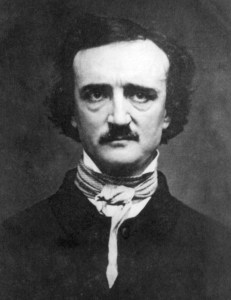
Edgar Allan Poe, 1848
In looking around me for some subject by whose means I might test these particulars, I was brought to think of my friend, M. Ernest Valdemar, the well-known compiler of the “Bibliotheca Forensica,” and author (under the nom de plume of Issachar Marx) of the Polish versions of “Wallenstein” and “Gargantua.” M. Valdemar, who has resided principally at Harlem, N. Y., since the year 1839, is (or was) particularly noticeable for the extreme spareness of his person — his lower limbs much resembling those of John Randolph; and, also, for the whiteness of his whiskers, in violent contrast to the blackness of his hair — the latter, in consequence, being very generally mistaken for a wig. His temperament was markedly nervous, and rendered him a good subject for mesmeric experiment. On two or three occasions I had put him to sleep with little difficulty, but was disappointed in other results which his peculiar constitution had naturally led me to anticipate. His will was at no period positively, or thoroughly, under my control, and in regard to clairvoyance, I could accomplish with him nothing to be relied upon. I always attributed my failure at these points to the disordered state of his health. For some months previous to my becoming acquainted with him, his physicians had declared him in a confirmed phthisis. It was his custom, indeed, to speak calmly of his approaching dissolution, as of a matter neither to be avoided nor regretted.
When the ideas to which I have alluded first occurred to me, it was of course very natural that I should think of M. Valdemar. I knew the steady philosophy of the man too well to apprehend any scruples from him; and he had no relatives in America who would be likely to interfere. I spoke to him frankly upon the subject; and, to my surprise, his interest seemed vividly excited. I say to my surprise; for, although he had always yielded his person freely to my experiments, he had never before given me any tokens of sympathy with what I did. His disease was of that character which would admit of exact calculation in respect to the epoch of its termination in death; and it was finally arranged between us that he would send for me about twenty-four hours before the period announced by his physicians as that of his decease.
It is now rather more than seven months since I received, from M. Valdemar himself, the subjoined note:
“MY DEAR P——,
“You may as well come now. D—— and F—— are agreed that I cannot hold out beyond to-morrow midnight; and I think they have hit the time very nearly.
“VALDEMAR.”
I received this note within half an hour after it was written, and in fifteen minutes more I was in the dying man’s chamber. I had not seen him for ten days, and was appalled by the fearful alteration which the brief interval had wrought in him. His face wore a leaden hue; the eyes were utterly lustreless; and the emaciation was so extreme, that the skin had been broken through by the cheek-bones. His expectoration was excessive. The pulse was barely perceptible. He retained, nevertheless, in a very remarkable manner, both his mental power and a certain degree of physical strength. He spoke with distinctness — took some palliative medicines without aid — and, when I entered the room, was occupied in penciling memoranda in a pocket-book. He was propped up in the bed by pillows. Doctors D—— and F—— were in attendance.
After pressing Valdemar’s hand, I took these gentlemen aside, and obtained from them a minute account of the patient’s condition. The left lung had been for eighteen months in a semi-osseous or cartilaginous state, and was, of course, entirely useless for all purposes of vitality. The right, in its upper portion, was also partially, if not thoroughly, ossified, while the lower region was merely a mass of purulent tubercles, running one into another. Several extensive perforations existed; and, at one point, permanent adhesion to the ribs had taken place. These appearances in the right lobe were of comparatively recent date. The ossification had proceeded with very unusual rapidity; no sign of it had been discovered a month before, and the adhesion had only been observed during the three previous days. Independently of the phthisis, the patient was suspected of aneurism of the aorta; but on this point the osseous symptoms rendered an exact diagnosis impossible. It was the opinion of both physicians that M. Valdemar would die about midnight on the morrow (Sunday.) It was then seven o’clock on Saturday evening.
On quitting the invalid’s bed-side to hold conversation with myself, Doctors D—— and F —— had bidden him a final farewell. It had not been their intention to return; but, at my request, they agreed to look in upon the patient about ten the next night.
When they had gone, I spoke freely with M. Valdemar on the subject of his approaching dissolution, as well as, more particularly, of the experiment proposed. He still professed himself quite willing and even anxious to have it made, and urged me to commence it at once. A male and a female nurse were in attendance; but I did not feel myself altogether at liberty to engage in a task of this character with no more reliable witnesses than these people, in case of sudden accident, might prove. I therefore postponed operations until about eight the next night, when the arrival of a medical student, with whom I had some acquaintance, (Mr. Theodore L —— l,) relieved me from farther embarrassment. It had been my design, originally, to wait for the physicians; but I was induced to proceed, first, by the urgent entreaties of M. Valdemar, and secondly, by my conviction that I had not a moment to lose, as he was evidently sinking fast.
Mr. L —— l was so kind as to accede to my desire that he would take notes of all that occurred; and it is from his memoranda that what I now have to relate is, for the most part, either condensed or copied verbatim.
It wanted about five minutes of eight when, taking the patient’s hand, I begged him to state, as distinctly as he could, to Mr. L —— l, whether he (M. Valdemar,) was entirely willing that I should make the experiment of mesmerizing him in his then condition.
He replied feebly, yet quite audibly, “Yes, I wish to be mesmerized” — adding immediately afterwards, “I fear you have deferred it too long.”
While he spoke thus, I commenced the passes which I had already found most effectual in subduing him. He was evidently influenced with the first lateral stroke of my hand across his forehead; but although I exerted all my powers, no farther perceptible effect was induced until some minutes after ten o’clock, when Doctors D—— and F—— called, according to appointment. I explained to them, in a few words, what I designed, and as they opposed no objection, saying that the patient was already in the death agony, I proceeded without hesitation — exchanging, however, the lateral passes for downward ones, and directing my gaze entirely into the right eye of the sufferer.
By this time his pulse was imperceptible and his breathing was stertorious, and at intervals of half a minute.
This condition was nearly unaltered for a quarter of an hour. At the expiration of this period, however, a natural although a very deep sigh escaped the bosom of the dying man, and the stertorious breathing ceased — that is to say, its stertoriousness was no longer apparent; the intervals were undiminished. The patient’s extremities were of an icy coldness.
At five minutes before eleven, I perceived unequivocal signs of the mesmeric influence. The glassy roll of the eye was changed for that expression of uneasy inward examination which is never seen except in cases of sleep-waking, and which it is quite impossible to mistake. With a few rapid lateral passes I made the lids quiver, as in incipient sleep, and with a few more I closed them altogether. I was not satisfied, however, with this, but continued the manipulations vigorously, and with the fullest exertion of the will, until I had completely stiffened the limbs of the slumberer, after placing them in a seemingly easy position. The legs were at full length; the arms were nearly so, and reposed on the bed at a moderate distance from the loins. The head was very slightly elevated.
When I had accomplished this, it was fully midnight, and I requested the gentlemen present to examine M. Valdemar’s condition. After a few experiments, they admitted him to be in an unusually perfect state of mesmeric trance. The curiosity of both the physicians was greatly excited. Dr. D—— resolved at once to remain with the patient all night, while Dr. F—— took leave with a promise to return at daybreak. Mr. L —— l and the nurses remained.
We left M. Valdemar entirely undisturbed until about three o’clock in the morning, when I approached him and found him in precisely the same condition as when Dr. F—— went away — that is to say, he lay in the same position; the pulse was imperceptible; the breathing was gentle (scarcely noticeable, unless through the application of a mirror to the lips;) the eyes were closed naturally; and the limbs were as rigid and as cold as marble. Still, the general appearance was certainly not that of death.
As I approached M. Valdemar I made a kind of half effort to influence his right arm into pursuit of my own, as I passed the latter gently to and fro above his person. In such experiments with this patient, I had never perfectly succeeded before, and assuredly I had little thought of succeeding now; but to my astonishment, his arm very readily, although feebly, followed every direction I assigned it with mine. I determined to hazard a few words of conversation.
“M. Valdemar,” I said, “are you asleep?” He made no answer, but I perceived a tremor about the lips, and was thus induced to repeat the question, again and again. At its third repetition, his whole frame was agitated by a very slight shivering; the eye-lids unclosed themselves so far as to display a white line of a ball; the lips moved sluggishly, and from between them, in a barely audible whisper, issued the words:
“Yes; — asleep now. Do not wake me! — let me die so!”
I here felt the limbs and found them as rigid as ever. The right arm, as before, obeyed the direction of my hand. I questioned the sleep-waker again:
“Do you still feel pain in the breast, M. Valdemar?”
The answer now was immediate, but even less audible than before:
“No pain — I am dying.”
I did not think it advisable to disturb him farther just then, and nothing more was said or done until the arrival of Dr. F—— , who came a little before sunrise, and expressed unbounded astonishment at finding the patient still alive. After feeling the pulse and applying a mirror to the lips, he requested me to speak to the sleep-waker again. I did so, saying:
“M. Valdemar, do you still sleep?”
As before, some minutes elapsed ere a reply was made; and during the interval the dying man seemed to be collecting his energies to speak. At my fourth repetition of the question, he said very faintly, almost inaudibly:
“Yes; still asleep — dying.”
It was now the opinion, or rather the wish, of the physicians, that M. Valdemar should be suffered to remain undisturbed in his present apparently tranquil condition, until death should supervene — and this, it was generally agreed, must now take place within a few minutes. I concluded, however, to speak to him once more, and merely repeated my previous question.
While I spoke, there came a marked change over the countenance of the sleep-waker. The eyes rolled themselves slowly open, the pupils disappearing upwardly; the skin generally assumed a cadaverous hue, resembling not so much parchment as white paper; and the circular hectic spots which, hitherto, had been strongly defined in the centre of each cheek, went out at once. I use this expression, because the suddenness of their departure put me in mind of nothing so much as the extinguishment of a candle by a puff of the breath. The upper lip, at the same time, writhed itself away from the teeth, which it had previously covered completely; while the lower jaw fell with an audible jerk, leaving the mouth widely extended, and disclosing in full view the swollen and blackened tongue. I presume that no member of the party then present had been unaccustomed to death-bed horrors; but so hideous beyond conception was the appearance of M. Valdemar at this moment, that there was a general shrinking back from the region of the bed.
I now feel that I have reached a point of this narrative at which every reader will be startled into positive disbelief. It is my business, however, simply to proceed.
There was no longer the faintest sign of vitality in M. Valdemar; and concluding him to be dead, we were consigning him to the charge of the nurses, when a strong vibratory motion was observable in the tongue. This continued for perhaps a minute. At the expiration of this period, there issued from the distended and motionless jaws a voice — such as it would be madness in me to attempt describing. There are, indeed, two or three epithets which might be considered as applicable to it in part; I might say, for example, that the sound was harsh, and broken and hollow; but the hideous whole is indescribable, for the simple reason that no similar sounds have ever jarred upon the ear of humanity. There were two particulars, nevertheless, which I thought then, and still think, might fairly be stated as characteristic of the intonation — as well adapted to convey some idea of its unearthly peculiarity. In the first place, the voice seemed to reach our ears — at least mine — from a vast distance, or from some deep cavern within the earth. In the second place, it impressed me (I fear, indeed, that it will be impossible to make myself comprehended) as gelatinous or glutinous matters impress the sense of touch.
I have spoken both of “sound” and of “voice.” I mean to say that the sound was one of distinct — of even wonderfully, thrillingly distinct — syllibification. M. Valdemar spoke — obviously in reply to the question I had propounded to him a few minutes before. I had asked him, it will be remembered, if he still slept. He now said:
“Yes; — no; — I have been sleeping — and now — now — I am dead.”
No person present even affected to deny, or attempted to repress, the unutterable, shuddering horror which these few words, thus uttered, were so well calculated to convey. Mr. L —— l (the student) swooned. The nurses immediately left the chamber, and could not be induced to return. My own impressions I would not pretend to render intelligible to the reader. For nearly an hour, we busied ourselves, silently — without the utterance of a word — in endeavors to revive Mr. L —— l. When he came to himself, we addressed ourselves again to an investigation of M. Valdemar’s condition.
It remained in all respects as I have last described it, with the exception that the mirror no longer afforded evidence of respiration. An attempt to draw blood from the arm failed. I should mention, too, that this limb was no farther subject to my will. I endeavored in vain to make it follow the direction of my hand. The only real indication, indeed, of the mesmeric influence, was now found in the vibratory movement of the tongue, whenever I addressed M. Valdemar a question. He seemed to be making an effort to reply, but had no longer sufficient volition. To queries put to him by any other person than myself he seemed utterly insensible — although I endeavored to place each member of the company in mesmeric rapport with him. I believe that I have now related all that is necessary to an understanding of the sleep-waker’s state at this epoch. Other nurses were procured; and at ten o’clock I left the house in company with the two physicians and Mr. L —— l.
In the afternoon we all called again to see the patient. His condition remained precisely the same. We had now some discussion as to the propriety and feasibility of awakening him; but we had little difficulty in agreeing that no good purpose would be served by so doing. It was evident that, so far, death (or what is usually termed death) had been arrested by the mesmeric process. It seemed clear to us all that to awaken M. Valdemar would be merely to insure his instant, or at least his speedy dissolution.
From this period until the close of last week — an interval of nearly seven months — we continued to make daily calls at M. Valdemar’s house, accompanied, now and then, by medical and other friends. All this time the sleeper-waker remained exactly as I have last described him. The nurses’ attentions were continual.
It was on Friday last that we finally resolved to make the experiment of awakening, or attempting to awaken him; and it is the (perhaps) unfortunate result of this latter experiment which has given rise to so much discussion in private circles — to so much of what I cannot help thinking unwarranted popular feeling.
For the purpose of relieving M. Valdemar from the mesmeric trance, I made use of the customary passes. These, for a time, were unsuccessful. The first indication of revival was afforded by a partial descent of the iris. It was observed, as especially remarkable, that this lowering of the pupil was accompanied by the profuse out-flowing of a yellowish ichor (from beneath the lids) of a pungent and highly offensive odor.
It was now suggested that I should attempt to influence the patient’s arm, as heretofore. I made the attempt and failed. Dr. F—— then intimated a desire to have me put a question. I did so, as follows:
“M. Valdemar, can you explain to us what are your feelings or wishes now?”
There was an instant return of the hectic circles on the cheeks; the tongue quivered, or rather rolled violently in the mouth (although the jaws and lips remained rigid as before;) and at length the same hideous voice which I have already described, broke forth:
“For God’s sake! — quick! — quick! — put me to sleep — or, quick! — waken me! — quick! — I say to you that I am dead! “
I was thoroughly unnerved, and for an instant remained undecided what to do. At first I made an endeavor to re-compose the patient; but, failing in this through total abeyance of the will, I retraced my steps and as earnestly struggled to awaken him. In this attempt I soon saw that I should be successful — or at least I soon fancied that my success would be complete — and I am sure that all in the room were prepared to see the patient awaken.
For what really occurred, however, it is quite impossible that any human being could have been prepared.
As I rapidly made the mesmeric passes, amid ejaculations of “dead! dead!” absolutely bursting from the tongue and not from the lips of the sufferer, his whole frame at once — within the space of a single minute, or even less, shrunk — crumbled — absolutely rotted away beneath my hands. Upon the bed, before that whole company, there lay a nearly liquid mass of loathsome — of detestable putrescence.



 For strange people like me who are both Horror addicts and Regency fans, the movie Pride and Prejudice and Zombies is the perfect mix of gore, tradition, and humor.

 Phil Slattery, Writer, Publisher