As you may know, I have been listening to an audiobook of Nikolai Gogol‘s Dead Souls for the second time, the first having been when I was in Russian lit class in college about 1978. I barely remember any of it from then except in a very broad, general fashion. But I remembered it was enjoyable and I remember one scene at the end of Book One (it’s divided into two books) where the protagonist is traveling across early nineteenth century Russia in his chaise with his coachman and valet in a very majestic, sweeping, epic moment as Gogol describes it.
I have been truly enjoying this like no other book I have read in the past twenty years. It is a terrific satire of not only nineteenth century Russian society, but of humanity as well. Indeed, the characters that Gogol describes are archetypes of certain types of people you probably see every day. You may well read one character’s dialog and think “I know someone just like that.” The characters are so vivid and distinctly different from each other that you can tell which character is speaking just by reading his words and their actions. There is one newlywed couple in a new home, where nothing has yet been finished being assembled or painted. This may be because they are so engrossed in and enchanted by each other, they don’t finish what they are doing. That may be because they kiss very frequently whenever they are together and they kiss so long that Gogol says you could “smoke a small cigar” while they kiss. There is another that is desperate for a friend and wants to become lifelong friends with anyone he meets. He also wants that friendship to be so intense that the Tsar will make them both general as a reward. There is another, a very fat, retired general, who pushes incredible amounts of food on his guests until they become so bloated they can hardly walk. Another is an incredible braggart who cheats at checkers and lies about his accomplishments and who he knows. There are many more.
Gogol must have had keen insight into human nature to be able to portray these people to bring them to life in the reader’s mind.
THE “Red Death” had long devastated the country. No pestilence had ever been so fatal, or so hideous. Blood was its Avator and its seal — the redness and the horror of blood. There were sharp pains, and sudden dizziness, and then profuse bleeding at the pores, with dissolution. The scarlet stains upon the body and especially upon the face of the victim, were the pest ban which shut him out from the aid and from the sympathy of his fellow-men. And the whole seizure, progress and termination of the disease, were the incidents of half an hour.
But the Prince Prospero was happy and dauntless and sagacious. When his dominions were half depopulated, he
Edgar Allan Poe, 1848
summoned to his presence a thousand hale and light-hearted friends from among the knights and dames of his court, and with these retired to the deep seclusion of one of his castellated abbeys. This was an extensive and magnificent structure, the creation of the prince’s own eccentric yet august taste. A strong and lofty wall girdled it in. This wall had gates of iron. The courtiers, having entered, brought furnaces and massy hammers and welded the bolts. They resolved to leave means neither of ingress or egress to the sudden impulses of despair or of frenzy from within. The abbey was amply provisioned. With such precautions the courtiers might bid defiance to contagion. The external world could take care of itself. In the meantime it was folly to grieve, or to think. The prince had provided all the appliances of pleasure. There were buffoons, there were improvisatori, there were ballet-dancers, there were musicians, there was Beauty, there was wine. All these and security were within. Without was the “Red Death.”
It was toward the close of the fifth or sixth month of his seclusion, and while the pestilence raged most furiously abroad, that the Prince Prospero entertained his thousand friends at a masked ball of the most unusual magnificence.
It was a voluptuous scene, that masquerade. But first let me tell of the rooms in which it was held. There were seven — an imperial suite. In many palaces, however, such suites form a long and straight vista, while the folding doors slide back nearly to the walls on either hand, so that the view of the whole extent is scarcely impeded. Here the case was very different; as might have been expected from the duke’s love of the bizarre. The apartments were so irregularly disposed that the vision embraced but little more than one at a time. There was a sharp turn at every twenty or thirty yards, and at each turn a novel effect. To the right and left, in the middle of each wall, a tall and narrow Gothic window looked out upon a closed corridor which pursued the windings of the suite. These windows were of stained glass whose color varied in accordance with the prevailing hue of the decorations of the chamber into which it opened. That at the eastern extremity was hung, for example, in blue — and vividly blue were its windows. The second chamber was purple in its ornaments and tapestries, and here the panes were purple. The third was green throughout, and so were the casements. The fourth was furnished and lighted with orange — the fifth with white — the sixth with violet. The seventh apartment was closely shrouded in black velvet tapestries that hung all over the ceiling and down the walls, falling in heavy folds upon a carpet of the same material and hue. But in this chamber only, the color of the windows failed to correspond with the decorations. The panes here were scarlet — a deep blood color. Now in no one of the seven apartments was there any lamp or candelabrum, amid the profusion of golden ornaments that lay scattered to and fro or depended from the roof. There was no light of any kind emanating from lamp or candle within the suite of chambers. But in the corridors that followed the suite, there stood, opposite to each window, a heavy tripod, bearing a brazier of fire, that projected its rays through the tinted glass and so glaringly illumined the room. And thus were produced a multitude of gaudy and fantastic appearances. But in the western or black chamber the effect of the fire-light that streamed upon the dark hangings through the blood-tinted panes, was ghastly in the extreme, and produced so wild a look upon the countenances of those who entered, that there were few of the company bold enough to set foot within its precincts at all.
It was in this apartment, also, that there stood against the western wall, a gigantic clock of ebony. Its pendulum swung to and fro with a dull, heavy, monotonous clang; and when the minute-hand made the circuit of the face, and the hour was to be stricken, there came from the brazen lungs of the clock a sound which was clear and loud and deep and exceedingly musical, but of so peculiar a note and emphasis that, at each lapse of an hour, the musicians of the orchestra were constrained to pause, momentarily, in their performance, to harken to the sound; and thus the waltzers perforce ceased their evolutions; and there was a brief disconcert of the whole gay company; and, while the chimes of the clock yet rang, it was observed that the giddiest grew pale, and the more aged and sedate passed their hands over their brows as if in confused revery or meditation. But when the echoes had fully ceased, a light laughter at once pervaded the assembly; the musicians looked at each other and smiled as if at their own nervousness and folly, and made whispering vows, each to the other, that the next chiming of the clock should produce in them no similar emotion; and then, after the lapse of sixty minutes, (which embrace three thousand and six hundred seconds of the Time that flies,) there came yet another chiming of the clock, and then were the same disconcert and tremulousness and meditation as before.
But, in spite of these things, it was a gay and magnificent revel. The tastes of the duke were peculiar. He had a fine eye for colors and effects. He disregarded the decora of mere fashion. His plans were bold and fiery, and his conceptions glowed with barbaric lustre. There are some who would have thought him mad. His followers felt that he was not. It was necessary to hear and see and touch him to be sure that he was not.
He had directed, in great part, the moveable embellishments of the seven chambers, upon occasion of this great fete; and it was his own guiding taste which had given character to the masqueraders. Be sure they were grotesque. There were much glare and glitter and piquancy and phantasm — much of what has been since seen in “Hernani.” There were arabesque figures with unsuited limbs and appointments. There were delirious fancies such as the madman fashions. There were much of the beautiful, much of the wanton, much of the bizarre, something of the terrible, and not a little of that which might have excited disgust. To and fro in the seven chambers there stalked, in fact, a multitude of dreams. And these — the dreams — writhed in and about, taking hue from the rooms, and causing the wild music of the orchestra to seem as the echo of their steps. And, anon, there strikes the ebony clock which stands in the hall of the velvet. And then, for a moment, all is still, and all is silent save the voice of the clock. The dreams are stiff-frozen as they stand. But the echoes of the chime die away — they have endured but an instant — and a light, half-subdued laughter floats after them as they depart. And now again the music swells, and the dreams live, and writhe to and fro more merrily than ever, taking hue from the many tinted windows through which stream the rays from the tripods. But to the chamber which lies most westwardly of the seven, there are now none of the maskers who venture; for the night is waning away; and there flows a ruddier light through the blood-colored panes; and the blackness of the sable drapery appals; and to him whose foot falls upon the sable carpet, there comes from the near clock of ebony a muffled peal more solemnly emphatic than any which reaches their ears who indulge in the more remote gaieties of the other apartments.
But these other apartments were densely crowded, and in them beat feverishly the heart of life. And the revel went whirlingly on, until at length there commenced the sounding of midnight upon the clock. And then the music ceased, as I have told; and the evolutions of the waltzers were quieted; and there was an uneasy cessation of all things as before. But now there were twelve strokes to be sounded by the bell of the clock; and thus it happened, perhaps that more of thought crept, with more of time, into the meditations of the thoughtful among those who revelled. And thus too, it happened, perhaps, that before the last echoes of the last chime had utterly sunk into silence, there were many individuals in the crowd who had found leisure to become aware of the presence of a masked figure which had arrested the attention of no single individual before. And the rumor of this new presence having spread itself whisperingly around, there arose at length from the whole company a buzz, or murmur, expressive of disapprobation and surprise — then, finally, of terror, of horror, and of disgust.
In an assembly of phantasms such as I have painted, it may well be supposed that no ordinary appearance could have excited such sensation. In truth the masquerade license of the night was nearly unlimited; but the figure in question had out-Heroded Herod, and gone beyond the bounds of even the prince’s indefinite decorum. There are chords in the hearts of the most reckless which cannot be touched without emotion. Even with the utterly lost, to whom life and death are equally jests, there are matters of which no jest can be made. The whole company, indeed, seemed now deeply to feel that in the costume and bearing of the stranger neither wit nor propriety existed. The figure was tall and gaunt, and shrouded from head to foot in the habiliments of the grave. The mask which concealed the visage was made so nearly to resemble the countenance of a stiffened corpse that the closest scrutiny must have had difficulty in detecting the cheat. And yet all this might have been endured, if not approved, by the mad revellers around. But the mummer had gone so far as to assume the type of the Red Death. His vesture was dabbled in blood — and his broad brow, with all the features of the face, was besprinkled with the scarlet horror.
When the eyes of Prince Prospero fell upon this spectral image (which with a slow and solemn movement, as if more fully to sustain its role, stalked to and fro among the waltzers) he was seen to be convulsed, in the first moment with a strong shudder either of terror or distaste; but, in the next, his brow reddened with rage.
“Who dares?” he demanded hoarsely of the courtiers who stood near him — “who dares insult us with this blasphemous mockery? Seize him and unmask him — that we may know whom we have to hang at sunrise, from the battlements!”
It was in the eastern or blue chamber in which stood the Prince Prospero as he uttered these words. They rang throughout the seven rooms loudly and clearly — for the prince was a bold and robust man, and the music had become hushed at the waving of his hand.
It was in the blue room where stood the prince, with a group of pale courtiers by his side. At first, as he spoke, there was a slight rushing movement of this group in the direction of the intruder, who, at the moment was also near at hand, and now, with deliberate and stately step, made closer approach to the speaker. But from a certain nameless awe with which the mad assumptions of the mummer had inspired the whole party, there were found none who put forth hand to seize him; so that, unimpeded, he passed within a yard of the prince’s person; and, while the vast assembly, as if with one impulse, shrank from the centres of the rooms to the walls, he made his way uninterruptedly, but with the same solemn and measured step which had distinguished him from the first, through the blue chamber to the purple — through the purple to the green — through the green to the orange — through this again to the white — and even thence to the violet, ere a decided movement had been made to arrest him. It was then, however, that the Prince Prospero, maddening with rage and the shame of his own momentary cowardice, rushed hurriedly through the six chambers, while none followed him on account of a deadly terror that had seized upon all. He bore aloft a drawn dagger, and had approached, in rapid impetuosity, to within three or four feet of the retreating figure, when the latter, having attained the extremity of the velvet apartment, turned suddenly and confronted his pursuer. There was a sharp cry — and the dagger dropped gleaming upon the sable carpet, upon which, instantly afterwards, fell prostrate in death the Prince Prospero. Then, summoning the wild courage of despair, a throng of the revellers at once threw themselves into the black apartment, and, seizing the mummer, whose tall figure stood erect and motionless within the shadow of the ebony clock, gasped in unutterable horror at finding the grave cerements and corpse-like mask which they handled with so violent a rudeness, untenanted by any tangible form.
And now was acknowledged the presence of the Red Death. He had come like a thief in the night. And one by one dropped the revellers in the blood-bedewed halls of their revel, and died each in the despairing posture of his fall. And the life of the ebony clock went out with that of the last of the gay. And the flames of the tripods expired. And Darkness and Decay and the Red Death held illimitable dominion over all.
Donatien Alphonse Francois, Marquis de Sade in 1760, age 19.
This is another video review of one of de Sade‘s works that I ran across while researching the author. Since today is de Sade’s birthday, and I have already posted a review of one of de Sade’s two most infamous works, I thought I would post a review of his other most infamous work.
The review is by Clifford Sergeant, who does excellent reviews of modern and classic works of literature on his Better than Food Youtube channel. I have seen several of his videos and I think they are terrific. However, reading and reviewing 120 Days of Sodom seems to have shaken him somewhat in this video.
As I mentioned in my previous post, last week, for some unknown reason, I had a burning curiosity about de Sade’s life. I watched a few YouTube videos on it, and, suffice it to say, my curiosity for his works has been sated, but I would love to learn more about de Sade’s life. He seems to be a fascinating character, though severely flawed to say the least.
From what I can gather about 120 Days of Sodom, de Sade wrote it while in prison (I believe in the Bastille). He wrote it to keep himself entertained and never intended to have it published. However, after he escaped prison, the manuscript was found in his cell and by some strange strokes of luck, was eventually published.
I hope you enjoy the video. It is a fascinating glimpse into one of literature’s most infamous works.
What can I say? Few people are not familiar with Poe’s tale of people trying to isolate themselves from a ravaging pandemic, a tale eerily appropriate for our time.
I have recently started watching Clifford Sargent’s book review channel “Better than Food”. These are terrific reviews. I watch these and I love the way Mr. Sargent seems to not review these clinically as a English professor might, but he seems to take them to heart. His genuine love for the literary art form is obvious. His reviews are insightful with a stream-of-consciousness delivery that draws the viewer into the world of whatever he is reviewing. Throughout a review, he may inject little bio notes about the author and/o many other factors that led to the development of the work. These reviews may be practiced, but it is obvious that he is not reading from a script and he doesn’t seem to be struggling to recall anything he memorized. He talks to you as if you were a fellow classmate as you discuss a work you both read for class or you read in a book club and now you two relax in his home or in a park or in his yard or on a staircase while you have coffee together. Most of the books he reviews are contemporary novels like Death to the Bullshit Artists of South Texas by Fernando Flores, though sometimes he dives into the past and reviews a classic like Goethe’s Faust or a modern classics like Hunter Thompson’s Fear and Loathing in Las Vegas or Jack Kerouac’s On the Road.
His review tonight was of Flannery O’Connor’s short story “A Good Man is Hard to Find”. I have heard of this story for many years and I have been intending to read it, but haven’t gotten around to it yet. After watching this review, I know I will have to read this ASAP. Apparently, I have been missing out on a great classic for years.
Be forewarned, this review does contain spoilers. I hope you enjoy it as much as I did.
I love this quick videos from #TheSchoolofLife on YouTube. I hope to post more of these in the future. Albeit superficial, they are entertaining and very useful for gaining quick information on a writer or topic that you are not familiar with. So, if you hear of someone in passing and you know absolutely nothing about him, you can quickly look them up and get a rough idea of their lives and works.
This week I am giving away The Scent and Other Stories: the Dark Side of Love; Nocturne: Poems of Love, Distance, and the Night, a callous and disinterested love; A Tale of Hell and Other Works of Horror: Stories of wizards, werewolves, serial killers, alien worlds, and the damned; and Click: A Police Thriller of Murder, Conspiracy, and Betrayal on a Small Texas Island. Take advantage of this offer while you can.
This week I am giving away The Scent and Other Stories: the Dark Side of Love; Nocturne: Poems of Love, Distance, and the Night, a callous and disinterested love; A Tale of Hell and Other Works of Horror: Stories of wizards, werewolves, serial killers, alien worlds, and the damned; and Click: A Police Thriller of Murder, Conspiracy, and Betrayal on a Small Texas Island. Take advantage of this offer while you can.
This week I am giving away The Scent and Other Stories: the Dark Side of Love; Nocturne: Poems of Love, Distance, and the Night, a callous and disinterested love; A Tale of Hell and Other Works of Horror: Stories of wizards, werewolves, serial killers, alien worlds, and the damned; and Click: A Police Thriller of Murder, Conspiracy, and Betrayal on a Small Texas Island. Take advantage of this offer while you can.
This week I am giving away The Scent and Other Stories: the Dark Side of Love; Nocturne: Poems of Love, Distance, and the Night, a callous and disinterested love; A Tale of Hell and Other Works of Horror: Stories of wizards, werewolves, serial killers, alien worlds, and the damned; and Click: A Police Thriller of Murder, Conspiracy, and Betrayal on a Small Texas Island. Take advantage of this offer while you can.
This week I am giving away The Scent and Other Stories: the Dark Side of Love; Nocturne: Poems of Love, Distance, and the Night, a callous and disinterested love; A Tale of Hell and Other Works of Horror: Stories of wizards, werewolves, serial killers, alien worlds, and the damned; and Click: A Police Thriller of Murder, Conspiracy, and Betrayal on a Small Texas Island. Take advantage of this offer while you can.
It was a little after half-past nine when the man fell overboard. The mail steamer was hurrying through the Red Sea in the hope of making up the time which the currents of the Indian Ocean had stolen.
The night was clear, though the moon was hidden behind clouds. The warm air was laden with moisture. The still surface of the waters was only broken by the movement of the great ship, from whose quarter the long, slanting undulations struck out like the feathers from an arrow shaft, and in whose wake the froth and air bubbles churned up by the propeller trailed in a narrowing line to the darkness of the horizon.
Winston Churchill in his later years.
There was a concert on board. All the passengers were glad to break the monotony of the voyage and gathered around the piano in the companion-house. The decks were deserted. The man had been listening to the music and joining in the songs, but the room was hot and he came out to smoke a cigarette and enjoy a breath of the wind which the speedy passage of the liner created. It was the only wind in the Red Sea that night.
The accommodation-ladder had not been unshipped since leaving Aden and the man walked out on to the platform, as on to a balcony. He leaned his back against the rail and blew a puff of smoke into the air reflectively. The piano struck up a lively tune and a voice began to sing the first verse of “The Rowdy Dowdy Boys.” The measured pulsations of the screw were a subdued but additional accompaniment.
The man knew the song, it had been the rage at all the music halls when he had started for India seven years before. It reminded him of the brilliant and busy streets he had not seen for so long, but was soon to see again. He was just going to join in the chorus when the railing, which had been insecurely fastened, gave way suddenly with a snap and he fell backwards into the warm water of the sea amid a great splash.
For a moment he was physically too much astonished to think. Then he realized he must shout. He began to do this even before he rose to the surface. He achieved a hoarse, inarticulate, half-choked scream. A startled brain suggested the word, “Help!” and he bawled this out lustily and with frantic effort six or seven times without stopping. Then he listened.
“Hi! hi! clear the way For the Rowdy Dowdy Boys.” The chorus floated back to him across the smooth water for the ship had already completely passed by. And as he heard the music, a long stab of terror drove through his heart. The possibility that he would not be picked up dawned for the first time on his consciousness. The chorus started again:
“Then–I–say–boys, Who’s for a jolly spree? Rum–tum–tiddley–um, Who’ll have a drink with me?” “Help! Help! Help!” shrieked the man, now in desperate fear.
“Fond of a glass now and then, Fond of a row or noise; Hi! hi! clear the way For the Rowdy Dowdy Boys!”
The last words drawled out fainter and fainter. The vessel was steaming fast. The beginning of the second verse was confused and broken by the ever-growing distance. The dark outline of the great hull was getting blurred. The stern light dwindled.
Then he set out to swim after it with furious energy, pausing every dozen strokes to shout long wild shouts. The disturbed waters of the sea began to settle again to their rest and widening undulations became ripples. The aerated confusion of the screw fizzed itself upwards and out. The noise of motion and the sounds of life and music died away.
The liner was but a single fading light on the blackness of the waters and a dark shadow against the paler sky.
At length full realization came to the man and he stopped swimming. He was alone — abandoned. With the understanding the brain reeled. He began again to swim, only now instead of shouting he prayed — mad, incoherent prayers, the words stumbling into one another.
Suddenly a distant light seemed to flicker and brighten.
A surge of joy and hope rushed through his mind. They were going to stop — to turn the ship and come back. And with the hope came gratitude. His prayer was answered. Broken words of thanksgiving rose to his lips. He stopped and stared after the light — his soul in his eyes. As he watched it, it grew gradually but steadily smaller. Then the man knew that his fate was certain. Despair succeeded hope; gratitude gave place to curses. Beating the water with his arms, he raved impotently. Foul oaths burst from him, as broken as his prayers — and as unheeded.
The fit of passion passed, hurried by increasing fatigue. He became silent — silent as was the sea, for even the ripples were subsiding into the glassy smoothness of the surface. He swam on mechanically along the track of the ship, sobbing quietly to himself in the misery of fear. And the stern light became a tiny speck, yellower but scarcely bigger than some of the stars, which here and there shone between the clouds.
Nearly twenty minutes passed and the man’s fatigue began to change to exhaustion. The overpowering sense of the inevitable pressed upon him. With the weariness came a strange comfort — he need not swim all the long way to Suez. There was another course. He would die. He would resign his existence since he was thus abandoned. He threw up his hands impulsively and sank.
Down, down he went through the warm water. The physical death took hold of him and he began to drown. The pain of that savage grip recalled his anger. He fought with it furiously. Striking out with arms and legs he sought to get back to the air. It was a hard struggle, but he escaped victorious and gasping to the surface. Despair awaited him. Feebly splashing with his hands, he moaned in bitter misery:
“I can’t — I must. O God! Let me die.”
The moon, then in her third quarter, pushed out from behind the concealing clouds and shed a pale, soft glitter upon the sea. Upright in the water, fifty yards away, was a black triangular object. It was a fin. It approached him slowly.


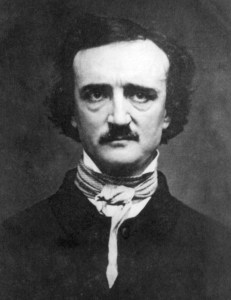

 What can I say? Few people are not familiar with Poe’s tale of people trying to isolate themselves from a ravaging pandemic, a tale eerily appropriate for our time.

 Phil Slattery, Writer, Publisher