In response to The Daily Post’s writing prompt: “An Odd Trio.”
Here is Ben Huberman’s challenge for the day:
“Today, you can write about whatever you what — but your post must include, in whatever role you see fit, a cat, a bowl of soup, and a beach towel.”
Here is my response:
On a cold winter day in Santa Fe, Nikki and Jay lay sunning themselves in the buff on beach towels under their living room sun lamp.
“I don’t understand why you hate Mr. Mann so,” said Nikki. “He’s an awesome cat, clever and cuddly and cute with beautiful blue eyes.”
“He’s got an attitude problem,” said Jay. “He’s always looking at me as if he were plotting something against me.”
Telmo the cat by Luizmo
“There you go, hating on him again. You just enjoy being cruel sometimes. You always have some mean thing to say. I really hate that new one you’ve come up with.”
“You mean ‘there’s got to be a better use for cats than violin strings’?
“That’s it. Sometimes you can be a real bastard. By the way, where is Mr. Mann? I haven’t seen him since I got home from work.”
“He’s around someplace. The little bastard has been under my nose all day.” Jay reached behind him, picked up a thermos, and poured its hot contents into a small bowl they were sharing. “How about some more soup? I spent a lot of the day making it just for you.”
“Yes, please. It’s delicious. It shows that you put a lot of time and care into it.” Nikki took the bowl and sipped. “What did you call this? Cocoa van?”
“No, it’s not coq au vin. We had that last week.” He could not repress a smile. “This is chat au vin.”
Nikki took another sip and then held her nose close to the soup and sniffed. She reveled in its aroma. “Chat au vin? You’ll have to teach me French some day.”
Jay took the bowl gently from her hand and set it aside. He slipped his arm around her waist and pulled her close. “First, I have some other French stuff I would like to teach you.”
He wrapped his arms around her tightly and kissed her long and deep, delighting in the taste of cat upon her lips and tongue.
What can you write in response to Ben’s challenge of the day?
Writing at Starbuck’s in Farmington, circa October 12, 2015.
Here’s a link to an neat, entertaining article on Timothy McSweeney’s Internet Tendency about some good, sound,basic advice on how to write anything better. I recommend printing these out and sticking them on your refrigerator, stapling them to your forehead, or tattooing them to your forearm.
In this article from mentalfloss.com Stacy Conradt tells us about ten renown figures from literature and history who had brief, quirky flings with the horror genre. Some of these you would probably never suspect of even hearing about the horror genre. One aspect that may be of interest to writers of horror is the minimal experience each author had with horror before dreaming up the concept for his/her foray into the genre.
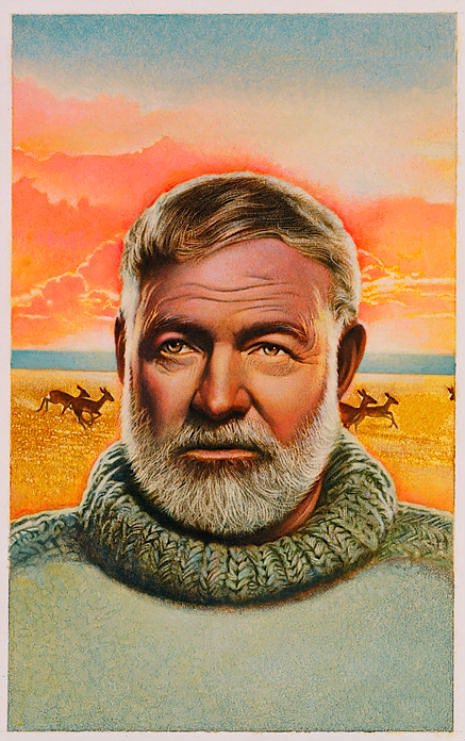
Ernest Hemingway Thought I do not know who the creator of this work is, I must ask that you respect their copyright.
The primary influences on my writing have always been Hemingway and Fitzgerald. Based on what I have read, neither was a fan of metaphors. Somewhere in the back of my mind I seem to recall Hemingway once calling metaphors “the weakest of animals” or “the “weakest of literary devices” or something like that (I have searched for this quote and haven’t found it yet). Ergo, I have always shied away from metaphors and I have found that it has helped my writing immensely by forcing me to be creative in my comparisons and analogies. While searching in vain for Hemingway’s quotation on metaphors tonight, I ran across this quotation from George Orwell which makes a few good points:
“By using stale metaphors, similes and idioms, you save much mental effort, at the cost of leaving your meaning vague, not only for your reader but for yourself. This is the significance of mixed metaphors. The sole aim of a metaphor is to call up a visual image. When these images dash [sic] … it can be taken as certain that the writer is not seeing a mental image of the objects he is naming; in other words he is not really thinking.”
Metaphors are a bridge to another idea; they take the reader onto a tangent. If I say, “The hunter stumbled through the woods like a wounded bear,” I am shifting the reader’s visual image from that of the hunter to that of a bear. Yes, I give the reader a concise description of how the hunter was stumbling, and the reader can probably visualize the stumbling rather accurately, but wouldn’t the reader become more involved with the hunter and be able to visualize the scene more precisely if the hunter is described as if he were a wounded bear stumbling. Wouldn’t it also be a bit more of an intriguing psychological puzzle for the reader to solve and come to his own sudden epiphany of something like “Oh, he’s moving like a wounded bear!” For example:
The hunter, half-dazed from a blow to the head, his dark eyes fixed on some point on the dim horizon, staggered back and forth, bumping into trees, sometimes leaning against them to keep from collapsing into the hard-packed snow, dropping to one knee then rising slowly, painfully catching his breath, limping, often groaning, sometimes bellowing out in a desperate hope that someone passing through the distant shadows might come to his aid.
Isn’t that more dramatic? Doesn’t that involve the reader more into the actions and situation of the main character? Yes, it’s considerably longer, but now the reader can visualize precisely the hunter’s agonizing movements. Now, instead of having to visualize a bear, all attention is focused entirely on visualizing the hunter. Now you are forced to be creative, to use something other than Orwell’s “stale metaphors, similes and idioms” and have to use something more dynamic. No one can accuse you of not really thinking or of being lazy in your descriptions.
In short, if I want to compare two objects, I describe one using the characteristics and attributes of the other. If I have done it well, the reader will see the likeness between the two, but will still remained focused, and maybe even more intensely, on the subject.
Painting of a Dog by Kim Duryang Sapsalgae, 1743
I have used this method for some time now, and I believe it has strengthened my works considerably.
Good story from The Drabble. If you are not familiar with them, they are dedicated to publishing fiction and non-fiction of 100 words or less. They occasionally post a story that breaks into horror, such as this one (reminiscent of the French conte cruel), but the site is definitely worth visiting just to see how writers handle the challenge of extreme brevity. The Drabble generally publishes one story per day, and you can be included in their feed to have it sent to you. You can find them at https://thedrabble.wordpress.com.
horror flash fiction isn’t quite short enough, these tweets seek to elicit a shudder, shock, or wicked laugh within the strict limit of 140 characters.” I look forward to @tweetsthecreeps submitting to this blog. Here are four samples:
The smell of death was something the neighbors got used to. When an arm came unearthed, everyone assumed it was a Halloween decoration.
I’m applying for a job at the blood bank but #MyResumeDoesntMention any of my early job history covering the period from 1837 until 1972.
I finally decided who I want to be for Halloween. Her skin will fit me beautifully if I get it off in one piece.
I always thought my bed’s warmth was just a matter of quality, ’til I turned in early & saw someone scramble out of it, into the crawlspace.
Working on a play in Hasting’s Hardback Café, late evening, October 16, 2015.
As I was preparing to go to the local theatre this evening, I was thinking about how I can improve my writing and what distinguishes the great writers of horror. Of course, the first two that came into my mind as being easily discernible from all others were Poe and Lovecraft. Obviously, what distinguishes them is their use of language. Both use very intense, muscular language with a distinctly archaic tone. Not knowing if there a precise term already exists for this style, I decided to call it “the dark language”, because of its tight connection with the horror genre and with the horrifying in general. For me, there seems to be something archetypal about this, arising out of the Jungian collective unconscious. Perhaps it is just that Poe bound the Dark Language so intimately with scenes of horror, terror, and suspense, which is also bound with genres such as the Gothic novel, that the sound of it automatically brings forth societal memories of dread.
I need to finish dressing if I am to dine at my favorite local sushi restaurant before heading to the play. Somehow, I just have the taste for something raw tonight.
Just now, I created a facebook page for the Art of Horror at https://www.facebook.com/slatterysartofhorror. Drop by, check it out, and friend me. Posts from this blog should feed automatically to Facebook as well as from my Twitter account.
I was just sitting here contemplating a couple of my stories and how I could improve them before I send them out for publication once again, when something occurred to me. At the moment I was thinking about what makes a satisfactory ending to a story for the general public. A story can be either simple or complex (in characterization, plot, backstory, all of the aforementioned, or whatever) and it can have either a simple or complex ending. How they are paired determines how the reader emotionally and intellectually responds to the story.
A simple story with a simple ending is probably the least satisfactory type of story. It is no challenge to most people and is not likely to stimulate interest. It is boring.
A simple story with a complex ending is probably not entertaining or satisfactory to most people, but it will stimulate the interest of a few. Not many people like or tolerate complex solutions to simple problems.
A complex story with a complex ending is satisfactory to some people, i.e. those intellectuals or faux intellectuals who enjoy complex matters, but these won’t be the majority.
A complex story with a simple denouement is probably the most satisfactory to most people. It stimulates the mind and enlightens the reader, helping him/her to see reality or the problems of reality in a new light. I have written often about a reader enjoying the vicarious experience of a story. It is the same with a complex story with a simple ending. The reader experiences the story vicariously; he/she feels the vicarious joy of having solved the problem along with the protagonist and any other characters accompanying the protagonist through the story.
A thought occurred to me tonight as I was watching another episode of the X-Files. I was “reading between the lines” of a dialog between Scully and Mulder, when it dawned on me that part of the art of writing is to write between the lines, i.e. to construct a dialog so that the reader will be able to read between the lines what you want him/her to read. I always think of Hemingway’s short story “Hills Like White Elephants” when I think about talking around something or reading between the lines, because is the classic example. One of my earlier posts, “Talking about Dogs” is on this same subject, when I say that part of the art of writing is like talking about a dog, without using the word “dog”. Anyway, that’s my thought for the night.
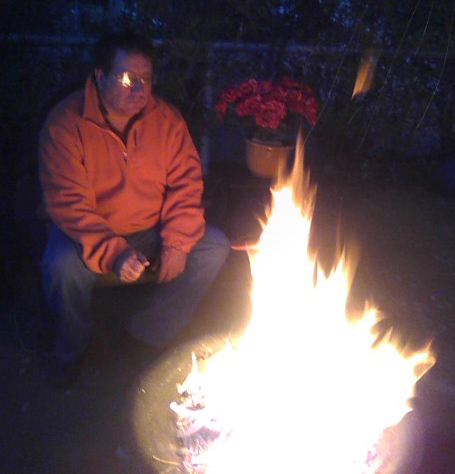
Relaxing by the front yard firepit on a chilly New Mexico evening circa 2013.
I recently purchased seasons 8 and 9 of the X-Files to complete my collection of the entire series. As you can note above, I am up to episode 6 of season 8: Redrum. No, it’s not based on The Shining or the famous line that sprang from there. This is a completely original script and I think one of the best X-Files. Why am I mentioning a Sci-Fi series in an article that should be about horror? This article is about good writing, whatever the genre.
I will endeavor to avoid spoiling the story for you.
As we all know, “redrum” is murder spelled backwards. This story is about a murder, but the alleged murderer finds himself traveling back in time to the day of the murder with the knowledge of how to prevent it.
I find the plot’s basic concept fascinating. A prosecutor (and friend of Agent Doggett) wakes up one morning to find himself in prison for the murder of his wife, about which he remembers nothing. As he is transferred to another facility for his safekeeping, he is assassinated. However, at that point time starts to flow backwards for him. Each morning he wakes up another day in the past (first he wakes up on Saturday, then on Friday, then on Thursday, etc.). With each day he learns a bit more about his predicament until finally he wakes up on the day of the murder and he has an opportunity to prevent it.
Unexpectedly traveling back in time is not a common theme, but it’s not rare either. I have to ask myself how Maeda and Arkin came up with the idea for this episode. Maybe it was based on amnesia; someone can’t recall his crime or immediate past and has to learn about it bit by bit, day by day, as the prosecutor does here. Maybe it arose out of a philosophical question such as “if we could travel back in time, we could change our future but would the ultimate destination be the same and all we change is the route we take to get there?” Maybe it was a thought that most stories show a protagonist going back in time to a certain point in time and then returning to the present; what if going back in time was not one big step, but several little steps. How could we change our lives in that case? What if as we traveled back in time, we knew as little about the past as we do about the future? We wouldn’t be able to convince those around us that we are traveling back in time, because we wouldn’t know any history to prove our story. They would believe us to be insane.
The whole scenario intrigues me. One man goes back in time for unknown reasons while the rest of the world around him proceeds as normal.
I have to ask myself what their creative process was.
This scenario opens up so many questions and possibilities. I love its originality. If you haven’t seen it, I recommend renting it as soon as possible.
We never find out what causes the protagonist to travel back in time. Like in a Stephen King novel, paranormal events happen out of the blue and at random. But according to Lovecraft’s theories of weird fiction, not knowing the cause/origin of a horrible event, makes the event more horrifying, because the event could happen to any one of us at any time.
A common principle of writing is “to suspend belief” (some say “to suspend disbelief”). In stories like this though, it is the natural laws of the universe that are suspended. Everything else, all the world/universe surrounding the event. is quite believable, which emphasizes just how weird the event is.
The story was written by Steven Maeda and Daniel Arkin. A quick search in Imdb shows that Steven Maeda has an extensive list of credits as either a writer or producer for such television series as X-Files, Lost, CSI:Miami, Helix, Lie to Me, and many others. Likewise Daniel Arkin has an extensive list of credits as a writer or producer for such shows as X-Files, Suits, Las Vegas, Alias, Medical Investigation, and others. I will have to watch for more shows with which either one is involved.
Check out the cool covers in this article from the folks over at Rare Horror. These remind me of ones I see going through those second-rate, family-run, second-hand bookstores that you find in side streets and back alleys (if you are lucky enough to find ones with the covers intact and not torn off): 5 Awesome Horror Book Covers.
The article is brief, but I won’t copy it here, because everyone with an interest in the art of writing should watch the accompanying five minute video of Steinbeck’s profound acceptance speech of the 1962 Nobel Prize. I will, however, copy below a short paragraph immediately preceding his six tips (I also highly recommend following the link to an entertaining and insightful Paris Review article on his observations on the art of fiction):
And for insights into how Steinbeck reached that pinnacle, you can read a collection of his observations on the art of fiction from the Fall, 1975 edition of The Paris Review, including six writing tips jotted down in a letter to a friend the same year he won the Nobel Prize. “The following,” Steinbeck writes, “are some of the things I have had to do to keep from going nuts.”
In earlier posts I mentioned that if one is to learn the art of writing, one must study the masters–regardless of genre. Writing well is writing well whether in mainstream literature, horror, romance, mystery, or whatever. After the basics of writing are mastered, then one can tailor stories to the accepted practices and traditions of his/her chosen genre. That is why I have been posting these articles with advice from horror and non-horror writers. Most of what they say is as applicable to horror as it is to mainstream literature or any other genre.
Tonight’s post is from Ray Bradbury. If you have not read The Martian Chronicles, run out and buy a copy or download one before you finish reading this article. You will find that it contains some of the most beautiful, poignant writing that you will ever encounter. I wish I could develop the skill that Bradbury shows and apply it to anything I write, whether it be a horror novel or a shopping list. Although this article will not help you do that, it will show you some of the important lessons that Mr. Bradbury learned in the school of literary hard knocks. The focus of the Open Culture article is a fifty-four minute video. The author of the article, Colin Marshall, summarizes the video into twelve points immediately below the video. I recommend watching the entire video before reading the twelve points, because you may or may not agree with Mr. Marshall’s summary.








 Phil Slattery, Writer, Publisher