
 Source: Master of Horror L.A. Banks and her contribution to Horror
Tag: authors
The Saturday Night Special: “In the Court of the Dragon” by Robert W. Chambers (1895)
“Oh, thou who burn’st in heart for those who burn
In Hell, whose fires thyself shall feed in turn;
How long be crying—’Mercy on them.’ God!
Why, who art thou to teach and He to learn?”
In the Church of St. Barnabé vespers were over; the clergy left the altar; the little choir-boys flocked across the chancel and settled in the stalls. A Suisse in rich uniform marched down the south aisle, sounding his staff at every fourth step on the stone pavement; behind him came that eloquent preacher and good man, Monseigneur C——.
My chair was near the chancel rail, I now turned toward the west end of the church. The other people between the altar and the pulpit turned too. There was a little scraping and rustling while the congregation seated itself again; the preacher mounted the pulpit stairs, and the organ voluntary ceased.
I had always found the organ-playing at St. Barnabé highly interesting. Learned and scientific it was, too much so for my small knowledge, but expressing a vivid if cold intelligence. Moreover, it possessed the French quality of taste: taste reigned supreme, self-controlled, dignified and reticent.
To-day, however, from the first chord I had felt a change for the worse, a sinister change. During vespers it had been chiefly the chancel organ which supported the beautiful choir, but now and again, quite wantonly as it seemed, from the west gallery where the great organ stands, a heavy hand had struck across the church at the serene peace of those clear voices. It was something more than harsh and dissonant, and it betrayed no lack of skill. As it recurred again and again, it set me thinking of what my architect’s books say about the custom in early times to consecrate the choir as soon as it was built, and that the nave, being finished sometimes half a century later, often did not get any blessing at all: I wondered idly if that had been the case at St. Barnabé, and whether something not usually supposed to be at home in a Christian church might have entered undetected and taken possession of the west gallery. I had read of such things happening, too, but not in works on architecture.
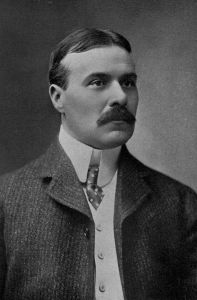
1903
Then I remembered that St. Barnabé was not much more than a hundred years old, and smiled at the incongruous association of mediaeval superstitions with that cheerful little piece of eighteenth-century rococo.
But now vespers were over, and there should have followed a few quiet chords, fit to accompany meditation, while we waited for the sermon. Instead of that, the discord at the lower end of the church broke out with the departure of the clergy, as if now nothing could control it.
I belong to those children of an older and simpler generation who do not love to seek for psychological subtleties in art; and I have ever refused to find in music anything more than melody and harmony, but I felt that in the labyrinth of sounds now issuing from that instrument there was something being hunted. Up and down the pedals chased him, while the manuals blared approval. Poor devil! whoever he was, there seemed small hope of escape!
My nervous annoyance changed to anger. Who was doing this? How dare he play like that in the midst of divine service? I glanced at the people near me: not one appeared to be in the least disturbed. The placid brows of the kneeling nuns, still turned towards the altar, lost none of their devout abstraction under the pale shadow of their white head-dress. The fashionable lady beside me was looking expectantly at Monseigneur C——. For all her face betrayed, the organ might have been singing an Ave Maria.
But now, at last, the preacher had made the sign of the cross, and commanded silence. I turned to him gladly. Thus far I had not found the rest I had counted on when I entered St. Barnabé that afternoon.
I was worn out by three nights of physical suffering and mental trouble: the last had been the worst, and it was an exhausted body, and a mind benumbed and yet acutely sensitive, which I had brought to my favourite church for healing. For I had been reading The King in Yellow.
“The sun ariseth; they gather themselves together and lay them down in their dens.” Monseigneur C—— delivered his text in a calm voice, glancing quietly over the congregation. My eyes turned, I knew not why, toward the lower end of the church. The organist was coming from behind his pipes, and passing along the gallery on his way out, I saw him disappear by a small door that leads to some stairs which descend directly to the street. He was a slender man, and his face was as white as his coat was black. “Good riddance!” I thought, “with your wicked music! I hope your assistant will play the closing voluntary.”
With a feeling of relief—with a deep, calm feeling of relief, I turned back to the mild face in the pulpit and settled myself to listen. Here, at last, was the ease of mind I longed for.
“My children,” said the preacher, “one truth the human soul finds hardest of all to learn: that it has nothing to fear. It can never be made to see that nothing can really harm it.”
“Curious doctrine!” I thought, “for a Catholic priest. Let us see how he will reconcile that with the Fathers.”
“Nothing can really harm the soul,” he went on, in, his coolest, clearest tones, “because——”
But I never heard the rest; my eye left his face, I knew not for what reason, and sought the lower end of the church. The same man was coming out from behind the organ, and was passing along the gallery the same way. But there had not been time for him to return, and if he had returned, I must have seen him. I felt a faint chill, and my heart sank; and yet, his going and coming were no affair of mine. I looked at him: I could not look away from his black figure and his white face. When he was exactly opposite to me, he turned and sent across the church straight into my eyes, a look of hate, intense and deadly: I have never seen any other like it; would to God I might never see it again! Then he disappeared by the same door through which I had watched him depart less than sixty seconds before.
I sat and tried to collect my thoughts. My first sensation was like that of a very young child badly hurt, when it catches its breath before crying out.
To suddenly find myself the object of such hatred was exquisitely painful: and this man was an utter stranger. Why should he hate me so?—me, whom he had never seen before? For the moment all other sensation was merged in this one pang: even fear was subordinate to grief, and for that moment I never doubted; but in the next I began to reason, and a sense of the incongruous came to my aid.
As I have said, St. Barnabé is a modern church. It is small and well lighted; one sees all over it almost at a glance. The organ gallery gets a strong white light from a row of long windows in the clerestory, which have not even coloured glass.
The pulpit being in the middle of the church, it followed that, when I was turned toward it, whatever moved at the west end could not fail to attract my eye. When the organist passed it was no wonder that I saw him: I had simply miscalculated the interval between his first and his second passing. He had come in that last time by the other side-door. As for the look which had so upset me, there had been no such thing, and I was a nervous fool.
I looked about. This was a likely place to harbour supernatural horrors! That clear-cut, reasonable face of Monseigneur C——, his collected manner and easy, graceful gestures, were they not just a little discouraging to the notion of a gruesome mystery? I glanced above his head, and almost laughed. That flyaway lady supporting one corner of the pulpit canopy, which looked like a fringed damask table-cloth in a high wind, at the first attempt of a basilisk to pose up there in the organ loft, she would point her gold trumpet at him, and puff him out of existence! I laughed to myself over this conceit, which, at the time, I thought very amusing, and sat and chaffed myself and everything else, from the old harpy outside the railing, who had made me pay ten centimes for my chair, before she would let me in (she was more like a basilisk, I told myself, than was my organist with the anaemic complexion): from that grim old dame, to, yes, alas! Monseigneur C—— himself. For all devoutness had fled. I had never yet done such a thing in my life, but now I felt a desire to mock.
As for the sermon, I could not hear a word of it for the jingle in my ears of
“The skirts of St. Paul has reached.
Having preached us those six Lent lectures,
More unctuous than ever he preached,”
keeping time to the most fantastic and irreverent thoughts.
It was no use to sit there any longer: I must get out of doors and shake myself free from this hateful mood. I knew the rudeness I was committing, but still I rose and left the church.
A spring sun was shining on the Rue St. Honoré, as I ran down the church steps. On one corner stood a barrow full of yellow jonquils, pale violets from the Riviera, dark Russian violets, and white Roman hyacinths in a golden cloud of mimosa. The street was full of Sunday pleasure-seekers. I swung my cane and laughed with the rest. Some one overtook and passed me. He never turned, but there was the same deadly malignity in his white profile that there had been in his eyes. I watched him as long as I could see him. His lithe back expressed the same menace; every step that carried him away from me seemed to bear him on some errand connected with my destruction.
I was creeping along, my feet almost refusing to move. There began to dawn in me a sense of responsibility for something long forgotten. It began to seem as if I deserved that which he threatened: it reached a long way back—a long, long way back. It had lain dormant all these years: it was there, though, and presently it would rise and confront me. But I would try to escape; and I stumbled as best I could into the Rue de Rivoli, across the Place de la Concorde and on to the Quai. I looked with sick eyes upon the sun, shining through the white foam of the fountain, pouring over the backs of the dusky bronze river-gods, on the far-away Arc, a structure of amethyst mist, on the countless vistas of grey stems and bare branches faintly green. Then I saw him again coming down one of the chestnut alleys of the Cours la Reine.
I left the river-side, plunged blindly across to the Champs Elysées and turned toward the Arc. The setting sun was sending its rays along the green sward of the Rond-point: in the full glow he sat on a bench, children and young mothers all about him. He was nothing but a Sunday lounger, like the others, like myself. I said the words almost aloud, and all the while I gazed on the malignant hatred of his face. But he was not looking at me. I crept past and dragged my leaden feet up the Avenue. I knew that every time I met him brought him nearer to the accomplishment of his purpose and my fate. And still I tried to save myself.
The last rays of sunset were pouring through the great Arc. I passed under it, and met him face to face. I had left him far down the Champs Elysées, and yet he came in with a stream of people who were returning from the Bois de Boulogne. He came so close that he brushed me. His slender frame felt like iron inside its loose black covering. He showed no signs of haste, nor of fatigue, nor of any human feeling. His whole being expressed one thing: the will, and the power to work me evil.
In anguish I watched him where he went down the broad crowded Avenue, that was all flashing with wheels and the trappings of horses and the helmets of the Garde Republicaine.
He was soon lost to sight; then I turned and fled. Into the Bois, and far out beyond it—I know not where I went, but after a long while as it seemed to me, night had fallen, and I found myself sitting at a table before a small café. I had wandered back into the Bois. It was hours now since I had seen him. Physical fatigue and mental suffering had left me no power to think or feel. I was tired, so tired! I longed to hide away in my own den. I resolved to go home. But that was a long way off.
I live in the Court of the Dragon, a narrow passage that leads from the Rue de Rennes to the Rue du Dragon.
It is an “impasse”; traversable only for foot passengers. Over the entrance on the Rue de Rennes is a balcony, supported by an iron dragon. Within the court tall old houses rise on either side, and close the ends that give on the two streets. Huge gates, swung back during the day into the walls of the deep archways, close this court, after midnight, and one must enter then by ringing at certain small doors on the side. The sunken pavement collects unsavoury pools. Steep stairways pitch down to doors that open on the court. The ground floors are occupied by shops of second-hand dealers, and by iron workers. All day long the place rings with the clink of hammers and the clang of metal bars.
Unsavoury as it is below, there is cheerfulness, and comfort, and hard, honest work above.
Five flights up are the ateliers of architects and painters, and the hiding-places of middle-aged students like myself who want to live alone. When I first came here to live I was young, and not alone.
I had to walk a while before any conveyance appeared, but at last, when I had almost reached the Arc de Triomphe again, an empty cab came along and I took it.
From the Arc to the Rue de Rennes is a drive of more than half an hour, especially when one is conveyed by a tired cab horse that has been at the mercy of Sunday fête-makers.
There had been time before I passed under the Dragon’s wings to meet my enemy over and over again, but I never saw him once, and now refuge was close at hand.
Before the wide gateway a small mob of children were playing. Our concierge and his wife walked among them, with their black poodle, keeping order; some couples were waltzing on the sidewalk. I returned their greetings and hurried in.
All the inhabitants of the court had trooped out into the street. The place was quite deserted, lighted by a few lanterns hung high up, in which the gas burned dimly.
My apartment was at the top of a house, halfway down the court, reached by a staircase that descended almost into the street, with only a bit of passage-way intervening, I set my foot on the threshold of the open door, the friendly old ruinous stairs rose before me, leading up to rest and shelter. Looking back over my right shoulder, I saw him, ten paces off. He must have entered the court with me.
He was coming straight on, neither slowly, nor swiftly, but straight on to me. And now he was looking at me. For the first time since our eyes encountered across the church they met now again, and I knew that the time had come.
Retreating backward, down the court, I faced him. I meant to escape by the entrance on the Rue du Dragon. His eyes told me that I never should escape.
It seemed ages while we were going, I retreating, he advancing, down the court in perfect silence; but at last I felt the shadow of the archway, and the next step brought me within it. I had meant to turn here and spring through into the street. But the shadow was not that of an archway; it was that of a vault. The great doors on the Rue du Dragon were closed. I felt this by the blackness which surrounded me, and at the same instant I read it in his face. How his face gleamed in the darkness, drawing swiftly nearer! The deep vaults, the huge closed doors, their cold iron clamps were all on his side. The thing which he had threatened had arrived: it gathered and bore down on me from the fathomless shadows; the point from which it would strike was his infernal eyes. Hopeless, I set my back against the barred doors and defied him.
There was a scraping of chairs on the stone floor, and a rustling as the congregation rose. I could hear the Suisse’s staff in the south aisle, preceding Monseigneur C—— to the sacristy.
The kneeling nuns, roused from their devout abstraction, made their reverence and went away. The fashionable lady, my neighbour, rose also, with graceful reserve. As she departed her glance just flitted over my face in disapproval.
Half dead, or so it seemed to me, yet intensely alive to every trifle, I sat among the leisurely moving crowd, then rose too and went toward the door.
I had slept through the sermon. Had I slept through the sermon? I looked up and saw him passing along the gallery to his place. Only his side I saw; the thin bent arm in its black covering looked like one of those devilish, nameless instruments which lie in the disused torture-chambers of mediaeval castles.
But I had escaped him, though his eyes had said I should not. Had I escaped him? That which gave him the power over me came back out of oblivion, where I had hoped to keep it. For I knew him now. Death and the awful abode of lost souls, whither my weakness long ago had sent him—they had changed him for every other eye, but not for mine. I had recognized him almost from the first; I had never doubted what he was come to do; and now I knew while my body sat safe in the cheerful little church, he had been hunting my soul in the Court of the Dragon.
I crept to the door: the organ broke out overhead with a blare. A dazzling light filled the church, blotting the altar from my eyes. The people faded away, the arches, the vaulted roof vanished. I raised my seared eyes to the fathomless glare, and I saw the black stars hanging in the heavens: and the wet winds from the lake of Hali chilled my face.
And now, far away, over leagues of tossing cloud-waves, I saw the moon dripping with spray; and beyond, the towers of Carcosa rose behind the moon.
Death and the awful abode of lost souls, whither my weakness long ago had sent him, had changed him for every other eye but mine. And now I heard his voice, rising, swelling, thundering through the flaring light, and as I fell, the radiance increasing, increasing, poured over me in waves of flame. Then I sank into the depths, and I heard the King in Yellow whispering to my soul: “It is a fearful thing to fall into the hands of the living God!”
The Saturday Night Special: “The Open Window” by Saki

(Hector Hugh Munro)
1870-1916
“My aunt will be down presently, Mr. Nuttel,” said a very self-possessed young lady of fifteen; “in the meantime you must try and put up with me.”
Framton Nuttel endeavoured to say the correct something which should duly flatter the niece of the moment without unduly discounting the aunt that was to come. Privately he doubted more than ever whether these formal visits on a succession of total strangers would do much towards helping the nerve cure which he was supposed to be undergoing.
“I know how it will be,” his sister had said when he was preparing to migrate to this rural retreat; “you will bury yourself down there and not speak to a living soul, and your nerves will be worse than ever from moping. I shall just give you letters of introduction to all the people I know there. Some of them, as far as I can remember, were quite nice.”
Framton wondered whether Mrs. Sappleton, the lady to whom he was presenting one of the letters of introduction came into the nice division.
“Do you know many of the people round here?” asked the niece, when she judged that they had had sufficient silent communion.
“Hardly a soul,” said Framton. “My sister was staying here, at the rectory, you know, some four years ago, and she gave me letters of introduction to some of the people here.”
He made the last statement in a tone of distinct regret.
“Then you know practically nothing about my aunt?” pursued the self-possessed young lady.
“Only her name and address,” admitted the caller. He was wondering whether Mrs. Sappleton was in the married or widowed state. An undefinable something about the room seemed to suggest masculine habitation.
“Her great tragedy happened just three years ago,” said the child; “that would be since your sister’s time.”
“Her tragedy?” asked Framton; somehow in this restful country spot tragedies seemed out of place.
“You may wonder why we keep that window wide open on an October afternoon,” said the niece, indicating a large French window that opened on to a lawn.
“It is quite warm for the time of the year,” said Framton; “but has that window got anything to do with the tragedy?”
“Out through that window, three years ago to a day, her husband and her two young brothers went off for their day’s shooting. They never came back. In crossing the moor to their favourite snipe-shooting ground they were all three engulfed in a treacherous piece of bog. It had been that dreadful wet summer, you know, and places that were safe in other years gave way suddenly without warning. Their bodies were never recovered. That was the dreadful part of it.” Here the child’s voice lost its self-possessed note and became falteringly human. “Poor aunt always thinks that they will come back someday, they and the little brown spaniel that was lost with them, and walk in at that window just as they used to do. That is why the window is kept open every evening till it is quite dusk. Poor dear aunt, she has often told me how they went out, her husband with his white waterproof coat over his arm, and Ronnie, her youngest brother, singing ‘Bertie, why do you bound?’ as he always did to tease her, because she said it got on her nerves. Do you know, sometimes on still, quiet evenings like this, I almost get a creepy feeling that they will all walk in through that window – ”
She broke off with a little shudder. It was a relief to Framton when the aunt bustled into the room with a whirl of apologies for being late in making her appearance.
“I hope Vera has been amusing you?” she said.
“She has been very interesting,” said Framton.
“I hope you don’t mind the open window,” said Mrs. Sappleton briskly; “my husband and brothers will be home directly from shooting, and they always come in this way. They’ve been out for snipe in the marshes today, so they’ll make a fine mess over my poor carpets. So like you menfolk, isn’t it?”
She rattled on cheerfully about the shooting and the scarcity of birds, and the prospects for duck in the winter. To Framton it was all purely horrible. He made a desperate but only partially successful effort to turn the talk on to a less ghastly topic, he was conscious that his hostess was giving him only a fragment of her attention, and her eyes were constantly straying past him to the open window and the lawn beyond. It was certainly an unfortunate coincidence that he should have paid his visit on this tragic anniversary.
“The doctors agree in ordering me complete rest, an absence of mental excitement, and avoidance of anything in the nature of violent physical exercise,” announced Framton, who laboured under the tolerably widespread delusion that total strangers and chance acquaintances are hungry for the least detail of one’s ailments and infirmities, their cause and cure. “On the matter of diet they are not so much in agreement,” he continued.
“No?” said Mrs. Sappleton, in a voice which only replaced a yawn at the last moment. Then she suddenly brightened into alert attention – but not to what Framton was saying.
“Here they are at last!” she cried. “Just in time for tea, and don’t they look as if they were muddy up to the eyes!”
Framton shivered slightly and turned towards the niece with a look intended to convey sympathetic comprehension. The child was staring out through the open window with a dazed horror in her eyes. In a chill shock of nameless fear Framton swung round in his seat and looked in the same direction.
In the deepening twilight three figures were walking across the lawn towards the window, they all carried guns under their arms, and one of them was additionally burdened with a white coat hung over his shoulders. A tired brown spaniel kept close at their heels. Noiselessly they neared the house, and then a hoarse young voice chanted out of the dusk: “I said, Bertie, why do you bound?”
Framton grabbed wildly at his stick and hat; the hall door, the gravel drive, and the front gate were dimly noted stages in his headlong retreat. A cyclist coming along the road had to run into the hedge to avoid imminent collision.
“Here we are, my dear,” said the bearer of the white mackintosh, coming in through the window, “fairly muddy, but most of it’s dry. Who was that who bolted out as we came up?”
“A most extraordinary man, a Mr. Nuttel,” said Mrs. Sappleton; “could only talk about his illnesses, and dashed off without a word of goodby or apology when you arrived. One would think he had seen a ghost.”
“I expect it was the spaniel,” said the niece calmly; “he told me he had a horror of dogs. He was once hunted into a cemetery somewhere on the banks of the Ganges by a pack of pariah dogs, and had to spend the night in a newly dug grave with the creatures snarling and grinning and foaming just above him. Enough to make anyone lose their nerve.”
Romance at short notice was her speciality.
###
Text from www.eastoftheweb.com
For your added enjoyment, follow this link to a film adaptation of “The Open Window” on youtube starring a young Michael Sheen.
Adaptation Nation
 Source: Adaptation Nation
Here’s a brief article about books on the small screen.
Keep It Simple
 Streamline your writing style by keeping your language simple and placing your story center stage.
Source: Keep It Simple
Here’s some good, practical advice on writing.
Press Release: Tickety Boo Press releases Death’s Sweet Echo
 Source:
 The Saturday Night Special: “One Summer Night” by Ambrose Bierce
The fact that Henry Armstrong was buried did not seem to him to prove that he was dead: he had always been a hard man to convince. That he really was buried, the testimony of his senses compelled him to admit. His posture — flat upon his back, with his hands crossed upon his stomach and tied with something that he easily broke without profitably altering the situation — the strict confinement of his entire person, the black darkness and profound silence, made a body of evidence impossible to controvert and he accepted it without cavil.
But dead — no; he was only very, very ill. He had, withal, the invalid’s apathy and did not greatly concern himself about the uncommon

October 7, 1892
fate that had been allotted to him. No philosopher was he — just a plain, commonplace person gifted, for the time being, with a pathological indifference: the organ that he feared consequences with was torpid. So, with no particular apprehension for his immediate future, he fell asleep and all was peace with Henry Armstrong.
But something was going on overhead. It was a dark summer night, shot through with infrequent shimmers of lightning silently firing a cloud lying low in the west and portending a storm. These brief, stammering illuminations brought out with ghastly distinctness the monuments and headstones of the cemetery and seemed to set them dancing. It was not a night in which any credible witness was likely to be straying about a cemetery, so the three men who were there, digging into the grave of Henry Armstrong, felt reasonably secure.
Two of them were young students from a medical college a few miles away; the third was a gigantic negro known as Jess. For many years Jess had been employed about the cemetery as a man-of-all-work and it was his favourite pleasantry that he knew ‘every soul in the place.’ From the nature of what he was now doing it was inferable that the place was not so populous as its register may have shown it to be.
Outside the wall, at the part of the grounds farthest from the public road, were a horse and a light wagon, waiting.
The work of excavation was not difficult: the earth with which the grave had been loosely filled a few hours before offered little resistance and was soon thrown out. Removal of the casket from its box was less easy, but it was taken out, for it was a perquisite of Jess, who carefully unscrewed the cover and laid it aside, exposing the body in black trousers and white shirt. At that instant the air sprang to flame, a cracking shock of thunder shook the stunned world and Henry Armstrong tranquilly sat up. With inarticulate cries the men fled in terror, each in a different direction. For nothing on earth could two of them have been persuaded to return. But Jess was of another breed.
In the grey of the morning the two students, pallid and haggard from anxiety and with the terror of their adventure still beating tumultuously in their blood, met at the medical college.
‘You saw it?’ cried one.
‘God! yes — what are we to do?’
They went around to the rear of the building, where they saw a horse, attached to a light wagon, hitched to a gatepost near the door of the dissecting-room. Mechanically they entered the room. On a bench in the obscurity sat the negro Jess. He rose, grinning, all eyes and teeth.
‘I’m waiting for my pay,’ he said.
Stretched naked on a long table lay the body of Henry Armstrong, the head defiled with blood and clay from a blow with a spade.
###
Text from www.eastoftheweb.com
7 Deadly Sins Acrostic
 Source: 7 Deadly Sins Acrostic
Here is an interesting way to do acrostics.
Forget Hemingway: This Is How A Linguist Would Write Dialogue

5 Horror Authors You Have to Read and Follow in 2016!

The Saturday Night Special: “The Tree” by H.P. Lovecraft
The Tree
by Howard Philips Lovecraft
(1920)
from www.hplovecraft.com
On a verdant slope of Mount Maenalus, in Arcadia, there stands an olive grove about the ruins of a villa. Close by is a tomb, once beautiful with the sublimest sculptures, but now fallen into as great decay as the house. At one end of that tomb, its curious roots displacing the time-stained blocks of Pentelic marble, grows an unnaturally large olive tree of oddly repellent shape; so like to some grotesque man, or death-distorted body of a man, that the country folk fear to pass it at night when the moon shines faintly through the crooked boughs. Mount Maenalus is a chosen haunt of dreaded Pan, whose queer companions are many, and simple swains believe that the tree must have some hideous kinship to these weird Panisci; but an old bee-keeper who lives in the neighbouring cottage told me a different story.


Many years ago, when the hillside villa was new and resplendent, there dwelt within it the two sculptors Kalos and Musides. From Lydia to Neapolis the beauty of their work was praised, and none dared say that the one excelled the other in skill. The Hermes of Kalos stood in a marble shrine in Corinth, and the Pallas of Musides surmounted a pillar in Athens, near the Parthenon. All men paid homage to Kalos and Musides, and marvelled that no shadow of artistic jealousy cooled the warmth of their brotherly friendship.
But though Kalos and Musides dwelt in unbroken harmony, their natures were not alike. Whilst Musides revelled by night amidst the urban gaieties of Tegea, Kalos would remain at home; stealing away from the sight of his slaves into the cool recesses of the olive grove. There he would meditate upon the visions that filled his mind, and there devise the forms of beauty which later became immortal in breathing marble. Idle folk, indeed, said that Kalos conversed with the spirits of the grove, and that his statues were but images of the fauns and dryads he met there—for he patterned his work after no living model.
So famous were Kalos and Musides, that none wondered when the Tyrant of Syracuse sent to them deputies to speak of the costly statue of Tyché which he had planned for his city. Of great size and cunning workmanship must the statue be, for it was to form a wonder of nations and a goal of travellers. Exalted beyond thought would be he whose work should gain acceptance, and for this honour Kalos and Musides were invited to compete. Their brotherly love was well known, and the crafty Tyrant surmised that each, instead of concealing his work from the other, would offer aid and advice; this charity producing two images of unheard-of beauty, the lovelier of which would eclipse even the dreams of poets.
With joy the sculptors hailed the Tyrant’s offer, so that in the days that followed their slaves heard the ceaseless blows of chisels. Not from each other did Kalos and Musides conceal their work, but the sight was for them alone. Saving theirs, no eyes beheld the two divine figures released by skilful blows from the rough blocks that had imprisoned them since the world began.
At night, as of yore, Musides sought the banquet halls of Tegea whilst Kalos wandered alone in the olive grove. But as time passed, men observed a want of gaiety in the once sparkling Musides. It was strange, they said amongst themselves, that depression should thus seize one with so great a chance to win art’s loftiest reward. Many months passed, yet in the sour face of Musides came nothing of the sharp expectancy which the situation should arouse.
Then one day Musides spoke of the illness of Kalos, after which none marvelled again at his sadness, since the sculptors’ attachment was known to be deep and sacred. Subsequently many went to visit Kalos, and indeed noticed the pallor of his face; but there was about him a happy serenity which made his glance more magical than the glance of Musides—who was clearly distracted with anxiety, and who pushed aside all the slaves in his eagerness to feed and wait upon his friend with his own hands. Hidden behind heavy curtains stood the two unfinished figures of Tyché, little touched of late by the sick man and his faithful attendant.
As Kalos grew inexplicably weaker and weaker despite the ministrations of puzzled physicians and of his assiduous friend, he desired to be carried often to the grove which he so loved. There he would ask to be left alone, as if wishing to speak with unseen things. Musides ever granted his requests, though his eyes filled with visible tears at the thought that Kalos should care more for the fauns and the dryads than for him. At last the end drew near, and Kalos discoursed of things beyond this life. Musides, weeping, promised him a sepulchre more lovely than the tomb of Mausolus; but Kalos bade him speak no more of marble glories. Only one wish now haunted the mind of the dying man; that twigs from certain olive trees in the grove be buried by his resting-place—close to his head. And one night, sitting alone in the darkness of the olive grove, Kalos died.
Beautiful beyond words was the marble sepulchre which stricken Musides carved for his beloved friend. None but Kalos himself could have fashioned such bas-reliefs, wherein were displayed all the splendours of Elysium. Nor did Musides fail to bury close to Kalos’ head the olive twigs from the grove.
As the first violence of Musides’ grief gave place to resignation, he laboured with diligence upon his figure of Tyché. All honour was now his, since the Tyrant of Syracuse would have the work of none save him or Kalos. His task proved a vent for his emotion, and he toiled more steadily each day, shunning the gaieties he once had relished. Meanwhile his evenings were spent beside the tomb of his friend, where a young olive tree had sprung up near the sleeper’s head. So swift was the growth of this tree, and so strange was its form, that all who beheld it exclaimed in surprise; and Musides seemed at once fascinated and repelled.
Three years after the death of Kalos, Musides despatched a messenger to the Tyrant, and it was whispered in the agora at Tegea that the mighty statue was finished. By this time the tree by the tomb had attained amazing proportions, exceeding all other trees of its kind, and sending out a singularly heavy branch above the apartment in which Musides laboured. As many visitors came to view the prodigious tree, as to admire the art of the sculptor, so that Musides was seldom alone. But he did not mind his multitude of guests; indeed, he seemed to dread being alone now that his absorbing work was done. The bleak mountain wind, sighing through the olive grove and the tomb-tree, had an uncanny way of forming vaguely articulate sounds.
The sky was dark on the evening that the Tyrant’s emissaries came to Tegea. It was definitely known that they had come to bear away the great image of Tyché and bring eternal honour to Musides, so their reception by the proxenoi was of great warmth. As the night wore on, a violent storm of wind broke over the crest of Maenalus, and the men from far Syracuse were glad that they rested snugly in the town. They talked of their illustrious Tyrant, and of the splendour of his capital; and exulted in the glory of the statue which Musides had wrought for him. And then the men of Tegea spoke of the goodness of Musides, and of his heavy grief for his friend; and how not even the coming laurels of art could console him in the absence of Kalos, who might have worn those laurels instead. Of the tree which grew by the tomb, near the head of Kalos, they also spoke. The wind shrieked more horribly, and both the Syracusans and the Arcadians prayed to Aiolos.
In the sunshine of the morning the proxenoi led the Tyrant’s messengers up the slope to the abode of the sculptor, but the night-wind had done strange things. Slaves’ cries ascended from a scene of desolation, and no more amidst the olive grove rose the gleaming colonnades of that vast hall wherein Musides had dreamed and toiled. Lone and shaken mourned the humble courts and the lower walls, for upon the sumptuous greater peristyle had fallen squarely the heavy overhanging bough of the strange new tree, reducing the stately poem in marble with odd completeness to a mound of unsightly ruins. Strangers and Tegeans stood aghast, looking from the wreckage to the great, sinister tree whose aspect was so weirdly human and whose roots reached so queerly into the sculptured sepulchre of Kalos. And their fear and dismay increased when they searched the fallen apartment; for of the gentle Musides, and of the marvellously fashioned image of Tyché, no trace could be discovered. Amidst such stupendous ruin only chaos dwelt, and the representatives of two cities left disappointed; Syracusans that they had no statue to bear home, Tegeans that they had no artist to crown. However, the Syracusans obtained after a while a very splendid statue in Athens, and the Tegeans consoled themselves by erecting in the agora a marble temple commemorating the gifts, virtues, and brotherly piety of Musides.
But the olive grove still stands, as does the tree growing out of the tomb of Kalos, and the old bee-keeper told me that sometimes the boughs whisper to one another in the night-wind, saying over and over again, “Οἶδα! Οἶδα!—I know! I know!”
David’s Haunted Library: Imago Mortis

The Farmington Writers Circle Meets February 11, 2016
 The next meeting of the Farmington Writers Circle will be on Thursday, February 11, 2016, at 7:00 p.m. at Hastings Hardback Café on 20th Street in Farmington, New Mexico. I will lead the discussion on establishing a blog and using it for publicity. Everyone is invited to attend. There is no charge and no membership requirements. Please contact me via this website if you have any questions. The Farmington Writers Circle is a group of local authors with an interest in publishing and marketing their works. Authors of all genres are welcome. If you would like to be on our electronic mailing list to be notified of upcoming meetings, please contact me.
Book reviews: Irene and Camille
 Source: Book reviews: Irene and Camille
 Source:
  Phil Slattery, Writer, Publisher