I just arrived at Ruby’s restaurant in Aztec planning on a breakfast of pappas con carne adovada and the waitress seated me at a booth next to a man that looks very much like the photo of the fictional character Jack Thurston I posted on Twitter (@jthurston666). Of course, the photo is a public domain photo I got from Pexels. Nonetheless, the coincidence seems uncanny. Has anyone else had a similar coincidence? I suppose this falls under the category of synchronicity.
With Iced Tea, Farmington, New Mexico, March 20, 2015
How does everyone like the new look for the weblog? I have shortened the name and made it a more accurate reflection of the content, though I may be changing that even more soon. I have reorganized the tabs, so that readers can find the new magazine and information on the Farmington Writers Circle more easily. Most of the old pages still exist, but they are now under “The Chamber Magazine” page. I have also reorganized the sidebar, keeping most of what was there previously, and maybe adding one or two new items and omitting one or two old ones. I will also be adding a page for each of my works published on Amazon under the “Published Works” heading. That might be a day or two more before those are up.
If you have suggestions to make the site more user friendly or to facilitate finding information, please let me know via e-mail, comment, or through one of my social media (which I will also be increasing).
If you are one of the you are one of the incredibly intelligent and tasteful people who has purchased one of my books from Amazon, please show your appreciation for my awe-inspiring writing skills by going back to Amazon and leaving a good review. Good reviews help move books up in the Amazon ratings and help sales, AND you’ll be able to sleep better tonight knowing you have done something to benefit mankind.
If you are one of those incredibly intelligent and tasteful people, and haven’t yet purchased one of my books, this is your opportunity to improve not only your lot in life, but mine as well, and to benefit mankind’s lot by raising the average I.Q. a smidgen.
If you’re not one of those people and haven’t purchased one of my books and, God forbid, don’t intend to, well, a good review still wouldn’t hurt.
Phil Slattery hiking in the Bisti Wilderness near Farmington, NM, circa 2013
Tonight I have been working on the final draft of the paperback version of “A Tale of Hell and other Works of Horror”. I took a break to talk with the fiancée (over the phone), have dinner, and watch one of my favorite episodes of House entitled “A Pox on our House” involving a suspected case of smallpox. Somehow I hit upon the idea what if it wasn’t a meteor/asteroid that wiped out the dinosaurs, but a virus? The story could be called “The Chicxulub Virus” after the Mexican location where the meteor/asteroid struck in the current Bay of Campeche. The virus could have been brought to Earth by the meteor/asteroid, spread quickly by air in the particulate cloud that the meteor/asteroid generated, and which encircled the Earth. A few mammals and other critters survived for whatever reason, to evolve into the species we have today or the virus could have started the evolution that created today’s species. Now, in a sort of Jurassic Park stimulus, instead of scientists finding “dino DNA” in amber, they unleash the virus and race to prevent it from spreading (reminiscent of The Andromeda Strain) or they struggle to fight its spread once it is airborne. This could be a very complex work even for a good sci-fi writer.
This is just a very rough idea and I haven’t worked out anymore details than you see here.
I have a long list of things to write and so I recognize that I will never write this. Therefore, I offer it out there to whoever wants it at no cost. If you do use it, and if you would be so kind, I would like to be listed in the acknowledgements as the originator of the basic idea.
If it’s true what they say, that 80 percent of success is showing up … Most often attributed to Woody Allen, the maxim “80 percent of success is showing up” has earned its p…
Phil Slattery hiking in the Bisti Wilderness near Farmington, NM, circa 2013
So far I have received two nice comments on my short story, “The Slightest of Indiscretions”, which was published earlier today at www.fictionontheweb.co.uk. Here they are:
Excellent writing brings this poignant story to life and makes the reader work to understand more of what might be. Very many thanks for a satisfying, emotionally intelligent read,
Ceinwen
Today I have been contemplating several things including what makes for a fascinating character in a story. To me, it is the same as what would make for a fascinating person that I meet in my day-to-day life. I thought about this for a while and decided that what makes a person fascinating for me is their way of thinking, how they handled any unusual situations they encountered, and the experiences they have had. However, what is fascinating for me, may not be fascinating for the readers of my stories. So I thought I would post a quick survey tonight and ask my blog audience: just what is it that you find fascinating about people in your lives and how does it differ from what you would consider a fascinating character in a work of literature, if it is different. Please feel free to post as long a response as you want in the comments section to this article. If you prefer, if you know of a good article on the subject, please include a link to it in your comment. I am eager to hear any new perspectives on this.
The WordPress.com stats helper monkeys prepared a 2015 annual report for this blog.
Here’s an excerpt:
A New York City subway train holds 1,200 people. This blog was viewed about 6,900 times in 2015. If it were a NYC subway train, it would take about 6 trips to carry that many people.
I received this writing prompt from The Daily Post on November 8: “What’s the date today? Write it down, remove all dashes and slashes, and write a post that mentions that number.”
I started to write a glib response about numerology, but then a bell went off in the back of my mind.
While I don’t believe in numerology, I do like to toy with things like this in my writing for the enjoyment of people who do. Having been a graduate student at one time, I know how grad students and other literati like to analyze a text to the nth degree, searching for hidden but profound meaning in every nuanced word or misplaced comma. I seldom do this with the intent of relaying some arcane theme (people will interpret stories however best fits their worldview anyway), but just so the literati will have some fun analyzing and arguing about the story. For me, this is part of the fun of writing. But the more practical side of me also sees it as a way to build up a readership.
One way for a story to become known is via word of mouth. They will discuss the book if they find it interesting or they find something in it to argue about with their colleagues in the English Department or with friends at work or with like-minded enthusiasts at the local book club. So I give them something to debate.
Mostly, the understated connections I use are meaningless. For example, I have been working on a sci-fi short story in which I wanted to mention a sidearm astronauts 200 years from now might carry, but I did not want to use a type of space weapon that has become a cliché in the sci-fi world like a Star Trek phaser or a Star Wars blaster or a Flash Gordon ray gun. I named it the Hawking S-505 Black Particle sidearm. Hawking, obviously, for Stephen Hawking, who I am sure will have tons of scientific stuff named for him in the future including spaceports and starships. “Black Particle” as a form of dark energy relating to dark matter, which is cutting edge science these days, but will probably be trite in two centuries. S-550: the “S” is for sidearm; 550 is a US highway that runs through the town where I live currently. If I need a number, such as a serial number, I often use an old phone number or my birthdate or some other useless bit of trivia. As the original post from The Daily Post suggested, I might use a form of today’s date or some other date with meaning in my life. If the subject relates to magic(k), I might consult a book on numerology and choose/compose something appropriate. For example, in one horror story I have been writing for a long time, the protagonist walks through a tunnel under a dilapidated castle, where black magick was once practiced. The sides of the tunnel are covered in symbols and numbers including the number “4”, which symbolizes evil in some traditions.
For the names of characters, I frequently glance at the bookshelf to the right of my easy chair, where I write on my laptop, and combine the names of two authors to produce a name that has the right “sound” for the character or I might combine names from history or art or some other field. For example, I see I have one book by Bill Moyers and another by George Plimpton. I might name a character Bill Plimpton. In another sci-fi work (yet to be published) I needed the names for a nine man reconnaissance team to go aboard a derelict starship. I went to Google Translate and took the word for “warrior” from nine languages ranging from Gaelic to Swahili, so none would be immediately recognizable as a word for warrior (at least in the US), yet the names would express the cultural diversity of the crew.
Anyway, for me that is part of the fun of writing. How do you have fun with your writing?
In response to The Daily Post’s writing prompt: “An Odd Trio.”
Here is Ben Huberman’s challenge for the day:
“Today, you can write about whatever you what — but your post must include, in whatever role you see fit, a cat, a bowl of soup, and a beach towel.”
Here is my response:
On a cold winter day in Santa Fe, Nikki and Jay lay sunning themselves in the buff on beach towels under their living room sun lamp.
“I don’t understand why you hate Mr. Mann so,” said Nikki. “He’s an awesome cat, clever and cuddly and cute with beautiful blue eyes.”
“He’s got an attitude problem,” said Jay. “He’s always looking at me as if he were plotting something against me.”
Telmo the cat by Luizmo
“There you go, hating on him again. You just enjoy being cruel sometimes. You always have some mean thing to say. I really hate that new one you’ve come up with.”
“You mean ‘there’s got to be a better use for cats than violin strings’?
“That’s it. Sometimes you can be a real bastard. By the way, where is Mr. Mann? I haven’t seen him since I got home from work.”
“He’s around someplace. The little bastard has been under my nose all day.” Jay reached behind him, picked up a thermos, and poured its hot contents into a small bowl they were sharing. “How about some more soup? I spent a lot of the day making it just for you.”
“Yes, please. It’s delicious. It shows that you put a lot of time and care into it.” Nikki took the bowl and sipped. “What did you call this? Cocoa van?”
“No, it’s not coq au vin. We had that last week.” He could not repress a smile. “This is chat au vin.”
Nikki took another sip and then held her nose close to the soup and sniffed. She reveled in its aroma. “Chat au vin? You’ll have to teach me French some day.”
Jay took the bowl gently from her hand and set it aside. He slipped his arm around her waist and pulled her close. “First, I have some other French stuff I would like to teach you.”
He wrapped his arms around her tightly and kissed her long and deep, delighting in the taste of cat upon her lips and tongue.
What can you write in response to Ben’s challenge of the day?
I was just sitting here contemplating a couple of my stories and how I could improve them before I send them out for publication once again, when something occurred to me. At the moment I was thinking about what makes a satisfactory ending to a story for the general public. A story can be either simple or complex (in characterization, plot, backstory, all of the aforementioned, or whatever) and it can have either a simple or complex ending. How they are paired determines how the reader emotionally and intellectually responds to the story.
A simple story with a simple ending is probably the least satisfactory type of story. It is no challenge to most people and is not likely to stimulate interest. It is boring.
A simple story with a complex ending is probably not entertaining or satisfactory to most people, but it will stimulate the interest of a few. Not many people like or tolerate complex solutions to simple problems.
A complex story with a complex ending is satisfactory to some people, i.e. those intellectuals or faux intellectuals who enjoy complex matters, but these won’t be the majority.
A complex story with a simple denouement is probably the most satisfactory to most people. It stimulates the mind and enlightens the reader, helping him/her to see reality or the problems of reality in a new light. I have written often about a reader enjoying the vicarious experience of a story. It is the same with a complex story with a simple ending. The reader experiences the story vicariously; he/she feels the vicarious joy of having solved the problem along with the protagonist and any other characters accompanying the protagonist through the story.
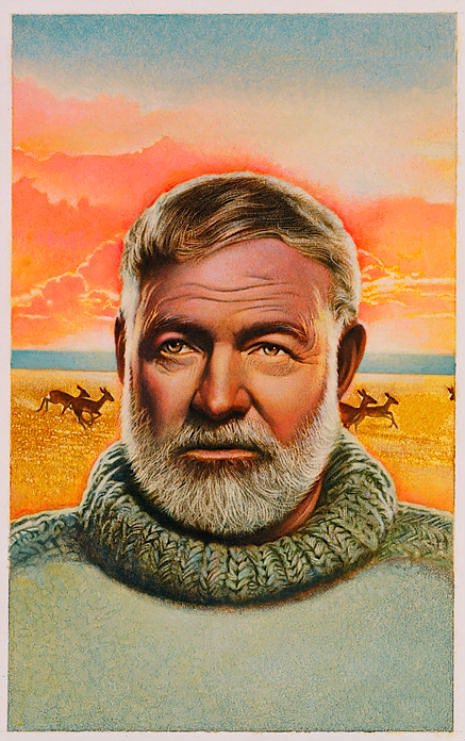
Ernest Hemingway (Though I do not know who the creator of this work is, I must ask that you respect their copyright.)
There is a story that Ernest Hemingway wrote the following to win a bet with other writers that he could write the shortest story:
“For sale: baby shoes. Never worn.”
Even a little research on the Internet shows that there is considerable doubt that Hemingway wrote this story, with the earliest reference to it as a Hemingway work not appearing until 1991. There is also considerable evidence that the story existed in various forms as early as 1910, when Hemingway was 11 and well before his writing career began. Whatever the facts, it is an extreme example of the lean, muscular writing for which Hemingway was famous.
In an interview with The Paris Review (see The Writer’s Chapbook, 1989, pp. 120-121), Hemingway did say:
“If it is any use to know it, I always try to write on the principle of the iceberg. There is seven-eighths of it underwater for every part that shows. Anything you know you can eliminate and it only strengthens your iceberg. It is the part that doesn’t show. If a writer omits something because he does not know it then there is a hole in the story…First I have tried to eliminate everything unnecessary to conveying experience to the reader so that after he or she has read something it will become a part of his or her experience and seem actually to have happened. This is very hard to do and I’ve worked at it very hard.”
So “Baby Shoes” is a good example of Hemingway’s iceberg principle, even if he didn’t write it.
“Baby Shoes” is also a good example of what I like to think of as the Tao of writing (see my earlier posts): creating a story by a careful, strategic use of what is not said. No where in the story does it state that a couple had apparently been expecting a baby, that they bought shoes for it, but then something happened to the baby to cause its death, and now the parents want to sell the shoes. None of that is stated. It is all implied, but yet we know what happened–or at least we have a good idea of what happened, even if we do not know the concrete facts of the matter.
There are also other facets of the story that we can infer, albeit tenuously. From the fact that they bought baby shoes we can infer that the parents were probably eager to have the child. From the fact that the parents want to sell the shoes we can infer that they probably don’t want them around any more as a remainder of a painful experience, but at the same time they may want to see someone else make good use of them or that they are hard up for money.
But one question I have that concerns human psychology is why is it that most people can read these same six words and come away with the same perception of what occurred? Does it have to do with Jungian Archetypes floating around in each of us or is it that each of us has had the same broad experience(s) so that we can interpret these six words in a very similar way?
In the art of sculpture, those areas of a work that are empty, yet give the work its form, are called “negative space”. An example is the space between each of your fingers. If there were no space, there would be no individual fingers. In that sense, a story like “Baby Shoes” makes maximum use of what might be termed “literary negative space”.
It is not really the words that give this story its power, but how we psychologically connect the ideas behind the words that fuel this extremely brief, but epic and poignant tale.
This is part of the magic of writing: conjuring worlds out of nothing.

 I just arrived at Ruby’s restaurant in Aztec planning on a breakfast of pappas con carne adovada and the waitress seated me at a booth next to a man that looks very much like the photo of the fictional character Jack Thurston I posted on Twitter (@jthurston666). Of course, the photo is a public domain
  photo I got from Pexels. Nonetheless, the coincidence seems uncanny. Has anyone else had a similar coincidence? I suppose this falls under the category of synchronicity.

 If it’s true what they say, that 80 percent of success is showing up … Most often attributed to Woody Allen, the maxim “80 percent of success is showing up” has earned its p…







 Phil Slattery, Writer, Publisher