Publisher, Rural Fiction Magazine; publisher, The Chamber Magazine; founder, the Farmington Writers Circle. I have written short stories and poetry for many years. In my careers as a Naval officer and in the federal government, I have written thousands of documents of many types. I am currently working on a second edition for my poetry collection and a few novels.
Originally posted on Nicholas C. Rossis: This is a guest post by Daniela McVicker. Daniela is a contributor to Essayguard. She has a master’s degree in English Literature and is truly passionate about learning foreign languages and teaching. Daniela works with the students to help them reveal their writing talent and find their one true…
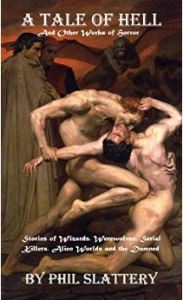
The new cover for A Tale of Hell and Other Works of Horror as of November 15, 2019.
My e-book collection of my horror shorts A Tale of Hell and Other Works of Horror” is available on Amazon Kindle. For your copy, go to my Amazon author’s page (amazon.com/author/philslattery) where you can find links to my other works as well.
In this collection of published and previously unpublished stories of horror, I offer a look into the minds of people who perpetrate horrors, from acts of stupidity with unintended results to cold-hearted revenge to pure enjoyment to complete indifference. Settings range from 17th-century France in the heart of the werewolf trials to the resurrection of the Aztec black arts to a medicine man’s revenge in the Old West to the depths of Hell to mob vengeance and modern day necromancy to sociopathic serial killers and on to alien worlds in the distant future.
Don’t forget to show your appreciation for these tales by leaving a review on Amazon, Goodreads, or other social media.
P.S. Winn gave the collection four stars on Amazon, calling it “Great variety”, and commented: “The author has given readers a fantastic collection of varied horror stories. Short stories, flash fiction and even shorter micro fiction tales are included in a collection that might have readers keeping their lights on. I have read other books by this author and love the writing style and the way his words draw one into the tales.”
Comments on previously published stories (which are only a part of those in this collection) include:
Jay Manning, editor of Midnight Times commented in its Spring, 2006 issue: “Wolfsheim” is basically a traditional horror story that tells the tale of a small European village confronted by the threat of werewolves. If you like stories about lycans, you definitely need to check this one out. Great stuff.”
Publisher Charlie Fish of Fiction on the Web summarizes A “Tale of Hell” as a “… chilling vision of hell”. Other comments on “A Tale of Hell” from readers of Fiction on the Web:
Phil Slattery March, 2015
“An intense and well paced story, cleverly leading the reader up a number of garden paths before Jack’s reality finally clarifies and appears in all its horror. The writing is focused and spare as Jack’s malevolent characteristics and idiosyncrasies manifest themselves…Overall a strong tale that lingers in the imagination…”
“brilliantly descriptive piece on man´s apparently unstoppable descent, literally into hell,…”
” Enjoyed this story. I thought it was nicely written. Started with a familiar vision of hell, but added several unique treatments; kept me interested in how it all would end. Thanks”
Publisher Charlie Fish of Fiction on the Web summarizes “Dream Warrior” as a “…powerful revenge epic about a man who visits his Mexican grandfather for spiritual guidance after a violent crime results in the death if his fiancée”. Fiction on the Web readers commented:
“quite literally a rite of passage, mystical and with an interesting payoff, one which Miguel may have to reckon with in time. some very good writing and characterisation. well done”
“…this is a rite of passage, complex and rich with significance. The cultural invocations are vivid and intense, the work of a writer in his/her full stride. The future for Miguel, who knows? The readers interest is fully engaged with what is to come…”
“Really enjoyed the story-kept me up past my bedtime reading it!”
“I loved the concept, was fascinated by the almost hallucinatory detail of legend with its fatal shadowlands.”
Reader comments on “Murder by Plastic” include:
“Chilling and brilliantly economical”
“Very well-paced and intriguing”
“Fabulous story! Five stars!”
Follow me using the link on the homepage or check back frequently for updates.
Don’t forget to leave a review on Amazon, Goodreads, or on other social media after you subscribe to my website.
I started reading Equus awhile back, and, even though I was enjoying it, put it aside for whatever reason and didn’t get back to it until a few days ago.
This is a fascinating story, definitely drama and tragedy, but also something of horror as well. It is based on an actual event the author Peter Shaffer heard about in 1973. He wrote the play shortly thereafter. If you are not familiar with the story, it is set in England in the early 70’s. A psychiatrist interviews a 17-year-old boy, Alan Strang, who blinded six horses. Initially, the boy responds only in advertising jingles, but gradually he is able to tell of the events and motivations that led to his horrendous act. I have never seen Equus performed, though I would love to. The staging in the book is quite imaginative and I would love to see how it’s carried out.
I saw the film version with Richard Burton, which dates from the mid-70’s (as best I recall). It’s good, but not as good as the film adaptation of Who’s Afraid of Virginia Woolf? in which Burton also starred.
As you probably know, since July 1, I have put aside Shadows and Stars to work on my play Incommunicado. It’s about a man who retreats to a ghost town in the Gila Mountains of New Mexico for a drunken weekend of writing and escape, but ends up fighting personal demons.
I picked up Equus again primarily to help me format the script for Incommunicado, but going through the story again is eye-opening. I see nuances I did not notice before. I also now appreciate even more the creativity Peter Shaffer must have had when writing Equus. I also appreciate the staging more, because I can see how his minimalist design focuses the audience’s collective mind on the essential events of the play’s events and the Alan Strang’s story. I can also appreciate how Shaffer knew something of psychology or was able to learn it quickly in order to create a plausible, intriguing backstory for Alan Strang. Even Alan’s nonsensical, endless recitation of jingles has a reason behind it.
Selfie with Lotus in background near Arkansas Post, September 4, 2019
This will help me formulate some ideas for Incommunicado. I have got most of the first act down and parts of the second and third (I had originally planned Incommunicado to be a one-act play, but that won’t be long enough to get out my ideas). Most of the first act switches between monologue and soliloquy, with the main character, Quinn Gallagher, often addressing the audience directly. In acts two and three the focus will be on the dialogue between Quinn and a local woman named Suzie. Each act represents one day of Quinn’s weekend. Act 1 is his arrival on Friday. Act 2 is Saturday. Act 3 is his departure on Sunday. Of course, I am trying to make Quinn complex and intriguing. I am learning though, that for Quinn to have a complex and intriguing conversation with Suzie, Suzie must also be complex and intriguing and there must be some form of conflict either between them or between them and the world or some combination thereof. Otherwise, the play devolves into Quinn moralizing, philosophizing, and lecturing.
I am taking a minimalist approach to the set design and to the number of characters. In addition to Quinn and Suzie, there is only one other, Ruth Baxter, the owner of the Bed and Breakfast where Quinn stays. I might be more imaginative in set design now that I am reviewing Equus.
Of course, during this, I am also toying with how I can market the play now, and that consists mainly of mentioning in these posts whenever I can or in conversation. Choosing the topics discussed in the play will also help its marketability. I don’t cheapening the play by mentioning specific products (like I have seen in Stephen King stories), but choosing topics that have a universal appeal or to which many people can relate. For example, battling alcoholism is a major topic of discussion in Incommunicado.
If you get the chance, by all means see the play version of Equus (the option I recommend the strongest), read the book, or see the movie. There has been a recent production of Equus starring Daniel Radcliffe, and movie produced of it, but I have unfortunately not had the pleasure of seeing either. I will try to see both as soon as I can.
Don’t forget to like this post and subscribe to my website. I would love to hear your comments on this post.
The witch from The Witch in the Window (2018), directed by Andy Mitton.
Last night/early this morning, my wife and I watched The Witch in the Window (2018, directed by Alex Mitton) on Shudder.
This is one movie that will keep you on the edge of your seat and has an ending that was disturbing yet somewhat comforting.
The movie involves a divorced father who takes his estranged 12-year-old son for a while so that they can work together on a house in Vermont in order to flip it. Naturally, as you can tell by the title, the story relates how the father and son are plagued by the ghost of a witch that was the house’s most recent inhabitant.
There is no blood or gore in this film, nor are there any jump scares, torture, or any of the other usual tropes or motifs found in most of today’s horror. Instead, this story focuses on the poignant relationship between the father and the son. The father cares deeply for his son and tries to help him with his problems and issues as best he can. The son takes his father’s advice to heart. This relationship is developed tenderly and carefully. Then the witch appears. What she does does not destroy or disrupt the tightening father-son bond, but makes the movie’s end heart-rending. If you liked The Witch, you will probably like The Witch in the Window (the two are not related in any sense so far as I could see).
If you want blood and guts, this movie is not for you. If you like to see carefully constructed character development and great acting and to actually feel something that reaches to your heart and soul instead of just turning your stomach or making your skin crawl, this movie is for you.
Shudder is becoming our favorite Amazon channel for horror.
Don’t forget to like this article and subscribe to this website.
Prevent the spread of the Coronavirus/COVID-19. Follow federal, state, and local guidelines. Use common sense when the guidelines are insufficient.
Sign on Arkansas Route 1 signaling the entrance to Rohwer Relocation Center.
On July 5, my family and I drove 28 miles to visit the Rohwer Relocation Center, the site of an internment camp where 8,275 Japanese-Americans lived from 1942 to 1945.
To stand now in the middle of the immense expanses of heat-soaked cotton fields surrounding the site and to imagine what life must have been like can be heart-rending.
The wayside exhibits give a poignant portrayal of the harsh existence for these people, who happened to be of the wrong race when war came upon the US. Many, if not most or maybe even all, of these people came from California, a much milder climate than that of southeast Arkansas (I now live in Arkansas but I have lived in Alameda and San Diego). Most of the waysides have a recording describing some aspect of camp life narrated by perhaps the most famous former resident of Rohwer Relocation Center, George Takei, a.k.a. Mr. Sulu of Star Trek fame. Born in 1937, Mr. Takei lived here from the time he was about five years old to when he was about eight.
The inhabitants of Rohwer Relocation Center lived in military-style barracks, modified somewhat to accommodate families, but still exceptionally Spartan for any family. In one
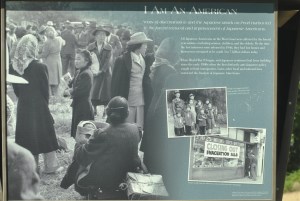
Civilians arriving at Rohwer Relocation Center.
instance, Mr. Takei talks about his family’s arrival to find their new home a single room containing only a pot-bellied stove and five cots, one for each member of the family. Having been forced to leave their jobs behind, inhabitants struggled to find new ways to support themselves, because, while their former lives were left behind, their bills followed them. Most inhabitants found whatever jobs they could locally, maybe toiling on nearby farms or in other manual labor. Many jobs, even those within the camp, paid only $12-$19 per month, which was about half of what the non-Japanese staff of the camp was making. The move forced many people to sacrifice their life savings in order to survive. The few artists that were interned here were able to continue their professions, but I cannot say the market for art in rural southeast Arkansas during World War II was as lucrative as it might have been in California. Still, there was a hospital, so there was some medical care. And there was some schooling for the children, though I do not recall how this was arranged.
A few monuments exist today at the site, which honor the interned, along with the headstones of several that died here. The monuments honor the Japanese-Americans who served in the Second World War, with many of them coming from the Rohwer Relocation Center. Japanese-American soldiers were typically sent to the European front where, they would be less likely to side with or mix in with the enemy. In fact, Japanese-Americans made up the 442nd battalion and fought in some of the most vicious fighting experience by the US, specifically at Anzio, Salerno, and Monte Cassino. The names of those killed in action are listed on a few of the monuments along with memorable remarks about the Japanese-American experience at home and in war, fighting for the country that interned them and their families.
Visit the site if you have the opportunity. It can be found on Google Earth and Google Maps will give you the directions. Enjoy the photos here that I took during my visit and reflect upon the multi-layered composition of our nation as many of us struggle for a greater voice in the future of our nation during this time of racial unrest and political upheaval.
Monument at the Rohwer Relocation Center cemetery, which is designated a National Historic Landmark. Photo by Phil Slattery
Internees at Rohwer Relocation Center. Photo by Phil Slattery. Wayside Exhibit by the National Park Service.
Monument to 100th battalion (442nd Regimental Combat Team) made up of Japanese-Americans. This unit saw action at Anzio, Monte Cassino, and Salerno. Photo by Phil Slattery
Monument to Japanese-Americans interned at Rohwer. Photo by Phil Slattery
Monument section displaying the Japanese-American creed. Photo by Phil Slattery
Headstones of some of the Japanese-Americans who died at Rohwer Relocation Center. Photo by Phil Slattery
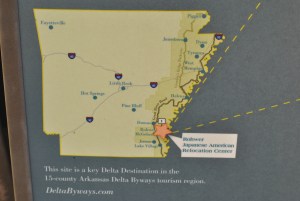
Map showing location of Rohwer Relocation Center in Arkansas. Photo by Phil Slattery
Photo of monument section poignantly describing how many Japanese-Americans served their country despite their families being interned. Photo by Phil Slattery
Monument section describing the Japanese-American experience during WWII. Photo by Phil Slattery
Inscription on a monument at Rohwer Relocation Center. Photo by Phil Slattery
They call them Savages. Brutal. Efficient. Expendable. The empire relies on them. The Savages are the greatest weapon they ever developed. Culled from the streets of their cities, they take the ones no one will miss and throw them, by the thousands, at the empire’s enemies. If they live, they fight again. If they die,…
This book is a rich resource of well researched historical facts and a concise re-telling of the story of one of many Mayflower pilgrims. Noelle describes the characters in a series of narratives that depict the crossing with its difficulties, the landing, the search for a suitable location, the troubles establishing themselves as a village, […]
“Love is like the wind, you can’t see it, but you can feel it” – Nicholas Sparks Love is one of the most beautiful emotions we experience as humans. Though we can invite it into our lives, we do not have the control over the how, when and where love starts to express itself. The […]
The new cover for A Tale of Hell and Other Works of Horror as of November 15, 2019.
The last face Jack saw was the executioner’s as he slid the needle into Jack’s arm.
“I didn’t mean to kill him,” said Jack.
“The jury decided that you did,” replied the executioner.
What seemed like several minutes passed while Jack, strapped to the gurney, sweated and waited, head throbbing with tension, watching the buzzing fluorescent lights overhead, until a black fog enveloped him.
He awoke standing naked holding two buckets overflowing with concentrated sewage. Sweat mixed with grime and soot rolled down his arms. The atmosphere, a mixture of steam, tear gas, sulfur, and the smell of death, burned his throat and stung his eyes, filling them with tears. What little he could see glowed mottled orange and red. Thousands of naked men and women, covered in grime and sweat, cringed whimpering among jagged rocks or ran about in terror while lugging buckets of sewage, blood, or God knew what else.
From the short story “A Tale of Hell” by Phil Slattery
My e-book collection of horror shorts A Tale of Hell and Other Works of Horror” is free today on Amazon Kindle. For your copy, go to my Amazon author’s page where you can find links to my other works as well.
In this collection of published and previously unpublished stories of horror, I offer a look into the minds of people who perpetrate horrors, from acts of stupidity with unintended results to cold-hearted revenge to pure enjoyment to complete indifference. Settings range from 17th-century France in the heart of the werewolf trials to the resurrection of the Aztec black arts to a medicine man’s revenge in the Old West to the depths of Hell to mob vengeance and modern day necromancy to sociopathic serial killers and on to alien worlds in the distant future.
Comments on previously published stories include:
Jay Manning, editor of Midnight Times commented in its Spring, 2006 issue: “Wolfsheim” is basically a traditional horror story that tells the tale of a small European village confronted by the threat of werewolves. If you like stories about lycans, you definitely need to check this one out. Great stuff.”
Publisher Charlie Fish of Fiction on the Web summarizes “A Tale of Hell” as a “… chilling vision of hell”. Other comments on “A Tale of Hell” from readers of Fiction on the Web:
“An intense and well paced story, cleverly leading the reader up a number of garden paths before Jack’s reality finally clarifies and appears in all its horror. The writing is focused and spare as Jack’s malevolent characteristics and idiosyncrasies manifest themselves…Overall a strong tale that lingers in the imagination…”
“brilliantly descriptive piece on man´s apparently unstoppable descent, literally into hell,…”
” Enjoyed this story. I thought it was nicely written. Started with a familiar vision of hell, but added several unique treatments; kept me interested in how it all would end. Thanks”
Publisher Charlie Fish of Fiction on the Web summarizes “Dream Warrior” as a “…powerful revenge epic about a man who visits his Mexican grandfather for spiritual guidance after a violent crime results in the death if his fiancée”. Fiction on the Web readers commented:
“quite literally a rite of passage, mystical and with an interesting payoff, one which Miguel may have to reckon with in time. some very good writing and characterisation. well done”
“…this is a rite of passage, complex and rich with significance. The cultural invocations are vivid and intense, the work of a writer in his/her full stride. The future for Miguel, who knows? The readers interest is fully engaged with what is to come…”
“Really enjoyed the story-kept me up past my bedtime reading it!”
“I loved the concept, was fascinated by the almost hallucinatory detail of legend with its fatal shadowlands.”
Reader comments on “Murder by Plastic” include:
“Chilling and brilliantly economical”
“Very well-paced and intriguing”
“Fabulous story! Five stars!”
Get your copy today and check for other free works of mine as well while you are on Amazon.
Pliny, Natural History, 26 3 “This plague didn’t exist among our ancestors. It first invaded Italy during the principate of Tiberius Claudius when some Roman knight from Perusia, secretary to a quaestor, brought the infection with him after he had been serving in Asia Minor. Women, enslaved people, and those of the low or humble […]





 I started reading Equus awhile back, and, even though I was enjoying it, put it aside for whatever reason and didn’t get back to it until a few days ago.









 Phil Slattery, Writer, Publisher