Observations on the X-Files: Redrum, Season Eight, Episode 6

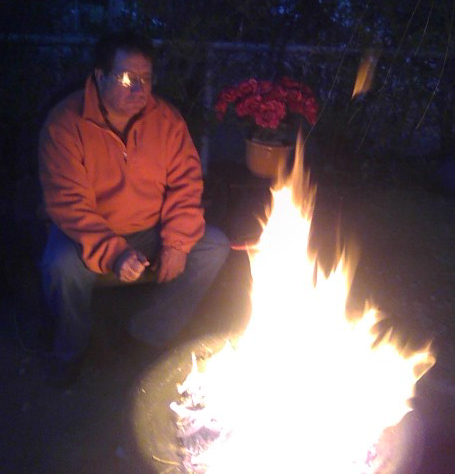
Relaxing by the front yard firepit on a chilly New Mexico evening circa 2013.

I recently purchased seasons  8 and 9 of the X-Files to complete my collection of the entire series.  As you can note above, I am up to episode 6 of season 8: Redrum.  No, it’s not based on The Shining or the famous line that sprang from there.   This is a completely original script and I think one of the best X-Files.   Why am I mentioning a Sci-Fi series in an article that should be about horror?  This article is about good writing, whatever the genre.

I will endeavor to avoid spoiling the story for you.

As we all know, “redrum” is murder spelled backwards.  This story is about a murder, but the alleged murderer finds himself traveling back in time to the day of the murder with the knowledge of how to prevent it.

I find the plot’s basic concept fascinating.  A prosecutor (and friend of Agent Doggett) wakes up one morning to find himself in prison for the murder of his wife, about which he remembers nothing.  As he is transferred to another facility for his safekeeping, he is assassinated.  However, at that point time starts to flow backwards for him.  Each morning he wakes up another day in the past (first he wakes up on Saturday, then on Friday, then on Thursday, etc.).  With each day he learns a bit more about his predicament until finally he wakes up on the day of the murder and he has an opportunity to prevent it.

Unexpectedly traveling back in time is not a common theme, but it’s not rare either.   I have to ask myself how Maeda and Arkin came up with the idea for this episode.  Maybe it was based on amnesia;  someone can’t recall his crime or immediate past and has to learn about it bit by bit, day by day, as the prosecutor does here.  Maybe it arose out of a philosophical question such as “if we could travel back in time, we could change our future but would the ultimate destination be the same and all we change is the route we take to get there?”   Maybe it was a thought that most stories show a protagonist going back in time to a certain point in time and then returning to the present; what if going back in time was not one big step, but several little steps.  How could we change our lives in that case?   What if as we traveled back in time, we knew as little about the past as we do about the future?  We wouldn’t be able to convince those around us that we are traveling back in time, because we wouldn’t know any history to prove our story.   They would believe us to be insane.

The whole scenario intrigues me.  One man goes back in time for unknown reasons while the rest of the world around him proceeds as normal.

I have to ask myself what their creative process was.

This scenario opens up so many questions and possibilities.   I love its originality.    If you haven’t seen it, I recommend renting it as soon as possible.

We never find out what causes the protagonist to travel back in time.  Like in a Stephen King novel, paranormal events happen out of the blue and at random.   But according to Lovecraft’s theories of weird fiction, not knowing the cause/origin of a horrible event, makes the event more horrifying, because the event could happen to any one of us at any time.

A common principle of writing is “to suspend belief” (some say “to suspend disbelief”).   In stories like this though, it is the natural laws of the universe that are suspended.    Everything else, all the world/universe surrounding the event. is quite believable, which emphasizes just how weird the event is.

The story was written by Steven Maeda and Daniel Arkin. A quick search in Imdb shows that Steven Maeda has an extensive list of credits as either a writer or producer for such television series as X-Files, Lost, CSI:Miami, Helix, Lie to Me, and many others.   Likewise Daniel Arkin has an extensive list of credits as a writer or producer for such shows as X-Files, Suits, Las Vegas, Alias, Medical Investigation, and others.  I will have to watch for more shows with which either one is involved.

Thoughts?  Comments?

From Rare Horror: 5 Awesome Horror Book Covers

from Rare Horror
from Rare Horror

Check out the cool covers in this article from the folks over at Rare Horror.  These remind me of ones I see going through those second-rate, family-run,  second-hand bookstores that you find in side streets and back alleys (if you are lucky enough to find ones with the covers intact and not torn off):   5 Awesome Horror Book Covers.

“Summer Thunder” and the Horror of Tragedy

Relaxing by the front yard firepit on a chilly New Mexico evening circa 2013.

I picked up a copy of the latest issue of “Cemetery Dance” this evening and read the Stephen King short story “Summer Thunder”. This is a very interesting piece. I won’t spoil the ending for you, but the story is about a man, his dog, and his neighbor, who have survived a nuclear holocaust and are slowly succumbing to radiation poisoning.

This story was quite different from the other Stephen King stories I have read (which have been quite a few, though not all by any means). There is no supernatural factor in the story. There are also no twists or surprises. The story maintains the same pace throughout, just as the protagonists face the same things day in and day out until they die.

I would classify this story as horror-tragedy, because, even though it has very little of the blood and gore normally associated with the horror genre, it definitely has a horror “feel” to it, but that horror is subtle and understated. “Summer Thunder” sets up a tragic scenario and the horror finds its basis in watching these people suffer through no fault of their own. They were not involved in starting the war in any way; that was done by world leaders thousands of miles away. These are the common citizens, the “Everymen” that normally populate King’s works as protagonists, and who must pay the horrific price for their government’s actions. That is the tragedy and that is a large part of the horror.

What is also horrifying about the story is not the action described in it, but the scenario it describes, because this scenario is definitely one that could literally happen to each of us, should our government and/or other governments decide for whatever reason, to push the proverbial button. Each of us can (or perhaps should) see ourselves as the main character, who will be forced to watch his or her world disintegrate after a nuclear apocalypse.

That concept alone should be enough to bring the true horror of this story:  that this scenario is, and has been for a long time, a real possibility for each of us.

Thoughts?  Comments?

Art & Soul: Victorians and the Gothic | RAMM, Exeter’s Royal Albert Memorial Museum & Art Gallery

Here’s a brief, but interesting article for aficianados of the Gothic:

Art & Soul: Victorians and the Gothic | RAMM, Exeter's Royal Albert Memorial Museum & Art Gallery.

Bloody Good Writing Volume 1

Good article on a few of the basics. Check it out.

The Overseer's avatarHorror Novel Reviews

                          3 Things (Possibly) Wrong With Your First Page

By Tom Leveen

b28720ed-a46e-4e8e-aca3-9b0999da4909_zpspacwsuq0

You only get one chance to make a first impression, right? Nowhere is that more accurate than the first page of your novel, whether you are submitting it to literary agents, traditional editors, or uploading it yourself across all e-platforms.

How does your first page stack up? Cross-reference it against this checklist and find out!

1. Shoulda started with chapter 2.
Just before submitting my first novel, Party, to editors, my agent made one last editorial suggestion: Move chapter 7 to chapter 1. Ridiculous! Absurd! I very nearly refused.

Then I gave it a shot, just to satisfy my own curiosity. And wouldn’t you know…it made the entire novel sing like never before. We sold it a couple weeks later to Random House. I am 100%…

View original post 549 more words

The Final Re-Post from Open Culture: John Steinbeck’s Writing Tips

John Steinbeck  (from the website  Letters of Note)
John Steinbeck
(from the website
Letters of Note)

Here is my final re-post from Open Culture: http://www.openculture.com/2012/02/john_steinbecks_nobel_prize_speech_and_his_six_tips_for_the_aspiring_writer.html.

The article is brief, but I won’t copy it here, because everyone with an interest in the art of writing should watch the accompanying five minute video of Steinbeck’s profound acceptance speech of the 1962 Nobel Prize.  I will, however, copy below a short paragraph immediately preceding his six tips (I also highly recommend following the link to an entertaining and insightful Paris Review article on his observations on the art of fiction):

And for insights into how Steinbeck reached that pinnacle, you can read a collection of his observations on the art of fiction from the Fall, 1975 edition of The Paris Review, including six writing tips jotted down in a letter to a friend the same year he won the Nobel Prize. “The following,” Steinbeck writes, “are some of the things I have had to do to keep from going nuts.”

Enjoy.


More from Open Culture: Twelve Writing Tips from Ray Bradbury

Ray Bradbury  by Lou Romano
Ray Bradbury
by Lou Romano

Ray Bradbury Gives 12 Pieces of Writing Advice to Young Authors (2001)

In earlier posts I mentioned that if one is to learn the art of writing, one must study the masters–regardless of genre.  Writing well is writing well whether in mainstream literature, horror, romance, mystery, or whatever.  After the basics of writing are mastered, then one can tailor stories to the accepted practices and traditions of his/her chosen genre.  That is why I have been posting these articles with advice from horror and non-horror writers.  Most of what they say is as applicable to horror as it is to mainstream literature or any other genre.

Tonight’s post is from Ray Bradbury.  If you have not read The Martian Chronicles, run out and buy a copy or download one before you finish reading this article.  You will find that it contains some of the most beautiful, poignant writing that you will ever encounter.  I wish I could develop the skill that Bradbury shows and apply it to anything I write, whether it be a horror novel or a shopping list.   Although this article will not help you do that, it will show you some of the important lessons that Mr. Bradbury learned in the school of literary hard knocks.  The focus of the Open Culture article is a fifty-four minute video.  The author of the article, Colin Marshall, summarizes the video into twelve points immediately below the video.  I recommend watching the entire video before reading the twelve points, because you may or may not agree with Mr. Marshall’s summary.

Enjoy.

More from Open Culture: Humor and Writing Advice From Kurt Vonnegut

Kurt Vonnegut, 1972
Kurt Vonnegut, 1972

Here’s a brief video with Kurt Vonnegut giving a fun presentation on the shape of a story:  http://www.openculture.com/2011/04/the_shape_of_a_story_writing_tips_from_kurt_vonnegut.html    Be sure to read the short article below the video.  It contains a link to Vonnegut’s eight rules for writers.

Michael McCarty ‘Modern Mythmakers: 35 Interviews with Horror & Science Fiction Writers and Filmmakers’ Review

This looks like a fascinating book. I’ll have to pick one up.

The Overseer's avatarHorror Novel Reviews

Written by: Chad Lutzke

“Love is the answer to everything.” Not exactly something you may expect to hear coming from Ray Bradbury, but Michael McCarty manages to dig in and bring out such sides to otherwise seemingly dark individuals. As the subtitle suggests, Modern Mythmakers picks at the brains of thirty-five different contributors to the horror and science fiction genres: Writers, actors, producers, and directors. Many of whom you will undoubtedly be very familiar with, and others, not so much. Nevertheless, I found a great interest—and even encouragement—in most of the interviews within.

The interviews with those I wasn’t familiar with made the reads no less entertaining; Joe McKinney, for example—a name I was unfamiliar with—a well-read police sergeant turned author, with quite a story to tell, had me literally laughing out loud at one point in the interview when answering McCarty’s question: “If you could be a monster, what…

View original post 581 more words

From Open Culture: Writing Tips from Neil Gaiman, Henry Miller, and others

Neil Gaiman at the 2007 Scream Awards Photo by pinguino k
Neil Gaiman
at the 2007 Scream Awards
Photo by pinguino k

Here’s the second batch of writing tips from Open Culture.  They include tidbits from Neil Gaiman, Henry Miller, Elmore Leonard, George Orwell, and Margaret Atwood.  Enjoy.

From Open Culture: Stephen King’s Top 20 Rules for Writers

Stephen King at Comicon, 2007 Photo by Penguino
Stephen King
at Comicon, 2007
Photo by Penguino

Stephen King’s Top 20 Rules for Writers

Great article.  Over the next week I hope to post more writing tips from great authors as they appeared in Open Culture.  They have a wealth of good advice that I would like to share.